Key takeaways
- 108 turquoise lakes down a Y-shaped UNESCO valley (Shuzheng / Rize / Zechawa) at 2,000–3,100 m — the colour is real, from carbonate water over white travertine.
- The train station is Huanglongjiuzhai (黄龙九寨), 1 h 39 min from Chengdu East since August 2024. ⚠️ It is named for both parks but sits ~27 km from Huanglong and ~92 km from Jiuzhaigou — a further two hours by road. Arriving is not the same as being there.
- Budget ¥280 in peak season (1 Apr – 15 Nov) — ¥190 entry plus the ¥90 eco-bus, which is compulsory — and ¥160 from 16 Nov to 31 Mar. Real-name booking opens 14 days ahead at 8am and peak dates sell out.
- ⚠️ The shuttle back to the station stops running hours before the outbound does. Outbound services run into the late evening; the last return leaves in the late afternoon. Confirm the day’s actual times before booking an evening train home.
- One day covers the three arms if you start at opening and accept 20,000 steps; two days is the relaxed version. Go late September to mid-October for the foliage, avoiding the 1–7 Oct Golden Week.
What Jiuzhaigou is
Jiuzhaigou (九寨沟, “Nine Village Valley”) is a 720 km² nature reserve in the Min Mountains of northern Sichuan, in the Aba Tibetan and Qiang Autonomous Prefecture, about 450 km north of Chengdu. UNESCO inscribed it as a Natural World Heritage site in 1992 for its alpine karst landscape, threatened wildlife (giant panda, Sichuan takin), and the travertine dam-pool system that creates the lakes. The name comes from the nine historic Tibetan settlements in the valley — their villages survive as heritage sites inside the park.
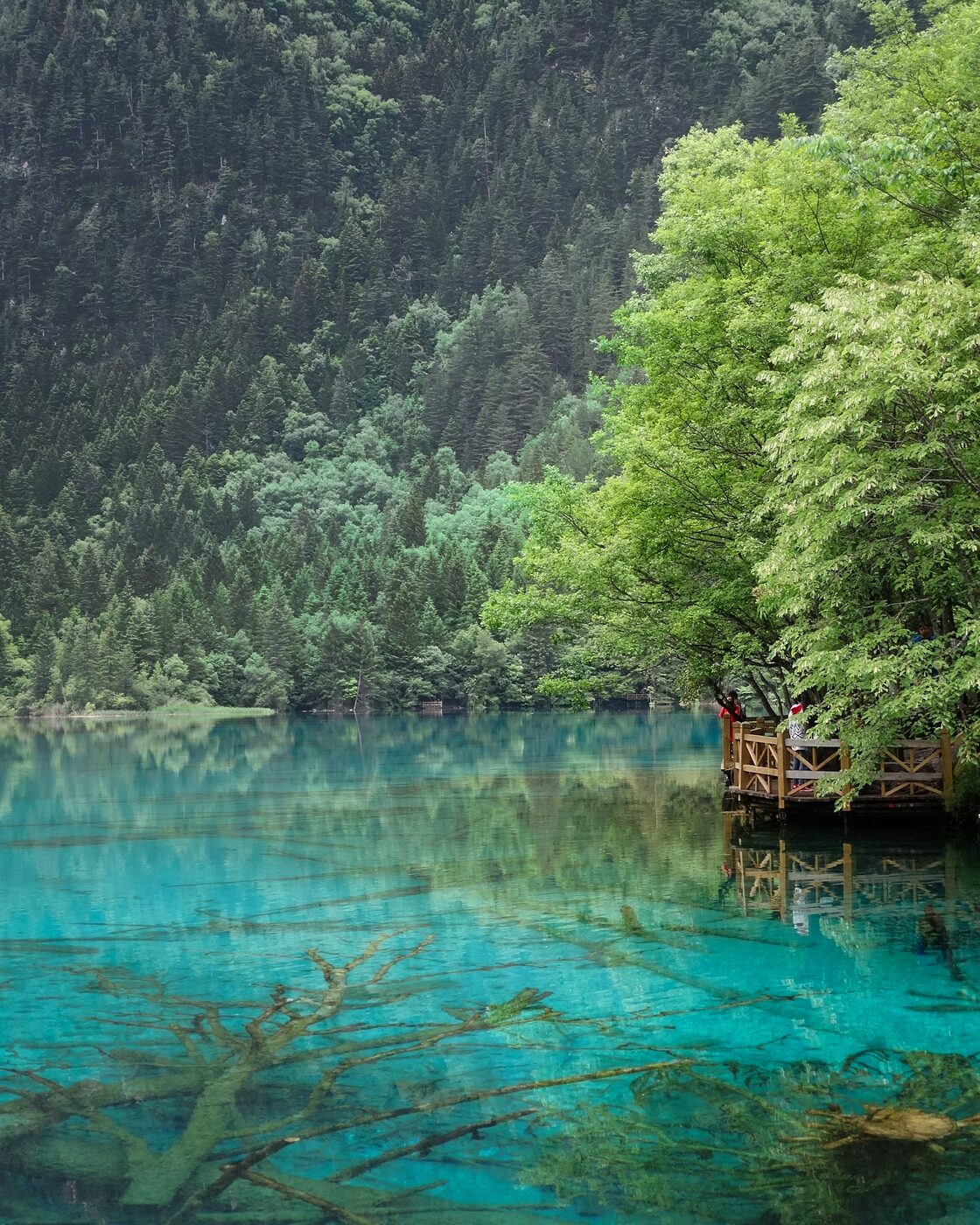
The colour is geology, not editing. The bedrock is carbonate limestone; water dissolves calcium carbonate and re-deposits it as pale travertine, which both dams each lake and lines its floor. A white bottom, very clear low-turbidity water (visibility 30 m+ in places), algae mats, and depth stack to read the lakes as turquoise (shallow), jade-green, or near-black-blue (deepest, like Long Lake). The result is 108 lakes spread from glassy mirror surfaces to the layered colour-stack of Five Flower Lake — kept stable by UNESCO protection and a closed shuttle-bus system (no private cars inside).
Tickets, the daily cap & advance booking
One thing to check the week you travel. This valley closes. It shut for most of two years after the 2017 earthquake, and as recently as 26 July 2026 a mudslide closed the Zechawa arm and everything above Jianzhu Lake in Rize for several days; the scenic area confirmed full reopening on 30 July 2026, with the cap back at 41,000 a day. Nothing is restricted as we write. But heavy summer rain is the normal trigger here, and the scenic area posts these notices on its own site (jiuzhai.com) days before any English source carries them — so if you are travelling in the July–August rains, look there before you set off rather than after.
Two charges, and both must be booked online before you travel — there is no ticket window at the gate. Tickets are real-name (实名制): bring your passport (not a photocopy) and present it at the gate. Most visitors buy them together, which is why the number worth remembering is the combined one: ¥280 in peak season and ¥160 in winter.
| Charge | Peak (Apr 1 – Nov 15) | Off-peak (Nov 16 – Mar 31) |
|---|---|---|
| Park entry valid one calendar day | ¥190 | ¥80 |
| Internal shuttle bus unlimited hop-on/off that day | ¥90 | ¥80 |
| Second-entry off-peak only (二次进沟) | — | +¥20 |
The key foreigner gotcha: entry, coach and ticketing are real-name and timed-slot (分时预约), and there is no on-site ticket window at all — you must book online first and scan your passport at the gate. The daily cap is ~41,000 in peak season (~23,000 off-peak); peak-autumn weekends sell out 3–7 days ahead. Book before you arrive — turning up on spec on a Golden-Week or October weekend is the riskiest thing you can do.
Booking opens exactly 14 days ahead, at 8am Beijing time, and autumn dates go in the first minutes — set an alarm rather than browsing that evening. Book via Trip.com (English UI) or the official Jiuzhaigou WeChat mini-program / 阿坝旅游网 (abatour.com, Chinese UI, harder for foreigners) — your passport scans directly at the gate. If a date shows sold out, the mini-program’s waitlist (候补) auto-allocates cancelled tickets. Entry runs 8:00am–2:00pm in peak season (8:30am off-peak); last entry is 2pm and the park closes ~6pm. Be in the eco-bus line by ~7:30am for the first departure. Foreign-card POS is unreliable — pre-load Alipay or WeChat Pay with your foreign card in Chengdu, or carry ¥500 cash as backup.
The three valley arms & the must-see lakes
The park is a Y-shape. The trunk enters from Zhangzha town in the south and runs up to a central junction at Nuorilang (Nuorilang Waterfall), where it branches into the Rize arm (the headline one) and the higher Zechawa arm. You ride the shuttle along each arm, hopping off at lake stops.
| Arm | Highlights |
|---|---|
| Shuzheng 树正沟 trunk · 2,000–2,400 m | The gentle entry experience: Reed Lake (yellow autumn reeds), Sparkling Lake, the Shuzheng Lakes (19 lakes stepped down travertine dams — the clearest look at the dam-pool geology), Shuzheng Waterfall, and a Tibetan village exhibit. |
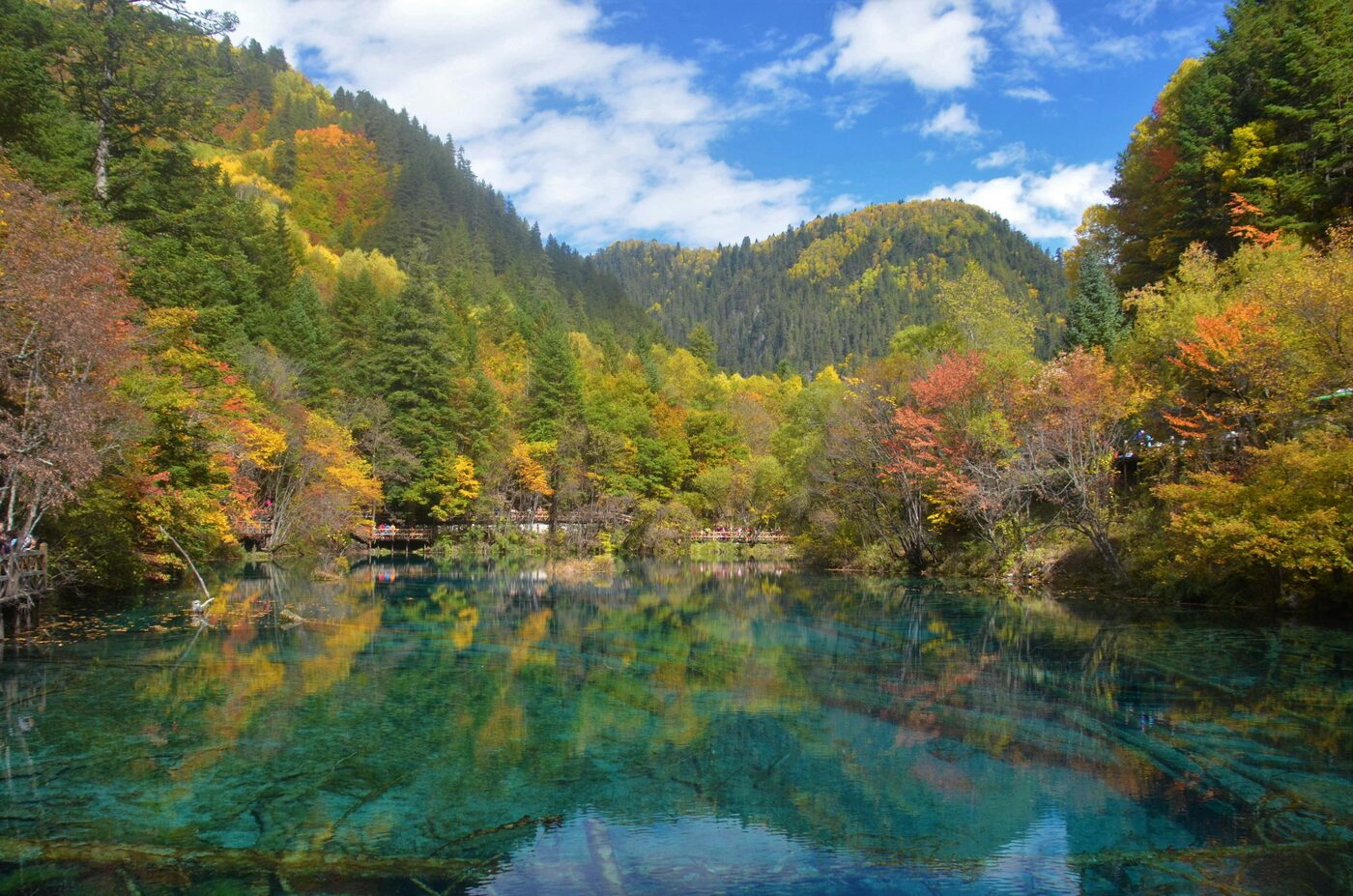
| Rize 日则沟 NE arm · 2,400–3,200 m | The arm everyone comes for; allow 4–5 h. Five Flower Lake (五花海 — the most photographed lake in China, five colour zones in one basin), Pearl Shoal Falls (a 200 m-wide travertine waterfall), Mirror Lake (glassy reflections, best 7–10am), Arrow Bamboo Lake (the Hero film location), and Panda Lake. |
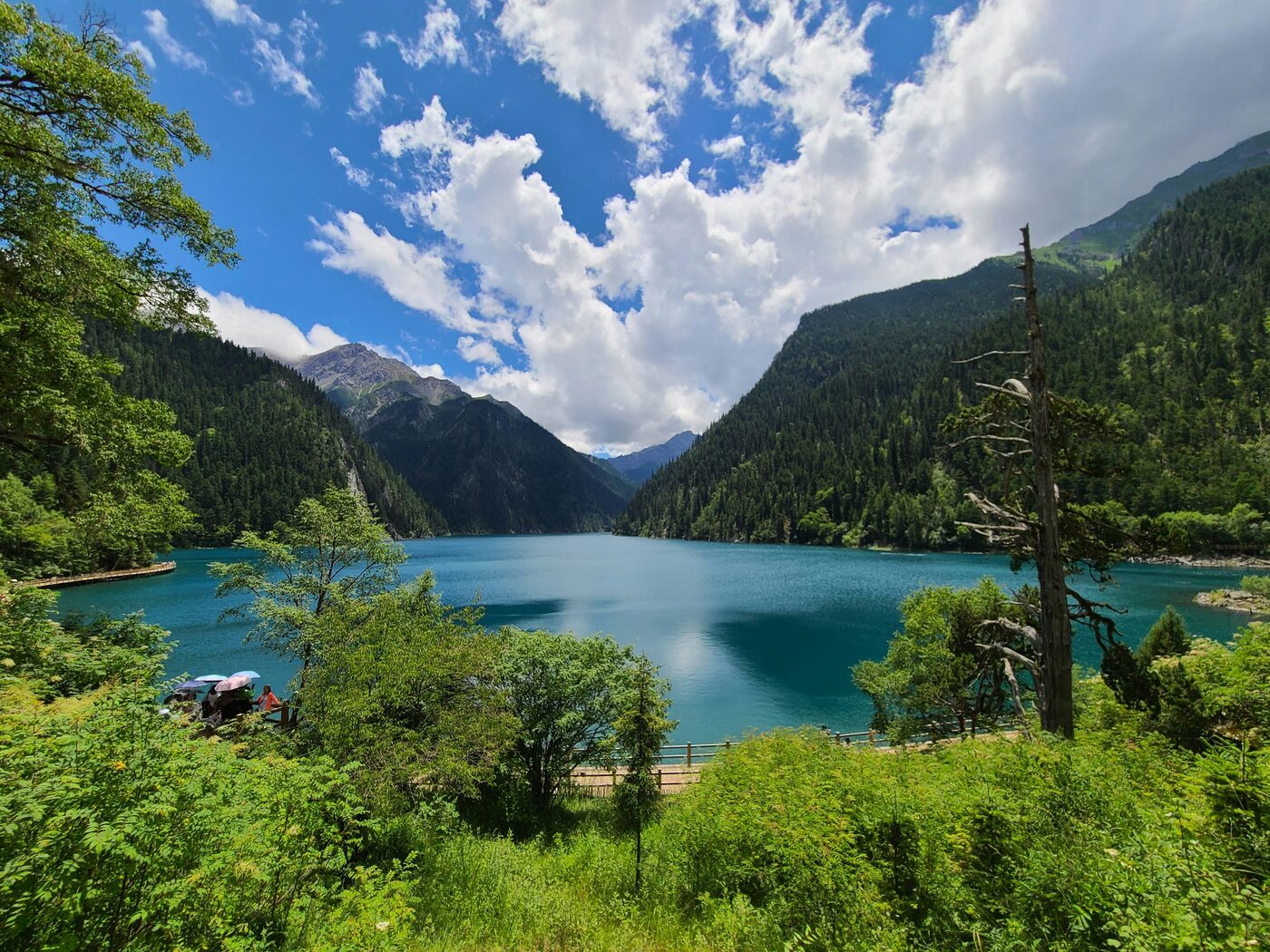
| Zechawa 则查洼沟 S arm · 2,900–3,100 m | Quieter and more dramatic, but altitude hits hardest. Long Lake (长海 — the largest lake in the park at ~3,100 m, ~100 m deep, deep blue-black, ringed by snow peaks) and Five-Color Lake (五彩池 — small but vivid, colours shifting within metres over a white bottom). Lower Seasonal Lake only fills in spring. |
If you split into two days, do the lower Shuzheng + Rize arms on Day 1 and save the high Zechawa arm for Day 2 — that builds in acclimatization. The geology repeats across all three arms, so even a single day shows you the signature look; two days lets the light come round.
The eco-bus & how a day flows
No private vehicles run inside the park — the included green eco-bus is how you move, and in practice it’s mandatory: you can’t walk between the arms. You hop off at lake stops, walk the short boardwalk trails between adjacent stops, and re-board. Here is the standard two-day flow.
| When | Plan |
|---|---|
| Day 1 · 7am | Enter at opening, ride straight to Arrow Bamboo Lake (top of Rize), then walk-and-shuttle back down: Five Flower Lake → Pearl Shoal Falls → Mirror Lake → Shuzheng Lakes. Exit ~5pm. |
| Day 2 · 7am | Ride to Long Lake (top of Zechawa), then Five-Color Lake, then back down to revisit Five Flower Lake in afternoon golden-hour light. |
| One day only | Shuzheng + Rize, skip Zechawa. You get Five Flower Lake, Mirror Lake, Pearl Shoal and Shuzheng Waterfall — but spend most of the day on the bus and miss Long Lake. |
Restrooms are free at every shuttle stop. Ride to the far end of an arm first and work back downhill — it’s easier walking and beats the mid-morning crowd surge up from the gate. Three tips travelers pass around: the gate buses are dispatched by direction at random, so if the next one isn’t going your way, ride it up Shuzheng and pick up an onward bus rather than waiting; seats aren’t guaranteed, and for the views sit on the right heading up Rize, on the left heading up Zechawa or Shuzheng; and the panorama of Five Flower Lake is from the Tiger’s Mouth (老虎嘴)overlook above it, not the lakeside boardwalk.
Getting there from Chengdu
The 川青铁路 (Chengdu–Xining high-speed railway) reached Huanglongjiuzhai station (黄龙九寨) on 30 August 2024. That cut the one-way journey from a 10-hour mountain bus to about 2 hours by train plus a ~2-hour transfer — and made HSR + shuttle the default for independent foreign travelers.
| Option | Total time | Cost (one-way) | Best for |
|---|---|---|---|
| HSR + shuttle (default) | ~4–5 h | ¥180–400 | Most foreign travelers since 2024 |
| Flight (CTU → Jiuhuang) | ~3.5 h | ¥600–1,400 | Tight schedule + altitude-tolerant |
| Overnight bus | 8–10 h | ¥150–220 | Budget; HSR sold out |
HSR + shuttle: from Chengdu East, take a C/D high-speed train to Huanglongjiuzhai (~2 h, fastest 1 h 39 min, ¥128–141 in 2nd class, multiple daily departures). The station is named for both UNESCO sites but sits at Chuanzhusi, still ~92 km from the Jiuzhaigou gate(~2 h drive); from there a scheduled direct shuttle (¥50–60, ~2 h, synced to arrivals) or a taxi (¥200–250, confirm the price first) reaches Zhangzha. The road climbs through a ~3,800 m pass before dropping to 2,000 m at the gate, so some feel a brief altitude spike en route. Step-by-step schedules and the station orientation are in our Chengdu-to-Jiuzhaigou transit guide.
Flight: Jiuhuang Airport (JZH) sits at 3,447 m — one of the highest in China. The 1-hour flight saves time but there’s no acclimatization buffer (500 m to 3,448 m in an hour), so headaches on landing are common. Take it only if your schedule truly can’t fit the extra 90 minutes, or if HSR seats are sold out.
The shuttle back is not the mirror of the shuttle out — plan the return first. Services from the station to the park run through the evening, which makes a late arrival easy and gives a false impression of the timetable. The last departure back to the station goes hours earlier, in the afternoon; travellers’ accounts of exactly when disagree by as much as three hours, which is itself the reason to check rather than to trust a figure. Confirm the day’s actual return times on the 九旅悦行 mini-programme or at the visitor centre when you arrive, and do not book an evening train out of Huanglongjiuzhai until you have. Getting this wrong does not mean a late night — it means an unplanned night in Zhangzha.
Altitude — a quick fact, not a blocker
The gate is at 2,000 m and the highest lakes (Long Lake ~3,100 m, Five-Color Lake ~3,000 m in Zechawa) reach a little over 3,000 m — a “threshold” altitude where most people are fine walking and shooting photos and only feel mild breathlessness or a quick pulse if they rush or scramble. Symptoms — low-grade headache, a disrupted first night’s sleep — usually settle by Day 2, and the flat boardwalks plus eco-bus make it genuinely doable for kids and older travelers. Sensible, non-medical prep: spend a full day in Chengdu (500 m) first, drink 3+ litres of water on Day 1, skip alcohol the first night, eat light, walk at 60–70% pace, and do the high Zechawa arm on Day 2 rather than Day 1. Don’t bother pre-loading altitude pills with no symptoms; instead buy a couple of cheap portable oxygen cans locally (pharmacies and shops in Zhangzha, cheaper than online) as insurance for Long Lake. One local rule worth heeding: avoid catching a cold your first night — a chill at altitude is the thing most likely to turn a mild headache into a rough day. Travelers with serious heart, lung, or sleep-apnea conditions should consult their doctor before booking — this is a quick-fact, not medical advice.
Best time & how long to stay
The scenery is highly season-dependent — pick the wrong window and you get grey water under flat cloud. Match the month to what you came for: autumn foliage peaks mid-October to early November; lakes are fullest and bluest June–August (the summer high-water season, when the sun is out); waterfalls run biggest July–September; and blue ice and rime form December–February.
| Window | What you get |
|---|---|
| Late Sep – mid-Oct peak | The famous autumn foliage — gold, orange, crimson trees against turquoise water. Oct 8–25 is the absolute peak; days 10–18°C. Avoid Oct 1–7 Golden Week (cap fills by 9am, 90-min shuttle queues, tripled hotel rates). |
| Mid-Apr – mid-May spring thaw | Lakes melt, waterfalls run heavy on snowmelt, fewer crowds. The ticket is not cheaper — peak pricing starts 1 Apr, so you pay the same ¥190 as October. You miss the foliage but get spring drama; some upper lakes still partly frozen. |
| Jul – Aug the monsoon gamble | High-water season: lakes are at their fullest and, on a clear morning, their bluest, and the waterfalls are at peak flow — but it’s the rainy season, so ~50% of afternoons bring a shower that greys the water, and it’s the busy summer-holiday crowd. Bring a rain shell and grippy shoes and treat the light as a lottery. Upside: a cool 18–22°C escape from Chengdu’s heat. |
| Mid-Nov – Mar winter | The only cheaper window: ¥80 rather than ¥190, a ¥110 saving from 16 Nov – 31 Mar, plus quiet trails — but many lakes freeze and foliage is gone. Worth it only for frozen-lake photography, and Five-Color Lake stays unfrozen for a striking contrast. |
How long: two days is the sweet spot (all three arms, acclimatization built in); add a third for Huanglong, 40 km away — a second UNESCO site of gold calcified terrace pools that looks nothing like Jiuzhaigou’s lakes (no aesthetic-fatigue risk), at 3,200–3,580 m. The low-effort way is the cable car up (¥80) then the shuttle (¥20) to the core, a ~800 m climb to Five-Colour Pool (15–20 min, breathless but not brutal), and a 3–4-hour walk down past the terraces — don’t take the down-cable and skip the best of it. Peak entry is ¥170 (¥60 off-peak, cable closed mid-Dec–Mar); reach it by ¥250–400 taxi or the early 06:00/07:00 coach from Zhangzha (~3 h). Huanglong is higher than any Jiuzhaigou lake, so do it after a day here to acclimatize.One day at Jiuzhaigou is rushed; under a day isn’t worth the transit. See our best time to visit China guide to fit it into the wider trip.
Practical for foreigners
- Payment: Alipay / WeChat Pay at most stalls, hotels and windows; foreign Visa / Mastercard rarely works on-site — carry ¥500–1,000 cash.
- Signage & language: bilingual Chinese / English / Tibetan with pinyin at the gate, shuttle stops and major platforms; it thins out on deeper trails.
- Connectivity: hotel Wi-Fi in Zhangzha is reliable; inside the park it’s patchy (4G in the lower valleys, weak in upper Rize / Zechawa) — pre-download offline maps and cache anything you need from blocked services in Chengdu.
- What to wear: layers. The 2,000 m gate can be 18°C while Long Lake at ~3,100 m is 8°C and windy; a light down jacket is essential in the shoulder seasons. Grippy shoes for wet travertine boardwalks; sunglasses + sunscreen for intense high-altitude UV.
- Rules: the whole valley is a forest-fire-control zone — smoking is banned everywhere and fined from ¥500, and drones are banned outright. Stepping off the boardwalk is forbidden and enforced (fines from ¥500). Use the marked photo spots.
- 2017 earthquake: a magnitude-7.0 quake hit on 8 August 2017, damaging some lakes — Sparkling Lake (火花海) breached, but it was rebuilt and reopened in 2020. The park fully reopened on 28 September 2021; all the headline sights (火花海, Nuorilang Falls, Five Flower Lake, Long Lake) are open in 2026, though a few look different from pre-2017 photos.
- Tibetan & Qiang culture: the prefecture is Tibetan and Qiang territory — don’t photograph residents without asking; butter tea and yak yoghurt are worth trying at the village stall.
Book a Jiuzhaigou tour or transfer from ChengduNASDAQ: TCOM
Trip.com lists real-name park tickets, the Huanglongjiuzhai station transfer, Zhangzha hotels and multi-day Jiuzhaigou + Huanglong bundles — booked in English on a foreign card, with live availability against the daily cap.
Where to stay — the park-gate hotels
You base at the park gate. Zhangzha (漳扎镇) is a 1.5 km strip of hotels and restaurants 100 m from the entrance, and it exists entirely for Jiuzhaigou tourism — so stay here rather than commuting in. Don’t book the cheaper hotels in Jiuzhaigou county town 40 km away — the “stay outside, tour inside” rule means you want to be a 10-minute walk from the gate for the early entry, not an hour’s drive out. There’s no big international chain right at the gate; for a first China trip the practical pick is a reliable mid-range Chinese brand, with two higher-end options if you want them.
Where to book these: China’s home-grown chains — 亚朵 (Atour) and 桔子 (Crystal Orange) — are listed most completely on Trip.com, with English checkout and foreign-card payment. It’s the main booking platform for mainland hotels; Western sites like Booking and Agoda carry only a fraction of their branches.
Stay at the park gate — Zhangzha town (漳扎镇)
Zhangzha is the 1.5 km hotel strip at the Jiuzhaigou entrance, 100 m from the gate — it exists entirely for the park, so base here rather than commuting in. There is no big international chain right at the gate; the practical choice for most foreign visitors is a reliable mid-range Chinese brand (Atour, Crystal Orange) at a fraction of the resort rate. Two higher-end options are listed if you want them. Distances are to the park gate.
- On the Zhangzha strip, a short drive / walk from the park gate.Design-led mid-range chain that foreign guests rate highly — comfortable, well-run, English-app booking, and far better value than the resorts. Most front desks arrange the Huanglongjiuzhai station transfer.
- Zhangzha town, ~5–10 min from the park gate.Clean 4-star Chinese-brand rooms in the ¥600–1,000 band — English-friendly enough for a first visit, and the best price-to-comfort ratio at the gate.
- Side streets off the main strip, walkable to the gate.¥250–500/night clean guesthouses with basic English signage; most can book the Huanglongjiuzhai shuttle and some include breakfast.
- On the Zhangzha strip near the park entrance.The most familiar international flag at the gate (¥800–1,400) — predictable English service if you prefer a known brand over a Chinese chain.
- Resort complex near Zhangzha, a short transfer from the gate.The established premium option (¥1,800+) — a domed indoor-garden resort, dramatic if dated. Only worth it if a five-star resort experience is the point of the trip.
Frequently asked questions
Is Jiuzhaigou worth the 3-day detour from Chengdu?
For travelers with at least 8 total days in China, yes — Jiuzhaigou is genuinely a top-3 natural sight in the country and the 2024 high-speed rail line (the 川青铁路, Chengdu–Xining) cut the one-way transit from a 10-hour bus to about 2 hours by train, which removed the single biggest objection foreigners had. The 108 lakes are not photo-edited; the turquoise color is real, caused by carbonate-rich water over white travertine and pale algae mats. Skip if you have under 7 days in China total (Jiuzhaigou eats 3 days that could be a major city), if you're visiting July–August (afternoon rain greys the lakes ~50% of the time), or if 3,100m altitude is medically risky for you.
How do I get from Chengdu to Jiuzhaigou in 2026?
Three options. (1) HSR + shuttle (the default since the 川青铁路 opened in 2024): Chengdu East → Huanglongjiuzhai station, ~2 hours (fastest 1 h 39 min), ¥128–141 in 2nd class. Then ~2 hours by scheduled direct shuttle (¥50–60, synced to arrivals) or taxi (¥200–250) to the park entrance in Zhangzha town. Total ~4–5 hours. (2) Flight: Chengdu → Jiuhuang Airport (JZH), 1 hour airborne plus ~2 hours ground transfer to the park, but the airport sits at 3,447m and altitude can hit immediately on landing. (3) Overnight / long-distance bus: 7–10 hours, ¥150–220 — only worth it if HSR seats are sold out.
How many days do I need at Jiuzhaigou?
Two days is the sweet spot. Day 1 covers the lower Shuzheng Valley plus the Rize Valley arm including Five Flower Lake (the headline photo) and Pearl Shoal Falls. Day 2 covers the Zechawa arm (Long Lake, Five-Color Lake) plus revisits to Day 1 lakes you want better light on. One day is possible but rushed — you will see two of the three valley arms and skip one — and you will spend most of the day on shuttle buses. Three days lets you add Huanglong (the second UNESCO site, 40 km away) as Day 3. Less than one full day is not worth the transit.
When is the best time to visit Jiuzhaigou?
Late September through mid-October is the peak — autumn foliage layers gold, red, and orange against the turquoise water in the photos that made Jiuzhaigou famous. Specific weeks: the second and third weeks of October are the absolute peak, but avoid October 1–7 National Day Golden Week (visitor numbers hit the ~41,000 daily cap and the shuttle bus queue can stretch 2 hours). Mid-April through mid-May is the spring thaw alternative — frozen lakes melt, waterfalls run heavy from snowmelt, fewer crowds — though not a cheaper ticket, because peak pricing starts 1 Apr. Skip July and August (rain). Mid-November through March is the only cheaper window (¥80 rather than ¥190, a ¥110 saving) and you pay for it in frozen lakes and no foliage.
Is altitude sickness a problem at Jiuzhaigou?
Mild risk for most travelers. The park entrance sits at 2,000m and the highest lakes (Long Lake ~3,100m, Five-Color Lake ~3,000m in Zechawa Valley) top out a little over 3,000m. Symptoms most foreigners feel: mild headache, slight breathlessness on stairs, disrupted first night's sleep. Symptoms typically resolve by Day 2. Diamox (acetazolamide) is overkill for a 3,000m day visit but can be carried as insurance — consult your doctor. Practical prep: arrive in Chengdu (500m) at least one full day before traveling up; drink 3+ liters of water Day 1; avoid alcohol the first night; walk slowly between shuttle stops; if you feel severe symptoms, take the shuttle down to the 2,000m entrance immediately. Travelers with serious heart or respiratory conditions should consult a doctor before booking.
Can I do Jiuzhaigou and Huanglong together?
Yes — they are 40 km apart and both UNESCO-listed, and the standard Chengdu-Jiuzhaigou multi-day itinerary adds Huanglong as Day 3 or Day 4. Huanglong is famous for its calcified terrace pools (similar geological process as Pamukkale in Turkey, but at 3,500m altitude with pine forest backdrop) — the easy way is the cable car up (¥80) plus the ¥20 shuttle, a short climb to Five-Colour Pool, then a 3–4 hour boardwalk walk down from 3,580m to 3,200m past the terraces (skip the down-cable — the walk down is the point). Peak entry ¥170 (¥60 off-peak). Most travelers do Huanglong as a half-day add-on with a ¥250 round-trip taxi, the early 06:00/07:00 coach from Zhangzha (~3h), or as part of a Trip.com bundle. Note that Huanglong's altitude is higher than Jiuzhaigou's main visitor areas, so do it after you have a full day at Jiuzhaigou's lower elevations to acclimatize.
What's the difference between the 3 valley arms?
Jiuzhaigou is a Y-shape with three valley arms branching from a central junction. Shuzheng Valley (the trunk of the Y, lower elevation) holds Reed Lake, Shuzheng Lakes, and Shuzheng Waterfall — the entry experience, gentlest scenery, lowest altitude. Rize Valley (east arm of the Y) holds the famous Five Flower Lake (五花海, the most photographed single lake in China), Pearl Shoal Falls, Mirror Lake, and Arrow Bamboo Lake — this is the headline arm and what most travelers come for. Zechawa Valley (south arm of the Y) holds Long Lake (长海, the largest lake in the park) and Five-Color Lake (五彩池) at the highest elevations, ~3,000–3,100m — quieter, more dramatic, but altitude hits hardest here.
How much does a Jiuzhaigou trip cost?
From Chengdu, mid-range, 3 days / 2 nights, per person double-occupancy: ¥3,500–5,500 total (~USD $490–770). Breakdown: HSR round-trip ¥260–300, taxi/shuttle to park round-trip ¥100–500, peak-season park ticket ¥190 + shuttle bus ¥90 (one day, multi-day tickets discounted), Zhangzha town hotel ¥400–900/night for 2 nights, meals ¥200–300/day. Add ¥600–1,500 for Huanglong on Day 3 if combining. The top-end Tibetan-styled luxury resort tier at $1,000+/night pushes the trip to USD $2,500–4,000+. Off-season (Nov 16 – Mar 31) is roughly 40% cheaper end-to-end thanks to the ¥80 park ticket and lower hotel rates.
Sources
Checked August 2026 · Written from our own first-hand travel in China.