This guide is written by an editorial team based in Chongqing — the editor has lived in mainland China since 2018 (8 years on the ground). The picks, logistics and priority calls draw on aggregated 2024-2026 r/travelchina, r/chinatravel and r/luoyang threads, Trip.com listings, and 2026-05-23 Amap (高德地图) routing and POI data. This is aggregated editorial coverage — corrections from Luoyang residents and recent visitors are welcomed (see the about page).
How to think about Luoyang — and how to prioritise
Luoyang sits at the sharp end of Chinese history. It served as the capital of 13 dynasties — from the legendary Xia through the Eastern Han, Wei, Western Jin and Northern Wei, and most significantly the Tang, when the Empress Wu Zetian moved the imperial court here and the city swelled to a population of roughly one million. The physical residue of that era — Buddhist cave temples carved under imperial patronage, a ruined imperial palace larger than the Forbidden City, and the cult of the peony flower — is what foreign visitors come to see.
The attractions cluster into three zones that also inform your itinerary:
- South of the city (Yi River corridor) — the Longmen Grottoes, roughly 13 km south of the city centre by Metro Line 2. This is the headline sight and should anchor Day 1.
- City centre and the Sui-Tang ruins area — Yingtian Gate, the Sui-Tang Heritage Park, the Luoyang Museum, Luoyi Ancient City, and Wangcheng Park are all within 2-3 km of each other in the western part of the city. Metro Line 1 connects them.
- East of the city (and further afield) — White Horse Temple is 12 km east of the city centre; Guanlin Temple is about 9 km south (also via Metro Line 2, or taxi). Laojun Mountain is a 150 km day trip south.
For where to sleep and how to reach Luoyang by HSR, see where to stay in Luoyang and the Luoyang railway station guide. Getting around between the sites is covered in getting around Luoyang.
1. Longmen Grottoes — the UNESCO Buddhist cliff face
The Longmen Grottoes (龙门石窟, Lóng Mén Shí Kū — “Dragon Gate Stone Caves”) are Luoyang's defining site and one of China's three great Buddhist cave-temple complexes alongside Dunhuang and Yungang. Inscribed as a UNESCO World Heritage Site in 2000, the site extends roughly 1 km along both banks of the Yi River, where limestone cliffs were carved over six centuries — from the Northern Wei dynasty (494 CE) through the Tang — into more than 2,300 caves, 100,000 Buddhist statues and 2,800 inscriptions.
The centrepiece is the Fengxian Temple (奉先寺) — an open-air niche housing the 17.4 m seated Vairocana Buddha (卢舍那大佛), commissioned by the Tang Emperor Gaozong and Empress Wu Zetian and completed in 675 CE. The proportions are extraordinary: the ears alone are 1.9 m long. The face is widely considered one of the finest surviving examples of Tang-dynasty Buddhist sculpture, and the Fengxian compound — with the Vairocana flanked by Ananda, Kasyapa, Bodhisattvas and the Heavenly Kings — is a complete cosmological statement in stone.
The full deep-dive — cave-by-cave highlights, ticket logistics, the East Hill vs West Hill sequence, getting there on Metro Line 2 — is in the dedicated Longmen Grottoes guide. Plan on 2 to 3 hours minimum; the site is large and the carvings reward slow attention.
2. White Horse Temple — China's first Buddhist temple
White Horse Temple (白马寺, Bái Mǎ Sì) is officially regarded as the first Buddhist temple in China, founded in 68 CE during the Eastern Han dynasty when Emperor Ming sent envoys to India and they returned with two Indian monks and the first Buddhist sutras — carried, according to the tradition, on white horses. The monks translated texts here and were buried in the grounds; their tombs are still present.
The temple is a working religious site — incense burns continuously, monks are in residence, and the morning chanting sessions (usually around 7 am) are the most atmospheric time to visit. The main complex contains successive hall compounds typical of Chinese Buddhist architecture, but White Horse Temple is unusual in also hosting a set of international pavilions on its grounds: an Indian pavilion (built with Indian government funding), a Burmese pavilion, and a Thai-style wat — an unusual cluster of divergent Buddhist architectural traditions on one site.
The full logistics — bus 56 from Luoyang Station, ticket prices, photography rules inside the halls — are in the White Horse Temple guide. Located 12 km east of the city centre; allow 1.5 hours.
3. Yingtian Gate — Wu Zetian's coronation gate
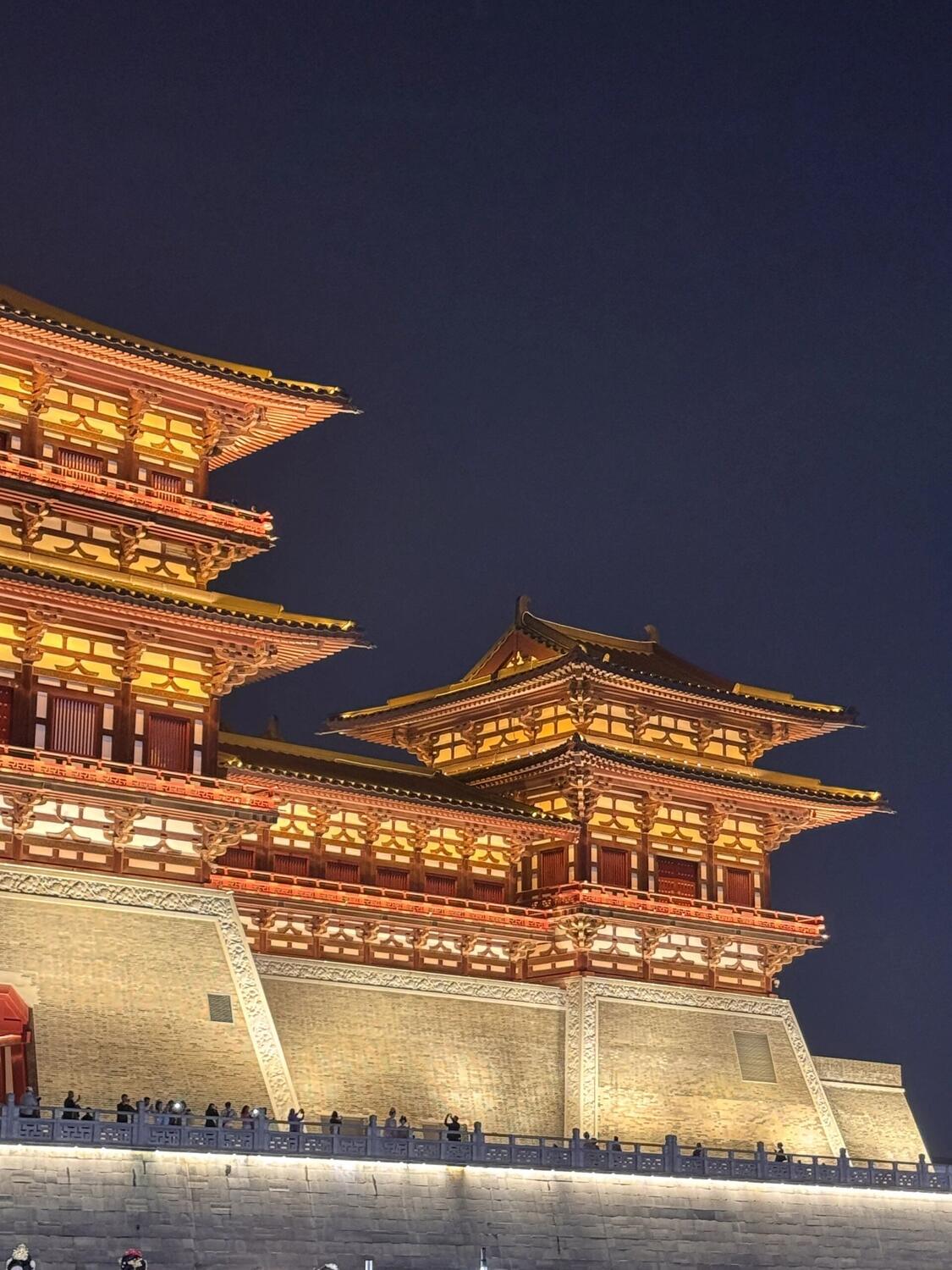
Yingtian Gate (应天门, Yìng Tiān Mén — “Gate Answering Heaven”) was the ceremonial south gate of the Sui-Tang imperial palace in Luoyang — the gate through which the Emperor received foreign ambassadors, through which state processions entered the palace city, and, most significantly, where Wu Zetian was crowned in 690 CE as the founding sovereign of the Zhou dynasty — the only woman in Chinese history to hold the title of Emperor in her own name.
The gate was destroyed, rebuilt multiple times, and finally dismantled after the fall of the Tang. A large-scale reconstruction was completed in 2019, faithful to Tang architectural specifications and built over the excavated foundation stones of the original. The result is a substantial complex: the main gate tower flanked by two crow-stepped defensive towers (阙楼) and two wing corridors, the whole structure elevated on a 15-metre-high tamped-earth platform — imposing by any standard.
The reconstruction doubles as a museum: the interior rooms display Tang imperial court artefacts, original foundation stones, and a reconstruction model of the full Sui-Tang palace complex (Luoyang's palace city was actually larger than Chang'an's, a fact that surprises most visitors). Amap coords: approximately 112.460318, 34.679369.
At night, Yingtian Gate is illuminated in Tang-style golden light and becomes the most photogenic structure in Luoyang — the combination of the roofline silhouette, the platform scale and the warm light is genuinely arresting. If you are in Luoyang for two or more nights, visit once in the day (for the museum) and once after dark (for the exterior illumination). The gate is adjacent to the Luoyi Ancient City district and the walk between them is straightforward.
4. Sui-Tang Luoyang City Heritage Park — the imperial palace footprint
The Sui-Tang Luoyang City Heritage Park (隋唐洛阳城 国家遗址公园) is the archaeological site and cultural-heritage park built around the excavated remains of the imperial palace of the Sui (605-618 CE) and Tang (618-904 CE) dynasties. The Sui emperor Yang commissioned the construction of a new capital at Luoyang in 605 CE — an undertaking involving reportedly two million labourers — and the palace complex (called the Palace City, 宫城) became the centre of the Tang empire under Wu Zetian.
The park's two major reconstructed structures are:
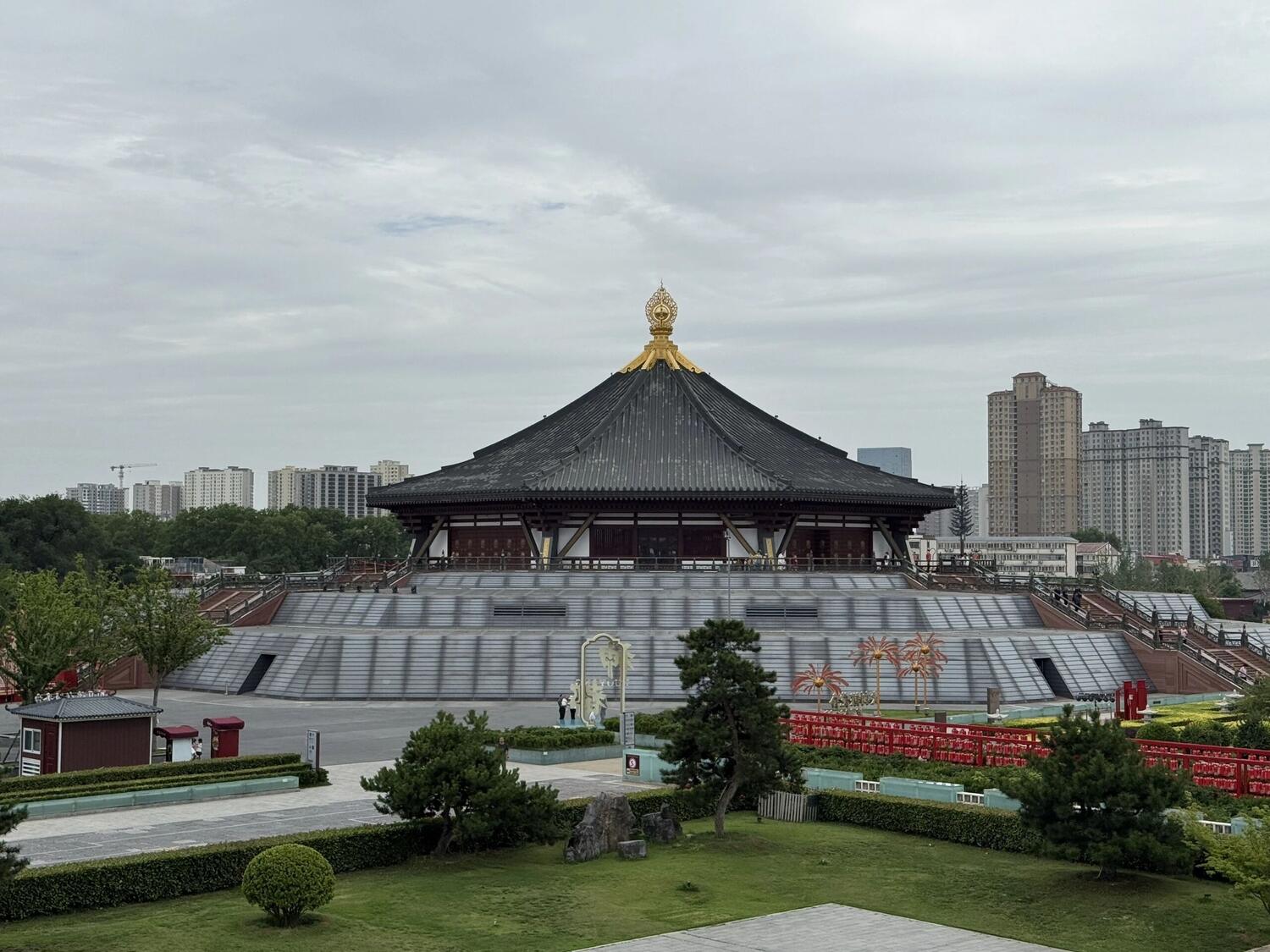
- Mingtang (明堂 — Hall of Enlightenment) — Wu Zetian's ceremonial hall, completed in 688 CE, where she conducted state rituals. The reconstruction (opened 2014) is a circular timber hall with a conical thatched roof — an architectural form unusual in surviving Chinese buildings, deliberately referencing pre-imperial ritual architecture. It houses exhibits on the Tang court and the Luoyang capital period.
- Tiantang (天堂 — Celestial Hall) — a five-storey tower reaching 88 m, built by Wu Zetian in 688-689 CE originally as a Buddhist temple tower and later converted to secular use. The reconstruction (adjacent to the Mingtang) is the tallest structure in the heritage park and offers a panoramic view over the ruins and the modern city. The interior floors hold exhibits on Tang Buddhist art and imperial-capital archaeology.
Together with Yingtian Gate, the park covers the western third of the original palace city footprint. It is a large site — allow 2 hours for both reconstructed halls and the outdoor excavation zones. Metro Line 1 (Sui-Tang Heritage Park station) serves the area directly.
5. Luoyi Ancient City — Luoyang's lantern quarter
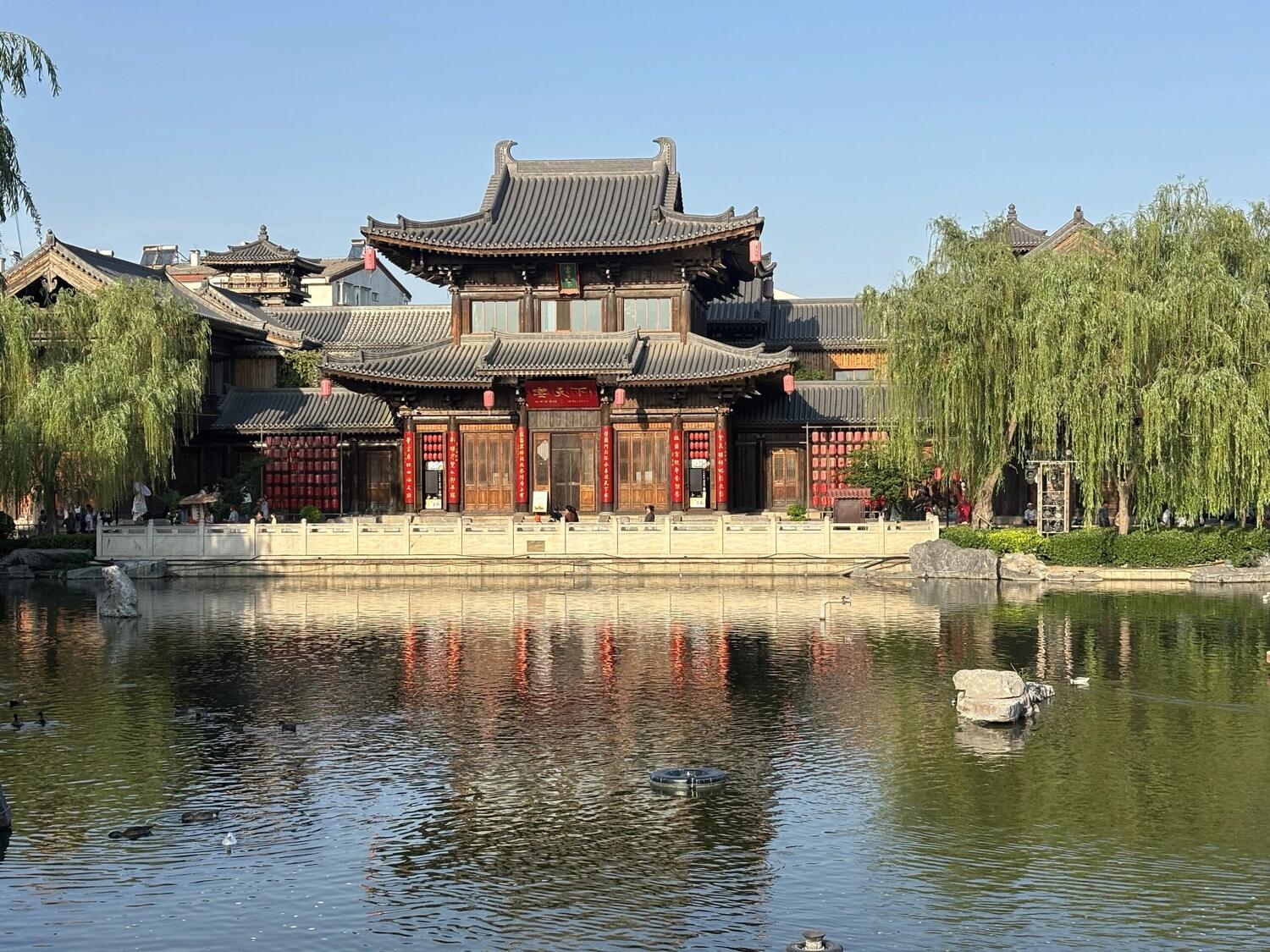
Luoyi Ancient City (洛邑古城, Luò Yì Gǔ Chéng) is the city's headline night-tourism development — a restored cluster of Tang-era-style lanes and courtyards immediately east of the Sui-Tang ruins area. “Luoyi” was one of the ancient names for the Luoyang settlement; the complex opened around 2020 and has become the most photographed area in Luoyang for domestic tourists. Amap coords: approximately 112.485027, 34.680541.
The experience centres on:
- Paper lanterns (灯笼) — strung densely across the lanes, lit from dusk, the defining visual of the neighbourhood and the source of most of the viral images circulating on Chinese social media. The lantern density increases towards the central courtyard area.
- Hanfu costume rental — primarily Tang-dynasty court dress, available from multiple rental shops within the complex (and from shops on the surrounding streets). Rates run roughly ¥100-200 for an evening, including a basic hair styling session. The Tang-era styling — elaborate headdresses, trailing sleeves — is specifically designed for the lantern-backdrop photo. You do not need to rent Hanfu to walk the quarter, but a significant proportion of visitors do, and the costumed crowds are part of the atmosphere.
- Street food and snacks — a concentration of Luoyang food stalls selling water banquet (水席) components, Luoyang noodles (烩面 variant), and standard Chinese night-market snacks. See the what to eat in Luoyang guide for detail on the water banquet tradition.
Luoyi Ancient City is free to enter (some inner courtyards may charge a small entry fee). It is quietest on weekday afternoons; at its most atmospheric on weekend evenings, particularly during the peony festival season. The Sui-Tang Heritage Park, Yingtian Gate and the Luoyang Museum are all within 10-15 minutes' walk.
6. Guanlin Temple — the burial site of Guan Yu's head
Guanlin Temple (关林, Guān Lín — “Guan Forest”) is, as far as historical record shows, the only site in China that holds the remains of Guan Yu (关羽) — specifically his head, interred here after he was executed in 220 CE following his capture by Sun Quan's forces during the Three Kingdoms period. His body was buried in Dangyang, Hubei; his soul in Chengdu; his head in Luoyang. Amap coords: approximately 112.474575, 34.610186.
Guan Yu in death became something larger than he was in life. Through successive imperial patronage — Sui, Tang, Song, Ming and Qing emperors all elevated his status — he was eventually deified as Guandi (关帝), the God of War and Righteousness, and more practically the patron deity of business, sworn brotherhood and police officers. Guanlin Temple is consequently one of the most active businesspeople's pilgrimage sites in central China; the incense smoke is constant, and the temple functions as a genuine place of worship rather than a museum.
The temple complex is built on the Tang forest-tomb (林) pattern — a long ceremonial avenue of carved stone figures (horses, lions, officials) leads to a mound enclosing the burial site. The main hall contains a large gilded statue of Guan Yu in his iconic red-faced, green-robe portrayal. The surrounding cypress and pine forest gives the compound a quieter atmosphere than most urban Luoyang sites.
Allow 45 to 60 minutes. Guanlin is accessible by Metro Line 2 (same line as Longmen Grottoes, three stops closer to the city); it is a natural pairing with a Longmen Grottoes visit — do Guanlin first (less crowded in the morning), then continue south to Longmen.
7. Luoyang Museum — free entry, Tang sancai and the imperial-capital story
The Luoyang Museum (洛阳博物馆) is Luoyang's main civic museum, relocated to a purpose-built facility in the Sui-Tang ruins area in 2011. Entry is free with passport (as of 2026; Chinese nationals need ID). Closed Mondays. Amap coords: approximately 112.451541, 34.643323.
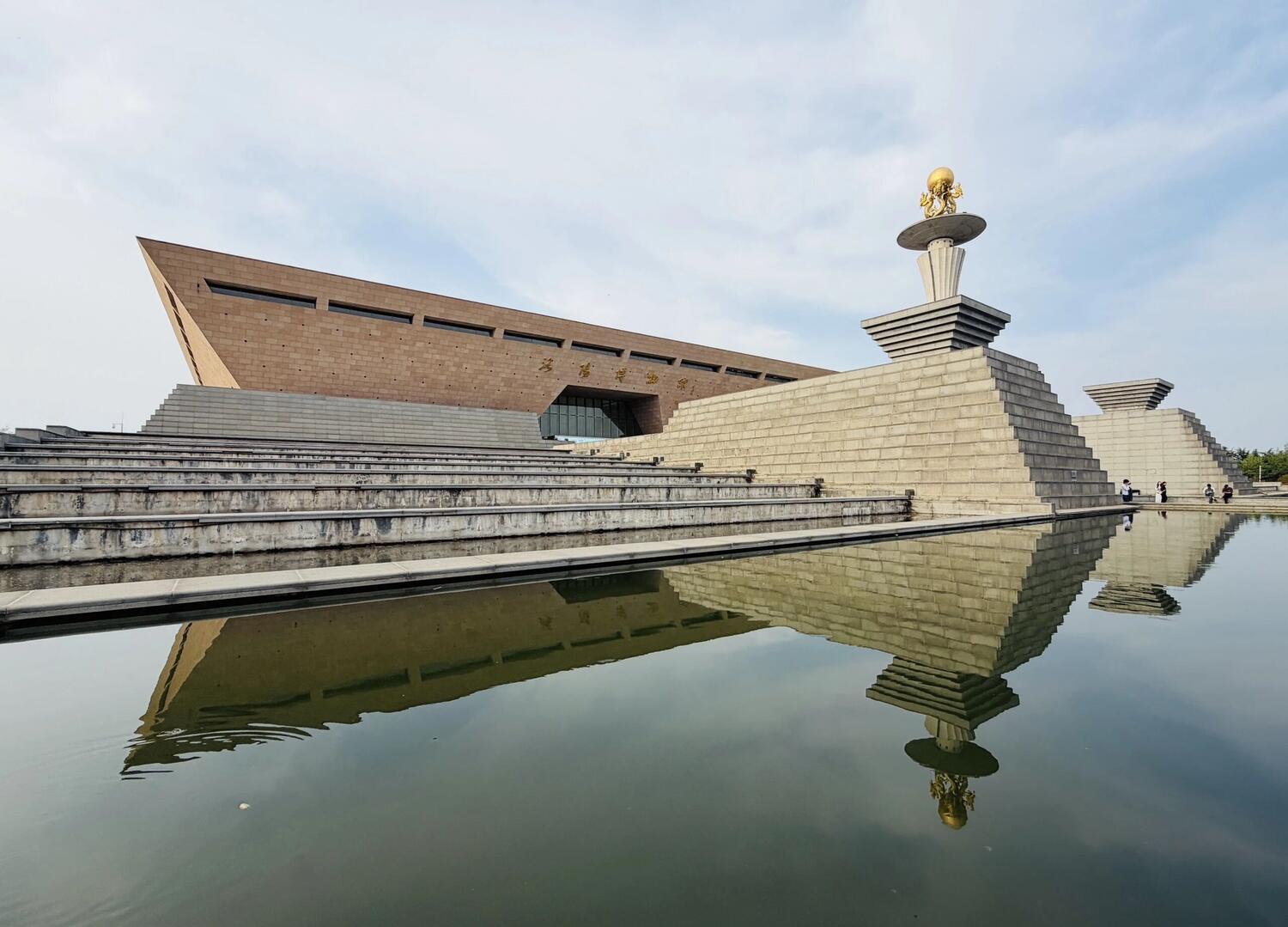
The permanent collection covers Luoyang's full historical arc, but three sections are worth prioritising:
- Tang sancai (唐三彩) — the tricolour lead-glazed ceramics that Luoyang's kilns produced during the Tang dynasty. “Three colours” (yellow, green, white, and sometimes brown and blue — the name is slightly misleading) were applied in patterns across figurines, horse models, camel models and vessels. They were primarily funerary objects — buried in the tombs of Tang nobles — and Luoyang, as the Tang eastern capital, has produced more Tang sancai than any other excavation area in China. The museum holds a substantial collection, including large-format horse-and-rider figurines and architectural models.
- Buddhist statuary — carvings and figures that provide the iconographic context for the Longmen Grottoes. The Grottoes site itself offers minimal interpretive signage in English; the museum's Buddhist art rooms fill in the Northern Wei through Tang stylistic evolution and help decode what you are looking at on the cliff face.
- Sui-Tang capital reconstruction model — a large-scale model of the Sui-Tang imperial palace city (宫城) and the surrounding administrative city (皇城), showing how the palace compound related to the broader urban grid. The visual is disorienting for visitors who have walked the ruins area without a sense of the full scale — the Luoyang palace city covered roughly four times the area of the inner Forbidden City. Metro Line 1 stop is nearby.
Allow 1.5 to 2 hours. Combine with the Sui-Tang Heritage Park and Yingtian Gate for a full Luoyang imperial-history day; all three are within 1.5 km of each other.
8. Luoyang Peony Festival — the imperial flower of the Tang
The Luoyang Peony Cultural Festival (洛阳牡丹文化节) runs annually from approximately mid-April through early May — the exact dates shift year to year with the bloom (a cold spring delays it; a warm one advances it). Check the city government announcement in early April for the confirmed 2026 dates. The festival is one of the largest flower festivals in China and draws several million domestic visitors over its roughly three-week run; foreign visitor numbers are considerably smaller but growing.
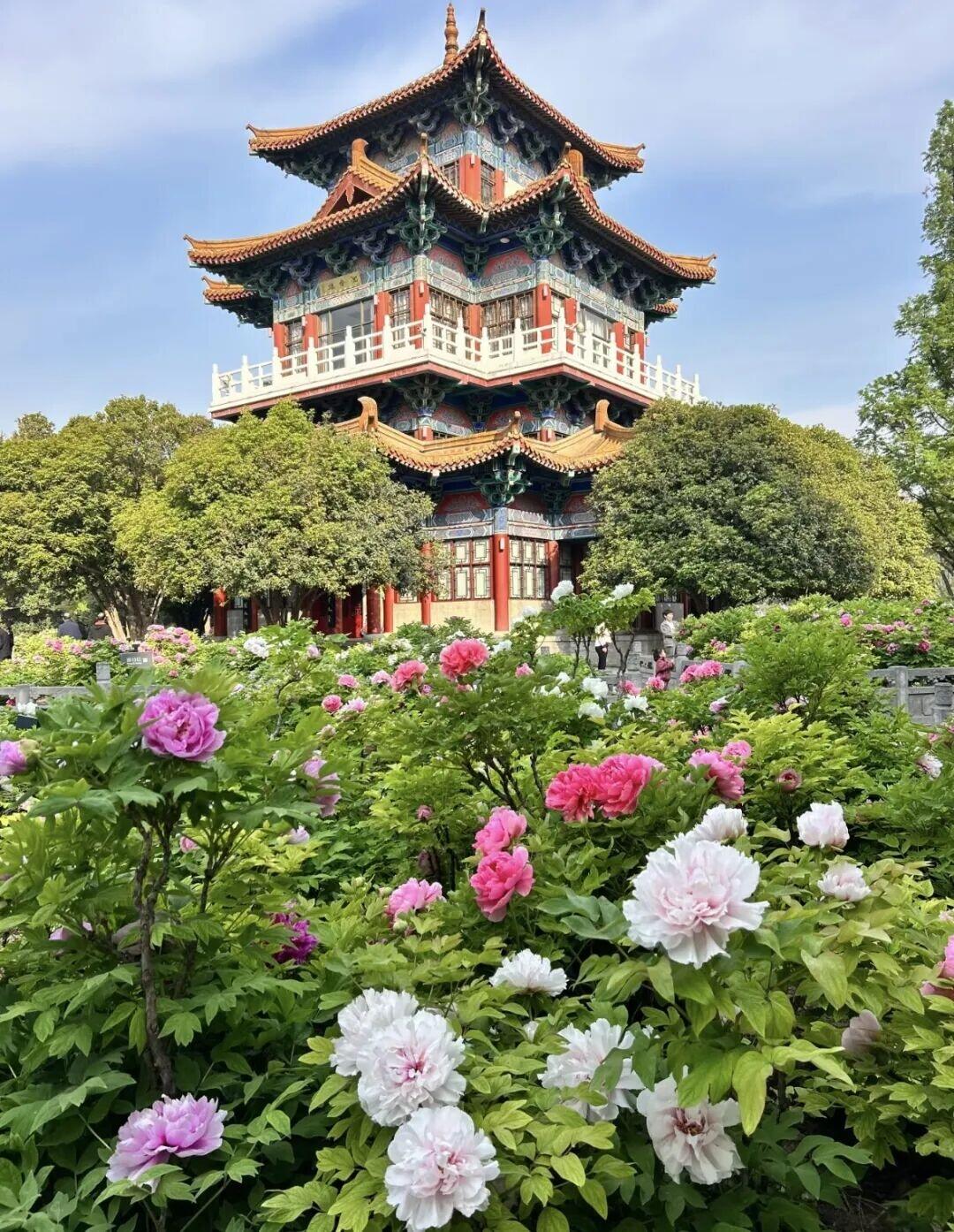
The association between Luoyang and the peony is pre-Tang, but it became entrenched under Wu Zetian and the Tang court. The story most commonly cited — with varying degrees of historical reliability — is that Wu Zetian, angered that peonies refused to bloom on imperial command while every other flower obeyed, banished them from Chang'an to Luoyang, inadvertently establishing the city as the peony capital. Whether or not the story is literally true, Luoyang has cultivated peony varieties for over 1,500 years; the city registers more than 1,000 named cultivars. Tang poet Bai Juyi (who served as a Luoyang official) wrote repeatedly about the extraordinary spectacle of the spring bloom and the crowds it drew — “the flowers that set the city mad.”
The main festival venues:
- Wangcheng Park (王城公园) — the largest and most central venue; see section 9 below. Metro Line 1.
- National Peony Garden (国家牡丹园) — the purpose-built research and display garden in the northern city area; extensive cultivar collections including some rarely grown varieties. Allow 2-3 hours.
- Sui-Tang Heritage Park peony zone — during the festival, the heritage park grounds incorporate a significant peony display that combines the flower with the imperial-ruins backdrop — one of the more unusual viewing settings available.
Practical notes: hotel prices in Luoyang roughly double during peak bloom weeks, and rooms at preferred locations sell out months in advance. Longmen Grottoes also reaches its daily visitor cap more quickly during the festival — book tickets in the early morning or in advance. Outside the festival window, Luoyang is uncrowded and straightforward to navigate.
9. Wangcheng Park — the Zhou Royal City site and the city's peony heart
Wangcheng Park (王城公园, Wáng Chéng Gōng Yuán — “Royal City Park”) occupies the site of the Zhou dynasty's Royal City (王城) — the administrative and ceremonial centre of the Zhou court during the Eastern Zhou period (770-256 BCE). The archaeological layers beneath the park have yielded Zhou-era bronze vessels and chariot burials; the park incorporates a small site museum with some of the more significant finds.
For most foreign visitors, the primary draw is the park's role as the central venue of the Luoyang Peony Festival. It holds the city's largest concentration of cultivated peonies — multiple terraced beds across a large footprint, with named varieties labelled — and during April-May the crowds are substantial and the atmosphere festive. Outside the festival window, the park is a quiet, green public space in the centre of Luoyang with relatively few tourists; the small zoo on its eastern side is a domestic-visitor feature of no particular relevance to foreign travellers.
The park is directly accessible by Metro Line 1 (Wangcheng Park station), making it the easiest major attraction in Luoyang to reach by public transit. It is centrally located and natural to combine with the Sui-Tang ruins area — both are on the same metro line. Allow 1 to 1.5 hours outside the festival; 2-3 hours during the peony bloom when the crowds slow movement through the display areas.
10. Laojun Mountain — Daoist sacred peak day trip
Laojun Mountain (老君山, Lǎo Jūn Shān — “Lord Lao Mountain”, named for Laozi, the founder of Daoism) is a sacred Daoist peak in Luanchuan County (栾川县), in the Funiu Mountain range, approximately 150 km south of Luoyang city — roughly 2 to 2.5 hours by car or hired vehicle. It is the headline day trip from Luoyang and is consistently rated as one of the most visually dramatic sacred mountains in China.
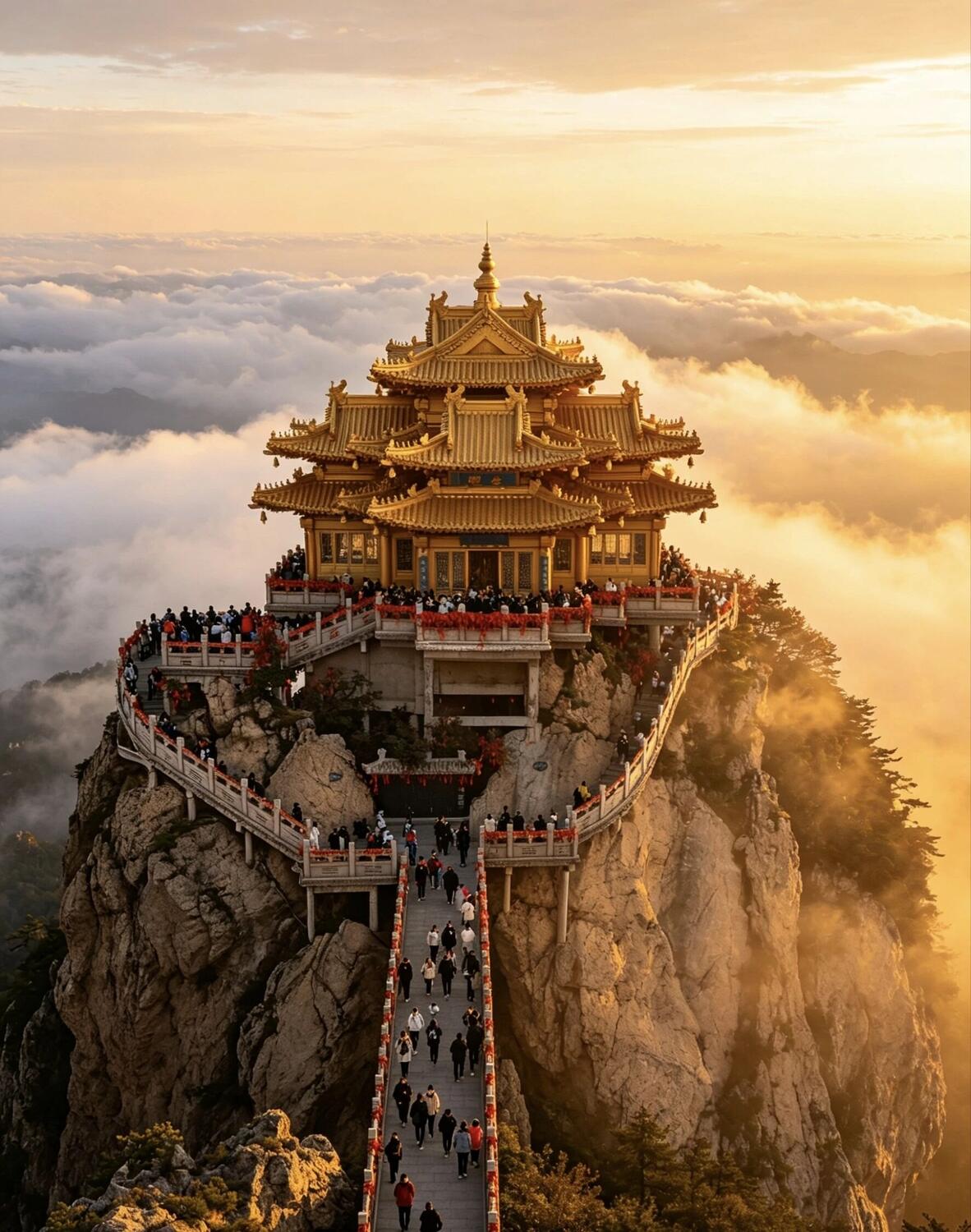
The summit complex — the Lao Tzu Temple (老君庙) cluster — sits at approximately 2,200 m altitude on a narrow ridgeline, with the distinctive gold-roofed peak temple emerging from cloud or mist on most mornings. The main temple buildings (Sanqing Hall, the Jade Emperor Pavilion, and the Lao Tzu Statue) form a compact group on the summit ridge accessible by cable car from a mid-mountain station (~1,700 m) or by trail from the lower car park. The cable car ride itself — ascending steeply through pine forest and then breaking above the treeline onto the open ridge — is one of the better mountain cable car experiences in central China.
Seasonal conditions matter significantly:
- Autumn (October-November) — the most dramatically photogenic window. Laojun Mountain receives early snowfall while the Funiu foothills still show autumn colour; the combination of snow on the gold temple roofs, cloud sea below the ridge, and coloured forest below is the image that viral-shared most widely. The mountain frequently appears snow-covered while Luoyang city is still warm.
- Spring (April-May) — wildflowers on the lower slopes; cloud formations build in the afternoon; combine with the peony festival if timing allows (the mountain is a long day trip — check whether both are feasible in a single visit or whether they need separate days).
- Summer (June-August) — cooler than the Luoyang basin, making it a reasonable escape from the summer heat.
- Winter — frequently snow-covered and accessible; the cable car operates year-round unless conditions are dangerous.
Getting there independently by public transport is possible but slow (long-distance bus from Luoyang to Luanchuan, then taxi to the mountain; total one way ~3-3.5 hours). The practical approach for most foreign visitors is a private car hire or a guided day tour from Luoyang — Trip.com offers combined Luoyang day tours that include Laojun Mountain with transport. An early start (leaving Luoyang by 7 am) is necessary to reach the mountain before crowds, spend 3-4 hours at altitude, and return to Luoyang by early evening.
How to prioritise — by trip length
The following priority call is honest rather than comprehensive — it names what to cut, not just what to do:
- 1 day in Luoyang: Longmen Grottoes only. Two to three hours at the site, followed by a late lunch in the nearby Longmen Old Street, and an evening walk through Luoyi Ancient City after dark (lanterns are lit from sunset; entry is free). That is a full day and covers the city's two most visually distinct experiences.
- 2 days in Luoyang: Day 1 — White Horse Temple in the morning (east of the city, quieter early), then the Sui-Tang Heritage Park complex (Yingtian Gate, Mingtang and Tiantang halls, Luoyang Museum) in the afternoon. Evening at Luoyi Ancient City. Day 2 — Longmen Grottoes in the morning, Guanlin Temple en route back (Metro Line 2 covers both). Afternoon at Wangcheng Park if the peony season is active; otherwise the museum if you skipped it.
- 3 days in Luoyang: Days 1-2 as above. Day 3 — Laojun Mountain day trip (leave early, return by evening). This adds the most visually different experience — the Daoist mountain landscape is a complete tonal contrast to the urban Buddhist-art and imperial-ruin itinerary of the first two days.
- 4+ days in Luoyang (or peony season overlap): The peony festival venues (National Peony Garden, Wangcheng Park display, Sui-Tang Park peony zone) can collectively absorb a half-day. A fourth day allows this properly, with time to walk the full Wangcheng Park cultivar display at a relaxed pace during peak bloom.
For the full station guide and arrival logistics, see Luoyang railway station — Luoyang Longmen Station (龙门站) is the high-speed entry point on the Zhengxi HSR, with Xi'an ~1h25m away and Zhengzhou ~30 minutes. For food recommendations, see what to eat in Luoyang — the Luoyang water banquet (洛阳水席) is one of the oldest surviving banquet formats in Chinese cuisine and worth planning a meal around. Hotels across the five main stay areas are in the where to stay in Luoyang guide.
Frequently asked questions
What is Luoyang most famous for?
Is the Luoyi Ancient City worth visiting if you don't dress in Hanfu?
When is the peony festival in Luoyang in 2026?
Is Laojun Mountain worth the day trip?
Can you do Luoyang in a day from Xi'an?
What's the difference between Yingtian Gate and the Sui-Tang Heritage Park?
Are tickets needed in advance for Luoyang attractions?
Is the Luoyang Museum worth going to?
Related Luoyang guides
- Longmen Grottoes guide — the UNESCO headline deep-dive: cave-by-cave highlights, the Fengxian Temple Vairocana Buddha, Metro Line 2 logistics, ticket booking.
- White Horse Temple guide — China's first Buddhist temple (68 CE), the international pavilions, Bus 56 access from Luoyang Station.
- Where to stay in Luoyang — five-area comparison (Old Town / Sui-Tang ruins / Longmen area / Wangcheng / Luoyang North Station).
- Luoyang railway station guide — Luoyang Longmen Station (HSR) vs Luoyang Station (conventional); Xi'an 1h25m, Zhengzhou 30 min, Beijing 2h.
- Getting around Luoyang — Metro Lines 1 and 2, bus routes to Longmen and White Horse Temple, DiDi, and the Laojun Mountain transfer.
- What to eat in Luoyang — the Luoyang water banquet (洛阳水席), Luoyang noodles, the Luoyi Ancient City snack strip, and where to eat near Longmen.
Sources: editorial team based in Chongqing (8-year mainland-China resident), editor's about page, Amap (高德地图) routing and POI data queried 2026-05-23, and aggregated r/travelchina, r/chinatravel and r/luoyang threads 2024-2026. Ticket prices, festival dates and operational status of attractions change — confirm before your visit.