Fares, fleets, inclusions and sailing times below are checked against operator fare terms, cruise-line fleet listings and recent traveller reports — see the sources card at the end for what was checked against which. Prices move; the from-price you are quoted is only comparable once you know which excursions it includes, so read the inclusion list before the fare.
Key takeaways
- Ask which gorges your ship transits in daylight. Most ordinary sailings pass Xiling Gorge overnight, and passengers sleep through it.
- The yuan prices you find by searching in Chinese are 内宾价, the mainland-ID fare. Foreign-facing fares start about US$520 per person, plus a mandatory ¥150–200 service charge.
- Shennong Stream is usually a paid excursion, not an inclusion — as are most shore stops (¥280–295) and usually the dam ship lift (¥290–380). A real all-inclusive tier exists — check which one you are buying.
- Downstream (Chongqing → Yichang, 4 days) is the default: with the current, about 10–15% cheaper, and it ends at the dam.
- You cannot choose your deck outside the suites — but every cabin is river-view, and both banks have scenery, so the side does not matter.
First: which cruise do you mean?
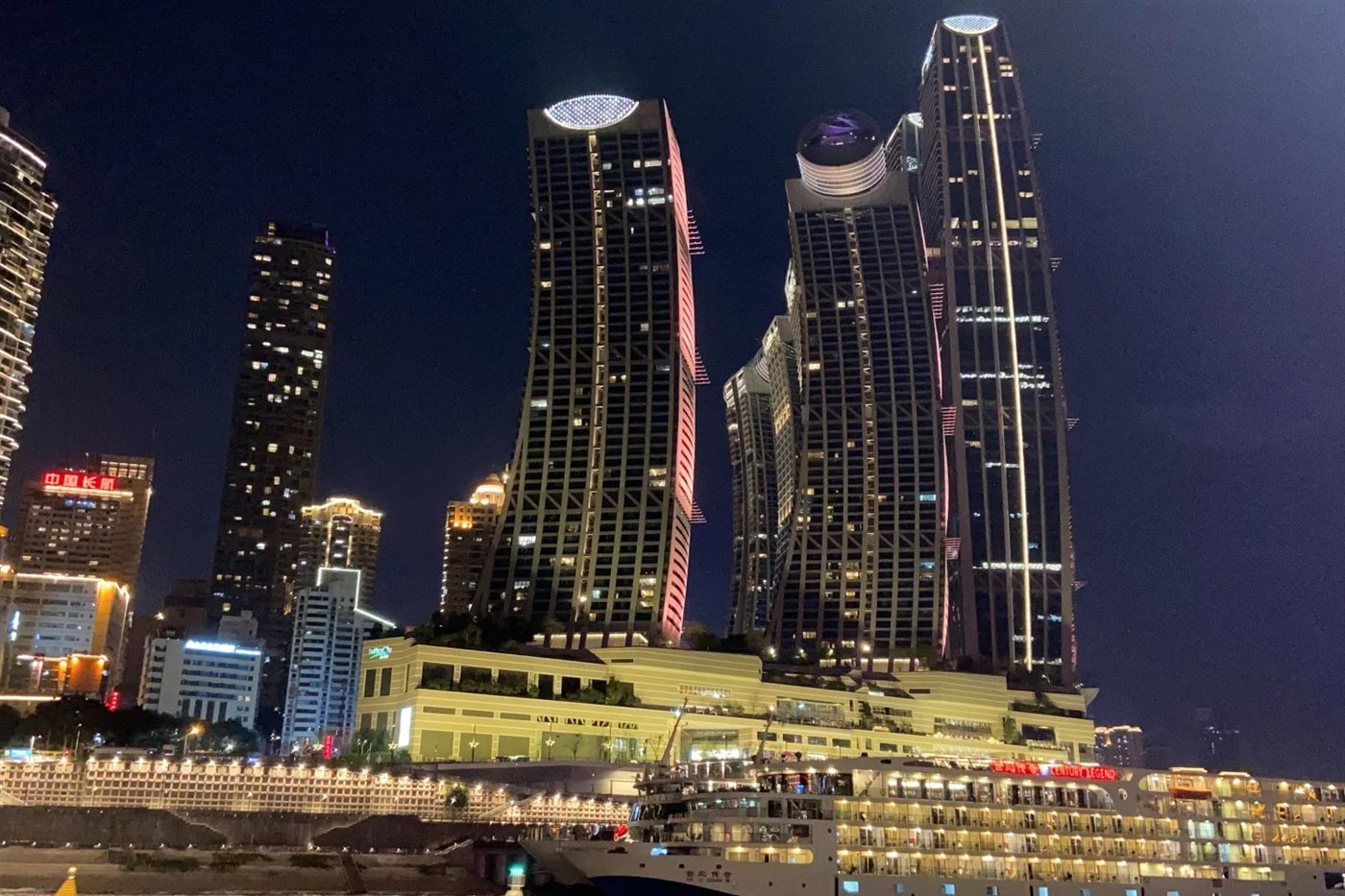
The single most-confused Chongqing booking decision foreign visitors make is the difference between the Two Rivers Night Cruise and the Yangtze River Three Gorges Cruise. They share a departure port (Chaotianmen) and nothing else. Search “Chongqing river cruise” — or “Yangtze river night cruise”, which people genuinely type for the short one — and you can book the wrong thing entirely.
| Cruise | Duration | Price | Overnight? |
|---|---|---|---|
| Two Rivers Cruise 两江夜游 | ~45 min | ¥158 · ¥110–138 online | No — back to your hotel |
| Yangtze / Three Gorges Cruise 长江三峡游轮 | 4 days / 3 nights (5/4 upstream) | from US$520 per person | Yes — cabin on board |
Everything below is about the second row. If it turns out you wanted the first, that page is here — a different scope, budget, booking lead time and itinerary entirely. One small vocabulary note that will help you read Chinese listings: a river cruise ship is 游轮; 邮轮 is an ocean liner, and a listing using it is usually not describing this trip.
Should you book one?
Decide on time first, taste second. The Three Gorges scenery genuinely lives up to its reputation and the boat is the only way to see most of it — but four days is a large fraction of a China trip, and the experience rewards a particular kind of traveller.
Book it if
- You have 14+ total days in China and don’t mind giving four to one experience.
- You like cruises in general — the onboard rhythm is already known to you.
- You travel with a non-walker and want a slow, structured trip with no daily logistics.
- You’re a scenery or photography person — the ship is inside the gorges before any bus can arrive.
- You’re combining Chengdu, Chongqing and an eastern city — the cruise connects them without backtracking.
Skip it if
- You have under 10 days in China total — four boat days cost you a major city.
- You’ve already done Yangshuo’s Li River, which delivers similar cliff scenery in one afternoon.
- You dislike structured group activities (tai chi class, calligraphy demo, captain’s cocktail).
- You’re on a tight budget — Zhangjiajie or Huangshan deliver scenery for far less.
- You need to stay reachable — signal drops for three to four hours at a stretch in the gorges.
One worry you can drop: seasickness. This is a river, the ships are large and flat-bottomed, and almost nobody feels it — vessels carry free tablets at the medical room if you are the exception.
The gorge most ships pass in the dark
This is the thing to settle before you compare anything else, and almost no English listing mentions it. Travellers report that roughly nine in ten ordinary sailings transit Xiling Gorge overnight to keep the schedule. Passengers spend the evening on deck, go to bed, and wake up past the longest of the three gorges. The complaint is consistent enough that Chinese guides treat it as the classic first-timer mistake.
Daytime transit is a property of the sailing, not of the price
A more expensive cabin on the same ship does not move the ship. Some sailings are marketed specifically on daytime gorge transit — the Chinese phrase on the listing is 白天过三峡 — and that is the attribute to ask about. Put the question to the operator or agent in writing before you pay: which of the three gorges does this departure pass in daylight? No platform lets you filter by it, so it will not fall out of any comparison you run — but the ships that do it usually say so in the listing text (白天过全程三峡, “daytime transit of the full gorges”), so it is findable by reading rather than by searching.
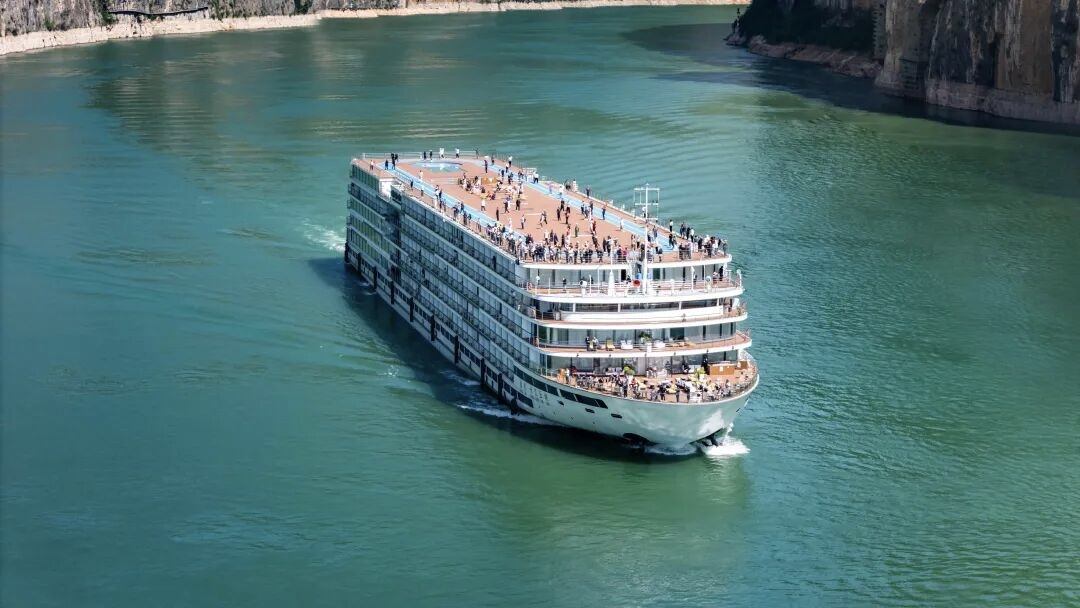
It matters because the gorges are a morning event, not an evening one. On a downstream sailing the good hours are early: Qutang Gorge at roughly 07:00–08:00 on day 3, Wu Gorge in the early afternoon around 13:00–14:00, and Xiling early on day 4. Passengers who set an alarm for 06:30 describe the quietest and best part of the whole trip — the decks are nearly empty. Passengers who treat the cruise as a lie-in miss the thing they paid for.
Downstream vs upstream
Both directions cover the same scenery in reversed order, so direction matters less than people think. Downstream is the default: shorter, cheaper, and it ends with the Three Gorges Dam as a finale. Go upstream if you want the slower version, or if Chengdu is your next stop.
| Downstream (Chongqing → Yichang) | Upstream (Yichang → Chongqing) | |
|---|---|---|
| Duration | 4 days / 3 nights | 5 days / 4 nights |
| Why this length | Running with the current | Slower against the current |
| Price | About 10–15% cheaper | The premium buys an extra night |
| First evening | Sails at ~19:00–20:30, past the lit Chongqing skyline | Usually stays alongside overnight |
| End-point benefit | Three Gorges Dam as the finale | Connects to Chengdu by high-speed rail |
| Suits | Most foreign travellers | Older parents, young children, slower trips |
Whichever you pick, note that there is no return ticket. Yangtze cruises are sold one way; you fly or take high-speed rail back from the far end, and a round trip would simply show you the same gorges twice at double the price. Century Legend also sells an extended Chongqing–Shanghai sailing of about 11–12 days, which is a different holiday rather than a longer version of this one.
Which line, which ship
English-language guides often say only four lines serve foreign passengers. More do — and since the ship is the single biggest variable in what the trip feels like, it is worth knowing the whole field before you filter it.
| Line | Ships in 2026 | English service | From (pp) | Best for |
|---|---|---|---|---|
| Century Cruises世纪游轮newest ships | Vision (enters service 21 Sep 2026, 650 guests), Voyage, Oasis (2023), Victory (2022), Glory (2019); Legend runs the long Chongqing–Shanghai route | Full English front desk; Western breakfast; electric propulsion on the newer hulls | from $620–772 | Newest hardware on the river |
| Victoria Cruises维多利亚best English | Isabella (2025, 570 guests), Sabrina (2020, 690), Jenna (2009, refit 2018), Anna (2006, refit 2019), Katarina (2004, refit 2017) | The only American-based operator on the river; most consistent English service | from $417–520 | English service and a Western-run guest experience |
| President Cruises总统游轮 | Mid-range fleet; optional excursions priced slightly below the others (¥280) | Serviceable, less polished than Victoria | mid-range | Value when the newer ships are sold out |
| Vista Cruises美维all-inclusive | Harmony (April 2026) and Aurora (July 2026) — both brand new, sold as all-inclusive packages | New entrant; the all-inclusive framing removes the excursion-by-excursion maths | from $681 | Travellers who would rather not price each excursion separately |
| Yangtze Gold长江黄金 | Large ships, well equipped; some hulls now dated | Mixed — travellers report bilingual service has slipped on parts of the fleet | varies | Only on a promotion you have checked the ship for |
| Yangzi Explorer长江探索small ship | Single small ship, 124 guests, operated by Sanctuary Retreats; sails March–November only | International management throughout | from $1,579 | Small-ship luxury — and it is shallow enough to avoid the coach transfer |
Century Paragon has been retired. It has no sailings at all in 2026, but it is still listed on plenty of third-party pages and in older guides. If a quote names it, the seller is working from a stale inventory file — which is worth knowing before you trust the rest of the quote.
The one genuinely new thing this year: Century Vision enters service on 21 September 2026 — 650 guests in 236 cabins, 15,000 tons, on the standard four-day Chongqing–Yichang run. If you are sailing in late 2026 it will be the newest ship on the river by some margin, and inventory on a maiden season is usually easier to get than the equivalent on an established ship.
Below this field: smaller domestic-market operators run the same route without English service or Western breakfast — fine if you read Chinese, frustrating if not. And bear in mind that a budget ship is rarely as cheap as it first looks once the excursions in the next section are added back.
Which cabin — and what you can actually choose
Start with what is not a decision, because most advice on this gets it wrong. You cannot pick your deck. Outside the top suites, standard and family cabins are assigned when you check in rather than chosen when you book, so any guide telling you to request deck 3 is describing a conversation you will not get to have. If you do get the chance to express a preference, the one worth using it on is avoiding deck 5: it sits directly beneath the open sun deck and picks up furniture being dragged in the evening and footsteps at dawn.
The second thing to drop is anxiety about which side of the ship you are on. On these vessels every cabin is an unobstructed river-view cabin, and the gorges have scenery on both banks. There is no good side.
| Cabin | Cost difference | What you actually get |
|---|---|---|
| Interior / window-only | ~¥1,000 less pp | Identical entitlements — same meals, same excursions, same activities. You watch the gorges from the public deck, which is crowded at exactly the moments worth watching. |
| Standard balconymost people | the baseline | Roughly 25 m², en-suite, and your own chair for a 07:00 gorge transit without competing for deck space. A comfort upgrade, not a requirement. |
| Suite | substantially more | Larger balcony and a sitting area — and the only category where you can genuinely choose your position on the ship. The scenery is identical. |
Travelling alone? Expect a single-occupancy supplement — every fare on this page is quoted per person on the assumption that two of you share the cabin. Travelling with children? The standard structure is roughly 10% of the fare for under-2s, 75% for a 2–12-year-old occupying a bed and 50% without one, which makes a family cabin better value than the headline price suggests.
What it really costs you
If you have searched this and found wildly different numbers, you are not confused — you have been reading two separate price lists that happen to describe the same cabin.
The yuan price you found is probably not yours
Chinese booking sites publish 内宾价 — the fare for mainland-ID holders, commonly ¥2,280–2,880 per person for a balcony cabin on a Century-class ship in 2026. These ships price off the Western-passenger fare and discount from it, and the Chinese sites say so openly: their price tables note that the foreigner fare is quoted separately, by phone. It is not published anywhere you can read it. On top of the fare, foreign guests pay a mandatory service charge of about ¥150–200 per person, collected at check-in or added at booking; the same envelope is voluntary for mainland guests.
So the honest number for a foreign traveller is the one quoted on foreign-facing bookings. These are per person, on double occupancy — a per-cabin figure is roughly double, which is where a lot of the confusion between quotes comes from:
| Ship | From, per person | Note |
|---|---|---|
| Victoria Jenna / Anna | $417 | Older hulls, refitted; the cheapest English-served option |
| Victoria Isabella / Sabrina | $520 | The two newest Victoria ships |
| Century Oasis / Victory / Glory | $620 | The mainstream choice |
| Vista Harmony / Aurora | $681 | New in 2026, sold all-inclusive |
| Century Voyage / Vision | $772 | The largest and newest |
| Yangzi Explorer | $1,579 | 124 guests; a different category of trip |
Basic standard cabins across the fleet run roughly $355–571 per person. Peak season — July, August and public holidays — adds about 15–20%.
What the fare includes, and what it does not
“All-inclusive” on this river is both a real product category and a misused phrase, and telling them apart is worth more than any other check on this page. The real category has grown quickly: a dated 2026 Chinese industry roundup counts 14 genuinely all-inclusive ships (一价全含) on which there are no paid shore excursions at all and the dam ship lift is in the fare. The misuse is everything else — cheaper sailings advertise one price, include two or three basic stops, and charge the rest per person as you go.
The test that separates them: a genuine all-inclusive listing names the excursions it covers — White Emperor City, Shennong Stream, the ship lift — one by one. A listing that only says “all-inclusive” and then lists two stops is using the phrase as marketing. Count the named stops, not the adjective.
| Included in the fare | Charged on top |
|---|---|
| Your cabin, and the meals marked on the itinerary | Optional shore excursions — about ¥290 per person each on Century, ¥295 on Victoria, ¥280 on President |
| Soft drinks served with meals | Three Gorges Dam ship lift — ¥290–380 on most ships (included on the all-inclusive tier) |
| The shore excursions specifically listed on your itinerary — read the list, not the adjective | Shennong Stream, which is commonly one of the paid excursions rather than an inclusion |
| Onboard activities, lectures, daily cabin cleaning | Dinner on your embarkation night, which most fares leave out |
| Accident insurance and government taxes | Drinks outside meals, laundry, spa, wifi on some ships, single supplement |
Ask for the itemised inclusion list in writing before you pay. Not “is it all-inclusive?” — the answer to that is always yes — but which named shore excursions are covered. Two or three paid stops at ¥290 each turn a cheap fare into a mid-range one, and that is the arithmetic the cheapest listings depend on you not doing.
The ship lift deserves its own note, because it is the add-on most people say was worth it: a vertical lift that raises the whole vessel past the dam, rather than the five-stage lock. Some ships transit it with you still aboard (the phrase on Chinese listings is 原船过升船机); on others you pay to transfer to a smaller boat, which involves a fair number of steps and is worth avoiding if anyone in your party is unsteady. Ask which arrangement your ship uses — it is a different experience, not a different price.
What a day on board is actually like
The rhythm is busy mornings, slow afternoons, organised evenings — and almost none of it needs planning from you. Going downstream from Chongqing, this is roughly the shape of it:
| When | Stop | What it is |
|---|---|---|
| Day 1 evening | Chongqing skyline重庆夜景 | A downstream ship sails at about 19:00–20:30, so the first night on deck passes the lit city — the same view the 45-minute night boats sell. |
| Day 2 | Fengdu Ghost City丰都鬼城 | Temple complex themed on the afterlife. About 2 h. Commonly one of the included stops; skippable unless Chinese folk religion interests you. |
| Day 2 | Shibaozhai Pagoda石宝寨 | 12-storey red wooden pavilion against a cliff, reached by a footbridge. Photogenic and brief. |
| Day 3 ~07:00–08:00 | Qutang Gorge瞿塘峡 | Shortest (8 km) and most dramatic of the three — the scene on the back of the ¥10 note. An early start; the decks are at their quietest. |
| Day 3 morning | White Emperor City白帝城 | The usual day-3 shore excursion. Normally a paid extra (about ¥290 on Century). |
| Day 3 ~13:00–14:00 | Wu Gorge巫峡 | 45 km of winding misty cliffs and the Twelve Peaks of Wushan, including Goddess Peak. Early afternoon, not morning. |
| Day 3 | Shennong Stream神农溪 | Tributary transfer onto sampans rowed by Tujia boatmen. Widely described as included; on most fares it is a paid excursion of roughly ¥200–290. Check your list. |
| Day 4 ~06:30–08:00 | Xiling Gorge西陵峡 | Longest (76 km) and gentlest. ⚠️ The one most often transited overnight — see the section above before you book. |
| Day 4 | Three Gorges Dam三峡大坝 | The world's largest hydroelectric dam; the visit is normally included. The ship lift is ¥290–380 extra on most ships, and in the fare on the all-inclusive tier. |
Around that: boarding day runs to a safety briefing at about 20:00 and a captain’s welcome at 21:00; gorge days start with an alarm at 06:30–07:00 and breakfast at 08:00; the dam day has a free morning and a farewell dinner; and on the last morning breakfast is at 07:00 with luggage handed to the crew. Evenings carry a cabaret or a culture lecture.
Three practical things nobody tells you. You will lose mobile signal for three to four hours at a time inside the gorges, so download anything you want to read first. The whole route is a no-fly zone — drones cannot be flown anywhere on this trip, and fishing rods are barred too. And at the shore stops you can usually ask to go round independently rather than following the guide, which is quicker and a great deal quieter; experienced passengers do this routinely.
Boarding, disembarking, and fitting it in
Most sailings board at Chaotianmen 朝天门, in the middle of Chongqing, a short walk from Chaotianmen station (朝天门站) on metro lines 1 and 6 — show a taxi driver 朝天门码头 for the cruise wharf. Chaotianmen has more than a dozen numbered berths, and the operator texts you the berth one to two days before departure — so there is no point trying to pin down a number when you book. Boarding runs about 16:00–18:00 for a 19:00–20:30 departure; arrive 1.5–2 hours early.
You may not board in Chongqing at all
When the river runs low — roughly April to June — or runs high enough in flood season that bridge clearance becomes the limit, ships over about 130 m cannot reach the city berths. The operator then assembles passengers at a collection point in Chongqing and runs a free coach, about 2–2.5 hours, downstream to Fengdu (丰都) or Fuling (涪陵) to board there. It is not a rare event and it is not a fault; it is how the river works. Two consequences worth planning around: your first evening is spent on a bus rather than sailing past the Chongqing skyline, and you should not book a tight onward connection at the far end. Booking a ship under 10,000 tons — the Yangzi Explorer among them — sidesteps it, because a shallower draft still reaches the city.
At the far end, downstream sailings disembark at Maoping or Zigui near the dam, followed by a coach of about 1.5–2 hours to Yichang East railway station (宜昌东站). From there it is 4–6 hours by high-speed rail to Shanghai or Beijing.
Most travellers building a multi-week trip use the cruise as the middle leg, so it joins west to east without backtracking: Beijing or Shanghai, then Xi’an, then Chengdu, then the 1h15m train to Chongqing, then the cruise, then rail onward from Yichang — about 14–17 days in total. Use the interactive HSR map to plan the train segments.
Two small things at the dock. Chaotianmen has a great many steps, so travel light or ask whether your operator has porters — on most ships they will carry large bags to your cabin at no charge. And bring your passport: boarding is real-name, and it is the document that replaces the Chinese ID card everyone else is holding. Spending the night in Chongqing first? The city’s 8D landmarks fill a day, and since the first night’s dinner usually is not included, hot pot before you board is the standard move.
Best months to sail
- April–June and September–October. Spring brings waterfalls down the gorge walls from snowmelt; autumn is clearer with more settled weather. Both book up 3–4 months ahead. ⚠️ May and June are also when low water most often forces the coach transfer described above, so if boarding in the city centre matters to you, September–October is the safer half.
- July–August are hot (35°C+ and humid), hazy enough to flatten gorge photographs, and busiest with domestic holidaymakers — with peak pricing about 15–20% above the rest of the year.
- Mid-to-late November is the quiet third option: autumn colour on the slopes, far fewer people, and a cold and windy deck. Worth it if you will actually stand outside in it.
- December–March sailings are cheapest, but the gorges are often in cloud and part of the fleet goes into refit. The Yangzi Explorer does not sail at all outside March–November.
Whichever window you pick, the ships are the constraint rather than the dates: the fleet is small, each ship sails the route roughly twice a week, and a named ship in a good month is the thing that sells out — not “the cruise”. If you have settled on a particular vessel, or you need a departure that transits the gorges in daylight, treat 3–4 months ahead as normal for spring and autumn rather than cautious.
How to book
Three channels sell the same sailings at different prices, and the ordering here is the opposite of the short night cruises in Chongqing, where the operator’s own window is the expensive one:
| Channel | Price | What you get |
|---|---|---|
| International booking platforms | Dearest | English checkout, foreign cards, standard refund terms, and a written record of what you bought. |
| The cruise line direct | Middle | The most accurate information about the ship, and no hidden add-ons — but the English sites lag the platforms badly. |
| Chinese travel agents | Cheapest | Contract rates well below list — but Chinese-language contracts, domestic payment methods, and effectively unreachable without a Chinese phone and payment app. |
For a foreign traveller the cheapest tier is not really on the menu, so the practical choice is between a platform and the line direct. The platform premium is buying something real — a checkout you can complete, a card that works, and terms you can enforce — but it is a premium, and you should know that rather than assume you are getting the keenest price on the river.
Whichever you use, put two questions in writing before you pay: which gorges the sailing transits in daylight, and exactly which named shore excursions the fare covers. Both change the value of the trip far more than the difference between any two channels. Book 8–12 weeks ahead for April–May and October departures.
What is actually bookable in English
Four multi-day sailings, checked on 2026-08-08 — prices are per person and move
Sailings are dated departures, so listings rotate. If one of the above has moved on, or you want a date it does not cover, search the three platforms — but remember none of them lets you filter by daytime gorge transit, so you still have to read the description for it and ask if it is not stated.
Editor’s note: the four sailings above were opened and checked on 2026-08-08; departures are dated and inventory rotates, so the search row is there for when one moves on. Whichever you use, check the ship, the date and the named inclusion list before you pay.
Frequently asked questions
Is the Yangtze River cruise the same as the Chongqing Two Rivers cruise?
No, and it is the single most-confused booking decision foreigners make about Chongqing, because both leave from the same port. The Yangtze Three Gorges Cruise (长江三峡游轮) is a 4-day/3-night downstream sailing from Chongqing to Yichang (5 days/4 nights upstream), you sleep on board in a cabin, and foreign-facing fares start around US$520 per person. The Two Rivers Night Cruise (两江夜游) is a 45-minute evening loop around the Chongqing waterfront, ¥158 at the pier or ¥110-138 booked online, and you are back at your hotel the same night. They share the Chaotianmen dock and nothing else. If you are searching 'Chongqing river cruise' or 'Yangtze river night cruise', be clear which one you mean — we have a separate full guide for the 45-minute night boat.
Will I sleep through the Three Gorges?
You can, and it is the most common regret on this trip. Travellers report that roughly nine in ten ordinary sailings pass Xiling Gorge — the longest of the three — in the middle of the night to keep the schedule, so passengers go to bed on the river and wake up past it. The gorges are not an evening event you can catch late: on a downstream sailing Qutang Gorge is around 07:00-08:00 and Wu Gorge around 13:00-14:00 on day 3, and Xiling is early on day 4. Before you book, ask the operator in writing which gorges the ship transits in daylight — some sailings are sold specifically on daytime gorge transit (白天过三峡). This is a property of the sailing, not of the price.
How much does a Yangtze River cruise cost, and why do the prices I find disagree?
Because you are reading two different price lists. Chinese-language booking sites publish 内宾价, the mainland-ID fare — commonly ¥2,280-2,880 per person for a balcony cabin on a Century-class ship in 2026. Foreign-facing bookings for the same cabin start around US$520 per person (Victoria Isabella), US$620 (Century Oasis, Victory, Glory), US$681 (the new Vista ships) and US$772 (Century Voyage and Vision), with the small-ship Yangzi Explorer at about US$1,579. Ships price off the Western-passenger fare and discount from it, and Chinese booking sites say plainly that a foreigner price exists and must be requested by phone. On top of that, foreign guests pay a mandatory service charge of about ¥150-200 per person, collected at check-in or added at booking; for mainland guests the same envelope is voluntary. All figures are per person on double occupancy — a per-cabin number is roughly double.
What is actually included in the fare, and what is not?
Included: your cabin, the daily meals marked on the itinerary, complimentary soft drinks at meals, the shore excursions specifically listed on your itinerary, onboard activities and lectures, daily cabin cleaning, accident insurance and government taxes. Excluded, and this is where people are caught out: optional shore excursions are charged per person per tour — about ¥290 on Century, ¥295 on Victoria, ¥280 on President — and the Three Gorges Dam ship lift is ¥290–380 per person depending on the line. Shennong Stream is commonly one of the paid excursions rather than an inclusion, despite how often it is described as included. The dinner on your embarkation night is usually not covered. Drinks outside meals, laundry, wifi on some ships, and the single-occupancy supplement are all extra. Ask for the itemised inclusion list before paying, not after.
Which Yangtze cruise ship is best for foreign travellers?
More lines carry English-speaking crew than most English guides admit: Century Cruises and Victoria Cruises lead, with President Cruises, Yangtze Gold, Vista (美维), Changjiang Cruises and the small-ship Yangzi Explorer also serving international passengers. Victoria is the only American-based operator on the river and has the most consistent English service; its 2025-built Isabella (570 guests) and 2020 Sabrina (690 guests) are the newest. Century has the newest hardware overall and runs electric propulsion — Oasis (2023), Victory (2022), Glory (2019), the larger Voyage, and Century Vision, which enters service on 21 September 2026 with 650 guests in 236 cabins. Century Legend runs the long Chongqing-Shanghai route. Century Paragon has been retired and has no 2026 sailings, so ignore any listing that still offers it.
Which cabin should I pick, and can I choose my deck?
You mostly cannot choose your deck. Outside the top suites, standard and family cabins are assigned at check-in rather than booked by floor, so deck-picking advice is largely moot — though it is worth asking to avoid deck 5, which sits directly under the open sun deck and picks up chairs being dragged and early-morning footsteps. The useful news is that on these ships every cabin is an unobstructed river-view cabin, and there is scenery on both banks, so which side you are on does not matter. A private balcony is a genuine comfort upgrade — your own chair for a 07:00 gorge transit, rather than the packed top deck — but it is a comfort upgrade, not a requirement: interior cabins run roughly ¥1,000 less per person and carry identical entitlements to meals, excursions and activities.
Should I cruise downstream or upstream?
Downstream (Chongqing to Yichang, 4 days/3 nights) is the default: it runs with the current, costs about 10-15% less, and ends at the Three Gorges Dam as a finale. Upstream (Yichang to Chongqing, 5 days/4 nights) is slower and more relaxed, suits travellers with older parents or children, and finishes in Chongqing where you can continue to Chengdu by high-speed rail. The scenery is the same in reverse. One difference worth knowing: a downstream ship sails on its first evening, so your first night on board passes the lit Chongqing skyline, while an upstream ship usually stays alongside overnight on day one.
Where do I board in Chongqing, and could I be bussed somewhere else?
Most sailings board at Chaotianmen in the city centre, a short walk from Chaotianmen metro station on lines 1 and 6. Chaotianmen has more than a dozen numbered berths and the operator texts you the specific berth one to two days before departure, so there is no point trying to pin it earlier. But you can be moved: when the Yangtze runs low (roughly April to June) or high enough in flood season that bridge clearance becomes the limit for ships over 130 m, large vessels cannot reach Chaotianmen and the operator assembles passengers at a city collection point and runs a free coach roughly 2 to 2.5 hours downstream to Fengdu or Fuling. Booking a ship under 10,000 tons — the Yangzi Explorer among them — sidesteps the transfer because a shallower draft still reaches the city berths. Boarding runs about 16:00-18:00 for a 19:00-20:30 departure; arrive 1.5 to 2 hours early, and pack light because Chaotianmen has a lot of steps.
When is the best time to take the cruise?
April to June and September to October. Spring brings waterfalls down the gorge walls from snowmelt; autumn is clearer and more settled. July and August are hot, hazy and busiest with domestic holidaymakers, and peak pricing adds roughly 15-20%. Mid-to-late November is a quieter third option for autumn colour on the slopes, at the cost of a cold, windy deck. Winter sailings are cheapest but the gorges are often in cloud, and the Yangzi Explorer only sails March to November. One seasonal catch that is not about weather: May and June are exactly when low water can force the coach transfer described above.
How do I book without overpaying, and is there a return ticket?
There is no return ticket — Yangtze cruises are sold one way, and you fly or take high-speed rail back from the far end. On channels, the ordering here is the opposite of the short night cruises: the booking sites are the most expensive, the cruise line's own site sits in the middle, and Chinese travel agents with contract rates are cheapest. For a foreign traveller the agent tier is largely unreachable — it runs on Chinese-language contracts, domestic payment and WeChat — so the practical choice is between a booking site and the line direct, and the booking site premium buys an English checkout, a foreign card and standard refund terms. Whichever you use, get the inclusion list and the gorge-transit times in writing before paying. Book 8-12 weeks ahead for April-May and October departures.
Can I bring a drone, and will I have phone signal?
No drone. The Yangtze cruise route is a no-fly zone end to end, so a drone is not something to pack and declare, it is something to leave at home; fishing rods are also barred. Expect to lose mobile signal for three to four hours at a stretch inside the gorges, which is worth knowing if anyone is relying on reaching you. Download anything you want to read or listen to before you board. Seasickness, by contrast, is a non-issue that people worry about anyway: this is a river, the ships are large and flat-bottomed, and vessels carry free tablets at the medical room if you are unlucky.
Can I do the Yangtze cruise as part of a 240-hour visa-free transit?
Tight but possible with careful planning. The cruise eats 4 days and you need a third-country onward flight within the 10-day window. A typical sequence: arrive Chongqing, take the 4-day downstream cruise, disembark at Maoping or Zigui near the dam, coach 1.5-2 hours to Yichang East station, high-speed rail to Shanghai (4-5 hours), then fly onward. Confirm your entry port and intended route are covered before relying on it — the permitted areas are defined per port of entry, not nationally. Most travellers on a cruise trip prefer a regular tourist visa, because 10 days leaves almost no buffer if water levels move your embarkation port.
Sources
Checked August 2026 · Written from our own first-hand travel in China.
Corrected since publication: An earlier version carried a single yuan price band that turned out to be the domestic fare. The foreign-facing prices are a different, higher list.