Key takeaways
- Three sacred ~6,000m snow peaks — Jambeyang 6,033m (the tallest), Chenresig & Chana Dorje — the “Last Shangri-La”.
- Admission is waived 1 Aug – 31 Oct 2026 (normally ¥146), and the shuttle and cart have been free since 29 May under a separate order — two measures, two end dates. A real-name reservation is still compulsory.
- From Chengdu: fly to DCY airport (1h, world’s highest at 4,411m — then 124 km on to the gate) or drive 683 km to Daocheng (11–12h via G318 + G227, gradual, safer).
- Trails run 4,000–4,700m — Milk Lake sits at ~4,600m. Acclimatize first; AMS hits 30–50% of fly-in visitors.
- The park is governed by a clock, not a price: staff turn walkers back from the high lakes at 14:00–14:30, and the last shuttle out is around 19:00.
- Go late September–October for autumn colour; not a first-China-trip add-on — Jiuzhaigou is the easier alternative.
What Daocheng Yading is — the Last Shangri-La
Daocheng Yading is a 1,344 km² nature reserve in southwestern Sichuan’s Garzê Tibetan Autonomous Prefecture, ~700 km from Chengdu. It is the highest-elevation, most remote and most photogenically dramatic of Sichuan’s attractions. The reserve centres on three sacred peakshonoured in Tibetan Buddhism, around which Tibetans have made pilgrimage circuits for centuries:
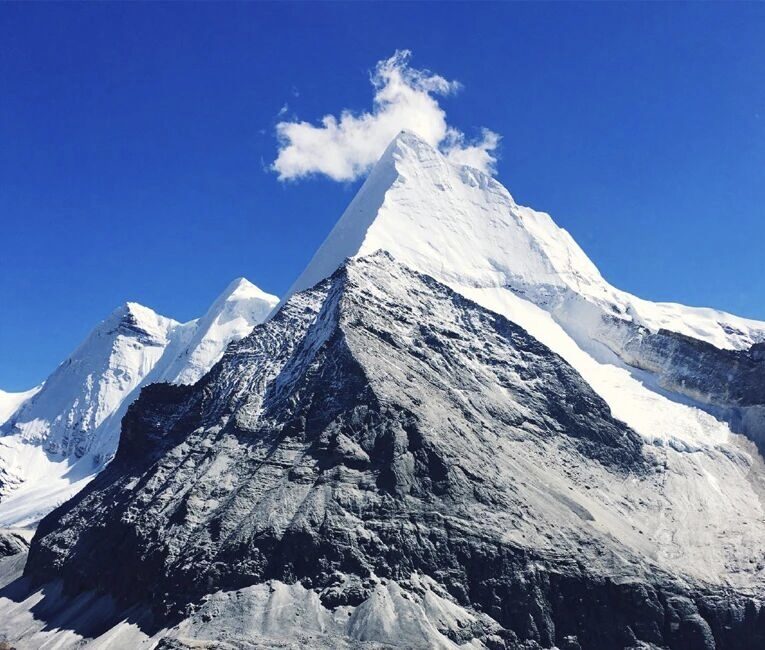
- Jambeyang (Yangmaiyong 央迈勇) — 6,033.0m, the tallest of the three, the “mountain of wisdom.”
- Chenresig (Xiannairi 仙乃日) — 5,998.5m, the “mountain of compassion.”
- Chana Dorje (Xiaruoduoji 夏诺多吉) — 5,951.3m, the “mountain of power.”
Heights are the figures the Ministry of Natural Resources published in October 2023 from a survey carried out in 2022 — the first re-measurement since the 1960s, and the one that changed which peak is tallest. Many older guides still cite the legacy figures of Chenresig 6,032m and Jambeyang / Chana Dorje 5,958m.
The reserve is nicknamed the “Last Shangri-La” (最后的香格里拉) — the term traces to a 1928 National Geographic article by American botanist-explorer Joseph Rock, who claimed his Yading expedition matched the fictional paradise in James Hilton’s Lost Horizon. The name is heavily commercialised, but the landscape is genuinely extraordinary: glacial-fed lakes glow turquoise, larch forests turn vivid yellow in October, and the Tibetan villages still actively preserve traditional ways of life.
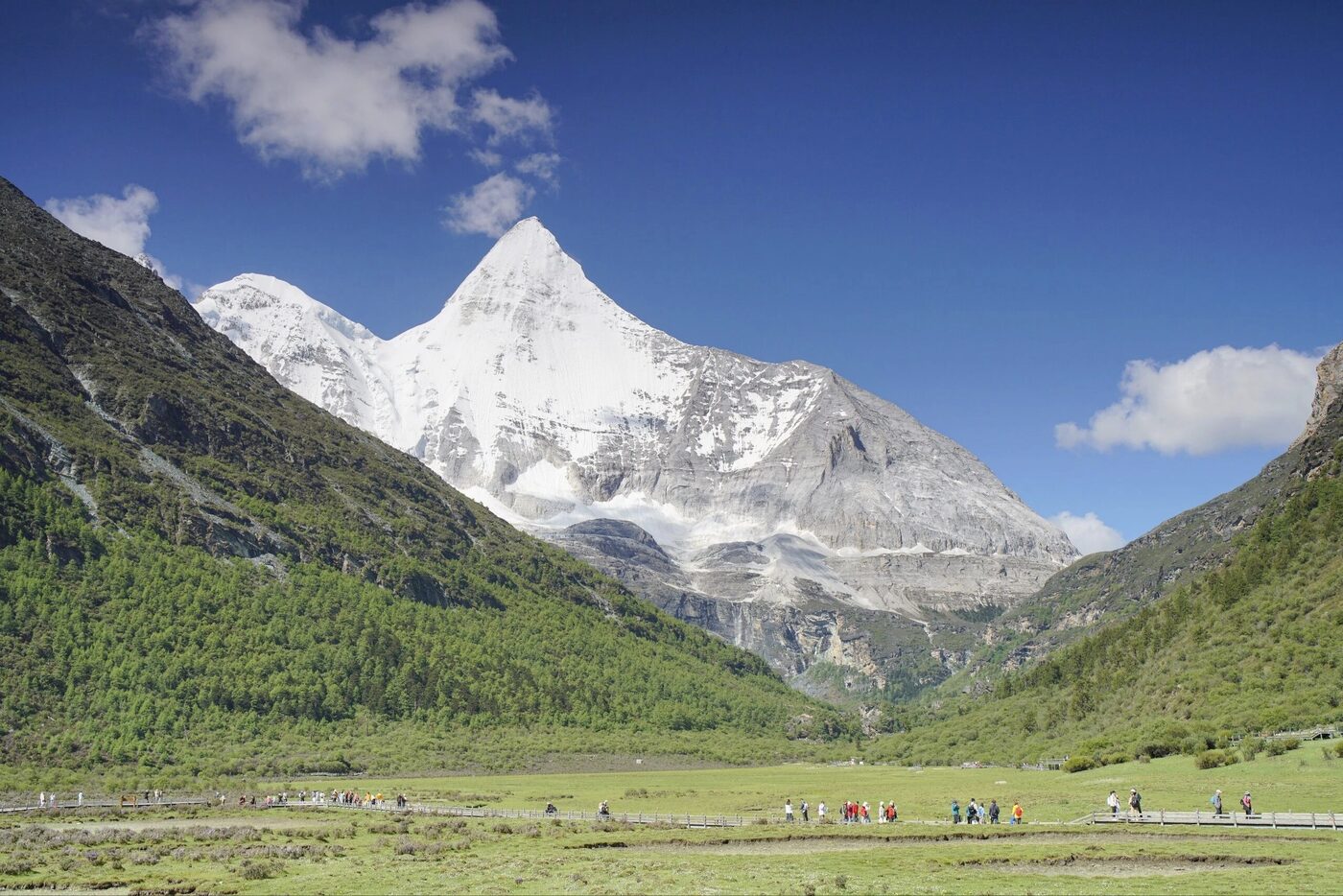
Worth it for experienced mountain trekkers, serious landscape photographers, and return visitors with proven altitude tolerance (Cusco, Lhasa, or a Colorado 4,000m trail without issue). Skip if this is your first China trip, you have only 7–10 days total, you’ve never been above 3,000m, or you have heart/lung conditions — Jiuzhaigou (3,400m max, 3h HSR from Chengdu) is the more sensible alternative.
The hikes & lakes — Pearl, Milk, Five-Color
Private vehicles can’t enter; the park shuttle drops you near Chonggu Monastery (3,900m) and the two loops start from there. Pearl Lake is the gentle short loop; Milk Lakeand Five-Color Lake are the hard high-altitude day and the photographic climax. Distances and altitudes below.
| Hike | Distance · time | Altitude | Difficulty |
|---|---|---|---|
| Pearl Lake 珍珠海 / 卓玛拉措 (short line) | ~2–3 h round-trip from the bus ~400 m to the monastery, ~845 m more | ~4,100m | Easy — boardwalk almost throughout, and it calibrates your pace at altitude. |
| Gongga Cuo 贡嘎措 (mid line) | ~2 km beyond Luorong, level ~1 h return from the pasture | ~4,200m | Easy — the honest answer for most visitors: all three peaks, no climb. |
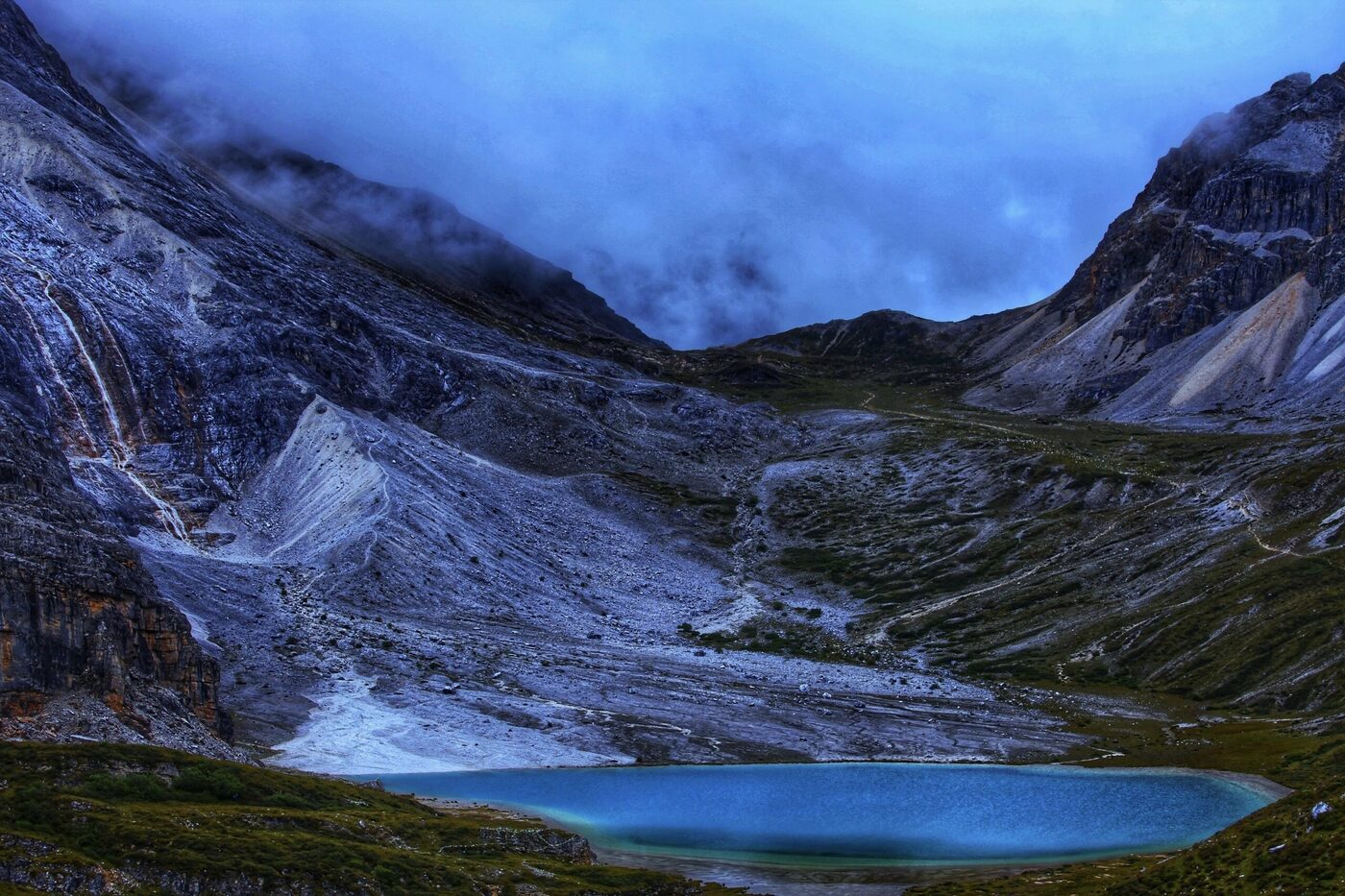
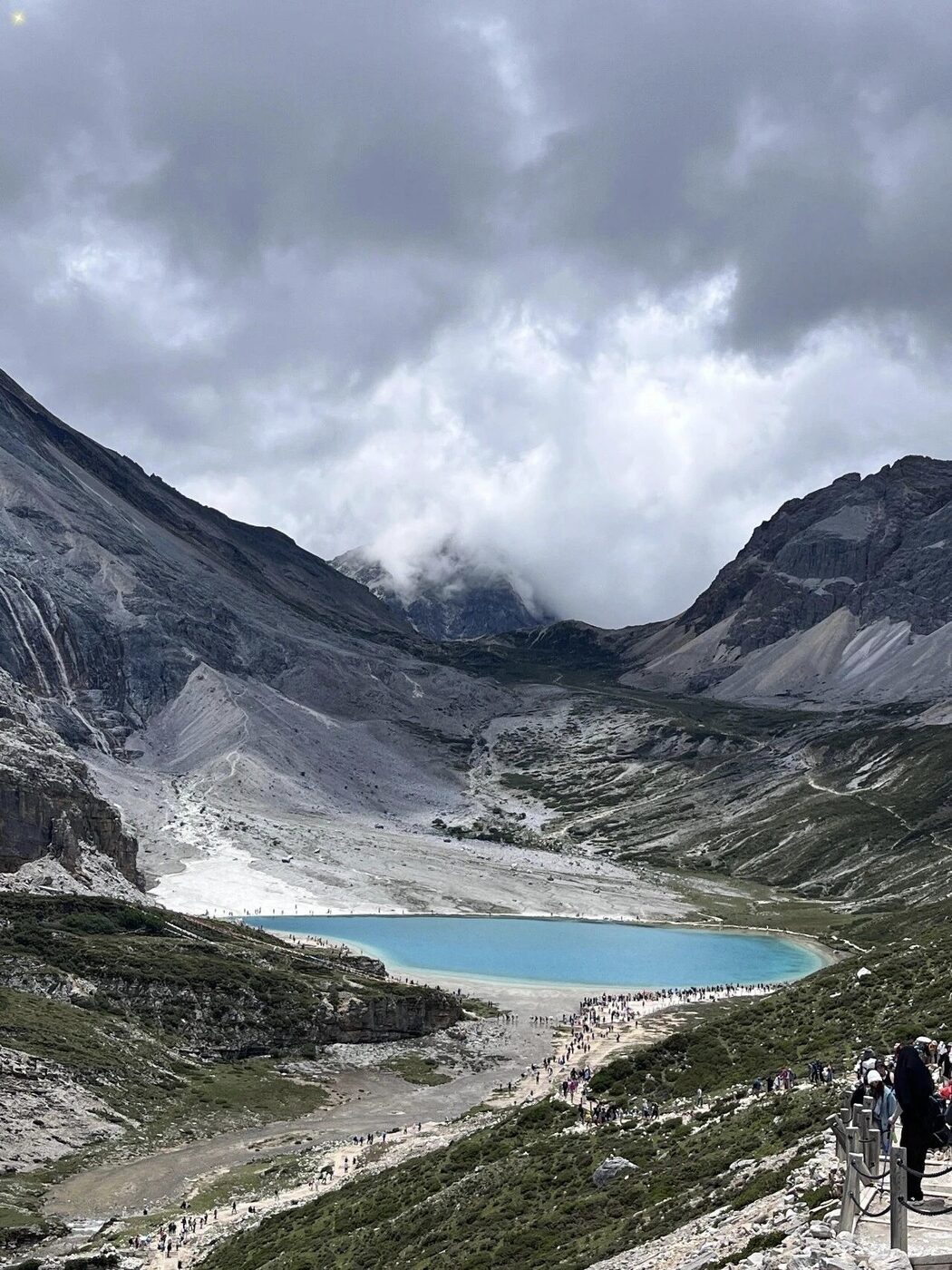
| Milk Lake 牛奶海 (long loop) | ~5 km each way from Luorong ~10–11 km RT · 6–8 h | ~4,600m | Hard — the famous photo. Flat boardwalk as far as Gongga Cuo, then a steep climb (~400–450 m gain) that tests the lungs. |
| Five-Color Lake 五色海 | +~300 m above Milk Lake | ~4,700m | Hard — a steep push beyond Milk Lake; the trip’s highest point. |
| Luorong Pasture 洛绒牛场 (long-loop base) | shuttle + optional cart | 4,180m | The staging meadow under the three peaks where the long loop begins. |
On a 5-day plan the short line to Pearl Lake is Day 3 and the Milk Lake / Five-Color Lake push is Day 4 — never both on your first full day in the park. The three sacred peaks ring the Luorong meadow, so even a visitor who rides the cart up and walks no trail at all still sees them. Travellers report the altitude, not the distance, is the real test: many unfit walkers still make it on a “slow pace plus oxygen” approach — the question is whether you can keep your heart rate down.
The mid line is the one nobody writes down. English guides present Yading as a choice between a stroll and an expedition. There is a third option, and for most visitors it is the right one: take the cart to Luorong Pasture and walk the level boardwalk on to Gongga Cuo — a small lake about 2 km further, on the flat, with Jambeyang directly above it. You get the meadow, the three peaks and a lake, at 4,200m, without the climb that turns the day into a test.
Ponies (骑马): a horse team runs from Luorong Pasture as far as Sheshenya (舍身崖), about 3.5 km up, at roughly ¥300 one-way or ¥500 return. It does not reach the lakes — the last ~1.5 km, which is the steep part, is on foot regardless. Around 120 horses run a day, so the queue forms at the pasture before 07:30 in season, and there is a rider weight limit. The verdict from travellers splits honestly down the middle: it saves you the flat section, which was never the hard bit.
The clock — the five times that decide your day
Everything above assumes you have the hours to do it, and at Yading you very likely don’t. The park closes its gate in the middle of the afternoon, clears the high trail before that, and runs its last vehicles hours later than either — so the constraint is never the one printed on the ticket. These are the five times that govern the day.
| Time | What happens | What it means for you |
|---|---|---|
| 07:00 | Gate opens; first shuttle up (08:20 from 1 Dec to 14 Apr). | Be on it. It puts you at Luorong Pasture around 09:00 — the only start that leaves the long line comfortable. |
| 14:00–14:30 | Staff stop people continuing past Gongga Cuo toward Milk Lake and Five-Color Lake. | The real deadline. Not past that point in time and you are turned back, however fit you are. |
| ~15:30 | Milk Lake itself is cleared. | Plan to start down by 15:00. Five-Color Lake is the first thing to drop if you are behind. |
| 16:40 | Admission and ticketing stop (15:50 in winter). | Arriving after lunch is legal and nearly pointless — the shuttle alone is an hour each way. |
| 18:00 · ~19:00 | Last cart down from Luorong Pasture; last shuttle out of Zhaguanbeng. | Services thin out after about 18:30. Aim to be back at Zhaguanbeng by 17:30. |
Missing the last shuttle is not a taxi problem. There is no other traffic on that road: it is a ~7 km walk down to Yading village, in the dark, at 4,000m, and the temperature at the lakes drops to 2–3°C when it rains. Traveller accounts of getting this wrong describe sitting out the night in a hut by the trailhead. That is the reason the clearing times exist, and the reason a 13:00 entry — which the gate will happily sell you — is a bad idea rather than a late start.
None of these times are on your ticket, and the park’s own signage is in Chinese. They also shift: the winter timetable is shorter at both ends, and the last shuttle runs later in the autumn peak than it does in May. Ask at the visitor centre what the last bus is that day before you get on the first one.
Tickets, the shuttle bus & electric cart
You buy a park entry ticket; the internal shuttle is mandatory (private vehicles can’t enter) and the electric cart on the long loop is optional. In August 2026 you pay for none of it — but for two different reasons, on two different clocks, and the difference is what tells you when it ends. Prices:
| Item | Now | Standing price · notes |
|---|---|---|
| Park admission | Free to 31 Oct 2026 | ¥146 peak (April 1–November 30) / ¥120 low season. Waived for all visitors, foreign passports included. |
| Internal shuttle bus visitor centre → Zhaguanbeng | Free, no end date | ¥120 return. Mandatory — private vehicles cannot use the 38 km road. |
| Electric cart Chonggu Monastery → Luorong Pasture | Free, no end date | ¥70 return / ¥50 one-way. Optional; saves ~1 hour of walking each way. |
| Ponies Luorong Pasture → Sheshenya | ~¥300 one-way | Still charged. ~¥500 return, ~120 horses a day; the steep final 1.5 km is on foot regardless. |
Two measures, two end dates — don’t merge them. The Ministry of Culture and Tourism named the scenic area on 27 April 2026 over its shuttle pricing, and a provincial investigation found that the only road in — 38 km of provincial highway, about 32 km of it inside the nature reserve — had been gated behind a compulsory ¥120 bus. Fares were cut to 88% on 13 May and suspended outright from 29 May; more than 170,000 visitors had ridden free by mid-July. That suspension has no end date and lifts only after a cost audit and a formal price hearing. The free admission is a separate, dated promotion (1 August – 31 October 2026), and its own notice says in as many words that it covers the entrance ticket and not the vehicles. So admission returns on 1 November whether or not the transport fees have.
The ¥80 cart fare you will see everywhere is out of date. ¥80 is the approved standard from the county price documents of 2005 and 2013; the scenic area cut the return fare to ¥70 in August 2022 and ¥70 is what was actually charged. The arithmetic gives it away — the 88% discount announced on 13 May produced ¥105.6 and ¥61.6, and 61.6 is 88% of 70, not of 80.
One more thing the free window changes: the ¥146 ticket used to be valid three days, with a half-price ¥60 shuttle for a second entry. While admission is free, each day is booked separately — a second day in the park needs its own reservation and its own place in the daily cap.
A realistic 5-day total from Chengdu, all-in (transport, hotels, food), runs ¥4,000–7,000 ($550–960) per person; the park itself is currently the smallest line in that. Inside the gate, visitors report ¥50–150 a day — an oxygen canister is about ¥20 from the vending machines, a meal at Luorong Pasture about ¥60. Bring the cash for it — payment on the plateau is covered in the practical section below.
Getting there from Chengdu — fly vs drive
Three ways in from Chengdu. The flight is fast but lands you abruptly at altitude; the drive is long but ascends gradually, which matters more than it sounds.
| Option | Time | Cost | Altitude · best for |
|---|---|---|---|
| Fly Chengdu → DCY | 1 hour | ¥600–1,500/leg | Abrupt to 4,411m · time-constrained travelers. |
| Drive (G318 + G227) | ~11 h to Daocheng town ~12 h to the gate, or 2 days | ¥1,500–3,000 driver/day | Gradual ascent · photographers, route-experiencers. |
| Coach (成都旅游客运中心 / 新南门) | 15–16 h, early morning departure | ¥200–280 | Gradual ascent · budget travellers. Some services break overnight in Kangding. |
Daocheng Yading Airport (DCY) sits at 4,411m — the highest civilian airport in the world. Flights run year-round but cancel often in winter; altitude exposure is immediate, and many travelers can’t function for 12–24 hours after landing. The airport is also not next to the park: the visitor centre is a further 124 km, which Amap models at just over two hours and travellers describe as closer to three. Read that transfer as the good news it is — the visitor centre is at 2,900m, so the drive takes you 1,511m down from the runway, and going down is exactly what your first day should do. Daocheng town is only 48 km from the airport, but at 3,750m it is the higher place to sleep, not the lower.
The drive is one of the most scenic in China: the G318 “Sichuan-Tibet highway” forms the middle stretch, crossing multiple 4,000m+ passes (Zheduo, Gaoersi) before the route forks onto G227 toward Litang and Daocheng — not G318 the whole way. Amap measures 683 km to Daocheng town and 759 km to the park gate; experienced drivers manage the first in one 11-hour day, but most split it over two with an overnight at Kangding (2,600m) for natural altitude acclimatization. The coach from Chengdu leaves early morning from 成都旅游客运中心, the station still widely called Xinnanmen (新南门汽车站), and takes 15–16 hours to Daocheng bus station; from there it is another 77 km — an hour and a half — to the park gate.
Altitude — what to know before you go up
This is a serious high-altitude destination and the single biggest reason trips go wrong. The park entrance is ~3,800m, the main trails 4,000–4,700m, and Milk Lake sits at ~4,600m. Flying lands you at 4,411m within hours of leaving Chengdu (500m) — abrupt exposure that triggers acute mountain sickness (AMS) in 30–50% of foreign travelers; the gradual drive is much safer.
- Symptoms: headache, nausea, loss of appetite, breathlessness even at rest, disrupted sleep, fatigue. Onset 4–12 hours after arrival; often peaks day 2–3.
- Acclimatize before going high: sleep your first night as low as you can — Kangding (2,600m) on the drive, or for fly-in visitors descend from the 4,411m airport to Shangri-La Town / Riwa (2,900m, the lowest base near the gate) rather than staying up at Daocheng town (3,750m). Keep Day 1 to light activity, no exertion, no heavy meals.
- Hydrate, skip alcohol the first day or two.
- Oxygen is sold on site — portable cans at Daocheng-town pharmacies (¥40–80) for emergency use.
- Some travelers carry Diamox (acetazolamide), prescribed in advance by their own doctor; discuss it with a physician before the trip.
- If unwell, descend: if symptoms persist past 48 hours or worsen, go down to ≤3,000m and see a doctor — AMS can progress to potentially fatal pulmonary or cerebral edema.
This is general travel information on elevation and acclimatization, not medical advice. Consult your own physician about altitude medication and any heart or lung condition before booking.
Best time & how long to allow
Best: late September to mid-October — autumn-colour peak (yellow larch, red bushland), mostly-clear weather, peaks visible most days. Mid-October is the photographic peak; many photographers plan years ahead. Second-best: late April to early June — green meadows, snow still on the peaks. Skip: July–August (rain, cloud-shrouded peaks) and December–March (heavy snow closes some trails, brutal cold to ). The Chinese Golden Week (Oct 1–7) falls inside the autumn peak — beautiful but chaotic; aim for Oct 8–25 if you can. See our best time to visit China guide for the wider picture.
How long: 4–5 days minimum including transit. A typical plan travels in on Day 1 and — if that meant flying — carries on down to Shangri-La Town at 2,900m rather than stopping at Daocheng’s 3,750m; spends Day 2 walking gently at low altitude, nothing above 4,000m; does the Pearl Lake short line on Day 3; pushes to Milk Lake and Five-Color Lake on Day 4; and returns to Chengdu on Day 5. Add a buffer day (7 days total) for weather — DCY flights cancel — and slower acclimatization. Less than 4 days and you don’t see the park properly. While admission is free, remember that every park day needs its own reservation, so book Day 3 and Day 4 separately.
Practical for foreign trekkers
- Layered clothing: peaks swing –5 to +15°C even in October. Down jacket, thermal base layers, waterproof shell, hiking boots with ankle support.
- Sunscreen and lip balm: high UV at 4,000m+ burns exposed skin in 30–45 minutes.
- Cash + Alipay: foreign cards rarely work outside Daocheng-town hotels; town ATMs take international cards but are limited.
- Mobile signal: 4G in Daocheng town, weaker in the park, near-zero on higher trails — download offline maps.
- Reserve before you go — there is no walk-up: entry is real-name online reservation only, one ticket per document per day, capped at 15,000 visitors a day. The official 「稻城亚丁」 WeChat mini-programme accepts a passport as the document type, and the free-admission window covers foreign visitors on the same terms. Once the day’s allocation is gone the gate windows stop selling it too — they hand out next-day tickets instead. The release window has moved repeatedly through 2026, so check it on the day rather than trusting a number: travellers in the free period describe slots appearing about a week out and morning entry times going within minutes, with same-day booking closing around 16:00. Mid-week is markedly easier than a weekend. If WeChat and a Chinese number are not available to you, the practical alternatives are an English booking site listing or a tour that handles the booking.
- The turnstile cannot read your passport: it takes mainland ID cards only, so passport holders check in at the manned window in the visitor centre — 10–30 minutes depending on the queue. Clear it the afternoon before, or before the 07:00 opening; losing that half hour costs you the first shuttle, and on the long line the first shuttle is the whole plan.
- No Tibet permit needed: Daocheng Yading is in Sichuan, not the Tibet Autonomous Region — a standard China visa is sufficient.
- Trekking poles: highly recommended; buy or rent in Daocheng town for ¥30–50.
Book a Daocheng Yading tour or transferNASDAQ: TCOM
Trip.com sells 4–5 day Daocheng Yading packages ($400–800) with an English-speaking guide, altitude support, and hotel + park + transport bundled — booked in English on a foreign card.
Where to stay — town vs village
Three bases, and altitude decides between them rather than convenience. Riwa / Shangri-La Town (香格里拉镇, ~2,900m) is at the park entrance and is the lowest of the three — the default first night, and the one to choose if anyone in the party is worried about altitude. Daocheng town (稻城县城, 3,750m) is 77 km and about an hour and a half short of the gate: a sensible staging post on the drive in, a poor base for two days in the park. Yading village (亚丁村, ~3,900m) sits up the shuttle road inside the scenic area, with the shortest morning to the trailheads and the highest, hardest sleep. Distances below are approximate.
Where to book these: no international chain reaches this far, so you book comfortable local properties — and Trip.com lists the most rooms here, with English checkout and foreign-card payment. Western sites like Booking and Agoda carry only a thin selection of plateau-town stays.
Daocheng town (3,750 m) — the drive-route staging post
The county town has the widest choice of rooms in the area and the wrong altitude to use them at: 3,750 m, 850 m above Riwa. Book here for the night you arrive overland, not for the nights either side of a walking day. The pick is a comfortable local property; nothing branded operates out here.
- Daocheng town centre, 77 km from the Yading gate and 48 km from the airport.Reliable, well-reviewed local rooms with heating and oxygen on request — a fraction of the price of the in-park lodges, and the sensible first-night sleep.
- Daocheng town and nearby Sangdui, on the road in from Kangding.Small Tibetan-decor stays with on-site dining; book ahead in the October peak when the town fills up.
- Daocheng town centre, the same 77 km short of the gate.The most comfortable rooms in town — heated, generally larger, with the best service. Still modest by big-city standards (this is a remote plateau town).
Riwa / Shangri-La town & Yading village — closest to the park
These are the two beds inside the park’s orbit, and they are a kilometre apart vertically. Riwa — officially Shangri-La Town (香格里拉镇, ~2,900 m) — is the low one, and the only one a body arriving off a 4,411 m runway can actually recover in. Yading village (亚丁村, ~3,900 m) is the high one: travellers who sleep there routinely describe a racing heart and no rest before the hardest walking day of the trip. Rooms up there run ¥400+ from August to October, with heating and piped oxygen now common. No international chain in either place, so check English service and reviews before booking.
- Mid-rangeYading village inns (亚丁村) →Inside the scenic area, closest to the Pearl Lake / Luorong trailheads — but the highest place to sleep (~3,900 m+).Saves the most morning transit, at the cost of sleeping high; only worth it once you have acclimatized lower down. Rooms are limited — book ahead in October.
- At the Yading entrance / visitor centre (~2,900 m), the foot of the 38 km shuttle road up to the village and trailheads — the lowest base near the park.At ~2,900 m this is actually lower than Daocheng town, which makes it the strongest first-night sleep for fly-in visitors managing altitude. Check the property is the Sichuan Shangri-La Town (Riwa), not Yunnan Shangri-La.
Frequently asked questions
Is Daocheng Yading free in 2026?
Right now, effectively yes — for two separate reasons with two separate end dates. Admission (normally ¥146 peak / ¥120 low season) is waived for all visitors, foreign passports included, from 1 August to 31 October 2026 under the scenic area's own announcement. Separately, the compulsory shuttle bus (¥120) and the optional electric cart (¥70 return) have been free since 29 May 2026, when the prefecture suspended transport charges after the Ministry of Culture and Tourism named the scenic area over them; that suspension has no end date and lifts only once a cost audit and a formal price hearing conclude. The free-admission notice states plainly that it does not cover transport, so on 1 November admission returns whether or not the transport fee does. You still need a real-name reservation either way, and the 15,000-a-day cap still applies.
Is Daocheng Yading worth the trip from Chengdu?
For dedicated mountain trekkers and photographers, yes — three sacred ~6,000m snow peaks (Jambeyang, the tallest at 6,033m, plus Chenresig and Chana Dorje), turquoise alpine lakes, and Tibetan villages combine into one of China's most photogenic high-altitude landscapes. The catch: it's 12 hours by car or a 1h flight from Chengdu, the trekking sits at 4,000-4,700m altitude, and it's a 4-5 day commitment minimum. Skip if you only have a week in China, struggle with altitude, or aren't specifically a mountain-trek-photographer traveler.
How do I get from Chengdu to Daocheng Yading?
Two main options. (1) Fly to Daocheng Yading Airport (DCY) — 1 hour from Chengdu Shuangliu (CTU), ¥600-1,500 one-way. The airport sits at 4,411 meters, the world's highest civilian airport, and it is not next to the park: the visitor centre is a further 124 km, which Amap models at just over two hours and travellers describe as closer to three. Altitude shock is real; some travelers can't function for 24 hours after landing. (2) Drive — 683 km to Daocheng town and 759 km to the park gate, about 11-12 hours of driving, in one long day or (better) split over two with an overnight in Kangding (2,600m) to acclimatize gradually. The scenic G318 'Sichuan-Tibet highway' forms the middle stretch, crossing 4,000m+ passes (Zheduo, Gaoersi) before the route forks onto G227 toward Litang and Daocheng — it is not G318 the whole way. Many photographers choose the drive for the journey itself. Scheduled coaches leave early morning from Chengdu's 成都旅游客运中心 (新南门汽车站) for about ¥200-280 and take 15-16 hours to Daocheng bus station; some services break the trip overnight in Kangding.
What altitude is Daocheng Yading and is altitude sickness a problem?
Park entrance 3,800m; main trekking trails 4,000-4,700m; Milk Lake (the famous photo) sits at ~4,600m. The flight option puts you at 4,411m within hours of leaving Chengdu (500m elevation) — abrupt exposure that triggers acute mountain sickness in 30-50% of foreign travelers. The drive option gradually ascends, much safer. Symptoms: headache, nausea, breathlessness, sleep disruption, fatigue. Day-1 mitigation: stay hydrated, no alcohol, no heavy meals, light activity only. Many travelers carry Diamox (acetazolamide) prescribed in advance. If symptoms persist past 48 hours or worsen, descend immediately.
When is the best time to visit Daocheng Yading?
Late September through October — peak autumn color (yellow larch, red bushland) plus mostly-clear weather. The 2-3 weeks around mid-October are the photographic peak; many photographers plan years in advance. Second-best: late April to early June — green meadows, snow still on peaks. Avoid: July-August (rain, mountains often shrouded), December-March (heavy snow closes some trails, brutal cold). Chinese Golden Week (Oct 1-7) inside the autumn peak — beautiful but chaotic; aim for Oct 8-25 if possible.
How many days do I need at Daocheng Yading?
Minimum 4-5 days if you want to actually see the park, including transit. Day 1: travel Chengdu → Daocheng (flight or drive), and if you flew, keep going down to Shangri-La Town / Riwa at 2,900m rather than sleeping at Daocheng town's 3,750m — the 1,511m descent from the runway is the whole point of that transfer. Day 2: gentle walking at low altitude, nothing above 4,000m. Day 3: enter the park on the first shuttle, do the short line to Pearl Lake (~4,100m). Day 4: the long line to Milk Lake (~4,600m) and Five-Color Lake — the photographic climax, and a day governed by the 14:00-14:30 clearing time rather than by your legs. Day 5: return Chengdu. 7 days lets you add a buffer day for weather and slower acclimatization. Less than 4 days = you don't see the park properly. Note that each day inside the park needs its own reservation during the free-admission window — the old three-day ticket does not apply while admission is free.
How much does Daocheng Yading cost in 2026?
Inside the gate, almost nothing at the moment: admission is waived to 31 October 2026 and both park vehicles are running free. The standing prices they will revert to are ¥146 admission in peak season (April 1-November 30) or ¥120 in low season, ¥120 for the compulsory shuttle bus, and ¥70 return (¥50 one way) for the optional electric cart between Chonggu Monastery and Luorong Pasture — note that the ¥80 cart fare most guides quote is the approved standard from 2005, which the scenic area itself cut to ¥70 in August 2022. Visitors in 2026 report spending ¥50-150 a day inside the park on food, water and an oxygen canister (about ¥20 from the vending machines). The real cost is getting there and sleeping: flights ¥600-1,500 a leg, a car and driver ¥1,500-3,000 a day, rooms from about ¥150 in Shangri-La Town to ¥400+ in Yading village in the autumn season. A realistic 5-day total from Chengdu is ¥4,000-7,000 ($550-960) per person, and the park itself is now the smallest line in it.
Are there guided treks for foreigners?
Yes — small-group tours booked in English through the big travel platforms are the usual route for anyone who does not want to organise a plateau trip themselves, and they bundle the transfers, the hotel and the entry admin. Walking inside the park needs no guide and no permit: the trails are boardwalk and marked, and the practical difficulty is altitude rather than navigation. What a tour genuinely solves for a foreign visitor is everything outside the gate — the 124 km airport transfer, a room at the right altitude, and the real-name booking. The experienced high-altitude walker can do all of it independently.
Can I book and enter Daocheng Yading on a foreign passport?
Yes to booking, with one step at the gate. The official 「稻城亚丁」 WeChat mini-programme takes a passport as the document type, real-name, one ticket per document per day, and the free-admission window covers foreign visitors on the same terms as everyone else. The turnstiles, however, read mainland ID cards only — a passport will not scan. Passport holders check in at the manned window in the visitor centre instead, which travellers who have done it describe as 10-30 minutes depending on how many people are queueing. Do it the previous afternoon or before the 07:00 opening, because losing that half hour costs you the first shuttle, and on the long line the first shuttle is the difference between finishing and being turned back.
Can I see Daocheng Yading and Jiuzhaigou in the same trip?
Technically yes, but it's a stretch. They're 350 km apart by car (8-10 hours) on rough mountain roads, and both require altitude acclimatization. A combined 9-10 day itinerary works only for travelers with hiking fitness, altitude tolerance, and no fixed return date. The pragmatic answer for most foreigners: do one or the other on a single trip. Jiuzhaigou is more accessible (3h HSR), more iconic, less altitude. Daocheng Yading is more remote, more dramatic for photographers, harder. If you must choose: Jiuzhaigou for first-time China visitors, Daocheng Yading for return visitors specifically prioritizing high mountains.
Sources
Checked August 2026 · Written from our own first-hand travel in China.