Key takeaways
- The famous photo is shot from across the river — mid-span on the Qiansimen Bridge walkway, not from inside.
- Lights are seasonal: on at 20:00 in summer, 18:00–18:30 in winter (~19:30 spring/autumn); off 23:00 in summer, earlier (~22:30) in winter — and the bridge’s own lights die before the building’s, so shoot that frame first.
- Free, and walk-in on weekdays; weekends and holidays switch to real-name booking (a staffed manual lane exists — the lane to use with a passport). Photographing the outside needs no booking at all.
- Enter at the top: Xiaoshizi (小什字) exit 9 → a level walk to the Cangbai Rd floor-11 entrance, then walk down — the lifts queue 1–2 h at peak, and arriving at the bottom means climbing.
- Pair it the same evening with Liziba and a hot-pot dinner — eat before light-on, and approach the bridge from the Jiangbei side while the south bridgehead is a construction zone.
What Hongyadong actually is
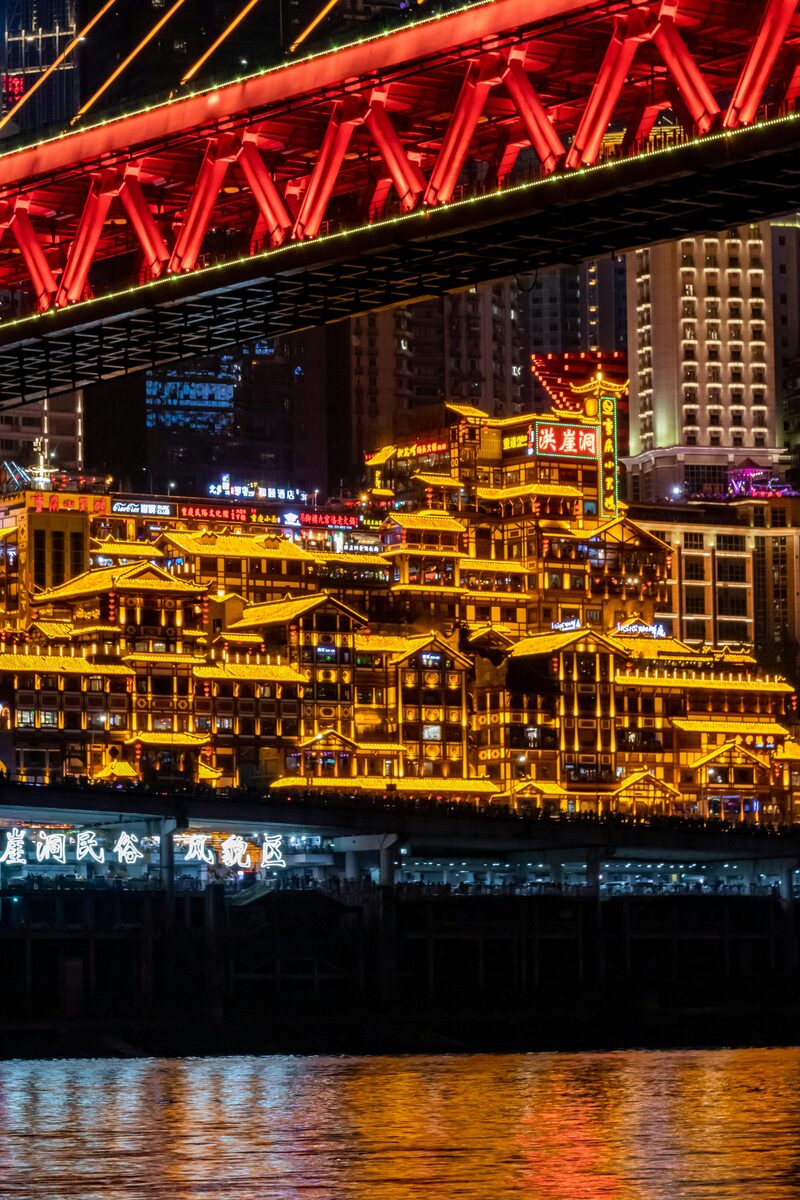
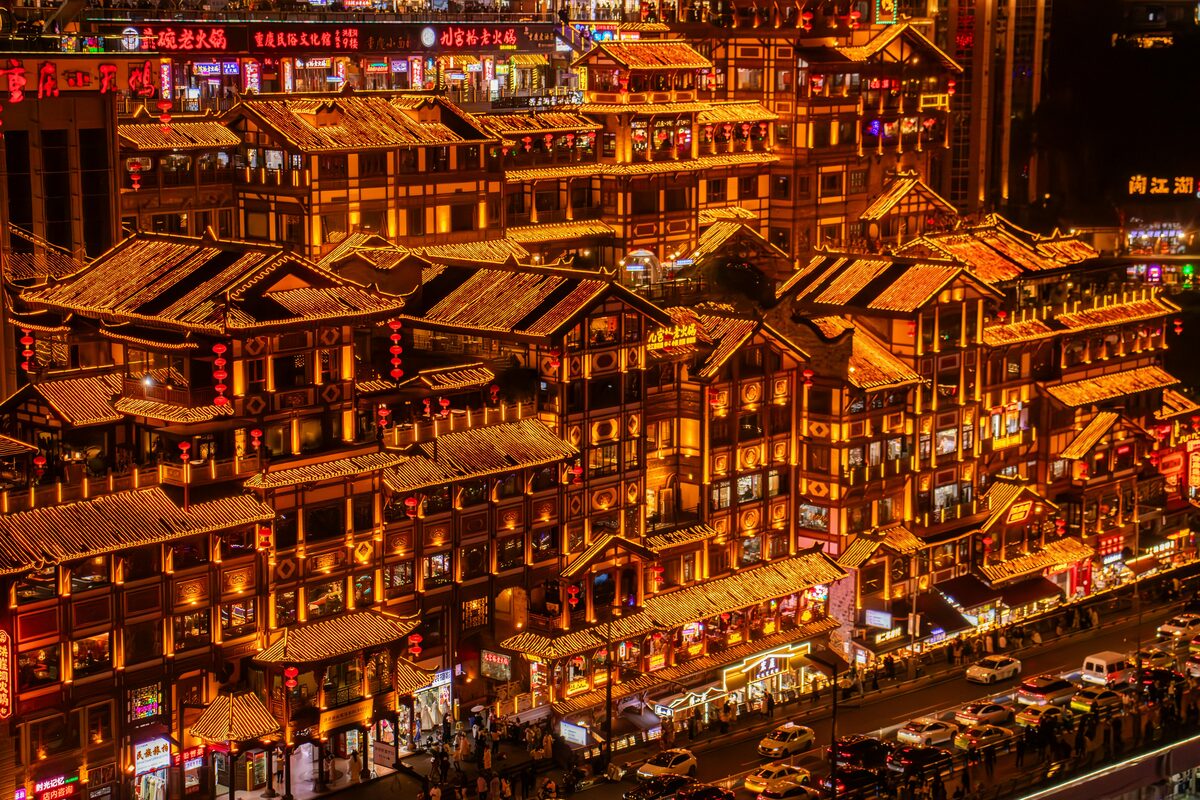
Hongyadong is Chongqing's most-photographed landmark — but the famous shot is made from the far bank, on the Qiansimen Bridge walkway, not from inside. Stand inside the complex and you're in the photo, not behind it (full photo directions below).
It is not a historical building: the 11-story complex was built in 2005–2006, styled on traditional Bayu stilt-house architecture (吊脚楼). The name keeps a Ming-dynasty Hong-family cliff fort that once stood here; the buildings are modern replicas — unlike Ciqikou, which is genuinely preserved. Lit up at night it reads like the bathhouse in Spirited Away — a comparison Hongyadong leans into itself. Say it [hong-yah-dong]; 洪崖洞 means “Hong Cliff Cave”, and the “cave” is a historical misnomer for a cliff fort (pronunciation and name history are in the FAQ).
Where Hongyadong sits in Chongqing
18 km across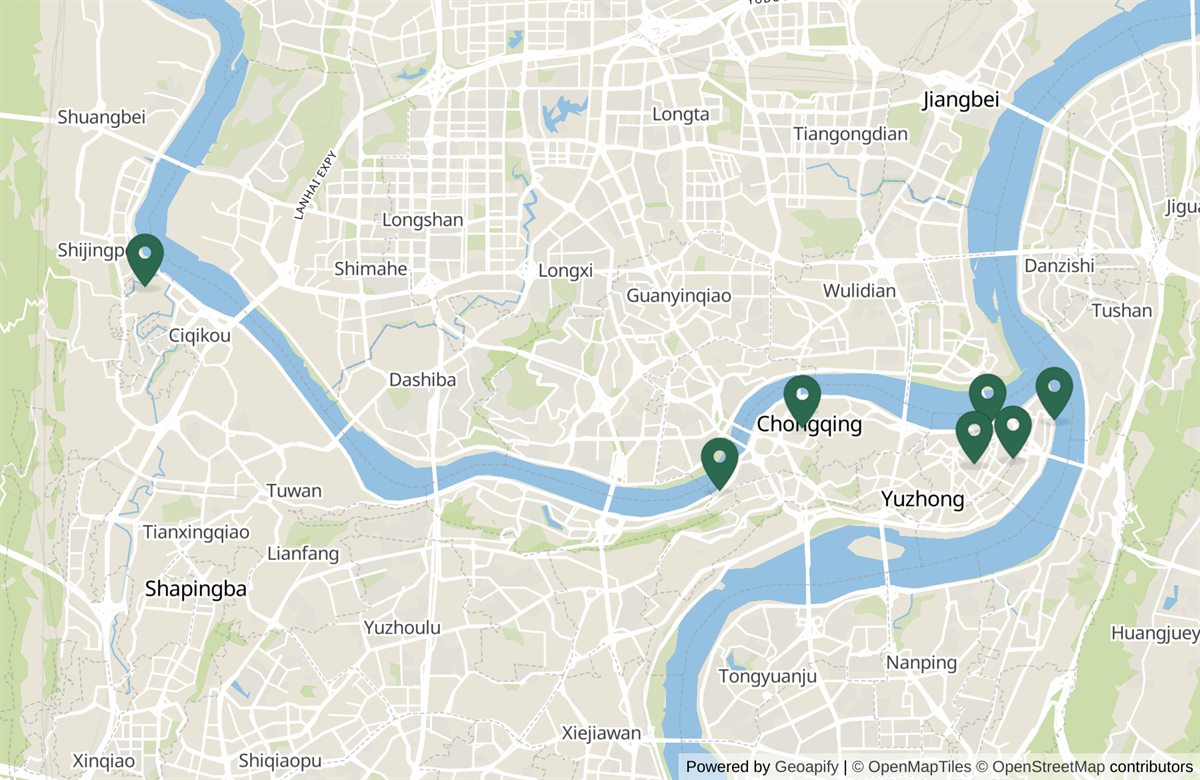 Ciqikou Ancient TownCiqikouLizibaHongyadongThree Gorges Museum3 Gorges Museum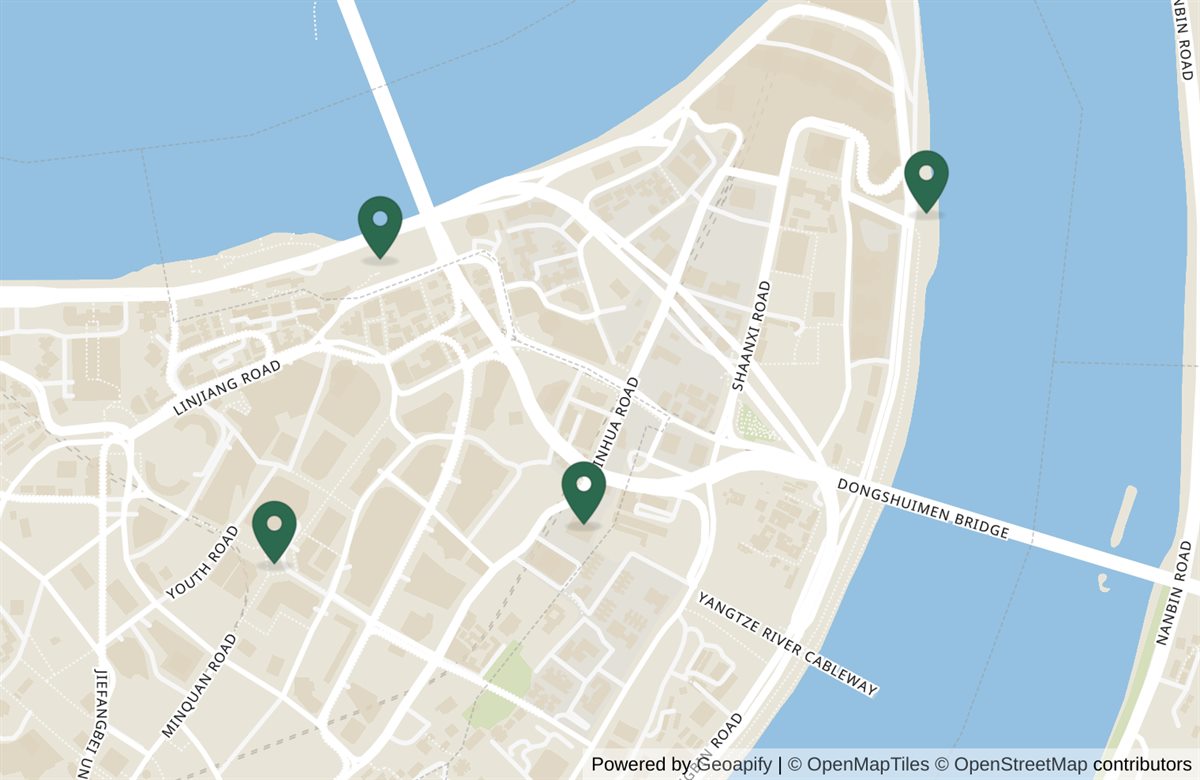
Where to stand — the photo spots, mapped
The canonical frame is from mid-span on Qiansimen Bridge (千厮门大桥): the whole 11-story facade fills the frame across the Jialing, with the bridge's own lit cables curving into the foreground. Use a wide lens — 24 mm equivalent on full-frame, ultrawide on a phone; night mode handles the dynamic range, no tripod needed. Everything else is a variation, and all of it happens in the 500 m of river below:
| Spot | How to reach it | What you get |
|---|---|---|
| Mid-bridge (the classic) | Line 6 to Grand Theatre (大剧院), exit 3, then a short walk onto the north end of the deck. | The postcard: full facade + neon cables. Crowded from light-on; on peak evenings police run one-way flow, so be on the deck ~30 min before light-on. |
| Reflection pool 天空之镜 | Grand Theatre exit 4; the shallow pool travellers nickname the “sky mirror” sits just below, toward the bank. | Symmetric reflection frame of the lit complex — the angle most tourists never find. |
| Pebble beach 江北嘴江滩公园 | Walk down through Jiangbeizui Riverside Park to the stony bank (about 15 min from the complex over the bridge). | Low, wide frame with river reflections and far fewer people. The stones are loose — grippy shoes, no heels. |
| Daijiaxiang walkway 戴家巷崖壁步道 | From the complex's top level, ~400 m / 5 min west along the cliff (also reachable from Linjiangmen, Line 2). | Quiet side-on frame of the stacked roofs from the cliff path — not the postcard, but atmospheric and rarely crowded. |
| Across the road street level | From the floor-1 riverside exit, cross Jiabin Rd by the pedestrian underpass — don't jaywalk it at night. | The classic upward angle from the pavement edge, close enough to fill the sky with lit eaves. |
Works at the south bridgehead · since Dec 2025
The Hongyadong end of Qiansimen Bridge is currently a construction site: a six-storey outdoor escalator is being built to link the Cangbai Rd level, the bridge deck and the riverside path, and travellers report hoardings narrowing the south walkway approach. Until it opens, get onto the bridge from the Jiangbei side (Grand Theatre, exit 3) — that end is unaffected — and treat the south approach as slow. When the escalator opens, the lift-queue advice on this page gets much better; until then, assume it is still a building site.
On the National Day Golden Week peak (5 Oct 2024), the south end of the bridge hit cap density — police enforced one-way pedestrian flow and the queue to step onto the deck from the Hongyadong side backed up twenty minutes, while the Jiangbei end stayed walkable. The pattern now repeats on ordinary busy evenings at a smaller scale. If you're visiting during any Golden Week, treat the Line 6 / Jiangbei approach as the only approach.
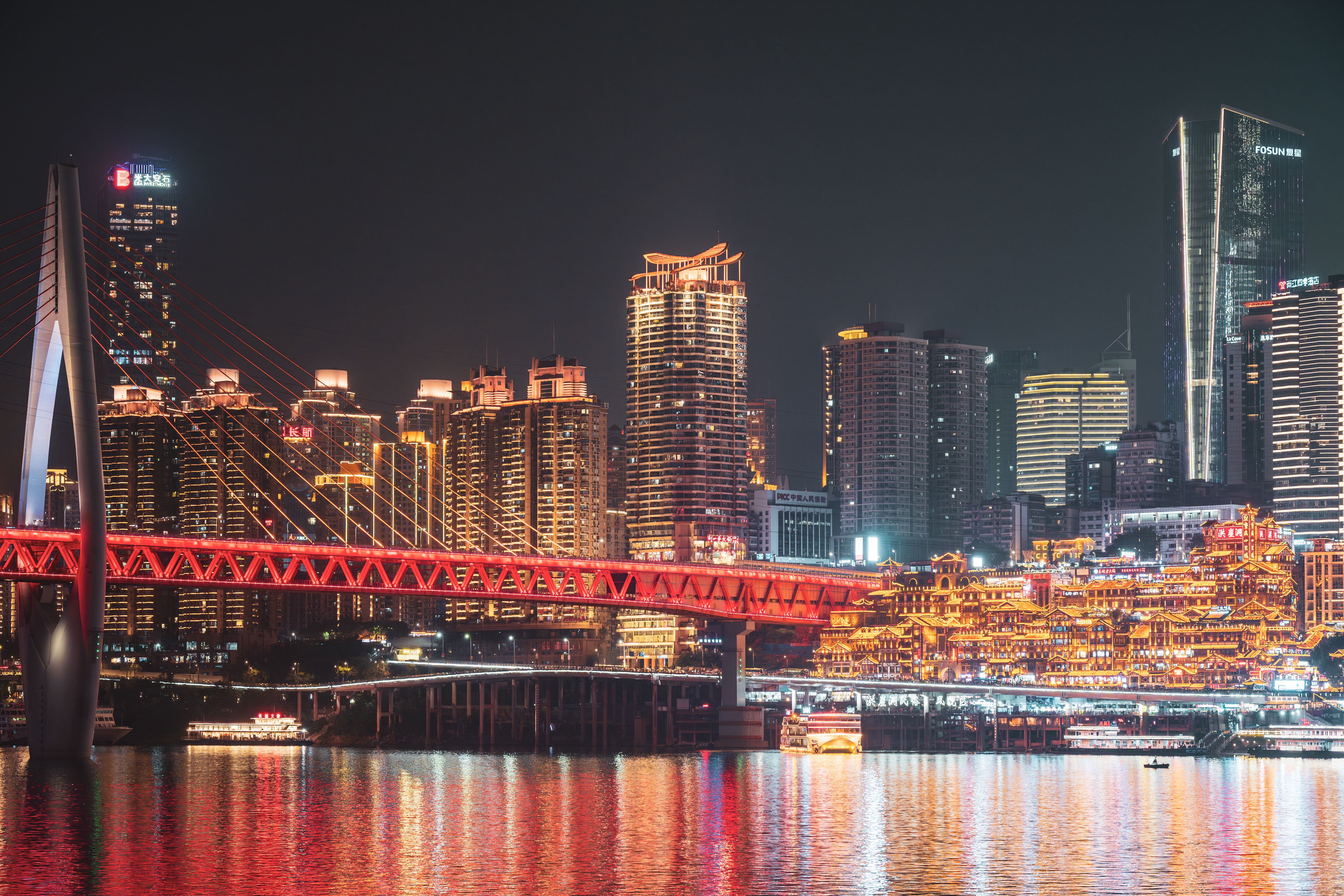
When the lights come on (and go off)
The light-on time is seasonal, set by the operator and moved with sunset — the 2026 notices ran 18:00–18:30 in winter, ~19:30 in spring and autumn, and 20:00 in summer (the summer schedule took effect 4 June 2026). Switch-off is 23:00 on the summer schedule; travellers report the winter switch-off runs earlier, around 22:30, and on major holidays the lights stay on later. We re-check that schedule here, so work from the bands above rather than from the operator’s WeChat accounts, which post in Chinese only. Best window: the first 30 minutes after light-on, while the sky still holds blue — photographers call it the blue hour, and it is the whole difference between the postcard and a black sky. One more clock to know: Qiansimen Bridge's own lights die before the building's — shoot the bridge-and-complex frame first, not last.
Watch the AQI. On 2026-01-15 Jiangbei recorded AQI 187, and haze at that level drains the contrast and colour out of every frame. Winter typically runs 75–110 on shoulder days, spiking past 150 on inversions; for the clearest air, prefer fall (Sep–Nov) or post-rain spring (Apr–May).
How to get there — arrive at the top
Hongyadong hangs on the cliff between two streets: Cangbai Road along its roof (the floor-11 entrance) and Jiabin Road at the river (floor 1). Arrive at the top and the whole building is downhill; arrive at the bottom and it is stairs all the way up. Every sensible approach therefore ends at Cangbai Road:
| From | How | Time · cost |
|---|---|---|
| Jiefangbei downtown CBD | Walk — 800 m downhill through the pedestrian streets to Cangbai Road. | ~10 min · free |
| Anywhere by metro | Line 1 or 6 to Xiaoshizi (小什字), exit 9, then a level ~450 m walk along Cangbai Road to the top entrance. (Line 2 to Linjiangmen also reaches the same level.) | ~6 min walk · ¥2–5 |
| For the photo first | Line 6 to Grand Theatre (大剧院), exit 3 for the bridge deck, exit 4 for the reflection pool — shoot from Jiangbei, then cross the bridge to the complex. | ~5 min walk · ¥2–5 |
| Jiangbei Airport CKG | Line 10 from T3 to Hongtudi (红土地), transfer to Line 6 to Xiaoshizi, exit 9. Tap in with Alipay / WeChat Pay. | ~60 min · ¥7 |
| Chongqing North HSR station | Same interchange as the airport: Line 10 south to Hongtudi (红土地), then Line 6. Heavy bags → a 20-min Didi avoids the transfer. | ~40 min · ¥5 |
In a taxi, ask for this
洪崖洞 沧白路入口
沧白路 88 号
Naming the Cangbai Road entrance matters: the complex's official address is on the riverside road at the bottom (嘉陵江滨江路 88 号), and a driver navigating there drops you at the foot of the building — all stairs, and gridlocked in the evening. The top address puts you at the level entrance instead.
The full CKG airport guide covers T2 vs T3 metro entry points and the cheaper Line 10 alternative if your hotel is on the Jiangbei side. The interactive Chongqing metro map has all 12 lines, tourist-friendliness scores, and a persona-aware view highlighting the routes around Hongyadong, Liziba and Ciqikou.
Inside: walk down, not up — and the lift truth
The interior is an 8D-vertical maze, not a museum, and the one rule that matters is enter at floor 11, leave at floor 1. From the Cangbai Road entrance the whole building is a descent — roughly 10 minutes of stairs and ramps if you don't stop, an hour if you drift. Done the other way it is a climb the height of a 19-story hill. The City Balcony (城市阳台), the free open terrace at floor 11, is both the natural starting point and the best inside-looking-out view of the river and bridge.
The lifts are the chokepoint. Between about 20:00 and 21:30, travellers report queues of an hour, sometimes two, for the exterior lifts. Walking down bypasses the whole problem. If you need a lift anyway, there is a quieter interior lift bank past the shops at the floor-11 entrance, dropping to the basement and connecting through the garage corridor to the riverside — the exact free route the “fast-track” touts outside charge ¥10 to walk you through. After about 21:30–22:00 the coach groups leave and everything is walk-on; the complex stays open (and lit, in summer) until 23:00.
Worth your time on the way down
- City Balcony (城市阳台), floor 11 — the free terrace; river, bridge and Jiangbei skyline from above.
- The floor-4 open corridor — the close-up frame of stacked eaves and lanterns that works even in daylight.
- 重逢1980, floor 5 — a 1980s-Chongqing retro quarter: period shopfronts, arcade machines, an old tram. The outer streets are free to wander; the inner zone with its holographic music show is ticketed (~¥39).
- 梦游巴渝十二景, floor 6 — a ticketed light-and-projection art space on the classic “twelve scenes of Ba-Yu”; traveller reports also describe newer immersive halls on the floors above. Optional — good on a rainy day, skippable on a clear one.
Skip
- The mid-floor food courts — tourist-priced; Ciqikou has the same Mahua (麻花) cheaper, and the Bayi Road snack street does the food better at half the price.
- The interchangeable souvenir strips — traveller reviews are blunt: same goods, floor after floor.
If you want a river-view table inside, the upper-floor hot-pot restaurants have window seats facing the bridge — with a real view tax. The move travellers swear by: sit down around 17:00, before the queues form, and the lights come on while you eat. On the block across Cangbai Road, small hot-pot places (traveller favourite: 丁孃孃, 沧白路 48 号) serve the same view from the other side at roughly half the price.
The Yuzhong-evening route — pairing it with everything else
Most foreigners doing 2–3 days in Chongqing want to fit Hongyadong, Liziba (the monorail-through-a-building) and at least one hot pot meal into the same evening. The city map at the top of this page shows why it works: Liziba is a short Line 2 ride west, and everything else is walkable. The key is eating before light-on, not after — and remembering the whole timetable floats with the season:
| Time | Step | Detail |
|---|---|---|
| Late afternoon | Liziba Station | Line 2 to Liziba (李子坝), exit 2, to the street-level viewing platform. The monorail passes through floors 6–8 of a 19-story residential building every 3–8 min. Stay for 3–4 passes. Free, ~25 min. |
| ~1h before light-on | Hot pot dinner | Eat before Hongyadong, not after, so you're in position before light-on rather than queuing at peak. The Bayi Lu area or the Jiefangbei pedestrian zone both work, 10 min from the river. |
| At light-on 20:00 summer 18:00–18:30 winter | Qiansimen Bridge | Be mid-span as the lights come up — from dinner, ride Line 6 one stop from Xiaoshizi to Grand Theatre (大剧院), exit 3, and walk onto the deck from the Jiangbei end while the south bridgehead works run. The bridge's own lights go off before the building's, so shoot this frame first. |
| After the shot | Walk the complex | Cross to the Cangbai Rd top entrance and walk the 11 floors down to the riverside — City Balcony first, floor-4 corridor on the way. |
| By 11pm | Head back | The complex clears at 23:00 and crowds surge at closing — for a taxi, walk up to Jiefangbei first. (Energy left? The Mountain City Trail / 山城步道 is a short ride or a 20-minute walk south-west.) |
What doesn't work: showing up at 8:30pm after a late dinner, going inside, wandering an hour trying to find the photo angle, leaving without ever crossing Qiansimen Bridge, and assuming Hongyadong was overrated. The building itself is fine; the experience the photos promised is on the other side of the river, and you have to know to go look for it.
Book a Chongqing day tour — 3 platforms compared
Sorted by format, not commission · all take a foreign card & English checkout
- GetYourGuide★ Editor’s pick
Chongqing Deep Explore — Private Car Service (incl. meals)
★ 4.9(118 reviews)Private carFull day · mealsFree cancellation
Verified Aug 2026 · re-checked quarterly
Book on GetYourGuide$189from · per person - Viator
Chongqing 8D Mountain-City Full-Day Join-In Tour
★ 4.8(43 reviews)Group join-in7–8 hoursPickupFree cancellation
Verified Aug 2026 · option pre-selected on landing
Book on Viator$49from · per person 
Chongqing 10-Hour Customized Tour (optional English guide)
Custom privateBuild your own route10 hours
Verified Aug 2026 · re-checked quarterly
Book on Trip.comCustomprice varies by configuration
Editor’s note: private car (GetYourGuide) for comfort and meals · group join-in (Viator) for value · fully custom (Trip.com) to pick the stops. We sort by format, not commission.
The pier below: night cruise yes, cheap ferry no
Hongyadong has its own cruise pier (洪崖洞码头) on the riverside below the complex, and the Two Rivers night cruise (两江夜游) boarding there is the one vantage nothing on land gives: mid-river, with Hongyadong, Qiansimen Bridge, the Grand Theatre and the Raffles City skyline in a single moving frame. Fares from this pier start around ¥138; the sailings worth having leave roughly 19:30–20:30, after full light-up. Boarding is real-name — bring your passport — and book online ahead rather than from street sellers, whose “cheap cruise” tickets are typically single-river standing room on boats too late to catch the full lighting. Check the departure pier on your ticket: Hongyadong pier and the Chaotianmen piers (朝天门 7 号 / 9 号码头) are over a kilometre apart, and mixing them up at 7:45pm is how people miss boats.
One correction to a tip circulating in travel notes: the ¥15 两江小渡 public ferry from this bank is a daytime service — last sailings around 17:30–18:00, before the lights come on. It's a lovely cheap river crossing in daylight; it is not a budget night-cruise substitute. Full ship-by-ship detail, including day and sunset sailings, is in our Yangtze River cruise guide.
What's walkable from Hongyadong
Hongyadong isn't only the facade — four things sit within a ten-minute walk and pair naturally with the visit (distances measured, not guessed):
- Daijiaxiang cliff walkway (戴家巷崖壁步道). ~400 m / 5 min west along the cliff. Old stilt-house lanes rebuilt into a quiet cliff-face path — the side-on photo angle, plus a genuinely pleasant walk between the two street levels.
- Luohan Temple (罗汉寺). ~500 m / 7 min, right by Xiaoshizi station. A working thousand-year-old temple boxed in by skyscrapers — the “ancient-meets-8D” frame, and nearly empty in the mornings while the crowds do the malls. Small entry fee.
- Kuixing Tower skybridge (魁星楼). ~700 m / 9 min west (or 220 m from Linjiangmen station). The famous proof that Chongqing has no ground floor: a plaza where the 22nd storey opens onto the street, with the suspended walkway from the film Better Days. Free, and five minutes from Jiefangbei.
- Jiefangbei (解放碑) + Bayi Road (八一好吃街). ~800 m / 10 min uphill. The downtown plaza and the snack street where the hot-pot half of the evening happens — see the evening route above.
Further afield on the same peninsula: the Jiefangbei & Mountain City Trail guide covers the walking layer, and Ciqikou is the one classic sight that needs a metro ride (30 min, Line 1).
The Yangtze Cable Car detour — when it's worth it
The Yangtze Cable Car (长江索道, Changjiang Suodao) crosses the Yangtze near Jiefangbei — a ~4½-minute ride, ¥30 one-way / ¥50 return. It runs 8am–10pm in summer (Mar–Nov) and 8am–9pm in winter (holidays 07:30–22:30), but admission stops about 30 minutes before closing, which is the number that bites if you are adding it after a Hongyadong sunset. It was a working 1980s commuter line; today it is mostly a tourist crossing. The north station is on Xinhua Road by Xiaoshizi (Line 1/6, exit 5B); the south station is at Shangxinjie (Line 6, exit 2, then 634 m on foot).
Two things decide whether to add it. First, check it is running — it shuts a full day roughly once a month for maintenance, usually a Tuesday or Wednesday, announced only two to three days ahead. Second, the queue: an ordinary weekday is often little or nothing, while weekends and holidays run an hour and up. Buy the one-way, not the return — the return leg makes you take a fresh queue number at the far station, so ¥50 buys the same wait twice. If the wait is under 30 minutes it is a fun add; over 45, skip it — you are trading a Hongyadong sunset hour for a queue. The cable car is also visible (and arguably more photogenic) from Hongyadong's upper floors. Full detail in the Yangtze Cable Car guide.
Scams to know about
Chongqing is safe — low petty crime, routine late-night walks. A few tourist-targeted patterns around Hongyadong / Jiefangbei worth knowing (Yuzhong authorities ran an enforcement sweep in mid-2025, but holidays still draw them):
- “Fast-track” touts (~¥10): there is no paid entry, queue-skip or ticket of any kind here. The route they sell is the free interior lift described above, or the free Daijiaxiang entrance. Wave them off.
- Fake staff & paid “guides”: people in vest/uniform lookalikes offer to lead you in for a fee. Entry is free and signposted; ask any passer-by for nothing.
- Paid photos, the price ladder: the quoted “¥68 for 10 shots” becomes ~¥20 per usable photo at selection, or a pushed ¥200 package, with reports of withheld originals. Bronze-statue performers pose with you, then ask ¥20. Phones do it free — swap with another tourist. In a real dispute, 12315 is the consumer hotline and police are posted nearby at peak.
- Dyed “golden plum” fruit (金西梅, ¥30+/jin) — locals call it 哈儿果, “fool's fruit”: dyed, flavoured unripe fruit. Skip.
- Night motorbike “taxis”: ¥15 for a few hundred metres, no meter, no helmet. Use DiDi, or walk up to Jiefangbei where cars can actually stop.
Best season for the night photograph
The lights run year-round and Hongyadong is open every day, but for the canonical photograph, season matters more than most foreign travel guides admit. The interaction of AQI, sunset time, humidity and crowd density makes some months substantially better:
| Season | Photo quality | Crowd | Notes |
|---|---|---|---|
| Spring Mar–May | Excellent | Moderate | Post-rain air clarity. May 1–5 Golden Week = avoid. |
| Summer Jun–Aug | Workable | Heavy | Heat 35–40°C; lights on 20:00 (late dusk). School holidays. |
| Autumn Sep–Nov | Peak | Heavy Oct 1–7, else moderate | Best air clarity of the year. Skip Oct 1–7 Golden Week. |
| Winter Dec–Feb | Variable (AQI) | Low (except CNY) | Inversion days drop visibility; earliest light-on (18:00–18:30) — the easy season for kids and early nights. |
For best-case weather and crowds, target mid-September to mid-November (skipping Oct 1–7), or April–May (skipping May 1–5). For best-case pricing on flights and hotels, mid-November to mid-January excluding Spring Festival is the honest budget window — colder, occasionally hazy, but the night-light contrast on clear days is the same. See our best-time-to-visit-China checker for the full month-by-region breakdown.
Where to stay nearby
The Yuzhong Peninsula puts Hongyadong and the rest of the 8D city core on foot — that's where most first-time foreign visitors should base. Across the Jialing in Jiangbei is quieter, newer luxury with sky-bar views back at the peninsula and a head start on the Line 6 photo approach. The sensible call for a first China trip is a mainland mid-range chain in the downtown core.
Frequently asked questions
How do you pronounce Hongyadong?
[hong-yah-dong] — three syllables, falling-rising-flat tones in Mandarin but you'll be understood without them. The name 洪崖洞 literally means 'Hong Cliff Cave' — 'Hong' (洪) is the family name of the original Ming-dynasty fortification commander, 'cliff' (崖) refers to the actual cliff face it's built into, and 'cave' (洞) is a historical misnomer (it was a cliff hideout system, not a true cave). In tourist English you'll also see 'Hongya Cave' — that's a phonetic compromise. Locals just say 洪崖洞 or shorten it to 'Hongya' (洪崖) in conversation.
What time do the lights come on at Hongyadong — and when do they go off?
The light-on time is seasonal — the operator moves it with sunset and posts the current schedule on the 洪崖洞 / 渝中文旅 WeChat accounts. The 2026 notices ran 18:00–18:30 in winter, around 19:30 in spring and autumn, and 20:00 in summer (the summer schedule took effect 4 June 2026). Switch-off is 23:00 on the summer schedule, and travellers report the winter switch-off runs earlier, around 22:30; on major holidays the lights stay on later than usual. The window most worth showing up for is the first 30 minutes after light-on, while the sky still holds blue. Note the lights on Qiansimen Bridge itself die earlier than the building's — roughly half an hour to ninety minutes before, depending on season — so shoot the bridge-and-complex frame first, not last.
What's the best photo spot for Hongyadong?
Qiansimen Bridge (千厮门大桥) pedestrian deck, mid-span, approached from the Jiangbei (north) side — NOT from inside the complex. From inside Hongyadong you are inside the photo subject, so you cannot photograph the building you are standing in. Take Line 6 to Grand Theatre (大剧院): exit 3 puts you by the bridge's north end, exit 4 by the riverside reflection pool travellers nickname 天空之镜 ('sky mirror') — a symmetric-reflection frame most tourists never find. The pebble beach in Jiangbeizui Riverside Park (江北嘴江滩公园) gives a low, wide frame with river reflections — wear grippy shoes, the stones are genuinely loose. The Daijiaxiang cliff walkway (戴家巷崖壁步道), five minutes west of the complex, gives a quieter side-on frame of the stacked roofs. Use a wide lens (24 mm equivalent or wider); phone night mode handles it — no tripod needed.
Is there an entry fee for Hongyadong, and do I need to book?
No entry fee, ever. On an ordinary weekday there is no booking either — you walk in. At weekends and on public holidays the scenic area switches to free real-name advance booking (the 洪崖洞 WeChat mini-programme, also bookable through Meituan), with entry by ID scan or QR code, and once the daily cap is reached both the booking system and the gate close. The flow is built around a Chinese ID card and it is unconfirmed whether the mini-programme accepts a passport — but a staffed manual lane operates at the entrance for anyone outside the smartphone flow, and travellers report staff register visitors there against an ID document; with a passport, that lane is the one to ask for. Two useful outs: photographing the exterior from the bridge or the far bank needs no booking at all, and the complex is open 09:00–23:00 daily (shops start closing ~22:00–22:30).
How do I get to Hongyadong from downtown Chongqing or the airport?
From Jiefangbei: walk — about 10 minutes, 800 m, downhill. From elsewhere by metro: Line 1 or Line 6 to Xiaoshizi (小什字), exit 9, then a level 6-minute walk along Cangbai Road to the TOP (floor-11) entrance — this is the painless way in, because you then walk down through the building rather than up. Line 2 to Linjiangmen (临江门) also works, a few minutes' walk to the same top level. Do not aim for the riverside entrance at the bottom (Jiabin Rd) on arrival — that way in is all stairs and ramps upward, and taxis dropping there hit heavy evening traffic. For the Qiansimen Bridge photo spot, take Line 6 to Grand Theatre (大剧院), exits 3 or 4. From Chongqing Jiangbei Airport (CKG): Line 10 from T3 to Hongtudi (红土地), transfer to Line 6 to Xiaoshizi — about 60 minutes, ¥7. From Chongqing North HSR station: Line 10 to Hongtudi, transfer to Line 6 — about 40 minutes, ¥5.
What should I actually do inside Hongyadong, and what should I skip?
Walk it top-down: enter at floor 11 from Cangbai Road, drift down to the riverside at floor 1, and treat the descent as the attraction — the stacked stilt-house architecture is the experience. Free highlights on the way: the City Balcony (城市阳台) open terrace on floor 11 for the river view, the floor-4 open-air corridor for close-ups of the stacked eaves, and the outer streets of 重逢1980 on floor 5 — a 1980s-Chongqing retro quarter with period shopfronts and arcade machines (its inner zone, with a holographic music show, is separately ticketed, around ¥39). Floor 6 has 梦游巴渝十二景, a ticketed light-and-projection art space. Skip: the food courts on the middle floors (tourist-priced versions of what Bayi Road does better) and the souvenir strips — traveller reports are blunt that the shops are interchangeable. If you want a river-view dinner inside, window tables at the upper-floor hot-pot restaurants exist but carry a view tax — sit down by 17:00 to get one without queuing, and the lights come on mid-meal.
How bad are the lift queues, and is there a way around them?
The vertical lifts are the complex's chokepoint: between about 20:00 and 21:30 travellers report queues of an hour, sometimes two. Three ways around it. First, walk DOWN, not up — enter at the top (floor 11) and descend by stairs and ramps; going down takes about 10 minutes and is far less punishing than the same stairs upward. Second, use the interior lift bank: past the shops at the floor-11 entrance there is a quieter internal lift that drops to the basement level, connecting through the garage/boarding corridor to the floor-1 riverside — the 'fast track' touts sell for ¥10 is exactly this free route. Third, go late: after about 21:30–22:00 the coach groups leave and the lifts are walk-on. If you must ride up from floor 1, travellers point to lift #2 by the garage as the air-conditioned one.
How long do I need at Hongyadong?
60–90 minutes covers the classic visit: 20–30 minutes on the Qiansimen Bridge side for the photograph, then 30–40 minutes walking the eleven floors top-down. Add roughly an hour if you're eating inside, and one to two hours more if you buy into the ticketed floors (重逢1980's inner zone, the floor-6 light show). If you're combining it with the standard Yuzhong evening — Liziba monorail late afternoon, hot pot, then Hongyadong at light-on — the complex slots in from about 18:00 in winter and about 20:00 in summer, because the whole timetable shifts with the seasonal light-on time.
Is the Yangtze Cable Car worth doing on the same evening as Hongyadong?
Conditionally yes. The Yangtze Cable Car (长江索道, Changjiang Suodao) is a 1,166 m cable car across the Yangtze near Jiefangbei — a ~4½-minute crossing, ¥30 one-way / ¥50 return, running 8am–10pm in summer and 8am–9pm in winter (holidays 07:30–22:30), with admission stopping about 30 minutes before closing. Two catches. It shuts a full day roughly once a month for maintenance, usually a Tuesday or Wednesday and announced only two to three days ahead, so check before you build an evening around it. And peak queues run an hour and up on weekends and holidays, though an ordinary weekday is often little or nothing. Buy the one-way rather than the ¥50 return: the return leg makes you take a fresh queue number at the far station, so it is the same wait twice. A foreign passport works at the visitor-centre window and the self-service machines. If the queue is under 30 minutes when you walk up it's a fun add; over 45 minutes, skip it and spend the time on the bridge instead. The cable car is also visible from Hongyadong's upper floors.
Is the night cruise from Hongyadong pier worth it — and what about the cheap ferry?
They are different products, and the cheap one cannot see the lights. The Two Rivers night cruise (两江夜游) boards at Hongyadong's own pier on the riverside below the complex (from ¥138 at this pier) and gives the one angle nothing on land can: mid-river, with Hongyadong, Qiansimen Bridge, the Grand Theatre and the Raffles City skyline in a single moving frame. The sailings worth having leave roughly 19:30–20:30, after full light-up; boarding is real-name, so bring your passport and book ahead online rather than from anyone selling 'cheap cruise tickets' on the street (those are typically single-river standing tickets, often too late to catch the full lighting). Check the departure pier when you book — Hongyadong pier and the Chaotianmen piers (7/9) are over a kilometre apart. The ¥15 两江小渡 public ferry that crosses from the same bank is a daytime service — last sailings 17:30–18:00, before the lights come on — so treat it as a cheap daytime river crossing, not a night-cruise substitute. Full cruise detail: our Yangtze River cruise guide.
Are there any scams I should watch out for around Hongyadong?
Four patterns, none dangerous, all reliant on confusion. (1) Paid 'fast-track' or 'guide' offers (~¥10): there is no paid entry of any kind here — the touts walk you to a free lift or the free Daijiaxiang entrance. Decline and walk on. (2) Roadside 'professional photographers': the quoted ¥68-for-10-shots turns into per-photo charges (~¥20) or a pushed ¥200 package at selection time, with reports of withheld originals. Use your own phone, or swap-photo with another tourist; in a dispute, 12315 is the consumer hotline and uniformed 城管/police are nearby. (3) Costumed characters and 'bronze men' pose with you first and demand ¥20 after — decline before the photo. (4) The fluorescent candied fruit sold as 金西梅 (locals call it 哈儿果 — 'fool's fruit') is dyed unripe fruit at ¥30+/jin; skip it. At night, skip the motorbike 'taxis' outside too — a few hundred metres for ¥15, no meter, no helmet; use DiDi.
Sources
Checked August 2026 · Written from our own first-hand travel in China.