Key takeaways
- It is a 6–8 hour day trip from Chengdu — about 50 min by train (¥27–54) plus a 25-min taxi to the scenic area.
- The 71m Tang Buddha (713–803 CE) is the world’s tallest pre-modern stone Buddha; UNESCO-listed in 1996.
- Two ways to see it: the river boat (¥70) for the iconic full-scale view, or the cliff descent inside the ¥80 hill ticket for face-level close-ups. The boat is a separate ticket, so you can do it without the ¥80.
- The descent queue runs 1–2h in peak season — arrive at opening (7:30am) or just do the boat.
- The Buddha faces west, so the face is in shade all morning and lit from about 1pm — come early for the queue, mid-afternoon for the light.
- With two days, pair it with Mt Emei for a double-UNESCO; with one day, do Leshan alone.
Who should add Leshan to a Chengdu trip
Worth it for: travelers with a full day to spare out of Chengdu, Buddhist-art and UNESCO enthusiasts, photographers (the river-confluence framing is unique), and anyone planning a 2-day Mt Emei combo — Leshan half-day plus an Emei full day is the strongest UNESCO pairing in Sichuan.
Skip it if: you have only 2–3 days in Chengdu and haven’t yet seen pandas (the Chengdu Research Base is the higher-value half-day — see our panda-viewing guide), you have strict mobility limits and can’t book a boat-only experience, or you’re visiting in a Chinese Golden Week when the stairway queue tops 2 hours.
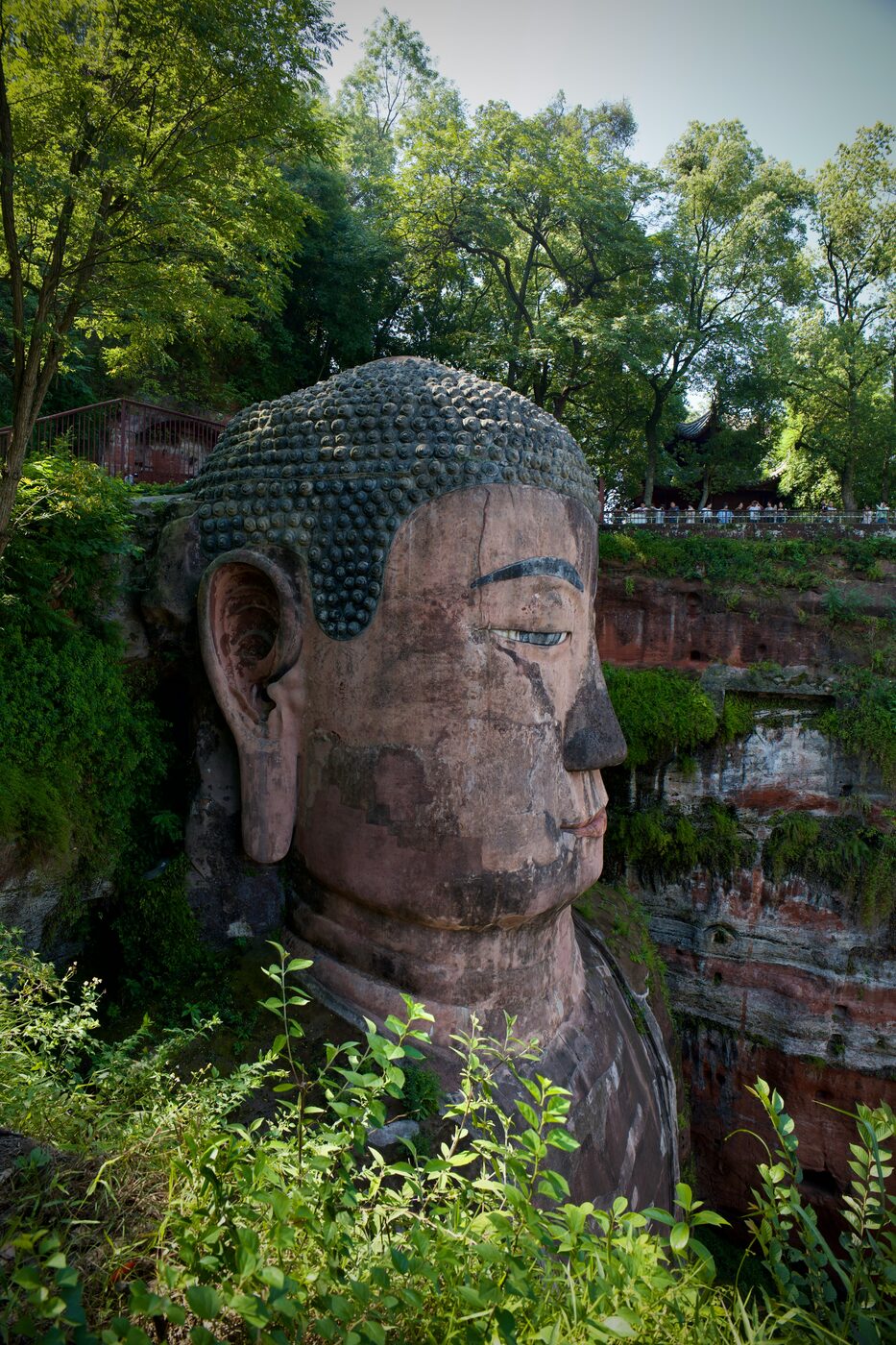
What the Leshan Buddha is (and why scale matters)
The Buddha depicts Maitreya (the Future Buddha) — seated, hands palm-down on the knees, back to the hill and face to the west, across the river confluence toward Mount Emei. Total height is 71m; the head is 14.7m with 1,021 coiled hair-knots, each ear is 7m, and the toes are 8.5m — a small group of adults can sit on a single toenail. It is nearly twice the height of the Statue of Liberty’s figure (without the pedestal) and the largest carved Buddha surviving from the pre-modern world.
Construction started in 713 CE under a monk named Haitong (海通), who proposed it after watching boats capsize where the Min, Dadu and Qingyi rivers meet. The idea was that a Buddha of this scale would calm the waters spiritually — but the displaced sandstone also filled the riverbed and genuinely reduced the eddies, making it a public-works river-engineering job as much as a religious one. Haitong died before it was finished; the project stalled, was revived under prefect Zhangchou Jianqiong, and completed in 803 CE under Wei Gao — a 90-year effort across three generations. UNESCO inscribed Leshan and Mt Emei jointly in 1996 as site ID 779.
Where Leshan sits, relative to Chengdu and Mt Emei
~130 km south of Chengdu~50 min by train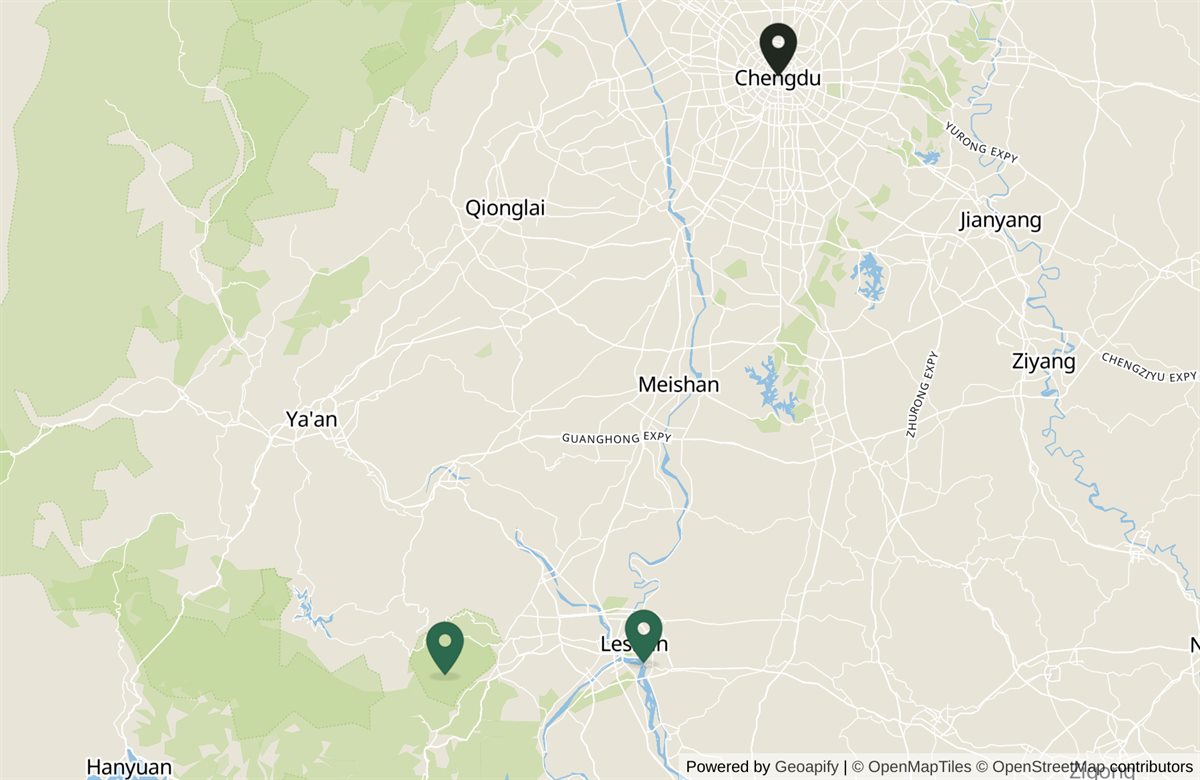 Mount EmeiMt EmeiLeshan Giant BuddhaLeshanChengduChengdu
One detail most visitors miss: a hidden internal drainage system — channels carved into the hair, behind the ears and through the chest folds drain rainwater internally rather than eroding the face. The Tang engineers’ 1,200-year erosion control still works, though sandstone weathering plus modern air pollution have driven ongoing restoration since 2001.
How to get there from Chengdu
Three ways out. For most foreign travelers the high-speed train is the cleanest.
| Option | Cost | Time | Best for |
|---|---|---|---|
| HSR + on-site DIY | ~¥250 total / pp | 6–8 hrs | Independent travelers |
| Trip.com group day tour | USD $60–90 / pp | 10–12 hrs | First-time foreigners |
| Private driver | ¥1,500–2,200 / day | 10–12 hrs | Groups of 3–4 sharing |
HSR (recommended): from Chengdu East Station (成都东站) take a train to Leshan (乐山站) — 46 minutes to 1h05, median 52 minutes, ¥27–54 in 2nd class (the C intercity services are the cheap end;¥27 on the 06:15 and 06:34). There are 54 departures a day, first 06:15, last 21:49. ⚠️ Two of them are not this journey: G8739 (11:00) and G8743 (18:53) reach the same station the long way round via Tianfu airport, Zigong and Yibin — 2h40 and 2h54, at ¥199 and ¥173. Same origin, same destination, roughly four times the fare, so read the duration before you pay.
Use Chengdu East, not Chengdu South. Both stations serve Leshan and you will see Chengdu South named for these trains, but the split is lopsided: Chengdu East has 54 departures from 06:15, Chengdu South has 13 and nothing before 08:04. Chengdu South does hold the single fastest run of the day (41 minutes) and is the right choice if you are staying out at Gao Xin — but an 08:04 departure cannot get you to the scenic area for opening, which is the whole queue strategy below. Book on the 12306 English app up to 15 days ahead for weekend slots. From Leshan station (乐山站) to the scenic area is 9.2 km, about 25 minutes by taxi (roughly ¥25–30) or the K1 tourist bus (¥2, about 40 minutes), which also calls at the Wuyou Temple stop, i.e. the site’s far end rather than its main entrance.
Show the driver this. Drivers at the station will not read “Leshan Giant Buddha”. The scenic area is 乐山大佛景区, and the entrance you want — ticket office, boat ticket hall and the shuttle stop — is the north visitor centre, 乐山大佛文化广场游客中心. Scenic-area enquiries: 0833-2355557.
Group day tour bundles round-trip transport, entry, boat or stairway access and a bilingual guide — zero logistics, but group pace and a fixed lunch stop; operators also sell the 2-day Leshan + Emei combo (~USD $130–180, Emeishan overnight included). A private driver is the only option that beats the train door-to-door, at roughly 2h each way by expressway — worth it for groups of 3–4 splitting the cost, and hard to justify below that.
Boat view vs the cliff stairway — pick one or both
The single decision that shapes your day — two different experiences, not interchangeable. Visitors who only do the stairway often regret missing the boat’s iconic full-scale shot.
| Boat view | Cliff stairway | |
|---|---|---|
| Cost | ¥70 round-trip | ¥80 scenic-area entry |
| Time | ~25–40 min on the water (sources disagree; the hold in front of the Buddha is the constant) | 2–3 hrs incl. queue |
| What you see | Full 71m figure framed against the cliff | Head, ear, shoulder, foot at close range |
| Stairs | None (wheelchair OK) | 200+ steep steps, single-file |
| Queue (peak) | 10–20 min | 1–2 hrs |
| Best for | The signature photo, families, elderly | Close-up detail, art-history fans |
The boat (¥70) leaves from Jiazhoudu dock (嘉洲渡, 160 m from the north visitor centre) for most of the year; boats run at river level far enough out that the whole 71m figure fits one frame, with a photo pause in front of it. This is the shot you’ve seen, and it can’t be got from land. Departures roll rather than run to a timetable, roughly 7:30am–6pm from 1 April to 7 October and 8am–5pm from 8 October to 31 March.
⚠️ It does not stop for the winter — what changes is the pier. From around mid-November the Jiazhoudu dock closes for the low-water season and boarding moves to the Wuyou dock (乌尤码头) at the southern end of the scenic area; the thing that actually suspends is the ¥2 cross-river ferry, which is a different boat doing a different job. If you have read that the river cruise shuts down from November to March, that is a misreading of those pier notices. Sailing times do move with the water level and the weather all year, so the one thing worth checking on the day is which pier your ticket names — the two are 3 km apart.
The cliff descent (¥80) entry covers Lingyun Mountain, the temple complex and the cliff path beside the Buddha. Note the 2026 change: the historic Nine-Bend Plank Path (九曲栈道) is closed, so the descent now runs one-way down the Lingyun Plank Path (凌云栈道) past the head, the 7m ear and the shoulder to the foot — single-file, no turning back, still steep and narrow, the only way to grasp the scale at face level. The queue runs 1–2h in peak season (7–8 月 and Golden Weeks are “terrifying” in travellers’ words) — go at the 7:30 opening or skip it and take the boat.
Doing both? Boat first while you’re fresh, cliff path after lunch. Allow 5–6 hours on-site plus ~2 hours travel each way — a 9–10 hour day.
Tickets, queue strategy & the payment reality
Scenic-area pricing (cross-checked June 2026):
| Ticket | Price | Notes |
|---|---|---|
| Lingyun scenic area cliff descent + temples + tombs | ¥80 | The main entry — includes Lingyun Temple, Wuyou Temple and the Mahaoyaai Han tombs (no separate Wuyou ticket). |
| Boat round-trip | ¥70 | Bought separately from the ¥80 — the iconic full-scale view, and the only half of the site you can do without the hill ticket. Boards at Jiazhoudu; Wuyou dock from around mid-November. |
| Night session 夜游凌云山, peak season only | ¥60 boat | 19:30–22:30 in the peak-season window above, last admission 21:30; no winter night opening is posted. Capped at 3,000 a night, so it is the easiest ticket to get — but the Buddha’s feet are closed after dark. |
| Oriental Buddha Park 东方佛都, optional | ¥80 | A separate, independent attraction next door — you do NOT have to buy it; ignore any tout who claims the big-Buddha ticket “requires” it (see scams below). A combined Leshan–Fodu ticket exists and the scenic area suggests it when daytime stock runs out, but we have not been able to source its price, so don’t take a quoted figure on trust. |
| Scenic-area shuttle 观光车, optional | ¥10 one way ¥15 return | One line, every 10 minutes or when full: north visitor centre ↔ Baxiandu ↔ Buddha north gate (set-down only) ↔ east gate–Huahuwan ↔ Oriental Buddha Park ↔ south gate ↔ south visitor centre. The north gate being set-down only is the part that changes a plan. (A ¥20 figure circulates widely; it belongs to a different scenic area in the same price lists.) |
| Reservation real-name, timed, same-day only | Required | A rolling 7-day window: the seventh day ahead is released at 18:00 each afternoon on the 大佛旅游 mini-program (WeChat or Alipay). There is no longer window, so advice to “book ten days out” for a Golden Week cannot be followed. Weekdays go 2–3 days out; summer and weekends need most of the window, and the 9–11am slots often go within hours of release. Window sales are online leftovers only, capped daily in peak — don’t rely on them. |
| Mt Emei Golden Summit for the 2-day combo | ~¥370 | ¥160 entry (peak) + ¥90 coach + ¥120 cable car RT. |
Real-name tickets and ID
All tickets are real-name (实名制) — your passport number is printed on the ticket and scanned at the gate, so bring your physical passport, not a copy: the automatic gates here do not read foreign passports, and entry is through the staffed lane. Entry is also a timed slot. The official channel is the 大佛旅游 mini-program (searchable in WeChat or Alipay) — Chinese-only, and awkward without a Chinese setup. The simplest English path is to pre-buy on Trip.com against your passport the night before, which also lets you skip the ticket window. The on-site office takes cash, WeChat Pay and Alipay; foreign-card POS is unreliable, so carry ~RMB 500 cash backup.
Queue strategy for the cliff stairway
Arrive at opening time — 7:30am in peak season, 8:00am in low — the only reliable window for a sub-30-minute queue. (Note where that boundary falls: it is 7/8 October, so most of October is low season here, not peak.) By late morning the descent line is already 1–2 hours; by noon in peak season 2+ hours. After 1pm in peak season, just do the boat: admission stops at 4:30pm, two hours before the gates close at 6:30pm, and the descent won’t finish in time. The descent entrance is poorly signed in English — walk through the Lingyun Temple courtyard, past the head-viewing platform, to the river-facing side (wooden archway + queue rope).
Scams to refuse
- Fake “free guides” & “fast-track”. At the gate, the HSR station and roadside, “helpful” people posing as free/charity guides or selling an “inside fast lane” steer you to a high-price incense shop or a shopping stop. For a guide, hire the official one at the visitor centre.
- The “you must buy 东方佛都” line. 东方佛都 is a separate, independent attraction (¥80) — there is no forced bundling. If anyone blocks you or claims the Giant Buddha ticket requires it, refuse and call the complaints line.
- Temple fortune-telling & high-price incense. Inside the temple, a “guide” or “monk” who offers to read your fate / assign a “guardian Buddha” and then pushes a several-hundred-yuan crystal, amulet or “lamp-lighting” blessing is a scam — smile and walk on. Lingyun Temple hands out free incense, so don’t buy the pricey stuff outside.
Book a Leshan day tour or pre-buy ticketsNASDAQ: TCOM
Rather not gamble on the ticket-window line or work out the HSR + taxi yourself? Trip.com lists Leshan day tours from Chengdu (round-trip transport, English guide, boat or stairway entry) and pre-bought scenic-area tickets against your passport — booked in English on a foreign card.
What you'll see — 4 zones inside the scenic area
Three more zones come with the combined ticket. Most tour groups skip the Han tombs — serious history fans shouldn’t.
| Zone | Time | Why it’s worth it |
|---|---|---|
| The Buddha cliff face | 30–45 min | The headline: 71m of carved sandstone, 1,021 hair knots, 7m ears, 8.5m toes. Boat for the wide frame, stairway for close-up chisel detail. |
| Lingyun Temple 凌云寺 | 30–60 min | The Tang temple atop the mountain where the Haitong-era monks lived; mostly Ming-Qing rebuilds, deeply shaded courtyards (good heat escape). ⚠️ It keeps its own hours, 8am–5:30pm — an hour earlier than the scenic area in peak season, so do it before the last of the afternoon, not after. |
| Mahaoyaai cliff tombs 麻浩崖墓 | 20–30 min | Underrated, ~0.5km along the riverside: Han-dynasty (25–220 CE) cliff tombs with carved beds and reliefs — 500 years older than the Buddha. |
| Mahao Park & riverside | 15–30 min | The exit path: pavilions, stelae, and a downstream profile view of the Buddha — a free second angle. |
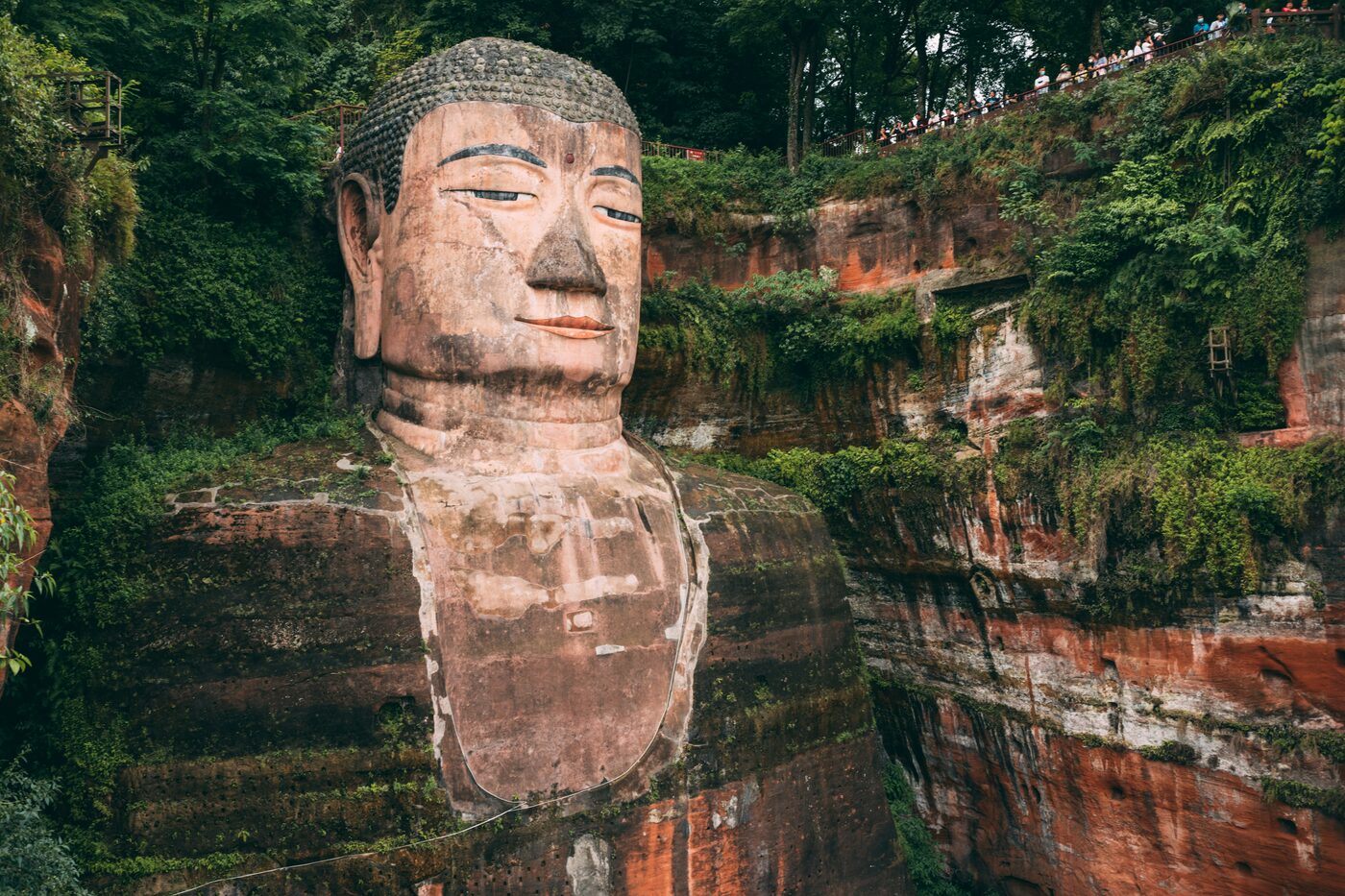
The Mt Emei 2-day double-UNESCO combo
The thing to do with two days. UNESCO listed Leshan and Mt Emei jointly in 1996 (site ID 779) — they are the same protected complex. Mt Emei is a sacred Buddhist mountain (one of China’s four; Golden Summit 3,077m), with cable cars to the summit, mountain monasteries, wild macaques and a sea-of-clouds dawn; Leshan is the riverside capstone. The itinerary that works:
| When | Do |
|---|---|
| Day 1 am | Early train Chengdu East → Leshan (~50 min), taxi to the scenic area for opening. Cliff descent + Lingyun Temple; lunch in Zhanggongqiao. |
| Day 1 pm | Boat tour (¥70); done ~3pm — and this is the right way round for two separate reasons, the queue in the morning and the light in the afternoon, since the Buddha’s face is not in sun until about 1pm. Then the train to Emeishan: 15–23 min, ¥11, about 17 a day — far quicker and cheaper than the ~40-minute taxi usually quoted for this leg. Check into a hotel near Baoguo Temple. |
| Day 2 dawn | 5am, coach to Leidongping, cable car to the Golden Summit (3,077m). Sea-of-clouds dawn ~6:30am if clear. |
| Day 2 am | Descend via cable car + shuttle to Wannian Temple (the key monastery, with a Song-dynasty bronze elephant). |
| Day 2 pm | Lunch at Baoguo Temple, late-afternoon HSR Emeishan → Chengdu (~1h, ¥65–104). |
See our Mt Emei Buddhist Mountain guide for cable-car options, monastery highlights and the wild-macaque wallet/food rules (the trail macaques will steal a bag of chips — there are signs).
If you can only do one day: pick Leshan, not Mt Emei. Emei needs an overnight for the dawn Golden Summit — a same-day round-trip squeezes everything into a flat-light midday window. Leshan works cleanly in 6–8 hours, and you’re back in Chengdu for a hot-pot dinner.
Where to eat — tossed-foot beef & local snacks
Leshan’s food is distinct from Chengdu’s — milder, broth-driven, less numbing málà. The signature 跷脚牛肉 (tossed-foot beef) is named for a 1930s street stall with no chairs, where customers ate with one foot propped on a crossbar. The 张公桥 (Zhanggongqiao) food street, 10 minutes by taxi from the entrance, has 6–8 famous tossed-foot-beef restaurants; 古市香 (Gushixiang) and 周村 (Zhou Cun) are the most foreigner-friendly, with picture menus.
| Dish | Price | What it’s like |
|---|---|---|
| Tossed-foot beef 跷脚牛肉 | ¥25–40 / bowl | Clear-broth boiled beef and offal in a clay pot, ~30-herb stock; the signature dish. |
| Sweet-skin duck 甜皮鸭 | ¥35–55 / half | Sichuan roast duck with a sugar glaze, distinct from the Beijing version. |
| Bo-bo-ji 钵钵鸡 | ¥1 / skewer | Leshan-area cold-skewer-in-broth chicken, now Sichuan-wide; dip skewers in the broth. |
| Tofu pudding 豆腐脑 | ¥6–10 / bowl | Leshan-style with chili oil, peanuts and pickles; a breakfast specialty. |
Skip the restaurants directly inside the scenic-area entrance — prices run 2–3× higher than Zhanggongqiao and the quality is mid-tier tour-bus food.
When to visit (and when to skip)
A year-round low-elevation destination, but the window matters for crowds and light.
| Period | Verdict |
|---|---|
| April–May | Best: 18–25°C, low rain, clear afternoons. Avoid May 1–5. |
| Sep–early Nov | Post-monsoon clarity, cool mornings. Avoid Oct 1–7. Note the site switches to low-season hours on 8 October, so most of the month opens at 8am and closes at 5:30pm. |
| Nov–March | Best off-peak: cool (5–12°C), low crowds, and the lower river brings the boat closer. Two trade-offs: the boat boards at the Wuyou dock rather than Jiazhoudu, and there is no night session outside the 1 Apr–7 Oct window. |
| July–August | Avoid: hot, humid (32–36°C); rainy-season landslides can cancel the Emei combo. |
| Golden Weeks | Avoid: Spring Festival, May 1, Oct 1 — stairway queues 3+ hours, HSR sells out. |
Best time of day — and the queue and the light want opposite things. The figure faces west, and China runs a single time zone set on 120°E while Leshan sits at 103.77°E, so solar noon here falls near 1pm on the clock you are reading. A west-facing surface gets no direct sun before that: the face is in shade all morning and lit from about 1pm until the site closes (computed from the site’s coordinates for the solstices and equinoxes, not measured on the day). Most guidance — including an earlier version of this page — has this the wrong way round.
So do not try to serve both with one arrival time. Come at opening if you want the cliff descent, because that is the only hour the queue is short; put the boat in the early afternoon, when the face is finally lit and the water is where you want to be anyway. Two honest caveats: the figure sits in a deep niche whose own walls cut the window at both ends, and the Sichuan basin is overcast more often than not, so this bounds what is possible rather than promising it. See our best time to visit China guide for the regional picture.
Practical for foreign travelers
What to bring
- Physical passport (real-name ticketing — copies don’t work) and ~RMB 500 cash (foreign-card POS is unreliable).
- Walking shoes — uneven stone stairway plus a ~1km riverside path back.
- Sun hat/umbrella for the exposed boat deck and a light jacket year-round (cool over the water; near-freezing on the Emei summit).
- Water bottle — refill stations inside; bottled water is ¥8–10 inside vs ¥2–3 outside.
Language, payment, connectivity
Signage is reasonably bilingual by domestic-site standards (gates, paths, restrooms); Zhanggongqiao menus are mostly Chinese (a camera-translation app handles it). WeChat Pay and Alipay work everywhere — carry cash as a foreign-card backup; see our Alipay-for-foreigners guide for setup. Mobile data drops at the foot of the Buddha (you’re inside a sandstone bowl) — download the offline map first.
Accessibility
The boat tour is fully wheelchair-accessible (ramp, level deck, no climbs) and gives the better full-scale view anyway; the Lingyun Temple courtyard is reachable via a gentle 10-minute paved path. The cliff stairway is not accessible — narrow steps, no railings on some switchbacks, no alternative route. For mobility needs: boat + temple, skip the stairway.
How Leshan fits a Chengdu trip
Most do Leshan as Day 3–4 of a Chengdu visit — Day 1 city core (Jinli + Wuhou Shrine + hot pot), Day 2 the panda base, Day 3 Leshan; with 5+ days, the 2-day Emei combo on days 3–4. Our things to do in Chengdu guide and the Chengdu city page cover the city portion and accommodation.
Where to stay (base in Chengdu)
Nobody needs a bed in Leshan for the Buddha. What decides where you sleep is the 06:15 train: the whole queue strategy above depends on being at the gate for opening, and that means being at Chengdu East early enough to catch one of the first departures. (The one reason to book outside Chengdu at all is the 2-day Mt Emei pairing — and then the bed belongs at Emeishan, not here.)
Frequently asked questions
Is the Leshan Giant Buddha worth a day trip from Chengdu?
Yes, with one important caveat. The 71m Tang-dynasty Buddha is the world's tallest pre-modern stone Buddha — at full scale, the toes alone are 8.5m long, and the whole figure is carved into a sandstone cliff at the confluence of three rivers. Round-trip from Chengdu is 6-8 hours including 1h HSR each way and on-site time, so it eats a full day. Worth it if you care about Tang Buddhist art, UNESCO heritage, or river-confluence landscape; skip if you only have 2-3 days in Chengdu and pandas + city core take priority. The unique angle most foreigners miss: Leshan is on the same UNESCO listing as Mt Emei (ID 779), so if you go you can extend to a 2-day double-UNESCO with one extra night in Leshan or Emeishan town.
Boat view or walking stairs — which is better?
Different experiences, not interchangeable. The boat (¥70) runs at river level — you see the entire 71m figure framed against the cliff in a single view (plus the 'reclining Buddha' hill profile and a cliff-side Tang stele), and that's the photograph you've seen of Leshan. No climbing, family/elderly friendly, no real queue. It runs ALL YEAR: 7:30am–6:30pm from 1 April to 7 October and 8am–5:30pm from 8 October to 31 March, departing when full rather than to a timetable. What changes in the low-water months is the pier, not the service — from around mid-November the Jiazhoudu dock by the north visitor centre closes and boarding moves to the Wuyou dock at the southern end. (If you have read that the boat stops for the winter, that is a misreading of those pier notices; the cross-river ¥2 ferry is the thing that suspends.) Sailing times still move with the water level and the weather, so check which pier your ticket names before you travel to it. One decisive thing about the boat: its ticket is separate from the ¥80 hill ticket, so you can ride it WITHOUT buying the ¥80 at all. The cliff descent (inside the ¥80 hill ticket) is where you touch the foot and feel the scale up close — but the historic Nine-Bend Plank Path (九曲栈道) is closed for rock remediation, so the descent runs one-way down the Lingyun Plank Path (凌云栈道), single-file, no turning back, steep and narrow, with peak-season queues of 1-2 hours. If you only do one, do the boat for the iconic full-scale view; do the cliff path only if you have stamina, time, and want the close-up.
Is there a night visit — and can you still reach the feet?
Yes in the summer half, no in the winter half, and either way you cannot reach the feet on it. The scenic area posts the night session for 1 April to 7 October ONLY — 19:30 to 22:30, with admission closing at 21:30 — and posts no winter night opening at all. What it gives you is the Buddha's head from the upper level and the lit hillside terraces; what it explicitly does not give you is the cliff descent, because the foot platform is closed after dark and the scenic area says so in as many words. So if the point of your trip is standing at the feet, that has to be a daytime visit. One practical use for it: the night session is capped at 3,000 a night and is much easier to get than a daytime slot, so it is the scenic area's own suggested fallback when the daytime ticket has sold out.
Can foreign visitors use the automatic gates, and is there a discount?
Use the staffed lane, and budget the full ¥80. Foreign passports are not read by the automatic gates here — travellers consistently report going through the manual channel where a member of staff checks the physical document, so bring the passport rather than a photo of it and allow a few extra minutes at the entrance. On price, be careful with what you read elsewhere, because the answer genuinely varies between neighbouring Sichuan sites rather than following a regional rule: Mount Emei publishes an explicit half-price tier for individual foreign passport holders, Mount Qingcheng explicitly has none, and Leshan sits between the two. Leshan's published half price (¥40) is for children and students, and no tier names foreign nationals — so an individual walking up with a passport should plan on ¥80. Two things can change that. If you hold a Hong Kong, Macau or Taiwan travel permit, you have had half price at both Leshan and Mt Emei since 1 May 2025. And if you arrive as part of an inbound tour group, the scenic area's 2026 policy gives overseas groups 50% off both the daytime hill ticket and the night session, everywhere except Spring Festival, the 1 May week and the 1 October week — which is where the '¥40 for foreigners' you may have read online comes from. It is real; it is just not available to you walking up alone.
How do I get from Chengdu to Leshan?
Three options. (1) HSR + on-site DIY (recommended for most foreign travelers): Chengdu East Station (成都东站) → Leshan (乐山站), 46 minutes to 1h05 with a median of 52 minutes, ¥27-54 in 2nd class, 54 departures a day, first 06:15 and last 21:49. Use Chengdu East rather than Chengdu South — both stations serve Leshan, but South has only 13 departures and nothing before 08:04, so it cannot get you to the scenic area for opening. ⚠️ Check the duration before you book: two departures a day (G8739 at 11:00 and G8743 at 18:53) reach the same station the long way round via Tianfu airport, Zigong and Yibin — 2h40 and 2h54, at ¥199 and ¥173. Same origin, same destination, four times the fare. From Leshan station to the scenic area is ~25 minutes by taxi (9.2 km, roughly ¥25-30) or the K1 tourist bus (¥2, about 40 minutes). (2) Trip.com group day tour with English guide, USD $60-90, hotel pickup 7am, return 7pm, includes boat or stairway entry. (3) Private driver from Chengdu, ¥1,500-2,200/day, ~2h each way by expressway. The HSR is the easiest in the Chengdu day-trip set — the train delivers you to Leshan station directly, no transfers.
How long does the cliff-stairway queue actually take?
At the 7:30am peak-season opening (8am from 8 October to 31 March) the cliff-descent queue is typically under 30 minutes; by late morning on an ordinary day it is already 1-2 hours, and the three Chinese Golden Weeks (Spring Festival, May 1, October 1) run 2-3 hours or worse. The bottleneck is the descent itself — now a single one-way path down the Lingyun Plank Path beside the Buddha (the older Nine-Bend Plank Path is closed for rock remediation), single-file and narrow, with photo stops at the head, ear and shoulder slowing the line. Same access at 11am in peak season will be 2+ hours; skip the descent if you arrive after 1pm in peak season — admission to the scenic area stops at 4:30pm and you won't get down and back before it does. Tour groups pour in after 9:30, so 7:30-8:00 or after 2:30pm are the calm windows.
Can I combine Leshan and Mt Emei in one day?
Realistically no, do not try. Leshan + Mt Emei main scenic spots (Wannian Temple + Golden Summit at 3,077m) need a minimum of 2 days, ideally 3. The standard combo is: Day 1 morning train Chengdu East → Leshan, cliff descent first while the queue is short, lunch, then the boat in the early afternoon when the Buddha's face is finally in sun (4-5 hours on-site); then the short hop to Emeishan. ⭐ Do that hop by TRAIN, not by road — Leshan to Emeishan runs about 17 times a day in 15-23 minutes for ¥11 in second class, against roughly 40 minutes by taxi. Day 2: dawn cable car to the Golden Summit, descend via Wannian Temple, back to Chengdu in the evening. UNESCO inscribed Leshan and Mt Emei in 1996 as a single property (site ID 779) precisely because they are geographically and culturally one complex — going to one without the other misses the point. If you only have one day, just do Leshan; if you have two, do both.
What should I eat in Leshan?
Leshan's signature is 跷脚牛肉 (qiao-jiao niu-rou, literally "tossed-foot beef") — a clear-broth boiled beef-and-offal soup served in a heavy clay pot with rice on the side. The story is that the original 1930s street stall had no chairs, so customers ate with one foot up on a stool, hence the name. The 张公桥 (Zhanggongqiao) area, 10 minutes' taxi from the scenic area entrance, is the local food street with 6-8 famous tossed-foot-beef restaurants — bowl ¥25-40, small group dinner ¥80-150 total. Beyond that: 甜皮鸭 (sweet-skin duck, a Sichuan-style roast duck with sugar glaze), 钵钵鸡 (bo-bo-ji, cold-skewer-in-broth chicken — Leshan-area dish that has spread to Chengdu in the last decade), and 豆腐脑 (savory tofu pudding) for breakfast. Skip the scenic-area restaurants; prices double and quality is mid-tier.
Is the Leshan Buddha climb steep / accessible?
The cliff stairway is steep and not wheelchair-accessible — 200+ stone steps over a 60m vertical drop, narrow single-file in places, no railings on the river-side edge of certain switchbacks. Knees take a beating on the descent (a single one-way path down the Lingyun Plank Path to the foot of the Buddha — the older Nine-Bend Plank Path is closed as of 2026). The boat tour is fully accessible — wheelchair ramps onto the vessel, no climbs, and gives you a better full-scale view than the stairway anyway. For elderly travelers, families with young children, or anyone with knee/mobility limits: do the boat, skip the stairway. The Lingyun Temple complex above is reachable by a gentler 5-10 minute walk from the entrance gate, so you still get the cultural-site experience without descending the cliff.
When was the Leshan Buddha built and who built it?
Construction started in 713 CE (Tang dynasty, reign of Emperor Xuanzong) and finished 803 CE — a 90-year project across three generations. The originator was a Chinese Buddhist monk named Haitong (海通), who began the project to calm the violent currents at the confluence of the Min, Dadu, and Qingyi rivers — local legend holds that the displaced rock from the carving filled the riverbed and genuinely reduced eddies, turning the project into a public-works engineering work as much as a religious one. After Haitong's death the project stalled; it was revived under Tang prefects Zhangchou Jianqiong and Wei Gao and finished in 803. The Buddha is a depiction of Maitreya (the Future Buddha), seated, with hands resting on the knees, facing west across the water toward Mount Emei — the standard Chinese description is 面对峨眉,脚踏三江, 'facing Emei, treading the three rivers'. That orientation is worth knowing before you plan photographs, because it puts the face in shade all morning. UNESCO inscribed the site jointly with Mt Emei in 1996 as World Heritage ID 779; the two are one property, not two listings.
Sources
Checked August 2026 · Written from our own first-hand travel in China.