Key takeaways
- The headline act is bian lian (变脸) — a 300-year-old state-protected technique that swaps painted silk masks in a fraction of a second.
- Shufeng Yayun (¥80–260, tea included; ~¥188–268 for the good online seats) is the one proper ~90-min show; Furong Guocui (芙蓉国粹, the Sichuan Opera Theatre, ¥75–175) is the grander professional alternative. The teahouse stages inside Jinli and Kuanzhai run cheap ¥18–48 30-minute versions — handy, but watch the ¥18 forced-tea trap.
- It is a ~90-minute variety show built for tourists — hand-shadow puppetry, tea-pouring, fire-spitting, then the face-changing finale.
- For Shufeng Yayun, book 1–2 days ahead; the mid-tier 贰品 seats (¥180–200) are the sweet spot for clear viewing.
- It pairs naturally with a tea house + dinner evening at Kuanzhai or Jinli — a 7:30–9pm slot in a slow-life Chengdu night.
One venue, nightly, four seat tiers — the ¥180–200 贰品 mid-tier is the sweet spot for seeing the masks, and the tier is picked at booking, not at the door.
See seats & ticketsWhat bian lian (face-changing) is
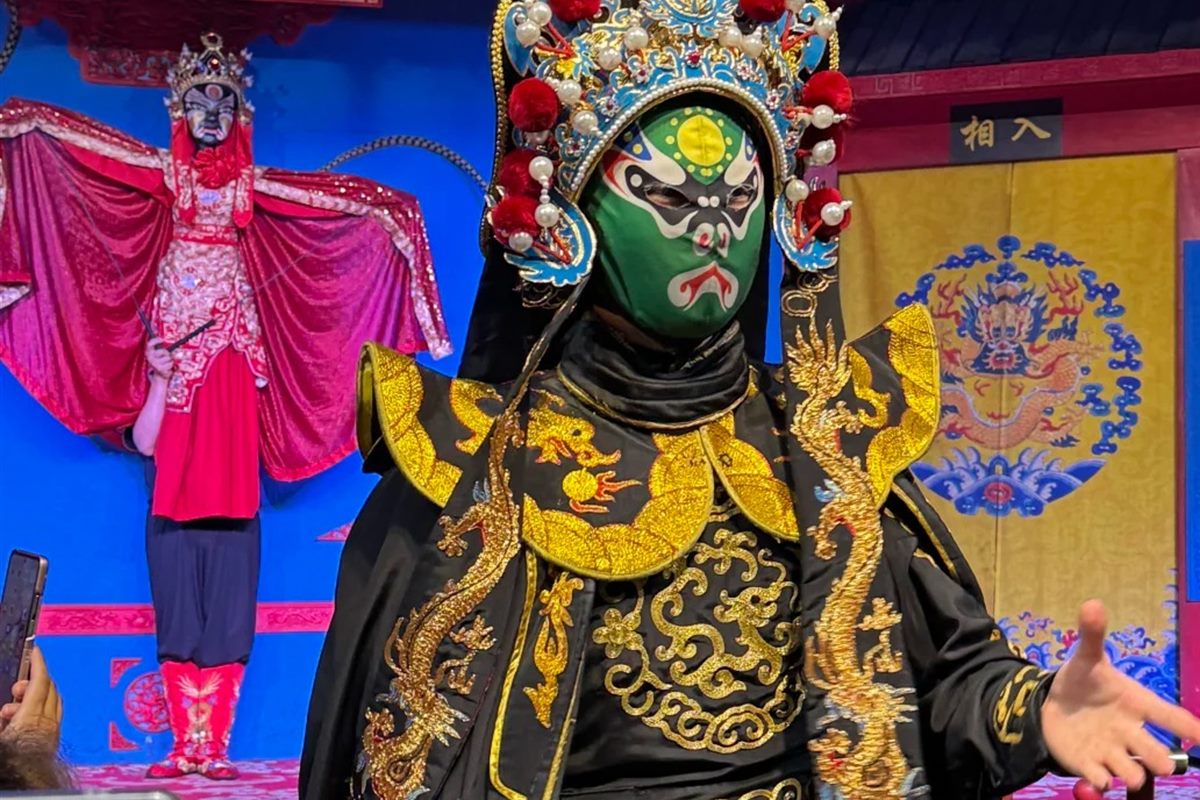
Bian lian (变脸) is the most photogenic Chinese performing-art tradition still actively performed — and Chengdu is the only city where you can reliably see it on any night of the week. The technique is a 300-year-old state secret: certified performers swap painted silk masks in fractions of a second, sometimes 8–10 changes in under a minute, with no visible hand movement.
It originated in Sichuan opera around the late Qing dynasty (1700s–1800s). Masters typically pass the technique only to direct apprentices, and the Chinese government formally protected it as state-controlled cultural heritage in the early 2000s; Sichuan opera joined China’s first National Intangible Cultural Heritage list in 2006. Public theories about the mechanism include hidden silk threads, mask-stack mechanisms and trained micro-movements — none officially confirmed. Only a small, certified circle of performers may perform it, the majority based in Sichuan.
What you see on stage: a single performer in elaborate Sichuan opera costume dances while painted masks — each a distinct colour and design — appear and disappear. The pace builds, accelerating to multiple changes per second by the climax, sometimes mid-spin or facing an audience member directly to show the impossibility of an ordinary hand move.
Where to watch face-changing
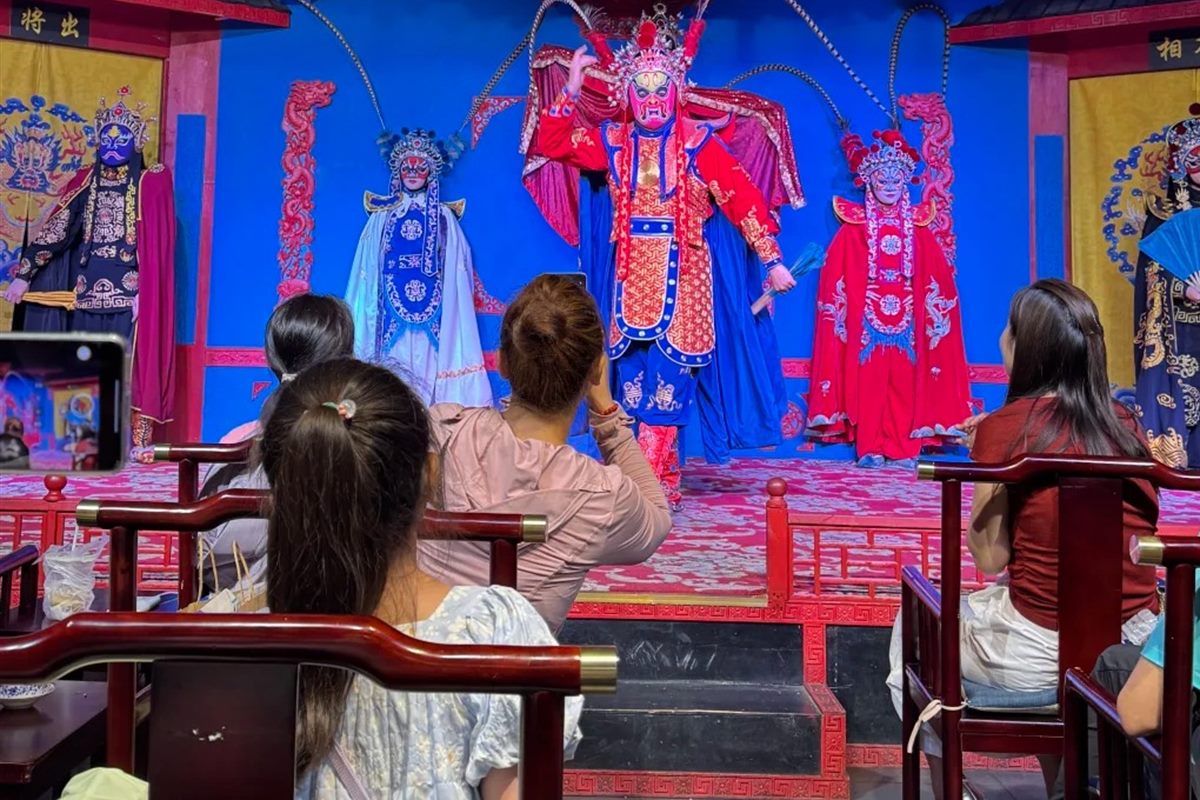
The real choice is one proper show versus the cheap-and-convenient teahouse stages. Shufeng Yayun is the established ~90-minute production at Cultural Park; the stalls inside Jinli and Kuanzhai run short rolling shows all afternoon and evening — fine if you’re already there, but priced with a catch (see below).
| Venue | Tickets · length | Best for |
|---|---|---|
| Shufeng Yayun 蜀风雅韵 · Cultural Park | ¥80–260, tea incl. (~¥188–268 online) ~90 min, daily 8pm | The one proper, polished show — four seat tiers, lighting design, English captions, full variety lineup. First-timers wanting the definitive version. |
| Jinli / Kuanzhai teahouse stages 锦里 / 宽窄巷子 | ¥18–48 ~30–40 min, rolling 2–9pm | Small 2nd-floor teahouse stages inside the tourist streets — cheap, short, walk-in while you’re already there. Watch the ¥18 low-price trap (below). |
| Furong Guocui 芙蓉国粹 · Sichuan Opera Theatre | ¥75–175, tea incl. multiple daily | The professional option at the provincial Sichuan Opera Theatre — a bigger, more theatrical hall, 3D-backed staging, conservatory-trained performers. The pick if Shufeng Yayun is sold out or you want a grander stage. |
Shufeng Yayun: Qintai Road, Cultural Park, Qingyang District (青羊区琴台路 · 文化公园) — Metro Line 2 to Tonghuimen (通惠门), Exit E, ~400 m (~5 min).Furong Guocui: Sichuan Opera Theatre (四川省川剧院) — central Qingyang District, a short taxi/metro hop from the old-town core.Jinli stages: mid-street, inside Jinli Ancient Street, Wuhou District — Metro Line 10 to 武侯祠(锦里), exit A2, ~220 m. (Line 3/5 to Gaoshengqiao also works but leaves you a ~1 km walk.)Kuanzhai stages: Wide-Narrow Alley — Metro Line 4 to Kuanzhai Alley (宽窄巷子站).Shunxing Old Teahouse: 顺兴老茶馆 — Century City / New Convention Centre, a dinner-plus-show option (tea seat ¥68–88).
The ¥18 teahouse trap
Inside Jinli and Kuanzhai, stalls advertise face-changing from ¥18 — but the cheapest ticket often forces a tea or minimum spend once you sit (a pot runs ¥58–138; some add an ¥8 “water” or small “utensil” fee). Before you sit, ask three things: is tea included, is there a minimum spend, can I watch without ordering. The ¥28 “tea-included” tier is the honest one. For a fixed price with no surprises, Shufeng Yayun is the safe pick.
See the Wide-Narrow Alley guide for the Kuanzhai context, or Jinli + Wuhou Temple for the courtyard-and-dinner pairing.
What the 90-minute show actually contains
Tourist variety shows are designed for short attention spans and English-non-fluent audiences. A typical lineup, in order — the face-changing is always the closer:
| Segment | Length | What it is |
|---|---|---|
| Hand-shadow puppetry | 5–8 min | A light show with hand silhouettes telling a folk tale. |
| Comedy skit | 8–12 min | A short Sichuan-opera scene with English subtitles; the humour translates poorly — treat it as costume-and-staging. |
| Tea-pouring acrobatics | 10–15 min | A long-spouted copper kettle (1–1.5 m spout) pours tea from impossible angles into front-row cups. Photogenic. |
| Hand puppetry | 8–10 min | A traditional stick-puppet folk tale. |
| Fire-spitting | 3–5 min | The performer breathes fire in extended sequences; front rows feel the heat. |
| Face-changing finale | 15–20 min | The headliner. A single bian lian performer builds from slow changes to a rapid climax — the last 60 seconds typically pack 8–12 changes. |
Full traditional Sichuan opera, without the variety lineup, runs 2–3 hours and is rarely staged for tourists. The variety show is the right entry point: it delivers the most-discussed technique without three hours and Chinese-language fluency.
Book the face-changing showNASDAQ: TCOM
Trip.com lists Sichuan-opera tickets (Shufeng Yayun primarily) with seat selection, an English program guide and an optional hotel pickup — booked in English on a foreign card, about USD $25–55 per person.
How to book + which seat tier to pick
Booking channels, in order of foreigner-friendliness:
| Channel | Price | Notes |
|---|---|---|
| Trip.com | ≈ door or less | English, seat selection, free cancellation 24h ahead — and promo pricing often lands at or below the door rate. The most reliable channel for foreigners. |
| Klook | Similar | Comparable to Trip.com, sometimes cheaper on combo deals (opera + dinner). |
| Domestic booking apps 美团 / 抖音 / 大众点评 | Cheapest | Promo seats ¥118–218 for Shufeng Yayun — but a Chinese-only checkout (needs a Chinese number / WeChat or Alipay). |
| Hotel concierge | + service fee | Convenient; includes an English call-ahead and sometimes a hotel transfer. |
| Door walk-up | No discount | No promo pricing, and the cheap teahouse stalls are where the tea-fee trap lives. Fine at Shufeng Yayun’s box office. |
Seat tier (Shufeng Yayun). The four tiers are transparent and all but the cheapest include tea and snacks. Front-row 壹品 VIP (¥260) puts you within arm’s reach — masks switch right in front of your face. 贰品 (¥180–200) is the sweet spot: a clear central view without front-row pressure. 叁品 (¥140–160) is fine for the variety acts, but the mask changes blur from the back. The cheapest 加座 (¥80–100) is a no-tea add-on seat. Online promos often drop every tier ¥30–50 below the door, so book 1–2 days ahead — especially weekends and Chinese holidays.
Building it into your Chengdu evening
The classic foreigner’s slow-life Chengdu evening, with the opera as the 7:30pm centrepiece:
| Time | What |
|---|---|
| 5:30–6:30pm | Tea house at Wide-Narrow Alley or Heming Tea House for a slow afternoon. |
| 6:30–7:30pm | Dinner — Sichuan classics in Wide Alley, or a Chengdu hot pot. |
| 7:30–9pm | Sichuan-opera variety show (a Jinli or Kuanzhai courtyard fits this slot best). |
| 9:30pm on | Yulin Road late-night chuan chuan xiang skewer pot, or back to the hotel. |
For the wider plan, see 17 things to do in Chengdu and the Chengdu 3, 5 or 7-day itinerary.
Hotels by the Wide-Narrow AlleyThe Jinli / Kuanzhai courtyards host the shows — a central base makes the slow-life evening easy. Searched in English on Trip.com.Search ↗Practical tips for foreign visitors
- Arrive 15 minutes early. Tea is included at Shufeng Yayun and you sip it through the show; at the cheap teahouse stalls, confirm the tea is in the ticket and not a separate charge.
- English subtitles vary. Shufeng Yayun has consistent captions; courtyard shows often provide only a paper program guide.
- Photography is allowed in most segments — but watch for posted no-photo signs at the bian lian finale. Video is usually fine.
- Don’t flash front-row performers. At tea-pouring or fire-spitting, a flash can disrupt the performer’s aim or balance.
- Tipping isn’t customary, but a ¥20–50 tip to the bian lian master after the show is appreciated and not unusual at smaller courtyard venues.
- Ignore “one-day face-changing workshop” ads. The real technique is state-protected and not taught to foreigners; those classes teach prop-store stage makeup.
Frequently asked questions
What is Sichuan opera face-changing (bian lian)?
Bian Lian (变脸 — literally 'changing faces') is a closely-guarded Sichuan opera technique where performers swap painted silk masks in fractions of a second — sometimes 8-10 mask changes in under a minute, mid-dance, with no visible hand movement. The mechanism has been a state secret since the Qing dynasty; only certified performers may learn it, and unauthorized teaching can result in legal action. The parent art form — Sichuan opera — was inscribed on China's first National Intangible Cultural Heritage list in 2006. For foreign visitors, it's the most photographable Chinese performing-art tradition still actively performed.
Where can I watch Sichuan opera in Chengdu?
The one proper, polished show most first-timers pick is Shufeng Yayun Teahouse (蜀风雅韵) at Cultural Park — a ~90-minute variety production, daily at 8pm (extra afternoon shows in peak season), ¥80–260 with tea included (the good mid seats most people book online run about ¥188–268). The professional alternative is Furong Guocui (芙蓉国粹) at the Sichuan Opera Theatre — a bigger, more theatrical hall with a 3D-backed production and mostly conservatory-trained performers, ¥75–175 with tea; the pick if Shufeng Yayun is sold out or you want a grander stage. Shunxing Old Teahouse (顺兴老茶馆) at Century City pairs the show with a Sichuan dinner (tea seat ¥68–88). Inside Jinli Ancient Street and Kuanzhai Alley, small teahouse stages run short (~30-40 min) face-changing shows on a rolling afternoon-evening loop for ¥18–48 — convenient if you're already there, but the cheapest ¥18 tickets usually force a tea or minimum spend once you sit (tea from ¥38), and the face-changing itself can be cut to 10-15 minutes, so ask before sitting down.
How long is a Sichuan opera show?
Tourist variety shows run 60-90 minutes and are designed for foreign audiences — short attention-friendly segments rather than full traditional opera. A typical lineup: hand-shadow puppetry (5 min), tea-pouring acrobatics with long-spouted copper kettles (10 min), comedy skit with subtitles (10 min), fire-spitting (5 min), face-changing finale (15 min). Most venues offer English subtitles or program guides. Full traditional Sichuan opera (without the variety lineup) runs 2-3 hours and is rarely shown to tourists — for that, attend the Sichuan Opera Theatre in non-tourist contexts.
Should I book Sichuan opera tickets in advance?
For Shufeng Yayun (the famous one), yes — book 1-2 days ahead, especially weekends and Chinese holidays. Front-row seats sell out first; back rows usually have walk-up availability but you'll be 8-10 meters from the face-changing climax. For Jinli and Kuanzhai courtyard shows, walk-up at 7pm usually works on weekdays; weekends benefit from a 1-day-ahead booking. Trip.com, Klook, and Dianping all sell tickets; the Trip.com listing has English service. Hotel concierge can also book for you with a small markup.
What's the difference between bian lian and face-painting?
Bian lian (face-changing) is a performance technique — silk masks are swapped in a fraction of a second mid-dance using hidden mechanisms. Traditional Chinese opera face-painting (脸谱 liǎn-pǔ) is the static makeup tradition — Beijing opera's elaborate red, white, black, and gold designs that signal character archetypes. They're related (Sichuan opera does use face-painting too) but distinct. The bian lian masks, when not being worn, are themselves face-painting style — but they switch in performance, which face-painting doesn't.
Are face-changing shows authentic or just for tourists?
The technique is authentic — bian lian is a 300-year-old protected art form. The variety-show packaging (60-90 minutes, English-subtitled, fire-spitting + tea-pouring lineup) is built for tourists, but the face-changing itself is the real thing performed by certified masters. Locals don't watch tourist shows; they attend full-length traditional Sichuan opera at the Sichuan Opera Theatre or in regional villages. For foreign visitors, the variety show is the right entry point — it shows you the most-discussed technique without requiring 3 hours and Chinese-language fluency.
Can I learn face-changing as a foreigner?
No, with rare exceptions. The technique is a state-protected secret; only Chinese citizens with formal opera-troupe affiliations may be trained, and even then only after several years of opera apprenticeship. There are no schools or short courses for foreigners. A small number of foreign performers have been trained (notably one Australian) but always through long-term apprenticeship in Sichuan opera companies. Don't believe online ads for 'one-day face-changing workshops' — those teach prop-store stage makeup, not real bian lian.
Is photography allowed during Sichuan opera shows?
Generally yes for non-flash photography, but with one critical exception: at the moment of mask changes, performers move so fast that any flash or shutter sound triggers the audience reflex of 'how did that happen?' — many venues now post no-photography signs specifically for the bian lian segment. Pre-mask-change photos are fine; the masks themselves are photogenic. Most venues allow video. The variety segments (tea pouring, fire spitting) are usually photo-friendly throughout. Check the venue's posted policy at entry.
Related Chengdu guides
- Wide-Narrow Alley (Kuanzhai) — courtyard opera venues.
- Jinli Ancient Street + Wuhou Temple — courtyard opera venue + dinner pairing.
- 17 things to do in Chengdu.
- Chengdu 3, 5, or 7-day itinerary.
- Chengdu city overview.
Sources
Checked August 2026 · Written from our own first-hand travel in China.