Key takeaways
- The Bund is a free, open-24/7 riverside promenade — no ticket, no gate.
- Go 6:30–9pm for the night view, when both the colonial buildings and the Pudong skyline are lit.
- Take Metro Line 2 or 10 to Nanjing East Road, then a 5–7 minute walk east to the water.
- Allow 1–2 hours; many visitors come twice — once by day for the architecture, once after dark.
- Skip the ¥50 Sightseeing Tunnel and refuse the “art student” / tea-ceremony touts.
What the Bund is
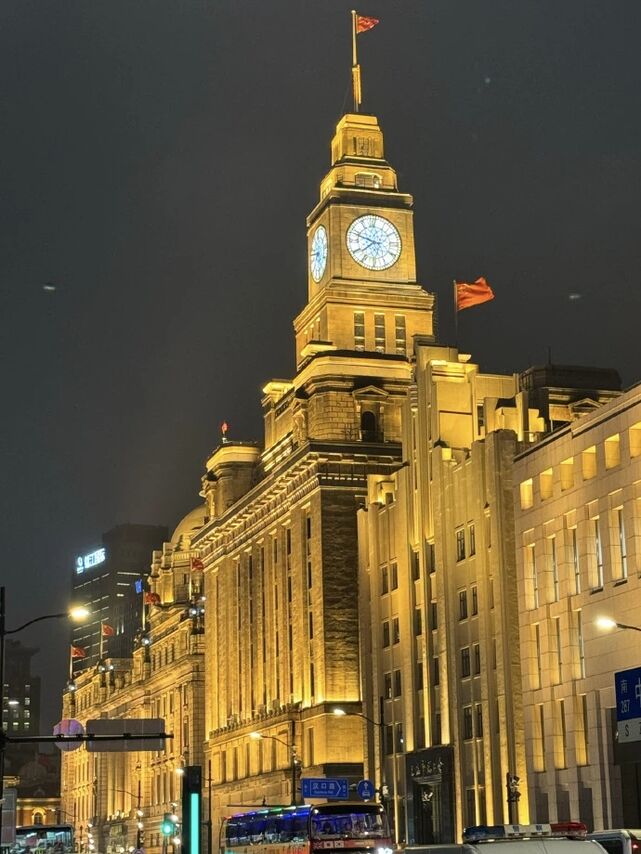
The Bund — 外滩, romanized Waitan, meaning roughly “outer bank” — is a roughly 1.5 km stretch of waterfront on the west bank of the Huangpu River in central Shanghai. Behind the promenade stands a continuous row of grand buildings: banks, trading houses, consulates and hotels built mostly between the 1900s and the 1930s, when Shanghai was a treaty port and this was the financial heart of East Asia. The styles run from neoclassical to Art Deco, and the row is sometimes called a “museum of international architecture.”
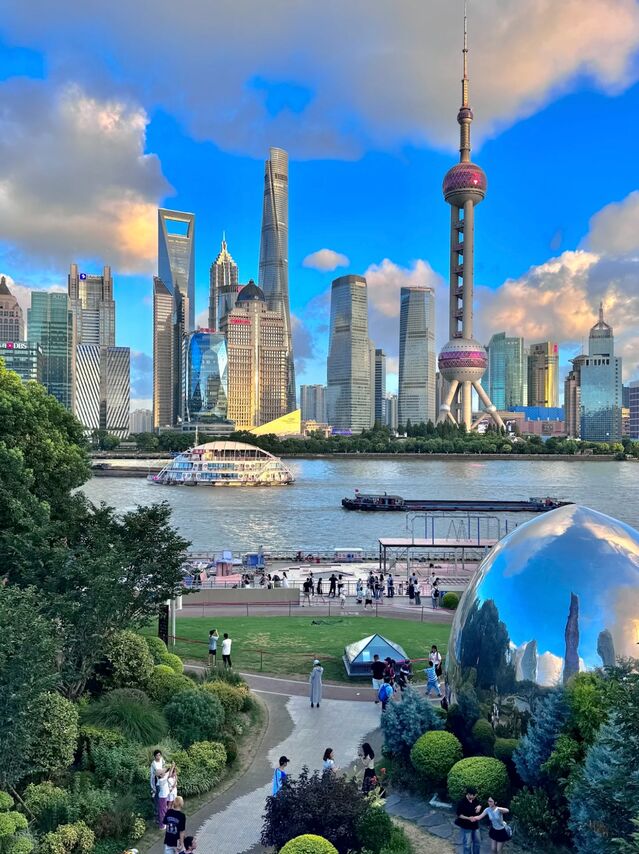
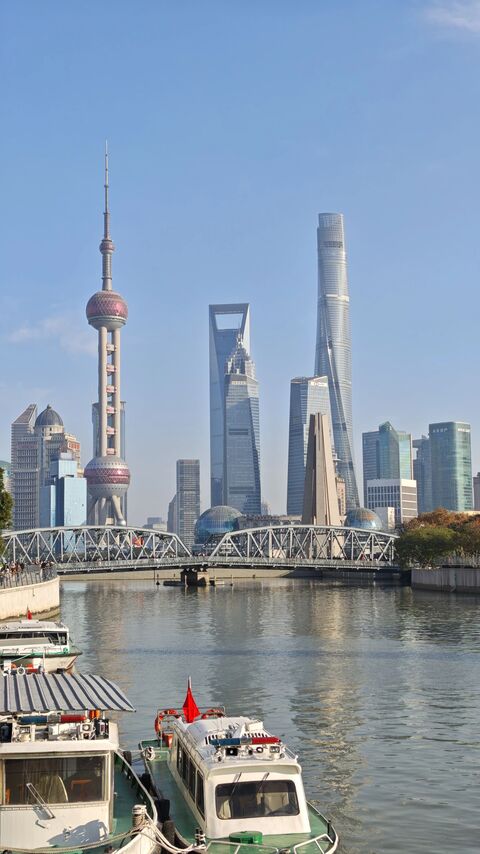
Across the river is Lujiazui — the Pudong skyline, with the Oriental Pearl Tower, the Jin Mao Tower, the Shanghai World Financial Center and the Shanghai Tower. The Bund is where the Shanghai of a century ago and the Shanghai of today stand face to face, and that contrast is exactly why it is the city’s defining view.
When to go
The Bund is worth seeing twice if time allows, and the lit window moves with the season rather than sitting at a fixed hour. The display runs roughly 19:00–23:00 in summer against 17:00–21:00 in winter — so a winter visitor who plans for a late evening arrives after the far bank has gone dark. Weekend and holiday nights run later still. ⚠️ On an ordinary weekday only part of the display is lit; the full lighting is concentrated on weekends and public holidays, which makes the night you come a real choice rather than a detail. The best photo light is the “blue hour” — the half hour that starts when the lights do, so 19:00 in summer and 17:00 in winter. Arrive twenty minutes before that to catch the last of the sunset first. The fullest, least-frantic viewing is the hour or two after, and there is usually a short light show on weekend and holiday nights. The three windows compared:
| Window | Why | Notes |
|---|---|---|
| Evening 6:30–9pm | The headline view | Both banks lit — colonial buildings behind you, Pudong towers across the water. Busiest window; Pudong lights switch off late, so don’t arrive too late. |
| Daytime | See the architecture | Facades, the Customs House clock tower, domes and columns — all lost in the dark. |
| Early morning 7–8am | The calm alternative | Quiet promenade, locals doing tai chi and walking, soft light for photography. |
How to get there
Take Metro Line 2 or Line 10 to Nanjing East Road station (南京东路) and walk 5–7 minutes east along the pedestrian streets to the waterfront. The Bund also connects on foot to the rest of central Shanghai:
- About 800 m / 11 minutes from Yu Garden through the Old City (per Amap).
- An easy walk from People’s Square along the East Nanjing Road pedestrian street.
- To cross to the Pudong side, Metro Line 2 runs one stop under the river for a few yuan, and there is a cheap public ferry.
Do not use the Bund Sightseeing Tunnel as transport — see “What to skip” below.
What to do along the Bund
The core experience is simply the walk — the full promenade end to end and back is about an hour with photo stops. Which spot you stand on changes the photo, and travellers rate them like this:
| Viewpoint | What you get |
|---|---|
| The Bund promenade (classic) | The iconic frame — the colonial row and the Pudong “three big ones” in one shot. Also the most crowded; a clean foreground means claiming a spot early. |
| North Bund (北外滩) | Wide open, far fewer people, and the full Lujiazui tower cluster head-on — the riverside lawn and the pedestrian sky-bridge are the go-to spots. You lose the colonial row’s face-on view. |
| Pudong riverside (浦东滨江) | Shooting back at the Bund from the east bank; the arched colonnade near Lujiazui and the Pudong art-museum galleries make cinematic frames for portraits and silhouettes. |
| South Bund (南外滩) | The quietest; steps and railings as foreground for a moodier, emptier shot, though the towers sit farther off (a longer lens helps). |
| Ground-level three-tower shot | To get all three Pudong towers stacked in one cyber-looking frame from street level, travellers point to the Dongtai Rd × Huayuanshiqiao Rd junction (东泰路×花园石桥路, phone at ground level, ultra-wide) and the Lujiazui ring footbridge — both free. |
Beyond the walk and the photo:
- Look up at the buildings. The Customs House (with its clock), the former HSBC Building, the Peace Hotel and the rest of the row are worth slowing down for. Several have lobbies or rooftop bars open to visitors.
- Rooftop bars and terraces. Some of the historic buildings house bars and restaurants with terraces facing Pudong — a drink at sunset is a classic Shanghai splurge (see the Shanghai city guide for the dining context).
- A Huangpu River cruise — optional; covered next.
The Huangpu River cruise question
A Huangpu River cruise is optional. Standard evening sightseeing boats run ¥120–150 and give you both the Bund and Pudong skylines from the water — a genuinely different angle and pleasant on a clear evening. But the free view from the promenade is already excellent, and the cruise adds about an hour. Take it if you want the on-water experience; skip it if your time is tight, because the walk along the Bund delivers most of the payoff for free.
The ¥2 local alternative to a cruise: travellers repeatedly rate the public ferry above both the tourist cruise and the sightseeing tunnel. The Dongjinxian ferry (东金线) crosses in ~5–10 minutes from Jinling East Road wharf (金陵东路渡口) to Dongchang Road wharf (东昌路渡口) for about ¥2 (tap a transit QR / metro card); from the open upper deck you see the colonial row and the Pudong towers at eye level, with the river breeze. It is not a narrated sightseeing loop — it’s a working commuter boat — but for the view it is unbeatable value.
Book a Huangpu River evening cruiseNASDAQ: TCOM
Want both skylines from the water? Trip.com lists the standard evening Huangpu River sightseeing cruises along the Bund and Pudong waterfront — compare departures and boats, booked in English on a foreign card.
What to skip
Along the Bund and the East Nanjing Road pedestrian street, a handful of tout scripts target foreign visitors. None are dangerous, but a couple can cost real money — the rule is simple: don’t take anything a stranger hands you, don’t follow them anywhere, don’t sit down, and buy tickets only from an official window or the official mini-program.
| The trap | How to handle it |
|---|---|
| “Art student” gallery invite | Friendly students with a portfolio invite you to a nearby “exhibition” that ends in a hard sell of overpriced paintings. Smile, say “no thanks,” don’t take the portfolio, keep walking. |
| Free tea ceremony | “Let’s make friends over tea” leads to a shocking bill for tea and tea-ware. Never sit down — once seated it is hard to leave. |
| “Let me photograph you” | A stranger grabs your phone to take your photo, then demands a per-shot fee. Decline the offer outright; take your own photos. |
| Sightseeing-tunnel scalpers | “Discount / skip-the-line” tickets at the tunnel entrance are face-price at best and a black-cab lure at worst. Buy only at the official window. |
| Knock-off dumpling shops | Near Yu Garden and Nanjing Road, look-alike signs mimic Nanxiang Mantou Dian / Jia Jia Tang Bao — thick-skinned, pricey imitations. Check the real branch’s address and shopfront on your phone first. |
| Street fortune-telling | “Free palm reading” turns into a demand to pay for a “ritual” or lucky charm. Say you’re not interested, don’t make eye contact, walk on. |
- The Bund Sightseeing Tunnel (外滩观光隧道) — a ¥50 one-way / ¥70 return ride through a ~3–5 minute tunnel of flashing lights under the river that travellers widely call a waste of money. To cross to Pudong, Metro Line 2 does it for a few yuan — or take the ¥2 ferry above for the view.
- Street vendors selling laser pointers and toys — harmless but persistent.
Where to stay near the Bund
The Bund side — Huangpu district, around Nanjing East Road and People’s Square — is the classic first-timer base: walking distance to the waterfront and on Metro Lines 2 and 10. The sensible call for a first China trip is a home-grown mid-range chain in that core; the heritage towers on the river itself are the splurge.
Related Shanghai guides
The Bund anchors a walkable cluster of central-Shanghai sights — pair it with these to fill a day or an evening:
- Shanghai city guide — things to do, getting around, where to stay, what to eat, practical essentials.
- Things to do in Shanghai — the 11 curated picks with a 3-day timeline.
- Yu Garden & Yuyuan Bazaar — the Ming garden an 11-minute walk from the Bund.
- Pudong skyline: Shanghai Tower vs Oriental Pearl — the towers you see across the river, and which deck to choose.
- Where to stay in Shanghai — the Bund side is the first-timer base; here is the full comparison.
Frequently asked questions
Is the Bund free to visit?
Yes — the Bund is completely free. It is a public waterfront promenade, open 24 hours a day with no tickets and no entry gate. You only pay if you choose to add something: a Huangpu River cruise (¥120-150), a paid observation point inside one of the historic buildings, or food and drink. The promenade itself, including the famous night view, costs nothing.
What time is best to visit the Bund?
Between about 6:30pm and 9pm. That is when both sides of the river are lit — the colonial buildings behind you on the Bund side and the Pudong skyline across the water — and the contrast is the whole point. The promenade is busiest then too. For a calmer experience, arrive around sunset before the crowds peak, or come early morning (7-8am) when locals are out exercising and the light is soft. The Pudong skyline lights are typically switched off late at night, so do not leave the night view too late.
Where is the best spot to photograph the Pudong skyline, and is the ¥2 ferry worth it?
The Bund promenade is the classic frame (colonial row plus the Pudong towers), but it is the most crowded. For fewer people and the full Lujiazui tower cluster head-on, travellers prefer North Bund (北外滩); for a moodier empty shot, South Bund (南外滩); and to stack all three Pudong towers in one street-level frame, the Dongtai Road × Huayuanshiqiao Road junction or the Lujiazui ring footbridge. To see both skylines from the water for almost nothing, skip the ¥50 sightseeing tunnel and take the ¥2 public ferry (东金线) from Jinling East Road wharf to Dongchang Road wharf — the open upper deck is the local's tip.
What exactly is the Bund?
The Bund (外滩, Waitan) is a roughly 1.5 km waterfront stretch on the west bank of the Huangpu River in central Shanghai. Behind it stands a row of grand early-20th-century buildings — banks, trading houses and hotels built between the 1900s and 1930s in neoclassical, Art Deco and other European styles, a legacy of Shanghai's treaty-port era. Across the river is Lujiazui, the modern Pudong skyline. The Bund is where old and new Shanghai face each other, which is why it is the city's signature view.
How do I get to the Bund?
Take Metro Line 2 or Line 10 to Nanjing East Road station (南京东路) — from there the Bund waterfront is a 5-7 minute walk east down the pedestrian streets. The Bund is also an easy walk from Yu Garden (about 800 m / 11 minutes through the Old City, per Amap) and from People's Square. Avoid the Bund Sightseeing Tunnel as 'transport' — it is a ¥50 novelty light tunnel under the river; Metro Line 2 crosses to Lujiazui for a few yuan.
Should I take a Huangpu River cruise?
It is optional. A Huangpu River cruise (¥120-150 for the standard evening sightseeing boats) gives you the Bund and Pudong skylines from the water, which is a genuinely different angle and pleasant on a clear evening. But the free view from the promenade is already excellent, and the cruise adds an hour. Take it if you want the on-water experience; skip it if your time is tight — the walk along the Bund delivers most of the payoff for free.
What should I skip at the Bund?
Skip the Bund Sightseeing Tunnel (外滩观光隧道) — a ¥50 ride through a tunnel of flashing lights that most visitors find kitsch. Be wary of 'art student' and tea-ceremony touts who approach English-speaking tourists near the promenade and East Nanjing Road; the friendly invitation to a gallery or tea house is a known overcharging scam. A polite refusal and keep walking. The street vendors selling laser pointers and toys are harmless but persistent.
How long should I spend at the Bund?
Allow 1-2 hours. Walking the full promenade end to end and back, taking photos, and pausing to look at the buildings fills about an hour; add time for a drink at a rooftop bar in one of the historic buildings, or a river cruise, and it becomes an evening. Many visitors do the Bund twice — once by day to see the architecture and once after dark for the lights.
Sources
Checked August 2026 · Written from our own first-hand travel in China.