Key takeaways
- An International Driving Permit is worthless in mainland China. China is party to neither the 1949 Geneva nor the 1968 Vienna road-traffic convention, so an IDP has no legal basis here — and driving on one counts as unlicensed driving, not a paperwork slip.
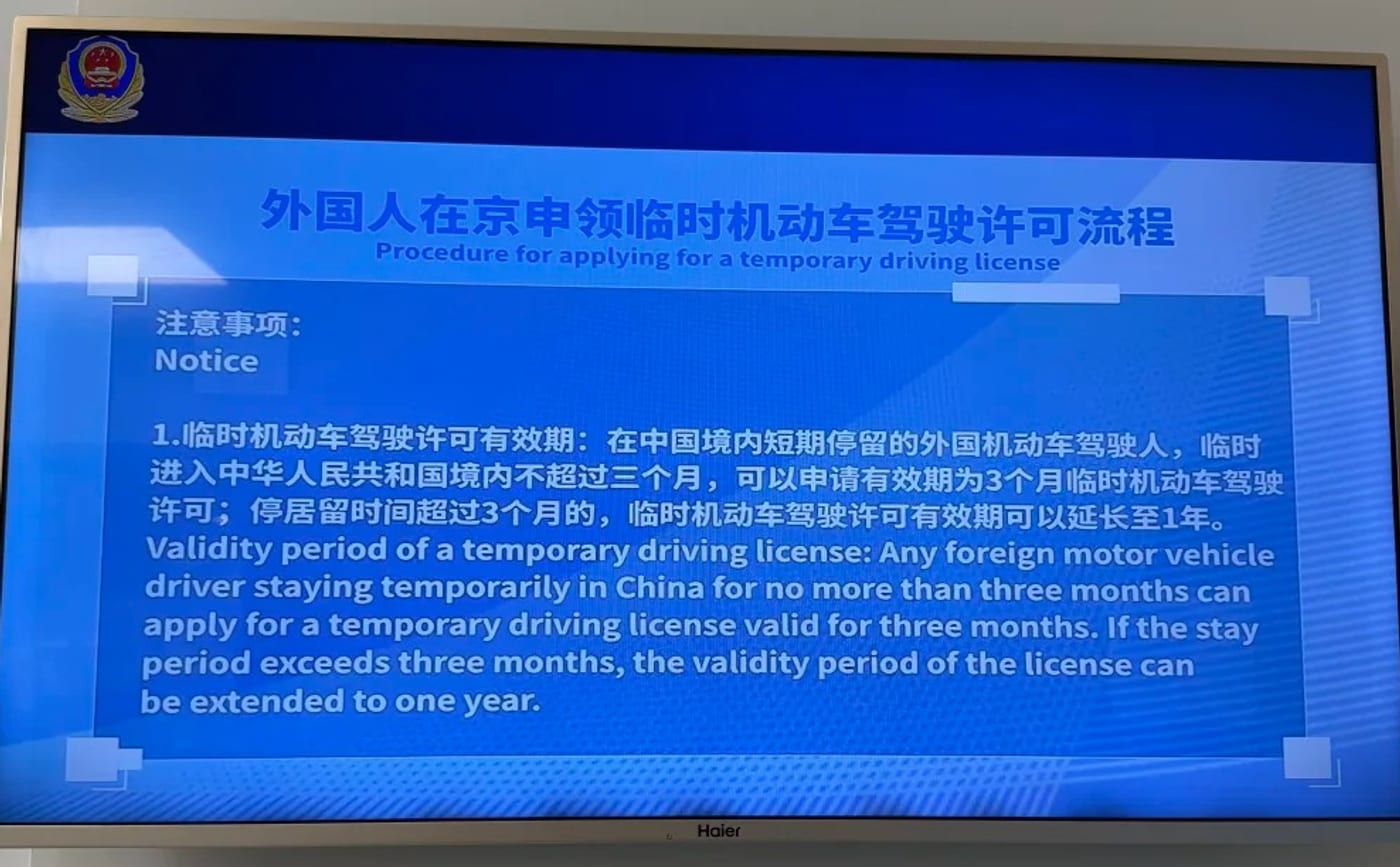
- What makes you legal is a Chinese temporary driving permit (临时机动车驾驶许可): three months, extendable to one year if your stay exceeds three months. Same-day, over the counter, ¥10 in Beijing.
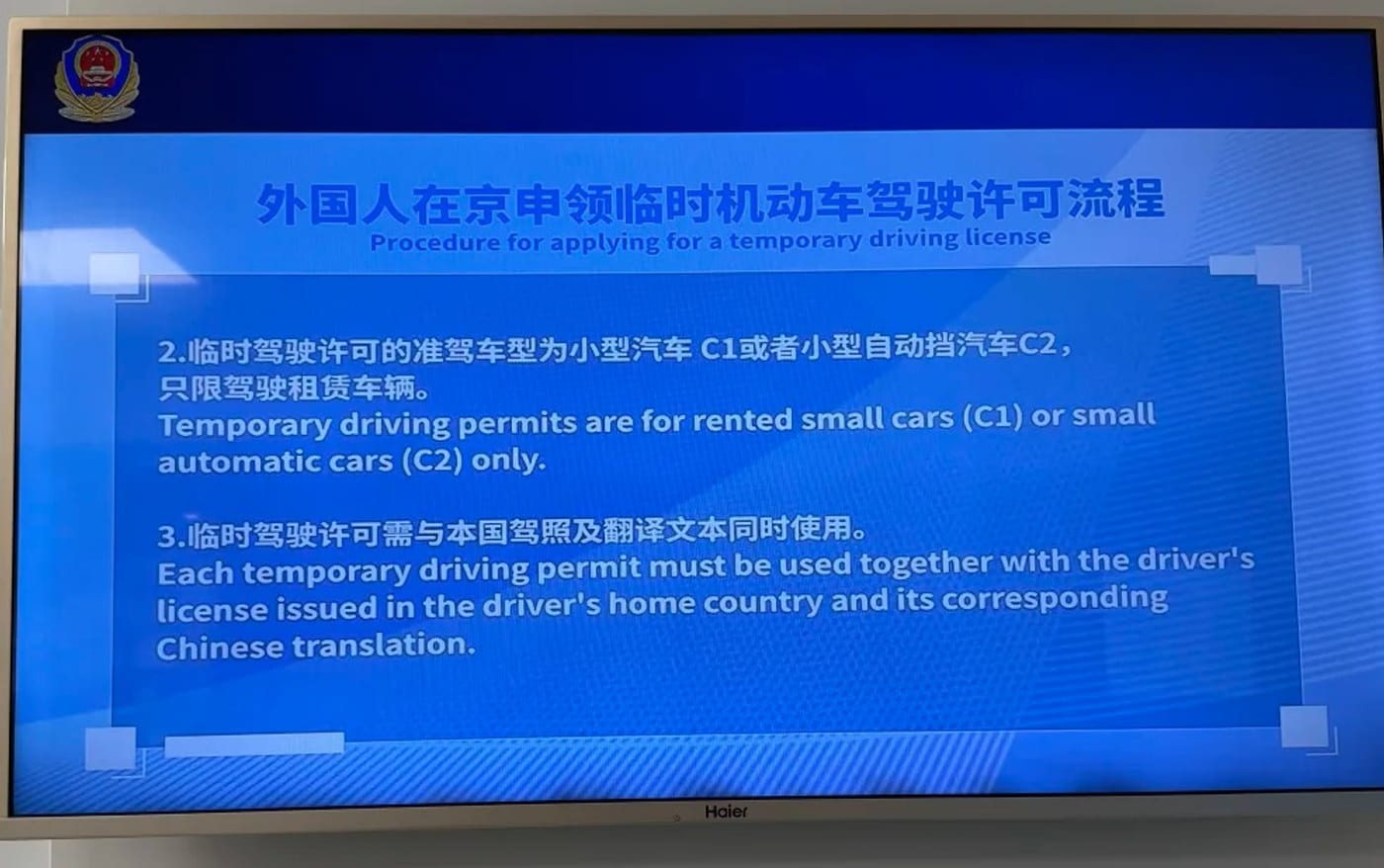
- ⚠️ It only covers a RENTED small car. The issuing authority states it in English at the counter — C1 or C2, rented vehicles only. A friend’s or family member’s private car is not covered, and your home licence’s extra categories do not travel with you.
- Some airports issue it on arrival — Beijing Capital T3, Daxing, and both Shanghai airports. Mind the hours: Shanghai’s desks close for lunch and shut entirely on Friday afternoons.
- Staying longer? Ordinary car categories sit the theory exam only — no road test, in 15 languages. But learner and probationary licenses (L/P plates) cannot be exchanged at all.
- Skipping it is ¥200–2,000 and possibly 15 days’ detention — but the real exposure is that motor insurance is void for unlicensed driving, so an at-fault crash is entirely on you.
Why the IDP fails here
If you have driven abroad before, the routine is familiar: get an International Driving Permit from your motoring association, carry it with your home license, and you are covered. That routine fails completely at the Chinese border.
An IDP is not a license. It is a standardized translation whose legal force comes entirely from two treaties — the 1949 Geneva and 1968 Vienna road-traffic conventions — under which signatory countries agree to honour each other’s licenses. China has signed neither, so an IDP carries no legal weight in mainland China whatsoever — not on its own, and not presented alongside your home license.
The consequence is harsher than most travellers expect. Driving on a foreign license or an IDP is not treated as a paperwork irregularity to be waved through — it is unlicensed driving, the same offence as never having held a license at all.
The same applies to Hong Kong, Macau and Taiwan licenses. Article 109(3) of the licensing regulation defines an “overseas driving license” to include those issued by foreign countries and by the Hong Kong and Macau Special Administrative Regions and the Taiwan region. A Hong Kong license does not cover a drive across the border into Shenzhen.
Why you will find the opposite answer so easily
Of every search term in this topic, only “international driving permit china” carries meaningful advertising spend — the rest are commercially dead. Someone is paying to reach people asking this exact question, and what they are selling is IDPs. A related claim circulating on rental platforms — that China has just added fifteen Schengen countries to its license-recognition list — is marketing copy with no basis in Ministry of Public Security policy. When money rides on the wrong answer, the wrong answer travels further.
What you actually need
The document that makes you legal is the temporary motor vehicle driving permit (临时机动车驾驶许可). Two Ministry of Public Security regulations govern it, and they do not say quite the same thing — which is where most of the confusion online comes from.
The general rule is Article 21 of the licensing regulation (Order 162 of 2022, as amended by Order 172, in force 1 January 2025): a holder of an overseas license who needs to drive temporarily applies to a vehicle administration office. Short-term entrants may hold a permit valid three months; those whose stay or residence exceeds three months may have it extended to up to one year.
Running alongside it is the older Order 90, which covers people entering for three months or less. Its scope is narrower and its terms are stricter: a maximum of three months, explicitly not extendable. The two are not in conflict — they describe different populations, and the one-year extension belongs to the newer general rule, not to the short-stay regime.
What the permit actually looks like
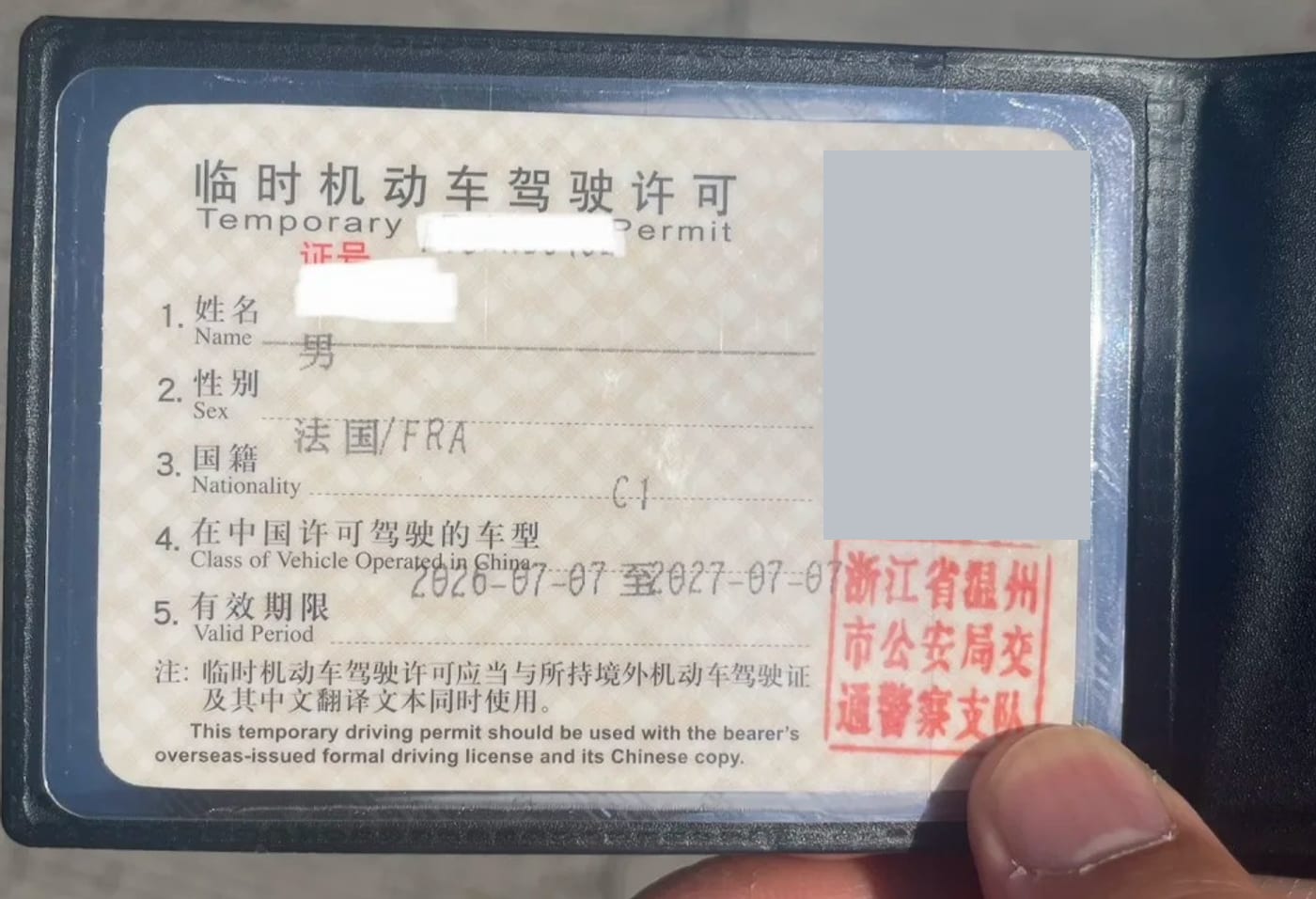
It is a small bilingual card, not an endorsement in your passport. It carries your nationality, the class of vehicle you may drive in China, and a validity period — and printed along the bottom, in English, is the instruction that decides how you must carry it: this temporary driving permit should be used with the bearer’s overseas-issued formal driving license and its Chinese copy. The permit alone is not enough at a roadside check. All three travel together.
Where to get it, and what it costs
This is a same-day, over-the-counter process in most cities, not an application you file and wait on. Expect roughly 30 minutes to an hour at the counter, including a road-safety education session — commonly a video of about half an hour that you are expected to actually watch.
Beijing 北京
Vehicle-administration main and branch offices · Capital Airport T3 · Daxing Airport · municipal service centre
Mon–Fri 08:30–18:00 · Sat–Sun 09:00–16:00
¥10. Medical certificate waived for small cars and motorcycles. Two 1-inch white-background photos.
Beijing Capital Airport desk 首都机场车管服务站
Terminal 3-C, level 1, opposite Gate 7, west side
Mon–Fri 08:30–11:30 · 13:30–16:30 (closed public holidays)
Tel 010-64530010. Stays under 3 months only. Does not handle traffic fines.
Shanghai 上海
Pudong / Minhang / Baoshan vehicle-admin branches · Hongqiao and Pudong airport PSB traffic-police divisions · Free Trade Zone branch
Airport desks 09:00–11:00 · 13:00–16:00 weekdays — Friday mornings only
Issued on the spot after a mandatory road-safety education session.
The airport desks are the genuinely useful discovery here, and their opening hours deserve more attention than they usually get. Shanghai’s airport counters close for lunch and shut entirely on Friday afternoons; Beijing Capital’s desk closes on public holidays. A landing that misses the window means a trip into the city instead. Beijing Capital’s desk also only serves stays under three months — longer visas are sent to the traffic bureau’s foreign-affairs division. Outside Beijing and Shanghai, assume there is no airport desk.
What to bring
- Passport with a valid visa or entry stamp
- Your home driving license, original
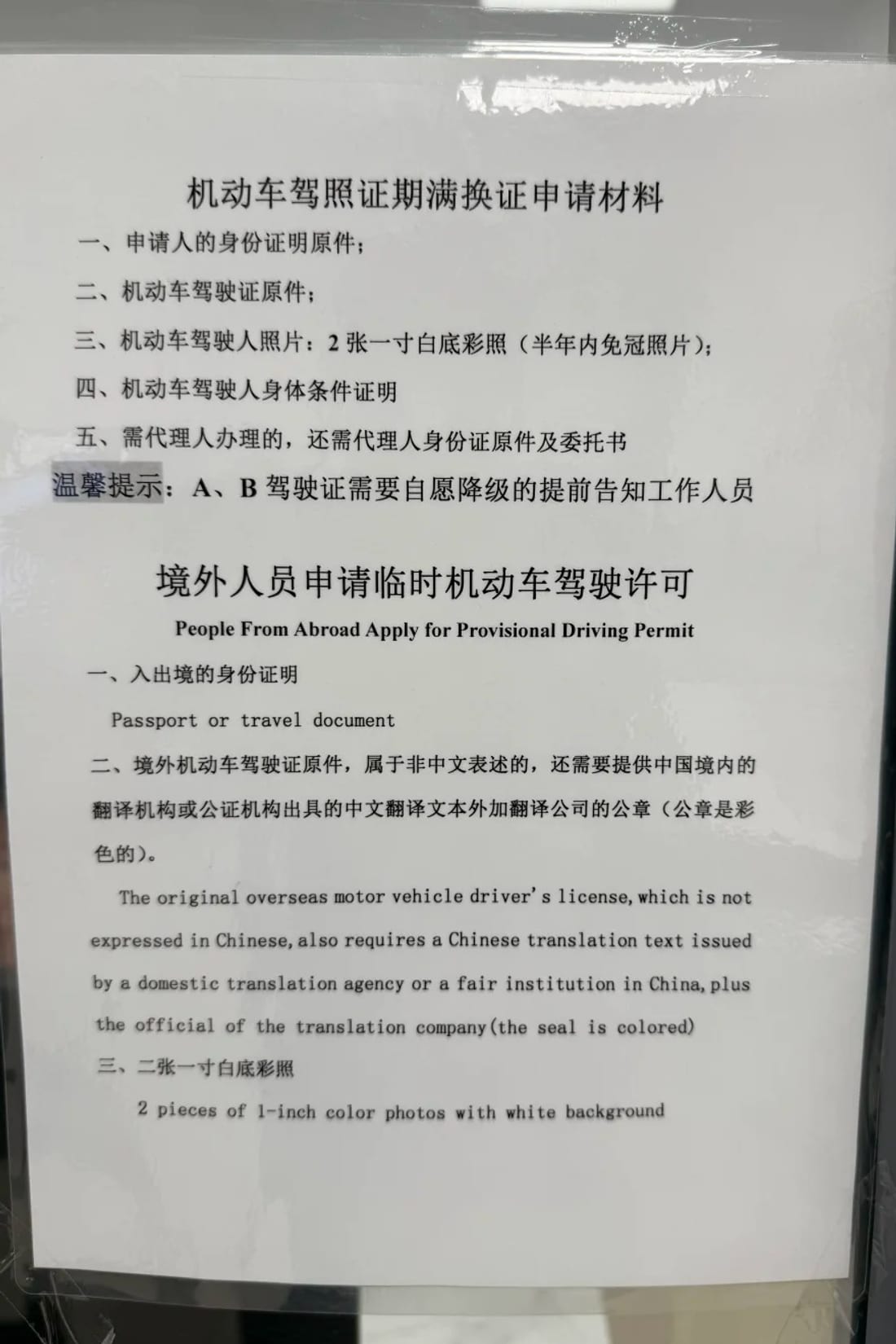
- A certified Chinese translation of it — see the warning below
- Accommodation registration — the paper certificate from the local police station, not a hotel booking confirmation. Our lodging registration guide covers how this works and when the hotel has already done it for you.
- Two 1-inch white-background photos (some offices can take them on site)
- A medical certificate — waived in Beijing for small cars and motorcycles, which covers most visitors
The translation is what gets people turned away
Travellers consistently report the translation as the single most common reason for being refused at the counter. It has to come from a translation agency or notary office inside China, and it has to carry that company’s official seal. The posted notice adds a detail almost nobody mentions: the seal must be in colour — a black-and-white photocopy of a sealed translation is not accepted. A translation done by a friend, or bought cheaply from an online marketplace, is refused, and some cities accept only specific designated agencies. A few cities, Shanghai among them, have begun offering an online route where you email a photo of the licence, pay online, and collect the translation with the permit.
It only covers a rented car
This is the part most write-ups get wrong, and it changes trips: the temporary permit does not let you drive a Chinese friend’s private car. The issuing authority states it plainly, in English, on the screen at the desk where the permits are handed out — temporary driving permits are for rented small cars (C1) or small automatic cars (C2) only.
Two consequences follow, and both catch people out:
- Borrowing is out. A friend’s car, a family member’s car, a company car — none of them are covered. If that is your plan, the temporary permit is the wrong document and you need the full licence exchange below.
- Your home entitlements do not travel. The permit is capped at C1/C2 — small car and small automatic — whatever your own licence allows. A motorcycle endorsement or a minibus category does not come with you. This matches Article 12 of Order 90, which sets the same limit for the rental case.
Travellers do report driving family cars in some cities without being stopped, and enforcement is not uniform across the country. That is worth knowing, but it is not a basis for planning: the roadside consequence if it goes the other way is unlicensed driving, with the void-insurance problem below attached to it.
Staying longer: the full exchange
If you are in China on a work, study or family visa, the full exchange is usually the better path — and for ordinary car categories it is less work than people fear, because there is no road test. You sit the theory exam only.
There are two separate conditions, and they are routinely confused:
- Your visa or residence permit must cover a stay of more than three months, and you need accommodation registration.
- When you obtained your foreign license, you must have been resident in the issuing country for at least 90 days cumulative within one year (Article 20). This one is about where you were when you got the license, not about your time in China. It exists to block licenses acquired on short trips to permissive jurisdictions, and it is the most common reason an application is rejected. Offices increasingly read the 90 days as cumulative across a year rather than continuous, so a trip home in the middle does not automatically disqualify you — but you will be asked for entry and exit records to prove it, and several offices reject app-generated records in favour of the stamped paper version.
Learner and probationary licenses cannot be exchanged. Article 109(3) explicitly excludes learner, temporary and probationary licenses from the definition of an overseas license — so L-plate and P-plate holders from Australia, New Zealand and elsewhere are out, regardless of how long they have been driving.
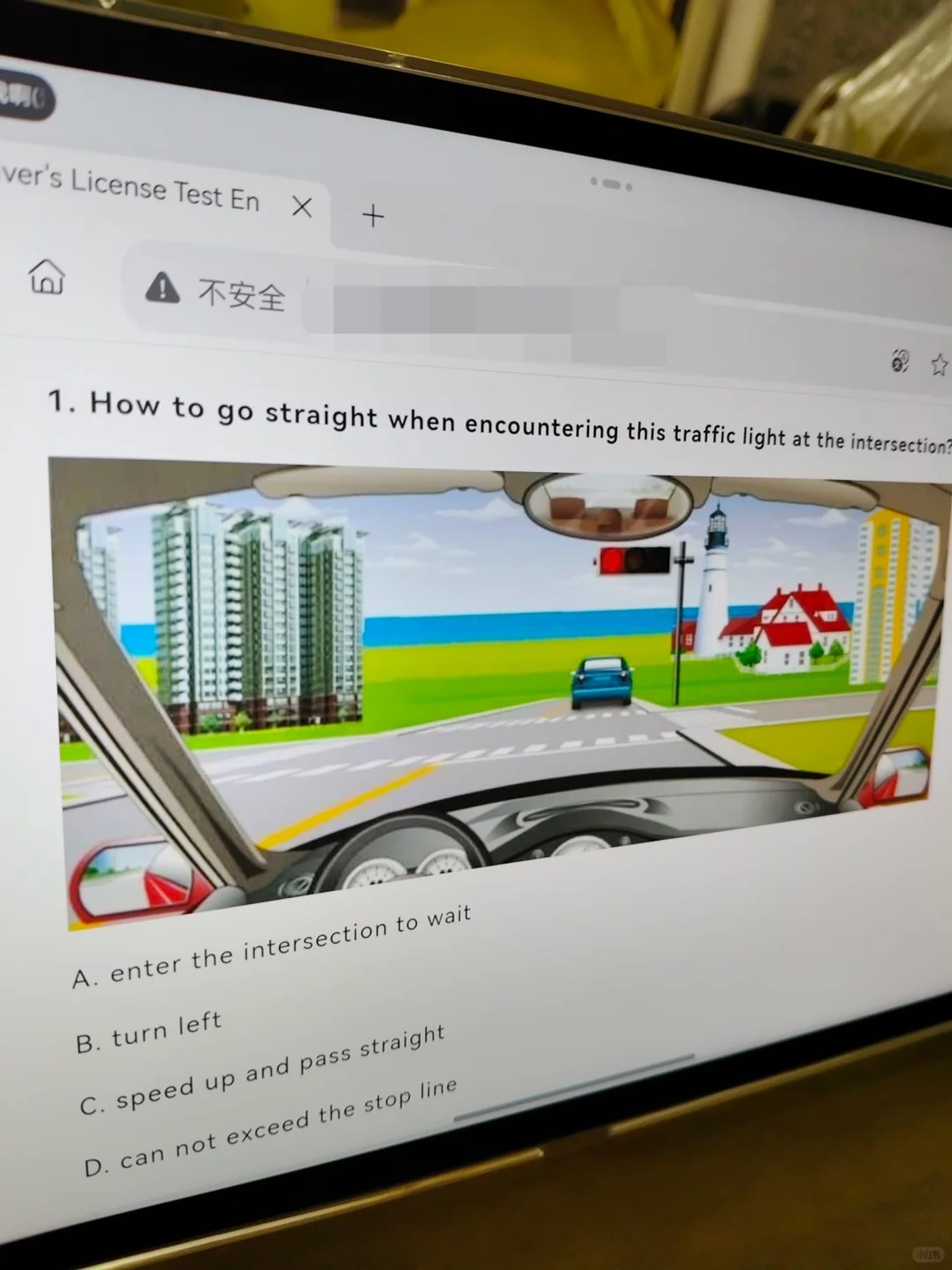
The theory exam, Subject 1, is available in 15 languages, including English, French, Russian, Japanese, German, Korean and Arabic. It is 100 questions in 45 minutes and the pass mark is 90 out of 100, with two attempts per booking. Travellers describe a question bank of roughly 1,300–2,200 items and two or three days of practice on a test app as enough, with booking, testing and collection often done in a single day for around ¥200–300. The pass mark is high, but the material is finite and memorizable — the difficulty is diligence, not driving skill.
The four countries that skip the test
China has mutual-recognition agreements with exactly four countries, whose licenses can be exchanged without sitting the theory exam:
Belgium
比利时
exam-free exchange
UAE
阿联酋
in force 14 Mar 2016
France
法国
in force 17 Aug 2021
Serbia
塞尔维亚
in force 13 Mar 2022
France’s agreement is the most generous and is worth spelling out, because it is two-tier. A French license holder staying under a year gets a temporary driving permit that is exempt from both the medical exam and the test. A French license holder resident over a year gets an exam-free exchange for a full Chinese license.
Everyone else — the United States, the United Kingdom, Canada, Australia, India, Singapore, Germany, Japan — takes the theory exam. The Ministry of Public Security has said it intends to widen the list, but has announced no additions. Until a new country appears on an official public-security page, treat “newly recognized” claims as advertising.
What it costs you to skip all this
Article 99 of the Road Traffic Safety Law sets the penalty for driving without a license at a fine of ¥200–2,000, which may also carry detention of up to 15 days. The vehicle can be impounded until someone licensed comes to collect it.
But the fine is not the number that should decide this. Motor insurance — both the compulsory policy and any commercial cover — is void for unlicensed driving. If you cause an accident while driving on an IDP or a bare foreign license, you are personally liable for the other party’s vehicle damage and medical costs, with no insurer behind you. That is the asymmetry worth internalizing: the permit costs ¥10 and a morning, and the thing it protects you from is unbounded.
Rules that surprise foreign drivers
- China drives on the right, with left-hand-drive vehicles. Drivers arriving from the UK, Ireland, Australia, New Zealand, Japan, Singapore, India, Malaysia, Hong Kong or Macau are switching sides.
- Drink-driving starts at 20 mg/100 ml — roughly one drink, and far below US or UK limits. Under GB19522-2024, in force since 1 August 2024, 20 up to 80 mg/100 ml brings a six-month suspension and a ¥1,000–2,000 fine. At 80 mg/100 ml and above it becomes a criminal offence — one to six months’ detention, a fine, and a five-year ban. There is no leniency for foreign drivers, and a conviction brings consular notification and visa consequences.
- The minimum driving age is 18, and unlike most countries there are also upper age limits, which vary by vehicle category.
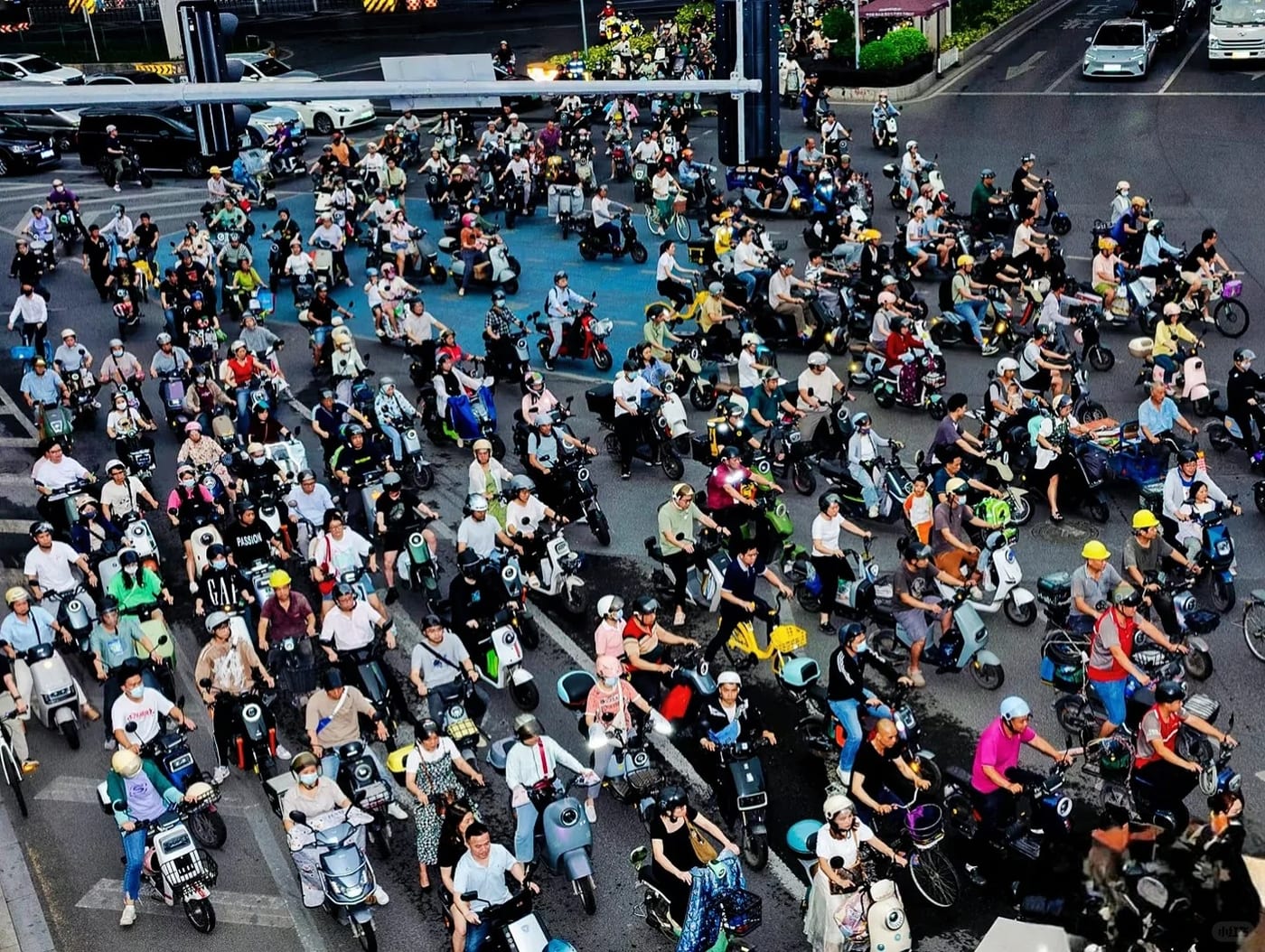
- Electric scooters are everywhere and follow their own physics — they appear from the wrong direction in bike lanes, at crossings, and at night without lights. Travellers new to Chinese roads consistently name this, not the traffic rules, as the genuine adjustment.
Is it worth it at all?
For a normal two-week trip, honestly: probably not. The permit costs a morning, the rules are built around renting rather than borrowing, and China has the most comprehensive high-speed rail network in the world sitting right there. On the corridors most visitors actually travel, driving is slower door-to-door, more stressful, and no cheaper.
Driving earns its place in specific cases: rural Yunnan and Guizhou, stretches of Xinjiang and Inner Mongolia, and any itinerary that is genuinely point-to-point away from the rail network. If your trip is a circuit of cities, the permit buys you a car you will mostly leave parked. Our high-speed rail overview and the rail route map are the faster answer for most routes.
FAQ
Can I drive in China with an International Driving Permit?
No. Mainland China does not recognize the International Driving Permit in any form — not on its own and not alongside your home license. China is not a party to the 1949 Geneva or 1968 Vienna road-traffic conventions, which are what make an IDP mean anything, so there is no legal basis for accepting one. Driving on an IDP is treated as driving without a license, not as a paperwork problem. Be careful here: this is one of the few China travel questions where paid advertising actively pushes the wrong answer, because IDP-issuing services bid on exactly this search.
What do I actually need to drive legally in China as a visitor?
A Chinese temporary driving permit (临时机动车驾驶许可). Article 21 of the Ministry of Public Security's licensing regulation (Order 162, as amended by Order 172, in force 1 January 2025) states that a holder of an overseas license who needs to drive temporarily must apply to a vehicle administration office: short-term entrants can get a permit valid three months, and those staying more than three months can have it extended to up to one year. It is issued the same day in most cities, costs ¥10 in Beijing, and several airports have desks that issue it on arrival.
Can I get the permit at the airport when I land?
In some cities, yes. Beijing Capital Airport has a vehicle-administration service station in Terminal 3-C, level 1, opposite Gate 7 on the west side, open Monday–Friday 08:30–11:30 and 13:30–16:30 excluding public holidays. Beijing Daxing also has one. Shanghai handles it through the traffic-police divisions of the airport Public Security Bureau at both Hongqiao and Pudong, open 09:00–11:00 and 13:00–16:00 on weekdays but mornings only on Friday. Those Friday and lunchtime gaps matter — a mistimed landing means the desk is shut. Most other airports have no such desk and you go to a city vehicle-administration office instead.
Can I use the temporary permit to drive my friend's car in China?
No. The temporary driving permit covers rented vehicles only. The Beijing traffic police state it in English on the information screen at the desk where the permits are issued: temporary driving permits are for rented small cars (C1) or small automatic cars (C2) only. That rules out a friend's car, a family member's car and a company car, and it also caps you at a small car or small automatic regardless of what your home licence entitles you to drive — a motorcycle or minibus category does not carry over. Article 12 of Order 90 sets the same C1/C2 limit for the rental case. Some travellers report driving family cars in other cities without being stopped and enforcement is not uniform, but if it goes against you the offence recorded is unlicensed driving, which also voids the insurance on the car. If driving a private car is the plan, you need the full licence exchange instead.
Does my Hong Kong, Macau or Taiwan license work in mainland China?
No. Article 109(3) of Order 162 defines an 'overseas driving license' to include licenses issued by foreign countries and by the Hong Kong and Macau Special Administrative Regions and the Taiwan region. All of them are treated the same way: you need the temporary permit or a full exchange to drive on the mainland. This surprises a lot of people who assume a Hong Kong license covers a Shenzhen or Guangzhou road trip.
How do I exchange my foreign license for a full Chinese one?
You need a visa or residence permit covering a stay of more than three months, plus accommodation registration, plus a separate and frequently misunderstood condition: Article 20 requires that at the time you obtained your foreign license you had resided in the issuing country or region for at least 90 days cumulative within one year. That rule is about where you were when you got the license — it is not a China-residence requirement, and it exists to block licenses bought on short trips abroad. Ordinary car categories then sit only the theory exam (Subject 1); there is no road test. Learner and probationary licenses (L and P plates) cannot be exchanged at all.
What language is the Chinese theory test in, and how hard is it?
Subject 1 is offered in 15 languages including English, French, Russian, Japanese, German, Korean and Arabic. It runs 45 minutes, has 100 questions, and you need 90 out of 100 to pass, with two attempts per booking. Traveller reports describe a question bank of roughly 1,300–2,200 items, two or three days of practice on a test app, and same-day booking, testing and collection, for a total of around ¥200–300. The pass mark is high but the material is memorizable.
Which countries can exchange their license without taking the test?
Exactly four: Belgium, the United Arab Emirates, France and Serbia. The UAE memorandum took effect on 14 March 2016, the France agreement on 17 August 2021, and the Serbia agreement on 13 March 2022. France's is two-tier — a stay under one year gets a temporary permit exempt from both the medical exam and the test, while residence over a year gets an exam-free exchange for a full Chinese license. The Ministry of Public Security has said it intends to expand the list but has announced no additions. Treat any claim that a batch of Schengen countries has been added as marketing rather than policy until it appears on an official public-security page.
What happens if I just drive on my foreign license anyway?
Article 99 of the Road Traffic Safety Law sets a fine of ¥200–2,000 for driving without a license, and it may also carry detention of up to 15 days. The vehicle can be impounded until a licensed driver collects it. The fine is not the real exposure though — both compulsory and commercial motor insurance are void for unlicensed driving, so if you cause a crash you personally pay the entire cost of the other party's vehicle and medical treatment. For a visitor that is the difference between a bad afternoon and a life-changing debt.
What is China's drink-driving limit?
Under national standard GB19522-2024, in force since 1 August 2024, a blood alcohol concentration of 20 mg/100 ml up to 80 mg/100 ml counts as drink-driving and brings a six-month license suspension plus a ¥1,000–2,000 fine. At 80 mg/100 ml or above it stops being an administrative matter and becomes the criminal offence of dangerous driving: one to six months' detention, a fine, and a five-year ban. The 20 mg threshold is far lower than the US or UK limits — in practice roughly one drink. There is no exemption or leniency for foreign drivers, and a criminal conviction carries consular notification and consequences for your visa or residence permit.
Should I actually bother driving in China as a tourist?
For most short trips, no. The paperwork takes a morning, the permit is designed around renting rather than borrowing a car, and China's high-speed rail and big-city metro systems cover almost every route a visitor wants at a speed and cost that private driving cannot match. Driving earns its keep in specific situations: rural Yunnan, the Guizhou countryside, parts of Xinjiang and Inner Mongolia, and anywhere your itinerary is genuinely point-to-point off the rail network. If your trip is a city circuit, the permit is effort spent on a car you will mostly leave parked.
Sources
Checked July 2026 · Written from our own first-hand travel in China.