A worked example · this is what a free plan looks like
Ten days in Chongqing and Zhangjiajie
A city built on cliffs, two limestone day trips, then five days in the sandstone pillars the Avatar mountains were drawn from. One 2h06 train in the middle and no domestic flights. Every leg below names the station, the exit, the fare and the queue, so nothing has to be looked up while you are standing there.
This is one of our plans, published as an example. Yours would be built the same way and around your own answers — ask for one, it is free and we never book anything for you.
Updated · China for Travelers Editorial
Ten days
The whole trip at a glance — tap a day to jump to it
- 1ArriveChongqing
- 2Chongqingcity day
- 3Wulongday trip
- 4Dazuday trip
- 5→ Zhangjiajie2h06 rail
- 6ZhangjiajieTianmen Mtn
- 7→ Wulingyuanvalley walk
- 8Wulingyuanthe plateau
- 9Wulingyuanglass bridge
- 10Fly homeZhangjiajie
What we were told
Seven answers off the form. Everything below is downstream of them, which is the whole difference between a plan and a top-ten list.
| Who | Two adults |
|---|---|
| How long | Ten days |
| When | Shoulder season — spring or autumn |
| What kind of trip | Landscape and mountains, with some city |
| Pace | One main thing a day |
| Hotels | Mid-range |
| Been to China before | No — first trip |
And here is what each of those answers moved:
- “Landscape, with some city” is why Chongqing gets four days rather than eight. It is the launch pad — the Yangtze, the karst, the carvings — and then the trip commits to the mountains.
- “First trip to China” is why Day 1 spends its words on Alipay and WeChat Pay rather than on a sight. Nothing else in the ten days fails as expensively as arriving unable to pay for a taxi.
- “One main thing a day” is why the Avatar plateau gets Day 8 to itself. Its bottleneck is the cable-car queue coming down in the afternoon, which is exactly what a rushed day runs into.
- “Shoulder season” is why the fares here are the high-season ones. Wulong drops from ¥260 to ¥210 in November–February and Dazu from ¥140 to ¥120 in December–February, and a winter plan would say so.
Yours would be yours to change
A plan is a starting point, not a schedule. No day here depends on the one before it, so anything that does not appeal can simply be skipped — and if you would rather swap a city, add a night or drop a day trip, you say so and we rework it. There is nothing to pay, for the plan or for a change to it.
Do this first
Three things have to happen before you fly, and one of them is a station name.
The single most expensive mistake on this trip
Book these two before you fly
Set up payment at your own kitchen table
The shape
Four nights in Chongqing with two day trips out of it, one train east, then five nights in Zhangjiajie split between the city and the park. Two hotel changes in ten days, and the only long journey is the one in the middle.
Why Chongqing first. The intercity leg is a 2h02–2h53 G-train, so it is genuinely a half-day move rather than a lost day — but it lands you 32 km from the park gate with a 40-minute transfer still to do. Doing that on the way in, when you have already had four days to find your feet, is easier than doing it jet-lagged on arrival. It also means Zhangjiajie’s two timed-ticket days fall late enough that you can watch the weather before committing.
| Nights | Chongqing ×4, Zhangjiajie city ×2, Wulingyuan ×3 |
|---|---|
| Hotel changes | Two — Day 5 and Day 7 |
| Domestic flights | None |
| The one long leg | Chongqing East → Zhangjiajie West, 2h02–2h53, ¥191–261 second class, 17 trains a day |
| Day trips from Chongqing | Wulong Karst and Dazu — both out and back, bags stay put |
| Timed tickets to book ahead | Tianmen Mountain · the forest park (every entry) |
Fenghuang and Furong ancient towns were considered and left out. Furong sits on the rail line south-west toward Huaihua so it can be added as an exit day; Fenghuang is about four hours by road and wants a night of its own, which in a ten-day trip has to come out of the park. A different brief would get a different answer.
Day 1 — Arrive Chongqing
Land, settle, Hongyadong after dark
Land, get to the hotel, and do nothing ambitious. Chongqing is built on a peninsula between two rivers and almost nothing is flat — the first evening is for looking at it, not walking it.
Set up Alipay and WeChat Pay before you leave home — not on arrival. Binding a foreign card needs SMS verification and sometimes fails on the first try. Almost nothing in China takes cash any more, so this is the single thing that makes or breaks a first trip. We have written both processes up step by step, including which cards actually bind and what to do when verification fails.
Airport → the centre
- 1Chongqing Jiangbei (CKG) → Jiefangbei — Metro Line 10 from the terminal, then change — about 45–60 minutes for ¥7–9. A taxi is 25–40 minutes off-peak
- 2Which terminal — T3A takes most international arrivals and has its own metro station; check yours before you plan the transfer
Hongyadong after dark. The stilt-house complex on the cliff is the image people come for, and it is free. Two things decide whether you enjoy it. Arrive high and walk down — the top entrance is on floor 11, level with the street, and the crowd flows downhill. And for the photograph itself, do not stand at Hongyadong: cross to the Jiangbei side.
Hotel → Hongyadong
- 1For the building itself — Metro Line 1 or Line 6 to Xiaoshizi (小什字), exit 9, then a level ~450 m walk along Cangbai Road to the floor-11 top entrance
- 2For the photograph — Line 6 to Grand Theatre (大剧院) instead — exit 3 for the bridge deck, exit 4 for the riverside reflection pool
Getting back
- 1The lights go off at 23:00 — On the summer schedule; travellers report nearer 22:30 in winter. Qiansimen Bridge’s own lights die before the building’s, so the bridge shot has the earlier deadline
When the lights come on
Weekends and holidays only
Full detail on our site
Tonight, and why you cross the river to photograph it
Arrive high, walk down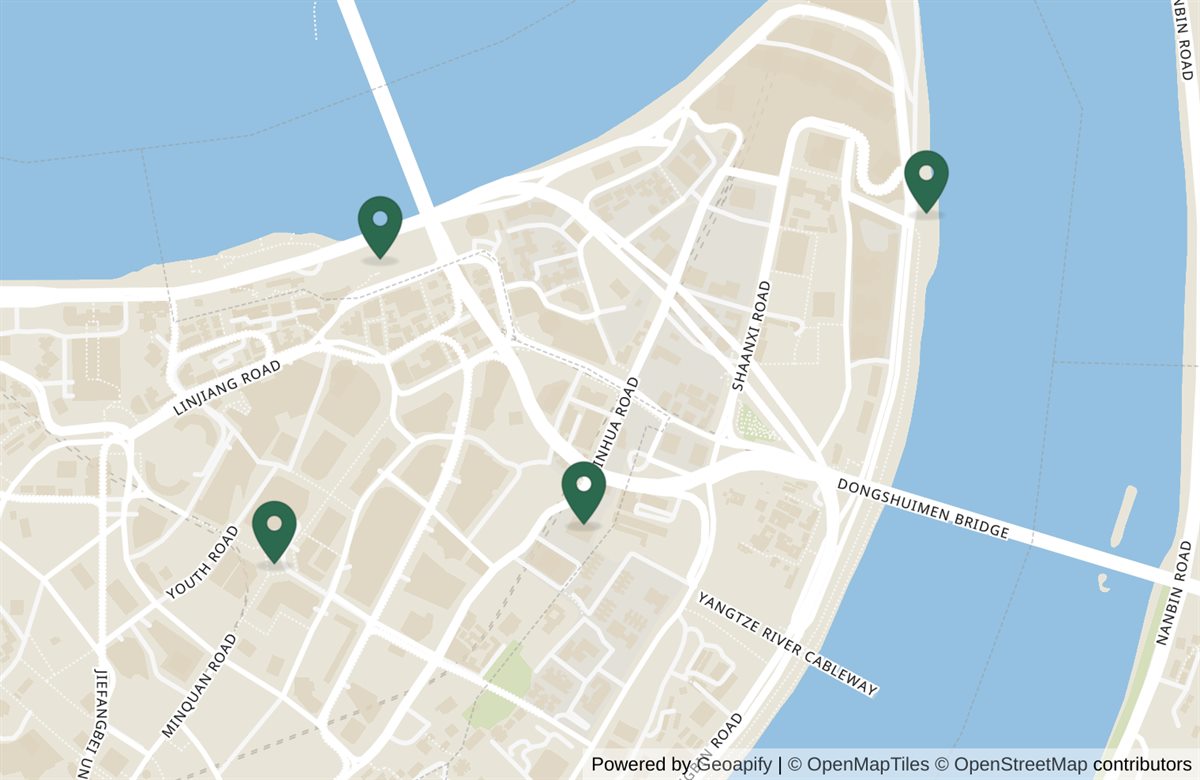 HongyadongHongyadongChaotianmen pierChaotianmenYangtze CablewayCablewayJiefangbeiJiefangbei
Sort this before you fly
A data eSIM for the first week
Install it before departure and it activates on landing. Keep your home SIM on roaming as well — a travel eSIM is data-only and cannot receive the SMS codes Alipay and WeChat send to verify you.
Where this plan sleeps
Four nights around Jiefangbei
Jiefangbei is the peninsula’s centre and it puts Hongyadong ten minutes downhill on foot, the Yangtze cable car within walking distance, and Metro Lines 1, 2 and 6 — the three you need for Liziba, the museum and the station — at the door. It is also the pick-up point for the Dazu coach on Day 4.
Day 2 — Based in Chongqing · no bags to move
Liziba, the Three Gorges Museum, a night on the water
One neighbourhood-hopping day on the metro, ending on the water. Nothing today needs a ticket booked in advance and two of the three stops are free.
Today across the city, and why it is three metro rides
Line 2, then Line 2 again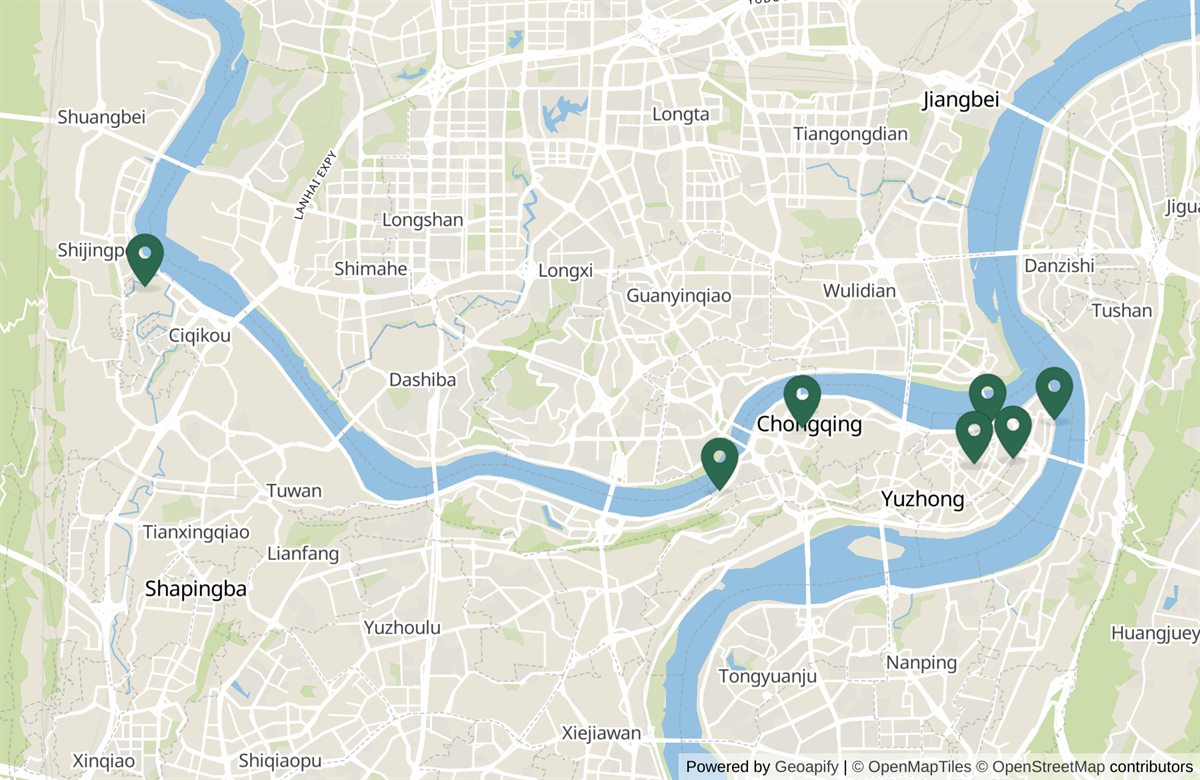 Ciqikou Ancient TownCiqikouLizibaThree Gorges Museum3 Gorges Museum
Liziba
Free
20–30 min
Three Gorges Museum
Free
2–3 h
Night cruise
¥158
45 min
Metro all day
¥2–7
per ride
Liziba first thing, and earlier than feels necessary. A working monorail passes through floors 6 to 8 of an occupied 19-storey tower. Trains come every 3–8 minutes, so waiting is never the problem — standing room is. Be in place by 8am on a weekday, 8:30at a weekend, ahead of the coach groups. The tempting compromise, 10 to 11:30, is a trap: the queue has already formed. From noon to 3pm you get the worst of both — peak crowds on a viewing platform with no shade at all, which in July and August matters more than the crowd does.
Jiefangbei → Liziba
- 1Metro — Line 2 to Liziba, about 10 minutes, ¥2
- 2At the station — Leave by exit 2 and follow the signs to 观景台 (guānjǐngtái, viewing platform) — it is about 65 m away against 105 m from exit 1, which loops around
- 3If you take a taxi instead — Name the platform 李子坝单轨穿楼观景平台 or the address 李子坝正街62号 — “Liziba metro station” reasonably lands you at the station entrance instead
Getting back
- 1Same line back — Line 2 returns you to Jiefangbei in about 10 minutes, or carries on to Zengjiayan for the museum
The station is a building site until December 2026
Then the Three Gorges Museum, which is free and is not on most itineraries. It faces the People’s Great Hall across the square and holds the Ba and Shu bronzes and the record of what the dam flooded. Start at the top floor and work down — the tour groups arrive mid-morning and work upward.
Liziba → the museum
- 1Metro — Line 2 to Zengjiayan (曾家岩), exit 3 — the entrance is about 120 m away and there is an underground passage, so you never surface into the heat or the rain
- 2Hours — 09:00–17:00, Tuesday to Sunday. The museum’s own notice puts last entry at 16:00 and clears the halls from 16:45
Closed Mondays — and everyone else will tell you to book
The evening: 45 minutes on the water. The night cruise is the one way to see both rivers, the cliffs and the lit skyline in one go, and it is the correct place to spend money on this day.
Three piers, and the last boat is a trap
If the sailing is cancelled
Book the day before
Two Rivers night cruise — ¥158 at the pier
The pier price is ¥158 for all three series; the booking platforms run ¥110–138 for the same 45 minutes, which is the rare case where the platform is genuinely cheaper than the window rather than the same. Book a 19:30–20:00 departure and check which pier the ticket names.
Day 3 — Out and back · sleep in Chongqing
Wulong Karst — the Three Natural Bridges
The first of two day trips, and the more spectacular one. Wulong’s Three Natural Bridges are three limestone arches standing over a sunken valley — you walk down into it, under all three, and back up. Four and a half to five and a half hours on site.
Why these are two separate days, not one
Opposite directions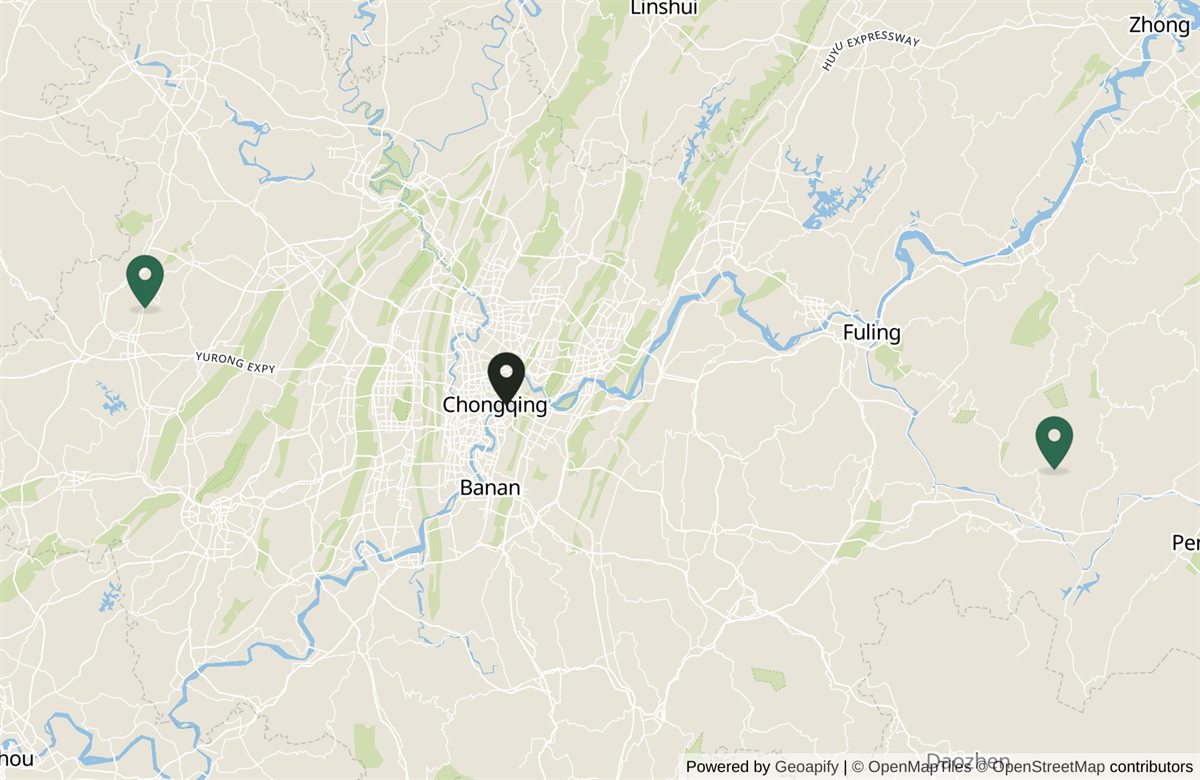 Dazu Rock CarvingsDazuWulong KarstWulongChongqingChongqing
Combined ticket
¥260
¥210 Nov–Feb
On site
4.5–5.5 h
walking down
From Chongqing
~2 h
each way
Booking
Timed slot
buy ahead
What the ¥260 is actually made of
If you only want one half
Tickets are timed-slot electronic ones bought ahead — the scenic area’s own site routes its ticket link to an online platform rather than a window, so there is no “just turn up and pay” option to fall back on.
Timed slot — book ahead
Wulong Karst tickets and day tours
Both the entry ticket and the door-to-door day tours are sold here in English. A tour solves the transport, which is the awkward part of this day; the tickets alone work if you would rather run it yourself.
Full detail on our site
Day 4 — Out and back · sleep in Chongqing
The Dazu rock carvings
Something completely different: 1,200-year-old cliff carvings, tens of thousands of figures cut into sandstone in the hills west of the city. Dazu is on the UNESCO list for Baodingshan — the 31 m reclining Buddha and the thousand-armed Guanyin.
Combined ticket
¥140
¥120 Dec–Feb
Hours
09:00–18:00
last entry 16:30
Coach
~3 h
¥48 one way · back 16:00
On site
2–4 h
depends on both sites
How to actually get there
- 1The easy way — A tourist coach from Jiefangbei (08:00) or Hongqihegou (08:30) to the Baodingshan visitor centre — ¥48 one way, ¥78 return. A 30-minute stop at 昌州古城 is part of the fare, so allow three hours
- 2Baodingshan → Beishan — 10.6 km, about 18 minutes by taxi (~¥30), or the flat-fare ¥3 大足旅游公交专线 — there is no scenic-area shuttle
Getting back
- 1Leave time for the coach back — Ticket checking stops at 16:30 and the site closes at 18:00 — work backwards from the last coach, not from closing time
Do not take the train, whatever the map suggests
One site or both
It caps its numbers
Sells out on high-season weekends
Dazu rock carvings — tickets and coach tours
Tickets and guided day trips both sold here in English. A tour is worth more than usual on this day, because the carvings are dense with iconography that the site’s own labelling assumes you already know.
Full detail on our site
Day 5 — Changing cities · check out this morning
Ciqikou, then the train east
Check out, one last Chongqing morning, then the train east. Ciqikou is a Ming and Qing port village on the Jialing, twenty-something metro minutes from the centre — the right size for a morning with bags in left luggage.
Hotel → Ciqikou
- 1Metro — Line 1 to Ciqikou, exit 1 — 35–55 minutes from the centre, ¥4–5
- 2Which archway you use matters — The nearest arch (金蓉门, ~230 m) puts you into the rebuilt back street. The old core’s own entrance is the couplet archway 黄桷坪牌坊, 720 m east, most of it along the 磁器口步行街
Enter by the far archway
Then back for the bags and out to the station. Give yourself more time than the journey needs — Chongqing East is 35 minutes from Jiefangbei on a single metro line, and a foreign passport means the staffed ID desk rather than the automatic gates, which has its own queue.
Three main stations, and only one of them is yours
重庆东站, not 重庆北站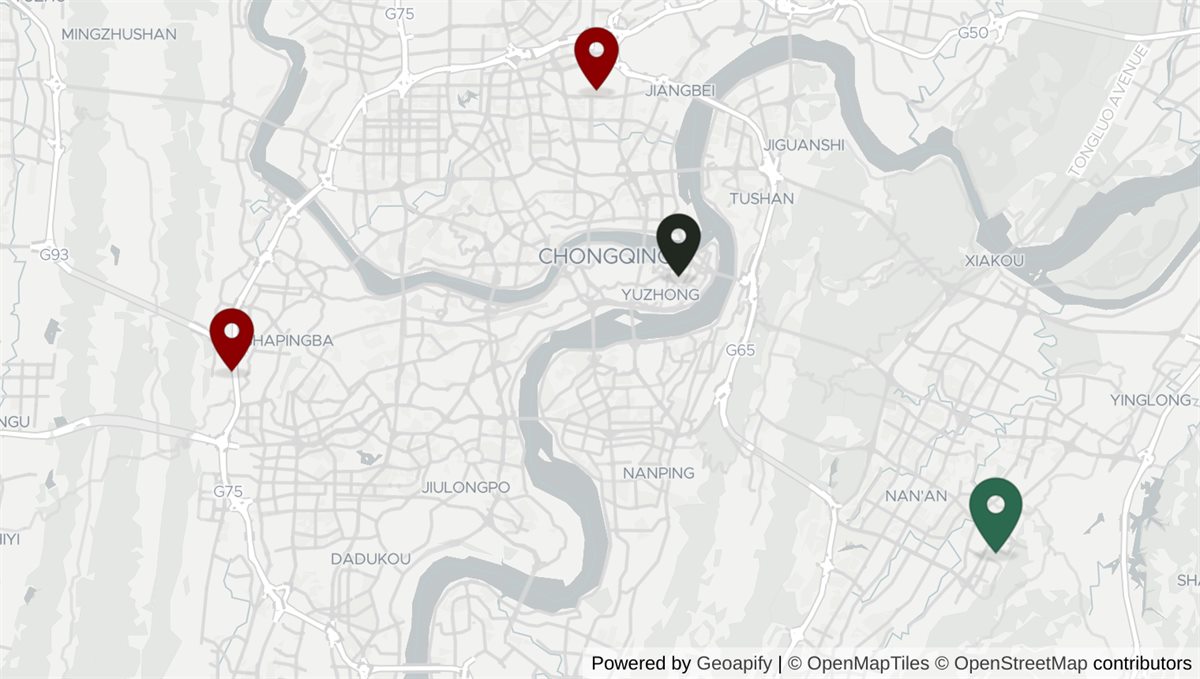 Chongqing EAST 重庆东站 · your trainEAST 重庆东站Chongqing North 重庆北站North 重庆北站Chongqing West 重庆西站West 重庆西站Jiefangbei 解放碑 · where this plan sleepsJiefangbei
Chongqing East → Zhangjiajie West
- 1Hotel → the station — Metro Line 6 to Chongqing East (重庆东站) — about 35 minutes from Jiefangbei. Line 6 is the only line that serves it; Lines 24 and 27 are still under construction
- 2At the station — Allow 45–60 minutes. Foreign passports use the staffed ID lane, not the automatic gates
- 3The train — G-train, 2h02–2h53 depending on the service, ¥191–261 second class. 17 a day, first 07:02, last 19:35
- 4Arriving — Zhangjiajie West (张家界西站) — about 30 minutes from the city and roughly 40 to Wulingyuan
Getting back
- 1If you miss it — Seventeen trains a day is a genuine safety net — the gap between departures is rarely more than an hour and a half. But the last one leaves at 19:35, and there is nothing after it
Two station names, both easy to get wrong
Opens about 15 days ahead
Chongqing → Zhangjiajie, 2h02–2h53
The same seats and the same fares as the state system, in English, without the foreign-passport friction of booking direct. Pick an early-afternoon departure and check that the origin reads Chongqing East.
Two nights, then you move again
Zhangjiajie city, near the cable-car base
Tomorrow is Tianmen Mountain, whose base station is in the city beside the old central railway station — so these two nights belong downtown rather than out at the park. On Day 7 you move to Wulingyuan and stay put for the rest of the trip.
Day 6 — Based in Zhangjiajie city
Tianmen Mountain and Heaven’s Gate
Tianmen Mountain is Zhangjiajie’s second headline sight and a separate mountain from the forest park — a cliff-top plateau above the city with a natural arch punched through it, reached by what is usually billed as the world’s longest passenger cableway. It is a full day and it starts in town.
Why Zhangjiajie is two bases, not one
You arrive in the middle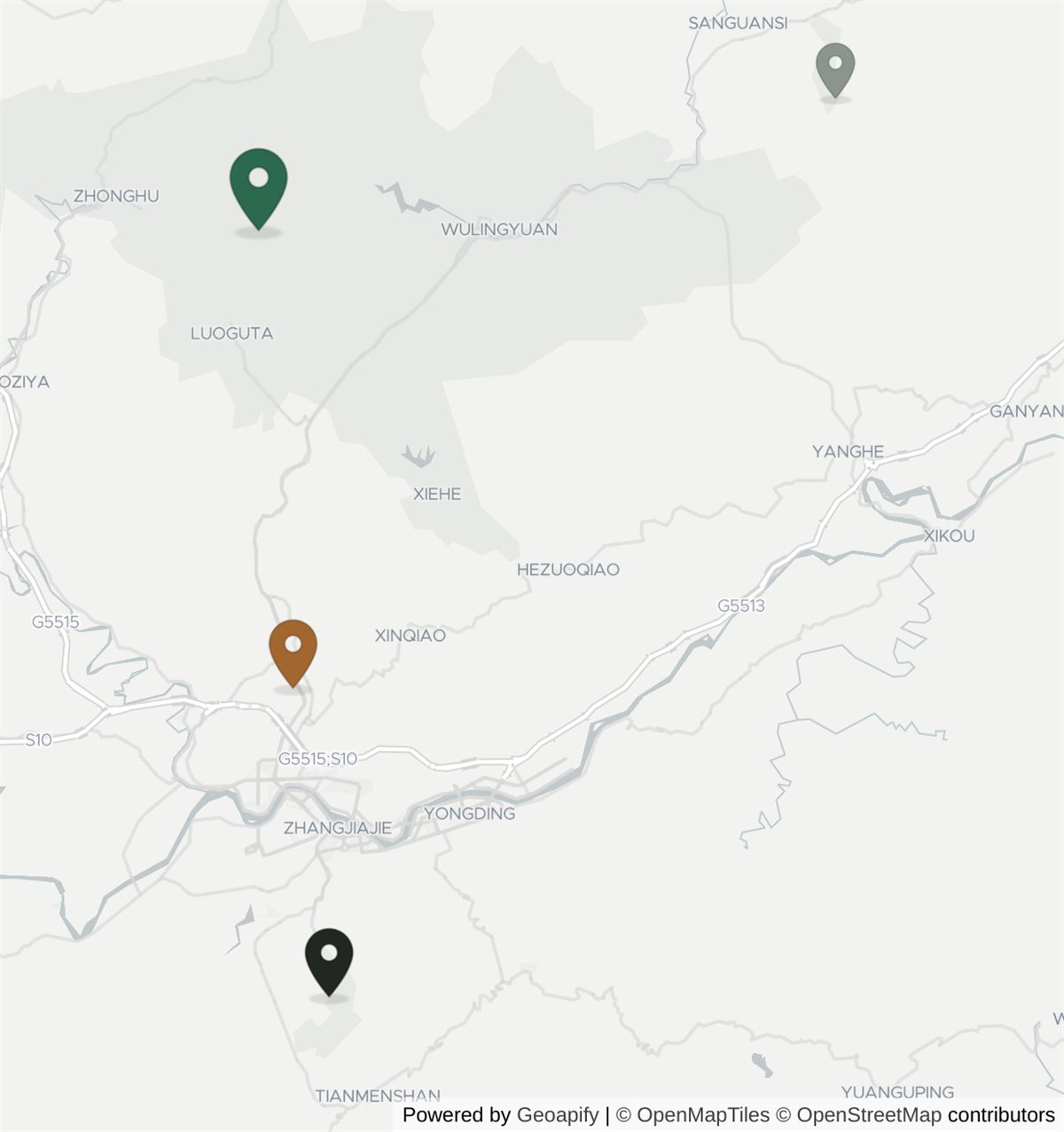 The forest park · Wulingyuan 武陵源The park 武陵源Grand Canyon glass bridge 玻璃桥Glass bridgeZhangjiajie West 张家界西站West stationTianmen Mountain 天门山 · in the cityTianmen 天门山
Combined ticket
¥288
everything included
Base station
In the city
by the old station
Booking
Real-name
timed slot
Tickets drop
08:00
~7 days out
Hotel → the cable-car base
- 1Taxi — 5–15 minutes, ¥15–30 — the base station sits next to the central (old) railway station, in the city itself
- 2What ¥288 covers — Admission, the lower cableway, the express cableway, the shuttle buses and the through-mountain escalators — there is nothing else to buy on the mountain
A-line and B-line use different entrances
The upper cableway is gone, and most sources have not caught up
What you came up for
Sells ~3 days ahead in peak season
Tianmen Mountain — the ¥288 combined ticket
Booked in English against your passport, which is the point: the official 张家界一机游 mini-programme is Chinese-only. Tickets release at 08:00 about seven days out, and Golden Week brings two-to-three-hour queues even with a ticket in hand.
Full detail on our site
Day 7 — Moving to the park · one short hop
Into Wulingyuan, then the Golden Whip Stream
A short move and then a flat walk — the easiest day of the ten, and placed here on purpose. You change hotels into Wulingyuan, the town at the park’s east gate, and spend the afternoon on the valley floor rather than fighting a cable-car queue with your bags still in reception.
Zhangjiajie city → Wulingyuan
- 1Coach or car — About 40 minutes — the park is roughly 32 km from the city
- 2Where you are going — Wulingyuan town, beside the east (Wujiayu) gate. Bags stay here for the next three nights
Then the Golden Whip Stream. It is the one part of the park that needs no cable car and no lift: a level path following a stream along the bottom of the sandstone pillars, looking up at what you will be standing on top of tomorrow. It is covered by the park pass, so today is also the day that pass starts.
Buy the park pass today, and set up tomorrow's entry at the gate
Keep food out of sight
8–10am slots go first
The four-day park pass — ¥236
Bought in English against your passport, with the first timed slot included in the purchase. Peak morning slots and the Golden Week / May Day weeks sell out; the rest of the year the pass is available a day or two ahead.
Three nights, no more moves
Wulingyuan, at the east gate
Staying in Wulingyuan rather than the city is what makes a 07:00 gate opening possible on Day 8 — from the city it is a 40-minute drive before you even queue. The glass bridge on Day 9 is also closer from here.
Day 8 — Based in Wulingyuan
The Avatar plateau — Yuanjiajie and Tianzi Mountain
The day the trip was built around. Up the Bailong Elevator to the Yuanjiajie plateau, along to the Avatar Hallelujah pillar and the No. 1 Bridge Under Heaven, then across to Tianzi Mountain for the widest panorama in the park and the cable car down.
Gate opens
07:00
last entry 17:00
Bailong Elevator
¥65
one way, up
Tianzi cable
¥72
one way, down
Eco-buses
Free
in the pass
Be at the gate for 07:00 — this is the whole reason the day exists
The loop, in order
- 1East gate → Bailong Elevator — Free eco-bus, 20–25 minutes, to the lift base at Shuiraosimen (水绕四门)
- 2Up — The elevator climbs 326 m to the Yuanjiajie plateau in about 90 seconds. Peak hours ~07:00, off-season from ~08:30; last queue around 17:15
- 3Across the plateau — Yuanjiajie for the Avatar pillar and the No. 1 Bridge, then the plateau eco-bus 20–30 minutes to Tianzi Mountain
- 4Down — Tianzi Mountain cable car, ¥72 one way
Getting back
- 1⚠️ The eco-buses run in three unconnected segments — Coming DOWN the Tianzi cable you have to walk to Shuiraosimen (水绕四门) to transfer toward Golden Whip or Yangjiajie — the network does not join up the way a metro map would
- 2Be at the cable station by mid-afternoon — It normally runs to 17:00–17:30, but on peak days the last descent can be pulled forward to 16:00 or even 14:00
Both lifts are intermittent — have the other one in mind
Why up the lift and down the cable, not the reverse
Full detail on our site
Day 9 — Out and back · sleep in Wulingyuan
The Grand Canyon glass bridge — or a second bite of the park
A choice, and both answers are good. The Grand Canyon glass bridge is a separate ticketed attraction east of Wulingyuan; the alternative is that your four-day pass is still valid, and the quiet side of the park is a genuinely better day than a queue.
Glass bridge
~¥178
B-line, bridge + canyon
Bridge only
~¥138
C-line
Canyon only
~¥53
A-line
Or the park
¥0 extra
pass still valid
Option A — the glass bridge. A 300 m-high glass-floored span across the Zhangjiajie Grand Canyon, on its own timed ticket. The B-line at about ¥178 covers the bridge and the canyon walk below it; ~¥138 buys the bridge alone and ~¥53 the canyon alone. Each of those figures is the bare fare plus ¥3 of voluntary insurance.
Option B — a second bite of the park. Yangjiajie is the quiet neighbour of the Avatar plateau with its own cable car (¥76 one way, ¥152 return) and far fewer people; Huangshizhai (¥65 one way) is the classic viewpoint above the west gate. Both are covered by the pass you already own, and both need that fresh entry reservation again.
Which we would pick
Timed slot — book the day before
Zhangjiajie Grand Canyon glass bridge
Book the slot ahead and arrange the ride back at the same time — this is outside Wulingyuan and walk-up transport at the end of the afternoon is thin.
Day 10 — Fly home
Out through Zhangjiajie, or the train to Changsha
Two ways out, and they are not equally good for everyone. Zhangjiajie has its own airport, and it also has a fast train to Changsha, which has a much bigger one.
Option A — fly from Zhangjiajie Hehua (DYG)
- 1The airport — Small, close to the city, and thin on international connections — it is the right answer if it happens to fly where you are going
- 2From Wulingyuan — Allow about an hour to reach it, plus the usual check-in
Option B — the train to Changsha, then fly
- 1Zhangjiajie West → Changsha — About 40 trains a day, 1h45–2h32, roughly ¥138–166 second class — the direct line north-west via Changde
- 2⚠️ It arrives at Changsha main station, not Changsha South — These are different stations 10 km apart. Changsha main (长沙站) is the one on the fast Zhangjiajie line; Changsha South (长沙南站) is the national HSR hub
- 3Changsha main → the airport — Metro Line 2 to Changsha South, about 18 minutes of riding for ¥3, then the maglev, which arrives beside it, out to Huanghua (CSX)
Do not book Zhangjiajie to Changsha South
If you have a spare day at the end
Check the station name, not just the city
Zhangjiajie → Changsha
Book the service into Changsha (长沙站) rather than Changsha South unless you have a reason to prefer the hub — it is faster and about half the price.
Practical, all trip
| Visa | Depends on your passport, and it is the first thing your own plan would answer. Dozens of nationalities now enter visa-free, and most of the rest qualify for 240-hour visa-free transit. |
|---|---|
| Passports | Carry the originals every day. Every ticket here is real-name, and stations, park gates and museums all check. |
| At any station | Allow 45–60 minutes. A foreign passport means the staffed ID desk rather than the automatic gates, and it has its own queue. |
| Payment | Alipay or WeChat Pay with a foreign card, set up before you fly. The park shuttles and the cable cars do not take cash. |
| Booking diary | Flights first · Tianmen Mountain ~7 days ahead at 08:00 · the park pass a day or two ahead, and the SECOND entry arranged at the gate on day one · Wulong and Dazu ahead in high season · the night cruise the day before |
| Closing days | The Three Gorges Museum closes Mondays. The mountains do not close, but their lifts do — Tianmen’s upper cableway is out of service entirely, and both Zhangjiajie lifts run intermittent maintenance. |
| Weather | Chongqing is brutal in July and August — above 40 °C is normal and the whole city moves indoors. Zhangjiajie’s pillars are best with mist, which means the shoulder seasons; winter brings ice on the walkways and occasional cable closures. |
| Altitude | None to speak of. The plateau tops out around 1,300 m and everything hard about it is stairs, not air. |
Not confirmed
Things a real plan would pin down against your actual dates, and which an example cannot:
- Which lifts are running. Both Zhangjiajie lifts and Tianmen’s cableways go in and out of maintenance, and the schedules are published in Chinese at short notice. We check them against your dates rather than assuming.
- Hongyadong’s passport lane. The reservation system is documented as taking a Chinese ID card, and the staffed manual lane at the gate is traveller-reported rather than officially published. It works; it is not written down.
- The Dazu coach timetable. The coach runs from Jiefangbei and Hongqihegou at ¥48 one way, with a single 16:00 return, but its times shift seasonally and we would confirm the first and last runs for your day rather than print a guess.
- Which Chongqing airport terminal you land at. It changes the transfer, and it is on your ticket rather than in our data.
How this is made
Every fare, duration and train count on this page is read out of our own rail dataset, and every ticket price, opening hour and closure warning out of our attraction records — not from memory and not from other people’s itineraries. Where a record carries a caveat, the day carries it too: that is why this plan tells you a cableway is demolished and a lift is intermittent, when the pages selling them do not.
A plan of your own is free, takes two or three minutes to ask for, and arrives at its own private address within a couple of days. We do not book anything for you and there is nothing to pay — for the plan or for changing it afterwards.
Would you rather have cities than mountains? There is a second worked example — ten days in Shanghai and Beijing, with Hangzhou, Suzhou and a water town as day trips.
Facts checked 8 August 2026. Background reading: the park, Tianmen Mountain, Wulong and the train between them.