Key takeaways
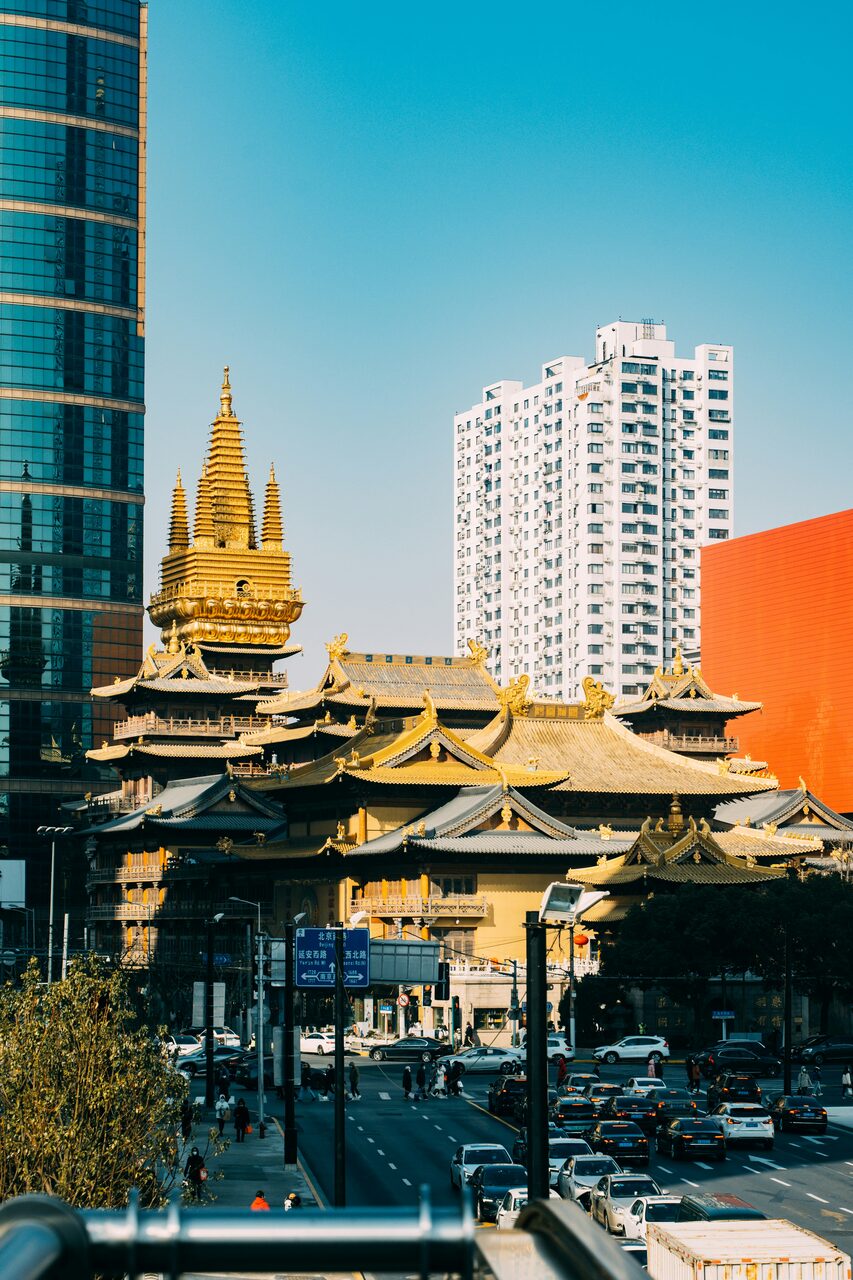
- It is a Buddhist temple ringed by 30-story office towers in Shanghai’s priciest shopping district — the contrast is the whole attraction.
- Metro Line 2, 7 or 14 to Jing’an Temple station, Exit 1; the gold-roofed gate is ~60 m away, directly above the station.
- ¥50 entry (includes 3 incense sticks), open 07:30–17:00 daily. For just the photo you don’t need a ticket — the free angles outside are grander.
- Inside: the Mahavira Hall with a 15-tonne silver Buddha, a camphor-wood thousand-armed Guanyin, the gilt pagoda, and the Ashoka pillar at the gate.
- Night lighting runs only Fri, Sat & public holidays (summer ~19:00–22:00, winter ~18:00–22:00) — go for the blue hour, and shoot from outside.
Is Jing'an Temple worth it?
Jing’an Temple (静安寺) ends up on almost every Shanghai itinerary, and it splits opinion. It is a Buddhist temple completely surrounded by 30-story office buildings, and the visual contrast — gold-leafed roofs and incense smoke against Tiffany & Co., LVMH and Plaza 66 — is the actual attraction. It gives the surrounding district (Jing’an, 静安区) and a major subway interchange their name.
The honest verdict from recent visitors is polarised. The complaints: it is small (an hour covers it) and commercialised. The praise: the CBD-meets-calm contrast genuinely lands, and the gold Mahavira Hall in sunlight is striking. So the practical call is this:
- Just want the photo? Don’t buy a ticket. The famous “ancient temple among skyscrapers” shot is better from the free spots outside — wider, grander, and you catch the towers behind.
- Want to go inside — to make an offering, or feel the contrast up close? Then ¥50 is fair. It is an active worship site with daily chants, not a museum.
How to get there
Metro Line 2 (green), Line 7 (orange) or Line 14 (pink) to Jing’an Temple station (静安寺). Take Exit 1. The temple’s mountain gate is about 60 metres away — the gold-roofed structure on the corner directly above the station. You literally cannot miss it.
| From | Route | Time · cost |
|---|---|---|
| The Bund | Line 2, 4 stops | ~25 min · ¥4 |
| People’s Square | Line 2, 3 stops | ~10 min · ¥3 |
| Lujiazui (Pudong skyline) | Line 2, 5 stops | ~20 min · ¥4 |
| Pudong Airport PVG | Line 2 direct | ~1 hr · ¥8 |
| Hongqiao Airport SHA | Line 2 direct | ~35 min · ¥6 |
| Xintiandi | Line 14 to Jing’an Temple direct | ~10 min · ¥4 |
Didi from People’s Square is ¥30–45 in moderate traffic, but slower than the subway in any rush hour. Walking from East Nanjing Road (the Bund-adjacent shopping street) is not recommended — it’s ~5 km and Nanjing Road is a pedestrian mob. The Shanghai city guide covers the wider metro map and where to base yourself.
Tickets, hours, and what's included
| Detail | What to know |
|---|---|
| Entry | ¥50 adult (~$7), technically an “incense-and-flower” ticket. Free on the 1st and 15th of the lunar month and on Buddha’s birthday. |
| Hours | Daily 07:30–17:00, last entry 16:30. Opens 04:30 on the 1st/15th and Buddha’s birthday for worshippers. |
| Chinese New Year | Open, but on a special pilgrimage arrangement with much higher prices (¥100 and up) and heavy local crowds. |
| Included | Three incense sticks per visitor at the entrance — so there’s no need to buy any from street sellers. All halls and floors. |
| Buying | At the gate — rarely a queue except major holidays. Pre-buy on Trip.com to skip the kiosk on Golden Week dates. |
What to see (in 90 minutes)
| Highlight | Time | What’s there |
|---|---|---|
| Ashoka pillar 阿育王柱 | 5 min | At the mountain gate: an 18-metre, 160-tonne granite pillar topped by a gilded four-lion capital. The photo everyone takes on the way in. |
| Mahavira Hall 大雄宝殿 | 25 min · main event | The signature hall — a bronze-tiled golden roof and, inside, a 15-tonne solid-silver Sakyamuni Buddha with an inlaid jade-and-coral relief behind it. The largest active worship space; you’ll see locals making offerings. No photos inside. |
| Guanyin Hall 观音殿 | 15 min | A 6.2-metre thousand-armed Guanyin carved from a single millennium-old camphor trunk — smooth, warm-toned, and rare at this scale. |
| Jing’an Pagoda 静安佛塔 | 15 min | A seven-storey Tibetan-style gilt pagoda covered in 868 relief Buddhas — the temple’s landmark tower, brilliant in daylight and lit at night on lighting evenings. |
| Bell tower + courtyards | 15 min | The bell tower and side chapels around the central courtyard. North gate exits onto West Nanjing Road for shopping; south gate puts you back at the subway. |
To attend a chant: morning chants run roughly 8:00–8:30 AM in the Mahavira Hall. Sit at the back, don’t photograph monks, no flash. Note this is not the separate Jade Buddha Temple (玉佛寺), which is ~5 km west and famous for a white-jade Buddha — a common mix-up.
Seeing it lit up at night
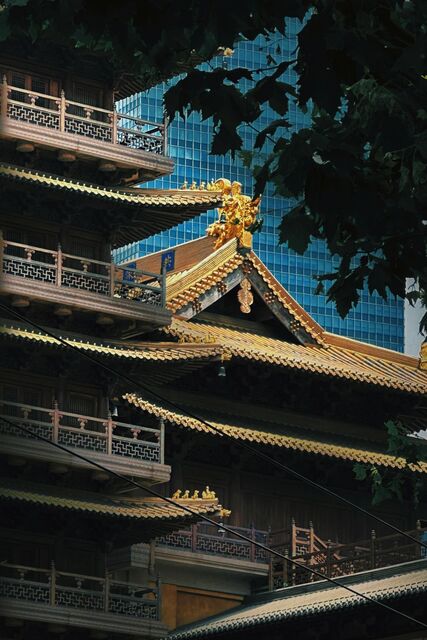
The temple lit gold against the dark towers is one of Shanghai’s best night shots — but don’t turn up on the wrong evening. The exterior lighting runs only on Fridays, Saturdays and public holidays, on a seasonal schedule:
- Summer (~April–October): lights on roughly 19:00–22:00.
- Winter (~November–March): lights on roughly 18:00–22:00.
- Best window: the blue hour, 15–30 minutes after the lights come on, when the deep-blue sky sets off the warm gold.
The best vantage points are all free and outside the temple:
- Huashan Rd × Yan’an West Rd footbridge — the panorama spot: golden roof, towers and car-light trails in one frame, full cyberpunk.
- Wheelock Square fountain pool (会德丰国际广场) — shoot low for the gold roof reflected in the water.
- Metro Exit 14 — riding the escalator down, the frame neatly boxes the temple’s eaves against the high-rises behind.
Timing and what to skip
- Best time. Arrive at 07:30 opening for a quiet visit with the golden roof in morning light, or after 3 PM once the tour groups thin out. Allow ~1 hour for a quick photo visit, 1.5–2 hours to go in, make offerings and eat at the vegetarian hall.
- The incense is included. Don’t buy incense from street sellers — three sticks come with your ¥50 ticket.
- Etiquette. No photos inside the halls; don’t step on the raised wooden thresholds; dress modestly (no vests or short skirts). It is an active place of worship.
- Skip the gift shop. The same Buddhist memorabilia as any tourist temple, marked up 3–4×.
How it fits into a Shanghai trip
Jing’an Temple is a 60–90 minute stop, not a half-day commitment. Three good combinations:
- Morning — 8 AM Jing’an Temple → walk 5 min to Jing’an Park → lunch on Anfu Road or around Plaza 66 (a short walk south).
- Afternoon & night — 4 PM Jing’an Temple → dinner in the French Concession → back for the blue-hour night shot on a Friday/Saturday when the temple is lit.
- En-route to/from Pudong Airport — 1 hr from PVG on Line 2; drop bags, then do Jing’an Temple as a first stop because it’s directly on the Line 2 route.
Pre-buy the ticket or a temple tourNASDAQ: TCOM
The ¥50 gate ticket rarely queues — but on Golden Week dates it does. Trip.com lists the Jing’an Temple ticket plus Shanghai temple-and-skyline tours, booked in English on a foreign card. (Only pay if you’re going inside — the outside photo is free.)
Frequently asked questions
Is Jing'an Temple worth the ¥50, or should I just see it from outside?
It divides visitors. The temple is small — an hour covers it — and the setting is commercialised, so some feel ¥50 is steep. But the appeal is the extreme contrast: gold-leafed halls and incense against a wall of glass office towers. Honest rule: if you only want the famous ‘ancient temple among skyscrapers’ photo, you do NOT need to buy a ticket — the free angles from outside are actually grander. Pay the ¥50 if you want to go inside to make an offering, or to feel that pocket-of-calm contrast up close.
What is the entry fee for Jing'an Temple?
¥50 for a standard adult ticket (about $7), technically an ‘incense-and-flower’ ticket that includes three sticks of incense — so there’s no need to buy any from street sellers. It is free on the 1st and 15th of the lunar month and on Buddha’s birthday. During Chinese New Year the temple runs a special pilgrimage arrangement with much higher prices (¥100 and up). You can buy at the gate — it rarely queues except at peak holidays — or pre-buy on Trip.com.
What time does Jing'an Temple open?
Open daily 07:30 to 17:00, last entry 16:30, year-round including Chinese New Year (busiest then). On the 1st and 15th of the lunar month and on Buddha’s birthday it opens earlier, at 04:30, for worshippers. The best times are 07:30 at opening — quiet, with the golden roof in morning light — or after 3 PM once the tour groups thin out.
How do you get to Jing'an Temple?
Metro Line 2, 7 or 14 to Jing’an Temple station (静安寺), Exit 1 — the temple’s mountain gate is about 60 metres away, the gold-roofed building on the corner directly above the station; you cannot miss it. From the Bund it’s ~25 min on Line 2; from People’s Square ~10 min on Line 2; direct on Line 2 from both airports (about 1 hour from Pudong, 35 min from Hongqiao).
What is there to see inside Jing'an Temple?
Four things stand out. The Mahavira Hall (大雄宝殿) has a bronze-tiled golden roof and, inside, a 15-tonne solid-silver Sakyamuni Buddha — the signature piece. The Guanyin Hall holds a 6.2-metre thousand-armed Guanyin carved from a single millennium-old camphor trunk. The Jing’an Pagoda is a seven-storey Tibetan-style gilt tower covered in relief Buddhas. And at the entrance stands an 18-metre granite Ashoka pillar with a gilded four-lion capital — the photo everyone takes on the way in. Allow 60–90 minutes; halls close to photography inside.
Can you see Jing'an Temple lit up at night?
Yes, but not every night — the exterior lighting runs only on Fridays, Saturdays and public holidays. In summer (roughly April–October) it’s on about 19:00–22:00; in winter (November–March) about 18:00–22:00. The magic window is the ‘blue hour’ 15–30 minutes after the lights come on, when the deep blue sky sets off the warm gold. Best free vantage points are outside: the Huashan Rd × Yan’an West Rd footbridge (full cyberpunk panorama), the fountain pool at Wheelock Square, and metro Exit 14, which frames the eaves against the towers.
Plan your Shanghai trip
- Things to do in Shanghai — 11 ranked picks + a 3-day itinerary.
- Shanghai city guide — transit, where to stay, what to eat.
- French Concession — the plane-tree neighbourhood a few Line-14 stops away, for dinner after the temple.
Sources
Checked August 2026 · Written from our own first-hand travel in China.