Key takeaways
- It is completely free. On 1 December 2025 both charges were abolished — the ¥45 scenic-area ticket and the ¥30 香花券 for the temple halls. The ¥75 that most English guides still quote no longer exists, and there is nothing to buy on site.
- Free does not mean walk-in: you need a free timed reservation, released daily at 08:00 for 7 days ahead. There is no same-day booking and no on-site window — turn up without one and you will be turned away.
- Miss a booked slot without cancelling by 17:00 the day before and you are blocked from booking for 30 days (60 for a second, 90 for a third).
- Foreign passports are accepted for booking — but expect to use the staffed lane, not the turnstile, which reads mainland ID cards and faces.
- On weekends and public holidays taxis cannot enter the area 08:00–17:00 and you finish on a ¥2 shuttle. On weekdays a car reaches the gate — the day you go changes the journey.
What Lingyin Temple is
Lingyin Temple (灵隐寺, “Temple of the Soul’s Retreat”) is one of the oldest, largest and wealthiest Chan (Zen) Buddhist temples in China. Founded in 328 AD in the Eastern Jin dynasty, it sits in a forested valley inside the range of hills that closes off the lake’s western side. Rebuilt many times across its seventeen centuries, it has functioned near-continuously as a monastery the whole time.
For a visitor it is two things in one place: carvings cut into a limestone crag along a wooded stream, and an active hillside monastery of great halls. Together they make Lingyin the single most-visited cultural site in Hangzhou after West Lake itself — and the natural cultural counterweight to a trip that is otherwise built around the lake.
Where Feilai Feng and the temple actually sit
Gate to temple: 1 km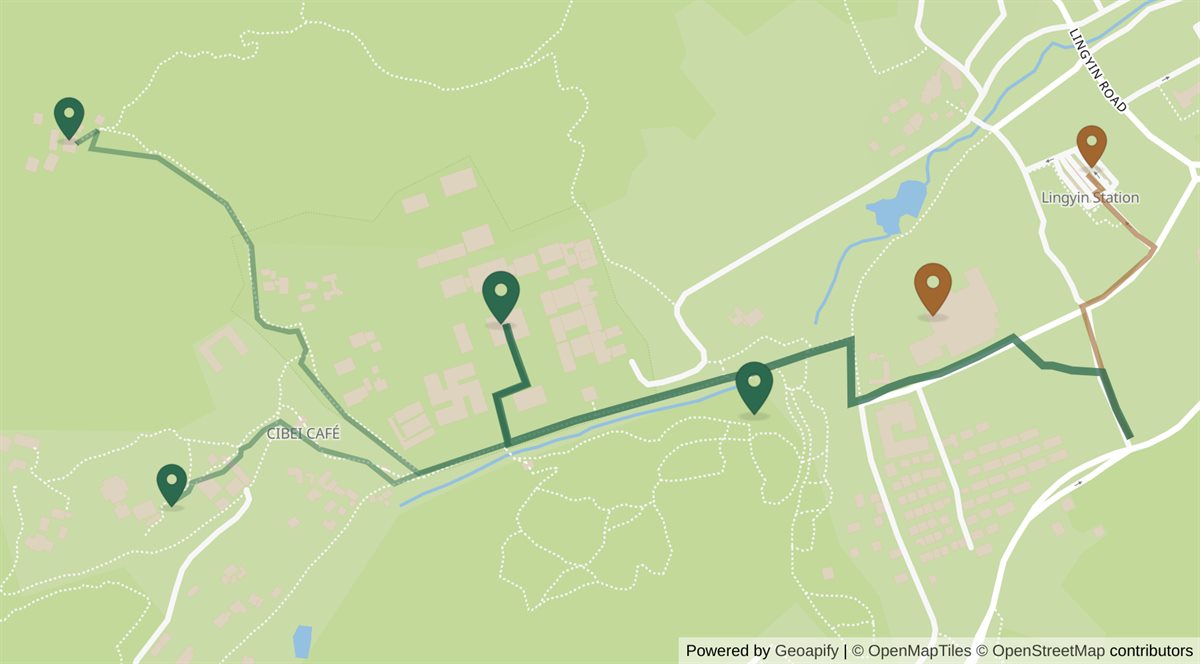 Bus 7 terminusBus 7Main gate & service centreMain gateFeilai Feng carvingsFeilai FengLingyin TempleLingyinYongfu TempleYongfuTaoguang TempleTaoguang
At its height under the tenth-century Kingdom of Wuyue the monastery is said to have housed thousands of monks across hundreds of buildings; war, fire and dynastic change levelled it repeatedly, and what stands today is largely a Qing-dynasty and modern rebuild on the old footprint. That long arc is the point — you are not visiting a single old building but a living institution that has occupied this valley for seventeen centuries.
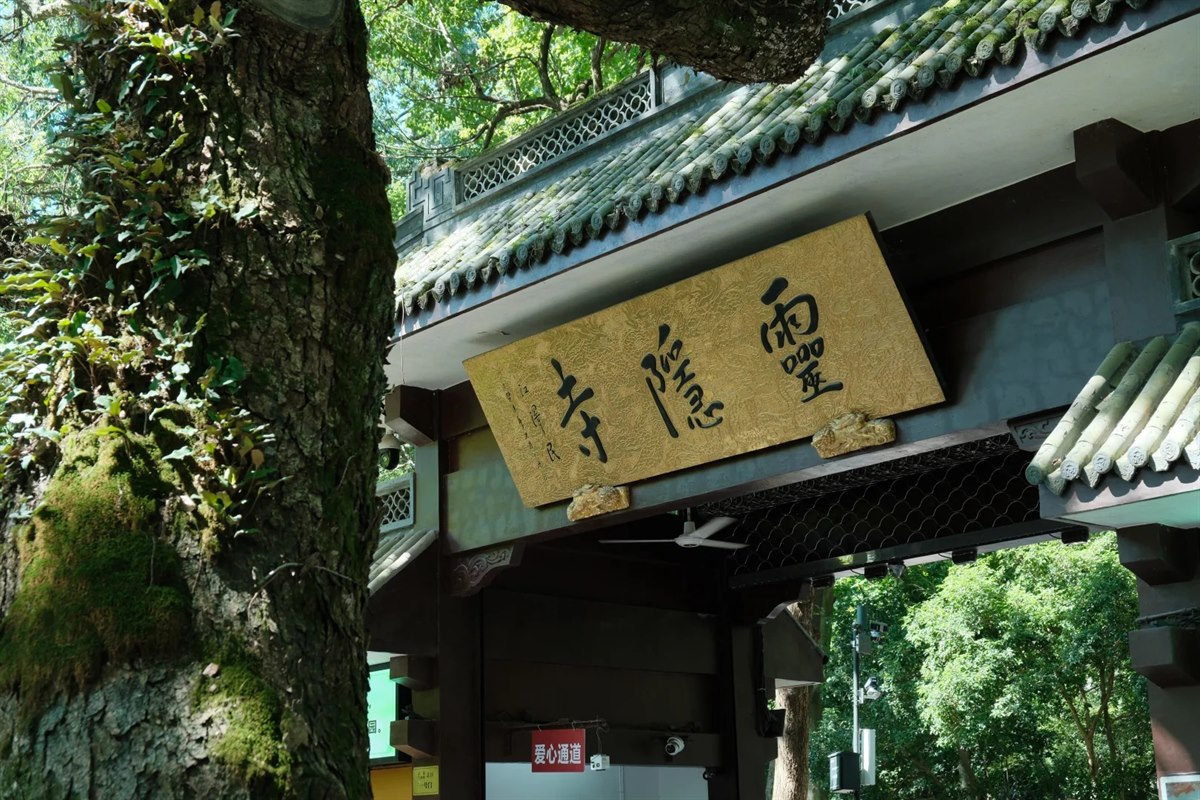
It is free now — and that is what most guides still get wrong
On 1 December 2025 the Lingyin / Feilai Feng scenic area stopped charging admission, and it is worth being precise about what that means, because almost every English guide is still half a policy behind. Two separate charges were abolished on the same day:
| What used to be charged | Now |
|---|---|
| Scenic-area ticket — ¥45 灵隐飞来峰景区 | Abolished. Covers the Feilai Feng carvings and the valley. |
| Temple ticket — ¥30 香花券, the “incense-and-flower” ticket | Abolished. This was bought separately, on-site, to pass Lingyin’s own gate. It no longer exists. |
The old total was ¥75, and that figure is what you will find on most English pages, often alongside advice about buying the second ticket at a window inside. There is now no ticket window, no second ticket and nothing to buy. One free reservation covers the entire scenic area — the carvings, Lingyin Temple, Yongfu Temple and Taoguang Temple. Ordinary worship is free too, and incense is provided; you do not need to buy “lucky” incense from anyone outside the gate.
Because it is free, two scams have grown around it. Counterfeit booking mini-programs closely imitate the official one and charge for what costs nothing. And touts have been reselling other people’s abandoned slots at ¥8–30 to people queuing on site — the practice the February 2026 penalty rules were written to stop. Anyone charging you for admission is reselling a free slot. A paid guided tour is a different product and perfectly legitimate; paid entry is not.
One more rule that catches people out: the reservation admits you once. Walk back out through the exit and it is spent. Yongfu Temple is further up the same valley, so do not leave Lingyin until you have seen it.
Booking it: the window, the passport and the no-show rule
The reservation is the whole difficulty of visiting Lingyin now, and it has changed twice in eight months — most recently on 1 February 2026, when the scenic area tightened the rules after 380,000 people no-showed in the first 56 days of free entry.
| What | Detail |
|---|---|
| Where | The official 杭州灵隐飞来峰 mini-program, inside WeChat or Alipay |
| How far ahead | Slots open 7 days out, released daily at 08:00 |
| Same-day? | No — and the on-site registration window was abolished on 1 Feb 2026 |
| Slots | Morning 7:30–12:00 (admits until 13:00) · afternoon 12:00–17:00 (admits from 11:00) |
| Per booking | Up to 5 people per phone; one document may be booked once per day |
| Daily caps | 35,000 weekdays · 50,000 weekends · 65,000 public holidays |
| If it is full | Join the waitlist by 20:00 the day before; allocations run from 17:00 in submission order |
| To cancel | By 17:00 the day before. No same-day cancellation. A waitlisted slot cannot be cancelled at all |
How far ahead you actually need to book depends entirely on the day. A weekday is rarely the constraint — a day’s notice is enough. A weekend wants about three days. Public holidays, and the 1st and 15th of the lunar month when Chinese visitors come to burn incense, need the full seven days and clear within minutes of the 08:00 release.
The no-show penalty is the part worth reading twice. If you do not turn up and did not cancel by 17:00 the previous day, it is recorded against both the booking account and the named visitor: 30 days’ suspension for the first, 60 for the second, 90 for the third. For a traveller on a fixed itinerary that is effectively permanent. The practical advice is the opposite of the usual: book the date you are confident about rather than the earliest one you could use — weekday capacity is rarely the binding constraint, so waiting costs nothing while a speculative booking can cost you the visit.
With a foreign passport, the booking itself works: the mini-program accepts passports alongside mainland ID cards, Hong Kong / Macau / Taiwan permits and the foreign permanent-residence card. You must switch the document type to Passport by hand, and the name has to match the passport exactly. Carry the physical passport — photographs and photocopies are refused.
At the gate, expect the staffed lane rather than the turnstile. The official wording is that you scan your document to enter, but the turnstiles are built around the mainland ID card and a face match, and travellers with passports consistently report them failing. With a booking already made, the staffed lane clears in about 3–5 minutes. Without one, there is no longer anything staff can do for you.
Feilai Feng — the rock carvings
Feilai Feng (飞来峰, “the peak that flew here”) is a limestone hill facing the temple across a stream. The name comes from a legend that the crag arrived overnight from India — a monk recognising a peak from his homeland, transplanted to Hangzhou. Its crags and grottoes are carved with roughly 340–470 Buddhist statues and reliefs cut between the 10th and 14th centuries — the Five Dynasties, Song and Yuan periods. This is the finest concentration of ancient rock carvings in southern China; most Chinese cave art is in the dry north (Dunhuang, Yungang, Longmen), which makes a southern open-air gallery like this genuinely unusual.
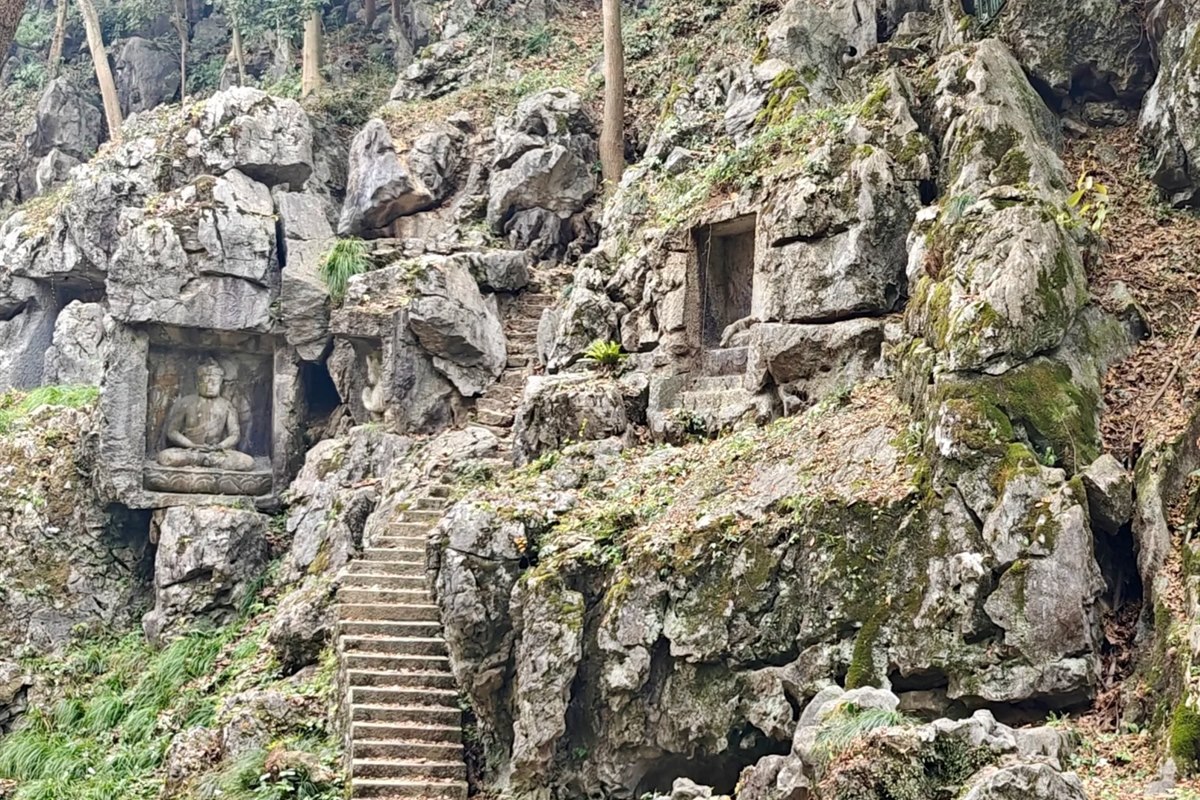
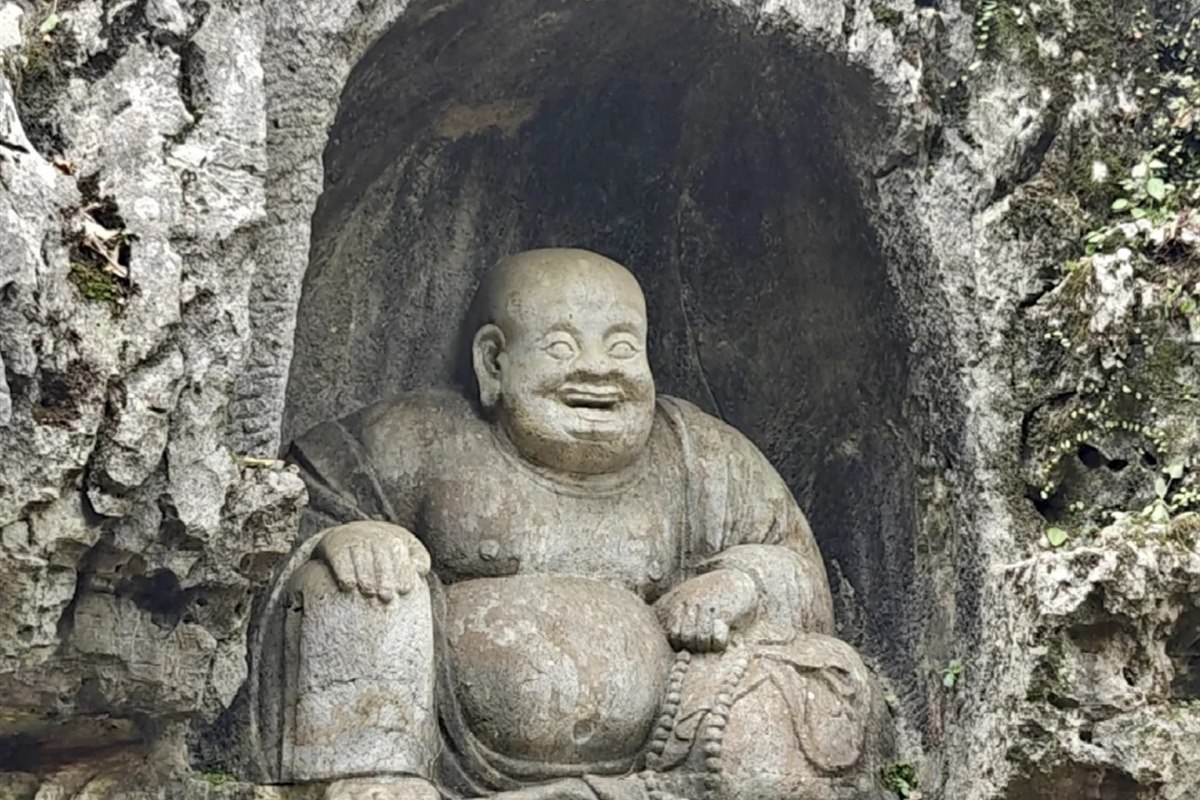
The carvings line a shaded streamside path, so seeing them is a gentle walk rather than a climb. The most famous is a large, round-bellied laughing Maitreya Buddha — the “Budai” form Western visitors recognise as the “happy Buddha” — carved into the rock around the 13th century and flanked by smaller arhat figures. Many of the niches are weathered and easy to walk past, so go slowly and look up: the best reliefs are set above eye level along the cliff face. The carvings are the first thing you walk through on the way to the temple gate, and they are covered by the same free reservation.
Inside the temple — the great halls
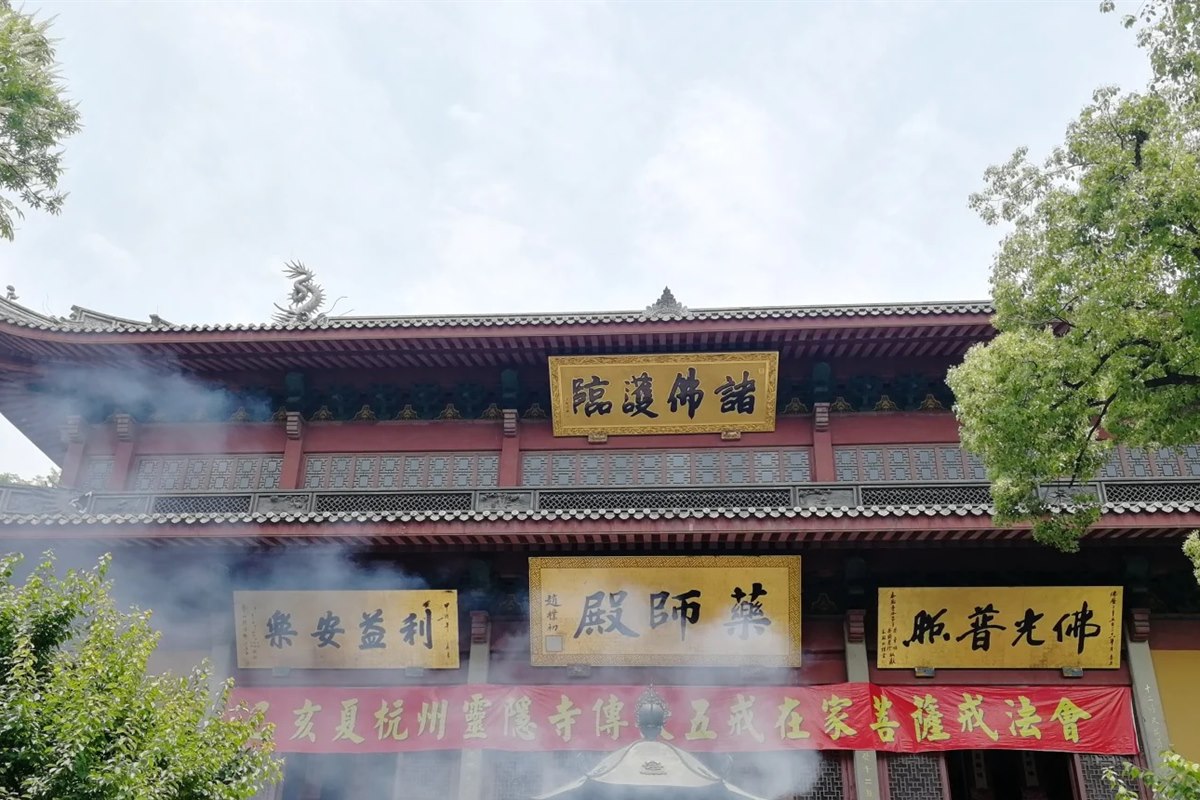
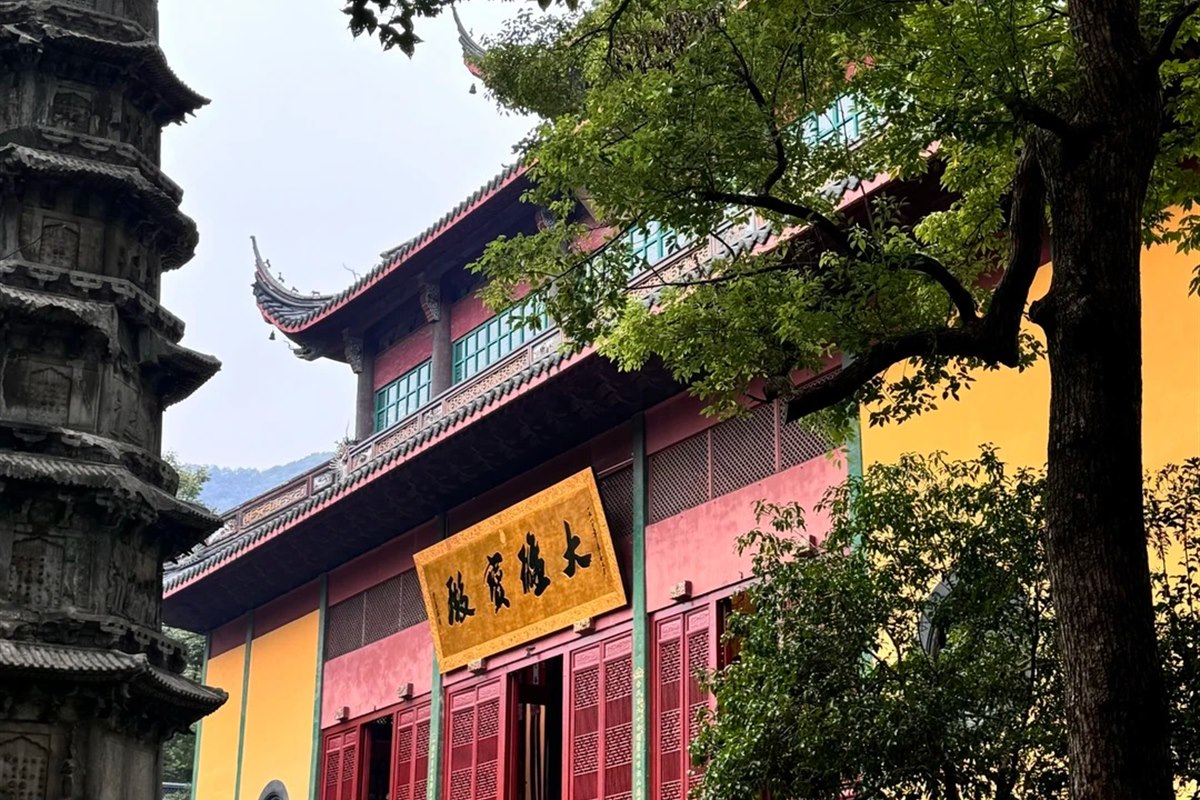
Past the temple gate, the monastery unfolds up the hillside as a sequence of ever-grander halls on a central axis, the way most Chinese Buddhist temples are laid out — you climb through them in order, each one a little higher than the last:
| Hall | What’s inside |
|---|---|
| Hall of the Heavenly Kings | The first hall — the four large Heavenly King figures, with a smiling Maitreya at its centre. |
| Mahavira Hall 大雄宝殿 | The main hall, holding a roughly 24.8-metre gilded seated Sakyamuni Buddha carved from camphor wood — one of the largest such statues in China. |
| Hall of the Five Hundred Arhats | Higher up the slope — a hall of individually sculpted disciple figures, each posed and expressive. |
Lingyin is a working monastery — robed monks, chanting and the constant drift of incense smoke are part of the place, not a performance. Treat the halls as places of worship: keep your voice down, and do not photograph monks or worshippers mid-prayer.
Getting there — and why the day of the week changes it
The temple is only about 4 km from the water in a straight line, but no metro station serves it and you finish by road. No road crosses the lake, so from the Hubin lakefront the drive is about 10 km and half an hour, swinging right around the southern end. The “20 minutes from West Lake” repeated on most English pages is not wrong so much as unlabelled: it holds from the lake’s north-west shore, which is about 3.5 km away. From the Hubin hotel strip on the east side, where most visitors wake up, it is half an hour.
Why the ride is longer than the distance
~10 km~30 min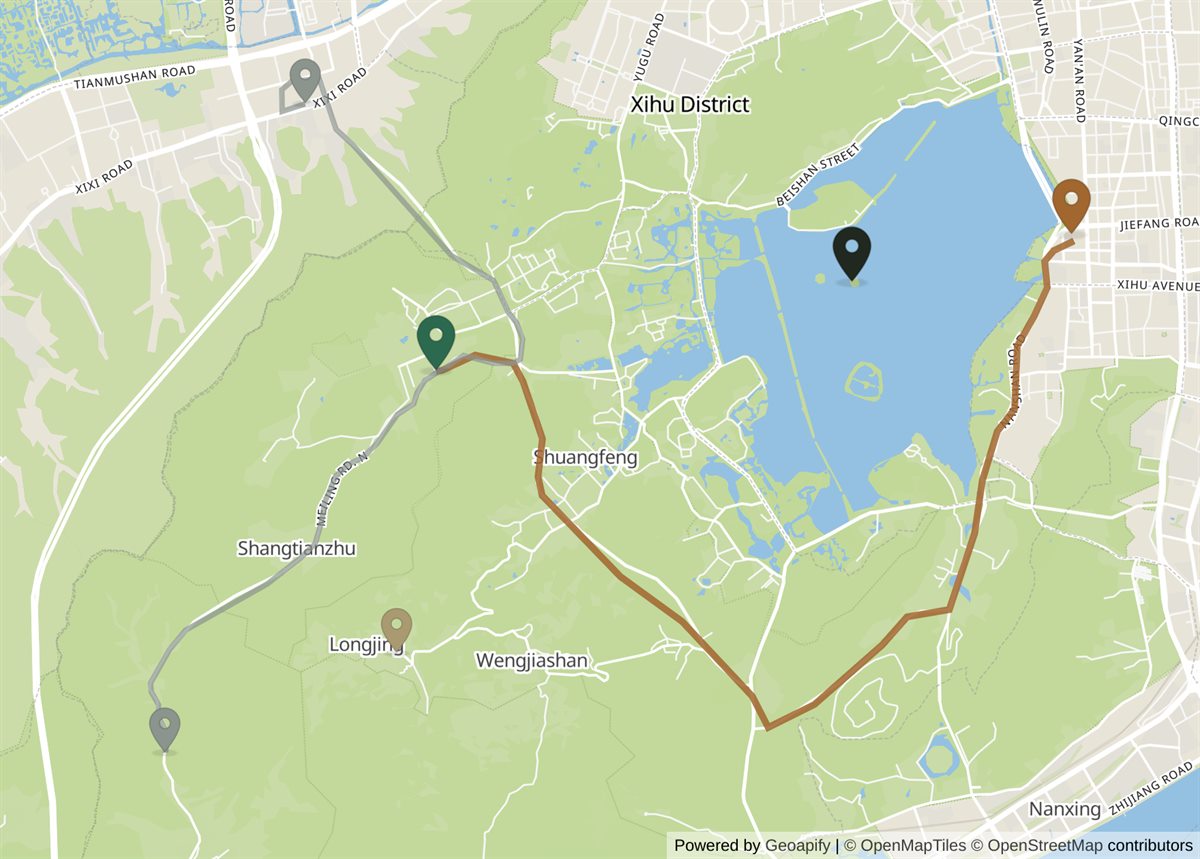 Lingyin Temple gateLingyinWest LakeWest LakeHubin lakefrontHubinWeekend car park · Xixi RdCar park NWeekend car park · XiaoyawuCar park SLongjing tea villagesLongjing
| From the lakefront | Time | Cost |
|---|---|---|
| Taxi / DiDi — weekdays | ~30 min | ~¥32 metered |
| Taxi / DiDi — weekends & holidays 08:00–17:00 | ~30 min + ~10 min shuttle | ~¥32 + ¥2 |
| Bus 7 → Lingyin bus station (terminus) | ~40–55 min | ¥2 |
| Bus 1314 → Lingyin East | ~40–55 min | ¥2 |
The traffic control is the thing to plan around. On weekends and public holidays, 08:00–17:00, taxis and ride-hail vehicles are barred from the Lingyin area altogether. Your app will silently reassign the drop-off to an outer car park — usually Xixi Road 608 (西溪路608号) to the north or Xiaoyawu (小牙坞) to the south — from where a ¥2 shuttle bus covers the rest. Take the shuttle: both car parks are over 4 km from the gate, which is ten minutes by road and about three quarters of an hour on foot. On a weekday there is no restriction at all and a car will take you to the gate. Getting back out works the same way in reverse: inside the control window you cannot be picked up in the area, so walk to Lingyin bus station and take the shuttle or a city bus out to the car parks first.
Where you sleep decides which of these two visits you getNASDAQ: TCOM
Everything above turns on one variable: how long you are in a car before 08:00. From the West Lake lakefront the ride is about half an hour, so a 7:30 slot means leaving around 07:00 and arriving while the gate is still open to traffic. From further out — the east-side station district, or a day trip in from Shanghai or Suzhou — the same slot needs an alarm most people will not actually set, and any slip puts you in the shuttle queue at an outer car park instead of at the gate.
Basing near the lake is worth twenty minutes of taxi here, and that is the whole of the argument — not the view, and not the temple, which costs nothing either way. It is also the base the rest of a Hangzhou trip wants, so it is rarely a trade.
Which gate? There are six, numbered 1, 2, 3, 5, 6 and 7 — there is no gate 4. Gate 1 is the main entrance, facing the 咫尺西天 archway and closest to the temple, and it takes an estimated 95% of all arrivals. Gate 7 is barely 100 m away, reaches Lingyin through the Qinglin Cave, and is what locals use to skip the queue. Gate 6 opens straight onto Yongfu Temple, and gate 2 serves the Beigaofeng cable-car station.
Two things not to do. Do not self-drive — beyond the control window there is single- and double-plate rationing plus a separate quota permit at weekends and in peak season, and parking is scarce. And do not plan to take the Beigaofeng cable car down and walk in without a booking: that route has its own security check and ID turnstile, a detail still missing from the guides that recommend it. There is also nothing at the top to walk to at the moment — Lingshun Temple (灵顺寺), the summit temple the cable car exists for, is closed for repairs from 25 May to 25 November 2026.
Opening hours, best time & how long
| What | Detail |
|---|---|
| Open daily | 7:30–17:30 (last entry 17:00) |
| Public holidays | Opens half an hour earlier, closes half an hour later |
| Reservation slots | Morning 7:30–12:00 · afternoon 12:00–17:00 — but they overlap: morning admits until 13:00, afternoon from 11:00 |
| Best arrival | Weekday, before 08:00 — that is when a car can still reach the gate |
| Time needed | 2–3 hours: ~45–60 min along Feilai Feng, then an hour-plus in the halls |
Almost every guide tells you to arrive before 8am to beat the tour groups. That is true, but it buries the better reason: 08:00 is when the weekend traffic control starts. Arrive before it and a car takes you to the gate; arrive after and you finish on the shuttle. On a weekday the distinction disappears entirely, which is the single biggest thing you can do for this visit — go on a weekday and most of the difficulty described on this page simply does not apply.
If a weekend is unavoidable, two things help. Come early or after 14:30, and use gate 7 rather than the main gate. And note that the afternoon slot is usually quieter than the morning one — the opposite of what most people assume when they book.
Free entry raised the numbers sharply: 26,000 people came on the first day alone, and the caps exist because of it. The days to avoid outright are public holidays and the 1st and 15th of the lunar month, the two days each month when worshippers arrive in force. Neither is marked on a Western calendar, so look them up before you settle on a date.
Practical for foreigners
- Book first — there is no fallback. The on-site registration window closed on 1 February 2026, so an unbooked visit ends at the gate. If your date is full, join the waitlist by 20:00 the day before.
- Leave the suitcase — self-service lockers at the service centre near gate 1 run about ¥4/hour (small) and ¥5/hour (large), typically with the first 30 minutes free; staffed shops at the outer car parks charge around ¥20 a day. The site is steps and stone paths, so wheeled luggage is miserable regardless.
- Dress modestly, wear comfortable shoes — covered shoulders and knees in an active monastery, and the halls climb stone steps. No photos or touching the Buddha statues inside halls; don’t step on the thresholds. Individual halls may be roped off while monks are chanting, and one can close briefly during a ceremony.
- Eat the temple vegetarian noodles — Lingyin’s Shifangyuan (十方苑), on the right once you are inside, does a bowl for about ¥20 and can sell out in peak season. Yongfu Temple’s hall, roughly 200 m further up on the left, runs ¥25–30 and is the one people rate higher — go before 11:30, because service slows badly afterwards.
- Pay with Alipay or WeChat Pay — shops are cashless-first; set up a mobile wallet before you travel. English signage is limited, so a translation app helps.
One name to keep straight: Faxi Temple (法喜寺, Upper Tianzhu) turns up in nearly every “temples near Lingyin” list, and it is not part of this scenic area. It belongs to the neighbouring Tianzhu area, runs a separate booking system and charges its own small admission — but needs no advance reservation, and opens earlier and closes later than Lingyin does. That makes it the sensible answer to “what can I do before 7:30?”, and it is why your Lingyin reservation will not get you through its door.
Lingyin sits in the same band of green hills as Hangzhou’s tea country, which makes the obvious pairings easy. The Longjing (Dragon Well) tea villages and the China National Tea Museum are both a short ride away in the same hills, so a clean half-day is Lingyin in the morning — early, to beat the crowds — then the tea hills in the early afternoon.
Or fold it into a West Lake day: the lake’s western shore is the closest part to the temple. Do Lingyin first thing, then come down to West Lake for the causeways, the Broken Bridge and Leifeng Pagoda in the afternoon and evening. The things-to-do guide sets out how the sights stitch together.
Half-day Hangzhou tours with an English-speaking guideNASDAQ: TCOM
Admission is free and you book it yourself — what is worth paying for here is the guiding. The Feilai Feng carvings carry almost no English labelling, and most visitors walk straight past the best of them. Trip.com lists guided half-days and private cars pairing Lingyin with West Lake.
Frequently asked questions
Is Lingyin Temple free now, and do I need to reserve?
It is completely free, and yes — you must reserve. Since 1 December 2025 the Lingyin / Feilai Feng scenic area (the Feilai Feng carvings plus Lingyin, Yongfu and Taoguang temples) charges nothing at all. Both old charges went at once: the ¥45 scenic-area ticket AND the ¥30 incense-and-flower ticket (香花券) for the temple halls, so the ¥75 total still quoted by most English guides no longer exists. But free does not mean walk-in. Entry is a free timed reservation booked on the official 'Hangzhou Lingyin Feilai Feng' (杭州灵隐飞来峰) mini-program in WeChat or Alipay. Slots open 7 days ahead, are released daily at 08:00, and there is no same-day booking — the earliest you can visit is tomorrow.
How much does it cost to visit Lingyin Temple?
Nothing. There is no admission charge anywhere in the scenic area, and no separate ticket for the temple halls — the ¥30 香花券 was abolished along with the ¥45 gate ticket on 1 December 2025. One free reservation covers Feilai Feng, Lingyin Temple, Yongfu Temple and Taoguang Temple. Anyone charging you for entry is reselling a free slot: touts have been reselling no-show slots at ¥8-30, and counterfeit booking mini-programs that imitate the official one are the single most-reported trap here. Paid guided tours are a different product and are legitimate; paid admission is not.
Can I book with a foreign passport, and can I scan it at the gate?
Yes to booking — the official mini-program accepts foreign passports (as well as Hong Kong, Macau and Taiwan permits and the foreign permanent-residence card); you have to switch the document type to Passport by hand, and the name must match the passport exactly. Carry the physical passport, as photos and photocopies are refused. At the gate, though, expect to use the staffed lane rather than the turnstile: the official wording says scan your document, but the turnstiles are built around the mainland ID card and a face match, and travellers consistently report passports failing there. With a booking already made, the staffed lane takes about 3-5 minutes.
What happens if I book and then do not go?
You lose the right to book again for a month. Since 1 February 2026 you must cancel by 17:00 the day BEFORE your slot — there is no same-day cancellation, and the on-site registration window was abolished at the same time. An uncancelled miss is recorded as a no-show: the first suspends both the booking account and the named visitor for 30 days, a second for 60 days, a third for 90. A slot obtained from the waitlist cannot be cancelled at all. This rule exists because 380,000 people no-showed in the first 56 days of free entry. Book the date you are sure of, not the earliest one you could take.
What is Feilai Feng?
Feilai Feng (飞来峰), 'the peak that flew here', is a limestone hill that faces Lingyin Temple across a stream. Its rock faces and grottoes are carved with roughly 340-470 Buddhist statues and reliefs cut between the 10th and 14th centuries — the Five Dynasties, Song and Yuan periods — making it the finest collection of ancient stone carvings in southern China. The best-known is a large, round-bellied laughing Maitreya Buddha. The carvings line a shaded streamside path and are covered by the same free reservation, seen on the way to the temple gate.
How do I get to Lingyin Temple from West Lake, and where does a taxi drop me?
There is no metro station at the temple, so the last stretch is by road. From the Hubin lakefront a taxi or DiDi is about 10 km and ~30 minutes (~¥32 on the meter) — the temple is only about 4 km west of the water in a straight line, but no road crosses the lake, so the drive goes right around its southern end. The widely-quoted '20 minutes from West Lake' holds only from the lake's north-west shore, about 3.5 km away; from the Hubin hotel strip on the east side it is half an hour. The catch is the day of the week: on weekends and public holidays between 08:00 and 17:00, taxis and ride-hail are barred from the Lingyin area entirely, and the app will reassign your drop to an outer car park — Xixi Road 608 (西溪路608号) to the north, or Xiaoyawu (小牙坞) to the south. Both are over 4 km out, so take the ¥2 shuttle that runs from them rather than trying to walk it: on foot it is about three quarters of an hour. On weekdays there is no restriction and a car reaches the gate. By bus, route 7 ends at Lingyin bus station and route 1314 stops at Lingyin East; both cost ¥2 and take 40-55 minutes.
What are the opening hours of Lingyin Temple?
The scenic area is open daily 7:30-17:30, with last entry at 17:00; on public holidays it opens half an hour earlier and closes half an hour later. Reservations are split into a morning slot (7:30-12:00) and an afternoon slot (12:00-17:00), but the two overlap in practice — the morning slot admits until 13:00 and the afternoon slot from 11:00. The afternoon slot is generally the quieter of the two.
Can I leave luggage, and can I come back in after leaving?
There are self-service lockers at the official service centre near gate 1, at roughly ¥4/hour for a small locker and ¥5/hour for a large one, with the first 30 minutes usually free; the outer car parks have staffed shops charging about ¥20 a day for a suitcase. Wheeled luggage is a poor idea inside in any case — the site is steps and stone paths. On re-entry the answer is no: the reservation admits once. Leave through the exit and it is spent, so do not walk out of Lingyin Temple before you have seen Yongfu Temple further up the valley.
What is there to see inside Lingyin Temple itself?
Lingyin is a working Chan (Zen) monastery with a sequence of great halls climbing the hillside. The Hall of the Heavenly Kings comes first; behind it the Mahavira Hall (大雄宝殿) holds a roughly 24.8-metre gilded seated Buddha, one of the largest of its kind in China carved from camphor wood; higher up is the Hall of the Five Hundred Arhats, a hall of individually sculpted disciple figures. Monks, chanting and incense smoke are part of the experience — it is an active place of worship, not a museum.
How long should I spend at Lingyin Temple?
Allow about two to three hours for an unhurried visit — roughly 45-60 minutes along the Feilai Feng carvings and stream, then an hour or more working up through the temple halls. Add travel time from West Lake at each end. Many visitors fold Lingyin into a half-day that also takes in the nearby Longjing (Dragon Well) tea villages or the China National Tea Museum, both a short ride away in the same range of hills.
What should I wear and how should I behave at Lingyin Temple?
Lingyin is an active Buddhist monastery, so dress modestly — covered shoulders and knees are the respectful default, and comfortable shoes help on the hillside steps. Keep your voice low inside the halls, do not photograph monks or worshippers mid-prayer, and do not step over thresholds onto altar platforms. Incense is offered free or with the temple ticket; you do not need to buy 'lucky' incense or services from anyone outside the gate.
Sources
Checked August 2026 · Written from our own first-hand travel in China.