Key takeaways
- The lake is free — no gate, no ticket, no opening hour; only a few sub-sights (Leifeng Pagoda, the boats, Yue Fei Temple, the evening show) are paid.
- Metro Line 1 → Longxiangqiao (龙翔桥): ~16 min from Hangzhou East rail station, then walk to the Hubin shore.
- Of the two causeways walk the Su (苏堤) — longer, quieter, and the one with the six old arched bridges; the short Bai Causeway ends at the Broken Bridge.
- Crossing to the south-west shore is either the boat to Three Pools Mirroring the Moon (¥55–70) or the 2.8 km Su Causeway on foot — the same journey two ways, so pick one. Leifeng Pagoda (¥40) has the best panorama.
- Go at dawn or dusk, on a weekday — and avoid the Oct 1–7 Golden Week. Lingyin next door is now free too, but needs a reservation 1–7 days ahead, so it is the one part of a lake day you cannot improvise.
What West Lake is
West Lake (西湖, Xī Hú) is a freshwater lake on the western edge of central Hangzhou — about 6.4 km² of water ringed by roughly 15 km of willow-lined shore, with low green hills closing it on the south and west and the modern city pressing up to the eastern bank. It is not a wilderness lake set apart from the city; it is the city’s living centre, and that contrast — old causeways and pagodas on one side, the skyline on the other — is part of what makes it.
It was inscribed on the UNESCO World Heritage List in 2011 as a cultural landscape — not for natural scenery alone, but because West Lake shaped Chinese garden design and landscape painting for around a thousand years. The deliberately composed causeways, islands and framed viewpoints are themselves the heritage. If you see one thing in Hangzhou, this is it — plan the lake first, then fit the city around it. The wider list is in the things-to-do-in-Hangzhou guide.

The single most useful fact: it is free
West Lake has no gate and no entry ticket. The lake, the shoreline path, both causeways, the lakeside parks and almost all the open scenery are free to walk, day and night — unusual for a sight of this fame in China. There is no ticket queue, no fixed entry point, no opening hour to plan around. A handful of specific sub-attractions inside the lake area do charge:
| Sub-attraction | Ticket |
|---|---|
| The lake, causeways, parks | Free |
| Leifeng Pagoda 雷峰塔 | ¥40 |
| Tour boat to the islands | ¥55–70 (incl. island landing) |
| Hand-oared boat 手划船 | ¥150–180/hour — per boat, seats 2–6 |
| Yue Fei Temple 岳王庙 | ¥25 |
| “Impression West Lake” evening show | A staged production on the water, not a boat ride — its own, much dearer ticket |
| Night sailing to the island 诗酒趁年华 | ¥188 — new for 2026. A Song-themed evening boat to the same island, first sailing 18:40 and last 20:40, from the eastern-shore piers. Sold at the pier on the day, not online. |
Lingyin Temple is free too — but not in the same way, and this is the one thing worth getting right before you plan the day. The major Buddhist site usually paired with a lake visit sits just west of the lake, and the whole Feilai Feng scenic area around it has charged nothing since 1 December 2025: both old tickets were abolished at once. What replaced the fee is a cap. Entry is by free timed reservation, released daily and bookable 1–7 days ahead with no same-day option, so the barrier moved from money to capacity rather than disappearing. The lake you can improvise; the temple you cannot. Full booking mechanics are in the Lingyin Temple guide.
The must-see spots
West Lake has no single gate — you start at one of the shore points. These are the set-pieces worth building a route around; the lake stroll itself is free, the pagoda/temple/boat carry their own small fees.
Where the five are
free to walkticketedwhere you arriveTerrain © Stadia Maps · Stamen Design · OpenMapTiles · © OpenStreetMap contributors.
| Spot | What it is | Free / ticket |
|---|---|---|
| Su Causeway 苏堤 | The ~2.8 km willow-and-peach causeway across the western side, banked from dredged lake mud under the Song poet-governor Su Dongpo nearly 1,000 years ago. Six arched stone bridges; walking it end to end at dawn is the classic experience. “Spring Dawn on the Su Causeway” is the first of the Ten Scenes. | Free |
| Bai Causeway & Broken Bridge 白堤 · 断桥 | The shorter ~1 km causeway along the north-east shore, ending at the Broken Bridge — named for “Lingering Snow on the Broken Bridge” (snow melting from one side looks broken from afar) and tied to the Legend of the White Snake. | Free |
| Three Pools Mirroring the Moon 三潭印月 | A small garden island in the southern water encircled by three stone pagodas standing in the lake — the view printed on the back of the ¥1 note, and the most reproduced image of West Lake. Reached by tour boat. | Boat ¥55–70 |
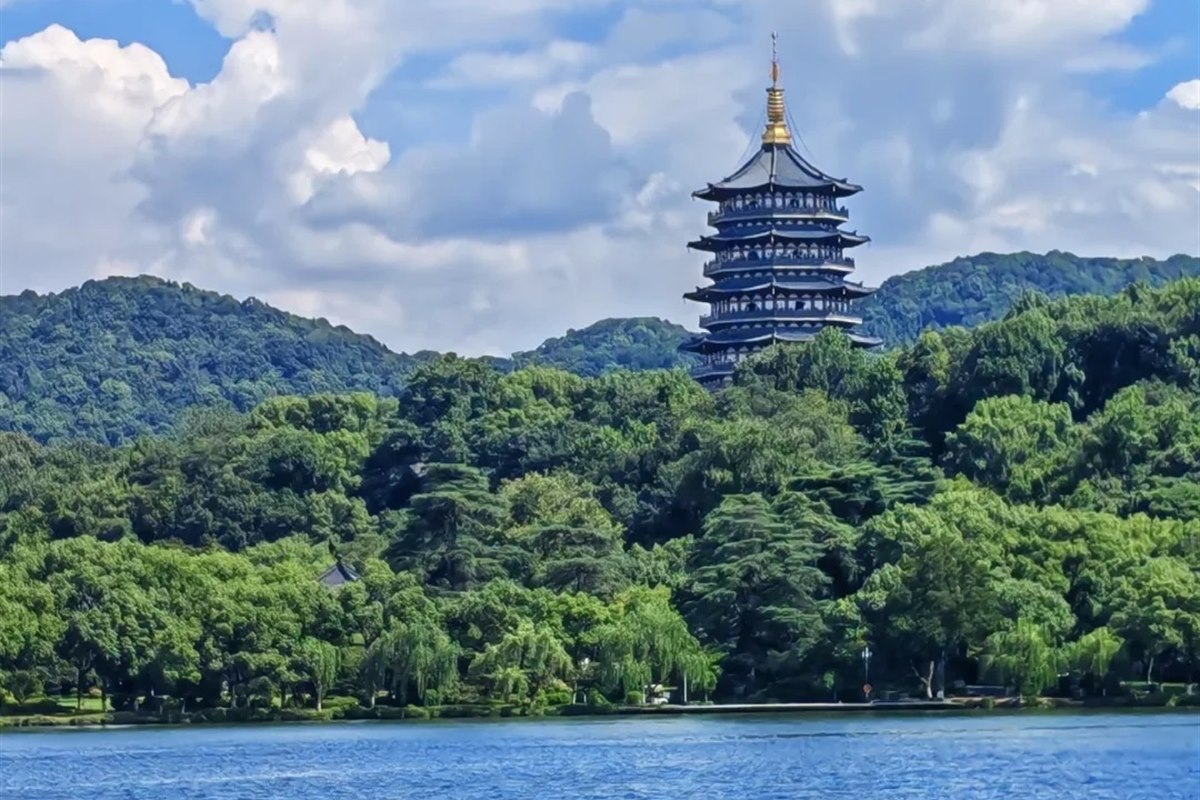
| Leifeng Pagoda 雷峰塔 | South-shore pagoda, rebuilt in 2002 over the preserved Song ruins (visible inside the base). Escalators up the hill and a lift inside make the climb easy; the upper deck gives the best single panorama of the whole lake. Hours run 08:00–20:00 (1 May – 31 Oct) · 08:00–19:00 (16 Mar – 30 Apr) · 08:00–17:30 (1 Nov – 15 Mar) — and admission stops 30 minutes before closing, which is the number a sunset visit turns on. | ¥40 |
| Lingyin Temple 灵隐寺 | Major active Buddhist temple and grotto carvings just west of the lake — usually paired with a lake day. Free since Dec 2025, but reservation-only: book 1–7 days ahead, no same-day. See its own guide. | Free · must book |
If you walk only one causeway, walk the Su Causeway — longer, quieter, and the one that was laid out to be looked at, bridge by bridge; the Bai Causeway is shorter, closer to the city and busier.
How to see it — walk, bike, boat or cart
The lake is large — roughly 15 km of shoreline — so you cannot circle the whole thing on foot in a few hours. Decide how to cover it, and pick a section rather than the full loop:
| Mode | Good for | Cost |
|---|---|---|
| On foot | The east and south shores and both causeways are flat and pedestrianised — the best way to feel the lake. Walk a section, not the whole 15 km. | Free |
| Shared bike | Hangzhou is a bike-share city and the shoreline road is largely cyclable — covers far more shore than walking. ⚠️ But both causeways ban bicycles outright, all day, every day, since 2018 — and the rule bars non-motorised vehicles from entering, so pushing one across is not the loophole either. A ride round the lake has to go around the outside; the getting-around guide has the legal 4.3 km detour. | ~¥1.5/30 min · unlock with Alipay/WeChat |
| Tour boat | Both transport and the best viewpoint — the crossing to the island and the south-west shore. Two boats: ¥55 plain, ¥70 painted. Both land you on the island. | ¥55–70 · lands at 4 piers only |
| Electric sightseeing cart | ⚠️ One-way, clockwise — the opposite of the day route below — you cannot ride it back the way you came, so it is not a bail-out for a counter-clockwise walk. Flag one down; tickets are sold on board and go dead the moment you step off. Four segments round a ~13.5 km loop, ~70 minutes. | ¥10 a segment / ¥40 the loop (green) · ¥20 / ¥80 (antique wood) |
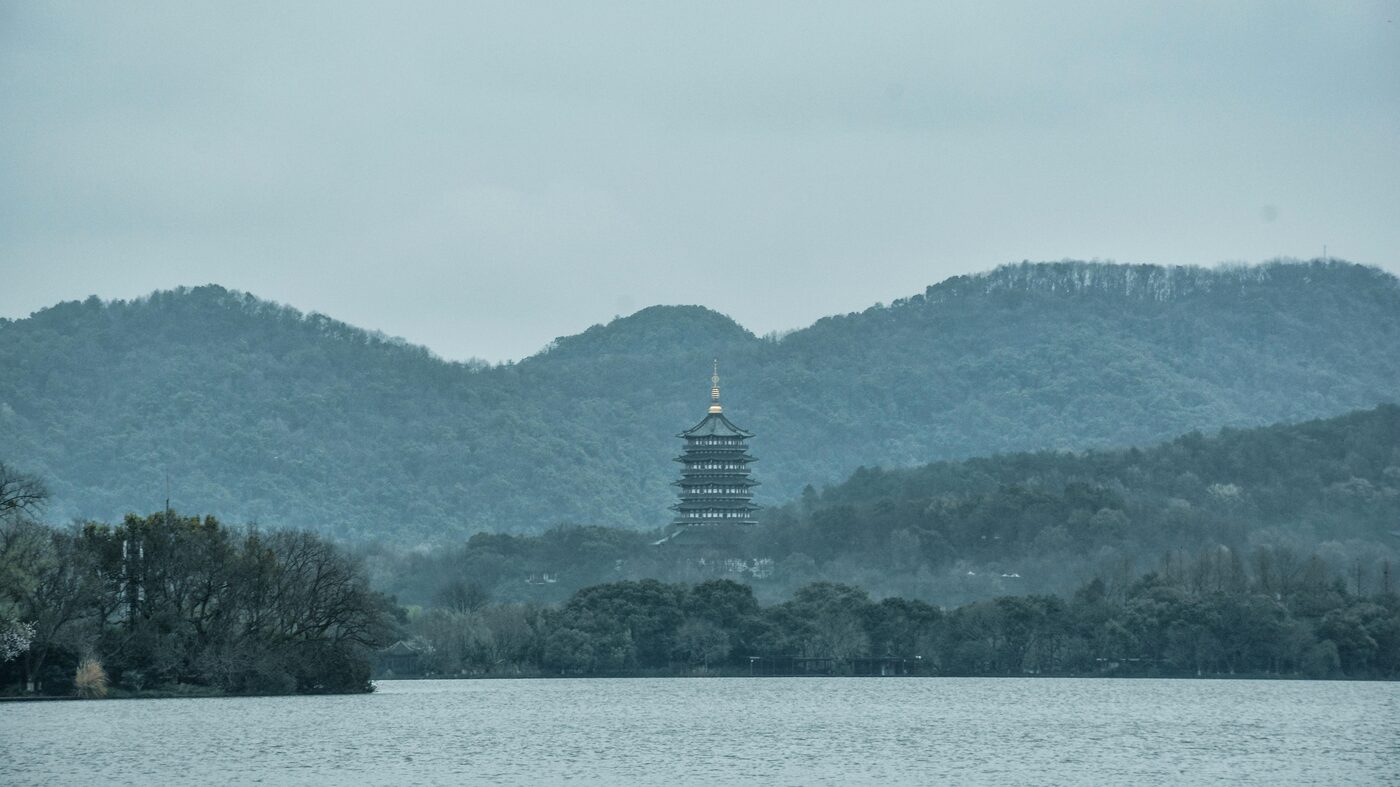
A boat out is worth it once — partly for the island, partly because the view back at the willow shoreline and Leifeng Pagoda from the middle of the water is the lake from the angle the classical painters chose. Set up Alipay before you go so the bikes, boats and carts all just work.
The one-day route
Both versions of the day open the same way — in at Longxiangqiao on the eastern shore, west along the Bai Causeway, and out onto Solitary Hill (孤山), the low wooded hill the causeway runs to, where the boat pier is and where the Xiling Seal Society (西泠印社) keeps its garden — a scholarly society devoted to seal-carving and calligraphy, and the one stop on this walk that is a place to go into rather than past. What changes after it is how you get to the south-west corner, and the boat and the Su Causeway are two ways of making that same crossing — so you do one or the other, not both.
Cross by boat. Walk the north shore, cut across the water to the island, land in the south-west corner and finish along the south shore. You see the Su Causeway from the boat instead of walking it.
Terrain © Stadia Maps · Stamen Design · OpenMapTiles · © OpenStreetMap contributors.
What each crossing costs you
- By boat. Board at Zhongshan pier (中山码头, on Solitary Hill opposite the West Lake Museum), land at the Huagang pier (花港码头 — the one beside the Viewing Fish at Flower Pond park) in the south-west. Two boats run it: ¥55 on a plain leisure boat, ¥70 on a painted one, both landing you on the island. ⭐ It picks up at nine piers but puts you down at only four — Huagang 花港, Hangzhou Hotel 杭饭, Zhongshan 中山, Hubin 湖滨 — and that choice is made at the window, not on the boat, so say where you want to land when you buy. Sailings 08:00–17:00.
- On foot. The Su Causeway instead, ~2.8 km from its north head by Yue Fei Temple to its south head. No ticket, and it is the better walk — but it is most of an afternoon, and it ends 500 m short of Leifeng rather than dropping you at the pagoda.
Two other boats you will see, neither of which makes this crossing. A hand-oared boat (¥150–180/hour, hired by the boat, 2–6 people) into the wilder inner-lake water at Maojiabu (茅家埠) and Wugui Pond (乌龟潭), where the big boats cannot go; and the hop-on hop-off lake bus-boat (¥6–8 a stop), which is water transport rather than sightseeing and stops at ten points round the shore.
Free sunset spots (and skipping the Leifeng ticket)
The famous “Leifeng Sunset” (雷峰夕照) is best shot for free from Changqiao Park (长桥公园) across the water — the sun setting on the pagoda tip, gold lake, pink-purple sky, and an open park with no gate and nothing to close. Other free picks: Jixian Pavilion (集贤亭) (lake-reflection silhouettes, but crowded), the south end of the Su Causeway, and, for the whole-lake panorama, a short climb up Baoshi Hill (宝石山). You do not need to pay ¥40 to climb Leifeng Pagoda for the sunset — climb it only if you want the elevator-assisted overhead view. ⚠️ One correction to a tip we used to carry here: Jingci Temple (净慈寺, ¥10) opposite is not a sunset alternative. It closes at 17:00, last entry 16:45, and Hangzhou’s sun sets between roughly 17:00 in deep winter and 19:00 at midsummer — so for most of the year the gate is shut before the light. It is a fine quiet afternoon stop. Best light: arrive 4–6 pm, or come at 7:30–9 am for the empty, misty lake.
Best time to visit — and how long
Allow a half-day minimum (the short Bai Causeway, the east lakefront and a boat across); give it a full day to walk the Su Causeway end to end, climb Leifeng Pagoda and pair the lake with Lingyin Temple. Dawn and dusk are the lake’s hours:
| When | What it’s like |
|---|---|
| Dawn | Near-empty paths, mist on the water — the lake at its most atmospheric. Walk a causeway now. |
| Midday (peak season) | Crowded, hot, flat light — the weakest slot. Use it for a meal or the indoor pagoda. |
| Dusk | Soft light, the lit-up shoreline, then the evening show. Return to the east lakefront for sunset. |
Season: spring (overlapping Longjing tea season in the hills west of the lake) and autumn are loveliest — mild and clear. Summer is hot and humid, though the lotus ponds peak then; winter is quiet and can be beautiful when snow dusts the Broken Bridge. Avoid the October 1–7 National Day Golden Week (the causeways go shoulder-to-shoulder), the Spring Festival period and the May 1–5 holiday; weekends draw heavy domestic crowds year-round. A weekday at dawn is the ideal — see our best time to visit China guide.
Getting there & around
The simplest route is Metro Line 1 to Longxiangqiao (龙翔桥) — the eastern-lakefront station, a short walk from the Hubin waterfront where most visitors first reach the water. Line 1 runs from Hangzhou East Railway Station, the main HSR hub, to Longxiangqiao in about 16 minutes with no transfer.
| From | How | Time |
|---|---|---|
| Hangzhou East Railway Station | Metro Line 1 to Longxiangqiao | ~16 min |
| Qinghefang / Hefang St old town | Walk | ~10–15 min |
| Wulin Square (downtown) | Metro Line 1, 2 stops, then walk | ~12–15 min |
| Xiaoshan Airport (HGH) | Metro Line 1 (Airport line) to Longxiangqiao | ~55–65 min |
| Lingyin Temple | Bus or taxi, either direction, from the lake’s north-west shore | ~20–25 min |
A taxi or DiDi works too, but central traffic is heavy and the east and south shores are pedestrianised, so metro-plus-walking is usually faster. Full network detail is in the Hangzhou city guide. West Lake is the classic Shanghai day trip too — ~45–60 min by high-speed train.
Practical for foreigners
- No gate, no entry hour — arrive at any shore point and start walking; nothing to scan or queue for at the lake itself.
- Ten Scenes (西湖十景) — an 800-year-old framework of ten set viewpoints tied to a season or time of day (Spring Dawn on the Su Causeway, Lingering Snow on the Broken Bridge, Autumn Moon on the Calm Lake, and more). You won’t catch all ten in one trip; use it to pick scenes that match your dates and hour.
- Payment — Alipay and WeChat Pay are universal (and unlock the bikes, boats and carts). Carry a little cash as backup; ticket windows at the pagoda and temples take mobile pay.
- Accessibility — the causeways and east/south shores are flat and step-free; Leifeng Pagoda has escalators and a lift, so the panorama is reachable without a stair-climb.
- Combine it — the old town (Qinghefang) in the morning and the lake in the afternoon is a natural pairing, a 10–15 min walk apart.
Book a West Lake cruise & guided tourNASDAQ: TCOM
Trip.com lists West Lake boat cruises, Leifeng Pagoda tickets and guided Hangzhou day tours that fold in Lingyin Temple — booked in English on a foreign card.
How West Lake fits a Hangzhou & Jiangnan trip
West Lake is the anchor; the rest of a Hangzhou stay slots around it:
- Lake + Lingyin Temple — the classic full day: causeway and boat in the morning, the Buddhist site and grotto carvings west of the lake in the afternoon. ⚠️ This is the pairing to book for: Lingyin costs nothing but releases its slots on a 1–7 day window with no same-day option, so it is the half of the day that has to be decided before you arrive in Hangzhou.
- Lake + Qinghefang old town — the historic street in the morning, the lake at dusk; a 10–15 min walk between them.
- Hangzhou as a Shanghai day trip / Jiangnan extension — ~45–60 min by HSR from Shanghai, and a natural stop on a Suzhou–Hangzhou water-towns loop.
When NOT to go: the three Golden Weeks (domestic crowds at their worst), weekends in peak season, or a flat-light midday — West Lake rewards an early start or a stay until sunset, not a rushed midday hour.
Where to stay for a West Lake visit
Two real choices, and the trade is water against dinner. The lakefront puts you a minute from the shore and a fair walk from anywhere still serving at ten; two metro stops back reverses both. Which is right depends on whether your day ends at sunset or after it.
The full breakdown of Hangzhou’s hotel areas is in the where-to-stay-in-Hangzhou guide.
Frequently asked questions
Is West Lake free to enter?
Yes. The lake itself, its shoreline path, the Su Causeway and the Bai Causeway, the lakeside parks and most of the open scenery are free to walk — there is no gate and no entry ticket for West Lake. This is the single most useful practical fact about it: you can spend a full half-day or longer here without paying anything. Only certain sub-attractions inside the lake area are ticketed — most notably Leifeng Pagoda (¥40), the tour boats out to the islands (¥55–70), Yue Fei Temple (¥25) and the evening 'Impression West Lake' show. Lingyin Temple, usually paired with a lake visit, sits just west of the lake and is ALSO free — it has been since 1 December 2025 — but unlike the lake it cannot be walked into: it needs a free timed reservation booked 1–7 days ahead, and there is no same-day booking.
How do you get to West Lake in Hangzhou?
Take Metro Line 1 to Longxiangqiao (龙翔桥) — this is the eastern-lakefront station, a short walk from the Hubin waterfront where most visitors first reach the water. From Hangzhou East Railway Station (the main HSR hub) it is about 16 minutes on Metro Line 1 with no transfer. West Lake is also an easy walk from the Hefang Street / Qinghefang old town. A taxi or DiDi works too, but central Hangzhou traffic is heavy and the lake's east and south shores are pedestrianised, so the metro plus walking is usually faster.
How long should I spend at West Lake?
Allow a half-day as the realistic minimum — the Bai Causeway, the eastern lakefront and a boat out to the island. A full day adds Leifeng Pagoda, a sunset on the south-east shore and Lingyin Temple just to the west. The lake is large — about 6.4 km² with roughly 15 km of shoreline — so you cannot 'do' all of it on foot in a few hours, and the honest limit is that crossing to the south-west corner is a choice rather than a checklist: you either take the boat across or walk the 2.8 km Su Causeway, not both, because the pier where the boat lands sits at the causeway's southern foot. Pick one crossing, or take the gentler east-shore stroll instead, and don't try to rush the whole circuit.
What are the Ten Scenes of West Lake?
The 'Ten Scenes of West Lake' (西湖十景) is a classic 800-year-old framework of ten set viewpoints, each named for a specific scene at a specific season or time of day — they shaped how Chinese poets and painters saw the lake. They include Spring Dawn on the Su Causeway, Lingering Snow on the Broken Bridge, Autumn Moon on the Calm Lake, Lotus in the Breeze at the Winding Garden, Evening Bell at Nanping Hill, and Three Pools Mirroring the Moon. You will not see all ten in one visit — they are tied to different seasons and hours — but the framework is a good planning lens: pick the ones that match your dates and time of day.
When is the best time of day to visit West Lake?
Dawn and dusk. At dawn the paths are near-empty and mist often sits on the water — this is the lake at its most atmospheric, and the 'Spring Dawn on the Su Causeway' scene exists for a reason. Dusk gives soft light, the lit-up shoreline and the evening light show. Midday in peak season is the crowded, hot, flat-light part of the day. If you can only go once, go early; if you can split it, walk a causeway at dawn and return to the east lakefront for sunset.
Should I take a boat on West Lake?
It is worth it once. The classic trip is the tour boat out to Three Pools Mirroring the Moon (三潭印月) in the southern water — a small island famous for the three stone pagodas standing in the lake around it, the image printed on the back of the ¥1 note. There are two boats on the run, not a price range: ¥55 on a plain leisure boat and ¥70 on a painted one, both landing you on the island. Sailings are 08:00–17:00. The detail worth knowing before you queue is that it boards at nine piers but lands at only four — Huagang (花港), Hangzhou Hotel (杭饭), Zhongshan (中山) and Hubin (湖滨) — and which of them you get is chosen at the ticket window rather than on the boat, so the crossing can either move you along your route or dump you back where you started. The view back at the willow shoreline and Leifeng Pagoda from the water is the payoff. For something quieter, a hand-oared boat can be hired by the hour at ¥150–180/hour — priced per BOAT rather than per person, seating 2–6, so a full boat is the cheap way to do it, and it is the only way into the wilder inner-lake water where the big boats cannot go.
Is Leifeng Pagoda worth climbing on a West Lake day?
If you want the single best panorama of West Lake and don't mind the ¥40, yes. Leifeng Pagoda (雷峰塔) stands on the south shore; the current structure was rebuilt in 2002 over the collapsed Song-dynasty ruins, which are preserved and visible inside the base. Unusually for a pagoda it has escalators up the hillside and a lift inside, so the climb is easy, and the upper deck lays out the whole lake — causeways, islands, skyline — with the dusk 'Leifeng Sunset' gilding it all. But if you only want to photograph the pagoda at sunset, you don't need a ticket: Changqiao Park (长桥公园) across the water is the classic free frame, and being an open park it has nothing to close. Do not plan on Jingci Temple (净慈寺, ¥10) opposite for this, as guides including ours used to suggest — it shuts at 17:00 with last entry 16:45, so outside deep winter the gate is closed before the light. In the 1 May – 31 Oct season the pagoda itself is open to 20:00 with last entry 19:30.
When should I avoid West Lake?
Avoid the October 1-7 National Day Golden Week if you possibly can — West Lake is one of the most visited sights in China and the causeways and lakefront become shoulder-to-shoulder during that week. The Spring Festival period and the May 1-5 holiday are also very busy. Weekends draw heavy domestic crowds year-round. The loveliest times are spring (which overlaps Longjing tea season) and autumn, on a weekday, arriving at dawn. Summer is hot and humid; winter is quiet and can be beautiful when snow dusts the Broken Bridge.
Sources
Checked August 2026 · Written from our own first-hand travel in China.
Corrected since publication: The old day route ran the boat crossing and the Su Causeway walk as consecutive steps. Their own coordinates show that is a detour, not a sequence — they are alternatives.