Key takeaways
- The Dragon’s Backbone terraces are 600+ years old, carved by the Zhuang & Yao up the Longsheng mountainsides ~2–2.5h north of Guilin.
- Admission is a flat ¥80 on the “1 ticket, 3 days” system (real-name); it covers all three villages, but they are not internally connected — the shuttle only runs within one village, so pick one per day.
- For a day trip choose Dazhai (金坑) — the only village with a cable car (¥55 up / ¥100 return) to Golden Buddha Peak; Pingan is all-hiking but has the night view.
- Best season: Sep–Oct golden harvest or Apr–Jun water-mirror. Day trips: leave Guilin before 7:00 to beat the tour groups; avoid the Oct 1–7 Golden Week.
- Refuse the touts (“sneak past the ticket / cheap private car”), the semi-forced Huangluo show fees, and mountain menu traps; stay overnight for the sunrise, sunset and mist.
What the Longji terraces are
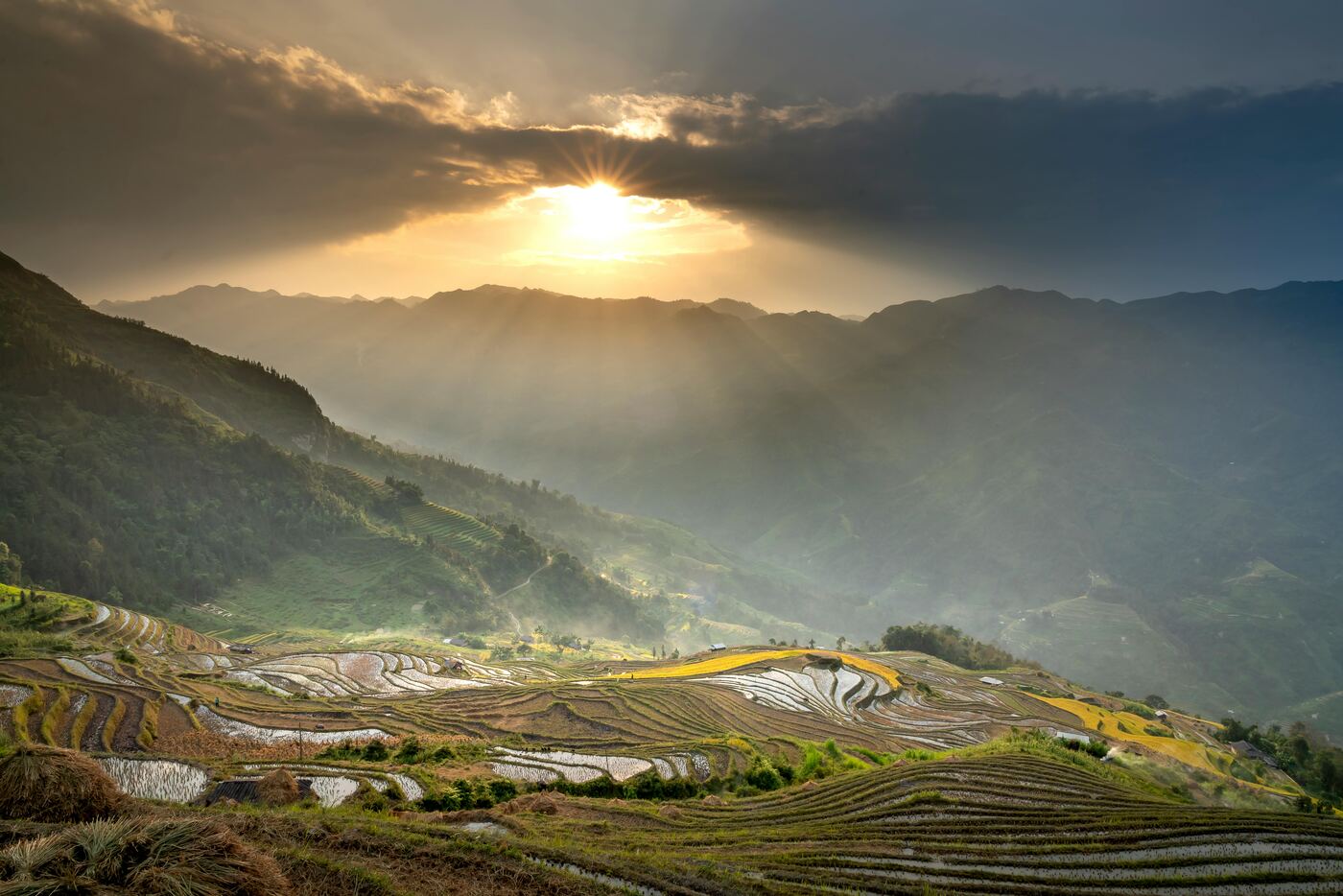
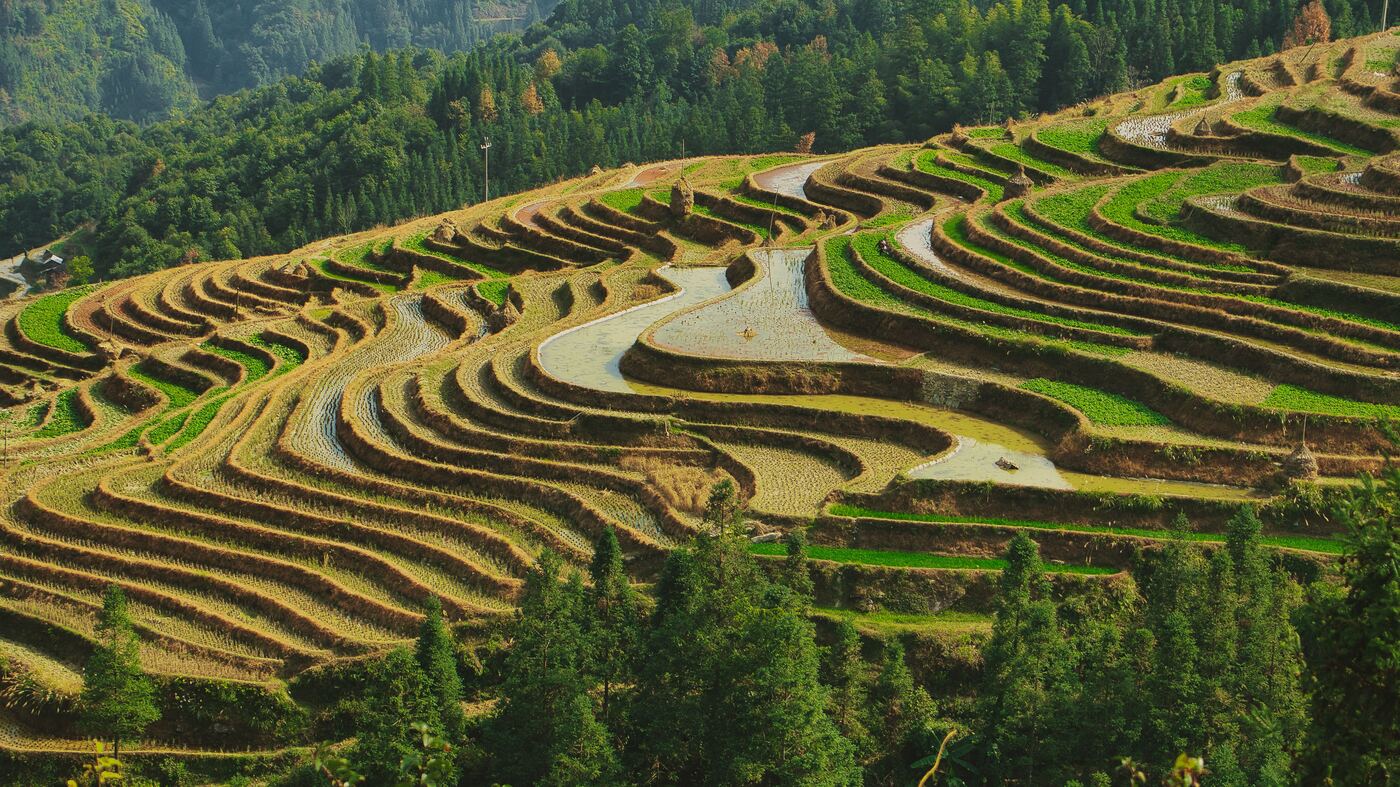
Longji (龙脊, “Dragon’s Backbone”) is a vast network of rice terraces cut into the mountainsides of Longsheng County, Guangxi, about 100 km north of Guilin. The Zhuang and Yao minority communities began carving the slopes more than 600 years ago, in the Yuan and Ming dynasties, building curved retaining walls that climb from roughly 800 m to 1,100 m elevation. The result is one of China’s most photographed agricultural landscapes — layered terrace lines that fill with mirror-water in spring and turn gold at harvest.
The scenic area splits into three villages on different sides of the Longji ridge: Jinkeng Dazhai (金坑大寨, Yao), Pingan (平安, Zhuang) and the Ancient Zhuang Village (古壮寨). Choosing between them — or linking two on the cross-ridge trail — is the main planning decision for a Longji visit, covered next.
Dazhai vs Pingan — which to pick
For a single day trip, pick one and commit; linking two needs an overnight. Here is the head-to-head:
| Area | Vibe | Viewpoints | Cable car |
|---|---|---|---|
| Dazhai (Jinkeng) 金坑大寨 (Yao) | The largest and most dramatic zone, widest views. Best for a day trip, sunset and anyone who wants to save their legs. | Golden Buddha Peak (金佛顶, No.3, highest) & the Thousand-Layer Staircase (千层天梯). | Yes — to Golden Buddha Peak |
| Pingan 平安壮族村 (Zhuang) | Earliest-developed, softer lines, classic; the only village with a night view. All uphill hiking — tiring for a day trip. | Seven Stars Around the Moon (七星伴月, 30–40 min uphill) & Nine Dragons and Five Tigers (九龙五虎). | No — reached on foot |
The call: for a day trip from Guilin, Dazhai is the stronger choice — the cable car does in 20 minutes what a 2–3 hour climb does on foot. Choose Pingan if you have more time, prefer a light hike, want the night view, or are staying over. To reach Dazhai, navigate to “金坑大寨停车场” (Jinkeng Dazhai car park) or the scenic-area ticket office, then take the in-park shuttle up.
The ¥80 ticket, the shuttle trap & the cable car
Admission to the scenic area is a flat ¥80, and the “1 ticket, 3 days” system (一票三日制) is still in effect: one ticket covers all three villages and stays valid for three days. It is now real-name ticketing — book on the official WeChat account or a booking site and scan your ID (passport for foreigners) at the gate.
The trap: the three villages are NOT internally connected. The in-park sightseeing shuttle (¥20–30 one way, ¥40–50 return) only runs within a single village — you can’t ride between them. So on a day trip, do one village in depth; trying to see two burns hours on transfers and waiting.
| Item | Cost | Note |
|---|---|---|
| Scenic-area ticket | ¥80 flat | Valid 3 days, all three villages; real-name (passport at the gate). |
| In-park shuttle 观光车 | ¥20–30 one way ¥40–50 return | Road up to the village from the ticket area — single-village only, can’t cross zones. |
| Dazhai cable car 金佛顶索道 | ¥55 one way ¥100 return | To Golden Buddha Peak; children under 1.2 m free. Only at Dazhai. |
The cable car is worth it, especially for a day trip: the climb to Golden Buddha Peak on foot is 2–3 hours of steep stone stairs, while the cable car takes about 20 minutes to the top, where the aerial view over the “fingerprint of the earth” is spectacular at sunset. The popular play is cable up, walk down (~1 hour on the paved stone path or a villager irrigation trail), which is quieter and more photogenic than the way up.
Getting there from Guilin
The terraces are ~80 km / ~2–2.5 hours north of Guilin (the mountain road and the in-village shuttle make it feel longer than the Amap driving time). A tour or private transfer handles it door-to-door; the public-transport route is very doable:
| Leg | How | Time · cost |
|---|---|---|
| Guilin → Longsheng town 龙胜县城 | Coach from Qintan Coach Station (琴潭客运站) or the North Bus Station | ~2–2.5 h · ¥35–50 |
| Longsheng → the terraces | At Longsheng bus station, transfer to a minibus for Jinkeng Dazhai or Pingan | ~1 h · ¥15–20 |
| Direct coach (peak season) | Guilin (Qintan) direct to Jinkeng Dazhai — skips the Longsheng transfer | ¥60–70 · check the timetable ahead |
| Day tour / private transfer | Hotel pick-up, handles the shuttle, admission & usually a Zhuang lunch; picks one village | ~2–2.5 h each way |
A tour is easier for most first-time visitors — you arrive and walk (~$50–90 incl. transport and admission). DIY is very manageable for experienced China travellers and noticeably cheaper — in peak season the direct Guilin–Dazhai coach is the neatest option. Full routing detail is in the things to do in Guilin & Yangshuo guide.
When to go — the seasons of the terraces
The terraces transform through the farming year; the best season depends entirely on the visual you are after. For a day trip, leave Guilin before 7:00 to arrive by 9:00, before the tour groups — clear air and clean, people-free terraces — and shoot the softer light and blue hour from about 16:00 before heading back.
| Season | The terraces |
|---|---|
| Apr–Jun water mirror | Flooded before and during planting; on calm mornings they reflect the sky and ridgelines like stacked mirrors, and morning mist makes it otherworldly. Exceptional dawn/dusk light. |
| Jul–early Sep green growing | Intensely green young rice, warm and humid. Lush but summer haze cuts long-distance clarity; afternoon showers frequent — beautiful, but not the peak photography window. |
| Mid Sep–late Oct golden harvest | The most spectacular season — rice ripens to gold and amber. Late September is the sweet spot, before the Oct 1–7 crush. Most sought-after and most crowded; book ahead. |
| Dec–Feb occasional snow | Rare but stunning when it lands — white on the curved terrace walls. Some guesthouses close, upper paths can ice over, and the cable car may suspend in severe cold. |
Avoid the July–August haze if photography is the goal, and October 1–7 (Golden Week) under all circumstances — the terraces and shuttle buses hit maximum capacity. See our Li River cruise guide for the other headline Guilin day trip to pair with this.
Touts & pushy fees to refuse
Longji is a real Zhuang and Yao community with tourist traffic, and a few set-ups are worth knowing before you go — none are hard to avoid:
- Gate touts & “逃票” drivers. Locals may offer to “sneak you in past the ticket” or a “private car cheaper than the cable car.” Don’t — they often drop you on a bare, view-less hilltop, or charge a steep fare (up to ~¥150/person). Use the official ticket gate and the park’s own shuttle and cable car.
- Huangluo long-hair show (黄洛瑶寨, ~¥80). The show itself displays Red Yao life and long-hair grooming, but the upsells are semi-forced: an on-stage “Yao wedding” costume then asks you to buy a “love token” (¥30–100), and the group photo costs extra. Ask all fees upfront, smile and decline if you don’t want to take part, or watch free from the outside area.
- Porters (背篓). On steep sections, villagers offer to carry luggage or children for ~¥30–50 — a legitimate service, but agree the final price face-to-face before you start up to avoid a dispute at the bottom.
- Mountain restaurants & inns. Everything is carried up by hand, so prices run high — check the menu, confirm what “one portion” costs (a “¥168 beer fish” surprise is a known trap), and book lodging on a proper platform (read the bad reviews) rather than trusting a roadside tout.
Book a Longji terraces tour or transferNASDAQ: TCOM
Trip.com lists guided Longji day tours from Guilin (~$50–90, transport + shuttle + admission + a Zhuang lunch) and private transfers — booked in English on a foreign card, so you skip the touts and just arrive and walk.
Staying overnight for sunrise & sunset
A day trip is doable but rushed, and it rarely catches the sunrise or sunset — which are the terraces at their best. An overnight in a stilt-house guesthouse buys you the morning mist over the “mirror” terraces, the sunrise, and the sunset turning the ridge gold, all with the villages nearly to yourself after the last day-trippers leave.
- Dazhai (金坑) — the widest views, Golden Buddha Peak and the Thousand-Layer Staircase, and the best sunset. The guesthouses are relatively the better ones (some with floor-to-ceiling window rooms), but the paths are steep, so luggage-hauling is a chore.
- Pingan — a good sunrise position and a night view, quieter overall, but the guesthouses are more uneven and it feels more commercialised.
The guesthouses are converted wooden stilt houses — “open the window onto the view” — with simple Zhuang or Yao home cooking (bamboo-tube rice 竹筒饭, oil tea 打油茶, cured pork). But mountain limits apply: soundproofing, hot water and Wi-Fi lag behind city hotels, and water pressure can be shaky in peak. Lower your expectations, pack a backpack rather than a suitcase, and consider a porter for heavy bags. Rooms run roughly ¥150–300 a night; book 2–3 days ahead outside the harvest peak, a week or more for mid-October.
Where to stay for a Longji visit
Two sensible bases: stay in the terrace villages (Dazhai or Pingan) for the sunrise, sunset and silence, or base in Guilin city and day-trip out. There are no hotel chains above the village gates — the village option is wooden stilt-house guesthouses, simple but part of the experience. For a day trip, the chains are in Guilin city.
Where to book these: the Longji village guesthouses and China’s home-grown city chains — 全季 (JI) and 亚朵 (Atour) — are listed most completely on Trip.com, with English checkout and foreign-card payment. It’s the main booking platform for mainland stays; Western sites like Booking and Agoda carry only a fraction of these properties.
Stay in the terrace villages (for sunrise & sunset)
There are no international or Chinese hotel chains above the village gates — the experience is wooden stilt-house guesthouses in Dazhai (Jinkeng, Yao) or Pingan (Zhuang), simple but genuinely part of the trip, roughly ¥150-300 a room. Staying the night is what unlocks the sunset light, the morning mist before day-trippers arrive, and the near-silence after the last shuttles leave. The value picks below are the mid-range guesthouses; a higher-comfort boutique inn is listed if you want it. Book on a proper platform and read the bad reviews — mountain soundproofing, hot water and Wi-Fi lag behind city hotels.
- In Dazhai village, by the cable-car station and the trails to Golden Buddha Peak — the widest views and the best sunset.The day-trip and sunset base: relatively the better guesthouses (some with floor-to-ceiling window rooms), walkable to the cable car; paths are steep, so pack light.
- In Pingan village, a short uphill walk above the gate — minutes from the Seven Stars Around the Moon viewpoint; a good sunrise position.The earliest-developed base: terrace-view stilt-house rooms with home-cooked Zhuang meals, walkable to both Pingan viewpoints without a cable car — quieter, if more uneven and commercialised.
- Above Pingan village, perched over the terraces — a higher-comfort option than the standard guesthouses.The upscale end of what Longji offers: timber boutique rooms with terrace views for travellers who want more comfort while staying in the village.
Base in Guilin city and day-trip out
If you are doing Longji as a day trip rather than staying overnight, base in Guilin city where the foreigner-friendly chains are — a home-grown mid-range chain like 全季 (JI) or 亚朵 (Atour) is reliable, English-app bookable, and a fraction of the five-star rate. From the city it is ~2-2.5 hours each way to the terraces.
- Central Guilin, near the Qintan Coach Station for the Longsheng connection — ~2-2.5 h to the terraces.China's most popular home-grown mid-range chains — modern, spotless, easy English-app booking, far better value than the city's luxury towers.
Frequently asked questions
What is the best month to visit the Longji rice terraces?
Two windows. The golden-harvest season, roughly mid-September to late October, is the single most spectacular — the terraces turn amber and gold and it's the photographers' peak (avoid the Oct 1–7 Golden Week itself). The other is the 'water mirror' season, roughly April to June, when the flooded terraces reflect the sky and, with morning mist, look otherworldly. Mid-summer (July–August) is full green — lush but hazy. December to February occasionally brings snow, spectacular but unreliable, and some guesthouses close. For a first visit chasing the classic shots, aim for the September–October gold or the April–June mirror.
Pingan vs Dazhai — which village should I pick, especially for a day trip?
For a day trip from Guilin, Dazhai (Jinkeng, 金坑大寨) is the stronger choice: it's the largest and most dramatic zone and the only one with a cable car, which saves your legs and gets you to the top viewpoint without a 2–3 hour climb. Pingan (平安壮寨) is the earliest-developed area, with the classic Seven Stars Around the Moon and Nine Dragons and Five Tigers viewpoints, softer terrace lines, and it's the only village with a night view — but it's pure uphill hiking, so a day trip here is genuinely tiring and it suits those with more time, light hikers, or an overnight. Navigate to 'Jinkeng Dazhai car park' (金坑大寨停车场) or the scenic-area ticket office, then take the in-park shuttle up.
Is the Dazhai cable car worth it, and how much is it?
Yes, strongly — for a day trip especially. The Jinkeng cable car to Golden Buddha Peak (金佛顶, the No.3 viewpoint) costs ¥55 one way / ¥100 return (children under 1.2 m free). Climbing to the same viewpoint on foot takes 2–3 hours up steep stone stairs; the cable car does it in about 20 minutes, and the aerial view over the 'fingerprint of the earth' is spectacular, best at sunset when the whole hillside glows gold. The best play is 'cable up, walk down' — descend on the paved stone path or a villager irrigation trail (~1 hour), which is quieter and more photogenic than the way up.
How does the ¥80 ticket work — and why can't I do two villages in one day?
Admission to the scenic area is a flat ¥80, and the '1 ticket, 3 days' system (一票三日制) is still in effect — one ticket covers all three areas (Jinkeng Dazhai, Pingan and the Ancient Zhuang Village 古壮寨) and stays valid for three days. It is now real-name ticketing: book on the official WeChat account or a booking site and scan your ID (passport for foreigners) at the gate. The catch that catches people out: the three villages are NOT internally connected. The in-park sightseeing shuttle (¥20–30 one way, ¥40–50 return) only runs within a single village — you can't ride between them. So on a day trip, pick one village and do it in depth; trying to see two in a day just burns hours on transfers and waiting.
How do I get to the terraces from Guilin?
By public transport: from Guilin, take a coach from Qintan Coach Station (琴潭客运站) or the North Bus Station to Longsheng county town (龙胜县城) — ¥35–50, ~2–2.5 hours — then at Longsheng bus station transfer to a minibus for Jinkeng Dazhai or Pingan (¥15–20, ~1 hour). In peak season some Guilin stations (Qintan) run a direct coach straight to Jinkeng Dazhai (¥60–70), skipping the Longsheng transfer — check the timetable on the official account ahead. A guided day tour or a private transfer handles all of it door-to-door. Total travel is ~2–2.5 hours each way; the mountain road plus the in-village shuttle make it feel longer than the Amap driving time.
Is an overnight stay worth it, and should I stay in Pingan or Dazhai?
Yes, if you can spare the night — a day trip is too rushed and rarely catches the sunrise or sunset, which are the terraces at their best. Dazhai (金坑) has the widest views, the Golden Buddha Peak and Thousand-Layer Staircase viewpoints, and the best sunset; its guesthouses are relatively the better ones, some with floor-to-ceiling window rooms, but the paths are steep and hauling luggage is a chore. Pingan is the earliest-developed, with a good sunrise position and a night view; it's quieter but its guesthouses are more uneven and it feels more commercialised. Either way the guesthouses are converted wooden stilt houses — 'open the window onto the view', but with mountain limits: soundproofing, hot water and Wi-Fi lag behind city hotels and water pressure can be shaky in peak. Lower your expectations, pack a backpack rather than a suitcase, and consider a porter for heavy bags.
What scams and pushy fees should I watch for at Longji?
A few, all avoidable. At the gate and roadside, locals may offer to 'sneak you in past the ticket' or a 'private car cheaper than the cable car' — don't; they often drop you on a bare, view-less hilltop or charge a steep private fare (up to ~¥150/person). Use the official ticket gate and the park's own shuttle/cable car. The Huangluo Yao Village long-hair show (黄洛瑶寨, ~¥80) has semi-forced upsells — an on-stage 'Yao wedding' costume that then asks you to buy a 'love token' (¥30–100) and a paid group photo; ask all fees upfront, smile and decline if you don't want to take part, or watch free from outside. Porters (背篓) who carry luggage or children on steep sections charge ~¥30–50 — agree the final price face-to-face before you start up. And mountain restaurants and inns price high (goods are carried up by hand), so check the menu, confirm what 'one portion' costs, and book lodging on a proper platform rather than trusting a roadside tout.
Can I hike between the viewpoints, or do I need the cable car?
At Pingan, hiking is the way to see it: the trail from the village gate to Seven Stars Around the Moon takes about 30–40 minutes uphill on stone-paved paths, with Nine Dragons and Five Tigers a further 15–20 minutes; there is no cable car here. At Dazhai the upper viewpoints (Golden Buddha Peak) are a 2–3 hour climb on foot, or ~20 minutes by cable car — the cable car is an optional shortcut, and 'cable up, walk down' is the popular compromise. A cross-terrace hike links Pingan and Dazhai in about 3–4 hours across the ridge — one of the best walks in the Guilin area, but only practical if you stay the night in one village and start from the other. Wear grippy shoes; the smooth stone paths are slippery in light rain.
Sources
Checked August 2026 · Written from our own first-hand travel in China.