Key takeaways
- A 240 m one-way floodlit limestone cave in Guilin’s Xiufeng district, ~6 km northwest of the centre.
- Centrepiece = the Crystal Palace of the Dragon King (水晶宫) — a vaulted chamber that was the Journey to the West Dragon Palace filming set.
- 70+ Tang-dynasty ink inscriptions record 1,300+ years of visitors — rare historical depth for a show-cave.
- Tickets a flat ¥90 (~¥82 online, half ¥45) with a free Chinese guide; allow ~1 hour. Refuse the ¥35 train, the ¥38 “潜龙渊” and the ¥35 photo frame — you need none of them.
- Go at 9:00 opening or after 16:30 to dodge the 10:00–14:00 tour groups. Pick this or Seven Star Cave, not both.
What Reed Flute Cave is
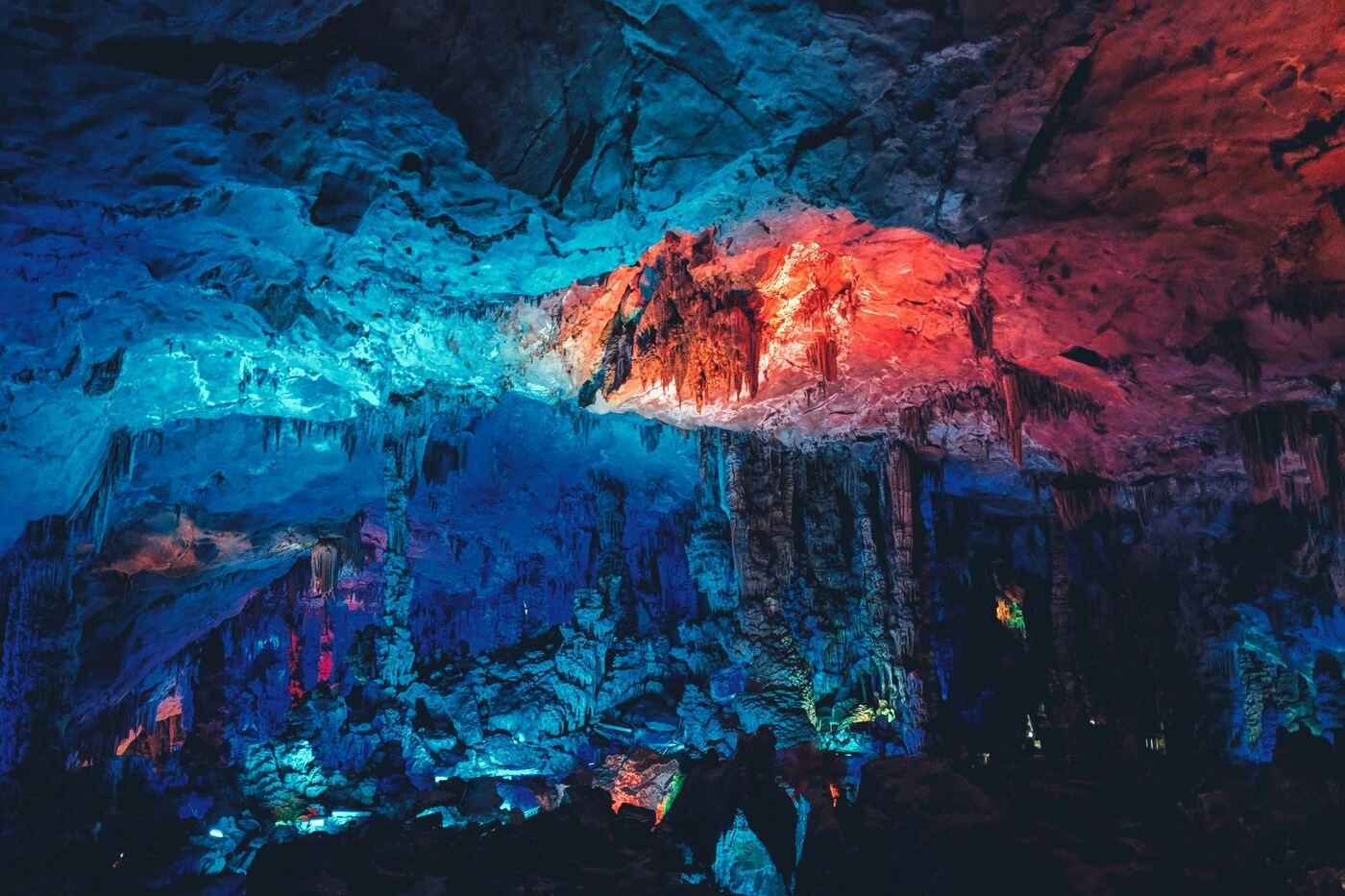
Reed Flute Cave is a 240-metre one-way walking route through a limestone cave in Guilin’s Xiufeng district, lit throughout by theatrical coloured floodlights. The cavity was dissolved out of Devonian limestone over millions of years — the same process that carved the famous Karst pillars above ground. Inside, stalactites hang from the ceiling, stalagmites rise from the floor, the two merge into columns over millennia, and translucent flowstone curtains fold from the ledges. The name comes from the reeds (芦苇) at the entrance, historically cut by locals to make flutes (笛). Reed Flute is Guilin’s earliest-developed show-cave — a “state-guest cave” (国宾洞) that has received many visiting heads of state. Set expectations for staged spectacle over a naturalistic, torch-lit cave: the lighting is what makes the formations visible at all.
Tickets, hours & the upsells to refuse
The cave is toured in groups led by a guide along a single one-way path — you enter at one end and exit at the other, with no turning back mid-route. Commentary is usually Mandarin only (it’s included free); key chambers are signposted in English and the route is visually self-explanatory, so foreign visitors navigate it fine. The essentials:
| Detail | What to expect |
|---|---|
| Adult ticket | Flat ¥90 (half ¥45; under 1.2 m / under 6 free). Booking ahead online usually ~¥82 — but tickets take ~1 hour to activate, so don’t buy at the gate. |
| Hours | ~08:00–17:30 (Jul–Dec) / 09:00–17:00 (Jan–Jun); last entry ~30 min before close. Often extended on public holidays. |
| Guide | A free Chinese-language guided walk is included with the ticket. |
| Time inside | ~50 min–1 hour with the guide; ~1.5 h if you linger and photograph. |
Refuse the internal upsells — you need none of them:
- Little train (小火车, ¥35) — the walk from the ticket check to the cave mouth is a gentle ~10 minutes. Just walk.
- Qianlong Yuan (潜龙渊, ¥38) — a new “cave within a cave” that is mostly projection effects and a fortune-telling routine in a cramped space. Skip it.
- Photo frame (¥20–35) — the Journey to the West spot takes a free small photo + keychain, then pushes a ¥35 crystal frame at the exit. Take the free one or use your phone.
- Exit “medicinal herbs” & the ¥300 sedan chairs — don’t look, touch or buy; pure tourist tax.
Book Reed Flute Cave tickets & a Guilin tourNASDAQ: TCOM
Entry tickets are cheapest booked ahead; for English narration the cave usually appears as a stop on English-guided Guilin city day tours — all booked in English on a foreign card.
What to see inside
The route strings together several named chambers. The Crystal Palace is the unmissable one; the rest reward a slower look as you pass through.
| Feature | Why it stands out |
|---|---|
| Crystal Palace of the Dragon King 水晶宫 | The vaulted centrepiece chamber, dense with columns and stalactites — the huge underground space used as the Dragon Palace in the classic 1986 Journey to the West, and reportedly used for state banquets in the 1960s. A reflective floor pool doubles the apparent height; groups pause here longest and the lighting is at its most theatrical. |
| Tang-dynasty ink inscriptions 唐代题字 | At least 70 ink-brush inscriptions on the walls — the earliest from the Tang dynasty (618–907 AD) — record names, dates and short poems. A medieval guest book in stone that gives the cave a historical depth most show-caves lack. |
| Reflection pools 倒影池 | Several stretches have still, clear floor water that mirrors the formations above; the doubled-stalactite effect is one of the cave’s signature shots — best before group foot traffic disturbs the surface. |
| Named formations | The Dragon King’s Throne, a “Mushroom Forest” of rounded stalagmites, and a “Snowflake” passage of fine crystalline wall textures — the guide points out the pareidolia shapes as you go. |
If the staged lighting feels too curated, the graffiti section anchors the visit in something genuinely ancient — and it is the detail that sets Reed Flute Cave apart from Guilin’s other illuminated cave, the larger Seven Star Cave (七星岩).
Reed Flute vs Seven Star Cave
Both are illuminated limestone caves in Guilin city; you only need one. Here’s the head-to-head:
| Cave | Feel | Best for |
|---|---|---|
| Reed Flute Cave 芦笛岩 | Smaller and more polished — a ~500 m route, concentrated, ~1 hour with the guide, not tiring; the “state-guest” cave. | A tight schedule, older visitors or children, or just wanting to see a cave quickly. |
| Seven Star Cave 七星岩 (in Seven Star Park) | Larger, longer and more open, a richer experience — but more walking and more effort. | Having time and wanting a bigger, more exploratory cave. |
The call: choose Reed Flute for the easy, polished visit; choose Seven Starif you have the time and want scale. There’s no reason to do both.
How to get there
The cave sits ~6 km northwest of central Guilin (the Zhongshan Road / Bell Tower area). City bus is cheapest; DiDi is the most flexible. From a Yangshuo base it is a Guilin-city day trip.
| From | How | Time · cost |
|---|---|---|
| Central Guilin (Bell Tower / Zhongshan Rd) | City bus 3 or 213 (stops at the cave entrance, 芦笛岩站) | ~25–30 min · ¥1–2 |
| Central Guilin (Bell Tower / Zhongshan Rd) | DiDi or taxi (set destination 芦笛岩景区) | ~15–20 min · ¥20–35 |
| Guilin North Railway Station (高铁站) | DiDi / taxi via the city centre | ~25–35 min · ¥30–50 |
| Guilin Liangjiang Airport (KWL) | DiDi / taxi through Xiufeng district | ~30–45 min · ¥45–65 |
| Yangshuo | Bus or DiDi to Guilin city, then city bus / DiDi to the cave | ~1.5–2 hrs total |
By bus: Routes 3 and 213 both stop at the cave entrance (芦笛岩站); tap in with Alipay or WeChat Pay. By DiDi: set the destination to 芦笛岩景区 — fares run ¥20–35 from the centre; a common play is DiDi out and bus back. From Yangshuo, take the first morning bus or DiDi to Guilin city (1–1.5 hrs), do the cave late morning, then spend the afternoon at Elephant Trunk Hill before heading back. Full transport detail is in the Guilin & Yangshuo guide.
Best time to visit
An all-weather, year-round attraction — the interior holds ~18–20°C whatever the season, which makes it a genuinely welcome cool escape from Guilin’s humid summer. The exterior gardens and pond are nicest in spring and autumn.
| When | What it’s like |
|---|---|
| 9:00 opening / after 16:30 | Least crowded — tour groups cluster 10:00–14:00, so the first slot or late afternoon means the guide isn’t rushing and you can linger over the wetter, livelier second-half formations. |
| Spring (Mar–May) | Pleasant temperatures, lush exterior gardens, moderate crowds; the cave is unaffected by April drizzle. |
| Summer (Jun–Aug) | The cave is a cool respite from the heat — a real seasonal plus — but July–August brings the highest domestic volumes; go before 10:00. |
| Autumn (Sep–Nov) | Best overall season for Guilin: clearer skies, comfortable temperatures, thinner crowds. September is the sweet spot before Golden Week. |
| Avoid Oct 1–7 (Golden Week) | Open, but Guilin sees its highest annual visitor density — entrance queues, congestion inside, busy roads. |
Photography: the Crystal Palace pool gives strong symmetrical shots when the water is still — usually earlier in the day. The coloured lighting cycles on a timer; waiting for the blue-wash phase tends to give the most dramatic frame. Tripods are impractical in the moving group, so a phone night mode handles the low light best. See our Li River cruise guide for the headline outdoor day the cave complements.
Practical for foreigners
- Footwear: closed-toe shoes with grip — the path has wet, polished stone and steep steps; sandals and smooth soles are a real slip hazard.
- Layer up: the cave holds ~18–20°C year-round; arriving from 30°C+ summer heat, the drop is noticeable — pack a light fleece or long-sleeved shirt.
- Bags: large backpacks and suitcases aren’t permitted inside — leave luggage at your accommodation; a small day bag is fine.
- Accessibility: the one-way route includes multiple staircases and a gradual descent; there is no wheelchair path through the interior — confirm access before buying tickets.
- Children: the 240 m route takes under 90 minutes and the lit formations engage most kids; it is theatrical, not pitch-black between chambers.
- Toilets: at the entrance / exit and in the exterior scenic area — none inside the cave, so go before entering.
Frequently asked questions
What are the current ticket prices and opening hours for Reed Flute Cave?
Admission is a flat ¥90 for adults (half ¥45 for students and seniors; children under 1.2 m or under 6 free). Booking on a travel site or mini-program ahead usually shaves it to about ¥82 — but online tickets typically take an hour to activate, so don't buy at the gate. Opening hours are roughly 08:00–17:30 (1 July–31 December) and 09:00–17:00 (1 January–30 June), with last entry about 30 minutes before closing; hours can extend on public holidays. The ¥90 covers the main cave with its free Chinese-language guided walk — it does not include the internal add-ons (see the scam/upsell notes below), none of which you need.
Is Reed Flute Cave worth visiting, or is it just "Disneyland-lit"?
It's a calibrated yes. The cave is lit with coloured floodlights, and without them the interior is pitch black — the lighting is what reveals the stalactite forms, so it is theatrical by necessity. Some of the 'photo vs reality' gap online is over-filtered posts, but in person the scale of the 'natural art palace' is genuinely impressive, especially the huge underground chamber — the Crystal Palace, which was the Dragon King's Palace filming location in the classic 1986 Journey to the West. Reed Flute is Guilin's earliest-developed cave, a 'state-guest cave' (国宾洞) that has received many visiting heads of state; the sights are concentrated and there's no backtracking. First-timers to Guilin who haven't seen a big show-cave will find it a worthwhile stop; if you've already done a larger cave like Yinzi Cave (银子岩), it can feel repetitive.
Reed Flute Cave vs Seven Star Cave — which should I pick?
Pick one; there's no need to do both. Reed Flute Cave (芦笛岩) is the smaller, more polished option — a ~500 m one-way route you can see in about an hour with the guide, concentrated and not tiring, so it suits a tight schedule, older visitors or children, or anyone who just wants to see a cave quickly. Seven Star Cave (七星岩), inside Seven Star Park on the east side of the Li River, is larger with a longer, more open route and a richer experience, but it involves more walking and effort. In short: choose Reed Flute for the easy, polished 'state-guest' visit; choose Seven Star if you have time and want a bigger, more exploratory cave.
What internal upsells and scams should I refuse at Reed Flute Cave?
Several, and you can skip all of them. (1) The little train (小火车, ¥35) pushed at the gate — the walk from the ticket check to the cave mouth is a gentle 10 minutes, so just walk. (2) Qianlong Yuan (潜龙渊, ¥38) — a newly-built 'cave within a cave' that is mostly projection effects and a fortune-telling routine in a cramped space; refuse it. (3) The photo trap (¥20–35) — at the Journey to the West spot they take a free small photo and give a keychain, then push a ¥35 crystal frame at the exit; take the free one or use your phone. (4) At the exit, don't look at, touch or buy the 'medicinal herbs', and the ¥300 sedan chairs at the gate are pure tourist tax. The core ¥90 ticket and its free guide are all you need.
When should I go, and how long does a visit take?
The route is a one-way loop; with the guide it takes about 50 minutes to an hour, or up to ~1.5 hours if you linger and photograph. Tour groups cluster between 10:00 and 14:00, so go right at 9:00 opening or after 16:30 — fewer people, the guide isn't rushing, and you can take your time over the wetter, livelier formations in the second half. The interior holds ~18–20°C year-round, which makes it a welcome cool escape on a hot Guilin summer day; the exterior gardens and pond are nicest in spring and autumn.
How do I get to Reed Flute Cave, from Guilin or Yangshuo?
The cave is ~6 km northwest of central Guilin (the Bell Tower / Zhongshan Road area). City buses 3 and 213 stop at the cave entrance (芦笛岩站), ~25–30 minutes, ¥1–2; a DiDi or taxi is ~15–20 minutes and ¥20–35 — a common play is DiDi out and bus back. From a Yangshuo base it is a Guilin-city day trip: take the first morning bus or DiDi to Guilin city (~1–1.5 hours), do the cave late morning, then pair it with Elephant Trunk Hill or a Li River waterfront walk in the afternoon before heading back.
What should I wear and can I visit without a guide?
Wear closed-toe shoes with grip — the path has wet, polished stone and some stairs, and sandals or smooth soles are a real slip hazard. Bring a light layer: the cave holds ~18–20°C, a noticeable drop if you've come from summer heat. Visits move in groups led by a guide along the one-way route; the commentary is usually Mandarin only, but key chambers are signposted in English and the cave is visually self-explanatory, so foreign visitors navigate it fine. If you want narrated depth in English, the cave usually appears as a stop on English-guided Guilin city day tours.
Sources
Checked August 2026 · Written from our own first-hand travel in China.