Key takeaways
- ⭐ There are no tickets at the door. Entry is by advance online booking only, released nightly at 20:00 for the day five days ahead — turning up without one does not work, and holiday dates go in minutes.
- A passport is accepted as the booking document in the official channel; at the entrance use the staffed lane rather than the automatic gates.
- Easiest route: Chengdu East → Guanghan North by intercity train, ~18 min and ~¥18, then 8.3 km (~16 min, ~¥20) by taxi. About 50 minutes door to door.
- Buy the ¥10 audio guide in the museum’s mini-programme and switch it to English. Without it the labelling assumes background you probably don’t have; a live English guide is ¥450 and effectively unbookable at short notice.
- Walk it backwards — straight to the second floor for the bronze spirit tree and the masks while it is empty, then down. And note the site itself is closed to the public; the museum is the visit.
What Sanxingdui is — and where it isn't
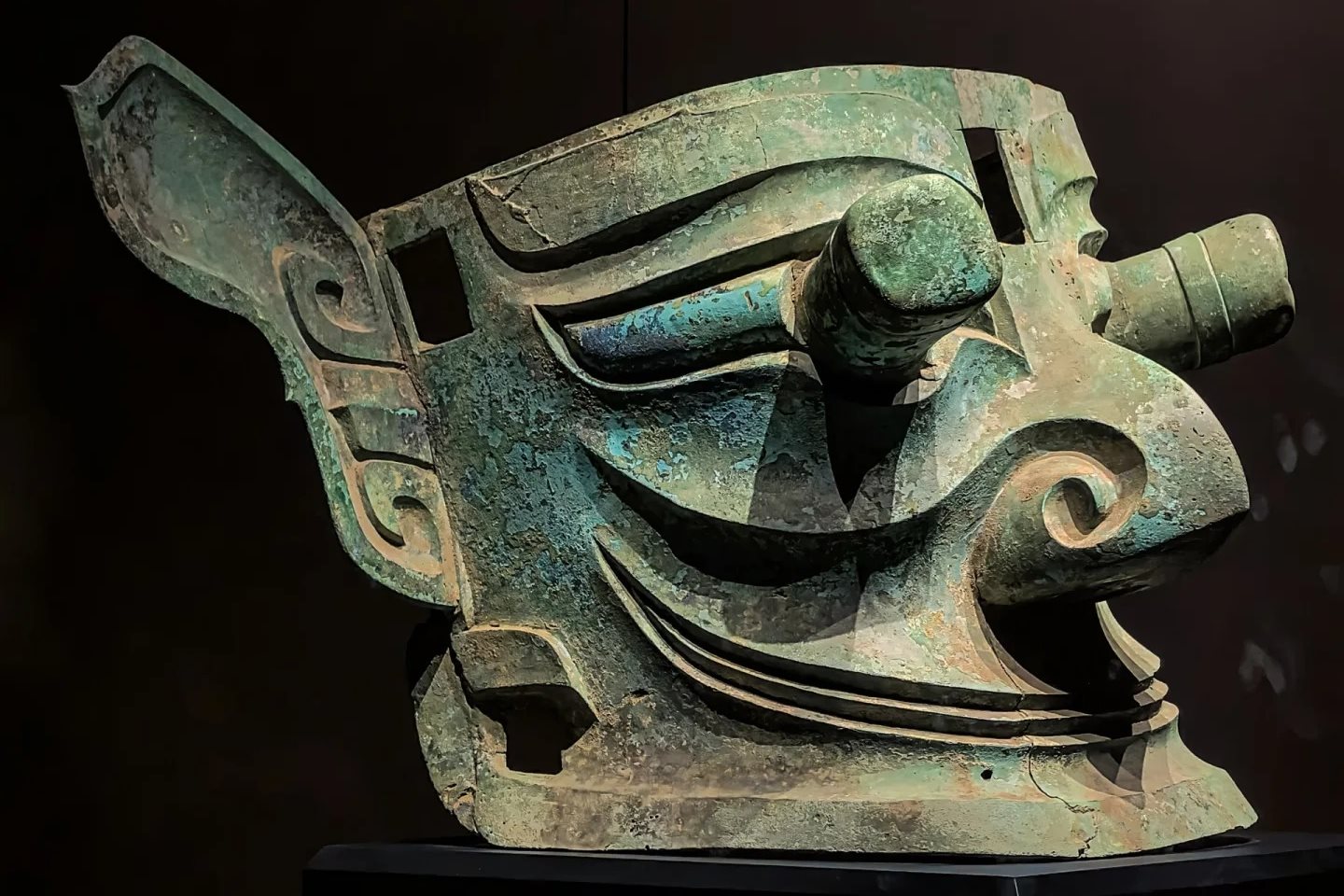
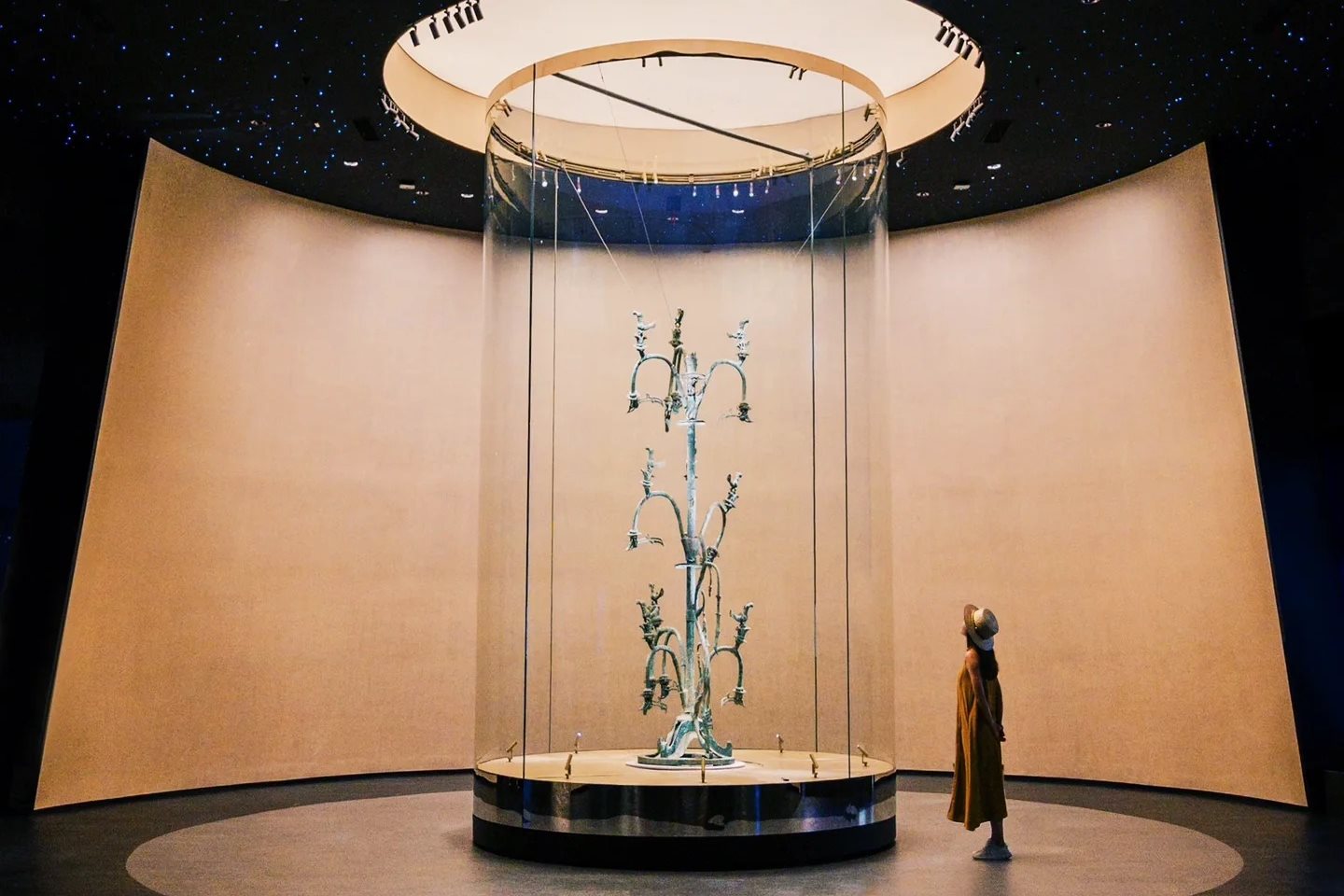
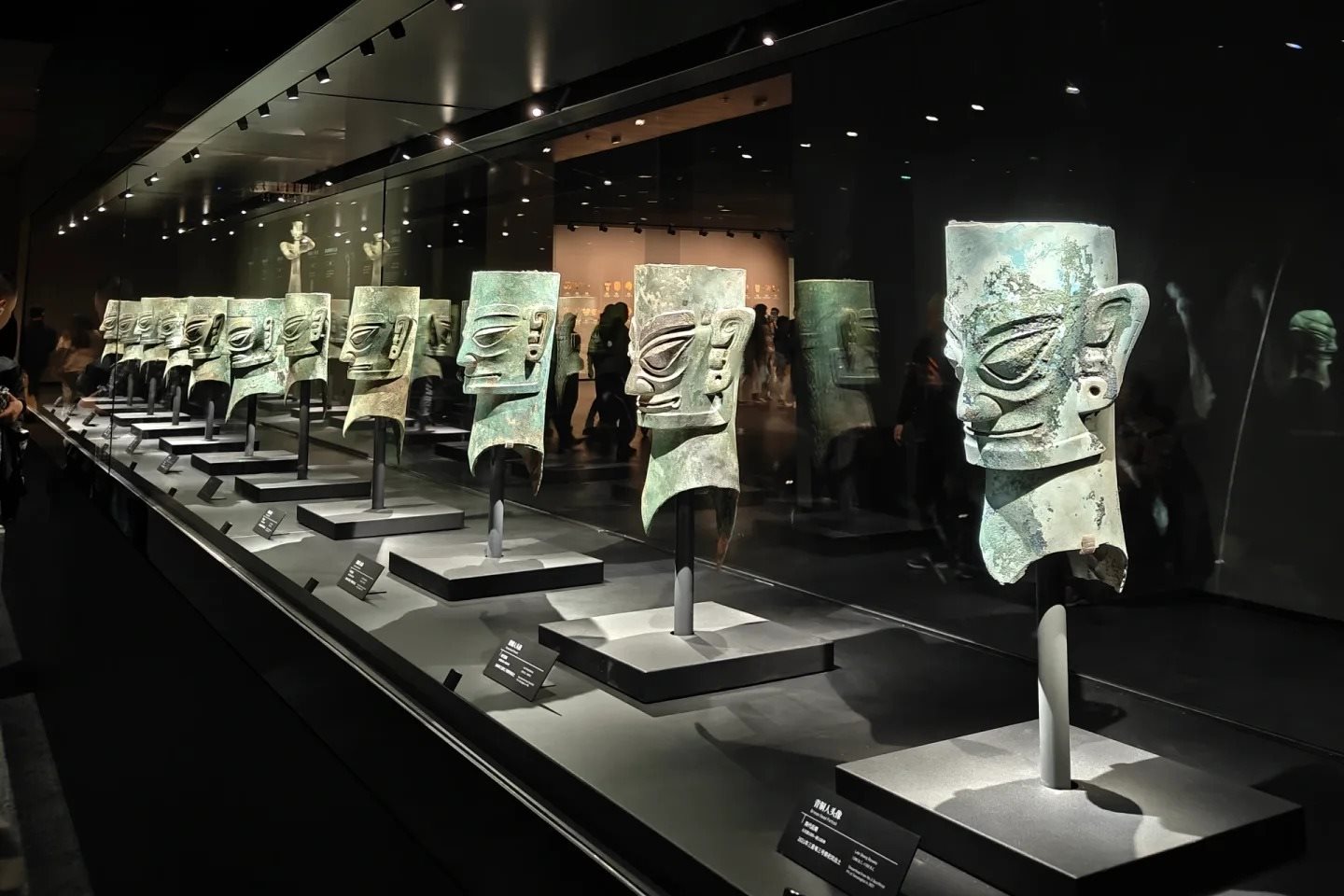
In 1929 a farmer digging a ditch near Guanghan struck a pit of jade. What the excavations eventually produced — most spectacularly in 1986 and again from 2020 — was the material culture of a Bronze-Age civilisation in the Sichuan basin that appears in no historical record: the ancient state of Shu. Its bronzes look like nothing else in Chinese art. Masks with pupils projecting on stalks. A standing figure 2.6 metres tall with enormous ringed hands. A bronze tree approaching four metres, hung with birds. A gold sceptre 1.42 metres long.
The headline object is the mask below — officially the Bronze Mask with Protruding Eyes, 138 cm across and 66 cm high, its pupils projecting 16 cm from the sockets, recovered from the No.2 sacrificial pit in 1986.
Two things about the geography are worth being clear on before you plan, because English write-ups routinely blur them.
It is not in Chengdu, and the site is not open. The museum is in Guanghan, in Deyang prefecture, 50 km out — near enough for a half-day, far enough that “a museum in Chengdu” will send you to the wrong city. And the excavation site itself (三星堆遗址) is closed to the public, 4 km from the museum. What you visit is the museum, where everything lifted from the pits is displayed.
The compensation for not seeing the pits is better than it sounds: the museum has a conservation hall where you watch bronzes being pieced back together through glass, which is the part of an archaeology museum that is normally behind a staff door.
Booking — the part that goes wrong
Sanxingdui runs on timed advance booking and nothing else. There is no ticket office selling same-day entry, so the failure mode is not a queue — it is a wasted round trip.
| Rule | Detail |
|---|---|
| When tickets appear | 20:00 China time, for the day five days ahead — a rolling five-day window, not a long one. |
| Where | The museum’s official WeChat service account (三星堆博物馆 / 三星堆 → 门票预约). Copycat accounts exist; the museum warns about them. |
| At the door | Nothing is sold on site. No booking, no entry. |
| How fast it goes | Holiday and school-holiday dates can clear within minutes of the 20:00 release. |
| Price | ¥72 adult · ¥36 student · free over 60 with ID. |
On a passport. The official booking channel accepts 护照 as a document type — choose it and enter the number exactly, because a mistyped passport number cannot be fixed at the entrance. The turnstiles have been upgraded and some now read passports, but the reliable route is the staffed lane, where a member of staff checks the passport against your QR code; travellers report gates 7 and 19. If a Chinese channel is not usable for you at all, a day tour that bundles admission is the realistic alternative — and unlike most attractions, here that is a genuine service rather than a mark-up on something you could have bought at the gate.
Getting there from Chengdu
This is the easiest logistics of any Chengdu day trip — the museum is 50 km out and the train does most of it in under twenty minutes.
| Option | Time | Cost | Notes |
|---|---|---|---|
| Train + taxi Chengdu East → Guanghan North (广汉北) | ~18 min + ~16 min | ~¥18 + ~¥20 | The pick. The station is 8.3 km from the museum; taxis wait outside. |
| Tourist coach Chunxi Road (below the IFS panda) | 70–90 min | ~¥25 one way | No changes, but slower, and the pick-up is not at a rail station. |
| Ride-hail / driver | ~85 min | ¥150–180 | 49.9 km from Tianfu Square. Sensible for three or four people sharing. |
Amap-measured on 11 August 2026: Chengdu East to the museum is 55.9 km by road, Tianfu Square 49.9 km, and Guanghan North station (广汉北站) to the museum 8.3 km. Allow about 50 minutes door to door on the train option and treat the whole outing as a half day once you add three hours inside.
Hours — and the hall that shuts early
| Period | Open | Last admission |
|---|---|---|
| Normal days | 08:30–18:00 | 17:00 |
| Golden Week, public holidays, Jan · Feb · Jul · Aug | 08:30–20:00 | 18:00 |
| Conservation hall | 09:00–17:00 | Closes at 17:00 whatever the main halls do |
The museum is open on Mondays — unusual in China, and worth knowing when you are assembling a week where everything else shuts. The single annual closure is Chinese New Year’s Eve.
Two numbers do the work here. The first is the conservation hall’s 17:00: arrive at four and you will see the bronzes but not the people mending them. The second is arithmetic — the visit takes three to four hours and admission stops at 17:00, so on a normal day the honest latest arrival is about 13:30, which with a 50-minute journey means leaving central Chengdu by half twelve. Getting home is not the constraint: Guanghan North runs until roughly 21:50.
On the extended-hours dates — Golden Week, the short public holidays and the January, February, July and August school holidays — an evening slot is the quietest way to see the place, because the coach groups have gone and the booking system is still releasing tickets against the later closing time.
What to see, and the order to see it in
Walk it backwards. Everyone entering starts on the ground floor and works up, which means the famous room fills from mid-morning. Go straight to the second-floor hall instead, see the headline bronzes while it is still empty, then work down and finish with the old hall and the conservation hall. It costs nothing and it is the difference between having the famous room to yourself and queueing three deep at every case.
| Where | Allow | What is there |
|---|---|---|
| Second floor 新馆二层 | 60–90 min | The bronze spirit tree at close to four metres, the 2.6 m standing figure, and the protruding-eye masks — the objects the museum is famous for. |
| Ground floor 新馆一层 | 40–60 min | The 1.42 m gold sceptre and the bronze sun-shaped object; smaller pieces, easier once the crowd has gone upstairs. |
| Conservation hall 文物修复馆 | 20–40 min | Conservators working on bronzes behind glass. Closes 17:00. |
| Old museum 老馆 | 30–60 min | Same ticket, much quieter since the new hall opened — jade and the smaller finds. |
Buy the audio guide. This is a collection where the labels assume you know what the Shu state was, and the objects are strange enough that context is the difference between an hour of “that’s odd” and a genuinely absorbing morning. The museum’s mini-programme sells one for about ¥10 a person that switches to English and plays on your own phone; physical units are ¥50 in English (¥30 in Chinese) and trigger automatically beside each case. A live English-speaking guide is ¥450 for up to twenty people and, in practice, cannot be arranged on the day in peak season — book it before you travel or use the audio.
Practical
- No flash. Banned throughout — it damages bronze patina and gold leaf, and staff will stop you.
- Free left luggage at the visitor centre on the right as you come in, backpacks included.
- Ignore the touts. Unofficial “guides” work the entrance; the museum sells its own audio guide and that is the one to buy.
- Two shops, not one. The large one at the exit has the fuller range and the shorter queue — walk past the small one on the way in.
- Getting back: taxis at the museum thin out late in the day; if you are on the last of the extended-hours slots, book a ride-hail before you leave the building.
Sanxingdui day tours & transfersNASDAQ: TCOM
Round-trip transport from Chengdu with admission included — the practical route if the Chinese-only booking channel is not open to you, booked in English on a foreign card.
Jinsha is shut until 2027 — plan around it
Chengdu has a second ancient-Shu museum, the Jinsha Site Museum (金沙遗址博物馆), built over a site found in 2001 and holding the finds of the culture that followed Sanxingdui. Almost every guide still sends people there as the easy in-city alternative to the trip out to Guanghan. It is closed. The museum announced its first full overhaul since it opened in 2007 and shut on 5 December 2025; it is scheduled to reopen on 30 April 2027. The closure covers everything — the grounds and visitor centre, the excavation hall, the exhibition hall, the shop and the cinema — so there is nothing to look at from outside and no reason to make the journey.
That removes the choice this section used to be about, and it is worth knowing before you decide how much ancient Shu you want: for the next stretch, Sanxingdui is the visit, not the first of two.
It also does something more useful. In its closure notice the museum said its pieces would keep appearing in the permanent displays of other collections, and it named three: the Sichuan Museum and the Chengdu Museum — both in Chengdu, both free with an advance ID booking, both closed Mondays — and Sanxingdui itself. So the museum you are already going to is one of the places its collection went. Which individual objects are on show at any moment is not published, and some of the more fragile things were withdrawn for conservation rather than moved, so treat this as a reason not to feel short-changed rather than a promise about a particular piece. The museum also runs a digital exhibition hall you can walk through online.
For the wider day-trip set — the UNESCO irrigation system, the Daoist mountain, the quieter panda base — see Dujiangyan and Mount Qingcheng, and our Chengdu itineraries for where a Sanxingdui half-day fits.
Frequently asked questions
Do I need to book Sanxingdui Museum in advance?
Yes, and this is the one thing that ruins visits. Tickets are released nightly at 20:00 China time for the day five days ahead, through the museum's official WeChat service account, and there are NO on-site sales — the ticket windows do not sell same-day entry, so a visitor who simply turns up is turned away at the door. Holiday and school-holiday dates go within minutes of release. A passport works as the booking document: choose 护照 as the document type and check the number twice, because a mistyped number cannot be corrected at the gate. If you cannot use a Chinese channel at all, a day tour that includes admission is the practical alternative.
How much is Sanxingdui Museum and what else costs money?
Admission is ¥72 for an adult and ¥36 for a student, and over-60s go free on production of ID. The only add-on worth planning is the audio guide, because the labelling assumes background most visitors do not have: the museum's mini-programme sells an audio guide for about ¥10 a person that switches to English and plays on your own phone, physical units rent for ¥50 in English (¥30 in Chinese), and a live English-speaking guide is ¥450 for a group of up to twenty — which in practice must be arranged before you travel, since weekend and peak-season requests cannot be filled on the day.
How do I get to Sanxingdui from Chengdu?
The easiest is the intercity train: Chengdu East to Guanghan North (广汉北) takes about 18 minutes and costs around ¥18, and the museum is a further 8.3 km — about 16 minutes and ¥20 by taxi — from that station. City centre to gallery is roughly 50 minutes door to door, which is why this works as a half-day rather than a full one. There is also a direct tourist coach from below the IFS panda on Chunxi Road at about ¥25 one way, slower at 70–90 minutes but with no changes. Driving or a ride-hail is 49.9 km from Tianfu Square (about 85 minutes) and ¥150–180. Note that Sanxingdui is in Guanghan, in Deyang prefecture — not in Chengdu itself.
What are the opening hours, and what is the last entry?
The exhibition halls open 08:30 and close 18:00, with admission stopping at 17:00. During Golden Week, the short public holidays and the winter and summer school holidays — January, February, July and August — the museum extends to 20:00 with admission stopping at 18:00. The conservation hall keeps its own shorter hours, 09:00 to 17:00, whatever the main halls do, so a late-afternoon arrival loses the room where you watch bronzes being reassembled. The museum is open on Mondays; the single annual closure is Chinese New Year's Eve.
How long do I need, and is there a better order to walk it?
Three to four hours: two to two and a half in the new hall, half an hour to an hour in the old one, plus the conservation hall. There is a better order and it costs nothing — walk it backwards. Everyone entering starts on the ground floor and works up, so go straight to the second-floor hall where the bronze spirit tree, the 2.6 m standing figure and the protruding-eye masks are, see them while the room is still empty, then work down and finish with the old hall and the conservation hall.
Can I see the actual excavation site?
No. The Sanxingdui site itself is closed to the public and sits 4 km from the museum; what you visit is the museum, where everything found in the pits is displayed. English write-ups often blur the two. The compensation is the conservation hall, where you watch the ongoing work through glass — the part of an archaeology museum that is normally invisible.
Sanxingdui or the Jinsha Site Museum — which one?
Sanxingdui, because Jinsha is closed. The Jinsha Site Museum shut on 5 December 2025 for its first full overhaul since opening in 2007 and is scheduled to reopen on 30 April 2027, with the whole site included — grounds, excavation hall, exhibition hall, shop and cinema. Guides still list it as the easy in-city alternative to the trip out to Guanghan; for now there is nothing to see there. Its own closure notice said its pieces would keep appearing in the permanent displays of other collections and named three, two of them free with an advance ID booking and closed Mondays: the Sichuan Museum and the Chengdu Museum, both in the city — and Sanxingdui itself.
What should I know before I go in?
Flash photography is banned throughout — it damages bronze patina and gold leaf — and staff will stop you. Left luggage at the visitor centre on the right as you enter is free, including backpacks. Ignore the unofficial guides touting near the entrance; the museum sells its own audio guide, and the ¥10 mini-programme version is the one to buy. There are two museum shops: the larger one at the exit has the fuller range and the shorter queue, so walk past the small one on the way in.
Sources
Checked August 2026 · Written from our own first-hand travel in China.