This guide is compiled by an editorial team based in Chongqing from official museum notices, Amap data and aggregated 2024–2026 visitor reports (including Chinese-language accounts). It is aggregated editorial coverage (see about page): the two-site arrangement is still settling in, so confirm the current setup and closed day for your site before you go.
Key takeaways
- The collection has moved: since Shanghai Museum East (Pudong) fully opened in 2024, the bronzes, ceramics and the ten treasures are there — go to East, not People’s Square.
- The original People’s Square building now mainly hosts international special exhibitions; visit it only if a specific show draws you.
- Admission is free and, on a normal day, walk-in — show your passport at security, no reservation needed. Book ahead only for holidays, school breaks and hot special exhibitions.
- Closed days are opposite: East closes Tuesdays, People’s Square closes Mondays — pick the branch by the weekday.
- Allow 3–5 hours at East; it’s quietest in the early afternoon once the morning groups clear.
First: the collection has moved to East
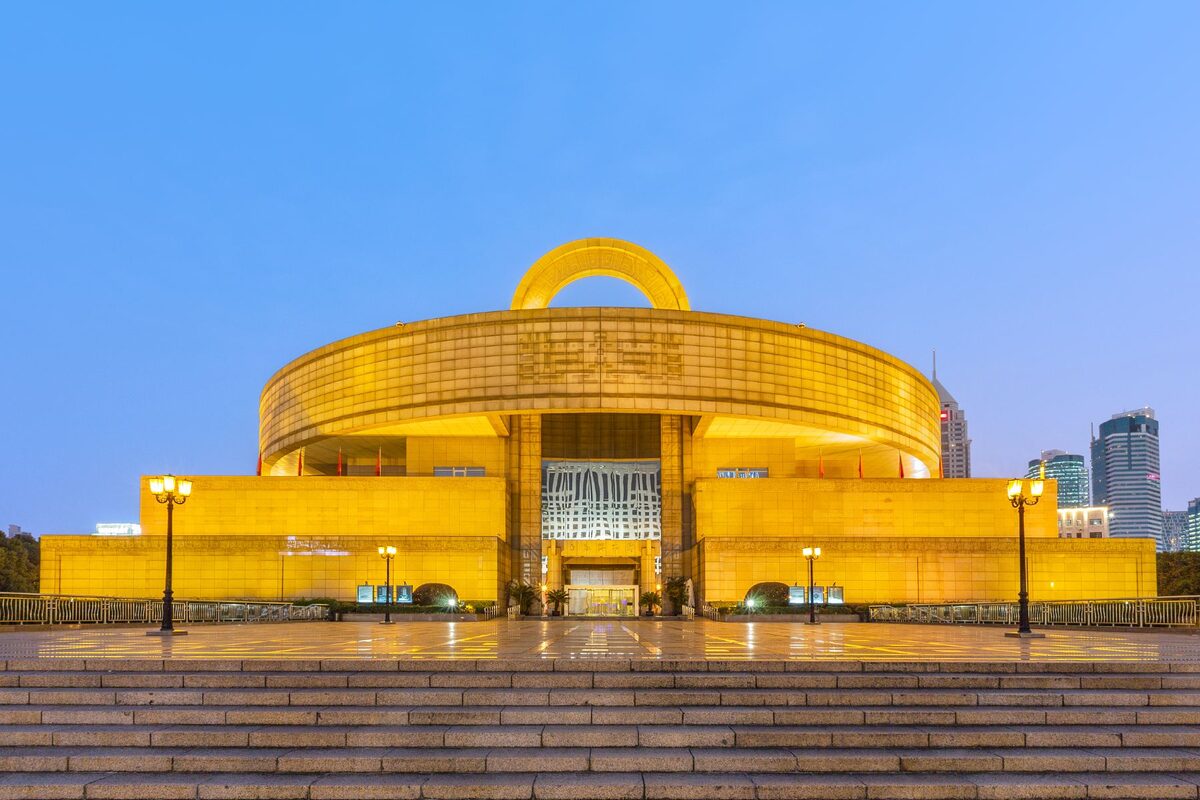
This is the one thing to get right. When the vast new Shanghai Museum East (上海博物馆东馆) in Pudong opened in full in 2024, the museum moved its core permanent galleries there — bronzes, ceramics, painting and calligraphy, jade, seals, sculpture — along with essentially all ten of its celebrated “treasures.” The original building on People’s Square kept the address and the iconic ding-vessel shape, but it now runs mainly international special exhibitions and a few thematic displays. So the old advice to “go to People’s Square for the bronzes” is out of date.
| Site | What’s there now | Hours · closed day | Best for |
|---|---|---|---|
| Shanghai Museum East上海博物馆东馆 (浦东)Pudong, 1952 Century Avenue — near Century Square; Metro Line 2go here | The collection is here now: bronzes, ceramics, painting/calligraphy, jade, seals, sculpture + all ten treasures. One of China’s largest museum buildings (opened in full 2024). | 10:00–18:00 · last entry 17:00 · closed Tuesdays | Almost everyone — this is the main museum now |
| Shanghai Museum, People's Square上海博物馆人民广场馆City centre on People's Square, Huangpu — Metro Line 1 / 2 / 8special exhibitions | The original 1996 ding-shaped building. Core permanent galleries have moved to East; now hosts rotating international special exhibitions + a few thematic shows. | 09:00–17:00 · last entry 15:00 · closed Mondays | Only if a specific special exhibition draws you |
For almost every first-time visitor the answer is simple: go to East. Save People’s Square for a return trip, or for a specific special exhibition you actively want to see. And note the opposite closed days — East on Tuesdays, People’s Square on Mondays — which is the single most common way visitors waste a morning.
Free entry — and now walk-in
Admission to the permanent collection is free, and the old “you must reserve a timed slot days ahead” hassle has largely gone. For a normal weekday visit you simply walk in:
- East: individual visitors have been walk-in since it opened — go to the B1-level east entrance, show ID, pass security, enter free.
- People’s Square: no longer walk-in — since 9 July 2026 it runs one PAID exhibition and nothing else, capped at 8,000 a day in timed slots. Book and buy before you go; the south gate is still the entrance.
- Foreigners: your passport is your ID at the service desk. No WeChat and no Chinese phone number needed on a normal day.
At East a reservation only comes back at peak times — public holidays and the summer and winter school breaks — when the building caps numbers. At People’s Square it is now permanent: the building is given over to one paid exhibition until 14 November 2027, capped at 8,000 day-session visitors and sold in timed slots. Chinese visitors book on the “上海博物馆” WeChat mini-program (up to ~14 days ahead). Because that needs a Chinese mobile number, foreigners book on the museum’s official website instead, which has an English booking page; if it is full, ask at the on-site service desk.
Honest disclosure: the permanent galleries are free and self-booked — there is nothing for us to sell you here. The only paid tickets are the special exhibitions, bought on the official channels.
The ten treasures — at East, floor by floor
The Shanghai Museum is a museum of Chinese art — not a general world museum — and one of the best of its kind anywhere. At East the star pieces are spread over three floors; this is the efficient order most visitors follow. English labelling is thorough throughout.
| Gallery · floor | What to look for |
|---|---|
| Bronze gallery · 1F青铜馆 | The Da Ke ding (大克鼎) — one of China’s great inscribed ritual bronzes — plus the ox-shaped Xi zun wine vessel and the Shang Yang measure (商鞅方升), a real Qin standardised-measure from the history books. |
| Ceramics gallery · 3F陶瓷馆 | A Song-dynasty Ru-ware celadon plate (the rarest of the five great Song kilns, that sky-blue glaze) and a Qing famille-rose “bats-and-peaches” vase — peak Yongzheng-era taste. |
| Painting & calligraphy · 2F书画馆 | Tang and later masters — Sun Wei’s High Scholars handscroll, Huaisu’s cursive script. Note: painting/calligraphy is shown on rotation, so confirm the current display on the official mini-program before a special trip. |
| Jade & seals · 2F玉器馆 · 玺印馆 | A rare full-figure Neolithic Shijiahe jade figure, and the solid-gold Jin-dynasty “Guiyi King of the Di” seal — specialist collections most visitors walk past too fast. |
| Sculpture gallery · 1F雕塑馆 | High-Tang white-marble Buddhist figures — a quiet, luminous room that rewards the ten minutes. |
A sensible route: start on 1F with the bronzes, take the escalators to 2Ffor jade, seals, painting and calligraphy, then finish on 3F with the ceramics. If time is short, the priority is clear — bronzes, then ceramics, each worth an hour on its own. The B1 gift shop is a genuinely good browse (the Da Ke ding merchandise is a running joke online).
How to visit
- Time. Allow at least 3 hours at East, a full day if you’re a keen museum-goer — it is one of the largest museum buildings in China. Short on time? Do the bronzes and ceramics.
- When to go. Don’t assume the 10:00 opening is empty — queues form at the door and outside the painting-and-calligraphy gallery, where the regulars are keen. For the calmest visit, arrive in the early afternoon (about 14:00–16:00) after the morning tour and school groups clear; the painting gallery is quietest late in the day.
- Closed day. East closes Tuesdays, People’s Square closes Mondays (both open on a public holiday that falls on their normal closed day). Check the official calendar for your site and date.
- Rainy-day option. Free and air-conditioned, either site is one of Shanghai’s best wet-weather or hot-afternoon plans.
Getting there
Route to the site you actually want — they sit on opposite sides of the Huangpu River.
| Site | How to reach it | Note |
|---|---|---|
| Shanghai Museum East | Pudong, 1952 Century Avenue, near Century Square on the Metro Line 2 corridor (Century Avenue / Science & Technology Museum end). Foreigners enter via the B1-level east entrance service desk. | This is the site to route to for the collection. |
| People's Square site | On People's Square, Huangpu. Metro Line 1, 2 and 8 all meet there — one of Shanghai's central interchanges, reachable from anywhere in the city; enter via the south gate. | Only worth it for a current special exhibition. |
See the Shanghai subway guide for the metro basics — ticketing, the apps that work, and which lines connect the central sights.
Want a guided day around the museum?NASDAQ: TCOM
The museum is free — you reserve it yourself, and we don’t sell entry. But if you want a guide to walk you through Chinese art history, or to combine the Bund, Yu Garden and a museum in one day, Trip.com lists English-language Shanghai cultural tours and nearby paid experiences, booked on a foreign card.
Nearby — and where to stay
The People’s Square site sits in the dead centre of the city, so it slots naturally into a day of central sights — and that district is a sensible base for a first Shanghai trip. The East building pairs instead with a Pudong day (the Lujiazui skyline is two Line-2 stops away).
- The Bund. A short walk or one metro stop from the People’s Square site — the classic riverfront skyline view, best at dusk.
- Pudong skyline. The Lujiazui towers are a short hop from Shanghai Museum East — a natural pairing for a Pudong day.
- Where to stay in Shanghai. The Bund / People’s Square side puts you within walking distance of the central sights — the district breakdown and area-by-area hotel picks are in that guide.
Frequently asked questions
Which Shanghai Museum should I visit — People’s Square or the East building?
For the famous collection, go to Shanghai Museum East (上海博物馆东馆) in Pudong. Since the East building fully opened in 2024, the core permanent galleries — bronzes, ceramics, painting and calligraphy, jade, seals, sculpture — and essentially all ten ‘treasures of the museum’ have moved there. The original People’s Square building now mainly hosts rotating international special exhibitions (an Egypt show, an Americas show) plus a few thematic displays. First-timers with limited time should go straight to East.
Is the Shanghai Museum free, and do I need to reserve?
The East building is free and walk-in for individuals — a passport at security is all it takes, and that is where the collection is. ⛔ The People’s Square building is a different answer as of 9 July 2026: for the run of the Ancient Americas exhibition, to 14 November 2027, it shows nothing else and EVERY visitor must book and pay. Its walk-in weekdays, which ran from 1 September 2025, are over; it is now capped at 8,000 day-session visitors sold in timed slots. Two galleries inside East — the Ancient Civilisation Exploration Hall and the Digital Gallery — also still need their own booking even though the building itself does not.
What are the opening hours and closed days?
The two sites have OPPOSITE closed days, and the trap underneath that is the last entry. Shanghai Museum East opens 10:00–18:00 and stops admitting at 17:00, and closes on Tuesdays. The People’s Square building opens 09:00–17:00 and stops admitting at 15:00 — two hours before its doors shut, which is the single easiest way to lose a visit here. It closes on Mondays. Both stay open on public holidays that fall on their normal closed day, and the date is printed on your booking.
How do foreign visitors get in without a Chinese ID or WeChat?
On a normal day it is easy: bring your passport, go to the service desk (at East it’s the B1-level east entrance), have it checked, pass security and walk in free — no reservation, no WeChat needed. Only at peak times does a reservation apply, and because the WeChat mini-program needs a Chinese phone number, foreigners book instead on the museum’s official website, which has an English booking page. If that is full, ask at the on-site service desk.
What is the Shanghai Museum known for, and which are the ten treasures?
Chinese art across millennia, with two world-class galleries: ancient Chinese bronzes and Chinese ceramics. At East the star pieces sit by floor — the Da Ke ding ritual bronze and the Shang Yang measure in the 1F bronze gallery; a Song-dynasty Ru-ware plate and a Qing famille-rose vase in the 3F ceramics gallery; classical painting and calligraphy on 2F (rotated, so check what’s currently shown); jade, seals and sculpture across 1F–2F. English labelling is thorough throughout.
How much time should I spend, and when is it least crowded?
Allow at least 3 hours at East, a full day if you’re a keen museum-goer — it is one of the largest museum buildings in China. The bronze and ceramic galleries reward an hour-plus each. For fewer crowds, arrive in the early afternoon (roughly 14:00–16:00), after the morning tour and school groups have moved on; the painting-and-calligraphy gallery is quietest late in the day. Don’t assume the 10:00 opening is empty — queues form at the door.
Related Shanghai guides
- Shanghai city guide — things to do, getting around, where to stay, what to eat, and practical essentials.
- Things to do in Shanghai — the 11 curated picks with a 3-day timeline.
- The Bund — a short walk or one metro stop from the People’s Square museum site.
Sources
Checked August 2026 · Written from our own first-hand travel in China.