Key takeaways
- A single peak right beside Zhangjiajie city — separate from the National Forest Park 32 km north (do both on a 2–3 day trip).
- The 7.5 km cable car leaves from downtown, next to the central railway station — ~30 min each way.
- Headline sights: the Tianmen cave / Heaven’s Gate arch, the 999 steps, cliff-edge glass skywalks, and the 99-bend Tongtian Avenue.
- One combined ticket, ¥288 (¥285 + ¥3 insurance, same on A/B/C), covers the cableways, shuttle, escalators and admission; with the upper cable being rebuilt (since Nov 2025) all routes reach the top via the cave-plaza escalators — pick A (city cable up), B (express up, best in peak) or C (express both ways).
- Allow a full day; it’s real-name timed-entry (book in English on Trip.com, passport at the gate). Go a weekday Apr–Jun or Sep–Nov, arrive by 8am, and avoid the Oct 1–7 Golden Week (2–3h queues).
What Tianmen Mountain is
Many foreign visitors arrive in Zhangjiajie picturing the Avatar floating mountains — the sandstone pillars of the Zhangjiajie National Forest Park (the Wulingyuan UNESCO area, ~32 km north of the city). Tianmen Mountain (天门山, tiān mén shān — “Heaven’s Gate Mountain”) is a different attraction: a single dramatic peak at 1,518.6 m rising from the very edge of the city. Its cable-car base station sits next to the central railway station; you look up from your downtown hotel and see it.
The two are separate, complementary attractions on different transport routes — not combinable in one day without rushing both. The standard 2–3 day plan gives one full day to Tianmen Mountain and one or two to the National Forest Park. The park was established in 1992; the cable car opened in 2005 and the glass skywalks from 2016. It is now Hunan’s second most-visited natural attraction after the forest park itself.
Terrain © Stadia Maps · Stamen Design · OpenMapTiles · © OpenStreetMap contributors.
Orientation — Tianmen Mountain sits right against Zhangjiajie city (its cable-car base is next to the central railway station); the National Forest Park — the Avatar pillars — is ~32 km north, and the Grand Canyon glass bridge is east of Wulingyuan. Three separate parks, three separate tickets. Tap any pin for what it is, how far and its ticket.
Glass skywalk or glass bridge? Don’t buy the wrong ticket
These are two different places and a common mix-up. The glass skywalks (玻璃栈道) are short cliff-edge paths on Tianmen Mountain, included in this ¥288 ticket. The Zhangjiajie Grand Canyon Glass Bridge (大峡谷玻璃桥) — the long span you may have seen in photos — is a separate attraction about 1.5 hours away near Wulingyuan, on its own separate ticket. If the bridge is what you want, it is a separate trip with its own guide — you can’t reach it from Tianmen’s summit.
Tickets & routes — which to pick (2026)
One combined ticket, ¥288 (¥285 + ¥3 insurance — the same price on all three lines), bundles admission, the city cableway, the shuttle bus, the 7-section through-mountain escalators and the Tianmen-cave express cableway — you don’t buy these separately. Students and 60–65s get a discounted ~¥152 ticket on valid ID; over-65s and the disabled ~¥116; under-1.2 m free. Ignore the ¥278 still quoted in many guides — that was the price before the November-2025 cableway rebuild and is no longer sold.
Cable rebuild (since 6 Nov 2025). The upper cableway section (mid-station → summit) is closed — it is being demolished and rebuilt, with no reopening date announced — so the old “city cable straight to the top” route no longer runs. On all routes you now reach the summit via the Tianmen Cave plaza + the 7-section through-mountain escalators (included). The cave express cableway had its own overhaul and reopened 20 March 2026. What still differs is how you go up vs down:
| Route | Up → down | Best for |
|---|---|---|
| A · big cable up | City cableway → mid-station → shuttle up the 99 bends → cave plaza → escalators to summit; down by the express cableway | First-timers who want the city-cableway ride (its lower half during the rebuild) + the 99-bend road. Peak-season queues for the big cable hit 2–3 h — take an early slot. |
| B · express up, big cable down | Shuttle to the mountain gate → express cableway → cave plaza → escalators to summit; down by the 99-bend shuttle + city cableway | ⭐ Best in peak season — the express cable barely queues and you tour the summit against the crowd flow (easier photos). |
| C · express both ways | Express cableway up and down (no 99-bend road) | Elderly / kids / motion-sick / short on time. In rain or snow the park sometimes runs C-line only. |
Line B (express up, city cable down) — pick it if peak season — the express barely queues and you tour the summit against the crowd flow.
How the mountain fits together — the summit up top, downtown at the bottom, and every way between them. The red dashed section is the upper cableway, closed for rebuilding since Nov 2025; pick a line to see which segments it rides up (green) and down (blue). Every fact on the diagram is in the table above and the text on this page.
Reserve a timed slot. Tianmen is real-name, timed-entry — book ahead. The official channel is the “张家界一机游” / Zhangjiajie Travel Assistant WeChat mini-program (daily tickets drop at 08:00, ~7 days out), which runs Chinese, English and Korean — for foreign visitors the obstacle is usually getting it to open at all rather than the language. A- and B-line use different entrances — don’t go to the wrong one. For most foreign visitors the simpler path is to book the dated ticket in English on Trip.com and enter with your passport. Extras paid on the day: the 5-stage cave escalator up from the cave plaza (¥32 — the999-steps bypass, a separate lift from the included through-mountain escalators), glass-skywalk shoe covers (¥5 on site — ignore the touts selling pricey ones at the base), and the summit sightseeing cable (¥25).
The headline experiences
The sights and the signature ways up, all on the one mountain — the cable car gets you in and out, and on the summit the cave, the plank walks and the escalators fill 3–5 hours. One thing to plan around: the upper cable car has been closed for rebuilding since November 2025, so every route now tops out via the cave plaza and the tunnel escalators (the current A/B/C lines are in the ticket section above).
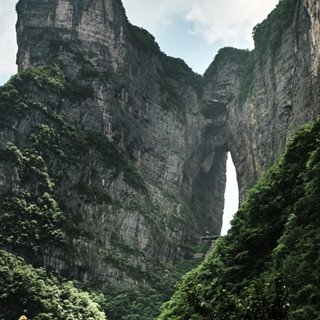
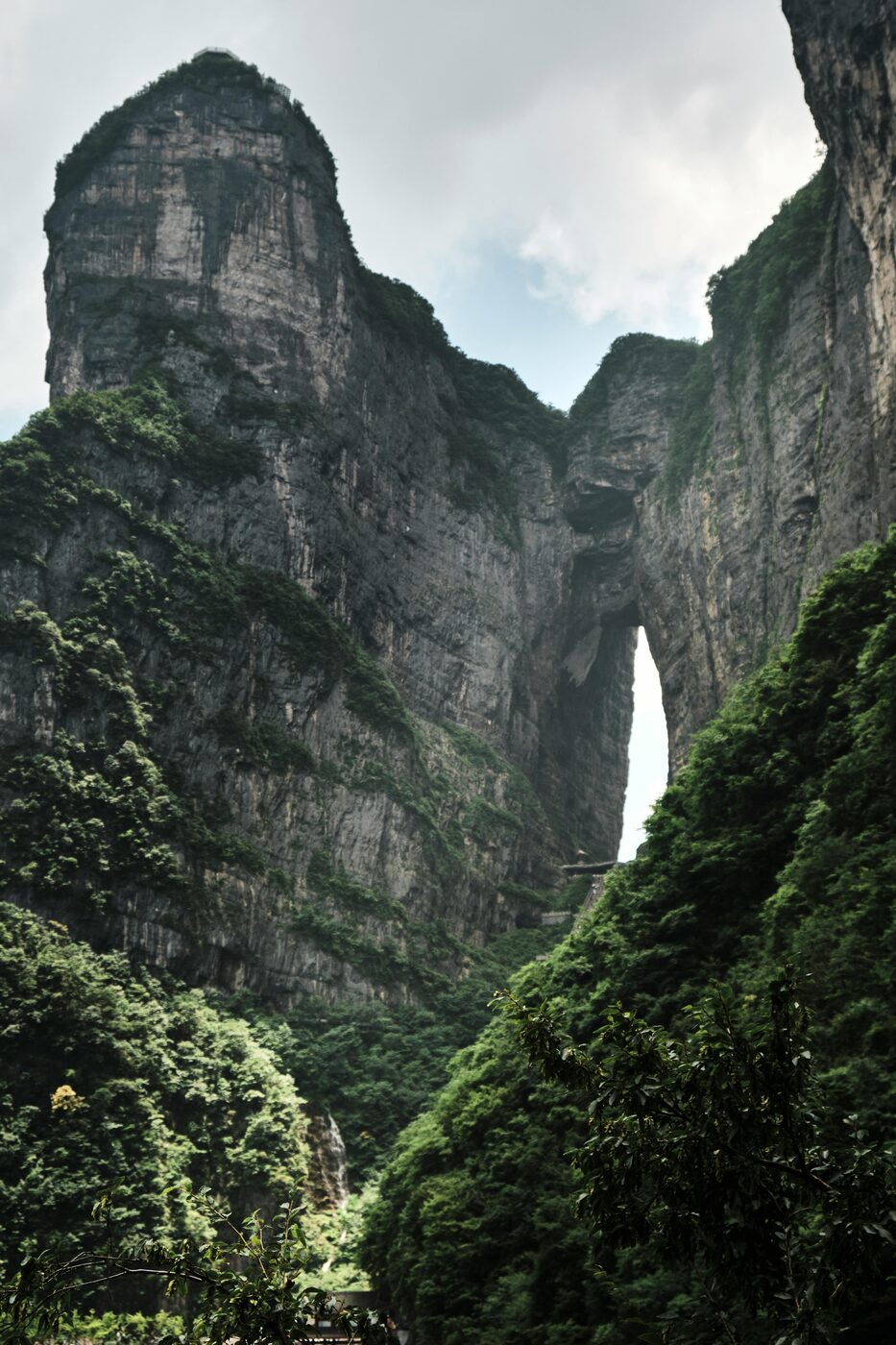
The mountain’s headline: the world’s highest natural cliff arch, at the top of the 999 steps. Best in morning mist (the “Heaven’s Gate” cloud, ~7:30–9:00) or lit up after dark. Shoot it head-on from the plaza, or look back from the mid-staircase to frame the arch above the stairway.
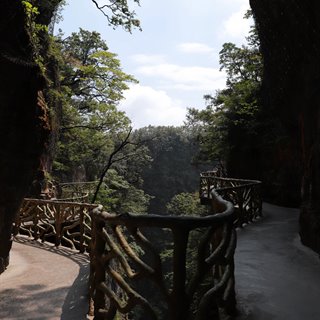
The west-line highlight and travellers’ “scenery ceiling” — a solid cliff-hugging boardwalk with a wider view than the glass. Friendlier for nervous heads than the skywalk: keep to the inside wall, look ahead not down, and it stays manageable.
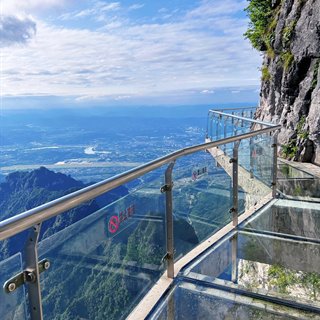
Transparent glass panels on the cliff edge over a sheer drop, looking across to the city. The most photogenic and most vertigo-inducing spot — but not compulsory: a normal boardwalk runs alongside, so acrophobes can skip it without missing the route. The east-line glass section is tamer and more crowded — skip that one.
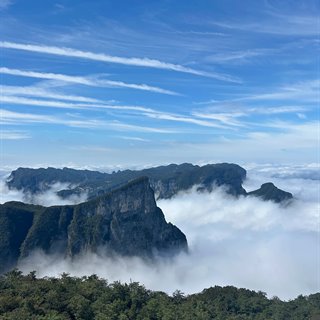
The 1,519 m high point, a 360° sweep over the Wuling range and the best cloud-sea vantage (clear morning after rain, ~9:00–11:30). Reached by the ¥25 forest sightseeing cable from the Tianmen temple — ride it back down from the top, where the queue is shorter.
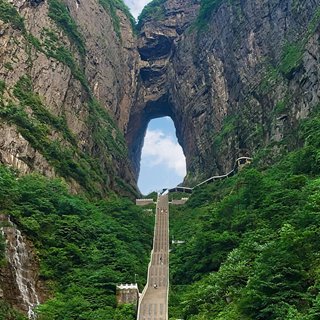
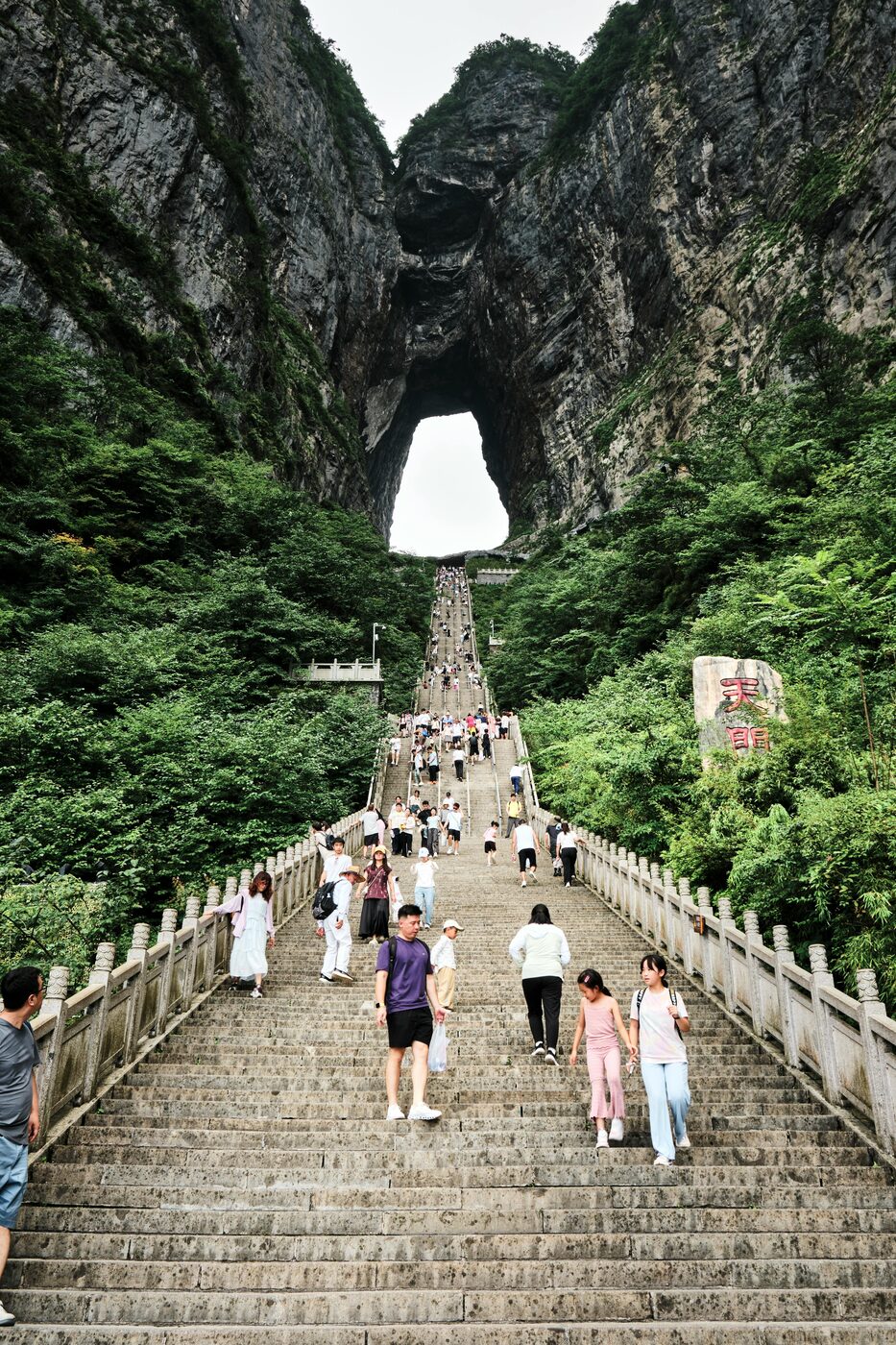
The steep cliff stairway from the cave plaza up to the arch (999 is symbolic — 9 / 久 = longevity). Fit walkers climb it; everyone else pays ¥32 for the Tianmen escalator alongside (up only; down is free). Don’t confuse it with the free tunnel escalators below.
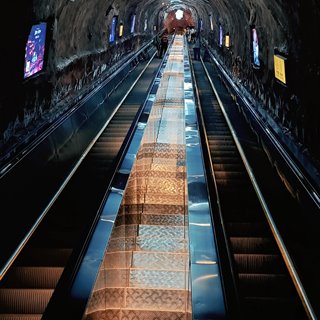
Seven linked escalators bored through the mountain, connecting the summit to the cave from the inside — free, included in the ticket, and a ride in itself (“like travelling through the earth”). This is the free one; the ¥32 escalator above, at the cave plaza, is the separate paid lift people mix it up with.
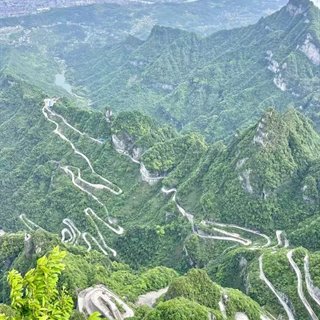
The 11 km, 99-hairpin road spiralling up the south face — you ride it by park shuttle (private cars are banned). Spectacular and stomach-testing: take motion-sickness tablets ~30 min ahead, especially with kids, and sit near the front.
Glass skywalks — practicalities
Tianmen Mountain has several sections of glass-floored cliff walkway (玻璃栈道) — transparent tempered-glass panels built into the cliff face above drops of several hundred metres. The most-visited section is on the west cliff, looking across the gorge toward the city. The structure is engineered well above visitor loads and has operated without structural incident since 2016; the real factor is personal nerve. Plan around these points:
- Shoe-covers (布鞋套) are issued free at each skywalk entrance and must be worn — they protect the glass and improve grip. Park covers are one-size; bring your own if you want a fit.
- Fear of heights: standing on glass over a sheer drop is genuinely vertigo-inducing. Most people with moderate nerves adapt within a minute; those with severe acrophobia can skip the glass — the cave and the solid wood/stone cliff boardwalks remain the highlights.
- Wet weather: panels are slippery even with covers; some sections close on heavy-rain days. Check conditions at the base station.
- Photography: early morning (8:00–9:30am, before the tour-group tide) gives the cleanest shots; midday brings the biggest crowds and harshest overhead light.
Getting there from Zhangjiajie city
The cable-car base station (天门山索道下站) is in the south of the city centre, beside Zhangjiajie Station (张家界站, the older non-HSR railway station) — not to be confused with the HSR Zhangjiajie West Station (张家界西站), ~8 km out. The cable car leaves from downtown, so a city-centre base makes the day easy:
| From | How | Time · cost |
|---|---|---|
| Zhangjiajie city centre hotels | Taxi or DiDi to cable-car base station (天门山索道下站) | ~5-15 min · ~¥15-30 |
| Zhangjiajie West Station (张家界西站, HSR) | Taxi or DiDi to cable-car base station | ~20-25 min · ~¥35-50 |
| Zhangjiajie Hehua Airport (DYG) | Taxi or DiDi direct to cable-car base station | ~15-20 min · ~¥30-45 |
| Wulingyuan / National Forest Park area | Taxi or bus to city centre, then taxi to base station | ~50-70 min · ~¥80-120 |
From Hehua Airport (DYG) the base station is only ~5 km — one of China’s shortest airport-to-attraction transfers, so a same-day visit works if you land before noon. From Wulingyuan, leave by ~7am to beat the cable-car queue. The getting-around-Zhangjiajie guide has the full city ↔ Wulingyuan transport logic.
A bed near the base station is worth an hour of queueNASDAQ: TCOM
The cable-car base sits in the middle of Zhangjiajie city, so this is an ordinary city-centre stay with the mountain at the end of the street — and it is the difference between walking to the first cars and leaving Wulingyuan at 7am to reach them.
Best time & how long
Allow a full day — ~30 min cable car each way, 2–3 hours on the summit (skywalks, cave,999 steps, boardwalks), and a ~40–60 min shuttle descent: 7–9 hours including city transit. A half-day is possible but rushed.
Season: spring (April–early June) and autumn (late September–early November) are best — bloom and fresh green in spring, the clearest skies and mist-and-forest colour in autumn. Summer (July–August) is cooler on the summit but afternoon thunderstorms often suspend the cable car (go before 8:30am). Winter snow and ice make the skywalks and steps hazardous, and some sections close.
- Avoid absolutely: October 1–7 National Day Golden Week — cable-car queues of 2–3 hours, shoulder-to-shoulder skywalks.
- Avoid if you can: May 1–5 Labour Day and Chinese New Year week.
- Best: any weekday outside national holidays, at the base station by 8am.
See our best time to visit China guide for the broader seasonal picture.
Practical for foreigners
- What to wear: the 1,519 m summit runs 8–12°C cooler than the city — bring a packable layer year-round. Closed-toe shoes with grip are essential for the boardwalks and 999 steps; smooth soles are a safety risk in the wet.
- Heights & steepness: the skywalks, exposed cliff boardwalks and 999 steps involve real elevation with minimal barriers in places. Visitors with severe acrophobia should research the specific sections first; the cave and solid boardwalks remain achievable.
- Payment & English: Alipay and WeChat Pay are universal; foreign-card POS at the physical window is unreliable. English signage is limited — bring a translation app for ticketing and directions.
- Weather closures: afternoon cloud and storms can temporarily suspend the upper cable car — a morning arrival is the safest plan.
How it fits a Zhangjiajie trip
Tianmen Mountain pairs with, but is separate from, the National Forest Park. The standard 2–3 day plan:
- Day 1 — Tianmen Mountain (this page): the cable car, cave, skywalks and 99-bend road, based from the city centre.
- Day 2–3 — National Forest Park / Wulingyuan: the Avatar pillars, Yuanjiajie, Tianzi Mountain and Golden Whip Stream, 32 km north — a separate full-day (or two-day) visit. See the National Forest Park guide.
- Optional: the Grand Canyon glass bridge — a third distinct attraction in the area.
When NOT to go: the Oct 1–7 Golden Week (2–3h queues), heavy-rain days (skywalk closures), or if you only have a couple of hours — Tianmen Mountain rewards a full day.
Book Tianmen Mountain tickets & a guided tourNASDAQ: TCOM
Trip.com sells the timed cable-car combined ticket and guided day tours from Zhangjiajie city — booked in English on a foreign card, which skips the unreliable on-site window.
Frequently asked questions
Is Tianmen Mountain the same as the Zhangjiajie National Forest Park?
No — they are two entirely separate attractions about 32 km apart. Tianmen Mountain (天门山) rises immediately beside Zhangjiajie city centre; its cable-car base station is next to the central railway station. The Zhangjiajie National Forest Park and the Wulingyuan UNESCO area (the Avatar sandstone pillars, Yuanjiajie, Golden Whip Stream) are located in Wulingyuan District, roughly 32 km north of the city. Most visitors who have 2-3 days in Zhangjiajie do both: one day at Tianmen Mountain, one or two days at the National Forest Park / Wulingyuan. They are not on the same transport route and cannot be combined in a single half-day.
How much does Tianmen Mountain cost?
The 2026 combined ticket is ¥288 (¥285 + ¥3 insurance), the same price on the A, B and C lines — it covers admission, the city cableway (its lower section during the rebuild), the shuttle bus, the 7-section through-mountain escalators to the summit, and the Tianmen-cave express cableway. Concessions: ~¥152 for students and 60–65s on valid ID, ~¥116 for over-65s and the disabled; under-1.2 m free. Foreign passports pay the standard rate. You may still see ¥278 quoted — that was the pre-November-2025 price and is no longer sold. Extras paid on the day: the 5-stage cave escalator up from the cave plaza ¥32 (the 999-steps bypass — a different lift from the included through-mountain escalators), glass-skywalk shoe covers ¥5, and the summit sightseeing cable ¥25. Check the official channel or Trip.com before you go.
How long does Tianmen Mountain take?
Allow a full day. The city cableway (a 7,455 m line — during the rebuild you ride its lower section to the mid-station) plus the 99-bend shuttle gets you up; the Tianmen-cave express cableway takes ~6–8 minutes. Add 2-3 hours on the summit for the glass skywalks, the Tianmen cave (天门洞) and the 999 steps, the cliff-side boardwalks and the summit meadows, plus the through-mountain escalators between the cave and the top. The 99-bend Tongtian Avenue shuttle leg takes ~40–60 minutes. Total including travel from Zhangjiajie city: 7-9 hours. A half-day is technically possible (up one way, the cave and one skywalk, down the other) but feels rushed.
What is the Tianmen cave (天门洞, Heaven's Gate)?
The Tianmen cave (天门洞) is a large natural arch through the cliff face at approximately 1,300 m elevation — the defining feature of the mountain. The name means "Heaven's Gate" (天门, tiān mén). The opening is roughly 131.5 m high and 57 m wide, large enough to be visible from the city below. It is reached from the Tianmen Cave plaza — either by climbing the 999-step "Stairway to Heaven" (free) or by the paid 5-stage escalators inside the cliff (¥32, up only); from the summit above, the free 7-section through-mountain escalators connect back down to the cave. The number 999 is symbolic — in Chinese numerology, 9 (jiǔ) sounds like "eternity/longevity" (久). With the upper cableway under rebuild since November 2025, every route reaches the summit this way, via the cave plaza and the escalators.
Are the glass skywalks at Tianmen Mountain safe?
The Tianmen Mountain glass skywalks (玻璃栈道) are cliff-edge walkways with a transparent tempered-glass floor, suspended above sheer drops. They are engineered to well above the visitor load required and have operated since 2016. The main risk factor is personal: if you are strongly afraid of heights, the transparent floor — with the valley hundreds of metres directly below — will be genuinely distressing. Visitors with moderate nerves generally adapt after a minute or two. Cloth shoe-covers (布鞋套) are issued at the entrance and must be worn over your shoes (they prevent sole scratching and improve grip on the glass). Wet weather makes the skywalks temporarily more slippery even with covers; check conditions.
What is the best time of year to visit Tianmen Mountain?
Spring (April to early June) and autumn (late September to early November) are the best months. In spring the mountain has rhododendron bloom and fresh greenery; in autumn the mist-and-forest colour is at its best. Summer (July-August) is hot and humid at the base but cooler on the summit, and the mist-cloud formations around the peaks can be spectacular — though afternoon cloud frequently closes the cable car temporarily. Winter brings snow and ice, making the skywalks and steps hazardous; some sections close. Avoid the October 1-7 National Day Golden Week entirely — Tianmen Mountain is one of the most photographed nature spots in Hunan and the queues for the cable car stretch to 2-3 hours.
How do I get from my hotel in Zhangjiajie city to the Tianmen Mountain cable-car base station?
The Tianmen Mountain Cableway base station (天门山索道下站) is located at the south end of Zhangjiajie city centre, adjacent to the city's main railway station (张家界站, the old non-HSR station). From most city-centre hotels it is a short taxi or DiDi ride — approximately 5-15 minutes and ¥15-30. From Zhangjiajie West railway station (张家界西站, the HSR terminus, ~8 km from the city centre), allow about 20-25 minutes by taxi. Zhangjiajie Hehua Airport (DYG) is approximately 5 km from the cable-car base station, roughly 15-20 minutes by taxi.
Can I combine Tianmen Mountain and the Zhangjiajie National Forest Park in the same day?
Not comfortably. Tianmen Mountain alone requires a full day — the cable car, summit skywalks, Tianmen cave and 99-bend shuttle descent add up to 7-9 hours including city transit. The National Forest Park / Wulingyuan area is 32 km away (about 50-60 minutes by road) and itself requires a full day minimum (two days to cover Yuanjiajie + Tianzi Mountain + Golden Whip Stream properly). The standard itinerary is: Day 1 Tianmen Mountain, Day 2-3 National Forest Park / Wulingyuan. Attempting both in one day means rushing both.
Sources
Checked August 2026 · Written from our own first-hand travel in China.