Key takeaways
- It’s in the Grand Canyon scenic area, Cili County — NOT the National Forest Park, NOT Tianmen Mountain.
- A 430 m glass deck ~300 m above the canyon floor — officially named 云天渡 Yuntiandu, once the world’s highest & longest glass-bottomed bridge (opened 2016).
- Three lines, timed-entry: B-line bridge + canyon ~¥178 · C-line bridge-only ~¥138 (fast exit, no descent) · A-line canyon-only ~¥53; the 7-pick-5 bundle ~¥298. Bookings open 30 days ahead — peak-season B-line slots go 3–5 days out.
- About 27 km / 35–40 min from Wulingyuan (50 km from the city): a ¥12–15 public coach every ~30 min from the bus station, a taxi (¥50–60) or a day tour — and ¥22 coaches run from the exit back to the city and the West station until ~19:00.
- The route is strictly one-way (bridge → canyon floor → exit boat): allow a half-day (4–5h) on the B-line, and don’t start after mid-afternoon — the last boat out runs ~16:30–17:00.
What the glass bridge is
The Zhangjiajie Grand Canyon glass bridge (张家界大峡谷玻璃桥) is a 430-metre glass-decked suspension bridge spanning the Zhangjiajie Grand Canyon in Cili County (慈利县), Hunan Province. Its official name is 云天渡 (Yuntiandu, roughly “crossing the cloudy sky”) — Chinese signage and tickets use it, so it helps to recognise both names. At mid-span you walk on transparent glass panels roughly 300 metres above the canyon floor. It opened in August 2016, designed by Israeli architect Haim Dotan with Chinese engineering teams, and at opening was billed as the world’s highest and longest glass-bottomed suspension bridge — a record that drew a wave of global media coverage.
The bridge is the centrepiece of the wider Grand Canyon scenic area, which also has a canyon-floor trail through waterfalls and pools, a boat ride on the canyon lake, a bungee-jump platform and a zip line. The gorge is a narrower, wetter, forested sandstone canyon — a different geological character from the famous quartz-sandstone pillars of the National Forest Park.
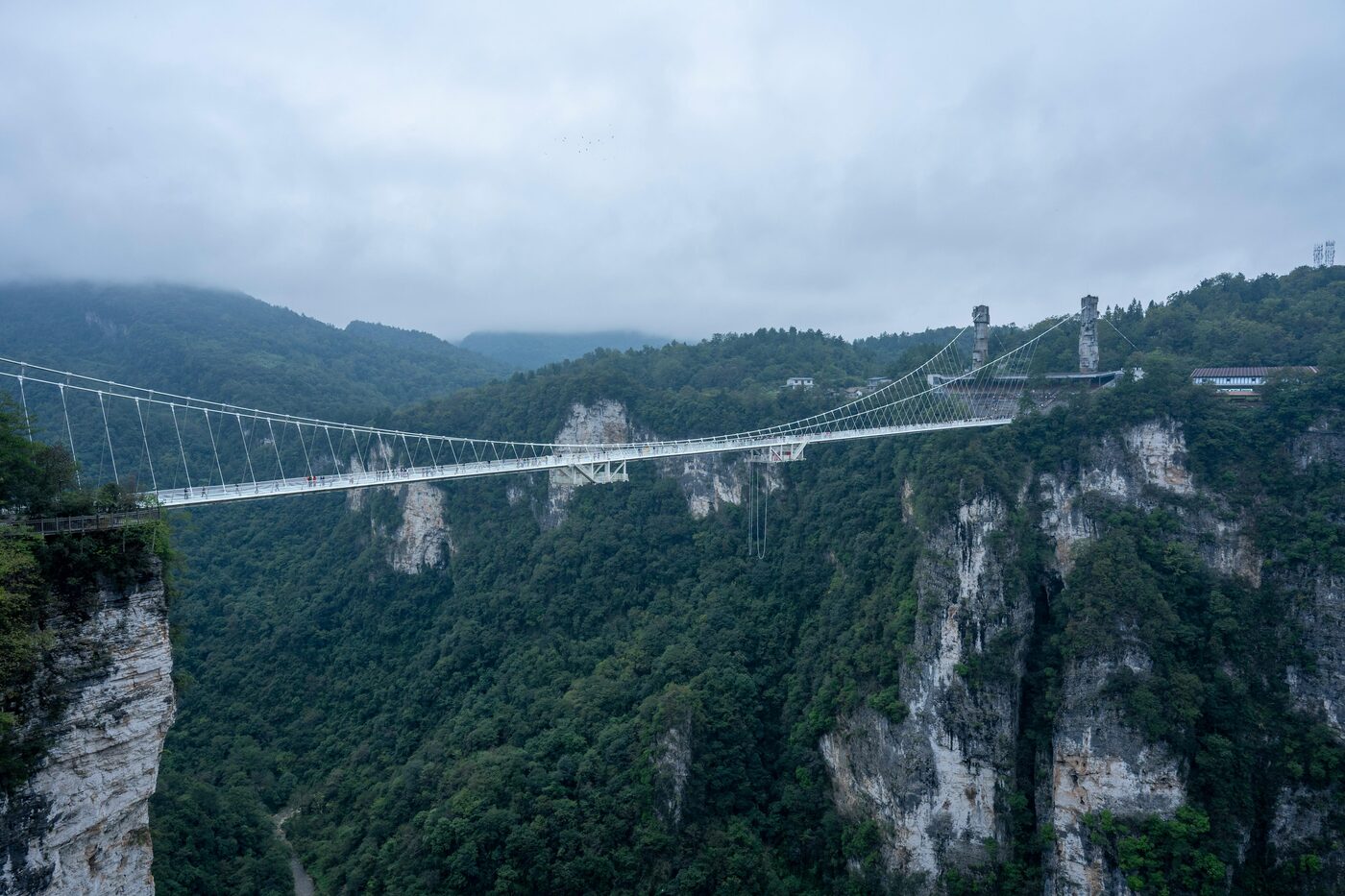
Tickets — A, B or C line, timed entry
The glass bridge sits inside the wider Zhangjiajie Grand Canyon scenic area, which sells three regular lines — A (canyon only), B (bridge + canyon) and C (bridge only) — each a bare fare plus a ¥3 voluntary insurance, which is why quotes vary by ¥3. The whole area is timed-entry, real-name and capacity-capped: gates open ~07:30–08:00 (a little later in winter) and each line stops admitting at a different time — B-line ~16:00, A-line ~15:30, C-line ~14:30 — because the one-way circuit has to finish before the last exit boat at ~16:30–17:00.
| Ticket | Price | What it is |
|---|---|---|
| Bridge + canyon (B-line) | ~¥178 | ⭐ The classic. Glass bridge → down into the canyon → the floor trail past the waterfalls → the exit boat across Shenquan Lake. ~3–4 h one-way, mostly downhill. Older ~¥219 / ~¥255 quotes are out of date. |
| Bridge only (C-line) | ~¥138 | Cross the bridge, then leave by the dedicated fast exit on the right — no canyon descent. The time-tight option: ~1 h on site. Earliest admission cutoff (~14:30). |
| Canyon only (A-line) | ~¥53 | The gorge floor, waterfalls and exit boat without crossing the glass bridge — the option if heights are a hard no. Fair warning: the way in is the steep Yixiantian stairs (~40 min of them); the ¥50 Yixiantian slide is the mid-way leg-saver. (Older listings quote ~¥118.) |
| + Experience bundle (7-pick-5) | ~¥298 | B-line entry plus five of these seven paid experiences: the VR flight cinema, the zip line, the Yixiantian slide, the Wuwangpo slide, the treasure-hunt lift (~¥30 alone), the sculpture lift (~¥20 alone) and the Rainbow Lake boat (~¥20 alone). ⭐ It is five rather than seven for a structural reason — see below. |
Why it is “pick five” and not “all seven”. Not because the scenic area is being stingy — because you physically cannot do all seven. The descent from the bridge splits into two routes and you take one of them, so five is simply the most anyone can use. The thrill route spends its picks on the VR cinema, the zip line, the Yixiantian slide, the Wuwangpo slide and the Rainbow Lake boat; the easy route spends them on the VR cinema, the treasure-hunt lift, the sculpture lift and the boat, riding the free sightseeing lift first.
Four things people wrongly assume. ① The first descent lift is free and already in your B-line ticket — it uses no pick; only the two lifts below it do. ② The bungee and the via ferrata are separate tickets entirely. ③ The lifts only charge downhill — riding any of the three up is free for everyone. ④ Each experience is once per day: use a pick on the treasure-hunt lift and you cannot ride it again without buying a fresh ticket.
Our recommendation: doing the B-line, just buy the bundle. The arithmetic is short. It adds ~¥120 to the B-line fare; the easy line’s lifts and boat alone retail at ~¥70 before the VR cinema, and one Yixiantian slide is ¥50 by itself — either way down burns through the difference. And the fallback for bundle-skippers is the steep-stairs descent that has families buying lift tickets halfway down anyway, at full price. Skip it only if you genuinely plan to walk everything and ride nothing.
Timed slots & booking. The official channel opens sales 30 days ahead — in peak season (summer weekends, May Day, Golden Week) B-line slots go 3–5 days out, so do not leave it to the final week; off-season weekdays are relaxed. Reserve on Trip.com in English or via the official “张家界一机游” mini-program (which does run English and Korean — the usual snag is that it will not open for many foreign accounts); foreign passports self-serve at the gate — the scenic area upgraded its ticketing system in July 2026 so a passport scans straight through at the machines or the staffed lane, with no paper-ticket exchange. The 260 m bungee (~¥1,998) is never in a bundle — you sign up on site at the bridge-east experience centre. Shoe covers (provided, mandatory) can be slippery on the glass — move slowly.
Book the glass-bridge ticket & tourNASDAQ: TCOM
Trip.com lists skip-the-line timed-entry tickets and Grand Canyon day tours with hotel pickup and a bilingual guide — the simplest way to handle the booking and the transfer, in English on a foreign card.
The experience — bridge, canyon floor, thrill add-ons
The crossing itself takes 20–30 minutes over a six-metre-wide deck of structural laminated glass. The bridge is a single suspension span anchored to the cliffs, and it sways gently in wind — structurally normal for a 430 m bridge, but more noticeable than a solid mountain walkway. Two honest expectation-setters from years of traveller reports: people who thought they were “fine with heights” are often more affected at mid-span (transparent glass + lateral exposure + movement), while hardened thrill-seekers sometimes find it tamer than the hype — the side rails are solid, and in bright sun the laminated glass reads slightly milky rather than window-clear. If heights are a real concern, the A-line gives the full canyon without the crossing; wear trousers rather than a skirt — the deck is transparent from below.
The whole scenic area stacks into three levels you move through one way, top to bottom — and the colour of each leg below tells you whether it’s in the B-line ticket, an experience-bundle item, or a separate ticket:
How the canyon stacks — bridge, the way down, the floor
One-wayColour = ticket tierOne-way, top to bottom. Cross the bridge (bungee and via ferrata are separate tickets; C-line holders take the fast exit at the far end instead of descending). Then pick a way down: the free sightseeing lift covers only the first drop — below it it’s the paid treasure-hunt and sculpture lifts or steep stairs, while the zip line lands above the Yixiantian slide entrance and the two slides run to the floor. The canyon-floor waterfall trail (~3–3.5 km) ends at the Shenquan Lake exit boat — last departure ~16:30–17:00, which is what sets the per-line entry cutoffs.
The same route, written out — gate to exit
The whole visit runs one way — in at the bridge, out at Shenquan Lake, no doubling back. Chip colour = ticket tier, matching the map above.
Everyone starts the same
main gate & security — ban-list; the via-ferrata DOWN hut is the timber house on your left here (skip it)bridge entry · west end430 m glass deck · 20–30 minmid-span: bungee platform (sign-up at the far end)bridge-east centre · VR flight cinema
Way down ① — the thrill line (most people)
flat walk 5–10 minzip line 358 m · 30–90 kg weigh-injunction platform: slide gate right · via-ferrata hut leftoptional detour: via ferrata ~1 h (~¥138), exits above the slideYixiantian slide · 2 sections · 800 mRainbow Square
Way down ② — the easy line (kids · seniors · vertigo)
sightseeing lift — free, uses no picktreasure-hunt lift — skips the steepest stairsshort level walksculpture lift or Wuwangpo slideRainbow Square
Skip the paid lifts and it is steep steps the whole way from the free lift to the square — the stretch that defeats families. All three lifts are free going up.
Everyone again, from Rainbow Square
Rainbow Lake boat · 5–10 minor the free boardwalk beside itcanyon-floor trail · 3–3.5 km · waterfalls · 1.5–2 hShenquan Lake jettyexit boat · ~10 min · everyone rides · last ~16:30–17:00exit car park — lockers · coaches to Wulingyuan, the city & the West station
On a C-line ticket? You cross the deck and leave by the fast exit at the far end — no descent, no canyon, done in about an hour.
Each experience in close-up:
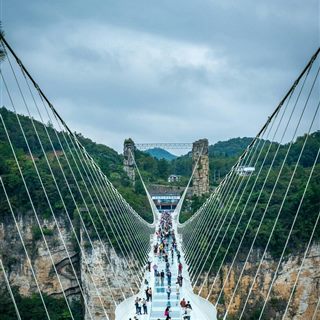
20–30 min over the 430 m deck, ~300 m up, with a gentle sway in wind. Free shoe covers are issued (self-brought ones refused). In the B and C lines; morning slots before ~10:00 get the thinnest crowds and best light. You come off the far end at the bridge-east experience centre — the VR flight cinema is here, and it is also where the zip line and the descent lifts part company.
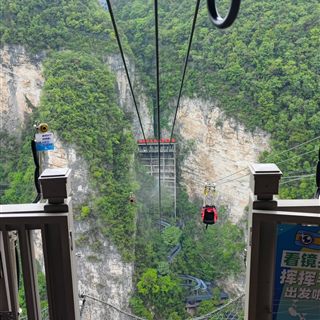
The single most queued thrill: 358 m across the canyon, ~302 m height differential, up to ~60 km/h. Six parallel lines cycle ~3 min. Hard limits, enforced by an actual weigh-in: 30–90 kg (the 95 kg figure circulating online is wrong, and staff turn people away over a couple of kilos), 1.2 m+, roughly ages 10–60. Getting to it is easy — a flat 5–10 min from the bridge-east centre — and you land a short flight of steps above a junction platform: slide gate to your right, via ferrata hut to your left, which is why the thrill chain never climbs. Phones are pouch-sealed, so no mid-ride filming; queues build after ~09:30 (2–4 h at peak). Skip grippy Crocs-type soles; they stall on the cable.
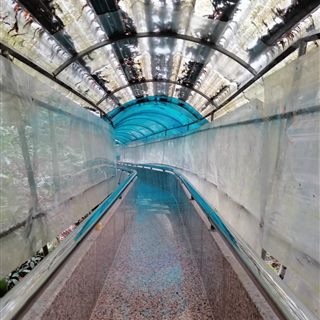
Two covered chutes replace the stairs down — and they sit on opposite sides of Rainbow Square, which trips people up. The long two-section Yixiantian slide is upstream, on the bridge side: you reach it a few minutes past the zip-line landing, and it is the traveller favourite (a cloth is issued to tie round your waist, and you control your own speed; ¥50 bought alone). The shorter Wuwangpo slide is downstream by the sculpture lift, and drops you back at the square. Doing both means backtracking between them. Wear long trousers — shorts riders come off with scraped thighs.
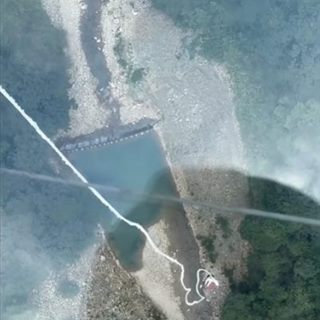
The 260 m platform mid-bridge — the world’s highest commercial jump, run by Bungy China. Sign up at the bridge-east experience centre (~¥1,998 incl. insurance, certificate and a first-person camera package; ~¥2,998 premium tier), then jump before you exit the far end — re-entering means re-clearing security. 40–105 kg, age 13+, under-20s with a guardian. Walk-up off-peak; book a day ahead on holidays.
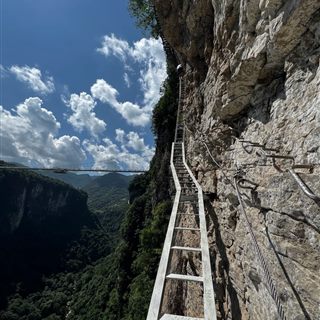
Iron-rung cliff traverse with the bridge as backdrop — a separate ~¥138 ticket (~¥120 online), not in the bundle. Do the UP route, and it slots into the thrill chain: its entrance is the hut on your left at the zip-line landing platform (the slide gate is on your right), the climb runs ~350 m and about an hour on the cliff, and it exits partway along the Yixiantian boardwalk — from there ~10 min downhill on foot brings you to the slide gate. So zip → via ferrata → slide flows entirely downhill, no backtracking. Not riding the zip? Tell staff at the ticket gate you want the up route and they escort you in through a side door. The DOWN route starts by the main entrance (the timber hut left of the bridge entry) and ends at the same slide-gate area — done first it strands you below the bridge with a steep stair climb back, so most people skip it. No toilets mid-course; phone on a neck strap.
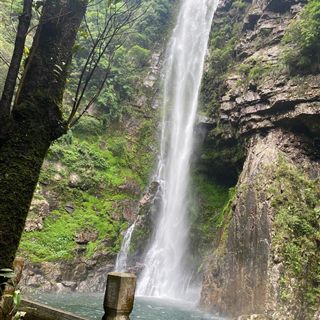
The B-line’s payoff: ~3–3.5 km of boardwalk (1.5–2 h) past a chain of falls — the walk-through Yilianyoumeng water curtain (expect spray — pack a poncho), Tianhe and Butterfly Spring falls, Rainbow falls with its sun-day double rainbows — all on the path, no detours. 5–8°C cooler than town, wet underfoot, almost no vendors on the final stretch: carry water.
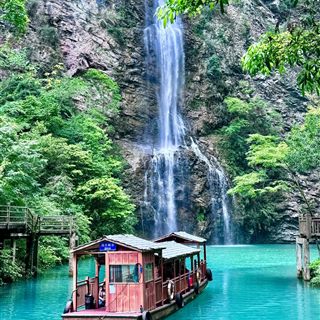
How the A and B lines leave, and everyone rides it — the boardwalk simply ends at the jetty and there is no path onward, so the ~10 min crossing is the only way out. Free, inside your ticket. The last boat runs ~16:30–17:00, which is what sets the per-line entry cutoffs. Sit opposite the wheelhouse for the open view. ⚠️ Don’t confuse it with the Rainbow Lake boat at the other end (below).
The other boat, and the one people mix up with the exit boat. It sits at Rainbow Square, where both descent routes land — the very start of the canyon walk, not the end. ~¥20 alone, or one of your bundle picks. Honest verdict: it is short, and a level boardwalk runs alongside it — 5–10 minutes on foot covers the same stretch for nothing. Ride it if the bundle already paid for it; don’t buy it separately.
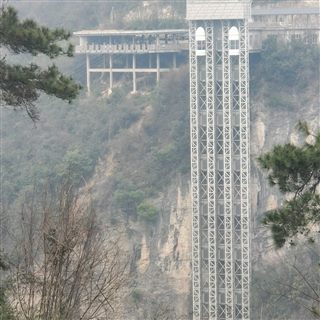
Three stacked lifts, and they are not equally worth it. The sightseeing lift is free in your B-line ticket (top drop; no pick used). Below it the treasure-hunt lift (~¥30) is the one to take — the stairs it replaces are the steepest on the route, hundreds of near-vertical timber steps that travellers single out as the leg-killer. The sculpture lift (~¥20) replaces a gentle ~10 min walk, and plenty of visitors call it the skippable one. After the treasure-hunt lift a short level walk leads to the third platform, where the last drop is a choice: the sculpture lift, the gentle ~10 min path, or the Wuwangpo slide — and the slide stands in for the sculpture lift only, never the treasure-hunt one. All land at Rainbow Square, so “ride all three lifts then the slide” is a plan nobody needs. All three lifts are free going up — the charge is downhill only.
The remaining bundle item, an air-conditioned VR flight cinema, is a rest stop for families more than a thrill — pick it as a fifth item on a hot day, not over the slides or the zip line.
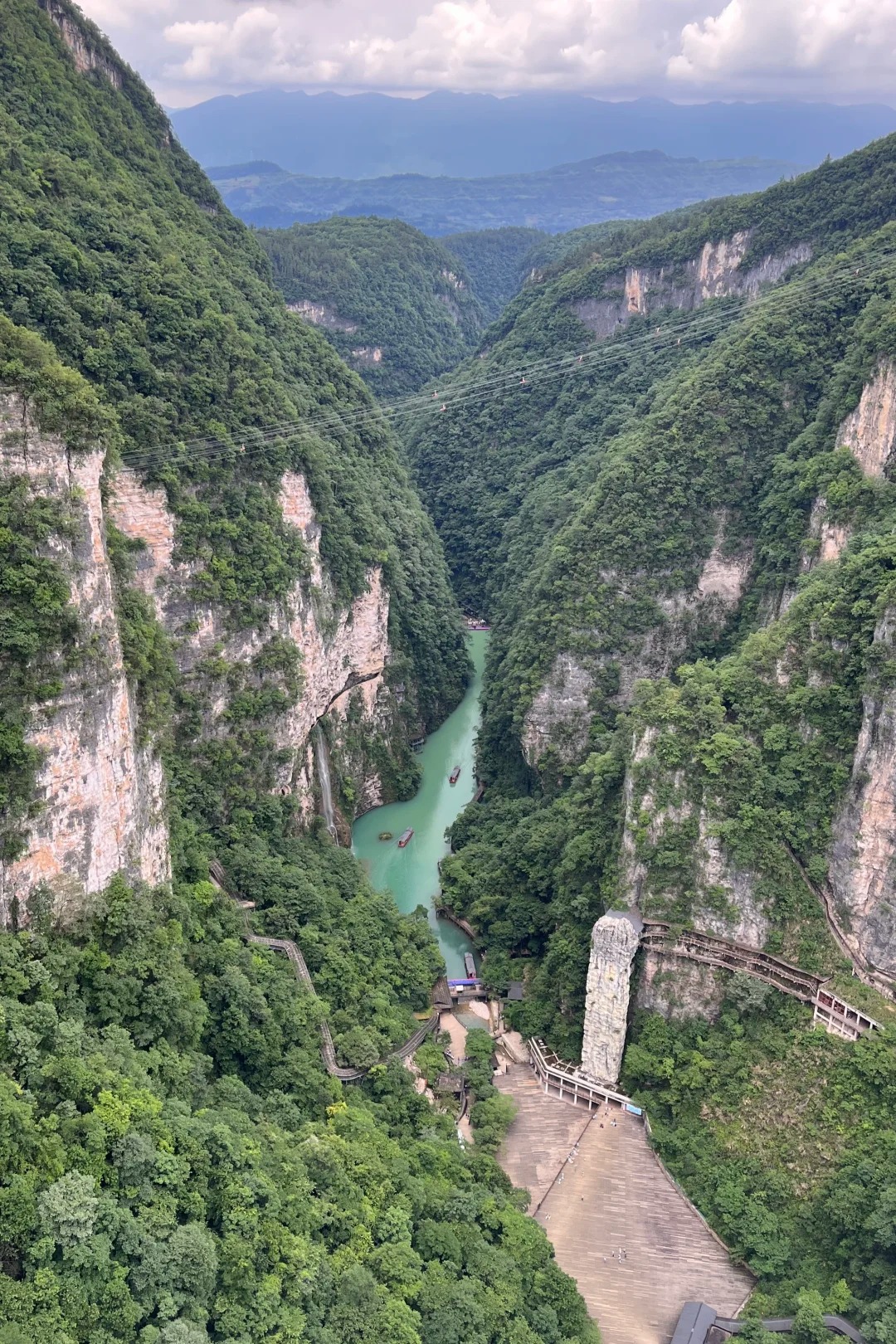
Don’t be talked into turning back. At the top of the descent, staff sometimes urge tired-looking visitors to skip the canyon floor — “it’s far, go back.” If you bought the B-line, press on: the waterfalls, the stream and the green lake below are the B-line’s payoff, the route is one-way by design, and turning back forfeits what you paid for. Also budget the legs honestly — after the bridge, the free sightseeing lift covers only the first drop; below it you either walk steep stairs or use the paid lifts inside the experience bundle.
Don't confuse it with the National Forest Park
The single most important practical detail: the glass bridge is NOT inside the Zhangjiajie National Forest Park (Wulingyuan) and NOT on Tianmen Mountain. All three share the “Zhangjiajie” label but are in entirely different places.
Terrain © Stadia Maps · Stamen Design · OpenMapTiles · © OpenStreetMap contributors.
Orientation — the glass bridge (ringed) sits on the eastern edge of the Zhangjiajie region, in Cili County: ~27 km east of Wulingyuan town, ~50 km from Zhangjiajie city. The National Forest Park — the Avatar pillars — is north of the city, and Tianmen Mountain rises right beside it. Three separate parks, three separate tickets. Tap any pin for what it is, how far and its ticket.
| Attraction | Where | What it is |
|---|---|---|
| National Forest Park Wulingyuan | North of the city | The UNESCO area with the “Avatar” sandstone pillars, Yuanjiajie, Tianzi Mountain and Golden Whip Stream. |
| Tianmen Mountain 天门山 | Southwest of the city | A separate mountain — world’s longest cable car, glass skywalk, Tianmen Cave and the 99-bend road. |
| Grand Canyon glass bridge 张家界大峡谷玻璃桥 | Cili County, ~27 km from Wulingyuan | The glass bridge + canyon scenic area; ~35–40 min drive from Wulingyuan — a full separate day trip (the day goes on the 4–5 h on-site, not the drive). |
Avoid the classic mistake: experienced China travelers have arrived at the wrong site because of map-search ambiguity. Confirm with your driver or operator that the destination is the 张家界大峡谷玻璃桥 in Cili County before setting out.
Getting there — closest from Wulingyuan
The bridge is in Cili County, and it’s much closer to Wulingyuan (~27 km) than to Zhangjiajie city (~50 km) — so if you’re doing the National Forest Park, tack it on from Wulingyuan, not the city. There’s no metro, but from Wulingyuan the connection is easier than most guides suggest: a cheap public coach runs from Wulingyuan bus station, alongside taxis, chartered cars and day tours.
| From | How | Time |
|---|---|---|
| Wulingyuan (park gateway) | Public coach from the bus station ¥12–15, ~every 30 min from ~07:00 · taxi ¥50–60 | ~35–50 min (27 km) |
| Zhangjiajie city centre | Chartered car / day-tour bus; return coaches from the exit run direct (below) | ~60–75 min (50 km) |
| Hehua Airport (DYG) | Chartered car, via city | ~60–80 min |
| Zhangjiajie West Railway (张家界西站) | Chartered car east through city; coaches back to this station from the exit | ~70–85 min |
- Public coach (the budget answer): from Wulingyuan bus station, ¥12–15, roughly every 30 minutes from about 07:00, 40–50 minutes. One catch — some services stop at the entrance, some at the exit car park: ask the driver before boarding, and you want the entrance.
- Scenic shuttle bus (城景巴士): ~¥15–30, lets you choose the entrance or the exit, and its return legs also serve the forest park’s 标志门 gate and the West railway station. The booking system changed on 24 July 2026: tickets moved off the old 智乘出行 mini-program to the operator’s own “城景巴士” WeChat official account (follow it, then tap 点我购票 at the bottom left). It is still a WeChat-based channel, so if that is out of reach the public coach or a taxi does the same job — but any guide still telling you to use 智乘出行 is out of date.
- Getting back: coaches leave the exit car park direct to Zhangjiajie railway station, the city and the West (HSR) station for about ¥22, running until roughly 19:00–19:30 — confirm the day’s last departure with staff when you arrive, and prefer the marked coaches over the touts working the gate.
- Luggage: because the visit is one-way, store bags at the exit, not the entrance — entrance-stored bags mean a shuttle ride back for them. Exit lockers ~¥2/h small (capped ~¥10) and ~¥3/h large (capped ~¥15); the entrance side has ~¥5/bag storage.
- Chartered car: arrange through your hotel or a Zhangjiajie operator. A round-trip day hire with waiting time is typically ¥300–500 — agree the price, the waiting duration and the return time before departing.
- Organized day tour: the simplest option for most foreign visitors — hotel pickup, the timed-entry ticket coordinated, transport handled, evening return. Especially worth it if you’re adding the bungee or zip line and their separate check-in logistics.
- DiDi: works in Zhangjiajie city but coverage in rural Cili County is limited — the reliable ride home is the ¥22 exit-car-park coach, not a hailed car.
Routing times from Amap (高德地图) path-routing; road conditions and seasonal closures can extend them. See the getting-around-Zhangjiajie guide for the wider transport picture.
Best time & how long
Open year-round, but the experience shifts by season; the canyon floor is shaded and cooler than the exposed bridge in summer.
| Season | What it’s like |
|---|---|
| Autumn (Sep–Nov) | The best season — clear air, comfortable temperatures, autumnal foliage. September is the sweet spot before the Golden Week rush. |
| Spring (Apr–May) | Green and lush, cooler; April rain is more frequent but the canyon is beautiful in light mist. |
| Summer (Jun–Aug) | Hot and humid, afternoon fog and rain common; higher chance of temporary closures after heavy rain. |
| Winter (Dec–Feb) | Possible but some trail sections may close after ice, and the bridge can be partially closed in severe cold. Fewer crowds, harsher conditions. |
| Golden Week (Oct 1–7) | Avoid absolutely — the bridge sells out days ahead, trails hit maximum density, and the road to Cili County clogs with holiday traffic. |
How long: allow a half-day (4–5 hours) — the crossing is 20–30 min, the canyon-floor trail 2–3 h, the boat ride 30–40 min, plus 1–2 h if you add the bungee or zip line. The drive from Wulingyuan is only ~35–40 min each way, so what makes it a full day out is the time on-site, not the road. See our best time to visit China guide for the broader picture.
Practical for foreigners
- Passport entry, self-serve (upgraded July 2026). Book the timed slot online with your passport (Trip.com in English, or the official channel), then scan the passport straight through at the gate — the scenic area upgraded its ticketing system in July 2026 so foreign passports work at the self-serve machines or the staffed lane, with no paper-ticket exchange and no surcharge.
- Security ban-list at the bridge. No thermos flasks or glass bottles, no selfie sticks or tripods, no large bags, no drones — lockers sit at the gate. Free shoe covers are issued on the deck; self-brought covers and stiletto heels are refused. Wear trousers rather than a skirt: the deck is transparent from below.
- Book the ticket and transport together. If your timed slot is 10:00 and the drive from Wulingyuan is ~35–40 min, leave by ~09:00 with a buffer for the security queue — factor this in when choosing a slot.
- Carry water. The canyon floor runs 5–8°C cooler than town and the boardwalk is wet — grippy trainers, a light layer, and your own water and snacks: the final 3–4 km of trail has almost no vendors beyond a lone coffee stand.
- Signal & maps. Mobile signal is intermittent inside the canyon. Download Amap (高德地图) or Baidu Maps offline tiles for Cili County and save the scenic-area name and coordinates before leaving the city.
- Weather closures. The bridge closes in high wind, and trail sections can close after ice or heavy rain — check the forecast and the scenic-area status the day before, and keep the itinerary flexible.
- Photography. A 430 m suspension bridge is not the place to stare at a phone instead of your footing; use the designated photo points on the approach and at the canyon viewpoints. On the zip line, staff pouch-seal phones — no mid-ride filming.
How it fits a 3–5 day Zhangjiajie trip
Zhangjiajie’s three big draws — the National Forest Park, Tianmen Mountain, and the Grand Canyon glass bridge — are spread across different areas, each needing half a day to a full day:
| Plan | Pattern |
|---|---|
| 3-day | Days 1–2 National Forest Park (Yuanjiajie + Tianzi Mountain + Golden Whip Stream need two full days); Day 3 glass bridge & Grand Canyon before departure. Tianmen Mountain is dropped — it competes with the bridge for Day 3. |
| 5-day | Days 1–2 National Forest Park; Day 3 Tianmen Mountain; Day 4 glass bridge; Day 5 buffer / departure — the relaxed version that does justice to all three. |
| Single day trip from Changsha? | Prioritize the National Forest Park — the glass bridge is too far east to combine well in one day. As an add-on within a 3–5 day Zhangjiajie stay, the distinct canyon landscape makes it worth it. |
The full basing context is in the where-to-stay-in-Zhangjiajie guide (the drive is the same length whether you start from the city or from Wulingyuan). For the wider itinerary, see things to do in Zhangjiajie.
The bridge doesn’t decide where you sleep — the drive is the same from either base, so this is the park’s question, not the canyon’s. Most 3–5 day trips take a room by the park gates in Wulingyuan; the full comparison is in the Zhangjiajie hotels guide.
Frequently asked questions
Where exactly is the Zhangjiajie Grand Canyon glass bridge?
The glass bridge is NOT inside the Zhangjiajie National Forest Park (Wulingyuan) and NOT on Tianmen Mountain. It sits in the Zhangjiajie Grand Canyon scenic area, administratively in Cili County (慈利县), about 50 km east of Zhangjiajie city — but only ~27 km (35-40 minutes) from Wulingyuan, which is the natural base for it. Confirm the route with your driver or tour operator before setting out — visitors occasionally end up at the wrong attraction because all three major draws share the 'Zhangjiajie' name.
Do I need to book the glass bridge ticket in advance?
Yes. The bridge runs on a timed-entry, capacity-capped system, and the official channel opens bookings 30 days ahead. In peak season (summer weekends, May Day, the October 1-7 Golden Week) B-line slots sell out 3-5 days out, so reserve well before the final week. On off-season weekdays, a day ahead or even same-day is usually fine. Tickets are sold through the official scenic-area reservation channel — the 张家界一机游 / Zhangjiajie Travel Assistant WeChat mini-program, which runs Chinese, English and Korean, though many foreign visitors find it simply will not open for them — and through major booking platforms; the reliable route is to book on Trip.com in English with a passport number. The ticketing system was upgraded in July 2026 so foreign passports now scan straight through at the self-serve machines or staffed lane — no paper-ticket exchange.
Has the Zhangjiajie glass bridge ever cracked? Is it safe?
No — there has been no structural incident since the bridge opened in August 2016. The viral "cracking glass bridge" videos that circulate online are either deliberately engineered special-effect walkways at other Chinese parks (the crack is a screen animation) or edited hoaxes; none were filmed here. Before opening, the deck was load-tested publicly — volunteers with sledgehammers and a car driven across the glass — and the bridge holds around 800 people at a time under a strict capacity cap. The three-layer laminated glass panels are structural: a cracked top layer (which is what shoe grit eventually causes on any glass walkway) does not compromise the deck. Normal caution applies in high wind, when the bridge occasionally closes.
Can I walk the glass bridge without hiking the whole canyon?
Yes — that is exactly what the C-line ticket (~¥138) is for. You cross the bridge, then take the dedicated fast exit to the RIGHT at the far end, without descending to the canyon floor. It suits travellers short on time, or anyone who wants the crossing but not the 3-4 hour one-way gorge walk. Two cautions: the scenic area is strictly one-way, so if you buy the full B-line and change your mind mid-descent you cannot simply walk back; and C-line entry stops earlier than B-line (around 14:30 vs 16:00), since the operator sequences everyone toward the exit boat.
Is the glass bridge scary? What should people with a fear of heights know?
Honest answer: yes, the bridge is genuinely vertiginous for most visitors, and especially for anyone with a fear of heights. You are walking on glass panels over a 300-metre drop into the canyon — the floor is transparent and the height is real. The bridge sways slightly in wind, which is normal for a suspension bridge of this length. Many visitors who consider themselves moderately comfortable with heights find themselves more affected than expected once they are out in the middle. If heights are a significant concern, this attraction may not be for you; visiting the canyon-floor trail and boat ride gives the full Grand Canyon experience without the bridge crossing.
How long does a visit to the Zhangjiajie Grand Canyon glass bridge take?
Allow half a day (4-5 hours) for a complete B-line visit. The bridge crossing itself takes 20-30 minutes. The canyon-floor trail — walkways through waterfalls, pools and forested gorge — takes 2-3 hours, one-way and mostly downhill. The exit boat across the lake adds 20-30 minutes. The zip line and slides (experience-bundle items) add queue time — the zip line alone can queue 2-4 hours in peak season — and the bungee adds 1-2 hours of sign-up and preparation. Note the timing chain: entry stops at ~16:00 for the B-line (earlier for A and C) because the last exit boat leaves around 16:30-17:00. The drive from Wulingyuan is only ~35-40 minutes each way, so what makes it a full day out is the time on-site, not the road.
Can I visit the glass bridge and the National Forest Park on the same day?
In principle yes, but it is tiring and not recommended for most itineraries. The glass bridge is about 27 km (35-40 minutes) from the Wulingyuan park gateway, and both deserve several hours. On a 3-day itinerary the standard pattern is: Day 1 and Day 2 in the National Forest Park / Wulingyuan, Day 3 as a glass-bridge and Grand Canyon day trip before departing. On a 5-day itinerary you have more flexibility. Trying to do both in a single day usually means rushing one of them.
What is the best way to get to the glass bridge from Wulingyuan?
The most practical options are a chartered car, a tour bus, or a private day tour arranged through your hotel or a Zhangjiajie operator. Chartered car (包车) from Wulingyuan typically costs ¥300-500 for a day including waiting time — agree the price and waiting arrangements before departing. Tour buses (organized through hotels or the Wulingyuan scenic-area visitor centre) are cheaper but run on fixed schedules. DiDi operates in Zhangjiajie city but coverage in rural Cili County is limited — do not rely on ride-hailing to return from the glass bridge without confirming availability in advance.
What are the ticket prices for the glass bridge?
The scenic area sells three regular lines in 2026, each quoted with a ¥3 voluntary insurance folded in: the B-line (glass bridge + the full canyon: floor trail, waterfalls and the exit boat across Shenquan Lake) at about ¥178 — the classic choice, 3-4 hours one-way; the C-line (bridge only, then a fast exit — no canyon descent) at about ¥138; and the A-line (canyon only, no bridge crossing — the option if heights are a hard no) at about ¥53. A '7-pick-5' experience bundle (~¥298) covers B-line entry plus any five paid add-ons — the confirmed ones are the zip line, the Yixiantian and Wuwangpo descent slides, the treasure-hunt lift (~¥30 alone), the sculpture lift (~¥20 alone) and a VR flight cinema. Two things people wrongly assume are in that count: the first descent lift is free with the B-line ticket and uses no pick, and the stairs are free throughout. The 260 m bungee (~¥1,998) is always separate, signed up on site. Older figures still circulating — a ~¥219 gate price, a ~¥255 combo — are out of date. Foreign passports pay the standard rate (no surcharge); the resident half-price student/senior concession does not apply. Verify at booking — Chinese scenic-area prices are reviewed seasonally.
When is the best time to visit the glass bridge?
The glass bridge is a year-round attraction but the experience differs by season. Autumn (September-October) offers the most dramatic canyon scenery — clear skies, richer foliage. Spring (April-May) is lush and green after the rains. Summer (June-August) can be hot and humid with frequent afternoon fog or mist; the canyon walkways are cooler than the bridge. Winter visits are possible but some trail sections may close after ice or heavy rain. Avoid October 1-7 (Golden Week) absolutely — it is the single busiest week in the Chinese tourism calendar; the bridge sells out days in advance and the canyon trails are overcrowded.
Sources
Checked July 2026 · Written from our own first-hand travel in China.