Key takeaways
- One of the world’s deepest gorges — a ~3,790 m peak-to-river drop on the upper Yangtze (Jinsha River), ~80 km north of Lijiang.
- Two ways to see it: the developed Upper Gorge boardwalk to the Tiger Leaping Stone (1.5–2 h, no trek) or the 2-day High Trail (Qiaotou → Tina’s, ~22 km).
- The Middle Gorge valley-floor descent (天梯 / 一线天) is closed as of 2026 after fatal accidents — the accessible iconic rock is at the Upper Gorge.
- Tickets need a real-name online reservation; the Lijiang side (¥65) and Shangri-La side (¥45) are separate areas — foreigners book via Trip.com.
- Go Mar–May or Sep–Nov; avoid Jun–Aug monsoon for hiking (rockfall) — though that is when the river runs highest and loudest.
What Tiger Leaping Gorge is
Tiger Leaping Gorge (虎跳峡, Hǔ Tiào Xiá) is a canyon on the upper Yangtze — here called the Jinsha River (金沙江, “River of Golden Sands”) — about 80 km by road north of Lijiang (~2 hours) on the way to Shangri-La. The gorge runs roughly 15 km along the canyon floor, with its walls climbing to two snow-mountain summits on opposite banks:
- Jade Dragon Snow Mountain (玉龙雪山, 5,596 m) on the east bank — the Naxi sacred peak that also dominates the Lijiang skyline.
- Haba Snow Mountain (哈巴雪山, 5,396 m) on the west bank — the cultural edge of Diqing (Shangri-La) Tibetan Autonomous Prefecture.
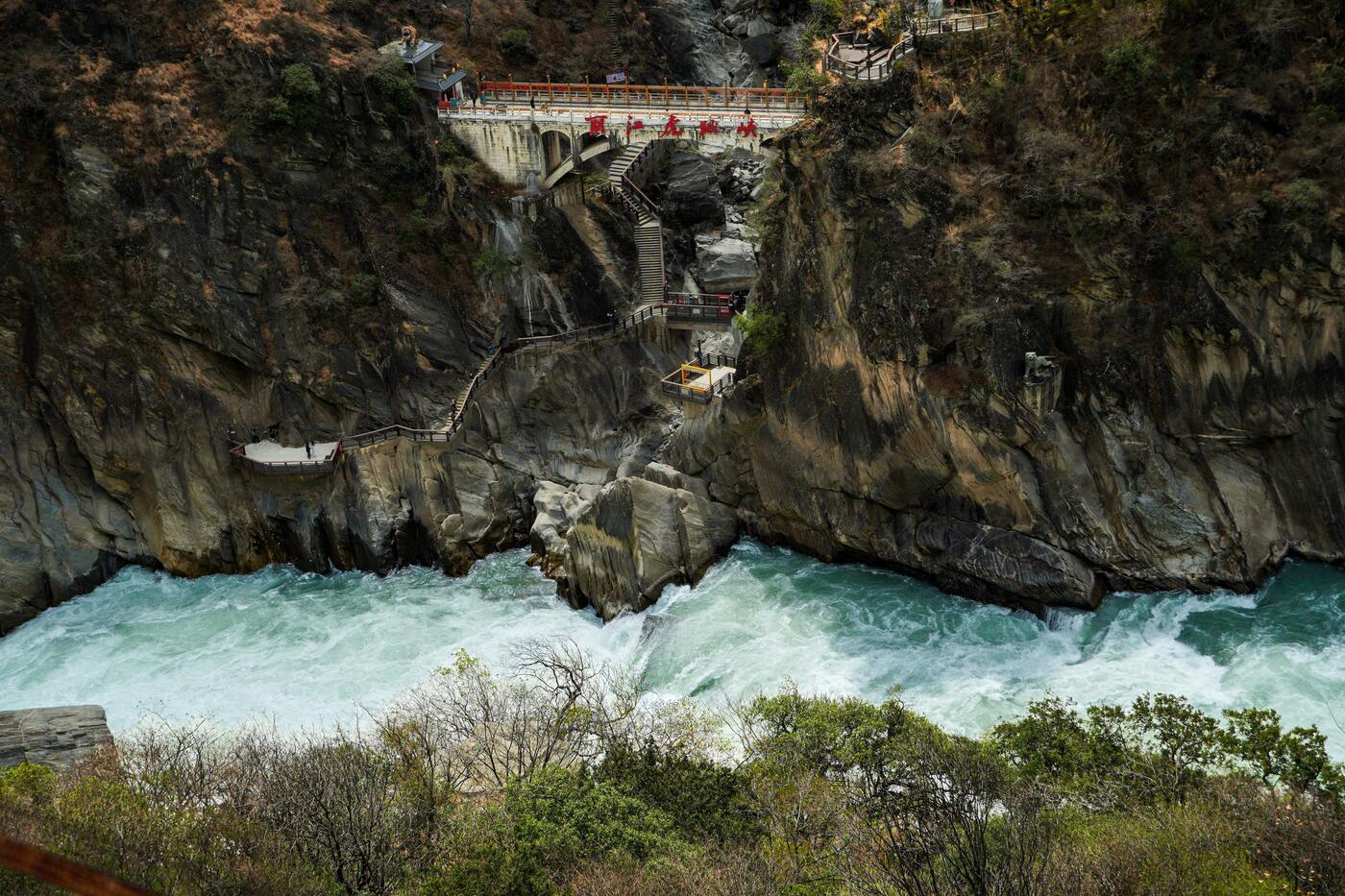
The peak-to-river drop is approximately 3,790 m, putting it in the same class as Tibet’s Yarlung Tsangpo Grand Canyon and Nepal’s Kali Gandaki as one of the deepest canyons on earth by vertical relief. The gorge’s signature is the Tiger Leaping Stone (虎跳石) at the Upper Gorge (上虎跳) — the narrowest point, where the river is squeezed to roughly 25–30 m around a boulder mid-channel while the walls rise thousands of metres on both sides. The name comes from a legend: a tiger chased by a hunter leapt the narrows using that midstream rock as a stepping stone. This is the developed, boardwalk-accessible viewpoint most day visitors come for.
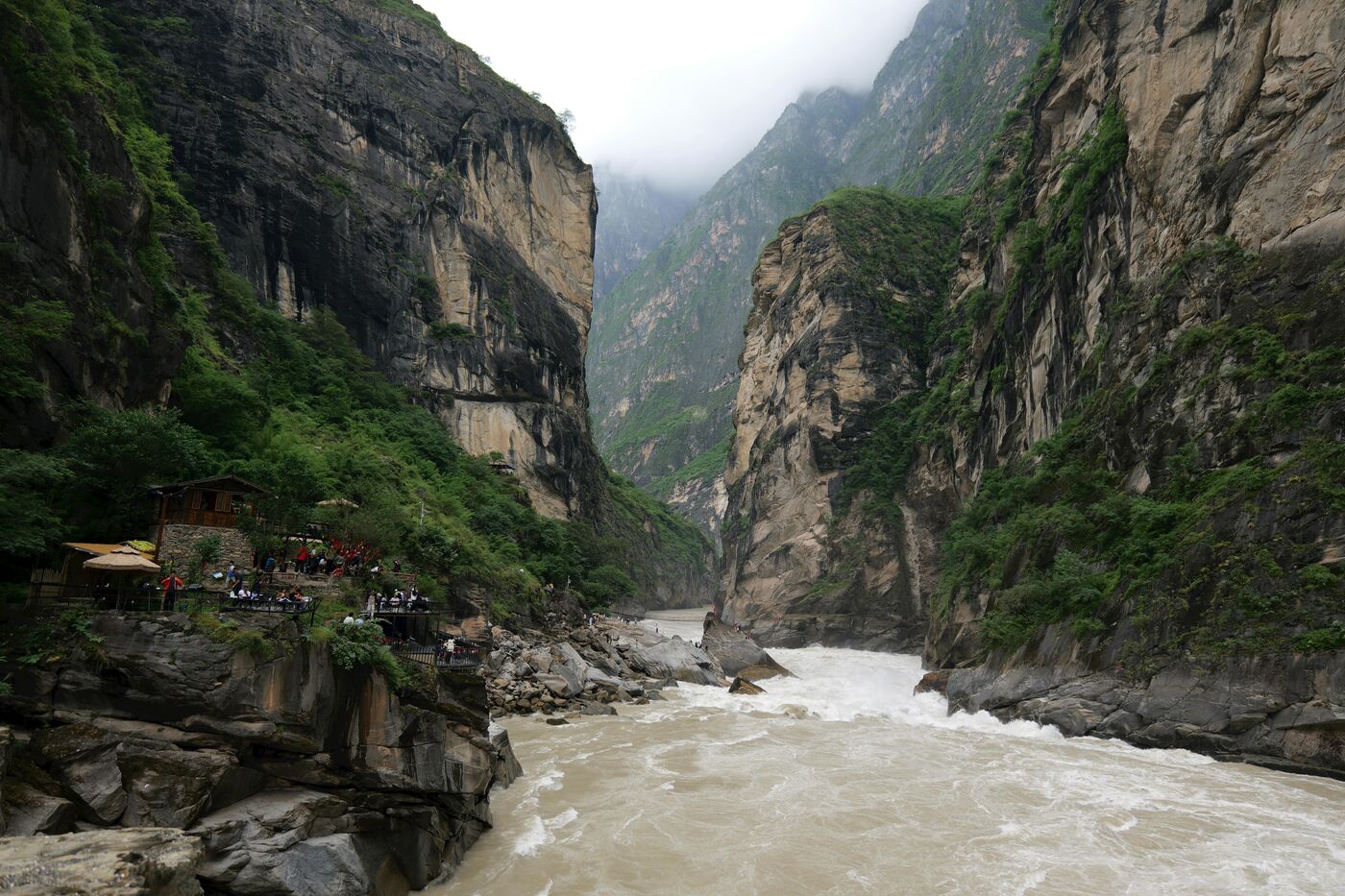
The two ways to see it
How you experience the gorge comes down to one choice: the developed Upper Gorge boardwalk, or the multi-day High Trail trek. They are different trips, not better-and-worse versions of the same one.
| Option | Time | Who it suits |
|---|---|---|
| Upper Gorge (上虎跳) boardwalk viewpoint | ~1.5–2 h on site half-day from Lijiang | Limited time or mobility, families with children, or anyone who just wants the iconic Tiger Leaping Stone view. A boardwalk and stairs (plus an optional ¥100 elevator) reach the narrows; no trekking needed. |
| High Trail (高路) 2-day trek (or 1-day section) | ~22 km · 2 days ~12–14 h moving | Trekkers with normal fitness who want the real mountain experience — the 28-Bends climb, ridge-top gorge views, and the Naxi guesthouses. Short on time? The Tea Horse → Halfway → Tina’s highlight section is ~9 km / 4–5 h in a day. |
The Middle Gorge (中虎跳) valley-floor descent is closed. The Sky Ladder (天梯), One-Line Sky (一线天) and Teacher Zhang path (张老师小路) down to the river are shut after repeated fatal accidents, and the water-level viewpoints are off-limits to ordinary visitors. Anyone offering to “take you down a shortcut for a fee” is leading you into an unopened area — a fine, and no insurance cover. The Upper Gorge and the High Trail are unaffected.
The high trail — stages & guesthouses
The high trail (高路, “the high road”) put the gorge on the foreign-trekker map in the late 1980s and has been well-documented since. It runs ~22 km from the Qiaotou trailhead (桥头, “Bridge Head”) to Tina’s on the valley road, over 2 days, marked throughout by yellow arrows painted on the rocks. Day 1’s defining test is the 28 Bends (28拐) — a switchback climb of about 1,000 m that takes most trekkers 2–3 hours (fit hikers 1.5–2; casual walkers allow 3 and rest often). It is steep and sun-exposed but not technical — no ropes or gear.
| Stage | Landmark | Guesthouse |
|---|---|---|
| Start | Qiaotou ticket booth (桥头) — start by 07:00–08:00 | — |
| Day 1 climb | 28 Bends (28拐), ~1,000 m up to the ridge traverse | — |
| Day 1 mid | High traverse, gorge views to Jade Dragon’s south face | Halfway (中途客栈) · Tea Horse (茶马客栈) |
| Day 1 overnight | ~12–14 km · 5–7 h total — arrive early afternoon | Naxi Family (纳西雅阁) — most recommended |
| Day 2 | East along the high path, ~8–10 km · 3–5 h | Tina’s (Tina’s 客栈) — breakfast / late stop |
| Finish | Descend to the road at Tina’s / Walnut Garden (核桃园) | Shuttle bus back to Lijiang, or a van onward to Shangri-La |
The guesthouses are Naxi-owned, simple but genuinely warm, with English spoken at the main stops; rooms run ¥60–150 per person. Naxi Family is the most-recommended Day 1 overnight for its food and service; Halfway (中途客栈) is the classic mid-trail rest for its gorge-terrace view; Tina’s (中峡旅店), at the road end of the trail, has fed foreign trekkers since the early 1990s and is where you catch the shuttle out. Day 2 drops from the high path down to the road — the last stretch below the Longdong waterfall has some steep, loose switchbacks that need care.
Booking & payment: contact your first-night guesthouse before leaving Lijiang (WeChat or WhatsApp both work) — less for availability than for current trail conditions, weather and the Qiaotou fee situation. Bring ¥500–800 cash per person; mobile signal is patchy and digital payment is unreliable on the high trail.
Safety — the objective facts
This is a mountain environment. The points that matter, as objective facts:
- Season is the biggest safety factor. Best and safest in Mar–May and Sep–Nov, when weather is stable and rockfall risk is minimal.
- Avoid Jun–Aug (monsoon). Heavy rain saturates the cliff faces above the trail — rockfall is a documented hazard and sections wash out. Several serious incidents involving foreign trekkers have occurred in monsoon months. Avoid the trail immediately after any heavy multi-day rain in spring or autumn too.
- Exposed sections on Day 1. Short stretches narrow to a metre or less with a cliff drop on one side — manageable for most adults without a fear of heights; the Upper Gorge boardwalk is the alternative if exposed edges are a problem.
- Footwear & water. The trail is rocky and uneven — proper closed walking shoes or boots, not sandals. Carry 2 L of water per person per day; trail-side springs and guesthouses exist but are not always reliable, so fill up at Qiaotou.
- Altitude is gentle. The trail runs ~1,800 m (Qiaotou) to ~2,600 m at its highest — lower than Lijiang (2,400 m), much lower than Shangri-La (3,200 m) or the Jade Dragon cable car (4,506 m). A day or two in Lijiang first leaves you acclimatised; if you come straight from Kunming, take the 28 Bends slowly.
- Signal & navigation. Phone signal is intermittent on the high trail. Don’t rely on live navigation — download an offline map and carry a printed trail description from the guesthouse. The route is well-marked, and a local guide (~¥100–200/day via the Qiaotou guesthouses) is optional, not required.
Getting there — Lijiang, Shangri-La, Qiaotou
The gorge sits ~80 km by road north of Lijiang (~2 hours) on the main Lijiang–Shangri-La route (gorge-area coords 100.050531°E, 27.189198°N). Any van making the full Lijiang → Shangri-La run passes through Qiaotou, so the gorge is the natural built-in stop between the two cities. Since late 2023 there is also a train option — the Lijiang–Shangri-La (Lixiang) railway has a Tiger Leaping Gorge station near Qiaotou.
| Leg | How | Time · cost |
|---|---|---|
| Lijiang → Tiger Leaping Gorge station Lixiang railway | Fast, scenic train to 虎跳峡站 near Qiaotou (opened 2023). No free shuttle at the station — taxi or shared car onward (~¥30–50 to the Upper Gorge). Confirm your return train on 12306 on arrival. | ~20–40 min · ticketed |
| Lijiang → Qiaotou shared van | Minivan (面包车) from Lijiang Bus Station, departs when full — or arrange via your Lijiang hotel. Drops right at the gorge / Qiaotou. | ~2 h · ¥45–60/seat |
| Lijiang → Qiaotou DiDi / private car | Full private car; set the destination as 桥头. Good for groups of 3–4 or stopping at Jinsha viewpoints. | ~2 h · ¥400–600 car |
| Qiaotou high-trail start | Walk from the ticket booth — the first yellow arrow points uphill. | Start by 07:00–08:00 |
| Gorge → Shangri-La onward exit | Shared van from Tina’s / Walnut Garden (核桃园) onward to Shangri-La (香格里拉 / Zhongdian). | ~2 h · ¥60–80/seat |
| Upper Gorge half-day option | The developed boardwalk to the Tiger Leaping Stone — the no-trek option. Reserve a ticket online first (real-name); an optional ¥100 elevator saves the stair climb back up. | ~1.5–2 h on site · ¥45 / ¥65 |
Distance and driving time are Amap (高德地图) routing data. Shared-van fares and entrance fees are 2024–2026 trekker-community figures and vary — confirm current prices with your guesthouse or at the Qiaotou booth.
Best time & how long
The two good windows, and how much time each way of seeing the gorge needs:
| When / how long | What to expect |
|---|---|
| Mar–May | Spring: wildflowers on the high trail, clear mountain views, cool at altitude. Stable weather, minimal rockfall — prime trekking window. |
| Sep–Nov | Autumn: the monsoon has passed, skies clear, the canyon is lush from summer rain. The other prime window. (Early Sep can carry residual monsoon — check first.) |
| Jun–Aug | Monsoon — avoid the High Trail (rockfall, washouts, slick edges). But this is when snowmelt and rain make the river its most violent — the Upper Gorge boardwalk sees the loudest, most spectacular water, the Tiger Leaping Stone half-drowned in spray. Great for the viewpoint, bad for trekking. |
| High Trail | 2 days / 1 night on the trail. Plan a Lijiang night before and a Shangri-La (or Lijiang) night after. |
| Upper Gorge | ~1.5–2 hours on the boardwalk — a half-day side-trip from Lijiang. |
For the season picture across the whole province, see the best time to visit Yunnan guide.
Practical for foreigners
- Reserve tickets first: entry is real-name with face/ID gates — book online before you arrive, don’t just turn up. Chinese visitors use 云南旅游通 / the official WeChat account (Chinese ID + mini-program), so foreigners are better off booking a ticket or day-tour on Trip.com in English on a foreign card. Carry your passport; it’s checked against the booking.
- Fees: ¥45 on the Shangri-La side or ¥65 on the Lijiang side — two separate scenic areas, tickets not interchangeable, so book for the side you’re visiting. The Upper Gorge elevator (~¥100 return / ~¥40 down) is optional — the stairs are 10–15 min down, so most skip it.
- Budget: ~¥300–600 per person for a 2-day High Trail trip (transport + entry + guesthouse + meals). Guesthouse meals are simple Naxi and Western food, ¥30–60.
- Cash: bring ¥500–800 per person — the canyon has patchy signal and digital payment is unreliable on the trail.
- Avoid the touts: ignore drivers at the station or Qiaotou who quote a fare then raise it or swap cars; use a proper ride-hail app or the scheduled bus. Skip the cheap ¥100–200 Lijiang day-tours (staged “altitude” oxygen and medicine sales, rushed timing, forced shopping stops). In the scenic area, decline anyone pressing a “free” blessing token or guide — it isn’t free.
- English & guides: spoken at the main Naxi guesthouses; the High Trail is yellow-arrow marked and well-documented in English. A local guide is optional (~¥100–200/day via the Qiaotou guesthouses).
How it fits a Yunnan trip
The gorge slots into the Lijiang–Shangri-La corridor — the standard sequence:
- High Trail → continue to Shangri-La — the logical exit. From Tina’s, take a van onward (~2 h). Shangri-La (3,200 m) means a real altitude jump after two days’ trekking — plan a rest afternoon, hydrate, skip alcohol the first night; Songzanlin Monastery (松赞林寺) and Pudacuo National Park (普达措) are a day each.
- High trail → back to Lijiang — if you’re not continuing the loop, a shared van retraces the road (~2 h); most gorge or Qiaotou guesthouses arrange it.
- Upper Gorge from Lijiang — drive or train in, walk the boardwalk to the Tiger Leaping Stone, return the same day (~half-day). Lijiang is the only realistic base for this.
Lijiang (2,400 m) is the natural pre-trek base — acclimatisation, guesthouse contact, van departure. For the full regional transport picture (the Kunming–Dali–Lijiang HSR, the Lijiang–Shangri-La road, altitude sequencing), see getting around Yunnan.
Book a Tiger Leaping Gorge tour or transferNASDAQ: TCOM
Trip.com lists guided gorge day-tours and Lijiang–Shangri-La transfers booked in English on a foreign card — the simplest way to fix transport if you’d rather not chase a shared van.
Where to stay
For the high trail you sleep on the trail itself, in a Naxi guesthouse; for everything else you base in Lijiang before the trek (and the Upper Gorge half-day) and optionally Shangri-La after. There is no foreigner-friendly chain at the trailhead — the two groups below cover both.
Where to book these: the trail guesthouses are best arranged directly (WeChat/WhatsApp) — but for your Lijiang or Shangri-La nights, China’s home-grown chains — 全季 (JI) and 亚朵 (Atour) — are listed most completely on Trip.com, with English checkout and foreign-card payment. Western sites like Booking and Agoda carry only a fraction of their branches.
On the trail — the Naxi trekker guesthouses
You sleep on the high trail itself, in a small network of Naxi-owned guesthouses that have hosted foreign trekkers for over 30 years. These are simple mountain guesthouses, not hotels — dorm beds and basic private rooms, solar hot showers (warm rather than hot in cold weather), and a short Naxi-and-Western menu. English is spoken at all three main stops. Reckon ¥60-150 per person per night. Cash (RMB) is strongly recommended — mobile signal is patchy on the high trail. Each guesthouse below is search-only; book your first night directly via WeChat or WhatsApp before you leave Lijiang.
- Mid-rangeNaxi Family Guesthouse (纳西雅阁) →Day 1 high trail, after the 28-bend climb — the most-recommended overnight stop.Naxi family-run, consistently praised for warm service and hearty home cooking before the Day 2 start. Private rooms and dorm beds.
- Mid-rangeTea Horse Guesthouse (茶马客栈) →Day 1 high trail, slightly earlier on the route than Naxi Family.Naxi-owned, named for the Ancient Tea Horse Road; popular with trekkers who want to stop a little earlier on Day 1. Similar facilities and price.
- Mid-rangeHalfway Guesthouse (中途客栈) →Mid-point of the Day 1 high traverse, on the upper slope.A long-standing high-trail stop famous for its terrace view straight down into the gorge — a classic mid-trail rest or photo break.
- Mid-rangeTina's Guesthouse (Tina's 客栈) →The road end of the High Trail, above the river — the classic finish.The most famous name on the gorge — feeding and sheltering foreign trekkers since the early 1990s. The Day 1 overnight for faster walkers, or the Day 2 breakfast stop; the cliff path to the river starts here.
Base before / after — Lijiang or Shangri-La
You do not base at the gorge. Lijiang (2,400 m, ~2 hours south by shared van) is the natural pre-trek base — acclimatisation, guesthouse contact, van or train departure — and the only realistic base for the Upper Gorge half-day. Shangri-La (3,200 m) is the natural post-trek base if you continue the loop. Most foreign visitors do best in a home-grown mid-range chain like 全季 (JI) or 亚朵 (Atour): reliable, English-app booking, a fraction of the five-star rate. Two international five-stars in Lijiang are listed if you want them.
- In Lijiang, ~2 hours by shared van from the Qiaotou trailhead.China's most popular home-grown mid-range chain — modern, spotless, easy English-app booking, roughly a third the price of the resorts. The pragmatic pre-trek base.
- In Lijiang, ~2 hours by shared van from the Qiaotou trailhead.Design-led mid-range chain that foreign guests rate highly — comfortable, well-run, far better value than the luxury lodges. A solid pre- or post-gorge night.
- Mid-rangeJI Hotel Shangri-La (全季) →In Shangri-La (3,200 m), ~2 hours past the gorge — the post-trek base.The reliable mid-range pick for the night after the trek, before Songzanlin Monastery and Pudacuo. Plan a rest afternoon on arrival for the altitude jump.
- In Lijiang, ~2 hours by shared van from the Qiaotou trailhead.If you want a five-star pre- or post-trek night in Lijiang — Naxi-styled resort grounds with the Jade Dragon backdrop.
Frequently asked questions
How deep is Tiger Leaping Gorge?
Tiger Leaping Gorge (虎跳峡) has a peak-to-river drop of approximately 3,790 m — measured from the summit of Jade Dragon Snow Mountain (玉龙雪山, 5,596 m on the east bank) down to the surface of the upper Yangtze River at the bottom of the gorge. The river narrows to roughly 25-30 m around the Tiger Leaping Stone at the Upper Gorge, with the canyon walls rising almost vertically on both sides. It is consistently cited as one of the world's deepest gorges by vertical drop, in the same class as the Yarlung Tsangpo Grand Canyon in Tibet and the Kali Gandaki Gorge in Nepal.
Is Tiger Leaping Gorge worth it?
Yes — almost universally so. There are two ways to experience it, and both are worth the journey from Lijiang. The developed Upper Gorge (上虎跳) is the easy option: a boardwalk down to the iconic Tiger Leaping Stone at the narrowest point of the river, about 1.5-2 hours, no trekking required — the option for limited time, families, or anyone who just wants the famous view. The 2-day High Trail (高路) is the classic trek: a genuine mountain hike with the 28-Bends climb on Day 1, ridge-top gorge views between the Jade Dragon and Haba snow peaks, and warm English-friendly Naxi guesthouses on the trail. The main caveats are that the trail is unsafe in monsoon season (June-August), and the valley-floor descent routes in the Middle Gorge (天梯 / 一线天) are closed after past accidents — so the accessible iconic photo is at the Upper Gorge, not down at the river in the Middle Gorge.
How long is the Tiger Leaping Gorge high trail?
The high trail (高路) runs approximately 22 km from the Qiaotou trailhead (桥头) down to Tina's Guesthouse on the valley road, typically done over 2 days. Day 1: Qiaotou → Naxi Family Guesthouse or Tea Horse Guesthouse, roughly 12-14 km with the 28-bend climb — most trekkers take 5-7 hours. Day 2: guesthouse → Halfway → Tina's, roughly 8-10 km and 3-5 hours, ending with a descent past the Longdong waterfall to the road. Total moving time across both days is approximately 12-14 hours. Short on time, a popular one-day version walks just the Tea Horse → Halfway → Tina's highlight section (~9 km, 4-5 hours).
Is Tiger Leaping Gorge dangerous?
The high trail has sections of exposed cliff path — notably the switchbacks on the Day 1 climb and a few narrowing points where the trail runs close to the edge above a long drop. These are manageable for most adult trekkers with normal fitness and no fear of heights. The main safety risk is SEASONAL: the gorge is subject to rockfall during and immediately after the monsoon season (June-August), and trail washouts do occur. Several serious incidents involving foreign trekkers have occurred, mostly during or after heavy rain. The advice from the Naxi guesthouse community is consistent: do not hike in monsoon season, and if the sky looks threatening after a rain, wait. Outside monsoon season (March-May and September-November especially), the trail is well-marked and the risk is low for normally fit adults who stay on the marked path.
Do I need a guide for Tiger Leaping Gorge?
No — the high trail is well-marked with yellow arrows painted on the rocks and signboards at key junctions, and the Naxi guesthouse community has operated an informal guide network for decades. The trail is well-documented in English by the foreign-trekker community. That said, hiring a local guide (~¥100-200 per day, arranged through the Qiaotou guesthouses) is a reasonable option if you are not confident navigating trail junctions in mountain terrain or if weather is unpredictable. A guide also adds cultural context to the Naxi landscape. Solo travel on the high trail without a guide is normal and safe outside monsoon season.
Can foreigners hike Tiger Leaping Gorge alone?
Yes — foreign independent trekkers have been doing the high trail solo (or in small groups of friends) for over 30 years. The Naxi-owned guesthouses on the trail are experienced with foreign travelers, English is spoken at Naxi Family Guesthouse, Tea Horse and Tina's, and the trail is documented in foreign-language guidebooks and online communities. The standard approach is to book your first-night guesthouse before you leave Lijiang (WeChat or WhatsApp works — the guesthouses respond to both), confirm the trail conditions, and start from Qiaotou early in the morning (07:00-08:00) to complete Day 1 with plenty of daylight.
What about altitude at Tiger Leaping Gorge?
The trailhead at Qiaotou (桥头) sits at approximately 1,800 m — lower than Lijiang (2,400 m). The high trail climbs to around 2,600 m at its highest section before descending toward the river. This altitude is gentler than Shangri-La (3,200 m) and significantly gentler than the Jade Dragon Snow Mountain cable car (4,506 m). Most trekkers who have already spent a day or two in Lijiang notice no significant altitude effects on the Tiger Leaping Gorge trail. If you arrive in Yunnan and go directly to the gorge without time in Kunming or Lijiang first, take the first hour slowly. Carry 2 L of water per person per day.
When should I NOT go to Tiger Leaping Gorge?
Avoid June, July and August — the summer monsoon season. Rockfall is a documented hazard when the rock faces above are saturated, and trail sections wash out. Even if a day starts sunny, afternoon storms in monsoon season can make the cliff-edge sections treacherous. The guesthouses at Qiaotou will tell you honestly whether conditions are safe. Early September can still see residual monsoon weather in some years — check with the guesthouse before committing. Also avoid going immediately after any heavy multi-day rain in spring or autumn — the same rockfall risk applies.
What does Tiger Leaping Gorge cost?
Entrance is ¥45 on the Shangri-La side (香格里拉虎跳峡) or ¥65 on the Lijiang side (丽江虎跳峡) — these are two separate scenic areas on opposite banks and the tickets are NOT interchangeable, so buy for the side you are actually visiting. The Upper Gorge optional scenic elevator is about ¥100 return (roughly ¥40 for the downward leg) — most travelers skip it, since the boardwalk stairs take only 10-15 minutes down and 20-30 back up. Tickets now require an online real-name reservation; foreigners book via Trip.com (English, foreign card) rather than the Chinese mini-programs. Guesthouses on the High Trail run ¥60-150 per person per night; trail meals are ¥30-60. A shared van from Lijiang is ¥45-60 per seat (~2 hours). Budget roughly ¥300-600 per person for a 2-day High Trail trip including transport, entrance, accommodation and food.
Do I need to reserve tickets in advance for Tiger Leaping Gorge?
Yes. The gorge now runs a strict real-name reservation system with face-and-ID entry gates, so book online before you arrive rather than turning up at the gate — travelers who arrive without a booking are routinely turned back to the visitor centre or the No. 7 car park to sort out a ticket, which wastes time. Chinese visitors book through the official WeChat account or apps like 云南旅游通; those need a Chinese ID and a WeChat mini-program, so foreign visitors are better served booking a Tiger Leaping Gorge ticket or day-tour through Trip.com in English on a foreign card. Bring your passport — entry is verified against the name on the booking.
Can I get to Tiger Leaping Gorge by train?
Yes — the Lijiang–Shangri-La (Lixiang) railway opened in November 2023 and has a Tiger Leaping Gorge station (虎跳峡站), a small stop near Qiaotou on the Shangri-La side. The fastest Lijiang–Shangri-La trains cover the line in about 1 hour 18 minutes, and the ride itself is scenic. There is no free shuttle at the station: from the station it is a short taxi or shared-car hop (travelers report roughly ¥30-50) to the Upper Gorge, or a bit more to the Qiaotou trailhead for the High Trail. Because departures can be limited at some times of day, confirm your return train on 12306 as soon as you arrive. Many visitors still prefer the shared van straight from Lijiang, which drops at the gorge or Qiaotou directly.
Is the Middle Gorge valley floor still open?
No. As of 2026 the Middle Gorge (中虎跳) descent routes to the river — the Sky Ladder (天梯), One-Line Sky (一线天) and the Teacher Zhang path (张老师小路) — are closed after repeated fatal accidents, and the valley-floor viewpoints (including the Middle Tiger Leaping Stone at water level) are no longer legally accessible to ordinary visitors. Locals may stop you at the trailheads, and forcing through counts as entering an unopened area — a fine, with no insurance cover if something goes wrong. This does not affect the two things most people come for: the developed Upper Gorge boardwalk to the Tiger Leaping Stone, and the High Trail along the upper canyon, both of which are open and safe on the marked routes.
Sources
Checked August 2026 · Written from our own first-hand travel in China.