This guide is written by an editorial team based in Chongqing — the editor has lived in mainland China since 2018. The picks, logistics and priority calls draw on aggregated 2024-2026 r/travelchina, r/yunnan and r/lijiang threads, Trip.com listings, Lonely Planet and China Highlights editorial canon, and 2026-05-23 Amap (高德地图) routing and POI data. This is aggregated editorial coverage — corrections from Yunnan residents and recent visitors are welcomed (see the about page).
How to think about Yunnan — four bases, one gradual ascent
Yunnan is not a single-city destination. Foreign visitors typically travel it as a multi-stop loop, ascending in altitude from Kunming through Dali and Lijiang to Shangri-La. That altitude order matters practically: your body acclimatises progressively rather than arriving cold at 3,200 m. The four main bases are:
- Kunming (昆明, 1,895 m) — the provincial capital and air-entry hub. Most foreign visitors arrive at Kunming Changshui Airport (KMG) and spend 1-2 nights before heading north. Primary day trip: Stone Forest (pick 4 below).
- Dali (大理, 1,980 m) — a relaxed Bai-minority walled town on the western shore of Erhai Lake, 3.5 hours northwest of Kunming by high-speed rail. Primary sights: Dali Old Town (pick 6) and Erhai Lake (pick 7).
- Lijiang (丽江, 2,400 m) — the UNESCO Naxi old town that anchors most itineraries, 1.5 hours north of Dali by rail or bus. Primary sights: Lijiang Old Town (pick 1), Jade Dragon Snow Mountain (pick 3), Tiger Leaping Gorge (pick 2 — a day trip or 2-day trail north of Lijiang).
- Shangri-La (香格里拉 / Zhongdian, 3,200 m) — the Tibetan-plateau town at the northwestern edge of Yunnan, 4 hours from Lijiang by bus or road. Primary sights: Songzanlin Monastery (pick 8), Pudacuo National Park (pick 9). Meili Snow Mountain (pick 10) is a further 3-4 hours northwest.
The best season question is more complex in Yunnan than in most Chinese destinations because the four bases have different micro-climates and different peak seasons. The dedicated best time to visit Yunnan guide covers every window month by month. For where to sleep at each base, see where to stay in Yunnan.
1. Lijiang Old Town — the UNESCO Naxi cobbled quarter
Lijiang Old Town (丽江古城 / 大研古城, Dà Yán Gǔ Chéng) is the single most-visited attraction in Yunnan and one of the best-preserved minority-culture urban landscapes in China. Inscribed as a UNESCO World Heritage Site in 1997, the old town covers roughly 3.8 km² of cobbled stone lanes, whitewashed Naxi courtyard houses, carved-timber eaves and a network of channels fed by the Yuquan spring. It sits at 2,400 m altitude — the thin air is noticeable for visitors arriving from lower elevations, but most acclimatise within 24 hours.
The commercial core — Sifang (Old Market) Square (四方街) and the lanes radiating from it — is dense with cafes, guesthouses, bars and craft stalls. North of the square, the lanes thin and the Naxi residential character becomes more apparent: elderly Naxi women in traditional blue-and-white dress still live in the courtyards here, and the morning foot traffic is local. The Black Dragon Pool (黑龙潭 / Jade Spring Park) at the northern edge of the old town is the iconic viewpoint — the Moon-Embracing Pavilion (得月楼) reflected in the pool, with the snow face of Jade Dragon Snow Mountain as backdrop, is the image that appears on more Yunnan postcards than any other.
The full deep-dive — the Mu Family Mansion (木府), the dongba script of the Naxi people, the Shuhe Old Town alternative, and how to navigate the crowded evening core versus the quiet northern lanes — is in the dedicated Lijiang Old Town guide. Plan at least one full day in the old town; most visitors who try to rush it in half a day regret it.
2. Tiger Leaping Gorge — one of the world's deepest gorges
Tiger Leaping Gorge (虎跳峡, Hǔ Tiào Xiá) is the most dramatic landscape in Yunnan and arguably one of the most dramatic natural landscapes in China. The Jinsha River (金沙江 — the upper Yangtze) cuts through a gorge roughly 3,790 m deep between Jade Dragon Snow Mountain to the south and Haba Snow Mountain (哈巴雪山, 5,396 m) to the north — at its narrowest, the gorge floor is less than 30 m wide while the peaks tower nearly 4 km above. The name comes from a local legend of a tiger that escaped hunters by leaping across the narrowest point on a mid-river boulder.
For foreign visitors, the draw is the two-day high trail — a classic backpacking route starting from Qiaotou (桥头) and following the rim of the gorge through a series of guesthouses (Naxi Family Guesthouse, Tea Horse Guesthouse, Halfway Guesthouse are the standard stops) before descending to Tina's Guesthouse and completing the route. The trail is challenging but not technical — steep sections, loose rock in places, no technical climbing. The classic two-day shape (night at a mid-trail guesthouse, second-day descent) is manageable for fit walkers. A lower road also runs through the gorge for those who want the views without the steep sections — the viewpoints at Middle Gorge (中虎跳) are accessible by road.
Safety note: the trail has rockfall risk, particularly after rain. The gorge flooding risk in the June-August monsoon is real — the trail is best avoided in that window. The full logistics, trailhead access from Lijiang, and guesthouse recommendations are in the Tiger Leaping Gorge guide.
3. Jade Dragon Snow Mountain — the sacred Naxi peak
Jade Dragon Snow Mountain (玉龙雪山, Yù Lóng Xuě Shān) rises to 5,596 m immediately north of Lijiang — the snow face is visible from the old town on clear mornings and is the defining backdrop of the Lijiang skyline. It is the southernmost glacier-bearing mountain in the northern hemisphere and is sacred to the Naxi people as the embodiment of the Sanduo deity (三朵), the protector of the Naxi nation.
The Big Cable Car (大索道) ascends to a station at 4,506 m — the highest cable car terminal in China. The upper station sits in a snow-and-glacier landscape with boardwalk paths through the ice zone; supplemental oxygen is available (and advisable for those who feel breathless). The total vertical ascent on the cable car is roughly 1,000 m and takes about 20 minutes. Visitors with heart conditions or a history of severe altitude sickness should consider whether the summit experience is appropriate for them.
The cable car tickets must be booked in advance — they sell out on peak days, and the mountain is frequently cloud-covered after mid-morning. A 7 am start from Lijiang to the cable car base is the standard approach for the clearest skies. The full logistics — ticket booking, bus to the mountain from Lijiang, what to wear at 4,506 m — are in the dedicated Jade Dragon Snow Mountain guide.
4. Stone Forest — the UNESCO karst day trip from Kunming
The Stone Forest (石林 / Shilin, Shí Lín — literally “Stone Forest”) is a UNESCO World Heritage Site inscribed in 2007 as part of the South China Karst — a vast network of karst formations that extends across Guizhou, Guangxi and Yunnan. The Shilin site in Yunnan covers roughly 350 km² of the Shilin Yi Autonomous County, with the main tourist zone being a compact area of grey limestone pillars and towers, some reaching 30-40 m in height, eroded over approximately 270 million years.
It is best understood as a Kunming day trip — located about 88 km southeast of the city centre, reachable in roughly 1.5 hours by tourist bus or hired car. The main visitor area is walkable in 2-3 hours; the rocks are labyrinthine, with viewing platforms and narrow paths between the pillars. The site is managed by the Sani Yi minority community (撒尼彝族) — the women in traditional Sani dress selling embroidery at the entrance are a feature of the experience, not a tourist confection; the Sani people have lived in this area for centuries and their relationship with the stone landscape is a genuine cultural thread.
The full logistics — transport options from Kunming, ticket prices, the outer vs inner stone forest zones — are in the dedicated Stone Forest guide. If your Kunming stop is only one night, the Stone Forest is the day trip most worth making before continuing north to Dali.
5. Yuanyang Hani Rice Terraces — the UNESCO mirror-water sunrise
The Yuanyang Hani Rice Terraces (元阳哈尼梯田, Yuán Yáng Hā Ní Tī Tián) are among the most photographed agricultural landscapes in the world — and among the most demanding to reach. Inscribed as a UNESCO World Heritage Site in 2013 as part of the Honghe Hani Rice Terraces, the terraces cover roughly 16,000 hectares of the steep mountainsides south of the Red River (红河 / Honghe), carved by the Hani minority people over more than 1,300 years. The terraces descend in thousands of steps from cloud-level ridges to valley floors, fed by a traditional forest-canal-terrace-village water management system that UNESCO cites as one of the most sophisticated historical agri-engineering systems in the world.
The signature experience is the Duoyishu (多依树) sunrise — arriving at the Duoyishu viewpoint before dawn and watching the mist-filled terraces reflect the sunrise in mirror panels of water. The mirror effect occurs when the terraces are flooded (October through April); harvest season (September-October) gives a different but equally photographed golden-terrace look. The other major viewpoint is Bada (坝达), facing southwest for sunset.
Yuanyang is geographically separate from the Kunming-Dali-Lijiang-Shangri-La corridor — it is in southern Yunnan, roughly 5-6 hours from Kunming by road, and most efficiently visited as a standalone 3-4 day extension (Kunming → Jianshui → Yuanyang) rather than shoehorned into the northern loop. The full logistics — transport from Kunming, overnight options in Duoyishu village, the seasonal photography windows — are in the Yuanyang Rice Terraces guide.
6. Dali Old Town — the Bai walled town and Three Pagodas
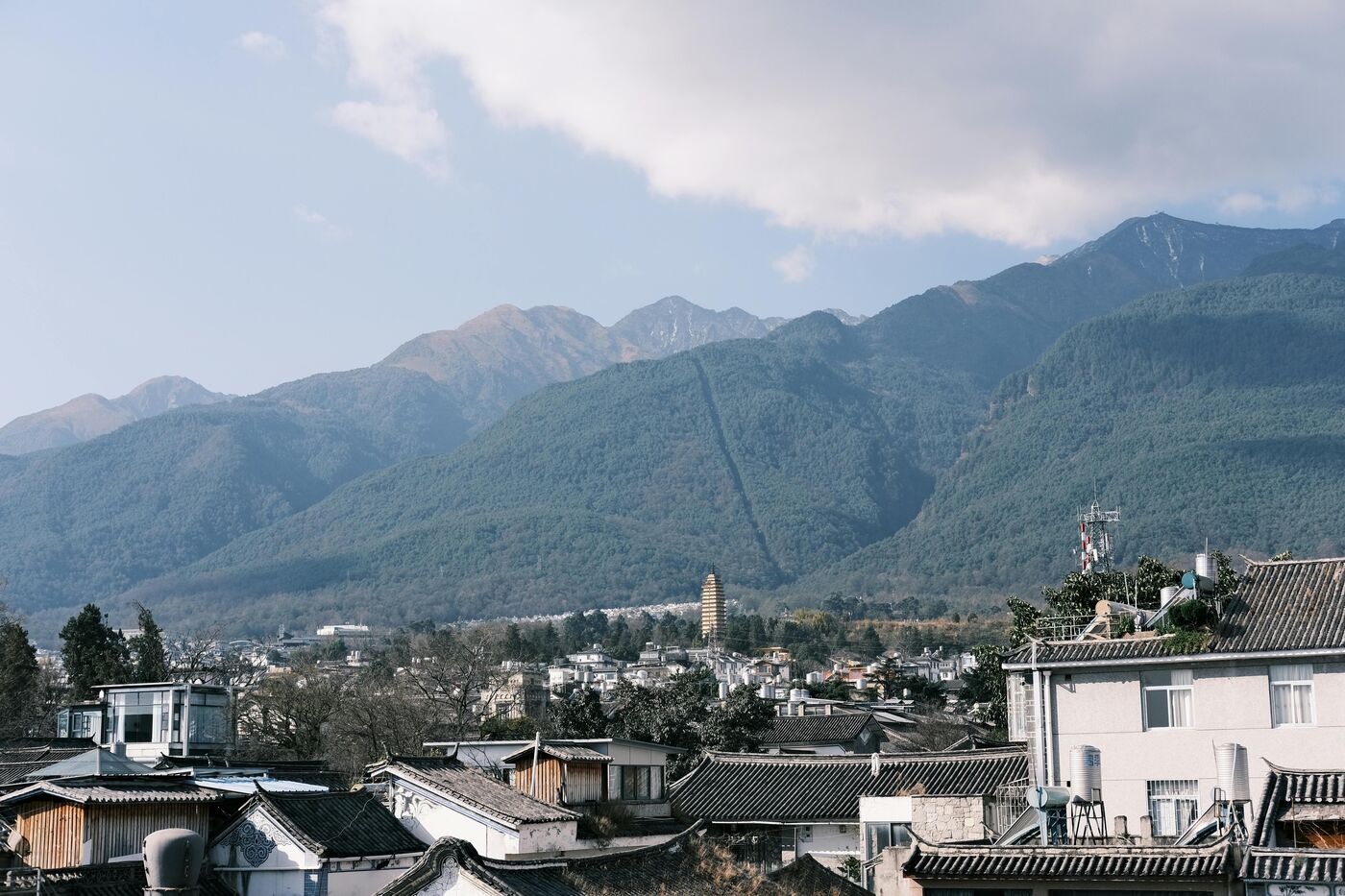
Dali Old Town (大理古城, Dà Lǐ Gǔ Chéng) is a walled city with over 1,200 years of history at the foot of the Cangshan mountain range (苍山, 4,122 m), on the western shore of Erhai Lake at roughly 1,980 m altitude. It was the capital of the Nanzhao Kingdom (738-902 CE) and the Dali Kingdom (937-1253 CE) — historically the dominant polity between Tang China and the kingdoms of Southeast Asia. The surviving old town within its restored walls is a grid of basalt-paved lanes, whitewashed Bai-minority courtyard houses (白族民居) with their distinctive carved-marble detailing, and a population that mixes Bai families with long-resident foreign travellers (Dali has had a backpacker scene since the 1980s and retains it).
The primary landmark outside the old town walls is the Three Pagodas of Chongsheng Temple (崇圣寺三塔) — three 9th-century Nanzhao brick pagodas standing on a terrace with Erhai Lake behind them and Cangshan above. The central Qianxun Pagoda stands 69.13 m tall (the tallest surviving Tang-era pagoda in Yunnan), flanked by two shorter octagonal pagodas. The composition — the trio against sky, the lake and the mountains — defines the Dali visual identity and is one of the most recognised architectural images in Yunnan. The site is about 2 km north of the old town walls; a free shuttle runs from the north gate.
Renmin Lu (Foreigners' Street) is the main commercial strip of the old town — cafes, guesthouses, gear shops and bars catering to a mix of domestic tourists and long-stay foreign travellers. It is less dense than Lijiang's Sifang Square area and has a notably more relaxed atmosphere. Dali is consistently rated as the most liveable Yunnan base by foreign travellers who spend more than a week in the province.
Dali Old Town (大理古城) is approximately 13 km north of Dali/Xiaguan Station (大理站) — the HSR station from Kunming. A taxi or DiDi covers the gap in about 20 minutes. For how flying into Dali compares with the HSR on this axis, see getting around Yunnan.
7. Erhai Lake — the highland lake and Cangshan sunset

Erhai Lake (洱海, ěr Hǎi — “Ear Sea”, named for its ear-like outline when viewed from the mountains) is a highland freshwater lake immediately east of Dali Old Town, covering roughly 256 km² at an elevation of 1,972 m. It is the second-largest plateau lake in Yunnan and one of the least-degraded major freshwater lakes in southwest China — a 2017 Dali government environmental clampdown closed hundreds of lakeside restaurants and guesthouses to protect water quality, a decision that was ecologically necessary and worth knowing about when planning accommodation.
The classic foreign-traveller experience is the south Erhai e-bike loop — renting an electric bicycle from Dali Old Town, cycling roughly 30 km south along the western lakeshore road through Bai villages, then returning via the same route or continuing the full ~120 km circumference over two days. The Bai fishing villages (particularly Xizhou 喜洲 to the north, with its well-preserved mansion architecture) are worth stopping at. Sunset over the Cangshan range reflected in the lake water is the most-photographed Erhai image.
Boat trips on the lake (from Caicun dock, 才村码头, a short e-bike ride east of the old town) are available to the Three Islands (三岛) — Tuanshan, Jinsuo and Putuo — traditional Bai fishing communities. The quality of these boat tours varies; the lake itself is the draw, not the island infrastructure. A half-day on the lake combined with an afternoon in Dali Old Town is the standard shape.
For transport to Dali and surrounding attractions, see getting around Yunnan.
8. Songzanlin Monastery — Yunnan's “Little Potala”
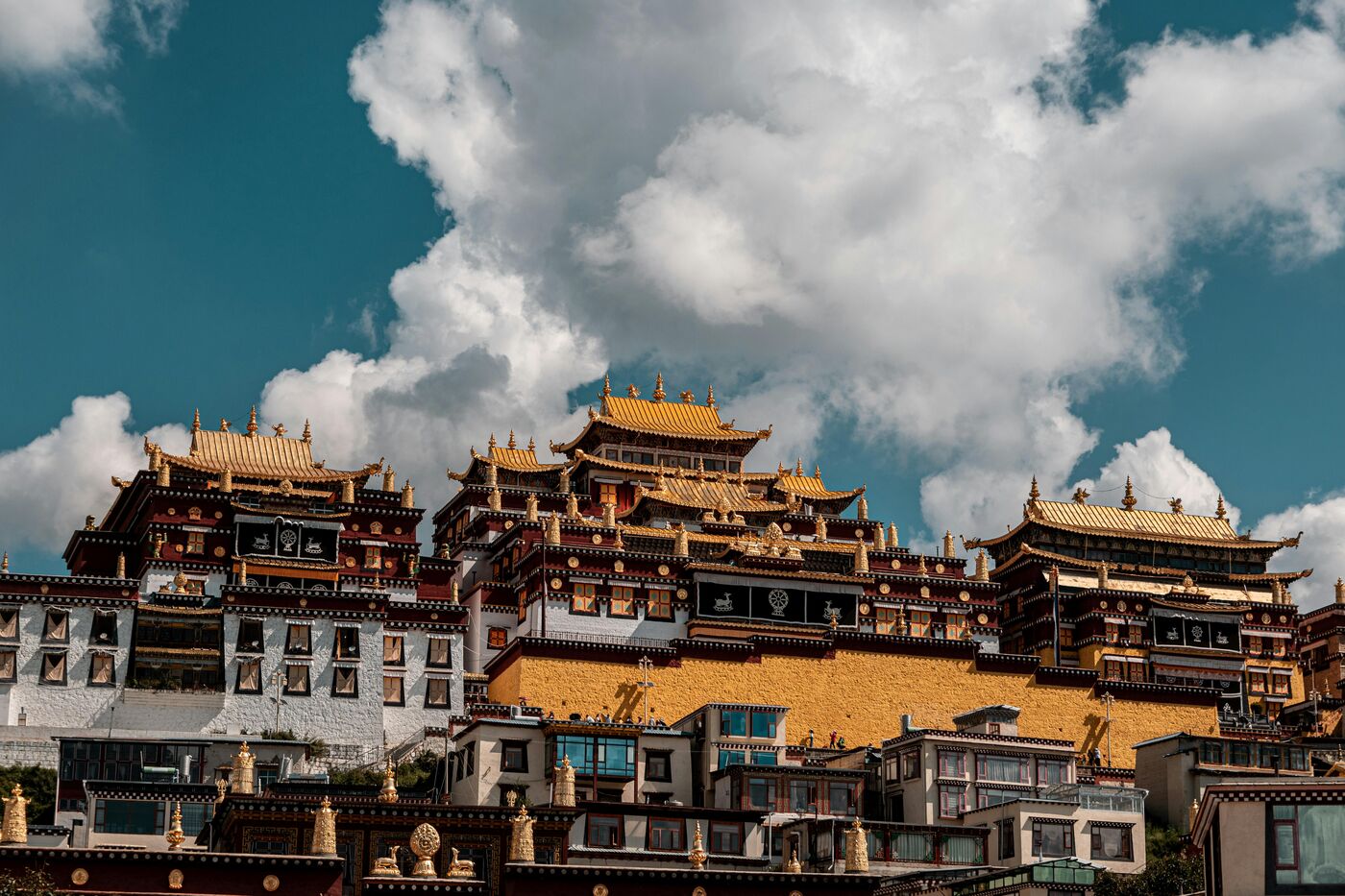
Songzanlin Monastery (松赞林寺, Sōng Zàn Lín Sì) is Yunnan's largest Tibetan-Buddhist monastery, founded in 1679 by the 5th Dalai Lama on a hillside approximately 5 km north of Shangri-La city centre, at an elevation of roughly 3,380 m. It is the religious and cultural centrepiece of the Tibetan-Buddhist community in Yunnan and one of the most important Gelug-school monasteries outside Tibet itself.
The monastery complex is built in three ascending tiers — a lower courtyard, a middle assembly hall level, and the gold-roofed main assembly halls (扎仓) at the top, reached by a long staircase that is itself part of the pilgrimage experience for local worshippers. The two principal assembly halls — Zhacang (Dukhang) and Jikang — contain significant collections of Tibetan Buddhist imagery, thangkas, and religious objects. The gold roofs visible from below, the white walls and the proportional similarity to the Potala Palace in Lhasa have earned it the “Little Potala” informal name — though the monastery is an active monastic community, not a museum replica.
Morning is the best visiting time — monks conduct prayer sessions in the assembly halls before mid-morning, and the light on the gold roofs from the east is at its most direct. The monastery is a 20-minute taxi ride from central Shangri-La; entry tickets are required. Respectful dress (covered shoulders and knees) is appropriate. Photography inside the main assembly halls is restricted — follow posted signs and the lead of other visitors.
9. Pudacuo National Park — China's first national park
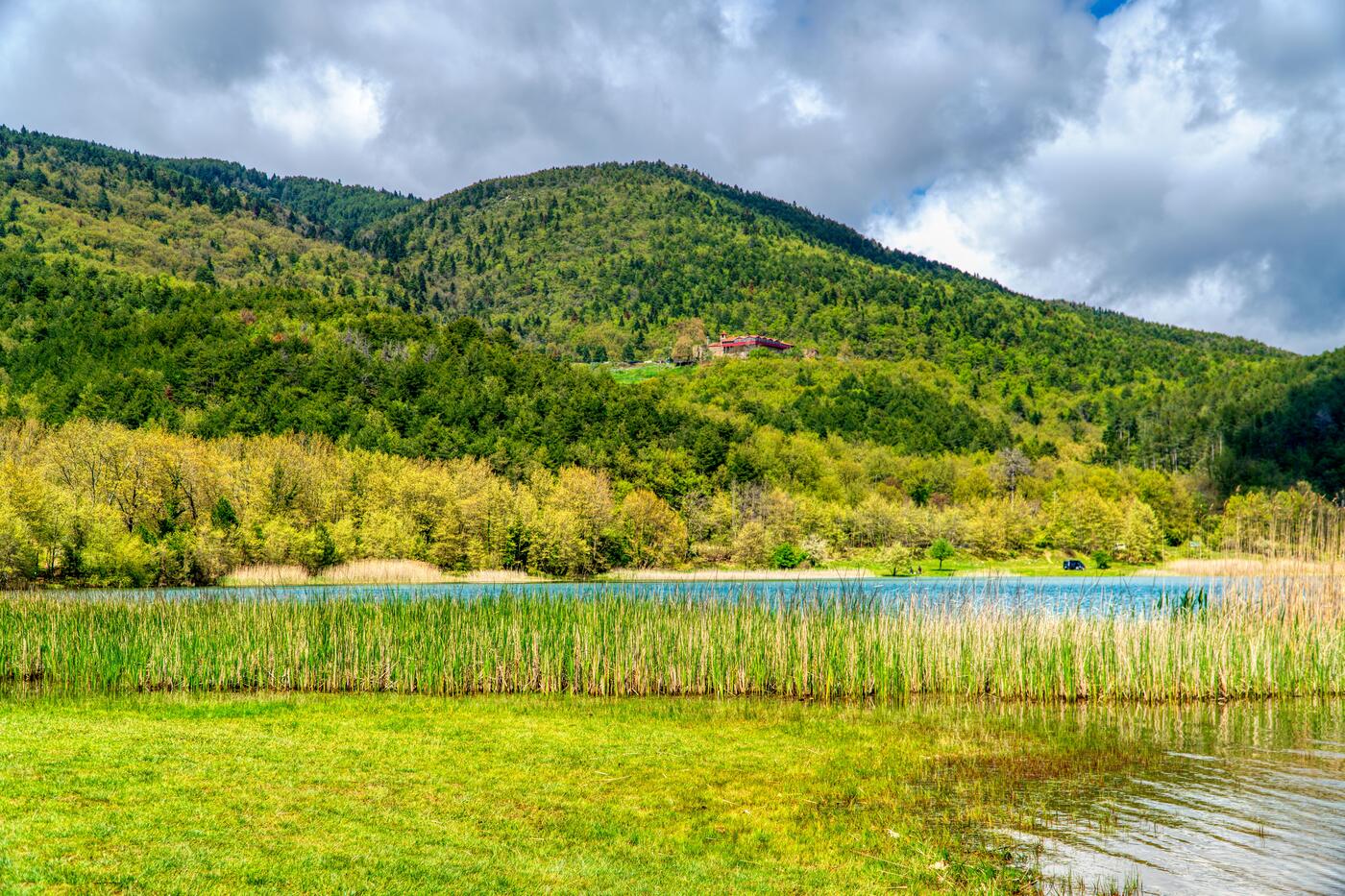
Pudacuo National Park (普达措国家公园, Pǔ Dá Cuò Guó Jiā Gōng Yuán) was established in 2007 as China's first national park in the Western conservation sense — a protected nature reserve where human activity is strictly limited, managed for ecological preservation rather than mass tourism. It sits within the Three Parallel Rivers UNESCO Natural World Heritage Site (三江并流), at altitudes between 3,500 and 4,100 m, roughly 22 km east of Shangri-La city.
The main visitor experience is a boardwalk loop connecting two high-altitude wetland lakes:
- Shudu Lake (属都湖) — the lower lake at approximately 3,705 m, a broad wetland lake surrounded by old-growth alpine meadow and conifer forest. Autumn (September-October) turns the surrounding forest yellow and orange — the autumn colour display is one of the most reliably vivid in Yunnan.
- Bita Lake (碧塔海) — the upper lake at approximately 3,538 m (the park's trail is not monotonically ascending — check the shuttle routing), a protected alpine lake where motorboats and swimming are prohibited. Bita is known for the Duojuan lily (杜鹃花) blooms around its shores in May and June.
Entry tickets include a shuttle bus between the lakes; the boardwalk between stops is gentle and flat, making Pudacuo one of the mostphysically accessible nature experiences in Yunnan — suitable for visitors who cannot do Tiger Leaping Gorge or the Jade Dragon Mountain high trail. Allow a full day. Buy tickets in advance during the autumn peak (September-October Golden Week is particularly busy).
10. Meili Snow Mountain — the sacred peak that has never been climbed

Meili Snow Mountain (梅里雪山, Méi Lǐ Xuě Shān), whose highest point is Kawagebo (卡瓦格博) at 6,740 m, is the highest peak in Yunnan and one of the most sacred mountains in Tibetan Buddhism. It has never been climbed to the summit — the most significant attempt, a joint Sino-Japanese expedition in January 1991, ended when an avalanche killed all 17 climbers. Following community opposition and the recognition that the Tibetan-Buddhist community regards summit attempts as a desecration of the sacred peak, the Chinese government closed Kawagebo to climbing in 1994. The ban remains in effect.
For travellers, the experience is the sunrise Golden Light (日照金山, rì zhào jīn shān — “sunrise gilding the mountain”): on clear mornings, the first sunlight hits the upper glacier of Kawagebo while the valley below remains in shadow, turning the peak a bright golden orange for 15-30 minutes before the colour fades. The viewing point is Feilai Temple (飞来寺) on the main road outside the town of Feilai (飞来), roughly 100 km northwest of Shangri-La in Deqin County (德钦县) — about 3.5 to 4 hours by road.
The Golden Light is not guaranteed — it requires a clear morning sky above the peak, which is far from daily in the monsoon season (June-August). The best window is October through April. Experienced travellers typically budget two or three nights at Feilai to maximise the odds. The Feilai viewpoint itself is free to access from the temple grounds; accommodation in Feilai village ranges from simple guesthouses to a handful of mid-range lodges with mountain-view rooms.
The standard approach from Shangri-La is by hired car or a shared tour van — public transport exists (buses to Deqin) but timings are limited and the last stretch to Feilai may require a taxi. The altitude at Feilai (~3,200 m, same as Shangri-La) is the same as your base, so no additional acclimatisation is needed.
Honourable mentions
- Shuhe Old Town (束河古镇) — a smaller, quieter Naxi village 4 km northwest of Lijiang Old Town, also UNESCO-listed (part of the same inscription). If the Lijiang old town's commercial density feels overwhelming, Shuhe is the alternative; fewer tourists, more working village character, and a good base if you prefer a calmer guesthouse environment.
- Xishuangbanna (西双版纳) — Yunnan's tropical south, on the border with Myanmar and Laos. Dai-minority Buddhist temples, jungle national parks, and a climate that is warm and dry in winter when the northern loop is cold. Geographically separate from the northern circuit — either a standalone trip or an add-on by flight from Kunming.
- Yunnan Nationalities Village (云南民族村) — a cultural village on Dianchi Lake (滇池) in Kunming presenting reconstructed villages of 26 of Yunnan's minority groups. Worth an afternoon from Kunming if minority-culture architecture interests you; the Lake Dianchi views are the setting.
- Cangshan Mountain (苍山) — the 4,122 m range behind Dali Old Town, accessible by cable car from two points. The upper meadows and ridgeline paths give views over Erhai Lake and back toward the Three Pagodas. The Jade Belt Cloud (玉带云游路) traversal path is a half-day walk along the mid-mountain contour; technically easy, scenically rewarding.
- Green Lake (翠湖, Cuì Hú) — Kunming's central park lake, famous for the wintering red-headed black seagulls (红嘴鸥) that arrive from Siberia in November and stay through March. A free public park and a pleasant morning walk before heading to the Stone Forest or the airport.
How to fit them in — itinerary by trip length
The altitude-ascending order (Kunming → Dali → Lijiang → Shangri-La) is not only the practical acclimatisation sequence — it is also the logical rail network sequence. The Yunnan-Guizhou HSR links Kunming to Dali in about 3.5 hours; from Dali, Lijiang is another 1.5 hours; the Shangri-La road connection adds 4 hours by coach or hired car (no direct train yet as of 2026-05-23).
- 5 days — northern Yunnan essentials: 1 night Kunming (Stone Forest day trip), 2 nights Dali (Old Town + Erhai e-bike loop), 2 nights Lijiang (Old Town + Black Dragon Pool). Skips Jade Dragon, Tiger Leaping Gorge, and Shangri-La — covers the relaxed touring end of the spectrum. Good for first-timers on a short window.
- 7 days — core loop: 1 night Kunming, 2 nights Dali (Old Town + Erhai + Three Pagodas + Cangshan cable car), 3 nights Lijiang (Old Town + Jade Dragon Snow Mountain day trip + Tiger Leaping Gorge day trip to Middle Gorge viewpoints), 1 night Shangri-La (Songzanlin). Tight but workable; the Shangri-La night is an overnight preview, not a deep visit.
- 10 days — fuller exploration: 2 nights Kunming (Stone Forest + city), 2 nights Dali, 3 nights Lijiang (adds a proper Tiger Leaping Gorge 2-day trail), 3 nights Shangri-La (Songzanlin + Pudacuo full day + a Meili Snow Mountain overnight to Feilai). Yuanyang is still a separate extension.
- 12-14 days — complete Yunnan: Add 3-4 nights in southern Yunnan for Yuanyang (Kunming → Jianshui → Yuanyang is the logistics chain). This is a full regional itinerary covering all 10 picks.
Whichever length you choose, cross-link to the best time to visit Yunnan before fixing your dates — the seasonal variation across four different micro-climates and altitude bands is the biggest trip-planning variable in Yunnan.
Frequently asked questions
What is the single must-see in Yunnan for a first-time visitor?
How many days do you need to see all 10 picks?
What is the best time of year to visit Yunnan?
Is Yunnan suitable for children?
Which picks are best for photographers?
Which picks are accessible for travellers with limited mobility?
Do I need altitude sickness medication for Yunnan?
Can I do Yunnan independently without a guide?
Related Yunnan guides
- Lijiang Old Town guide — the UNESCO Naxi quarter deep-dive: the Mu Family Mansion, Sifang Square, dongba script, the northern lanes vs the tourist core.
- Tiger Leaping Gorge guide — the 2-day high trail, guesthouse stops, seasonal safety notes, and the lower-road viewpoint alternative.
- Jade Dragon Snow Mountain guide — Big Cable Car to 4,506 m, ticket booking, altitude advice, best time for clear skies.
- Stone Forest (Shilin) guide — transport from Kunming, the karst walking zones, Sani Yi cultural context.
- Yuanyang Hani Rice Terraces guide — Duoyishu sunrise logistics, seasonal windows (mirror vs harvest), how to reach from Kunming or Jianshui.
- Where to stay in Yunnan — Kunming gateway hotels, Lijiang Old Town guesthouses, Dali courtyard stays, Shangri-La mountain lodges and Yuanyang sunrise villages.
- Best time to visit Yunnan — month-by-month breakdown across all four bases; monsoon dates; peak seasons for photography and festivals.
- Kunming Changshui Airport (KMG) guide — Metro Line 6 to the city, 240-hour transit visa eligibility, onward connections to all four Yunnan bases.
- Getting around Yunnan — the Kunming–Dali–Lijiang HSR, the Shangri-La road link, DiDi availability, the Tiger Leaping Gorge bus from Lijiang.
Sources: editorial team based in Chongqing (8-year mainland-China resident), editor's about page, Amap (高德地图) routing and POI data queried 2026-05-23, aggregated r/travelchina, r/yunnan and r/lijiang threads 2024-2026, Lonely Planet Yunnan editorial canon and China Highlights itinerary data. Ticket prices, altitude conditions, cable car availability and entry policies change — confirm before your visit.