This guide is written by an editorial team based in Chongqing — the editor has lived in mainland China since 2018 (8 years on the ground). Neighbourhood texture draws on aggregated 2024-2026 r/travelchina, r/chinalife and r/Suzhou threads and Trip.com listings; the walking and transit distances below are 2026-05-22 Amap (高德地图) routing data. This is aggregated editorial coverage — corrections from Suzhou residents are welcomed (see about page).
The decision shortcut
Suzhou is a city organized around its UNESCO Classical Gardens and its canal old town. Unlike a sprawling modern city without a clear centre, Suzhou has strong gravitational pull: most travelers come for the gardens, the canals and the silk heritage of the classical garden cluster — and the right base is the one that puts those within easy reach. Pick by what you are optimizing for:
- First time in Suzhou, want the canal old-town atmosphere → Pingjiang Road old town
- You want the densest central dining and snack-street scene → Guanqian Street
- You want Tiger Hill and the Lingering Garden on the doorstep → Shantang Street and Changmen
- You want a modern hotel, a lakeside skyline and big malls → Jinji Lake / Suzhou Industrial Park (SIP)
- Multi-city China trip, lots of high-speed rail → near Suzhou Railway Station
Five areas compared
| Area | To the gardens | To Suzhou Railway Station | Food density | Best for |
|---|---|---|---|---|
| Pingjiang Road old town | ~5 min walk or 1 metro stop (Line 6) | ~10 min (Metro Line 2) | 20+ POI / 500m | First-timers, canal heritage |
| Guanqian Street | ~15 min walk or 1-2 metro stops | ~8 min (Metro Line 1) | 20+ POI / 500m (dining core) | Central dining, shopping |
| Shantang Street & Changmen | ~20 min (Metro Line 2 transfer) | ~12 min (Metro Line 2) | 20+ POI / 500m | Tiger Hill, Lingering Garden |
| Jinji Lake / SIP | ~40 min (Metro Line 1) | ~30 min (Metro Line 1) | 20+ POI / 500m (malls) | Modern CBD, lakeside luxury |
| Near Suzhou Railway Station | ~10 min taxi / ~15 min metro | Co-located — walk | ~4 POI / 500m (transit precinct) | HSR multi-city trips only |
Metro and walking durations from Amap (高德地图) path-routing 2026-05-22, door-to-door including the walk to and from stations. Food density = Amap around-search hits for “餐饮” (restaurants) within 500m of each area's pedestrian centre; 20+ is the Amap result cap (the Suzhou food guide covers what to order — songshu guiyu, baiye xiaolong, biluochun tea, the noodle-breakfast culture). “To the gardens” = the Humble Administrator's Garden / Suzhou Museum cluster (Metro Line 6 station 拙政园苏博). Suzhou has no airport — the nearest major airports are Shanghai Pudong (PVG) ~85 km east and Wuxi Sunan Shuofang (WUX) ~40 km north; arrival is by HSR to Suzhou Railway Station.
1. Pingjiang Road old town (平江路) — the default first-timer pick
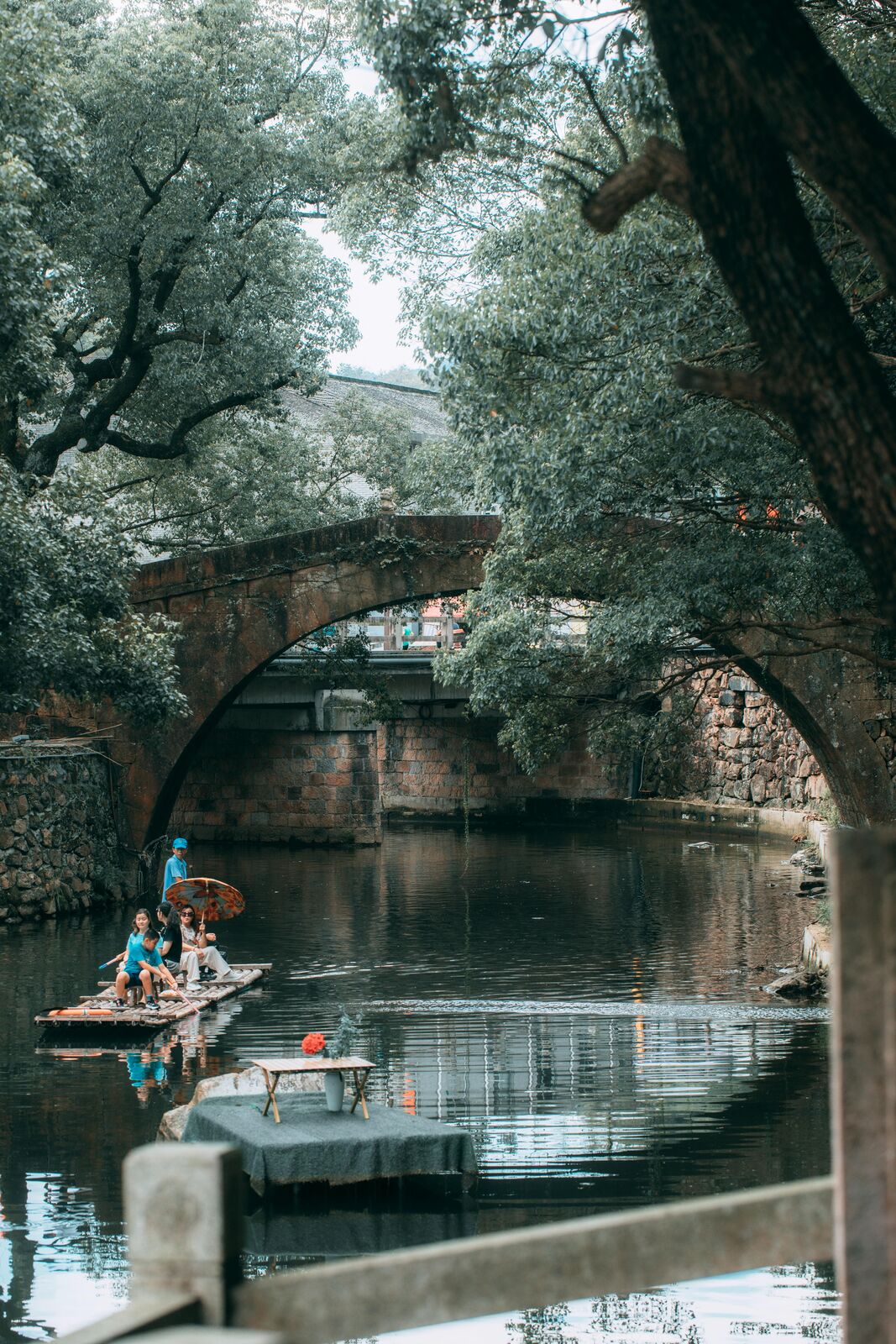
Pingjiang Road is Suzhou's most celebrated canal street — a restored Tang and Song-dynasty quarter in the northeast of the walled city, where willow-shaded waterways, stone arched bridges, teahouses and low whitewashed walls run unbroken for nearly a kilometre. It is the Suzhou that travelers come to see, and it is the natural first base.
The thing this area gives you that no other area does: the classical gardens are a few minutes' walk or a single metro stop away. Metro Line 6, which opened in 2024, has a station named 拙政园苏博 (Zhuozheng Yuan Subó) — literally “Humble Administrator's Garden / Suzhou Museum” — serving the UNESCO garden cluster directly. From Pingjiang Road, Lion Grove Garden (狮子林) is a short walk east, the Suzhou Museum (designed by I.M. Pei) is immediately adjacent, and the Humble Administrator's Garden (拙政园) is right there. Amap returned the maximum 20+ restaurant POIs within 500 m: a genuine cluster of Suzhou-cuisine noodle houses (Suzhou-style braised noodles, 苏式面), teahouses, sticky-rice snack stalls and canal-side restaurants rather than a mall food court.
Connectivity is solid beyond the gardens too. Metro Line 2 at nearby stations links to Suzhou Railway Station (苏州站) in about 10 minutes and to Tiger Hill in the northwest. Staying on Pingjiang Road itself, you can walk the canal at night — one of Suzhou's most famous experiences — and be at the garden gates before the crowds the next morning.
The Pingjiang Road trade-off. The canal quarter is touristy and busy during peak daytime hours. Hotels here range from boutique canal-side guesthouses to mid-range chains; the very characterful small guesthouses should be confirmed as foreigner-eligible before booking (a minority of tiny Suzhou guesthouses still cannot accept foreign passports). Canal-front rooms are in limited supply, so book ahead, especially for spring and National Day.
Closest metro: Line 6 at 拙政园苏博 (garden cluster); Line 1 and Line 3 at 临顿路 (Lindun Road) on the west edge of the old town; Line 2 at 桃花坞 (Taohuawu) for Suzhou Railway Station direction.
A canal outside the window is the whole reason to pay more hereNASDAQ: TCOM
A canal-facing room and a room in the same hotel one lane back are priced very differently. Decide which of the two you are actually paying for before you start filtering.
2. Guanqian Street (观前街) — the central dining core
Guanqian Street is the old town's commercial and dining heart — the main pedestrian shopping and snack street of central Suzhou, built around Metro Line 1 station 察院场 (Chayuanchang) and the surrounding department stores, Suzhou-cuisine restaurants and snack purveyors.
You stay here for a central base at the intersection of old-town access and Suzhou's densest food scene. Deyuelou (得月楼), a historic Suzhou-cuisine institution that has been operating for over 400 years and is one of the benchmark restaurants for classic Suzhou dishes like squirrel mandarin fish (松鼠桂鱼) and Biluochun-braised river shrimp, is right here. Amap returned 20+ restaurant POIs within 500 m — a real cluster of Suzhou noodle houses, snack shops and sit-down restaurants. Metro Line 1 at Chayuanchang puts the Suzhou Railway Station about 8 minutes away and the wider Line 1 network — including the SIP side — within straightforward reach.
The garden cluster is about a 15-minute walk northeast through the old town streets, or a short ride on Metro Line 6 from nearby stations. Staying at Guanqian Street, you give up the immediate canal-side atmosphere of Pingjiang Road — this is a commercial street rather than a water-street — but you are fully central, and the food density is the highest of any area in this guide.
Who this is right for. Travelers who want a central old-town base, easy restaurant access and solid metro connectivity. Shoppers. Anyone who wants a straightforward mid-range or budget hotel in the thick of things without the premium of a canal-front room.
Closest metro: Line 1 at 察院场 (Chayuanchang); Line 6 for the garden cluster direction; Line 3 for the SIP direction.
Central evenings without the canal-front premiumNASDAQ: TCOM
Rates here track the shopping calendar rather than the tourist one, so a weekday night can cost noticeably less than the same room on a Saturday. Shifting a night is often cheaper than shifting area.
3. Shantang Street & Changmen (山塘街 / 阊门) — old-town heritage near Tiger Hill
Shantang Street is Suzhou's other famous canal heritage street — a Tang-dynasty waterway on the northwest side of the old town, linking the Changmen city gate (阊门) to Tiger Hill (虎丘) in a long arc of canal-side Ming and Qing shophouses, teahouses and boat landings. It is less tourist-dense than Pingjiang Road on a daily basis, and the streetscape is considered by many residents to be the more architecturally authentic of the two.
You stay here primarily for access to Tiger Hill and the Lingering Garden. Tiger Hill (虎丘), Suzhou's most famous single hill — topped by the Yunyan Pagoda, Suzhou's leaning tower — is at the north end of Shantang Street, walkable from the canal-side hotels. The Lingering Garden (留园), one of the four great classical gardens of Suzhou and a UNESCO site, is also close. Metro Line 2 at 山塘街 (Shantang Street) station is right here. Amap returned 20+ restaurant POIs within 500 m, with a mix of Suzhou snack shops, noodle houses and canal-side restaurants — somewhat lower in international-brand density than Guanqian Street, but authentically local.
The Shantang Street trade-off. The Humble Administrator's Garden cluster — the most-visited and most internationally famous of the Suzhou gardens — is on the northeast side of the old town, about 20 minutes away by metro (a Line 2 transfer). If the Humble Administrator's Garden, the Suzhou Museum and Lion Grove are your primary targets, Pingjiang Road is the slightly better base. If Tiger Hill and the Lingering Garden are your focus, Shantang Street is the pick.
Who this is right for. Travelers who want atmospheric canal-side character, proximity to Tiger Hill, and a slightly quieter base than the most-touristed Pingjiang Road strip.
Closest metro: Line 2 at 山塘街 (Shantang Street).
The quieter canal, and the one that puts Tiger Hill on footNASDAQ: TCOM
Stock is smaller and more independent than on the Pingjiang side. Check recent reviews and confirm foreign-passport check-in, which not every canal-side guesthouse can do.
4. Jinji Lake / Suzhou Industrial Park (金鸡湖 / SIP) — the modern lakeside CBD
The Suzhou Industrial Park (SIP) is Suzhou's 21st-century side — a planned lakeside district around Jinji Lake (金鸡湖) in the east of the city, with wide boulevards, the Gate of the Orient twin-arch tower (东方之门), international-brand hotels, the Suzhou Center mall, and the nightly Jinji Lake light-and-fountain show that has become a draw in its own right.
You stay here for a modern, full-service hotel with a lakeside view. The big international brands — Hilton, Marriott, the InterContinental at 旺墩路288号 and the Crowne Plaza at 星港街168号 — are concentrated in SIP rather than the old town, which means newer rooms, larger pools and more consistent English-speaking front desk service. The mall dining around Jinji Lake is extensive; Amap returned 20+ restaurant POIs within 500 m. Metro Lines 1 and 3 serve the district, and the Suzhou Railway Station area is reachable in about 30 minutes on Line 1.
The Jinji Lake trade-off — and it is a real one. The classical gardens and the canal old town are approximately 40 minutes away by metro on Line 1 — a planned district, not a historic neighbourhood. If the UNESCO gardens and the canal streets are the core of your Suzhou visit, making the daily commute from SIP is a real time cost that compounds over a multi-day stay. The SIP side is genuinely different Suzhou: modern, clean, international — but the old town is why most foreign travelers come.
Who this is right for. Business travelers. Travelers who want an international-brand hotel and are treating the gardens as one excursion on a broader itinerary. Anyone visiting for the Jinji Lake light show and the modern lakeside architecture. Families wanting a large-format hotel with a pool.
Closest metro: Line 1 at 金鸡湖东 (Jinji Lake East) and 湖东 (Lake East); Line 3 at 苏州中心 (Suzhou Center).
Newer rooms and a pool, at the cost of the old townNASDAQ: TCOM
Ask which side of the lake. The SIP shore is the hotel strip; the far side is residential and quietly adds a bus leg to everything you do.
5. Near Suzhou Railway Station (苏州站) — HSR multi-city trips only
Suzhou Railway Station (苏州站) is the central station for intercity rail — including the HSR connections to Shanghai Hongqiao (~23-30 min) and onwards to Hangzhou, Nanjing and beyond. Metro Lines 2 and 4 meet here, and it is approximately 2.3 km from the classical garden cluster.
You stay here for exactly one reason: you are running a multi-city high-speed-rail trip and want to remove the transfer before an early departure. The station precinct has business-grade hotels purpose-built for transit passengers. Amap returns very few restaurant POIs within 500 m — around 4 — because this is a transit zone, not a neighbourhood. The dining is mostly inside the station complex itself.
Note on Suzhou North Station (苏州北站). Suzhou North is the separate high-speed-rail hub in the far north of the city, on Metro Line 2, primarily serving the Beijing-Shanghai and Shanghai-Nanjing HSR main lines. It is even further from the old town than Suzhou Railway Station. Unless you specifically need Suzhou North for an HSR departure, Suzhou Railway Station in the city centre is the more useful arrival and departure point for tourists.
The Suzhou Station trade-off. The garden cluster is about 10-15 minutes from here by taxi or metro — there is no real distance penalty for staying in the old town and riding in on travel day. Stay in the old town if Suzhou itself is the destination.
Who this is right for. Multi-city travelers whose Suzhou segment is short and HSR-bookended. Anyone with a very early morning train and nowhere else to leave bags.
Who this is wrong for. Every first-time leisure visitor whose primary goal is the gardens, the canals and Suzhou cuisine.
Closest metro: Lines 2 and 4 at 苏州火车站 (Suzhou Railway Station); Line 2 also serves Shantang Street and Tiger Hill.
Only right if Suzhou is a stop between two trainsNASDAQ: TCOM
Check whether the listing is on the north or south plaza. The station is large, the two sides do not connect quickly on foot with luggage, and the listing name will not tell you.
Where NOT to stay
Three patterns to avoid, based on aggregated foreign-visitor reports 2024-2026:
- Deep in SIP far from a metro station. The Suzhou Industrial Park is a large district, and a hotel that looks central on a map but is not walking distance from Metro Line 1 or Line 3 means long taxi commutes to the gardens and the old town. If you choose SIP, confirm it is within 10 minutes' walk of a Line 1 or Line 3 station.
- Near Suzhou North Station (苏州北站) unless you need it. Suzhou North is a high-speed-rail hub on the city's far northern edge — about 30-40 minutes by metro to the old town. It is not a neighbourhood. The station precinct has transit hotels; they suit a very early departure from Suzhou North only.
- Oddly-cheap hotels labeled “Suzhou” in Wuzhong or outlying suburbs. Trip.com will surface cheap 3- or 4-star hotels in Wuzhong district and other outlying areas that look central on a low-zoom map. Always check the walking distance to the nearest metro station before booking; a hotel 15+ minutes' walk from a station in a suburban Suzhou district is expensive in taxi spend once you factor in the daily trips.
When to book
Suzhou's pricing and availability track two main seasons:
- National Day Golden Week — the single hardest booking window (book 6-8 weeks ahead). October 1-7 is when the classical gardens sell out of timed-entry tickets weeks in advance, and central hotels follow. Rates spike sharply around Pingjiang Road and Guanqian Street. If your dates are fixed, book 6-8 weeks ahead. If they are flexible, avoid National Day week — the old town is extremely crowded.
- Spring blossom season (book 4-6 weeks ahead). The cherry blossoms in the gardens and the osmanthus-scented autumn air draw domestic visitors. Spring (roughly late March to early May) is the second-busiest period; four to six weeks ahead is prudent for the old-town areas.
- Osmanthus season in autumn. Suzhou's osmanthus (桂花) blooms in late September, scenting the canal streets. It is a lovely time to visit — moderately busy but well short of National Day intensity.
- Normal weeks (book 2-3 weeks ahead). Outside the peaks, two to three weeks is comfortable. June falls in the plum-rain (梅雨) season with persistent grey drizzle; rates ease slightly and Suzhou is quieter than in spring.
Weather context. Spring and autumn are the most comfortable seasons — mild temperatures, the gardens at their best. Summer (July-August) is hot and humid; good air-conditioning is essential. Winter is grey and damp but less cold than Beijing and the gardens are uncrowded.
Hotels near specific landmarks
For travelers anchoring their stay to a specific attraction or transit point rather than a neighbourhood:
- Hotels near the classical garden cluster on Trip.com →
- Hotels near Tiger Hill on Trip.com →
- Hotels near Suzhou Railway Station on Trip.com → — for HSR-bookended trips only; the old-town base is better for leisure stays.
- Hotels near Jinji Lake on Trip.com → — for modern-hotel / business travelers; note the ~40-minute metro to the old town.
Frequently asked questions
- Where should a first-time foreign visitor stay in Suzhou?
- The Pingjiang Road old town (平江路) is the default first-timer pick. It puts you inside Suzhou's restored canal quarter — stone bridges, willow-draped waterways, teahouses — within a short walk or one metro stop from the classical gardens (Metro Line 6, station 拙政园苏博, opened 2024). Amap returns 20+ restaurant POIs within 500 m, a genuine Suzhou-cuisine cluster of noodle houses, teahouses and snack shops. For a more modern base, the Guanqian Street area around Metro Line 1 gives you the central dining core and comparable garden access. The Jinji Lake / SIP side is the right call only if you specifically want a modern CBD hotel with the lake light show — it is a 40-minute metro trip from the gardens and a different city to the old town.
- Should I stay in the old town or near Jinji Lake?
- They are genuinely different Suzhous. The old town — Pingjiang Road, Guanqian Street, Shantang Street — is the reason most foreign tourists come: canal streetscape, classical gardens on the doorstep, Suzhou cuisine on the doorstep. Jinji Lake / SIP is Suzhou's modern planned city — big malls, international-brand hotels, the Gate of the Orient tower (东方之门), the lake light show. Metro Line 1 connects them and the journey is around 40 minutes end-to-end, so there is a real time cost if you are commuting to the gardens daily from the SIP side. The standard advice is to stay in the old town for the Suzhou experience and visit SIP's lake and towers as a half-day excursion, not the other way round. SIP is the right base if you specifically want a modern international-brand hotel and are treating the gardens as one item on a longer itinerary.
- How far is Suzhou from Shanghai and which station should I arrive at?
- Suzhou is approximately 85 km west of Shanghai by rail — one of the fastest inter-city connections in the Yangtze Delta. Shanghai Hongqiao (虹桥) to Suzhou Railway Station (苏州站, the central old-town station) takes roughly 23-30 minutes on high-speed rail; the same journey from Shanghai Hongqiao to Suzhou North Station (苏州北站, the far-north HSR hub) takes about 18-25 minutes. If you are staying in or near the old town — Pingjiang Road, Guanqian Street, Shantang Street — arrive at Suzhou Railway Station (苏州站), which is the more centrally located of the two and on Metro Lines 2 and 4. Suzhou North Station is faster from Shanghai but sits on the city's far north edge and means a longer metro trip into the old town. See the guide to Suzhou Railway Station and the Shanghai-to-Suzhou HSR article for full platform and connection details.
- Is the Guanqian Street area good for foreign visitors?
- Yes — Guanqian Street (观前街) around Metro Line 1 station 察院场 (Chayuanchang) is Suzhou's densest dining precinct for the old town, with department stores, snack streets and the famous Suzhou-cuisine institution Deyuelou (得月楼). It is the most central of the five areas: a short walk to the Suzhou Museum and the Humble Administrator's Garden, and Amap returns 20+ restaurant POIs within 500 m. The trade-off versus Pingjiang Road is atmosphere: Guanqian Street is the commercial-and-dining heart of the old town rather than the canal-and-teahouse quarter. For pure heritage texture, Pingjiang Road edges it. For dining variety and central convenience, Guanqian Street wins.
- Are there foreigner-friendly hotels in Suzhou that register guests with the PSB?
- Most international chains and the larger Chinese chains in Suzhou register foreign guests with the PSB (公安局) automatically at check-in — the passport scan is the registration. That covers the big-name hotels around Jinji Lake, the international brands near Suzhou Railway Station, and most mid-range chains around Guanqian Street. Some smaller canal-side guesthouses in the Pingjiang Road quarter and Shantang Street area are foreigner-eligible but you should confirm at booking; a small minority of very small guesthouses still cannot accept foreign passports due to local licensing. The safe default is to book on Trip.com's English site filtered by area — it surfaces foreigner-eligible inventory. Whatever you book, PSB lodging registration within 24 hours of arrival is a legal requirement; hotels handle it automatically, but staying with friends or in an unregistered guesthouse makes it your responsibility.
- When should I book a Suzhou hotel?
- Suzhou's peak periods are the spring blossom season (roughly late March to early May) and, above all, the October 1-7 National Day Golden Week — during National Day the classical gardens sell out of timed-entry tickets weeks ahead and central hotels follow. Book 6-8 weeks ahead for National Day. The spring season is busy but less extreme than National Day in terms of room availability; 4-6 weeks is prudent. Autumn is a lovely time to visit and Suzhou's osmanthus (桂花) blooms around late September — mildly busy but nothing like National Day. For normal weeks, two to three weeks ahead is comfortable. June falls in the plum-rain (梅雨) season and is the wettest month; rates ease slightly but the weather is grey and humid.
- Is Shantang Street a good base for visiting Tiger Hill?
- Yes — Shantang Street and the Changmen area (阊门) in Suzhou's northwest old town are the natural base for Tiger Hill (虎丘), the Lingering Garden (留园) and the canal heritage of the Tang-dynasty Shantang waterway. Metro Line 2 at 山塘街 (Shantang Street) station is right here. Amap returns 20+ restaurant POIs within 500 m, with a good range of Suzhou snack shops and noodle houses. The trade-off is that the Humble Administrator's Garden and the Suzhou Museum — the most-visited garden cluster — are in the NE old town and a metro ride away; Pingjiang Road is a slightly better base if the garden cluster is your priority. Shantang Street is also one of Suzhou's most atmospheric heritage streets after the tourist day-trip crowds thin in the evening.
- Where should I avoid staying in Suzhou as a foreigner?
- Three patterns. (1) Deep in the Suzhou Industrial Park (SIP) far from Metro Line 1 or 3: the SIP district is large, and a hotel that looks central on a map but is not near a Line 1 or Line 3 station means long taxi commutes to the gardens. (2) Near Suzhou North Station (苏州北站) unless you are specifically using that station for HSR connections — it is in the far north of the city, a 30-40 minute metro trip from the old town, and the station precinct is a transit zone without a neighbourhood. (3) Cheap outlier hotels labeled 'Suzhou' in Wuzhong or distant suburbs — always check the metro walking distance before booking.
Related Suzhou guides
- Suzhou city guide — things to do, getting in and out, getting around, what to eat, and practical essentials.
- Classical Gardens of Suzhou visitor guide — the Humble Administrator's Garden, the Lingering Garden, Lion Grove and the Master of the Nets Garden: timed-entry tickets, the best visiting order and what to look for in each.
- Things to do in Suzhou — Tiger Hill, Pingjiang Road, Shantang Street, Hanshan Temple, the Suzhou Museum and the Jiangnan water-town day trips.
- Suzhou Railway Station guide and Shanghai to Suzhou by high-speed train — the 23-30 minute HSR connection and which station to use for old-town access.
- PSB lodging registration — the 24-hour rule every hotel in China handles for foreign guests at check-in; still your responsibility if you stay with friends or in an unregistered guesthouse.
- Alipay setup for foreigners — how to pay for the metro, taxis and most Suzhou restaurants with a foreign card.
Browse all Suzhou hotels on Trip.com →
Footer — verification scope
Amap-verified 2026-05-22: the metro and walking durations and the restaurant-density counts in this guide, from Amap (高德地图) path-routing and around-search for “餐饮” (restaurants) within 500m of each area's pedestrian centre. Metro Line 6 station 拙政园苏博 confirmed open 2024 serving the Humble Administrator's Garden / Suzhou Museum cluster.
Not confirmed: neighbourhood texture, individual hotels and current pricing. Rates move weekly; use Trip.com filtered by area for current pricing.
Sources: editorial team based in Chongqing (8-year mainland-China resident), editor's about page, Amap (高德地图) walking and transit-routing API queried 2026-05-22, r/travelchina, r/chinalife and r/Suzhou threads 2024-2026 on Suzhou neighbourhood choice, and Trip.com hotel listings cross-referenced for which areas carry foreigner-eligible inventory.