This guide is written by an editorial team based in Chongqing — the editor has lived in mainland China since 2018 (8 years on the ground). Neighbourhood texture draws on aggregated 2024-2026 r/travelchina and r/chinatravel threads + Trip.com listings; road distances and transit times are Amap (高德地图) routing data verified 2026-05-23. This is aggregated editorial coverage — corrections from Yunnan residents are welcomed (see about page).
Which Yunnan base is right for you?
Yunnan is China's most diverse province — 25 of China's 56 recognised minority groups are native to the region, and the four bases sit across a 1,300-metre altitude range. The where-to-stay decision is a sequencing problem, not just a location problem. Most foreign travelers follow the same northward loop because it matches the altitude acclimatisation curve and the HSR corridor that opened in December 2023:
- Kunming (1,890 m) — arrival night, Stone Forest day trip, south Yunnan access (Yuanyang, Xishuangbanna)
- Dali Old Town (1,970 m) — Erhai Lake, Bai-minority culture, gentler than Lijiang; best on a 7-day-plus trip
- Lijiang Old Town (2,400 m) — UNESCO 1997, Naxi cobbled lanes, Jade Dragon Snow Mountain, Tiger Leaping Gorge approach; the foreign-traveler default in northern Yunnan
- Shangri-La (3,200 m) — Tibetan-plateau edge, Songzanlin Monastery, Pudacuo National Park, the road north to Meili Snow Mountain; add on a 7-day-plus trip
For seasonality across all four bases, see the existing best time to visit Yunnan guide — this article focuses only on the where-to-stay decision.
Four bases compared
| Base | Altitude | Best for | Hotel cluster | To KMG / nearest airport |
|---|---|---|---|---|
| Kunming city | 1,890 m | Arrival / acclimatisation / Stone Forest day trip | Green Lake, Jinbi Square, Wenhua Xiang | Metro Line 6 ~30 min |
| Dali Old Town | 1,970 m | Erhai Lake, Bai culture, gentler than Lijiang | Inside Old Town walls, Shuanglang east shore | ~1.5 h HSR to Kunming South + Metro |
| Lijiang Old Town | 2,400 m | UNESCO Naxi town, Jade Dragon Snow Mountain, Tiger Leaping base | Old Town lanes (pedestrian-only), Shuhe Old Town 6 km N | ~2.5 h HSR to Kunming South + Metro |
| Shangri-La (Dukezong) | 3,200 m | Tibetan culture, Songzanlin, Pudacuo, Meili Snow Mountain | Dukezong Old Town (rebuilt 2014+), new city | Flight DIG-KMG ~50 min or road+bus ~12 h |
Altitudes from Amap (高德地图) topographic data; transit times Amap road-routing and official rail timetables 2026-05-23. KMG = Kunming Changshui International Airport. Shangri-La Diqing Airport is DIG (airport code). The Kunming-Dali-Lijiang HSR opened December 2023; Shangri-La is not on the HSR network.
1. Kunming city — the arrival and acclimatisation base (1,890 m)
Kunming (昆明) is the capital of Yunnan Province and the canonical entry point for a first-time foreign visitor. At 1,890 m it is the lowest of the four bases — just high enough to feel fresh (the city is famous for its Spring City (春城) year-round mild climate) without the altitude stress that Lijiang or Shangri-La can produce on an unacclimatised body. It is also where most international flights land: Kunming Changshui International Airport (KMG) is a major Southwest China hub with direct connections to Southeast Asia, South Asia and the Middle East. Metro Line 6 connects the airport to the city centre in approximately 30 minutes.
Where to stay in Kunming. The main hotel cluster for foreign visitors sits in the central districts around Green Lake Park (翠湖公园) and Jinbi Square (金碧广场). Green Lake is the evening walk standard — the park is ringed by lake-facing cafes, courtyard guesthouses, and the Wenhua Xiang (文化巷) lane that has evolved into a backpacker and coffee-shop strip. Jinbi Square and the nearby Zhengyi Road commercial area anchor the mid-range and business hotel cluster. Metro Lines 1 and 2 cross near Dongfeng Square (东风广场) and connect to Kunming South Station (昆明南站) for the Dali-Lijiang HSR. Kunming has the densest foreigner-friendly chain-hotel inventory of the four Yunnan bases: Hanting and Pod Inn for budget (¥150-280); JI Hotel, Atour and Crystal Orange for mid-range (¥350-700); Sofitel Kunming, Pullman Kunming and InterContinental Kunming for high-end international brands (¥800-1,800). Chain SOPs make foreign-passport check-in and the mandatory 24-hour PSB registration routine.
What Kunming gives you as a base. The Stone Forest (石林) day trip — the UNESCO karst landscape ~120 km southeast of the city — is the headline Kunming-base excursion. You can reach it by HSR from Kunming South Station to Shilin West (石林西) in approximately 17 minutes, then a shuttle bus to the gate. Yunnan Provincial Museum, the Bird & Flower Market (花鸟市场), and the Crossing-the-Bridge Noodles corridor on Wenhua Xiang fill an arrival day. Kunming is also the logical base for the road south to Yuanyang (元阳哈尼梯田) — the UNESCO rice-terrace sunrise photographs — which are unreachable from the northern Yunnan bases without major backtracking.
Trade-offs. Kunming is a modern provincial capital — atmospheric pockets (Green Lake, the old Muslim Quarter of Shuncheng Street) coexist with a largely generic-feeling city centre. Most foreign travelers find one to two nights sufficient before moving north to Dali or Lijiang. The city has the densest chain-hotel and international-brand supply of the four bases, which makes it the most reliable for late bookings. Altitude sickness is not a concern at 1,890 m for most visitors, though some people arriving from sea-level cities notice a mild breathlessness on the first day.
Who this is right for. Every first-time Yunnan visitor for the arrival night. Travelers making a focused Stone Forest day trip. Anyone with a flight schedule that forces an early arrival or late departure through KMG. Travelers using Kunming as the southern anchor of a Yunnan loop.
Browse Kunming Green Lake chain hotels on Trip.com →
2. Dali Old Town — the Erhai Lake and Bai-culture base (1,970 m)
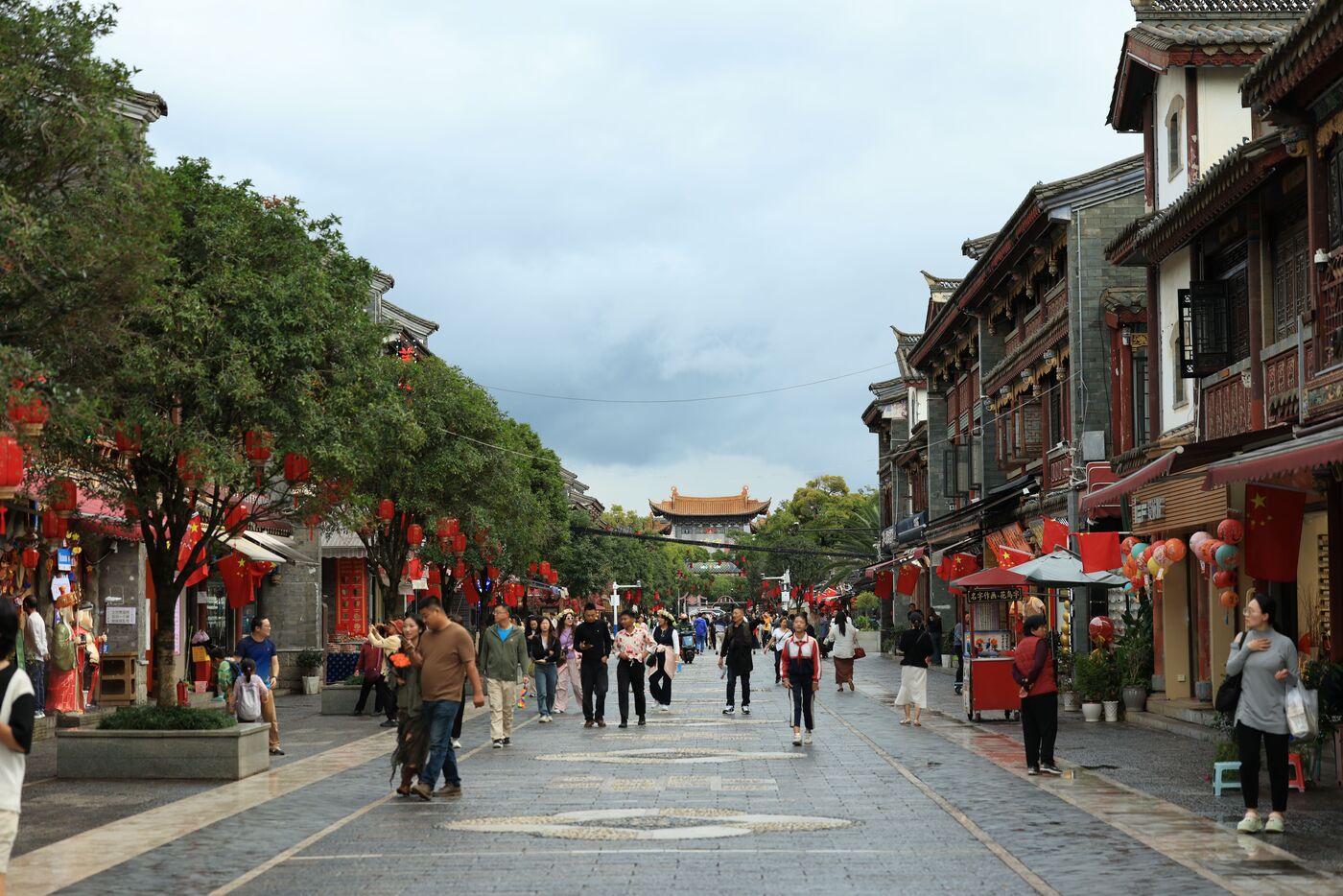
Dali Old Town (大理古城) is a 1,200-year-old Bai-minority (白族) walled town at the foot of the Cangshan mountain ridge (苍山, the 4,122-metre 19-peak limestone range), looking east across Erhai Lake (洱海 — the ear-shaped highland lake, 250 km² surface area, ~1,972 m elevation). It is inscribed on the provincial cultural-heritage register and is the administrative centre of Dali Bai Autonomous Prefecture. In the 9th century it was the capital of the Nanzhao Kingdom (南诏国), which at its peak controlled most of what is now Yunnan plus parts of northern Myanmar; the Three Pagodas (崇圣寺三塔 — the 9th-century Qianxun Pagoda at 70 m is the tallest, flanked by two smaller brick pagodas) north of the old town are the Nanzhao-era signature landmark.
Where to stay in Dali. Two distinct options: inside the walled Old Town, and on the Erhai east shore at Shuanglang (双廊).
Inside Dali Old Town walls — the hotel mix runs from budget guesthouses in the Bai-courtyard style (white-washed walls, carved timber eaves, central courtyard gardens) to mid-range boutique hotels. The Old Town is significantly less touristy than Lijiang in terms of domestic selfie-tour saturation — it has a Foreigner Street (洋人街, Huguo Lu) that is more lived-in than its name suggests and a lane grid that rewards wandering. Hotel density inside the walls is high; the main North Gate (北门) area and the east gate are the most convenient access points for taxis and DiDi. Chain inventory is limited inside the Dali Old Town walls — the courtyard buildings don't accommodate standardised chain layouts, so the in-walls supply is independent Bai-style guesthouses and small boutique hotels. Travellers who prefer chain SOP for foreign-passport check-in should base in Xiaguan (下关, the modern Dali city ~13 km south), where Hanting, JI Hotel and Hampton by Hilton Dali all operate near Dali Railway Station — then DiDi into the Old Town for sightseeing.
Shuanglang (双廊), Erhai east shore — approximately 30 km northeast of Old Town by road, this small peninsula village has become one of the most popular boutique-hotel destinations in Yunnan. The Erhai-side guesthouses here command lake views and attract a higher-end demographic. The trade-off is distance from Old Town and the Three Pagodas — you need a DiDi or organised transfer for every excursion. Amap-verified 2026-05-23: Shuanglang to Dali Old Town north gate is approximately 32 km / ~45 min by road.
What Dali gives you as a base. The Erhai Lake e-bike loop (the south shore road from Old Town to Shuanglang and back is a classic half-day ride, ~40 km; bike rental inside the Old Town ~¥30/day per r/travelchina 2025-2026 reports). The Three Pagodas. The Old Town market lanes with Bai embroidery, tie-dyed indigo cloth (扎染), and marble products (Dali marble is a genuine local industry — the Chinese word for marble is 大理石, literally Dali stone). Cangshan mountain hiking via the cable car from the west edge of the Old Town. And the gentler-paced old-town aesthetic that many travellers prefer after Lijiang's crowds.
Trade-offs. Dali is the easiest of the three northern Yunnan bases to skip on a short trip — a 5-day Kunming + Lijiang itinerary is a valid choice. It is best experienced on a 7-day-plus trip where a 2-night Dali stop genuinely adds the Erhai and Bai-culture dimension. The Dali HSR station (大理站) is approximately 13 km north of Old Town in Xiaguan (下关), the modern city — allow 20-25 min by DiDi from the station to the Old Town gate.
Who this is right for. Travelers on a 7-day-plus Yunnan loop who want the Erhai Lake experience. Photographers attracted to Shuanglang's lakeside boutiques. Visitors who prefer a less saturated old-town than Lijiang. Bai-culture and textile enthusiasts.
Erhai and Bai culture, at an altitude that does not biteNASDAQ: TCOM
Decide between the old town and the Erhai shore before you filter: they are a bus ride apart, both get called Dali on listings, and only one of them has the lake outside.
3. Lijiang Old Town — the UNESCO Naxi base (2,400 m)
Lijiang Old Town (丽江古城, also called Dayan 大研古城) is Yunnan's UNESCO cultural headline sight — the Naxi-minority cobbled-lane old town inscribed by UNESCO in 1997 at 2,400 m on the eastern edge of the Tibetan plateau. This is the foreign-traveler default base in northern Yunnan, and with good reason: it concentrates the highest density of Naxi-courtyard hotels (纳西院子), the atmospheric lane grid fed by the Black Dragon Pool spring water, Sifang Street (四方街 — the Naxi trading square at the old town's commercial heart), the Mu Family Mansion (木府 — the surviving palace complex of the Naxi chieftain lineage, Yuan and Ming dynasty origin), and Wangu Tower (万古楼) for the panoramic view over the old-tile rooftops toward Jade Dragon Snow Mountain.
Where to stay in Lijiang. The old town lanes are pedestrian-only — there are no roads inside the walls, only cobblestone paths and the canal network. Hotels meet guests at the nearest car-accessible gate and carry bags in; confirm your hotel's gate address before arrival. The main car-drop points are Xinyi Square (新义广场 area) to the north-west and the south gate road. Within the old town, the Naxi-courtyard hotel (纳西院子) is the architectural standard: a stone-and-timber compound with an enclosed courtyard garden, dark-wood eaves, and stone-flagged common areas. Budget options in the lanes run to clean guesthouses (¥180-300/night per Trip.com 2024-2026); mid-range Naxi-courtyard hotels are ¥300-600; the upper-tier boutiques with Jade Dragon views are ¥600-1,500+. No chain hotels operate inside Lijiang Old Town — the UNESCO inscription protects the architectural fabric, and the pedestrian lanes make standardised chain layouts impossible. Naxi courtyard guesthouses have genuine charm but the rooms are typically small, soundproofing is limited, and there is no elevator for luggage. Travellers who need standardised chain SOP for foreign-passport check-in or accessibility for heavy luggage should base in Shuhe Old Town (6 km north — has JI Hotel Shuhe and other mid-range chains on its perimeter) or the modern Lijiang new city near the railway station (Hanting, Hampton by Hilton Lijiang, Hilton Garden Inn Lijiang), then DiDi into the Old Town (¥8–15, ~10 min over ~2.4 km).
Shuhe Old Town (束河古镇) — 6 km north of Lijiang Old Town along the road toward Jade Dragon Snow Mountain — is the quieter, less commercialised Naxi village alternative. It also has stream-fed canals and courtyard guesthouses, at generally lower prices and with a more local-village character. The trade-off: Shuhe is further from the Lijiang Old Town food and nightlife cluster and requires a DiDi or e-bike for the 6 km transfer (~15 min). Many repeat visitors who have already experienced the Lijiang Old Town prefer Shuhe.
What Lijiang gives you as a base. Jade Dragon Snow Mountain (玉龙雪山) — the 5,596 m sacred Naxi peak above the city, the Big Cable Car to 4,506 m — is the flagship Lijiang-base excursion (approximately 27 km northwest of Old Town, ~40 min by DiDi). The Tiger Leaping Gorge (虎跳峡) — one of the world's deepest gorges at 3,790 m from riverbed to surrounding peaks — is approximately 60 km northwest of Lijiang via Qiaotou (桥头); the famous 2-day high-trail trek starts from Qiaotou and ends at Walnut Garden (核桃园). Black Dragon Pool (黑龙潭公园) with the famous Jade Dragon Snow Mountain reflection is 2 km north of the old town — the best morning photography spot in Yunnan. Naxi Ancient Music Orchestra performances (纳西古乐) happen nightly in the old town.
Altitude note. At 2,400 m, some visitors arriving from low-altitude cities notice mild symptoms on the first day — headache, breathlessness on stairs. Most adapt within 24 hours. Arriving from Kunming (1,890 m) after a night there gives the body a gradual acclimatisation; arriving directly from sea level is more demanding. Not medical advice.
Trade-offs. Lijiang Old Town is heavily commercialised for domestic tourism. High season (July-August, Chinese New Year, National Day) brings enormous crowds to Sifang Street and the main entry lanes. The bars along Xinyi Street can be very loud at night; choose hotels in the quieter inner lanes if noise sensitivity matters. Prices are higher than Dali or Kunming and can spike significantly during Golden Week and Chinese New Year.
Who this is right for. Every first-time foreign visitor to northern Yunnan — Lijiang is the Yunnan base most people mean when they say they are going to Yunnan. Hikers with Tiger Leaping Gorge on their list (the gorge is a Lijiang-base excursion). Travelers wanting the Jade Dragon Snow Mountain cable car. Naxi-culture and traditional architecture enthusiasts.
Browse Lijiang Old Town Naxi-courtyard hotels on Trip.com →
4. Shangri-La — the Tibetan-plateau edge base (3,200 m)
Shangri-La (香格里拉), formerly named Zhongdian (中甸) and renamed in 2001 after James Hilton's 1933 novel Lost Horizon, is the county seat of Diqing Tibetan Autonomous Prefecture (迪庆藏族自治州) in northwestern Yunnan at approximately 3,200 m. It is the Tibetan-edge of the four Yunnan bases — culturally and architecturally closer to Lhasa than to Kunming, with Tibetan Buddhism dominant, yak-butter tea on every menu, and Tibetan-style rammed-earth and timber architecture replacing the Bai and Naxi forms of the lower towns.
Dukezong Old Town (独克宗古城) — the old quarter of Shangri-La, which contains what was once China's largest surviving Tibetan-style old town — was largely destroyed in a fire on 11 January 2014. Approximately 343 wooden buildings burned. Reconstruction began quickly; by 2016-2017 most of the perimeter buildings were rebuilt in traditional Tibetan style and the old town has reopened as a functioning guesthouse and shop district. The rebuilt old town is new timber on old stone foundations — it lacks the patina of Lijiang or the depth of Dali, but the Tibetan architectural character is genuine and the setting (the hilltop Diegonji Prayer Wheel at the west end, the surrounding barley-and-yak plateau) remains powerful.
Where to stay in Shangri-La. Two zones: the Dukezong Old Town area, and the modern new city. For the Tibetan immersion experience, stay in the old town in a Tibetan-style guesthouse (藏式客栈) — the rebuild has produced some genuinely comfortable mid-range options (¥250-500/night per Trip.com 2024-2026). Chain hotels do not operate inside Dukezong Old Town — the post-2014 reconstruction prioritised Tibetan architectural form, so the in-town supply is independent Tibetan-style boutique inns. Higher-end lodges and boutique retreats exist outside the immediate town, often with mountain or plateau views (¥800-2,000+). The new city (older 20th-century Shangri-La town) is cheaper and has the standardised chain inventory for travelers who prioritise price or chain SOP over character — Hanting Shangri-La and JI Hotel Shangri-La both operate in the new city ~3 km from Dukezong, a ¥10-15 DiDi from the old town gate.
What Shangri-La gives you as a base. Songzanlin Monastery (松赞林寺) — the 'Little Potala' Tibetan-Buddhist monastery founded in 1679 by the 5th Dalai Lama, approximately 5 km north of the old town, is the single most important sight from a Shangri-La base (Amap-verified: 99.686°E, 27.876°N). Pudacuo National Park (普达措国家公园) — China's first national park (2007 designation), the Bita Lake (碧塔海) and Shudu Lake (属都湖) plateau wetlands at 3,500-4,100 m — is approximately 22 km east of Shangri-La (roughly 40 min by DiDi). The road northwest to Meili Snow Mountain (梅里雪山, Kawagebo 6,740 m) — Yunnan's highest and most sacred peak, the Feilai Temple (飞来寺) sunrise viewpoint outside Deqin — is approximately 180 km / 6 hours north of Shangri-La by road; a day-trip is aggressive, a 2-night extension is the right shape.
Altitude warning. At 3,200 m, Shangri-La is high enough that first-day altitude sickness is a realistic risk for visitors arriving without gradual acclimatisation — particularly if arriving by direct flight into Diqing Shangri-La Airport (DIG). Plan a rest day on arrival: do not exert yourself, avoid alcohol on day one, stay hydrated. The Kunming → Lijiang → Shangri-La road sequence (climbing from 1,890 m → 2,400 m → 3,200 m over 3-4 days) is the acclimatisation path most experienced Yunnan travelers recommend. This is editorial context, not medical advice.
Getting to Shangri-La. Shangri-La is NOT on the Yunnan HSR network. Options: (1) Road from Lijiang — approximately 180 km via the Tiger Leaping Gorge highway, 3-4 hours by long-distance bus or DiDi. The road passes through Qiaotou (the Tiger Leaping Gorge trailhead) — an excellent scenic sequence. (2) Direct flight Kunming (KMG) to Diqing Shangri-La Airport (DIG) — approximately 50 minutes; multiple daily Yunnan Airlines, China Eastern and China Southern services per Trip.com booking data 2026. Arriving by flight from sea level means arriving at 3,200 m with no acclimatisation — the rest-day guidance above applies especially strongly.
Trade-offs. Shangri-La is not right for a short Yunnan trip. The altitude alone adds a necessary rest day to any stay. The rebuilt Dukezong old town lacks the patina of Lijiang, and for a traveler who has only 5 days in Yunnan, skipping Shangri-La in favour of more time in Lijiang or Dali is a defensible call. The accommodation supply is thinner than the other three bases.
Who this is right for. Travelers on a 7-day-plus Yunnan trip who want the Tibetan-cultural experience without going to Lhasa. Anyone whose list includes Songzanlin Monastery and Pudacuo National Park. The base for the Meili Snow Mountain extension. Travelers with high-altitude experience who want the most visually distinct and culturally remote of the four Yunnan bases.
Browse Shangri-La Dukezong Old Town hotels on Trip.com →
Which base for which trip length?
The right base combination tracks trip length more predictably in Yunnan than in most Chinese destinations:
- 3 days — pick one base only. Default: Lijiang Old Town (the UNESCO Naxi town + Black Dragon Pool + Jade Dragon Snow Mountain cable car fills 3 full days). Kunming-only is the alternative for a Stone Forest focus or a connecting trip.
- 5 days — Kunming + Lijiang. One night in Kunming to acclimatise and see the Stone Forest (or arrive late, depart early); 3 nights in Lijiang for Old Town + Black Dragon Pool + Jade Dragon + optionally the Tiger Leaping Gorge day walk.
- 7 days — Kunming + Dali + Lijiang, or Lijiang + Shangri-La if the Tibetan base matters more to you than Dali-Erhai. The Kunming-Dali-Lijiang HSR (December 2023) makes this a comfortable sequence: 1 night Kunming → 2 nights Dali → 3 nights Lijiang.
- 10+ days — all four bases, plus optional Yuanyang extension from Kunming. Sequence: 1-2 nights Kunming → 2 nights Dali → 3 nights Lijiang → 2 nights Shangri-La. The gradual altitude climb (1,890 m → 1,970 m → 2,400 m → 3,200 m) aligns with the acclimatisation recommendation.
Avoid altitude shocks — the gradient matters
The Yunnan north-loop travels from 1,890 m (Kunming) to 3,200 m (Shangri-La) across 4-7 days if followed in sequence. This is a sensible gradient that most travelers handle without significant altitude sickness. The problematic pattern is jumping altitude: arriving by direct international flight to Kunming, then flying the same day or next morning into Diqing Shangri-La Airport (DIG), which puts you at 3,200 m with almost no acclimatisation time. Altitude sickness is unpleasant (headache, nausea, dizziness) and can turn serious in rare cases; it is the leading non-infectious reason foreign travelers seek medical attention in northwestern Yunnan.
The practical rules from aggregated r/travelchina 2024-2026 reports:
- Do not fly directly from a low-altitude city into DIG (Shangri-La) if you have no recent high-altitude experience — spend at least one night at Lijiang (2,400 m) first.
- On arrival in Shangri-La, rest on day one: no strenuous hiking, no alcohol, drink more water than usual.
- If you feel severe symptoms (persistent vomiting, difficulty breathing at rest, confusion), descend — a 3-4 hour road back to Lijiang significantly reduces altitude.
- Altitude medication (e.g. acetazolamide) is outside the scope of this guide — consult a physician before your trip if you have concerns.
This is editorial context based on aggregated traveler reports. It is not medical advice. Consult a physician before travelling to high altitude if you have pre-existing cardiovascular or pulmonary conditions.
Frequently asked questions
- Where should a first-time foreign visitor stay in Yunnan?
- Lijiang Old Town (丽江古城) is the default first-timer base for most foreign visitors to Yunnan. The UNESCO Naxi cobbled-lane old town at 2,400 m is the cultural centrepiece of northern Yunnan — it is pedestrian-only, atmospheric, and packed with Naxi-courtyard hotels across a range of budgets. If your itinerary is 5 days or more, the classic approach is to arrive in Kunming first (easier acclimatisation at 1,890 m, good Stone Forest day trip), then move to Lijiang for the UNESCO town + Jade Dragon + Tiger Leaping Gorge approach, and optionally add Dali on the same northbound road. Shangri-La (3,200 m) earns its own stop on a 7-day-plus trip but is not a first-timer default base because of altitude.
- Do I need to acclimatise before going to Shangri-La?
- Yes. Shangri-La (香格里拉, 3,200 m) is high enough that altitude sickness (高原反应) is a real risk for visitors arriving from sea level or from the lower Yunnan cities. The recommended approach is to climb gradually: spend 1-2 nights in Kunming (1,890 m), then Lijiang (2,400 m) for 2+ nights, then Dali (1,970 m) or directly to Shangri-La. If you fly directly into Shangri-La Diqing Airport (DIG) from a low-altitude city, plan a rest day on arrival — do not exert yourself on day one. Common symptoms include headache, nausea and disturbed sleep; they usually resolve in 24-48 hours. This guide is editorial, not medical advice — consult a physician if you have heart or lung conditions. Lijiang (2,400 m) can also cause mild symptoms in sensitive visitors; most people adapt quickly at that elevation.
- Is Dali Old Town worth staying in, or should I go straight to Lijiang?
- Dali Old Town (大理古城) is worth a 2-night stop if your trip is 7 days or more. It is less tourist-saturated than Lijiang (fewer selfie sticks, lower prices) and offers a genuinely different cultural experience — Bai-minority (白族) rather than Naxi, with the Cangshan mountain ridge behind and Erhai Lake to the east. The e-bike loop around Erhai south shore, the Three Pagodas (崇圣寺三塔), and the Shuanglang (双廊) east-shore village are specific to Dali and cannot be replicated from a Lijiang base. On a tight 5-day trip, many foreign travelers choose Kunming + Lijiang and skip Dali; on a relaxed 10-day trip, Dali is a highlight. The Kunming-Dali-Lijiang HSR corridor (opened December 2023) makes all three easily connectable: Kunming to Dali is ~1.5 hours, Dali to Lijiang is ~1 hour.
- When should I book for the Torch Festival in Lijiang and Dali?
- The Torch Festival (火把节) is the Yi and Bai minority's major annual celebration, typically in late July (24-26 July by the lunar calendar, exact dates vary year to year). In Dali, it is celebrated with a massive bonfire in front of the Three Pagodas and around Erhai Lake. In Lijiang, smaller Naxi torch ceremonies happen in the villages. Hotels in Dali Old Town and Shuanglang fill up 4-6 weeks ahead for the Torch Festival. Beyond the Torch Festival, Chinese New Year (January-February) is the biggest booking pressure point across all Yunnan bases — book 8 weeks ahead. National Day Golden Week (October 1-7) is the second biggest domestic tourism peak — 6-8 weeks ahead. The Yuanyang rice-terrace sunrise windows (November through February, when the paddies flood) are popular with photographers — Yuanyang guesthouses are limited, book 4 weeks ahead.
- How do I get between the four Yunnan bases?
- The Yunnan HSR corridor makes the connections much faster since December 2023: Kunming South (昆明南) to Dali Station (大理站) in approximately 1.5 hours by G-train; Dali Station to Lijiang Station (丽江站) in approximately 1 hour. Shangri-La (香格里拉) is NOT on the HSR line — it is accessed by road (approximately 3-4 hours by bus or DiDi from Lijiang via the Tiger Leaping Gorge highway) or by direct flight to Diqing Shangri-La Airport (DIG) from Kunming (approximately 50 minutes). Yuanyang (元阳, for the rice terraces) is a separate southern route — no HSR; approximately 3.5 hours by long-distance bus from Kunming East Bus Station. See the getting-around-yunnan guide for the full transport breakdown.
- Are there foreigner-friendly hotels in Yunnan that register with the PSB?
- All licensed hotels, guesthouses and hostels in Yunnan are required to register foreign guests within 24 hours of check-in via passport scan, satisfying the PSB lodging registration requirement. Most hotels on Trip.com and Booking.com in the four bases are licensed and foreigner-eligible. The exception is smaller unlicensed private accommodation — particularly in Shuanglang (双廊, east Erhai) and in some Shuhe Old Town (束河) guesthouses — which may not hold a PSB foreign-guest licence. Confirm at booking. In Shangri-La, the boutique Tibetan-style guesthouses in Dukezong Old Town (独克宗古城) are generally licensed (the 2014 fire prompted a full licensing review during reconstruction); check explicitly if booking a very small family guesthouse (家庭客栈). Whatever you book, hotels handle registration automatically; if staying with friends or in unlicensed accommodation, you must register in person at the local PSB within 24 hours of arrival.
- What should I budget for hotels at each Yunnan base?
- Prices are based on 2024-2026 Trip.com listings and r/travelchina reports; expect seasonal variation of ±30-50%. Kunming city centre: budget chains (Hanting, Pod Inn) ¥150-280/night; mid-range chains (JI Hotel, Atour, Crystal Orange) ¥350-700; international brands (Sofitel, Pullman, InterContinental) ¥800-1,800. Dali Old Town: Bai-courtyard guesthouses ¥180-350; mid-range boutiques ¥350-600; Shuanglang lakeside boutiques ¥500-1,000+. Lijiang Old Town: Naxi-courtyard hotels are the middle mass — ¥280-600 for the standard Naxi-courtyard mid-range room; quieter Shuhe Old Town is ¥200-450; the most atmospheric old-town boutiques run ¥600-1,500+. Shangri-La: Dukezong Old Town Tibetan guesthouses ¥250-500; new-city chain hotels ¥200-380; higher-end Tibetan-design lodges outside town run ¥800-2,000+ and are a significant part of the premium Shangri-La experience. Festival-season and Golden Week pricing can double or triple standard rates across all four bases — book early.
- Which base is closest to Yuanyang rice terraces?
- None of the four main bases are close to Yuanyang (元阳哈尼梯田) — it is in the deep south of Yunnan, near the Vietnamese border, approximately 3.5 hours by long-distance bus from Kunming East Bus Station. The standard approach is a dedicated 2-night sub-trip from Kunming (overnight bus down, 2 sunrises, overnight bus back) or a connecting segment within a longer Yunnan itinerary that includes Xishuangbanna or Honghe. Yuanyang is not reachable by HSR — the nearest high-speed station is Mengzi (蒙自), approximately 1.5 hours further west. For a Kunming-Dali-Lijiang-Shangri-La loop itinerary, Yuanyang is a separate extension; on a 10-day trip, most travelers choose between Yuanyang and Shangri-La, not both.
Related Yunnan guides
- Lijiang Old Town guide — UNESCO 1997 Naxi cobbled-lane old town, Sifang Street, Black Dragon Pool, Mu Family Mansion, Shuhe Old Town alternative.
- Tiger Leaping Gorge guide — one of the world's deepest gorges; the famous 2-day high-trail trek from Qiaotou to Walnut Garden, logistics and accommodation.
- Jade Dragon Snow Mountain guide — the 5,596 m sacred Naxi peak, the Big Cable Car to 4,506 m, Blue Moon Valley, Impression Lijiang show.
- Kunming Changshui Airport (KMG) guide — Metro Line 6, arrival logistics, 240-hour transit-visa eligibility, connections to Dali and Lijiang.
- Getting around Yunnan guide — the Kunming-Dali-Lijiang HSR, road to Shangri-La, Yuanyang long-distance bus, inter-base transport options.
- What to eat in Yunnan guide — Crossing-the-Bridge Noodles, wild-mushroom hot pot, Pu'er tea, Yunnan ham, Tibetan-Naxi high-plateau cooking.
- Best time to visit Yunnan — the seasonal question: rainy season mushroom windows, Torch Festival timing, winter rice-terrace sunrises at Yuanyang.
Browse all Yunnan hotels on Trip.com →
Sources
Amap-verified 2026-05-23: road distances between Shuanglang and Dali Old Town north gate (~32 km / ~45 min); Dali Station to Old Town (~13 km / ~20 min DiDi); Lijiang Old Town to Jade Dragon Snow Mountain cable car (~27 km / ~40 min DiDi); Lijiang Old Town to Tiger Leaping Gorge Qiaotou (~60 km / ~1.5 h); Shangri-La old town to Songzanlin Monastery (~5 km / ~10 min); Shangri-La to Pudacuo National Park (~22 km / ~40 min). KMG Metro Line 6 to airport ~30 min per Kunming Metro official timetable. Kunming-Dali HSR ~1.5 h; Dali-Lijiang ~1 h; KMG-DIG flight ~50 min — official rail and airline schedule data 2026.
Not confirmed: Individual hotel prices, guesthouse foreigner-eligibility status, current festival dates, and specific altitude-sickness outcomes. Rates and schedules move seasonally. Use Trip.com filtered by base for current pricing; see the Yunnan regional guide for up-to-date practical information.
Sources: editorial team based in Chongqing (8-year mainland China resident), editor's about page, Amap (高德地图) road-routing queried 2026-05-23, r/travelchina and r/chinatravel threads 2024-2026 on Yunnan accommodation and altitude, Trip.com hotel listings cross-referenced by base area, and official rail/airline schedule data for the Yunnan HSR corridor.