If you are marrying into a Chinese family, or standing next to somebody who is, the first thing worth understanding is that the word “engagement” is carrying a different load here.
A Western engagement is mostly a private decision made public: a proposal, a ring, an announcement. The Chinese equivalent is a formal agreement between two families, and the substance of it — betrothal gifts, dowry, what the wedding will look like, sometimes where the couple will live — is negotiated by the parents as part of it. That is why it comes with a ceremony, a gift list, and obligations running in both directions.
Plenty of couples now do both: a private Western-style proposal on one knee, then a family betrothal in the traditional form a few months later. Neither replaces the other.
Which finger the ring goes on — and why yours is probably wrong
Nothing about this one looks wrong from the inside, and nobody corrects a stranger's ring — so it goes unnoticed indefinitely.
| Engaged | Married | |
|---|---|---|
| China | Middle finger | Fourth (ring) finger |
| Western | Fourth (ring) finger | Fourth (ring) finger |
So a Western engagement ring, worn the way its owner has always worn it, reads as “married” in China. The Western fourth-finger convention comes from the old belief in a vena amoris running from that finger to the heart; the Chinese one distinguishes the two stages by using two different fingers.
There is also a left/right convention — 男左女右, men on the left hand and women on the right — though in practice most younger couples now wear it on the left regardless, simply because the right hand does more work. Nobody will correct you either way; the finger is the part that carries meaning.
The sequence, and the timing
A modern engagement runs roughly like this, though families reorder it freely:
- The proposal — increasingly a Western-style private one, and treated as separate from what follows.
- The families meet. This is where the substance is agreed: betrothal money, gold, dowry, the wedding date, sometimes housing.
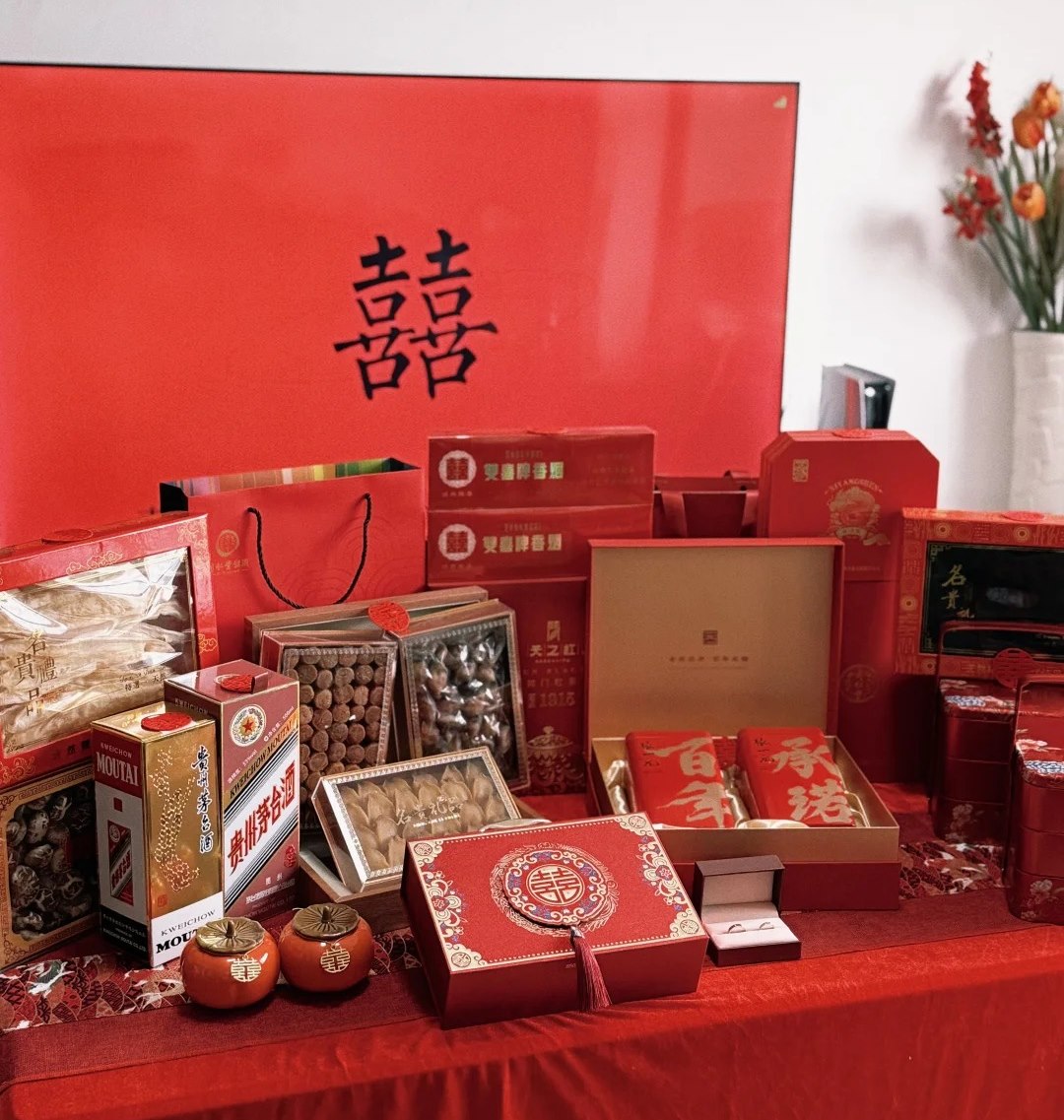
- The engagement ceremony — a banquet at a hotel or at home, for close relatives and a few friends, typically announced only one or two weeks ahead. Speeches, the gift exchange, rings, sometimes a signed betrothal document, then photographs and toasts.
- 过大礼, the formal delivery of betrothal gifts — two to three weeks out.
- Registration. The legal marriage is a separate administrative act at a registry office and can happen almost anywhere in this sequence — before the engagement, right after it, or shortly before the wedding.
- The wedding banquet. Usually 3–6 months after the engagement.
⭐ One traditional constraint catches people out because it is not a practical one: many older relatives hold that an engagement should not “cross the year” — the engagement and the wedding ought to fall within the same calendar year. Where that view is held, it will drive the date far harder than any question of venue availability.
Note also that the legal marriage and the wedding are genuinely separate events here, often months apart. A couple may be legally married for half a year before the banquet that everyone calls the wedding. This trips up guests who assume the ceremony they are attending is the legal one.
过大礼 — the betrothal gifts
Guò Dà Lǐ is the formal betrothal: the groom's family delivers a prepared set of gifts to the bride's family, and from that point the two families are publicly committed. It is the direct descendant of 纳徵, the fourth of the classical six rites.
The list is long, and every item on it is a pun or an omen rather than a present in the Western sense:
| What is sent | What it is doing |
|---|---|
| Betrothal money (聘金) and gold jewellery | The material commitment. Amount and gold weight are agreed between the families beforehand, not improvised. |
| Whole chicken, half a pig, whole fish, two bottles of spirits | Abundance. Whole animals rather than cuts — completeness is the point. |
| Dragon-and-phoenix cakes (龙凤饼) | These are the announcement. The bride's family distributes them to relatives — receiving one is how you learn of the engagement. |
| Four dried seafoods — hair moss, dried oysters, squid, sea cucumber | A pun. 发菜蚝豉 sounds like 发财好市 — “make a fortune, good business”. Chosen for the sound, not the flavour. |
| Oranges, apples, tea, red dates, peanuts, lily bulbs | Peace, and children soon — 枣 (dates) and 花生 (peanuts) together pun on “have a child early”. |
The timing is deliberate: 15–20 days before the wedding leaves the bride's family enough time to assemble both their dowry and their return gifts — which is the part that surprises people most.
Why the gifts go partly back
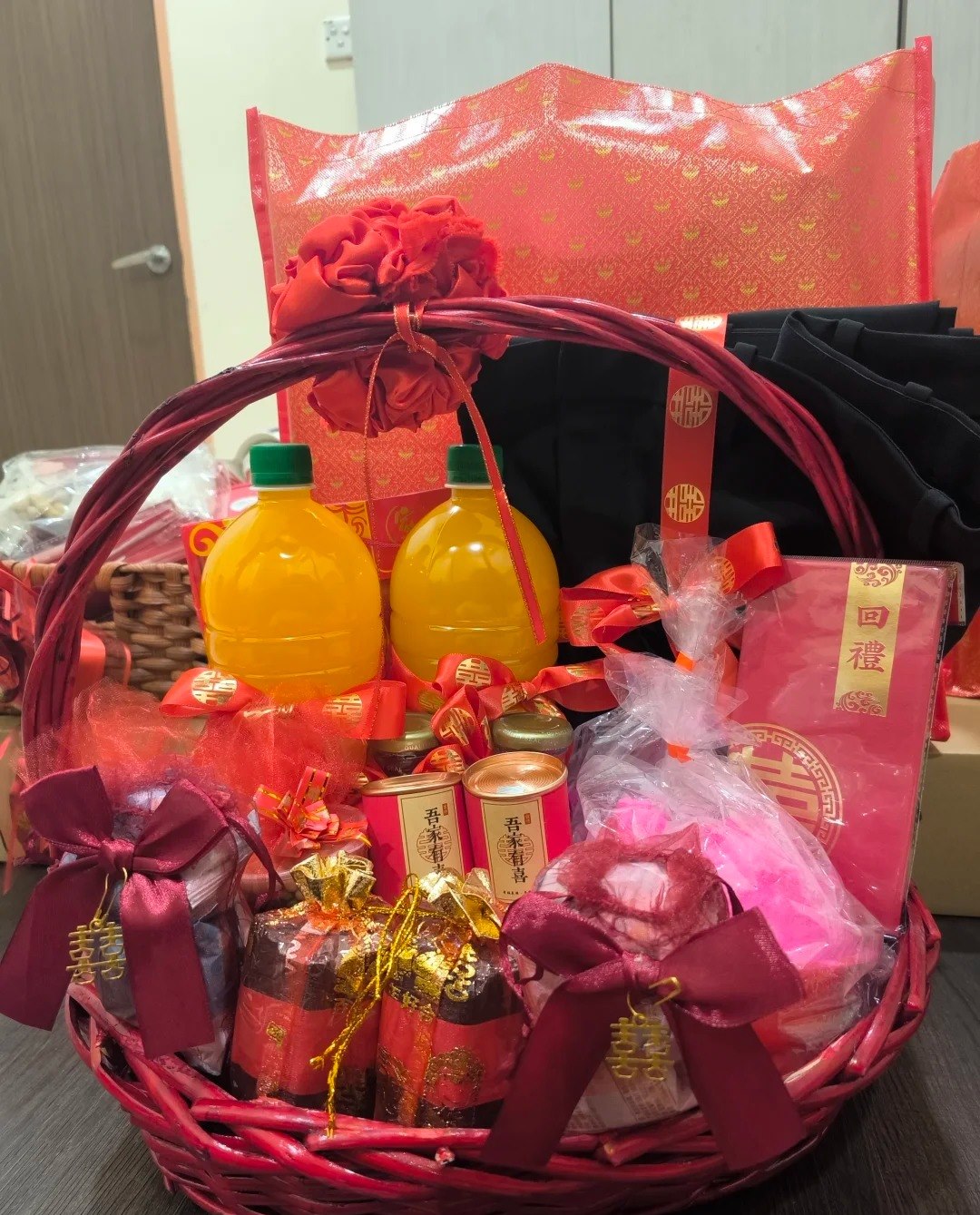
The bride's family does not keep everything. Tradition requires returning a portion: commonly half the cakes and half the fruit, often trousers or shoes for the groom, sometimes a pair of dragon-and-phoenix candles or a length of lotus root.
The reason matters more than the list. Keeping the whole delivery would frame the exchange as a purchase, which is precisely the reading the return gift exists to refuse. Sending part of it back says the two families are now one household rather than two parties to a transaction. Any account of Chinese betrothal that describes gifts flowing only one way has left out the half that carries the meaning.
The “three golds”
三金 is the gold given by the groom's family to the bride: classically a ring, a necklace and earrings. Two variations are common enough that you should expect either:
- Earrings swapped for a bangle, which is now probably the majority form.
- “Five golds” — the same set extended with a bracelet and an anklet.
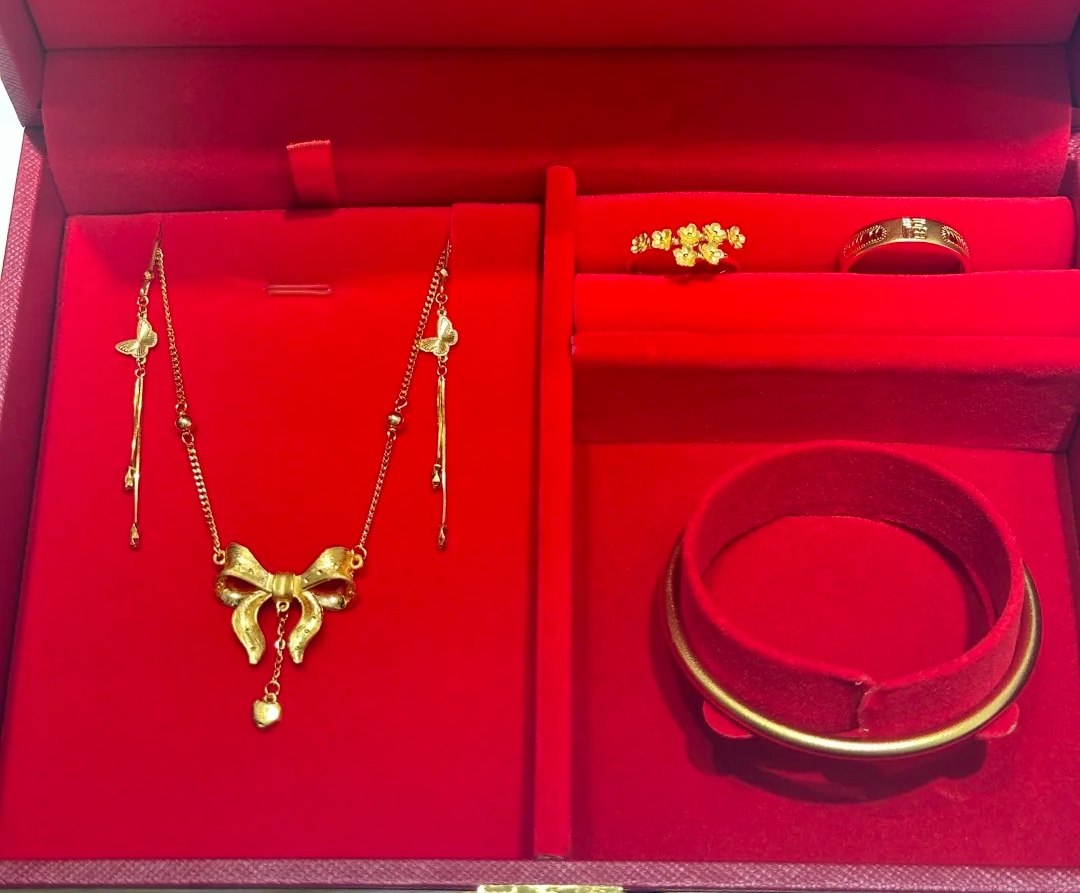
Regional practice diverges sharply. Northern families tend to keep to the classic three or five. In Guangdong and neighbouring provinces the expected items are different again: a dragon-and-phoenix bangle and a gold pig pendant rather than the northern set. And some couples replace the gold entirely with diamonds, which people half-jokingly call the “new three golds”.
It is bought together, usually with the bride present, and it is treated as hers rather than the couple's.
The six rites behind all this
The modern sequence is a compression of a six-stage process set out in the 《仪礼》, a ritual text of the Zhou period. No family performs all six today, but two of them survive in plain sight.
| Rite | What it was | Today |
|---|---|---|
| 纳采 | The formal proposal, made by an intermediary | The families' first formal meeting |
| 问名 | Asking the bride's name and birth details | Gone, except where dates are still matched |
| 纳吉 | Divining the match and reporting the result | Gone, though auspicious-date picking survives |
| 纳徵 | Sending the betrothal gifts | Survives directly as 过大礼 |
| 请期 | Asking the bride's family to fix the date | Absorbed into the families' negotiation |
| 亲迎 | The groom fetching the bride in person | Survives as the wedding-morning fetching, door games and all |
On betrothal money
We are not going to print a number, and it is worth saying why.
Betrothal money (彩礼) varies by province, by city, by village and by family to a degree that no single figure survives contact with a real situation; it moves quickly; and it is the subject of a live and genuinely contested public argument inside China, including official campaigns against inflated demands. A page quoting “the going rate” would be unreliable and would be taking a side in somebody else's debate.
What is stable is the mechanism, and that is what a foreign partner actually needs: the amount is agreed between the two families in advance, not proposed on the day; it travels with the gold as part of 过大礼; and in many families it does not stay with the bride's parents at all but goes with her, or comes back as part of the dowry. If you are the one marrying in, the useful question is not “how much” but “who is discussing this, and when” — because the answer is the parents, early, and long before anyone mentions it to you.
FAQ
Which finger does an engagement ring go on in China?
The middle finger — not the ring finger. Chinese convention reads the middle finger as 'engaged' and reserves the fourth finger for 'married', which is the opposite of the Western arrangement where an engagement ring goes on the fourth finger from the start. There is also a left/right convention (men left, women right), though most younger couples now simply use the left hand because the right one gets more use. If you are Western and engaged to a Chinese partner, wearing your ring the way you always have will read locally as married.
What is Guo Da Li (过大礼)?
The formal betrothal ceremony, and the point at which the two families are publicly committed. The groom's family delivers a prepared set of gifts to the bride's family — betrothal money, gold jewellery, wine and meat, dragon-and-phoenix cakes to be distributed to relatives as the announcement, dried seafood, and auspicious fruit and tea. It usually happens about 15–20 days before the wedding, timed to leave the bride's family room to prepare their dowry and their return gifts.
Does the bride’s family keep all the betrothal gifts?
No, and this is the part outsiders most often get wrong. Tradition requires the bride's family to return a portion — commonly half the cakes and fruit, sometimes trousers or shoes for the groom, a pair of dragon-and-phoenix candles, or lotus root. The logic is reciprocity: keeping everything would frame the exchange as a purchase, and returning part of it says the two families are now one rather than two parties to a transaction.
What are the “three golds” (三金)?
Traditionally a gold ring, a gold necklace and gold earrings, given by the groom's family to the bride. Many families now swap the earrings for a gold bangle, or extend to 'five golds' with a bracelet and anklet. Regional practice varies sharply: northern families tend to keep to the classic three or five, while in Guangdong and neighbouring provinces a dragon-and-phoenix bangle and a gold pig pendant are common instead. Some couples replace the set entirely with diamonds — a 'new three golds'.
How long is it between a Chinese engagement and the wedding?
Three to six months is the usual preparation window, though anything from three months to over a year happens. One traditional constraint is worth knowing if older relatives are involved: many hold that an engagement should not 'cross the year' — that is, the engagement and the wedding should fall in the same calendar year. If that view is held in the family, it constrains the date far more than any practical scheduling question.
Is a Chinese engagement the same as a Western one?
Structurally no. A Western engagement is primarily a commitment between two people, announced afterwards; the proposal and the ring carry the weight. A Chinese engagement is a formal agreement between two families, with both sets of parents involved in the substance of it — betrothal gifts, dowry, and the wedding's shape are all settled here. Many couples now do both: a private Western-style proposal first, then a family betrothal in the traditional form.
What were the traditional “six rites”?
The six-stage sequence set out in the 《仪礼》: 纳采 (the formal proposal), 问名 (asking the bride's name and birth details), 纳吉 (divining for a favourable outcome and reporting it), 纳徵 (sending the betrothal gifts), 请期 (fixing the date), and 亲迎 (the groom fetching the bride in person). No modern family performs all six, but the fourth survives directly as Guo Da Li and the sixth as the wedding-morning fetching of the bride.
Related
- Chinese wedding traditions — the wedding day itself: what to wear, what to put in the red envelope, and what happens hour by hour.
- WeChat Pay for foreigners — why a foreign-card account cannot send red packets, which matters at every stage of this.
- China Golden Week & holiday calendar — auspicious dates cluster around holidays, and so do full flights.