Almost everything written in English about Chinese weddings is written for the people planning one. This is for the other person — the one holding an invitation, working out how much money to put in an envelope, and quietly worried about turning up in the wrong colour.
Two things make that harder than it needs to be. The first is that most guides describe a historical Chinese wedding, with rites you are unlikely to see. The second is that the parts which do reliably happen — the envelope, the sign-in desk, the toasting — are exactly the parts nobody writes down, because everyone local already knows them.
What actually happens, in order
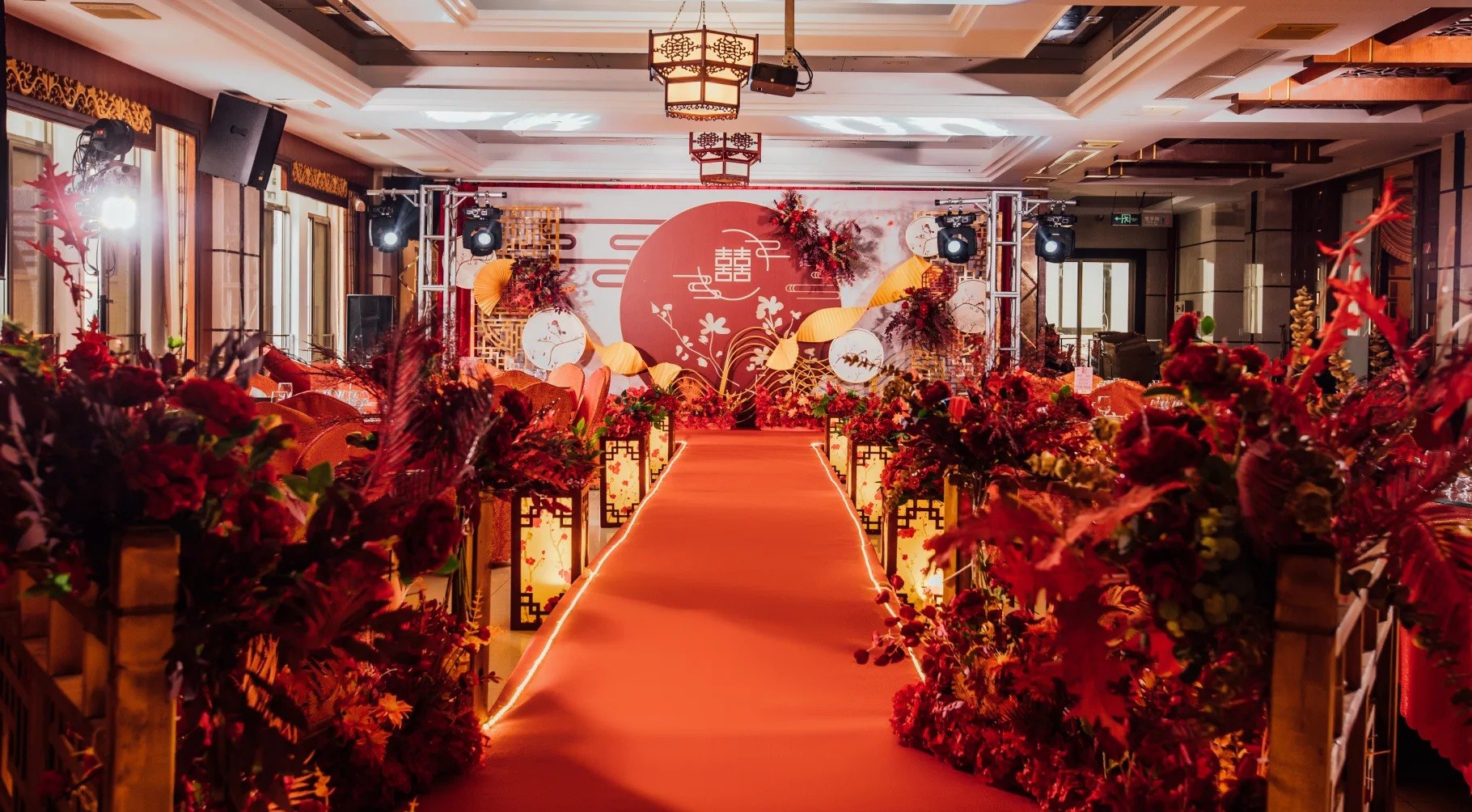
A modern mainland wedding is a hotel banquet with a short ceremony bolted to the front of it. The whole thing is compressed into an evening, and the schedule is tighter than a Western reception.
| Roughly | What happens | What you do |
|---|---|---|
| 16:00–17:30 | Sign-in desk open. Guests arrive, chat, are photographed. Often games in the reception area — pitch-pot, lantern riddles. | Hand over the envelope here. Collect your favour. Find your table. |
| 17:58 or 18:08 | Ceremony starts on an auspicious minute — 8 sounds like the word for prosperity. Lion dance or a light sequence to open. | Be seated. This is the part latecomers miss. |
| 18:08–18:25 | The ceremony proper: three bows, the shared cup, sometimes a fan rite or a lock of hair. Deliberately kept to 15–20 minutes. | Watch. Photos are fine and expected. |
| 18:25–18:35 | Tea to both sets of parents, who give red envelopes back and usually speak. | Applaud. You are not part of this. |
| from ~18:38 | Ceremony ends, food starts arriving immediately, couple change out of ceremonial dress. | Eat. Do not wait to be invited to start. |
| 19:30–20:30 | The couple work the room table by table, toasting. Guests finish and drift out; the couple see people off at the door. | Stand for the toast. Leaving after it is normal, not rude. |
Two consequences worth planning around. Arriving “fashionably late” means missing the ceremony, which is over inside half an hour. And the evening ends earlier than a Western reception — there is rarely dancing, and once the toasts are done the room empties quickly.
The red envelope: how much, and how to hand it over
Guests give money, not gifts. It goes in a red envelope, and the amount is the single thing people agonise over — including Chinese guests, who calculate it just as carefully.
| Your relationship | Typical, most of China | Shanghai / Jiangsu / Zhejiang |
|---|---|---|
| Colleague, or an old contact you rarely see | ¥200–500 | ¥600–1,000 |
| A friend you actually see | ¥500–800 | ¥1,000–1,600 |
| Close friend | ¥1,000+ | ¥1,600+ |
The regional spread is larger than the relationship spread, which is the part that catches people out. Guangdong is the clearest counter-example: across much of the Pearl River Delta ¥200–500 is entirely normal regardless of closeness, and hosts commonly hand part of the envelope back, or fold a corner and return it, on the principle that your turning up was the gift. Ask whoever invited you what is normal locally — it is not a rude question, and it is the only reliable answer.
The number itself matters. Even numbers only — odd amounts belong to funerals. Avoid anything containing 4, which sounds like the word for death. Digits that sound lucky are deliberately chosen: 6 (things going smoothly), 8 (prosperity), 9 (longevity), so ¥666, ¥888 and ¥999 are common, and ¥1,314 is a set phrase meaning “a whole lifetime”. One local quirk: in some places a flat ¥600 is avoided because it sounds like slipping away, and ¥666 or ¥688 is used instead.
The mechanics matter more than foreigners expect, and this is where a Western guest usually goes wrong:
- Cash, in new notes. Banks will swap worn notes for clean ones. Used notes read as careless here in a way they would not at home.
- Write your name on the envelope. The host keeps a ledger — these debts get repaid at your wedding, so the record is the point.
- Do not seal it. Staff open and record envelopes as guests arrive. Sealing it makes work for them; it is not a privacy breach.
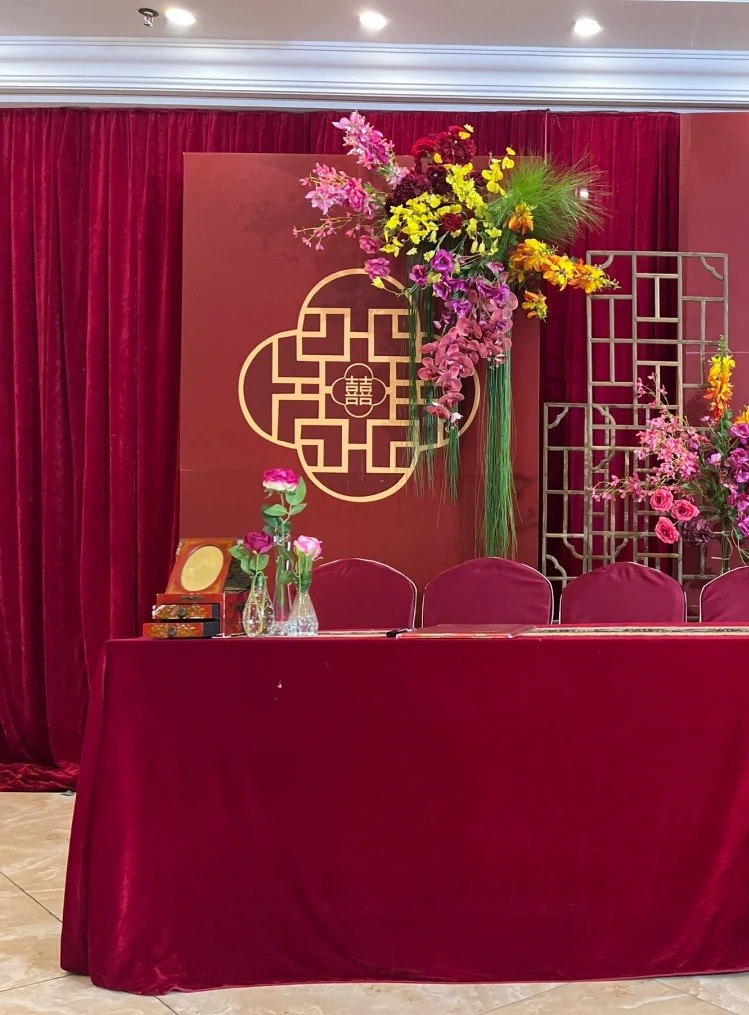
- Hand it to the sign-in desk, not the couple. Giving it directly to the bride or groom is awkward for everyone.
Cash is the norm here anyway, but for foreign guests it is also the only practical option: a WeChat account bound to a foreign card can pay merchants but cannot send red packets or person-to-person transfers. So the digital shortcut Chinese guests use when they cannot attend is closed to you — which is fine, because cash is what everyone prefers regardless. Bring it with you; do not plan to find an ATM near the venue.
What to wear, and the three colours to avoid
The rule that catches Western guests is white. At a Western wedding white is formal and safe; here it is one of the two funeral colours, and it also reads as competing with the bride. All-black is avoided for the same funerary reason. And bright red belongs to the bride — wearing it looks like an attempt to upstage her, which is precisely the thing everyone is trying to avoid.
- Avoid: pure white, all-black, bright red. Vivid green is also generally avoided.
- Safe: champagne, blush, lilac, light blue, or a deep dignified tone — burgundy, navy.
- Cut: nothing very revealing. Neat and respectful is the entire standard; formality levels are lower than a Western church wedding.
Nobody will say anything if you get it wrong, which is exactly why it is worth getting right.
The tea ceremony is not for you — and it is the emotional centre
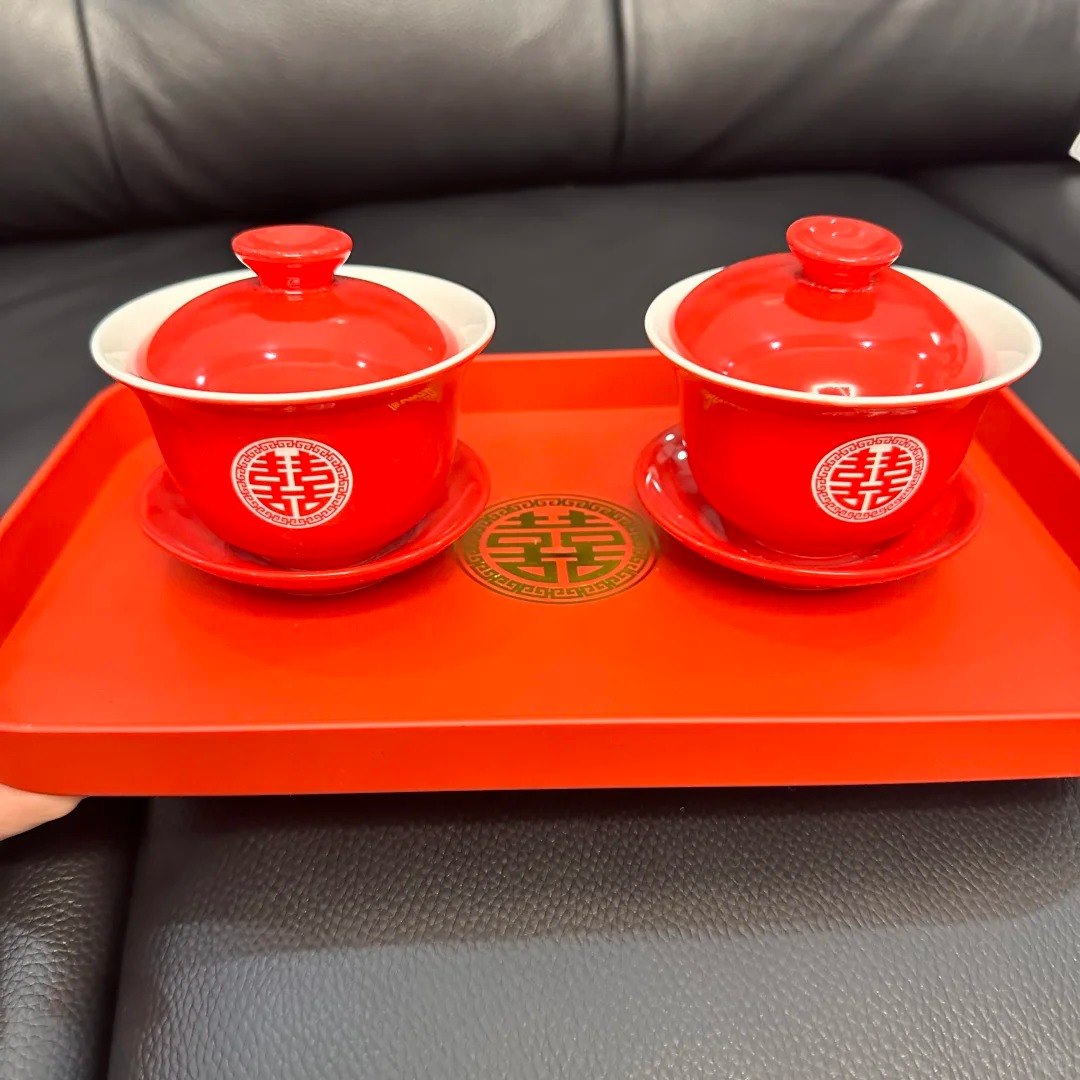
Partway through the ceremony the couple kneel and serve tea to both sets of parents. Its Chinese name — 改口茶, the “change of address” tea — says what it is for: as they serve it, the couple address each other's parents as mother and father for the first time. The parents drink, hand back a red envelope, and usually say a few words.
Two things Western guests get wrong here. You are not part of it — it is the couple to their parents, and guests applaud and photograph and nothing more. And the kneeling can look startling if you read it as submission. It is not; it is the formal, physical version of thanking the people who raised you, and it is routinely the moment that visitors report finding unexpectedly moving.
The other rite you will certainly see is the three bows: to heaven and earth, to the parents, and to each other. Older and fuller versions bow four times, adding the ancestors. It is the functional equivalent of exchanging vows, and like the tea it is directed at family rather than at the room.
The old rites — and which ones survive
If the couple have chosen a “traditional” ceremony you may see rites drawn from the 《仪礼》, a ritual text of the Zhou period. Almost no hotel wedding performs the full sequence; it is quoted from, the way a Western wedding quotes from a liturgy nobody follows completely.
| Rite | What it is | Will you see it? |
|---|---|---|
| 三拜 Three bows | Heaven and earth, the parents, each other | Nearly always |
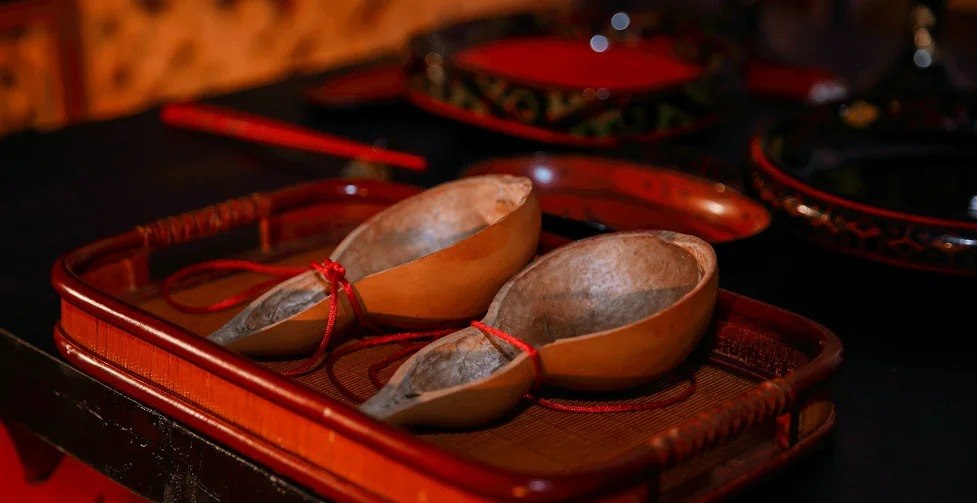
| 合卺 Hejin | A bitter gourd halved into two cups; each drinks, they swap and finish, then the halves are tied back together with red cord. Bitter vessel, sweet wine — hardship and sweetness shared. The gourd puns on fortune and rank, its trailing vine on ten thousand generations | Nearly always, usually as linked-arm cups |
| 改口茶 Tea | Tea to the parents, new forms of address | Nearly always |
| 却扇 Queshan | The bride holds a round fan before her face and lowers it. A Tang-dynasty rite: the groom had to compose a poem asking her to move it — the poet Li Shangyin wrote one on a groom's behalf | Sometimes — it photographs well |
| 解缨结发 Hair | Two rites: the groom unties the betrothal cord from the bride's hair, then a lock from each is cut and knotted together into a pouch. This is where the phrase “tied-hair couple” comes from | Sometimes |
| 沃盥 · 同牢 | Washing the hands from a ewer before the rite; sharing meat from one vessel | Almost never — slow, and hard to read from a table |
One correction worth having, because the internet gets it backwards. 却扇 was historically performed near the end — after the shared meat and the shared cup, once the bride had taken off her ornaments — not as an entrance. Modern ceremonies move it to the start because it makes a better opening image. Both are fine; they are just not the same thing, and a page telling you it is “the traditional entrance” is describing a staging decision from the last twenty years.
The rites that get dropped are dropped for practical reasons rather than cultural ones: hotels will not permit an open flame, so the brazier-stepping goes; sharing meat from a single vessel looks baffling from thirty feet away; and every extra minute is a minute several hundred hungry people spend not eating.
You may also see a 喜娘 working beside the bride — a ceremonial attendant who handles the props, prompts each movement and manages the dress. The role is old and regionally specific, with its own local names (掌福执礼, 全福人, 大妗), and in some places it was traditionally filled by a woman whose own family life was considered complete — parents, spouse and children all living. It is not a fossil: the tradition was added to a municipal intangible-heritage list in Fujian in 2022.
What the bride is wearing
Chinese brides commonly change outfits more than once during the evening. Two of them have names worth knowing, because they are different garments from different places, and guests often use the words interchangeably when the couple would not.
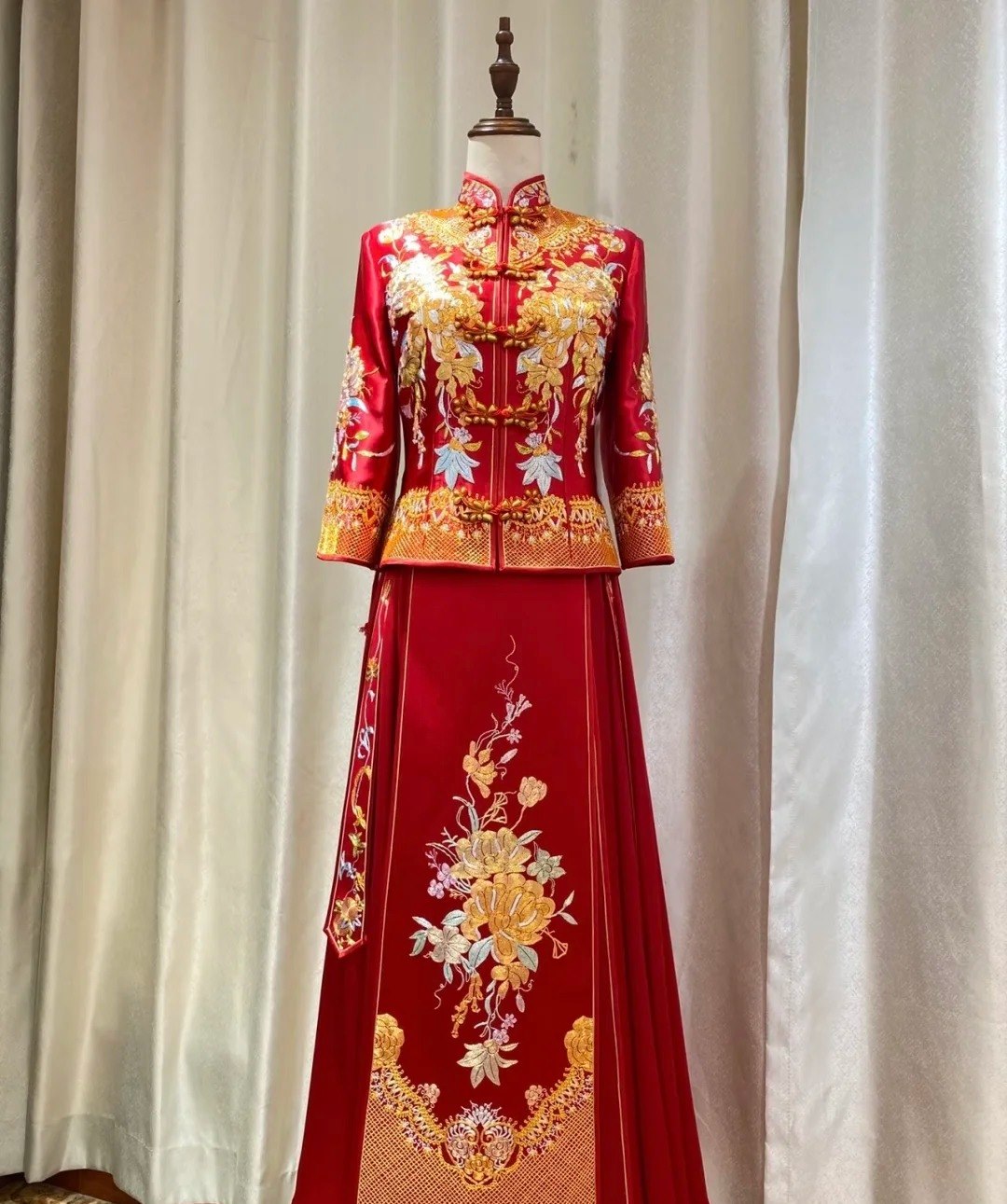
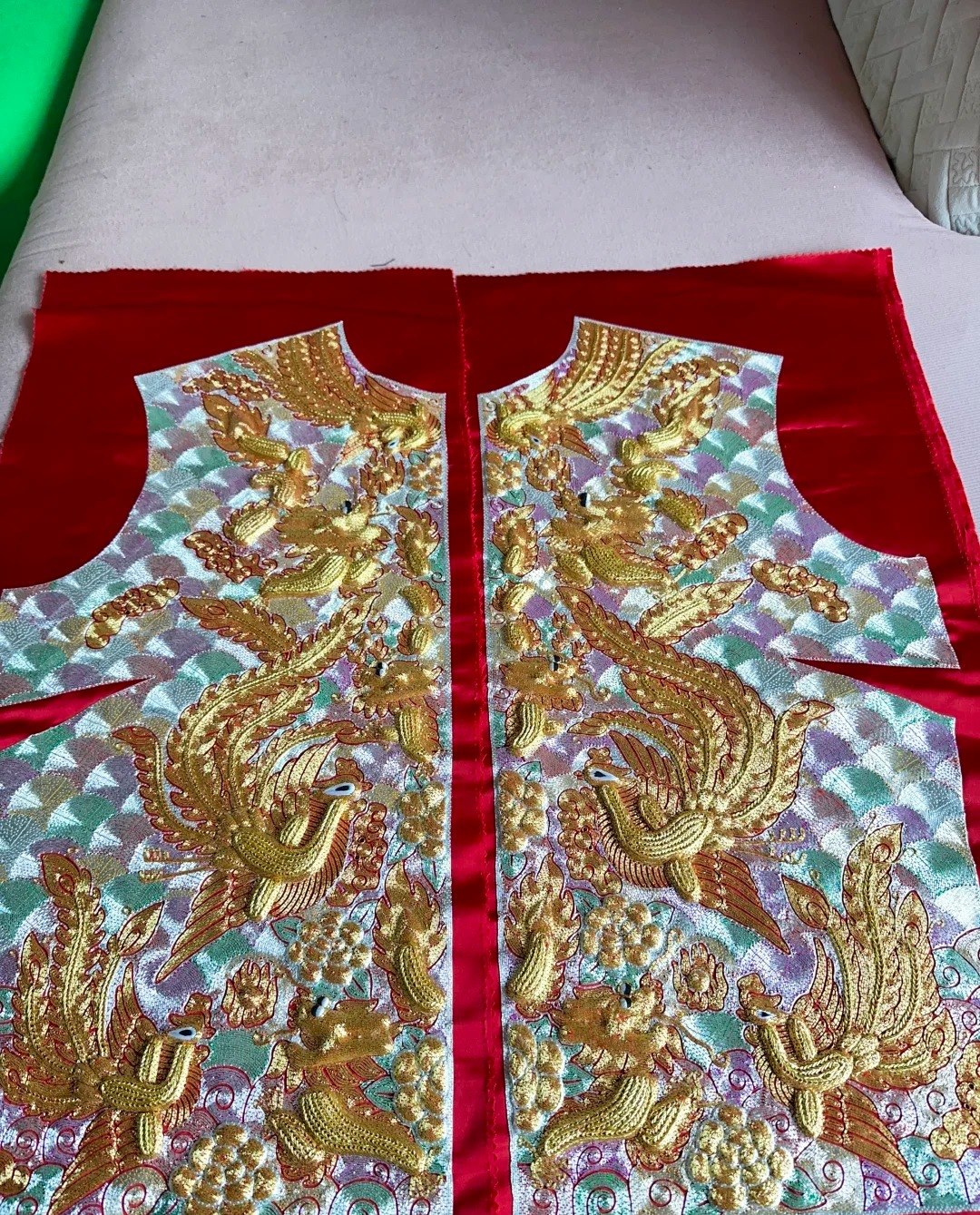
The longfenggua is the southern one — Guangdong, Hong Kong and Macau — fitted at the waist with a straight skirt, and covered in raised gold and silver embroidery that gives it real weight. Density of embroidery is how they are graded and priced. The xiuhe is the one seen more widely across the country, and it hangs loose rather than fitted — the flat, multi-coloured needlework is the quickest way to tell the two apart from across a room.
A detail that surprises people: “xiuhe” is not an ancient word. The garment is based on late-Qing and early Republican jacket-and-skirt dress, but the name comes from the character Xiuhe in a Chinese television serial that aired in 2001. The style is old; the label is younger than most of the people wearing it.
At the banquet
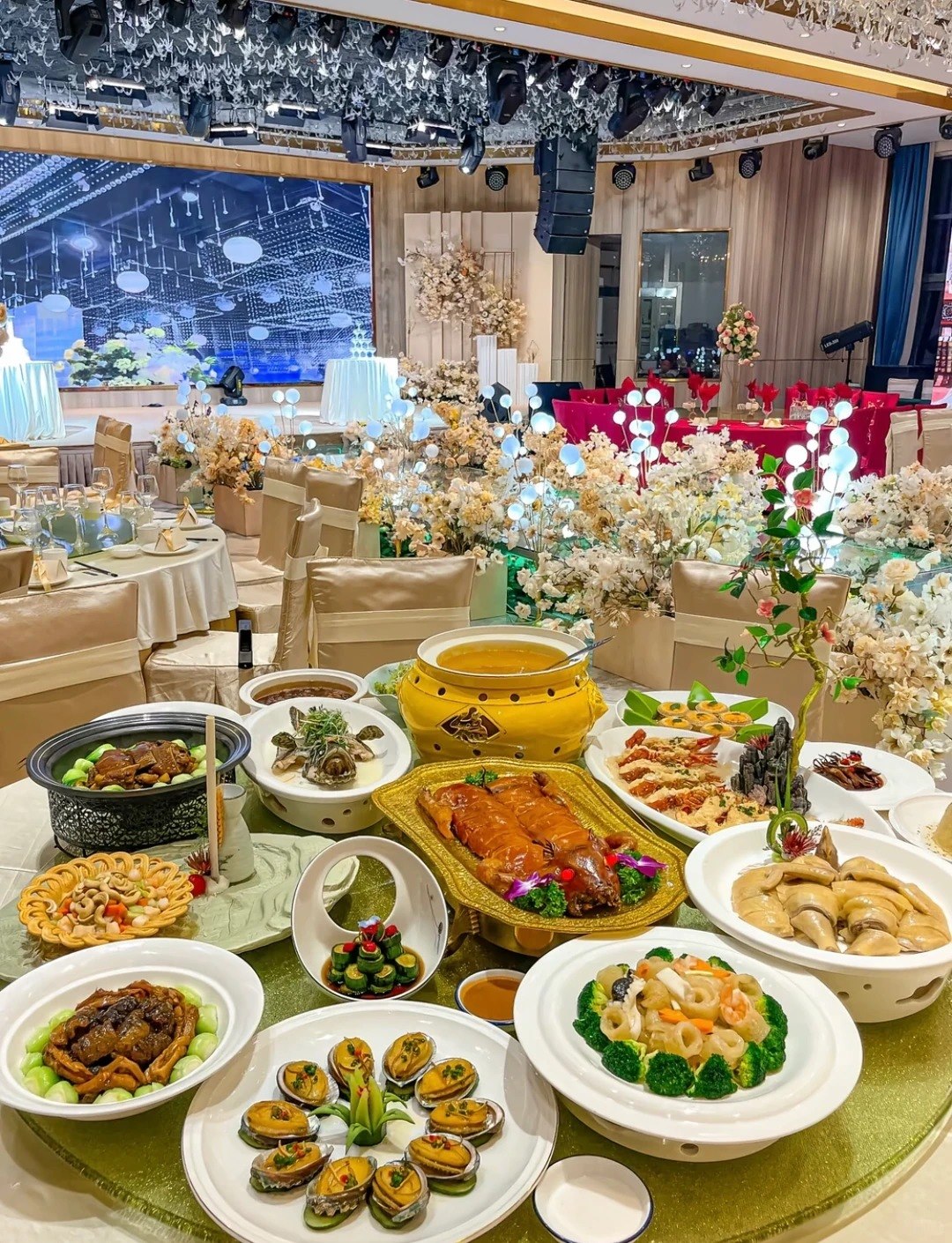
The food arrives fast and does not stop. A few things are worth knowing before you sit down:
- The expensive dishes are the unfamiliar ones. Abalone, sea cucumber, whole fish, whole poultry and braised feet are there precisely because they are costly and generous. If there are things you will not eat, tell whoever invited you in advance — hotels can substitute, and it is far easier before the night than during it.
- Start when the food starts. There is no signal to begin and no speech to wait through.
- The couple eat last, if at all. They spend the meal moving between tables. It is normal for them to eat almost nothing.
- You will be toasted. The couple work table by table with small glasses. Standing is polite. Drinking is not compulsory — nobody minds if you toast with tea or soft drink, and someone is usually deputised to drink on the couple's behalf anyway.
- Taking leftovers is normal. Guests packing up food at the end is thrift, not embarrassment.
If the couple are marrying in a city you are travelling to, the banquet is also the fastest introduction to that region's cooking you will get — the menu is regional in a way restaurant menus often are not. Our guide to China's regional cuisines covers what you are likely to be looking at.
What a Western wedding has that this one probably won't
These are the moments Western guests report waiting for and not getting. None of them means anything is wrong.
- The kiss. Frequently skipped. Chinese couples are often reticent about it in front of family, and nobody in the room is waiting for it.
- The bouquet toss as you know it. It happens, but the convention that only unmarried women compete is not observed — a male guest catching it, and the room congratulating him, is a normal outcome.
- Speeches from friends. Parents speak; a best man rarely does. There is no toast-and-anecdote tradition.
- Dancing. Almost never. When the toasts finish, the evening finishes.
- A gift table. There is no registry and no pile of parcels. The envelope is the whole of it.
Who hosts, and which celebration you attend
Traditionally the groom's family carried the cost of the banquet and the bride's family provided the dowry. That has largely given way to sharing — split by how many tables each side invites, or one side taking the venue while the other takes drinks, sweets and favours — and a growing number of couples simply pay for the whole thing themselves.
Where it affects you is the gift money. Each side keeps what its own guests gave, because those are individual social debts to be repaid at future weddings. And when the two families hold separate events — common when they are from different cities — the rule is simple: you attend the one you are connected to, and the envelope goes to the side you attend. Going to both, or giving twice, is only for people close to both families.
If the wedding is the reason for your trip, note that the couple may also hold a separate send-off meal at the bride's family home before the main banquet, or a return visit afterwards. Being invited to one and not the others is normal and is not a slight.
FAQ
How much money do you give at a Chinese wedding?
In mainland China, guests give cash in a red envelope rather than a gift. Traveller reports for 2026 put an ordinary colleague or acquaintance at ¥200–500, a friend you actually see at ¥500–800, and a close friend at ¥1,000 or more. Region matters more than relationship: in Jiangsu/Zhejiang/Shanghai ¥1,000 is roughly the floor for an ordinary friend, while in much of Guangdong ¥200–500 is normal and hosts often return part of it. If you are travelling in for the wedding, nobody expects you to match local rates — showing up is the point.
Which family pays for a Chinese wedding?
Traditionally the groom's family paid for the banquet and the bride's family provided the dowry. In practice today most couples share it — commonly split by how many tables each side invites, or the groom's side takes the venue while the bride's side takes drinks, sweets and favours. An increasing number of couples simply pay for it themselves. Gift money follows whoever is hosting: each side keeps what its own guests gave, because those debts have to be repaid individually at future weddings.
What colour should you not wear to a Chinese wedding?
Avoid three: pure white and all-black, which are associated with funerals in Chinese tradition, and bright red, which belongs to the bride. This trips up Western guests specifically, because white reads as formal and appropriate at a Western wedding. Safe choices are warm or soft colours — champagne, blush pink, light blue, lilac — or a dignified deep tone such as burgundy or navy. Bright green is also generally avoided. Nothing too revealing; smart and neat is the whole requirement.
What are the etiquette rules for guests at a Chinese wedding?
Four things cover almost all of it. Bring cash in a red envelope and hand it in at the sign-in desk on arrival, not to the couple. Write your name on the envelope and do not seal it — staff open and record it as you arrive, which is normal and not a breach of privacy. Dress in soft or deep colours, never white, black or bright red. And expect to be toasted rather than to toast: the couple work the room table by table late in the evening.
Do you give a gift as well as money at a Chinese wedding?
No. The red envelope is the gift, and bringing a wrapped present as well is unusual — there is no gift registry convention in mainland China. Guests are the ones who receive something: the sign-in desk usually hands out a favour (sweets, a small keepsake) as you arrive. If you want to bring something personal, avoid clocks and umbrellas, whose names sound like phrases about death and separation.
Is there a kiss at a Chinese wedding?
Often not. Western ceremonies build to the newlyweds' kiss; Chinese couples frequently skip it, and guests do not expect one. The emotional peak is elsewhere — usually the tea ceremony, where the couple kneel to serve tea to both sets of parents and address them as mother and father for the first time. Western guests routinely report that this, not the vows, is the part that moves the room.
What time does a Chinese wedding banquet start and finish?
Sign-in usually opens in the late afternoon, around 16:00–17:30, with the ceremony starting at an auspicious minute — 17:58 and 18:08 are common choices, because 8 sounds like the word for prosperity. The ceremonial part runs 15–20 minutes, food starts immediately after, and the couple move table to table toasting from roughly 19:30. Most guests have eaten and left by around 20:30. Arriving late means missing the ceremony entirely; arriving during sign-in is normal and expected.
Do I need to attend both families’ celebrations?
No. Where the two families hold separate events — common when they live in different cities — the rule guests follow is that the envelope goes to whichever one you attend. Go to the side you are connected to, give there, and that is complete. Attending both and giving twice is only for people close to both families.
Related
- Chinese engagement traditions — the step before the wedding: the ring finger, the betrothal gifts, and what goes back.
- WeChat Pay for foreigners — why a foreign-card account cannot send red packets, and what it can do.
- China's 8 regional cuisines — what is likely to be on the banquet table.
- China Golden Week & holiday calendar — weddings cluster around holidays; so do full flights and hotels.
- China visa for Americans — if you are flying in for it, start here.