What it is, and what it costs
Datang Everbright City (大唐不夜城, Dàtáng Bùyèchéng — literally “Great Tang Never-Night City”) is a 2 km pedestrian street running south from the South Square of the Big Wild Goose Pagoda to Kaiyuan Square. It is a modern build on a Tang theme: lantern canopies, sculpture groups, costumed performers, and a great deal of light.
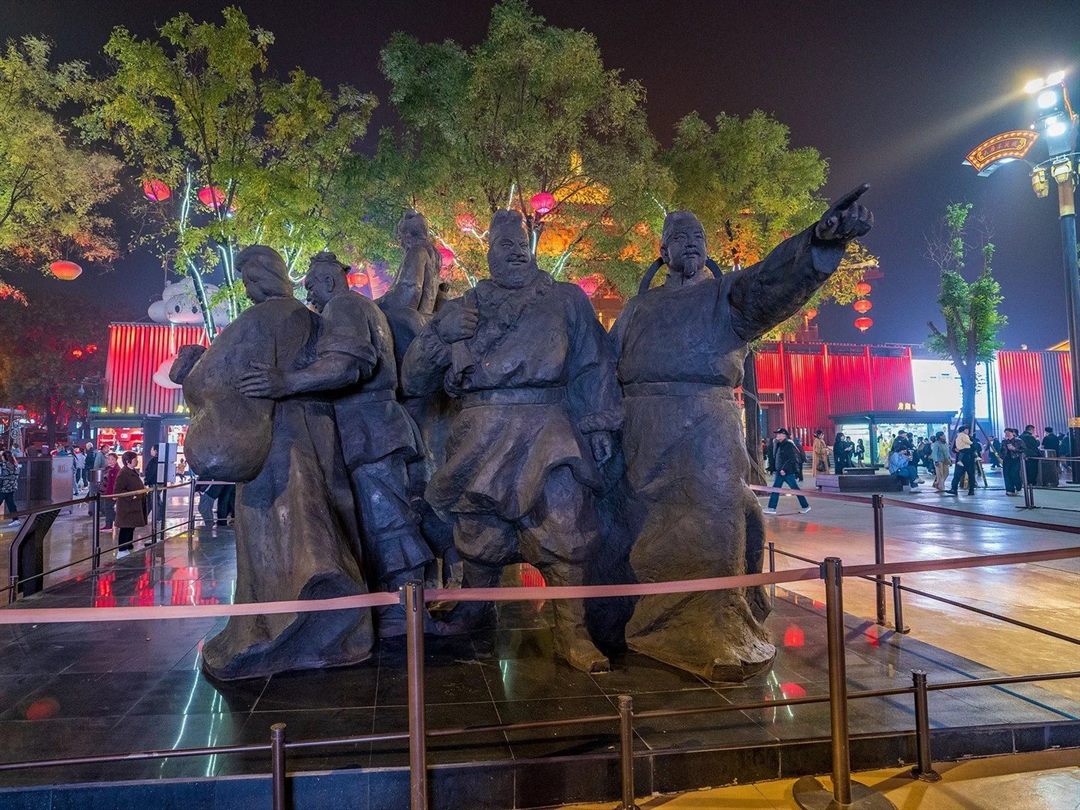
⭐ It is free, and so is everything on it. No ticket, no reservation, no gate, no cap. The street performances — upwards of twenty most evenings — are free as well. That matters more than it sounds, because it makes the street the only major Xi’an attraction you can decide to visit at nine o’clock at night with no preparation at all.
It also means one rule covers a whole category of trouble: if somebody is asking you to pay to be here, they are not selling you this street. That covers the “VIP viewing position” sellers, the entry-ticket touts and the booking-fee approach.
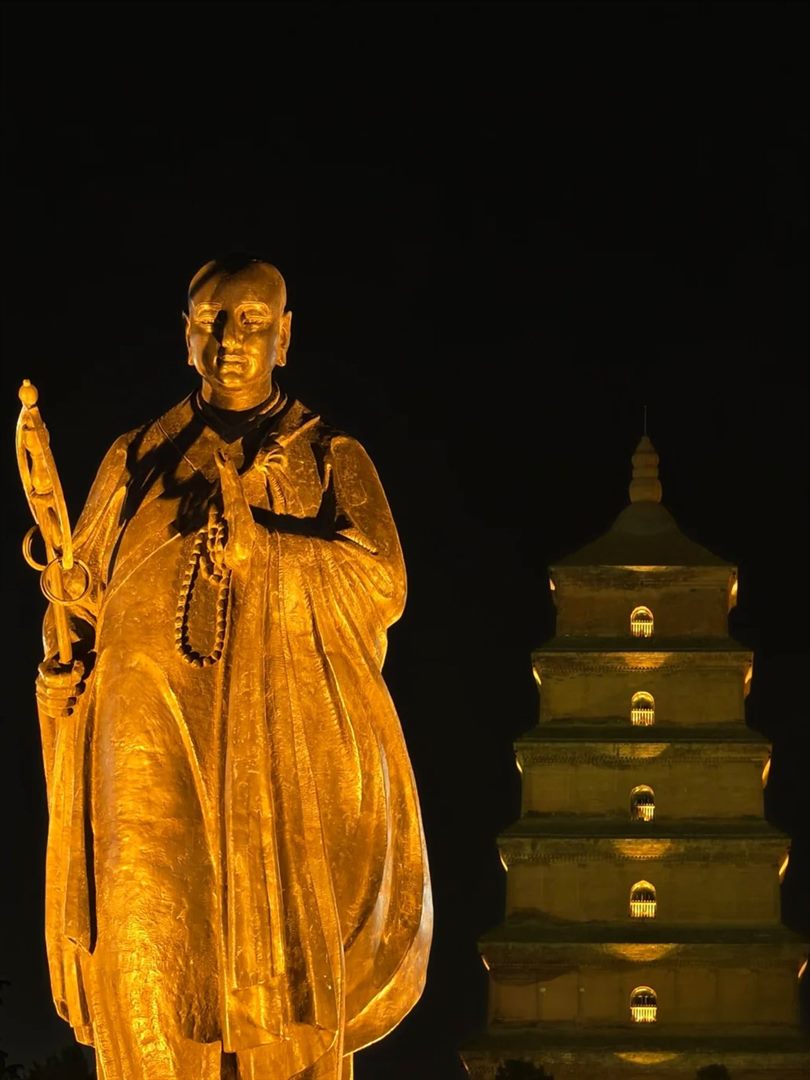
When the lights come on — and why one number is wrong
The street lights up on sunset, not on a fixed clock. So the hour moves through the year:
| Season | Lights on |
|---|---|
| Spring & autumn | 18:30–18:50 |
| Summer | 19:20–19:40 |
| Winter | 17:40–18:00 |
⚠️ You will find a single figure — usually around eight o’clock — printed as if it applied all year. It is one season’s number, and following it in December puts you on the street two hours after the lights came on, in the cold, for nothing.
⭐ The reason is worth carrying beyond this street. All of China runs on a single clock set for 120°E, and Xi’an sits near 108.9°E. That is about 11 degrees of longitude west of the clock it keeps, so its solar day lands roughly 44 minutes later than the same clock time on the east coast. Anything in Xi’an, Chengdu, Chongqing, Kunming or Lhasa that depends on the sun — a dusk visit, a sunrise climb, a lantern-lighting hour — runs later than an instinct calibrated on Beijing or Shanghai expects.
Walk it north to south
Start at the pagoda’s South Square and walk south to Kaiyuan Square. That direction is not a preference: the street’s own performance order runs that way, so walking it north to south takes the acts roughly in sequence and never doubles back. Doing it in reverse means walking away from each show as it starts.
In order, the things worth stopping for:
- The poetry pavement and lantern canopy — pressure-sensitive paving that scatters petals underfoot, under the densest stretch of lanterns. This is the hanfu-photograph section, and it is at the north end.
- 《盛唐密盒》 near 德发长 — a comedy question-and-answer act with two Tang officials that pulls the biggest crowd of the evening. It is performed entirely in Chinese; the physical comedy carries a fair amount of it, but this is the one act where not having the language costs you most.
- The poetry-and-dance sculpture stretch — short live pieces staged among the statue groups.
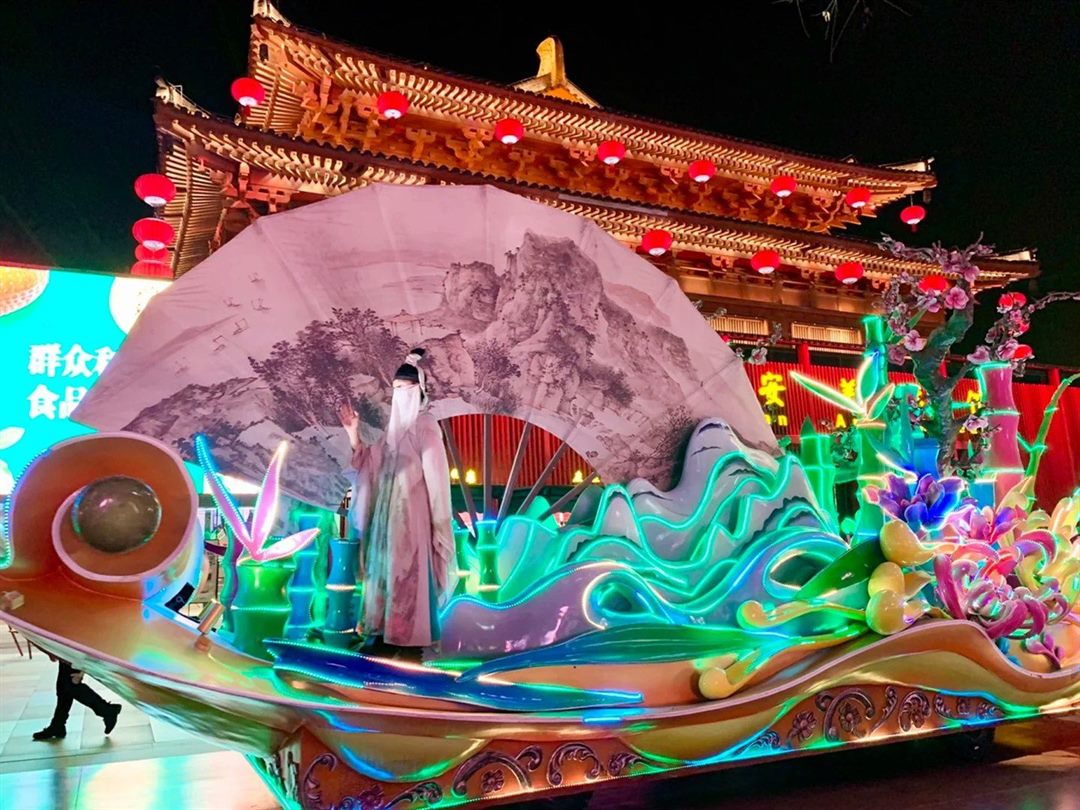
- 《花车斗彩》 at 团花广场 — a costume parade on floats, the most photographable of the moving acts.
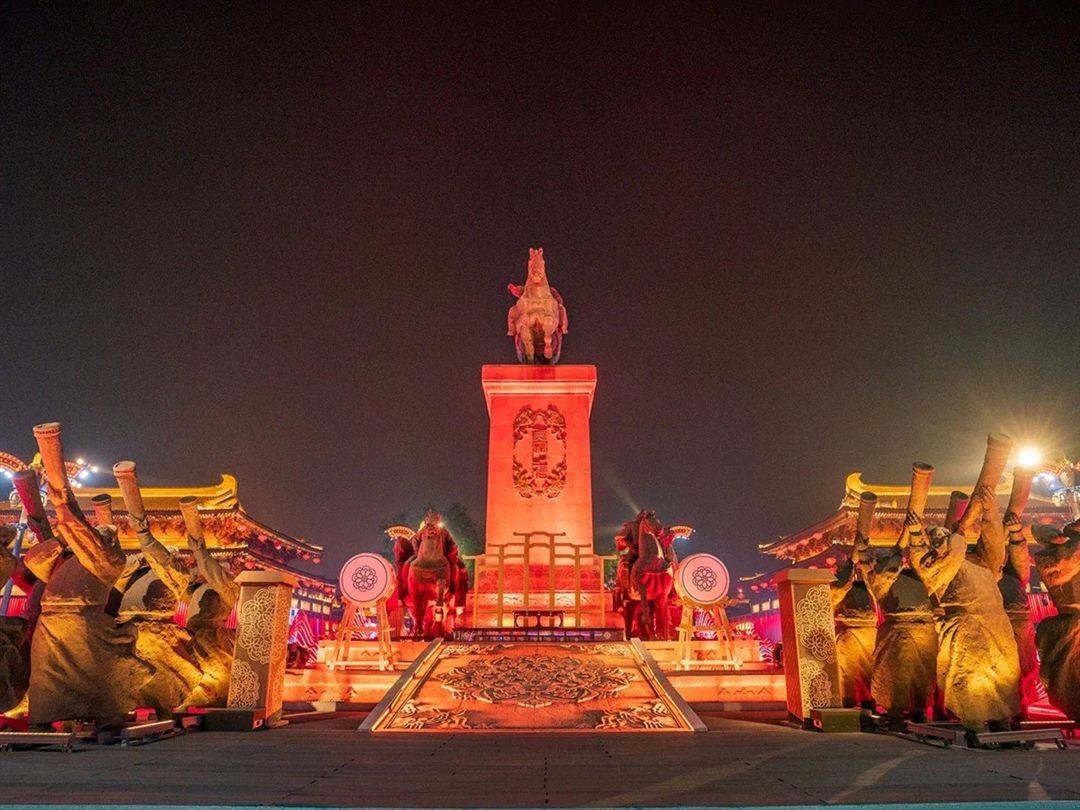
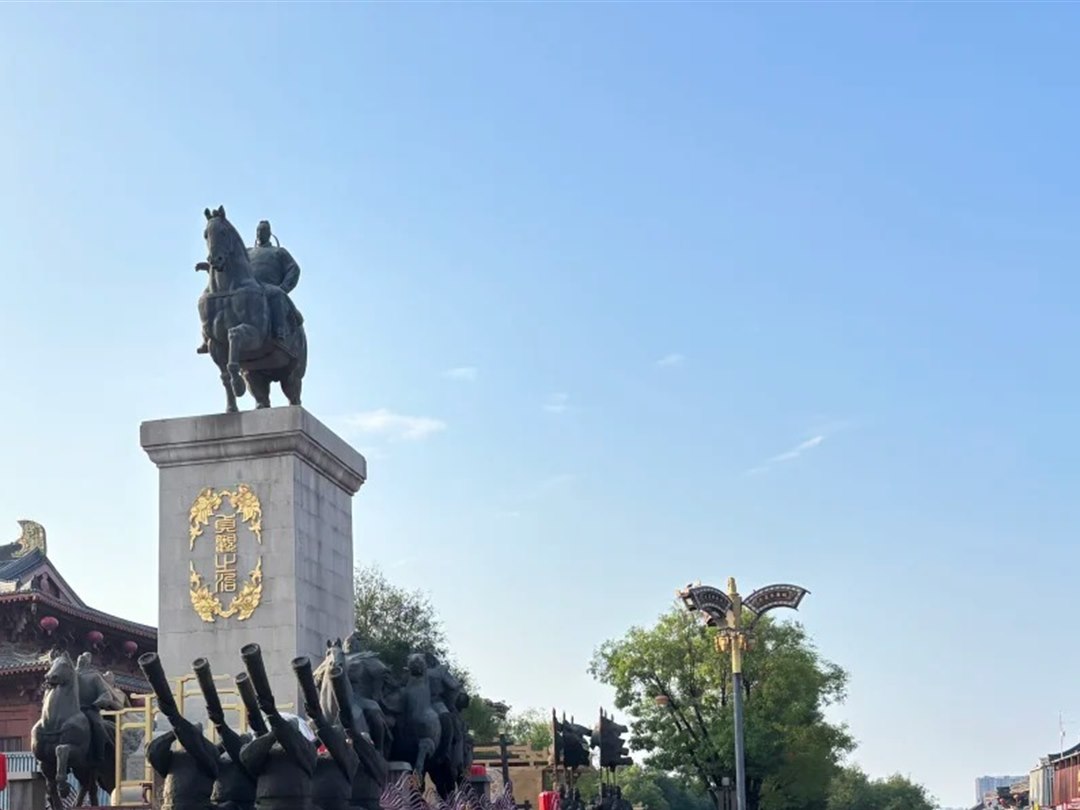
- The Emperor Taizong statue (贞观之治) — at Zhenguan Square, and the marker for roughly the middle of the street. ⛔ Not the cue that Kaiyuan Square is next: that is still 630 m further south.
- 《再回长安》 on the Kaiyuan Square main stage — a hundred-performer finale, and the largest thing on the street.
Budget realistically. A quick pass through the northern stretch is about 90 minutes; the full walk with two or three shows is closer to three hours, all of it standing or moving. Flat shoes.
The Tumbler Girl, and the show that is not here
The 不倒翁小姐姐 (“Tumbler Girl”) act — a performer in Tang costume on a concealed pivot, gliding and leaning over the crowd barrier to take people’s hands — is the single most-filmed thing on the street. It performs on the north side of Kaiyuan Square, at the street’s southern end — 630 m south of the Emperor Taizong statue, not beside it.
Typically three sets of about fifteen minutes: around 19:30–19:45, 20:15–20:30 and 21:00–21:10. Holidays may add one. For a front-row position — which is the only place the hand-holding interaction happens — arrive 40–60 minutes before a set. Late in each set the performer often takes a phone from the crowd and films back outward, so have yours already open on the rear camera rather than fumbling for it.
⛔ 《大唐追梦》 is not on this street. The names are similar enough that people arrive looking for it, and it is somewhere else entirely: a ticketed, book-ahead boat show inside Tang Paradise (大唐芙蓉园), which is a separate paid attraction nearby. Nothing on this street is ticketed, so the moment a “show” here requires a purchase, you are being sold something else — or nothing.
Getting there, and getting out again
Metro Line 3 or Line 4 to 大雁塔 (Dayanta), exit B or C. From exit C, turn right and walk straight ahead. Both exits put you on the south side of the interchange, which is the side you want.
⚠️ Budget 10–15 minutes on foot from the station to the street’s north end, not the two-minute hop the station name implies. The pagoda complex sits between the two, and you walk around it.
Getting out is the part people do not plan. On a busy night the station entrances can be closed temporarily after about 22:00, when the crowd leaving the finale hits the gates all at once. If that happens, walk south to 雁南三路 and take a taxi or ride-hail from there rather than queueing — it is a shorter wait and the pickup is easier.
⛔ Over Spring Festival, May Day and National Day, 大雁塔站 may cap entry outright rather than briefly closing a gate. The walk-in alternatives are 大唐芙蓉园站 or 北池头站. Check before a holiday visit; do not assume the nearest station will be open.
⭐ Come as the second half of a pagoda evening. Because the two run straight into each other, the plan that wastes nothing is the pagoda grounds at golden hour, dinner off the main street, and the walk south as the lights come on. Treating them as two separate outings costs you an hour of travel for no gain.
What to refuse
An open street with a large evening crowd attracts approaches, and two of them are worked specifically on people who look foreign.
- The costumed photo-posers. Performers dressed as bronze statues or as Sun Wukong drift over, pose with you for what looks like a free photograph, and then produce a payment QR code. The street does not employ them — the official acts are on stages and in parades, not wandering the crowd soliciting. Refusing costs nothing; declining to hand over your phone in the first place costs even less.
- The hanfu touts. Roadside agents advertise an all-in costume package at a low headline price, which grows false eyelashes, prop fees and photo-editing charges once you are in the chair. Honest rental with styling runs ¥80–¥150 a set and is found off the main street — around the Dayue City mall or in the side lanes. The reliable rule: never rent from somebody who approached you.
- The main-street food markup. Snacks on the street itself cost a multiple of the same thing one block back — bottled water runs about ¥5. Walk out to 慈恩路辅巷 or into the Dayue City or Intime City malls. For a sit-down meal rather than snacks, the two names locals give back are 德发长 (a dumpling banquet house) and 同盛祥 (泡馍 — mutton stew with torn flatbread).
⭐ Two free elevated viewpoints nobody advertises. The 4th-floor observation deck at the Dayue City mall (大悦城4楼观景台) looks down the length of the lit street with the pagoda behind it, and is usually near-empty while the street below is packed. The 2nd-floor terrace of the street’s Starbucks Reserve gives the same shot from lower down through glass. Both beat fighting for ground-level space during the 19:00–21:00 crush.
Key takeaways
- ⭐ Nothing here is for sale. Entry, the performances, the squares — all free, with nothing to book. So the rule that covers most of the trouble on this street is simple: anyone asking you to pay to be here, watch here, or stand here is not selling you this street.
- ⭐⭐ The lights come on at dusk, not at eight. About 18:30–18:50 in spring and autumn, 19:20–19:40 in summer, 17:40–18:00 in winter. The single figure most listings print is one season’s number.
- Walk it north to south, starting from Big Wild Goose Pagoda’s South Square. The performances arrive in order that way and you never double back.
- ⛔ Peak is 19:00–21:00 and it is genuinely shoulder-to-shoulder at weekends. After 21:30 the lighting is identical and the crowd is gone.
- Refuse the costumed photo-posers who produce a QR code afterwards, and never rent hanfu from someone who approached you — the honest ¥80–¥150 shops are one street back.
Frequently asked questions
Is Datang Everbright City free?
Yes — completely. There is no ticket, no reservation and no gate; it is a public pedestrian street, and every one of its street performances is free too. Anyone selling you a "VIP viewing position", an entry ticket or a booking fee is running a scam.
What time do the lights come on?
It moves with the season, because the street lights on sunset rather than on a clock: roughly 18:30–18:50 in spring and autumn, 19:20–19:40 in summer, and as early as 17:40–18:00 in winter. ⚠️ Most English listings print a single "8pm" figure, which is one season's number stated as if it were universal — it is wrong two seasons out of three.
When is it least crowded?
After about 21:30. The crush is 19:00–21:00, and at weekends or on a national holiday the street genuinely fills wall to wall in that window. The lighting does not change when the crowd thins, so the late slot gives you the same street with room to photograph it.
Where does the Tumbler Girl perform, and when?
On the north side of Kaiyuan Square — the street's southernmost point. ⛔ Not by the Emperor Taizong statue, which is 630 m further north at Zhenguan Square (贞观广场) and is a landmark for the middle of the street, not the end of it. Typically three sets of about fifteen minutes a day, usually around 19:30–19:45, 20:15–20:30 and 21:00–21:10; holidays may add one, and the day's own notice is what settles it. For front-row hand-holding interaction, arrive 40–60 minutes before a set.
Is 大唐追梦 (Dream Back to the Tang Dynasty) here?
No, and this is a common mix-up given the similar name. It is a separate, ticketed, book-ahead boat show inside Tang Paradise (大唐芙蓉园) — a different, paid attraction nearby. Nothing on this street needs to be booked, so if you are being asked to pay, you are not buying this street.
How do I get there on the metro?
Metro Line 3 or Line 4 to 大雁塔 (Dayanta), exit B or C. From exit C, turn right and walk straight ahead. Budget 10–15 minutes on foot from the station to the north end of the street rather than treating it as a doorstep exit. On a busy night the station entrances can shut temporarily after about 22:00 — if that happens, walk south toward 雁南三路 and take a taxi or ride-hail from there.
How long does it take to walk?
The street runs about 2 km north to south. A quick pass through the closest stretch is about 90 minutes; walking the whole thing and stopping for two or three performances is closer to three hours. Wear flat shoes — this is a long evening on your feet, not a short stop.
Can I combine it with Big Wild Goose Pagoda?
You should — they are one outing, not two. The street begins immediately south of the pagoda's South Square, so the natural evening is the pagoda grounds at golden hour and then straight into the street as the lights come on.
Sources
Checked August 2026 · Written from our own first-hand travel in China.
Corrected since publication: we said the Emperor Taizong statue was the landmark meaning Kaiyuan Square was next — it stands at Zhenguan Square, 630 m short of it, which is nearly a third of the street.