Key takeaways
- The real headline is the FREE music fountain at North Square — one of Asia’s largest; the 9pm night show is the spectacular one.
- Temple entry is a flat ¥10 (cut from ¥40 on 1 September 2025, which is why older listings disagree); the +¥25 pagoda climb is optional — and the top two floors have been reported shut for repair.
- Metro Line 3 or 4 → Dayanta Station, exit B/C: ~20 min / ¥3 from the Bell Tower.
- Shows run 12:00 / 16:00 / 19:00 / 21:00 (Tuesdays: only 19:00 & 21:00); arrive 15–20 min early for a centre spot.
- Datang Everbright City is the Tang-themed night street directly south — walk into it after the fountain for dinner.
What it is — Xuanzang's sutra pagoda
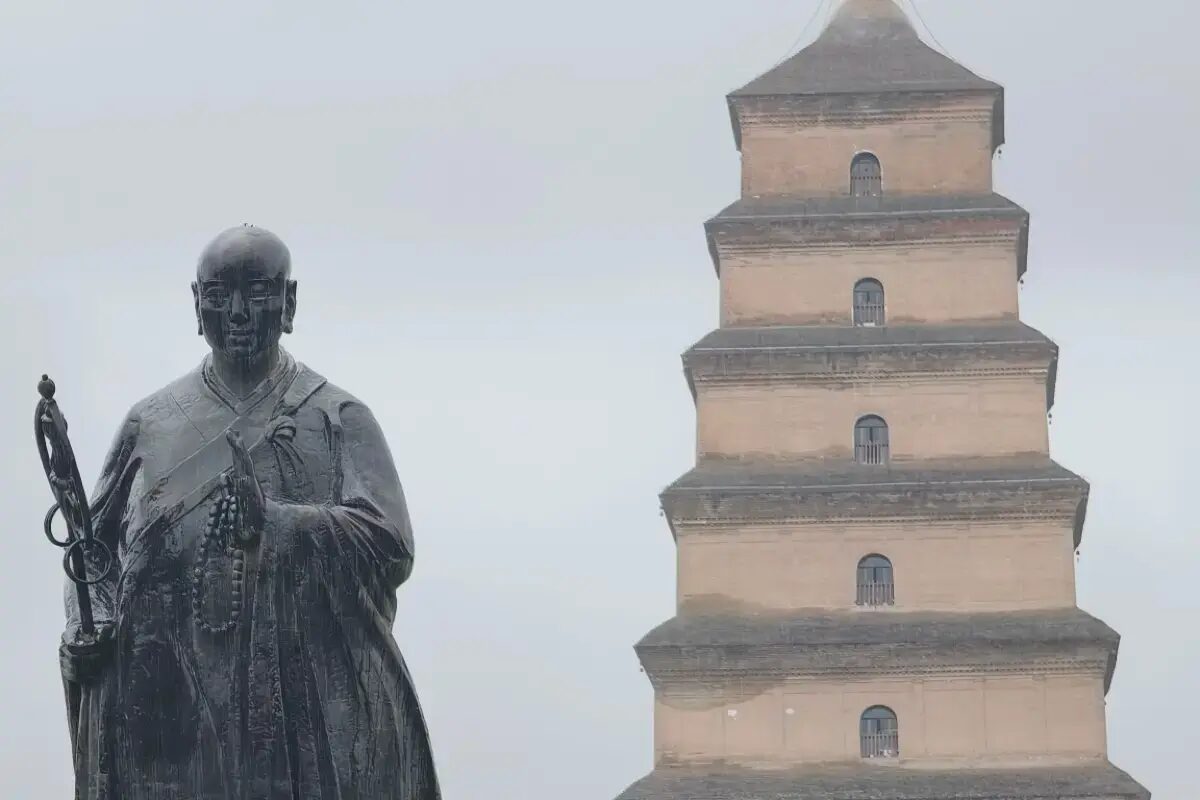
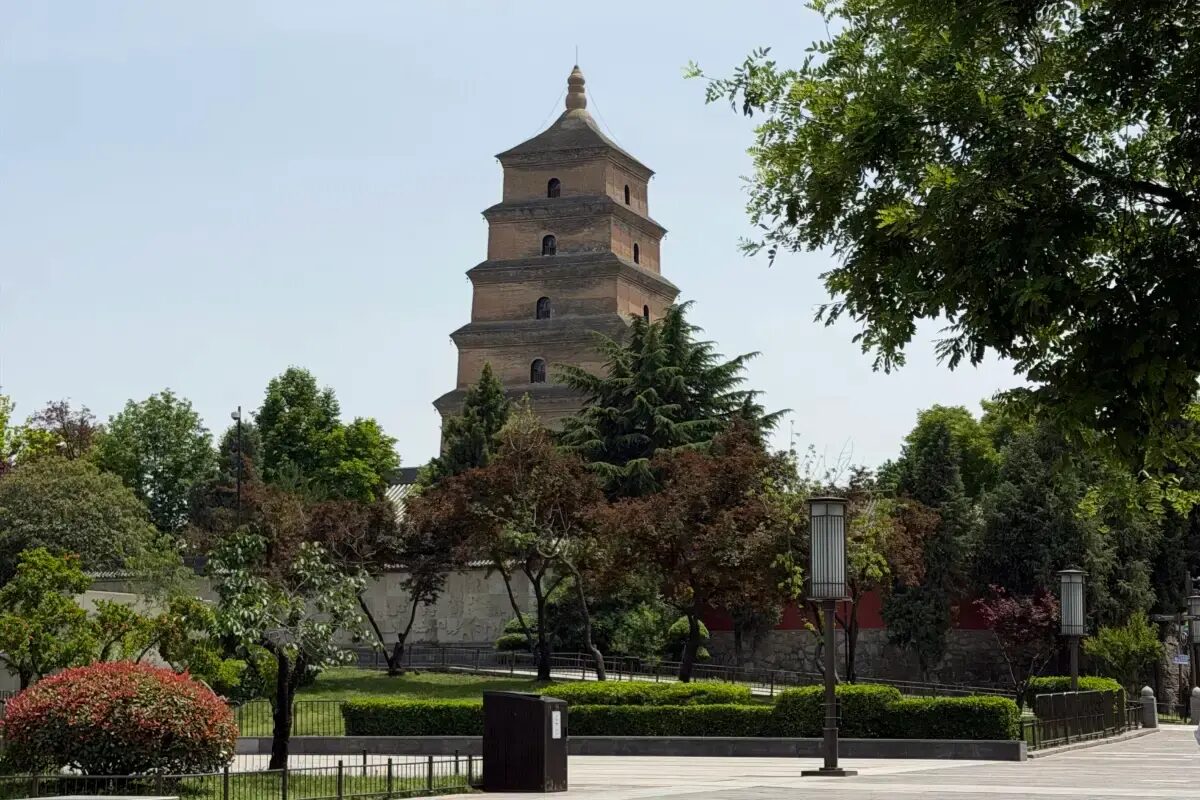
Big Wild Goose Pagoda — written Giant Wild Goose Pagoda about as often in English, and 大雁塔 (Dàyàntǎ) on every sign, ticket and metro announcement you will meet in Xi'an — is the single most-photographed Tang-dynasty structure in mainland China. The two English names are the same building; nothing is signed “Big” or “Giant” on site. The official site — the working Da Ci'en Temple (大慈恩寺, founded 648 CE) — sits in Xi'an's Yanta District, about 4 km south of the city wall. The 64m brick tower was commissioned in 652 CE under Emperor Gaozong specifically to house the Sanskrit sutras and relics that the monk Xuanzang (玄奘, 602–664 CE) brought back from his 17-year overland pilgrimage to India (629–645 CE). He spent his remaining years translating 657 manuscripts here into the canonical Chinese Buddhist texts that later shaped Buddhism across Korea, Japan, and Vietnam.
That pilgrimage is the basis of the 16th-century Ming novel Journey to the West (西游记) — the cultural reference Chinese visitors bring to the pagoda, and the reason anyone who's seen the 1986 CCTV series or Black Myth: Wukong recognises it. The current 7-story exterior dates to a 704 CE rebuild under Empress Wu Zetian; Tang-era brick survives at the lower levels, through 14 earthquakes including the catastrophic 1556 Shaanxi quake that levelled most of historical Chang'an. The pagoda is part of UNESCO's Silk Road World Heritage listing (2014).
Tickets — temple entry vs climbing the pagoda
Two charges to know: temple entry, and a separate fee to climb the tower. The fountain shows on the squares outside are free. Real-name ticketing — bring your passport; buy at the gate window or the WeChat mini-program (search 大慈恩寺).
| What | Price | Notes |
|---|---|---|
| Temple entry 大慈恩寺 | ¥10 | A flat, low fee (old guides quoting ¥40 are out of date). Includes Xuanzang Memorial Hall, the pagoda base, bell & drum towers, gardens. |
| Pagoda climb 登塔 | +¥25 | Bought on-site inside the grounds. Steep, narrow steps, no lift; floors 6–7 currently under repair (climb to the 5th) — most visitors skip it. |
| North Square fountain 北广场音乐喷泉 | Free | Open ground on the far side from the temple gate, free to walk onto at any hour. The headline show is at 21:00 (see below). |
| South Square 南广场 | Free | South of the pagoda, with the Xuanzang statue — it flows straight into Datang Everbright City. |
Hours: the grounds run roughly 8:00am–5:30pm peak (Mar 16–Nov 14) / 8:00am–5:00pm off-peak (last entry ~30 min before close); the climb closes a little earlier. Tickets can sell out a couple of days ahead during the Spring Festival, May 1 and October 1 Golden Weeks.
What to see — pagoda, temple & the two squares
The site is a north–south axis: the working temple and pagoda in the middle, a free plaza at each end. The grounds reward an hour; the squares are where the evening happens.
| Stop | Time · cost | Why it’s worth it |
|---|---|---|
| Da Ci'en Temple grounds 大慈恩寺 | 1 h · ¥10 | The Xuanzang Memorial Hall, the pagoda at golden hour, bell and drum towers, and quiet gardens — an active Buddhist temple, not a museum set. Free incense at the main hall. |
| Climbing the pagoda 登塔 | 30 min · +¥25 | Floors of small sutra and Xuanzang-pilgrimage displays plus the Tang ‘Sacred Teachings’ stele (partial English); floors 6–7 under repair, so currently to the 5th. Skippable unless you’re a Tang/Buddhist-history specialist. |
| North Square fountain 大雁塔北广场 | 1 h, evening · free | The music-fountain plaza north of the pagoda — one of Asia’s largest, and the city’s most spectacular free spectacle after dark (see next section). |
| Datang Everbright City 大唐不夜城 | 1–2 h, evening · free | A Tang-themed pedestrian street directly south of the pagoda — lit nightly, dense with halal Hui street food, hanfu costume-rental shops and free street performances; Xi’an’s most-photographed spot after dark. ⚠️ Its lights come on at dusk, so the hour moves with the season. |
For deeper Tang history with no crowds, the older Small Wild Goose Pagoda (小雁塔, 707 CE) sits inside the free Xi'an Museum complex — a metro ride north-west, not the short hop often quoted, and free but requiring a booking. It is the better intellectual stop on a second-time visit; first-timers come here for the fountain.
The North Square music fountain — the actual headline
North Square (大雁塔北广场), directly north of the pagoda, holds one of Asia’s largest matrix music fountains — jets choreographed to music and lit after dark, with the pagoda as the backdrop. In 2026 there are four shows a day, each about 10 minutes:
| Show | Time | Notes |
|---|---|---|
| Night finale | 21:00 | The one to optimise for — lights, water screen and lasers frame the pagoda after dark; the best photos. |
| Dusk show | 19:00 | Golden-hour version with the last of the sunset; also good. |
| Daytime shows | 12:00 & 16:00 | Lit by daylight, less dramatic. Cancelled on Tuesdays for maintenance (only 19:00 & 21:00 run). |
Crowds & photos: on a busy night the plaza fills fast, so arrive 15–20 minutes early for a spot on the central axis facing the pagoda. The front row catches spray — protect your phone. The show is weather-dependent; the official Da Ci'en Temple WeChat account posts day-of cancellations. After the 9pm show, the crowd flows south into Datang Everbright City, so many visitors eat there before the fountain and linger after.
How to get there
The closest stop is Dayanta Station (大雁塔站), served by Metro Line 3 and Line 4 — take exit B or C for North Square, a short walk. Either line works; both beat a taxi in the 5–7pm rush, when Yanta Road gridlocks.
| From | Best route | Time · cost |
|---|---|---|
| Bell Tower city centre | Metro Line 2 → Line 3 at Xiaozhai; or bus 5 / 27 / 41 | 20 min · ¥3 |
| Xi'an North HSR station | Metro Line 4 → Line 3 at Dayanming Palace | 35 min · ¥4 |
| Xi'an Railway city-centre station | Metro Line 4 direct to Dayanta | 25 min · ¥3 |
| Muslim Quarter | Walk to Bell Tower (10 min), Line 2 → Line 3 | 30 min · ¥3 |
| Xianyang Airport XIY | Airport Bus Line 2 → Bell Tower → metro | 90 min · ¥25+¥3 |
Taxi or DiDi from the Bell Tower runs ¥25–40 in light traffic but can double in the evening rush. Our Xi’an city guide has the wider transport picture.
Best time & how long
The single best window is a late-afternoon-into-evening visit: grounds at golden hour, dinner at Datang Everbright City, then the 8:30pm fountain. Allow 3–4 hours for the full evening (1.5–2 hours if you skip the show).
- April–May & September–October — peak weather (15–25°C); peony gardens in bloom in spring, maples in October. Best overall.
- July–August — hot (32–38°C) and humid; the evening show is comfortable but keep midday indoors.
- December–February — grounds open but sparse; the fountain is suspended on rain or snow days.
- Avoid the three Golden Weeks (Spring Festival, May 1, October 1) — crowds double and tickets sell out 4–5 days ahead.
See our best time to visit China guide for the broader seasonal picture.
Practical for foreigners
- Passport: required — real-name (实名制) ticketing at the gate and in the WeChat Mini-Program.
- Payment: Alipay and WeChat Pay everywhere; the official ticket windows take cards, but carry some cash for Datang Everbright City street food.
- English: signage is partial inside the pagoda; the temple grounds and squares are easy to navigate without Mandarin. Bring a translation app for menus.
- Accessibility: the grounds and both squares are flat and step-free; the pagoda ascent (~250 steps, no lift) is not.
- Costume photos: hanfu (汉服) rental shops around the squares run ¥80–200 for an hour, ¥300–800 with hair-and-makeup and a photographer — fun, but a ~1.5-hour commitment that competes with the show, so do it earlier.
How it fits a Xi'an trip
For most foreign travelers this is the Day 1 evening of a 2–3 day Xi'an base — the evening half of a day that starts elsewhere:
- Day 1 — afternoon City Wall bike ride (1.5–2 h), then Big Wild Goose Pagoda + Datang Everbright City + the 8:30pm fountain.
- Day 2 — full-day Terracotta Army, evening Muslim Quarter food walk.
- Day 3 (optional) — Small Wild Goose Pagoda + the free Xi'an Museum for deeper Tang history.
When NOT to go: the three Golden Weeks (crowds top 15,000 at the fountain), a winter rain or snow night (show suspended), or if you only want the pagoda interior — for most foreigners the ¥25ascent is the skippable part, not the fountain.
Book Big Wild Goose Pagoda tickets & a Xi'an tourNASDAQ: TCOM
Trip.com lists grounds tickets and English-guided Xi'an day tours that pair the Terracotta Army morning with the pagoda + North Square fountain evening — booked in English on a foreign card.
Frequently asked questions
Is Big Wild Goose Pagoda worth visiting?
Yes for most foreign travelers in Xi'an — but the headline isn't climbing the pagoda, it's the FREE music fountain show at North Square, one of Asia's largest. The 64m, 7-story Tang-dynasty pagoda was built in 652 CE to house monk Xuanzang's Sanskrit sutras (the journey behind Journey to the West). The ¥10 temple entry (Da Ci'en Temple) is genuinely worth it — an atmospheric working temple with Xuanzang's translation relics and free incense. The optional ¥25 pagoda climb is for history buffs or the overhead view; most visitors skip it. Most efficient plan: ¥10 temple, catch the 21:00 North Square fountain, then walk south into Datang Everbright City.
How much does it cost?
Da Ci'en Temple grounds entry is ¥10, students ¥5 — cut from ¥40 on 1 September 2025, which is why so many English-language listings still quote the old figure. Climbing the pagoda itself is a separate ¥25, bought on site inside the grounds and not addable to an advance booking; most visitors skip it. The North Square music fountain show is FREE. So the practical budget is ¥10 for the temple + nothing for the fountain, or ¥35 if you also climb. Real-name ticketing — bring your passport; buy at the gate or on the 'Da Ci'en Temple' (大慈恩寺) WeChat mini-program. Free entry for over-65s, under-1.2m/under-6 children, and the disabled with ID.
When is the best time for the music fountain show, and which square is it?
The famous fountain is at NORTH Square (大雁塔北广场), directly north of the pagoda — Datang Everbright City is to the south, so don't mix them up. In 2026 there are four shows a day, each about 10 minutes: 12:00, 16:00, 19:00 and 21:00. The 9:00pm night show is the spectacular one — lights, water screen and lasers framing the pagoda after dark, the best photos. On Tuesdays the two daytime shows are cancelled for maintenance and only the 19:00 and 21:00 run. Arrive 15-20 minutes early on a busy night for a centre-axis spot; the front row gets splashed, so protect your phone.
How do I get there from Xi'an Bell Tower?
The closest stop is Dayanta Station (大雁塔站) on Metro Line 3 and Line 4; take exit B or C for North Square, a short walk. From the Bell Tower it's about 20 minutes via Line 2 then Line 3 (change at Xiaozhai), ¥3; buses 5/27/41 are the ¥2 slow option. A taxi or DiDi is ¥25-40 in light traffic but can double in the 5-7pm rush on Yanta Road. From Xi'an North HSR station it's ~35 minutes via Line 4 to Line 3; from the central Xi'an Railway Station, Line 4 direct, ~25 minutes.
How long should I plan?
1-1.5 hours for the temple grounds, or 3-4 hours for the full evening with the fountain. Time-efficient plan: arrive late afternoon, walk the Da Ci'en Temple grounds (Xuanzang Memorial Hall, the pagoda, the bell and drum towers) at golden hour, then catch the 19:00 or — better — the 21:00 North Square fountain, and finish by strolling south into Datang Everbright City for dinner and its free street performances (the Tang-costume comedy and the 'tumbler' fairy). It's the standard evening half-day, pairing naturally after a daytime Terracotta Army or City Wall visit.
Should I climb to the top of the pagoda?
It's optional for most foreign visitors. The ¥25 ascent is a climb of steep, narrow stone stairs (no lift) inside the 1,370-year-old Tang structure; travellers have reported the top two floors shut for repair and the climb stopping at the fifth, though we could not find a dated notice either way in August 2026 — so treat the view from the top as a bonus rather than the reason you pay. Inside are the Tang 'Preface to the Sacred Teachings' stele (calligraphy by Chu Suiliang), a Ming gilt Buddha and palm-leaf sutras, and the top gives an overhead view toward Datang Everbright City. Climb if you're a Tang/Buddhist-history enthusiast or want the aerial photo; if you only want the pagoda in a photo, the free spots at ground level around the grounds and squares are plenty.
How does this compare to Small Wild Goose Pagoda?
Small Wild Goose Pagoda (小雁塔, Xiao Yan Ta) is the older, less-visited sister site — built 707 CE (55 years after Big Wild Goose), originally 15 stories but reduced to 13 after a 1487 earthquake. ⚠️ It is a metro ride NORTH-WEST rather than the short southwest hop often quoted: about 3 km in a straight line and over 5 km by road. It sits inside Xi'an Museum's complex (西安博物院) and has far smaller crowds. ⛔ Free, but not walk-in — one real-name booking covers the whole park, and it is CLOSED ON TUESDAYS. For Tang-history depth visitors it is the better intellectual stop; for first-time foreign visitors the standard recommendation is still Big Wild Goose for the fountain show.
What else is nearby?
Three Tang-themed sites cluster around the pagoda. (1) Datang Everbright City (大唐不夜城) — a Tang-themed pedestrian street extending SOUTH from the pagoda's South Square, free, lit nightly, the most-Instagrammed spot in Xi'an, dense with halal Hui-Chinese street food, Tang-costume rental shops (¥80-200/hour for a hanfu rental + photoshoot) and free street performances. (2) Tang Paradise / Datang Furong Yuan (大唐芙蓉园) — a themed park just southeast with Tang-style buildings, lakes and a nightly water-and-fire show; ~¥120 ticket. (3) The North Square fountain itself. Plan: late-afternoon temple, dinner at Datang Everbright City, then the 9pm North Square fountain. Tang Paradise is a separate half-day — too much to combine in one evening.
Sources
Checked August 2026 · Written from our own first-hand travel in China.