Airport guide · Guangzhou
Guangzhou Baiyun Airport (CAN): T3, transfers & the 2026 shake-up
Everything moved in 2025-26: T1 closed, the giant new T3 opened and took nearly every international flight, and an intercity railway now runs from both terminals to the Canton Fair and the Guangzhou South HSR hub. Here is the airport as it actually works now.
China for Travelers EditorialUpdated Terminal status & timings re-verified Jul 2026
- Intercity rail
- ¥5-23
- Pazhou 29 min · GZ South 28 min
- Metro Line 3 (T2)
- ¥7-12
- ~45-60 min to Tianhe CBD
- Taxi / DiDi
- ¥120-200
- ~45-70 min off-peak + toll
- T2 ↔ T3
- 6 min
- intercity ¥5 · free shuttle 24 h
Two checks before you fly. ① Ignore anything routing you to Terminal 1 or the “Airport South” metro stop — T1 closed for reconstruction in May 2026 and trains skip its stations. ② China Southern flies from T2; almost every other airline, including most international, now uses the new T3. The boarding pass shows which.
Terminals: T2, the new T3 — and what happened to T1
Baiyun rebuilt itself between October 2025 and May 2026. The sequence: T3 opened on 30 October 2025 (together with runway five — the first five-runway airport on the mainland), every remaining international airline moved to T3 on 22 January 2026, and on 7 May 2026 T1 closed for reconstruction, its last 11 domestic carriers moving to T3 the same night. Guides written before late 2025 describe an airport that no longer exists.
T2 — China Southern home base — ALL CZ flights (domestic + international) plus partner and several Asian carriers. Metro Line 3 (Airport North 机场北) and the Baiyun Airport North intercity station sit under its transport center. Traveller reports place some Asian carriers (e.g. Japan Airlines, Thai, Vietnam Airlines, Asiana) here too — the boarding pass is authoritative.
T3 — the 2025 mega-terminal — nearly ALL other airlines: most international/HK-Macau-Taiwan flights (moved 2026-01-22) + Air China, China Eastern, Hainan, Shenzhen Air, Juneyao, Spring and more. NO metro station yet — rail access is the Baiyun Airport East intercity station (concourse B2, 3-5 min walk to check-in); taxi ranks at arrivals door 72 (domestic) / 75 (international), ride-hail at the P12 garage.
T1 CLOSED for reconstruction since 2026-05-07 — its 11 remaining domestic carriers moved to T3, and both of its stations (Metro Airport South 机场南, Baiyun Airport South intercity) are skipped by passing trains. No satellite concourses: T2 and T3 are separate full terminals ~16 km apart by road.
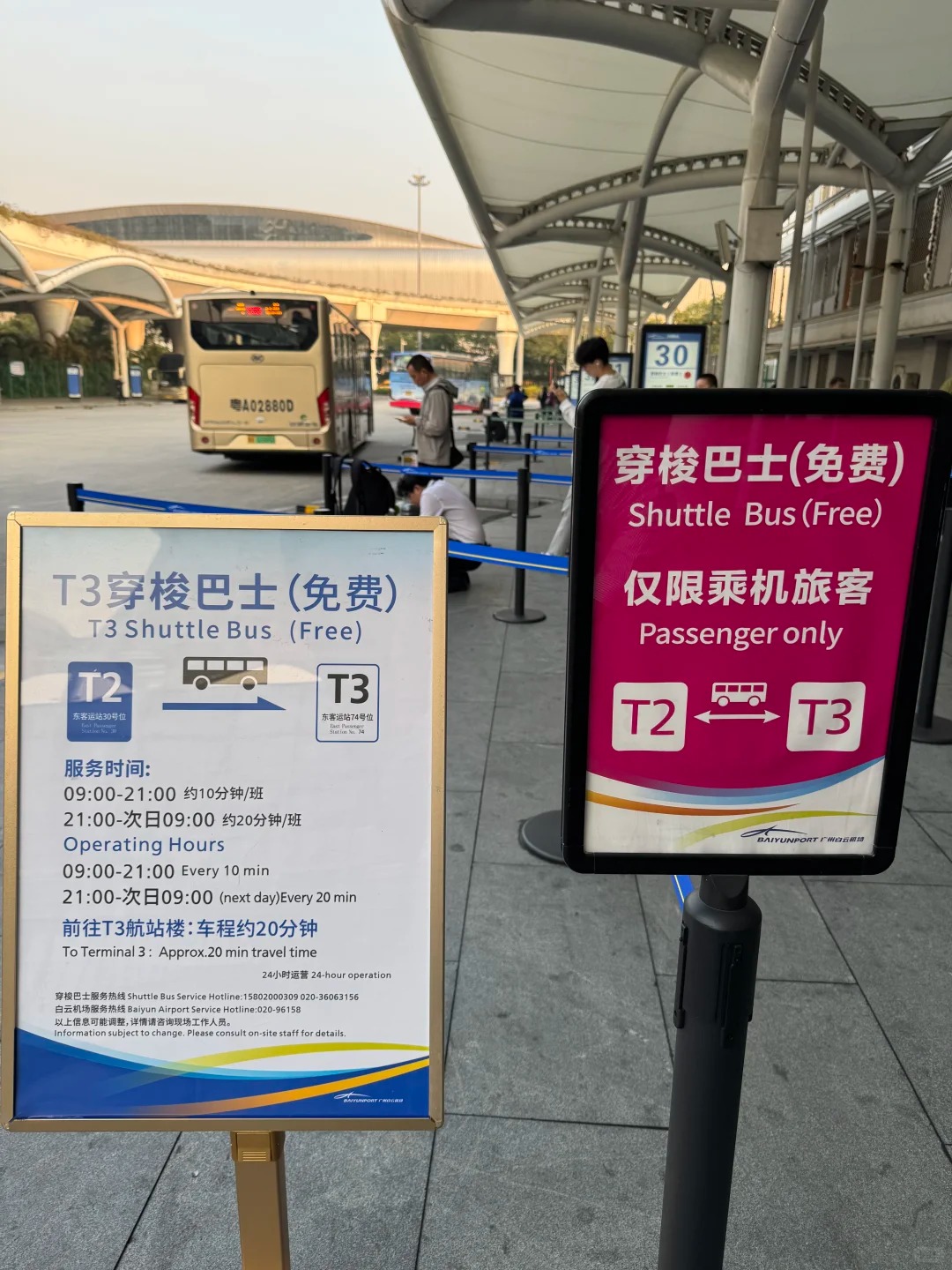
Read your boarding pass: The terminal prints on the boarding pass — check it, never assume. 2026 rule of thumb: China Southern = T2; almost everything else, including most international airlines = T3. Between T2 and T3: intercity train ¥5 / 6 min (Baiyun Airport North ↔ East), or the free 24 h shuttle ~20-25 min (T2 bay ~30, Transport Center East station; T3 Transport Center bus zone).
Guangzhou airport transfer: which option is right for you?
Four ways from CAN into the city — pick by terminal, destination and landing time. The 2025-new intercity railway changed the defaults:
Intercity railDonghuan (East Ring) intercity 广州东环城际
¥5-23 by distance
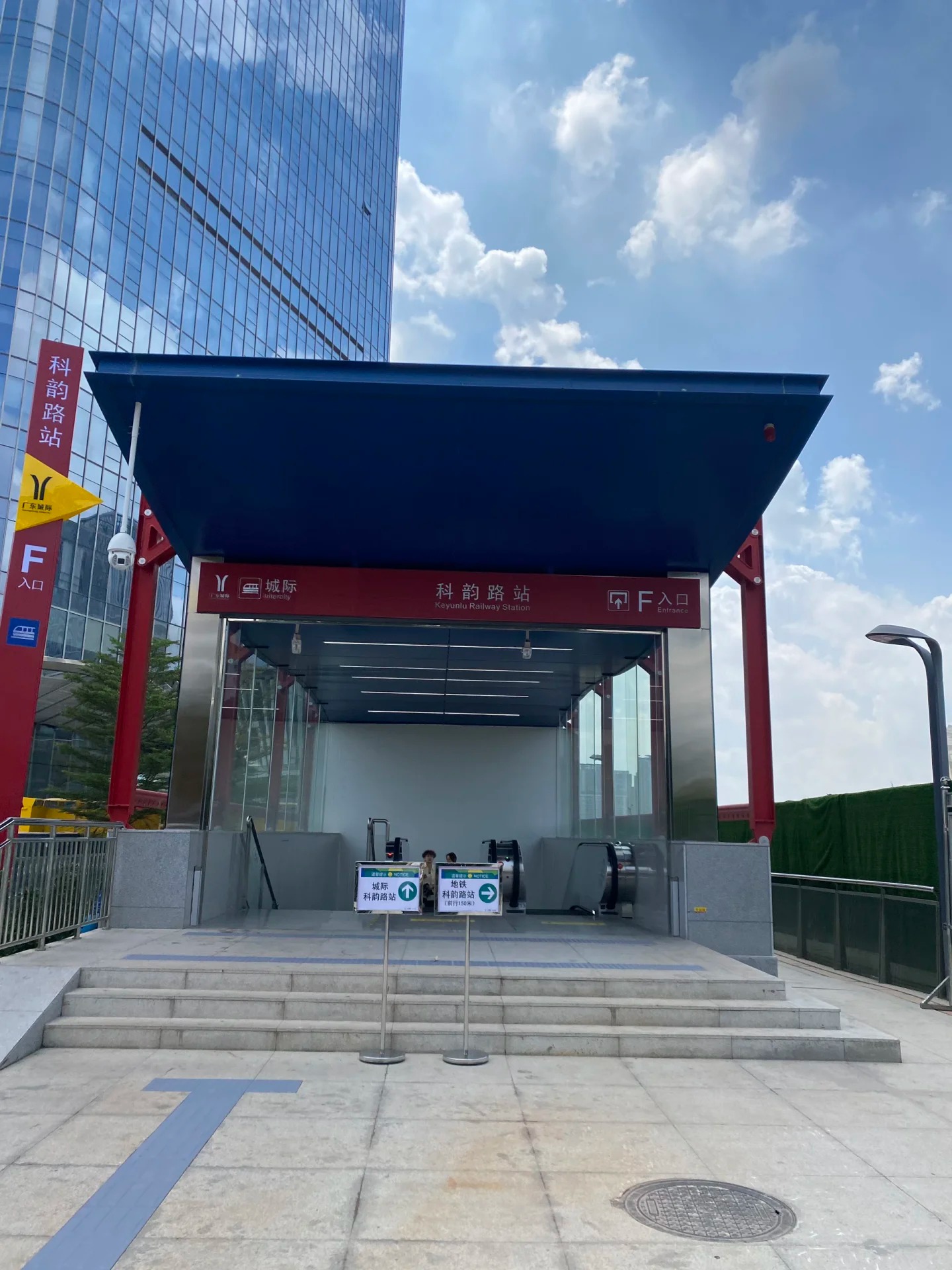
→ Pazhou / Canton Fair (29 min), Keyun Rd (23 min, Metro Line 5), Panyu = Guangzhou South HSR complex (28 min) · ~23-31 min train time by stop
Pick it if: Canton Fair, Guangzhou South HSR, or the east side of town — turn-up-and-go every ~15 min
Boards at Baiyun Airport North (under T2) or Baiyun Airport East (T3 concourse B2). Buy on 12306 (passport OK) or tap through with the Guangzhou Metro app QR — unreserved, metro-style. Last regular trains from the airport ~21:43 (North) / ~21:51 (East); a night express extends last departures to 22:34 / 22:41 (toward Foshan West via Pazhou).
MetroMetro Line 3
¥7-12
→ Tianhe CBD (Tiyu Xilu) direct; transfer for the old city · ~45-60 min to Tianhe; ~70-80 min to Beijing Rd with one change
Pick it if: the default from T2 for central Guangzhou — beats traffic
From T2 only: Airport North 机场北 station (Airport South serves the closed T1 and is skipped). From T3, first ride the Konggang Line 2 branch bus to Gaozeng station (¥2, ~15 min, every 10-15 min), the free shuttle to T2, or the intercity one stop. Line 3 runs until ~23:00-23:15 from the airport.
BusAirport Express coaches 空港快线
from ¥19.9 (most ¥20-50)
→ Zhujiang New Town, Guangzhou Railway Station, Tianhe, Guangzhou South, Foshan and more (~12 lines) · ~45-90 min by line and traffic
Pick it if: heavy luggage on a direct line — or any landing after the trains stop
T2 boards at the Transport Center East bus station, T3 at the West bus station. Night lines (Tianhe / Yuexiu directions) run past midnight — to ~0:55, some to ~5:30.
Taxi / ride-hailTaxi / DiDi
~¥120-200 metered + ¥10-26 toll
→ central Guangzhou · ~45-70 min off-peak
Pick it if: groups, late arrivals, or a hotel off the rail lines
Amap route: T2 → CBD ~45 km (toll ~¥10), T3 → CBD ~40 km (toll ~¥26) — tolls are passenger-paid. Ranks: T2 arrivals level; T3 door 72 (domestic) / 75 (international). Ride-hail pickup: T2 P8 garage level 2, T3 P12 garage. DiDi takes foreign cards in-app or via Alipay.
Landing late? Rail quits early: last intercity ~21:43/21:51 (night express 22:34/22:41), Metro Line 3 ~23:00-23:15. After that: the night airport coaches (to ~0:55, some lines ~5:30 — T2 East / T3 West bus stations) or the 24 h taxi/DiDi ranks. Late-night ride-hail hack from traveller reports: match faster at T2 departures level 4 door 44, or T3 P12 garage.
For a red-eye arrival, heavy luggage or a family, a pre-booked private transfer puts a driver at arrivals with your name — no late-night ride-hail queue:
The last mile: what to show, where to stand, where to buy
Baiyun is mid-rebuild, which makes the last hundred metres unusually easy to get wrong: one terminal has closed, one has no metro, and they are 16 km apart. Here are the characters to show a driver, the ride-hailing pickup, and how the airport train is actually paid for.
1. Show this to your driver
Never say “T1”. Terminal 1 closed for reconstruction on 2026-05-07 — Chinese mapping data now lists it as 暂停营业 (suspended). A driver sent to T1 delivers you to a building with no flights and a 16 km recovery.
| Show this | What it says |
|---|---|
| 广州白云国际机场 | Guangzhou Baiyun International Airport (CAN) |
| 广州白云国际机场T2航站楼 | Terminal 2 — all China Southern flights |
| 广州白云国际机场T3航站楼 | Terminal 3 — nearly everything else, incl. most international |
| 机场大道东888号 | T2 street address |
| 仁胜街93号 | T3 street address |
Names, addresses and the T1 closure status cross-checked against Amap (高德地图) POI records, 2026-07-27.
2. Ride-hailing: where to stand, what to type
At both terminals, ride-hailing collects from a marked zone inside a multi-storey car park, not the arrivals kerb — follow the 网约车 signs from arrivals and walk there before you order, or the driver circles while the meter thinks about starting. Traveller reports put the current zones at the P8 car park (Level 2) for T2 and the P12 car park for T3; the signage is the authority on the day, since the zones move with the building works.
Official metered taxi ranks are separate and easier to find: at T3 they are at arrivals door 72 (domestic) and door 75 (international); at T2, on the arrivals level. Use the marked rank — never an approach inside the terminal.
Flying out, type the terminal. Set 广州白云国际机场T3航站楼 (or T2航站楼) as the destination. “Baiyun Airport” on its own can route you to the wrong one of two terminals that are a 16 km road journey — and no walk — apart.
DiDi Rider, the international app, installs without a Chinese SIM, runs in English and takes most foreign Visa and Mastercard; the 滴滴出行 mini-program inside Alipay is the other reliable route. Setup in our DiDi for foreigners guide.
3. Where to buy the airport train ticket
The Donghuan (East Ring) intercity is the mode most arrivals should take, and it is not a metro — it is a national-railway service, so it is bought differently. Two ways, and the first is the one foreign visitors can complete:
12306 — works on a passport
The national rail booking system takes a passport as ID; buy in advance or on the spot, then collect or scan through. Our 12306 walkthrough covers the English flow and what to do when a foreign card is declined.
Guangzhou Metro app QR — tap straight through
Trains on this line run unreserved, metro-style, so a QR from the Guangzhou Metro app opens the gates with no seat booking. The app is Chinese-language and expects a Chinese payment method — real friction on a foreign card.
Board at 白云机场北站 (Baiyun Airport North, under T2) or 白云机场东站 (Baiyun Airport East, in the T3 transport centre on level B2, a 3-5 minute walk from check-in). Fares run ¥5-23 by distance and trains go every ~15 minutes. Full booking mechanics: how to use 12306 in English.
Last regular trains leave the airport around 21:43 (North) and 21:51 (East), with a night express extending to 22:34 / 22:41. After that it is the night coaches or a taxi.
Fast facts
| Fact | Detail |
|---|---|
| Chinese name | 广州白云国际机场 (Guǎngzhōu Báiyún Guójì Jīchǎng) |
| IATA / ICAO | CAN / ZGGG |
| Location | ~28-30 km north of central Guangzhou (Baiyun/Huadu districts) |
| Terminals | T2 + T3 (T1 closed for rebuild since 2026-05-07) |
| Airline split | China Southern → T2 · nearly all others incl. most international → T3 |
| Intercity rail | ¥5-23 · Pazhou 29 min · Guangzhou South 28 min · last ~21:43/21:51 (night express 22:34/22:41) |
| Metro Line 3 | ¥7-12 · from T2 (Airport North) only · until ~23:00 |
| Airport coaches | from ¥19.9 · ~12 lines · night lines to ~0:55+ |
| Taxi / DiDi | ¥120-200 + ¥10-26 toll · ~45-70 min off-peak |
| T2 ↔ T3 | intercity ¥5 / 6 min · free 24 h shuttle ~20-25 min · ~16 km by road |
| VAT refund | airside, both terminals · ¥200/store/day threshold · arrive ~3 h early |
| Cross-border coaches | Zhuhai Gongbei ~¥115 · Shenzhen Bay ~¥120 · west bus stations |
| To Shenzhen Bao’an airport | through intercity announced imminent (Jul 2026) · ~100 min |
Onward: Guangzhou South HSR and Hong Kong
Flying into CAN then taking a high-speed train onward? The hub is Guangzhou South Railway Station — and the intercity railway made it easy: Donghuan intercity direct from Baiyun Airport North (T2) or East (T3) to Panyu station — inside the Guangzhou South complex, exit G then ~1 min walk to the East Square, ~28 min train time, every ~15 min. The winning move: a taxi to Guangzhou South is ~62 km (~¥170-220), the train is ¥~20. From Guangzhou South, HSR reaches Hong Kong West Kowloon in ~48 min-1 h. Allow ~30-40 min for the Panyu → national-rail transfer (separate gates, security re-check).
To Hong Kong: from Guangzhou South, the HSR reaches Hong Kong West Kowloon in ~48 min-1 h with immigration co-located at West Kowloon — ~2.5-3 h door to door from the airport, ~¥150-170 all in. That is the clean path to central Hong Kong; the coach alternative is in the next section. Booking paths in 12306 vs Trip.com.
Onward to Macau and Shenzhen: the Greater Bay Area from CAN
CAN doubles as a gateway for the whole Pearl River Delta — many travellers land here and head straight for Macau, Shenzhen or Hong Kong without staying in Guangzhou. The 2026-new direct coaches leave from the Transport Center WEST bus stations at both T2 and T3:
Macau — coach to Zhuhai Gongbei. Direct coach to Zhuhai Gongbei port (~¥115, per 2026 traveller reports) — walk across the busiest land border in the world straight into Macau. No rail alternative reaches Gongbei faster with luggage.
Hong Kong with luggage — coach to Shenzhen Bay. Direct coach to Shenzhen Bay port (~¥120, ~9:30-20:20) — clear both immigration desks on foot, then an included shuttle connects onward. Best with big bags for HK's west side; for central Hong Kong the HSR via Guangzhou South usually wins.
Shenzhen — rail now, through trains imminent. Today: the Shenzhen Bay coach, or rail via Guangzhou South / Guangzhou North to Shenzhen North (see the Guangzhou-Shenzhen rail guide). Announced as imminent in July 2026: a through intercity linking CAN directly with Shenzhen Bao'an Airport in ~100 min (~¥78 reported) — check locally whether it has opened.
Booking friction: the cross-border coaches sell through a Chinese WeChat mini-program — advance booking, Chinese interface, and foreign cards often fail. Workable fallbacks: the rail route (12306 takes passports), or a pre-booked private transfer with an English booking path.
Airport → Canton Fair (Pazhou)
The twice-yearly Canton Fair pulls tens of thousands of buyers straight off arriving flights, and the 2025-new intercity is now the cleanest link: airport to Pazhou station in 29 min (¥~23, every ~15 min from either terminal's station). Pazhou station sits under the west side of the Canton Fair Complex, ~1 km from the halls — a 15-minute walk, a flag-fall taxi hop, or a shared bike.
- Fair shuttle bus: ¥35 with a Fair badge (~¥50 without) — T2 boards at the Transport Center East bus station (bay ~30), T3 at the West bus station; airport→fair ~9:00-16:00, fair→airport ~11:00-18:00, rolling departures at peak. Trap: on each phase's final day the airport→fair direction doesn't run — take the train.
- Metro chain: Line 3 from T2 → Line 8 to Xingangdong (hall A) or Pazhou (halls B/C), ~1.5 h — the fallback when trains and shuttles are done.
- Taxi: ~50 km, ~¥150-200 with tolls, ~48 min off-peak — but Fair-week traffic around the complex is brutal at 7:30-9:00.
Where to stay for the Fair: not at the airport — it is ~50 km from the halls. Base in Pazhou itself or Zhujiang New Town (Metro Line 8 direct); see Where to stay in Guangzhou for the area-by-area comparison.
In-terminal services
SIM cards
- Foreigner Service Center 外籍人士便利化服务中心 (carrier SIMs + payments help, multilingual) — T2 international arrivals hall, level 1.
Passport real-name registration is required at any counter. T3 arrivals has no dedicated carrier counter yet (traveller reports, 2026-07) — landing at T3, a travel eSIM activated before departure (data-only, no +86 number) is the low-friction path. See our connectivity guide.
Left luggage
T2: departures level 3 at both ends of the Yunjishi retail strip (southwest side 5:30-23:30, southeast side 24 h), arrivals level 1 east, and by the KFC at international departures island K — ~¥25-35/day for a 24-inch case, and free with two boarding passes on a <48 h transit. T3: departures level 4 west behind island C only; no arrivals-level storage yet (as of July 2026) — landing at T3 with bags to stash, use T2 or a luggage-forwarding service.
VAT refund (离境退税) — it happens airside here
Where: Both terminals, AIRSIDE in international departures: T2 — right after security near check-in island E (refund window by the currency exchange); T3 — east side of the airside retail zone, toward gate A939.
Customs verification first, refund window (Agricultural Bank counters) second — both inside the secure zone. Refund goods in checked bags? Tell the check-in agent BEFORE dropping the bag: staff hand it back so you carry the goods through to the customs desk, then re-drop it per their instructions. Threshold ¥200 per store per day (lowered from ¥500 in April 2025); receipts must match the passport name. Payout: WeChat scan credits instantly — card refunds take 1-2 months and foreign cards sometimes fail, so take cash or the instant channel where offered.
Timing: Peak queues run 1.5 h+ with a single window open — arrive ~3 h before an international departure if you plan to refund. Counters staffed ~8:00-23:00.
Full sequence and eligibility basics in the China departure checklist.
Customs (海关申报)
Standard PRC two-channel system after baggage claim: green (nothing to declare — most visitors walk through) or red for declarable items — cash ≥ US$5,000-equivalent or ≥ ¥20,000 RMB, goods above the personal allowance, antiques/artwork leaving China (export approval required), and professional camera/drone kits worth declaring on arrival so departure customs can't treat them as China purchases.
Sleeping at or near CAN
In the terminals: Timed rest pods (拾眠) at T2: international arrivals level 1 by door 53, and domestic departures level 4 — ~¥38/h daytime, ~¥68/h overnight, ~¥109 overnight package. A free rest zone with recliners sits on T2 arrivals level 2 (fills up on weekends).
On the field & nearby: A Hilton cluster rings the field (Hilton Garden Inn, Home2 Suites) with airport shuttles; China Southern's Pearl Hotel offers free stopover rooms on eligible CZ transit itineraries — worth checking before paying for a night.
Stay out here only for a genuinely early flight or late arrival — the airport is ~28-30 km from town. For basing the rest of the trip, see Where to stay in Guangzhou.
Frequently asked questions
Which terminal will my flight use at Guangzhou Baiyun Airport?
Check the boarding pass — but know the 2026 map: Terminal 1 CLOSED for reconstruction on 7 May 2026 and handles no flights. T2 is the China Southern home base — all CZ flights, domestic and international, plus partner and several Asian carriers (traveller reports place Japan Airlines, Thai, Vietnam Airlines and Asiana there). The new T3 (opened 30 October 2025) handles nearly everything else: all other international and HK/Macau/Taiwan flights moved there on 22 January 2026, along with Air China, China Eastern, Hainan, Shenzhen Air, Juneyao, Spring and more. Rule of thumb: China Southern = T2, almost everything else = T3.
How do I get from Baiyun Airport to central Guangzhou?
Four ways. The Donghuan (East Ring) intercity train — the 2025-new option — runs from Baiyun Airport North (under T2) and Baiyun Airport East (T3): Pazhou/Canton Fair in 29 min, Keyun Rd (Metro Line 5) in 23 min, Panyu inside the Guangzhou South HSR complex in 28 min; ¥5-23, turn-up-and-go every ~15 min. Metro Line 3 from T2's Airport North station reaches the Tianhe CBD in ~45-60 min for ¥7-12 (T3 has no metro — see below). Airport Express coaches cover ~12 city lines from ¥19.9, with night lines running past midnight. A taxi or DiDi runs ~¥120-200 metered plus ¥10-26 in tolls, ~45-70 min off-peak — the Amap route is ~45 km from T2, ~40 km from T3.
Does Baiyun Airport have a metro station? What about T3?
T2 yes, T3 no. Metro Line 3's north end serves T2 at Airport North (机场北), running into the Tianhe CBD until ~23:00. Airport South (机场南) served the now-closed T1 — trains skip it, so ignore any old directions pointing there. T3 has no metro station yet; three workarounds: ① the Konggang Line 2 branch bus to Gaozeng station on Line 3/9 (¥2, ~15 min, every 10-15 min), ② the free 24 h shuttle to T2 (~20-25 min), ③ the intercity train one stop to Baiyun Airport North (¥5, 6 min).
How do I get from CAN to Guangzhou South Railway Station for the HSR?
Take the Donghuan intercity — it delivers you to Panyu station inside the Guangzhou South complex in ~28 min (¥~20): exit G, walk ~1 minute to the East Square, then allow ~30-40 min to re-clear security for the national-rail side. Trains run every ~15 min from Baiyun Airport North (T2) and East (T3); buy on 12306 with a passport or tap through with the Guangzhou Metro app. Don't taxi it: the road route is ~62 km and ~¥170-220.
How do I get from Guangzhou airport to Hong Kong, Macau or Shenzhen?
Hong Kong: rail is the clean path — intercity to Guangzhou South (28 min), then HSR to Hong Kong West Kowloon (~48 min-1 h); ~2.5-3 h door to door, ~¥150-170 total. With heavy luggage, a direct coach to Shenzhen Bay port (~¥120, from the WEST bus station at either terminal) lets you walk the border and connect onward. Macau: the direct coach to Zhuhai Gongbei port (~¥115, same west bus stations) — walk across the border into Macau. Shenzhen: the same Shenzhen Bay coach, or rail via Guangzhou South / Guangzhou North to Shenzhen North; a through intercity linking CAN directly with Shenzhen Bao'an Airport (~100 min) was announced as imminent in July 2026. Note the cross-border coaches book through a Chinese WeChat mini-program — friction with foreign cards; the rail route or a pre-booked private transfer are the fallbacks.
How do I get to the Canton Fair from Baiyun Airport?
The Donghuan intercity is the 2025-new answer: airport to Pazhou station in 29 min (¥~23), landing under the west side of the Canton Fair Complex ~1 km from the halls — a 15-min walk, a flag-fall taxi hop, or a shared bike. During Fair phases a dedicated shuttle also runs: ¥35 with a Fair badge (~¥50 without), boarding at T2's Transport Center East bus station (bay ~30) and T3's West bus station, airport→fair ~9:00-16:00. Trap: on each phase's final day the airport→fair direction doesn't run. The metro chain (Line 3 → Line 8 to Xingangdong/Pazhou) takes ~1.5 h.
Where is the VAT refund at Guangzhou airport and how long does it take?
Both terminals process refunds AIRSIDE, inside international departures — customs verification first, then the refund windows (Agricultural Bank counters): at T2 right after security near check-in island E with the payout window by the currency exchange; at T3 on the east side of the airside retail zone toward gate A939. Refund goods in checked bags? Tell the check-in agent before dropping the bag — staff hand it back so you can carry the goods through verification, then re-drop it. Threshold is ¥200 per store per day (lowered from ¥500 in April 2025). Queues run 1.5 h+ at peak — arrive ~3 h ahead. WeChat payout credits instantly; card refunds take 1-2 months and foreign cards sometimes fail.
Can I sleep at Guangzhou airport overnight?
Yes. T2 has timed rest pods (拾眠) at international arrivals level 1 by door 53 and domestic departures level 4 — ~¥38/h daytime, ~¥68/h overnight, ~¥109 overnight package — plus a free rest zone with recliners on arrivals level 2 (fills up on weekends). For a real bed, a Hilton cluster rings the field (Hilton Garden Inn, Home2 Suites) with airport shuttles, and China Southern's Pearl Hotel offers free stopover rooms on eligible CZ transit itineraries — check that before paying for a night.
How do I get to Guangzhou from Hong Kong airport (HKG)?
Flying into Hong Kong instead? Three overland paths from HKG: ① a direct cross-border coach from the HKG ground transport centre to Guangzhou (~3.5-4 h including the border), ② the SkyPier ferry to a Pearl River Delta port without formally entering Hong Kong, ③ the Airport Express into town, then HSR from Hong Kong West Kowloon to Guangzhou South (~48 min on the train). The coach is simplest door to door; the train is fastest once at West Kowloon.
Related Guangzhou guides
- Guangzhou South Railway Station — the HSR mega-hub, 28 min from the airport by intercity.
- Guangzhou to Hong Kong by rail — West Kowloon HSR, fares and the border in detail.
- Guangzhou to Shenzhen — the corridor trains and which station to use.
- Guangzhou Metro guide — paying with a foreign card; Line 3 is the airport line.
- Where to stay in Guangzhou — the five hotel areas compared.
- Guangzhou city guide — attractions, transport, essentials.
- 240-hour visa-free transit — CAN is an eligible transit port for most Western nationalities.
- Alipay for foreigners — set up payments before you ride the metro out.
Browse Guangzhou hotels on Trip.com
Sources
Checked August 2026 · Written from our own first-hand travel in China.