Key takeaways
- An active Buddhist temple about 1,400 years old on the bank of the Grand Canal, west of Suzhou’s old city by the ancient Maple Bridge (枫桥).
- Famous for one Tang poem — “Maple Bridge Night Mooring” (枫桥夜泊) — whose midnight bell made it known across East Asia; reviews split, so come for the poem, not the scale.
- You can strike the bell yourself, ¥5 for three rings. But the giant “First Bell” and the poem stele are actually next door in the free Maple Bridge (枫桥) scenic area — worth pairing, with an evening light show.
- Admission is ~¥20 (includes three incense sticks); plan a compact ~1 hour.
- Best pairing: the quieter West Garden Temple (西园寺, ¥5 — resident cats and good vegetarian noodles), a short hop away; reach both by taxi.
What Hanshan Temple is
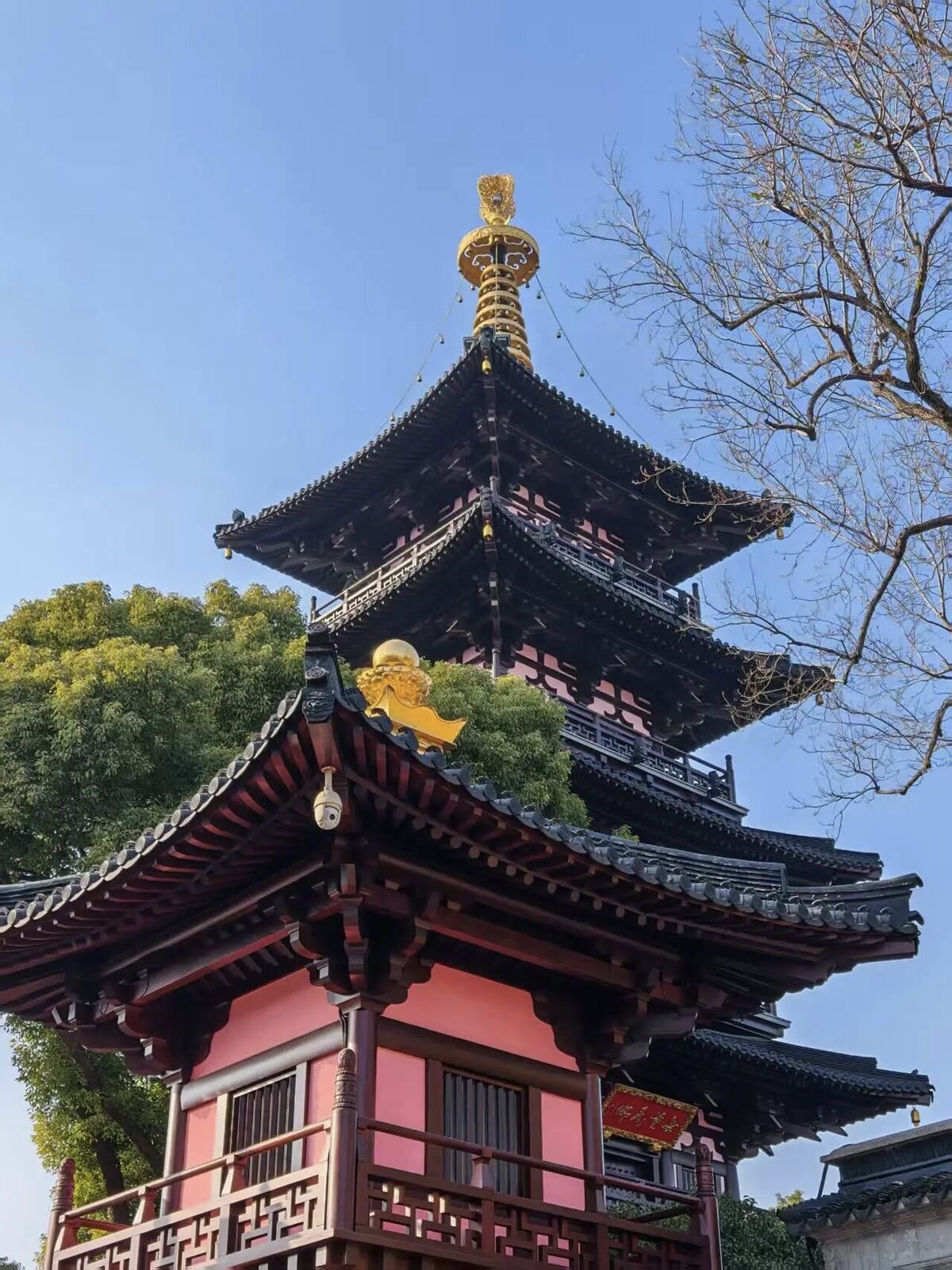
Hanshan Temple (寒山寺) — the “Cold Mountain Temple” — is an active Buddhist temple about 1,400 years old, standing west of Suzhou’s old city on the bank of the Grand Canal, beside the ancient Maple Bridge (枫桥, Fengqiao). It takes its name from Hanshan, an eccentric Tang-dynasty poet-monk associated with the site. The temple has been destroyed and rebuilt many times over the centuries; what you see today is comparatively modern, but the setting — a yellow-walled temple, a stone arched bridge and the canal lined with willows — is among the most painted and photographed in Suzhou.
Its fame rests on a single poem. In the Tang dynasty the poet Zhang Ji (张继) moored his boat here overnight, heard the temple’s bell strike at midnight, and wrote “Maple Bridge Night Mooring” (枫桥夜泊) — a few lines still memorised by Chinese schoolchildren, which carried the temple’s name and its bell across China, Japan and Korea. That literary weight, more than the architecture, is why people come.
Tickets & what's inside
Hanshan Temple charges a modest admission ticket. Inside, the draw is the temple’s poetry and bell heritage rather than a sprawling complex — you can see the main halls, the courtyard and the bell tower in well under an hour.
| Item | What it is | Price |
|---|---|---|
| Admission | Temple entry — the halls, the courtyard, the bell tower and the canal-side grounds; comes with three incense sticks. | ~¥20 |
| Strike the bell | Ring the bell in the bell tower yourself — popular given the poem. | ¥5 / 3 rings |
| Maple Bridge scenic area 枫桥景区 (next door) | The giant “First Bell,” the huge poem stele, the Maple Bridge and the Grand Canal — with an evening light show. | Free |
One thing to know: the record-breaking ~108-tonne bell and the huge poem stele are not in the temple — they’re in the adjacent, free Maple Bridge (枫桥) scenic area, which stays open into the evening (to ~9pm) and projects the poem onto a wall after dark. So the natural plan is the paid temple for the story, then the free scenic area for the bell and the night atmosphere. On New Year’s Eve the bell is struck 108 times at a separate ticketed event that draws thousands. The temple opens 07:30–17:30, and stops admitting at 17:00.
How to see it & getting there
Hanshan Temple sits west of the old city on the Grand Canal, and it is not next to a metro station. The nearest stops are on Metro Line 1 (滨河路 / 塔园路), about 1.5–2 km — a 20–30 minute walk — away, so most visitors take a taxi or DiDi, roughly 15–20 minutes from the city centre.
| From | How | Time |
|---|---|---|
| Suzhou city centre | Taxi or DiDi — the easy, direct way in | ~15–20 min |
| Metro Line 1 (滨河路 / 塔园路) | Nearest stations, then walk ~1.5–2 km to the temple | ~20–30 min on foot |
| Maple Bridge (枫桥) | Adjacent — the canal-and-arched-bridge scene is right outside | A few minutes’ walk |
Because there is no metro at the door, the simplest plan is to taxi in and pair the temple with the Maple Bridge / Fengqiao scenic area just outside. Our things-to-do guide sets out how Suzhou’s sights stitch together.
Best time & how long
| What | Detail |
|---|---|
| Time needed | About 1–1.5 hours, with the adjacent Maple Bridge |
| Morning | Quietest and best for photos of the canal and arched bridge |
| New Year’s Eve | The famous 108 bell strikes — atmospheric but very crowded |
| Pair with | Maple Bridge / Fengqiao scenic area for a relaxed half-day |
The temple is compact, so timing is about light and crowds rather than needing a full day. A morning visit gives the calmest grounds and the cleanest canal photos; the New-Year’s-Eve bell ceremony is the one date that draws a real throng.
Practical & how it fits a Suzhou trip
- It’s a stop, not an outing — fold Hanshan into a half-day on Suzhou’s western edge rather than making a separate trip for it.
- Go for the story — the halls are a quick look and quite commercialised (souvenir stalls all around); the reason to come is the poem, the bell and the canal-and-bridge scene outside.
- Pair with the free Maple Bridge area — the giant bell, the poem stele and the canal are next door for free, best in the evening; and the quieter West Garden Temple (西园寺, ¥5) nearby has resident cats and good vegetarian noodles.
- Taxi in — there’s no metro at the door, so a taxi or DiDi (~15–20 min from the centre) is the practical way to arrive.
- Pay with Alipay or WeChat Pay — the ticket window and on-site shops are cashless-first; set up a mobile wallet before you travel.
The honest call: Hanshan is small, so come for the poem, the famous bell and the canal scene, not a grand temple complex. Do Suzhou’s classical gardens and Pingjiang Road first, then fold the temple into a relaxed half-day.
Book Hanshan Temple tickets or a Suzhou tourNASDAQ: TCOM
Trip.com lists Hanshan Temple admission and Suzhou day tours that include it — booked in English on a foreign card, with the ticket sorted before you arrive.
Frequently asked questions
Is Hanshan Temple worth visiting?
For most travellers, yes — but go for the story, not the scale. Hanshan is a compact working temple, not a grand complex, and the interior is a quick look. What earns it a stop is its fame: this is the temple of the Tang poem 'Maple Bridge Night Mooring', whose midnight bell made it known across East Asia, and the canal-and-arched-bridge scene outside is one of the most photographed in Suzhou. Fold it into a half-day on the western edge of the old city and it is well worth the hour.
How much are Hanshan Temple tickets, and is it free?
It is not free, but it's cheap: admission is about ¥20 and includes three incense sticks, with concessions for children and seniors (under-6 / under-1.4 m free). Hours are 07:30–17:30, last entry 17:00. Striking the great bell yourself is a separate ¥5 for three rings. Reviews are polarised — the temple itself is small and quite commercialised, with souvenir stalls all around, so come for the poem's story rather than expecting a grand complex.
What is Hanshan Temple famous for?
A poem and a bell. In the Tang dynasty the poet Zhang Ji (张继) moored his boat near the temple's Maple Bridge overnight, heard the temple bell strike at midnight and wrote 'Maple Bridge Night Mooring' (枫桥夜泊) — a poem still memorised in Chinese schools, which made the temple's bell famous across China, Japan and Korea. On New Year's Eve the bell is struck 108 times (108 symbolises the release of worldly troubles in Buddhism), drawing thousands.
How do you get to Hanshan Temple?
It sits west of the old city on the bank of the Grand Canal, and it is not next to a metro station. The nearest stops are on Metro Line 1 (滨河路 / 塔园路), about 1.5–2 km — a 20–30 minute walk — away. Most visitors take a taxi or DiDi instead, which is about 15–20 minutes from the city centre and is the easy way in.
How long do you need at Hanshan Temple?
Plan about one to one-and-a-half hours — the halls, the bell tower and the courtyard, plus the adjacent Maple Bridge (枫桥) canal scene just outside. It is a compact sight; pairing it with Maple Bridge / the Fengqiao scenic area rounds out a relaxed half-day on the western edge of Suzhou.
Can you ring the bell, and where is the famous giant bell?
Yes — you can strike the bell in the temple's bell tower for ¥5 (three rings), a popular thing to do given the poem. But note the record-breaking giant bell (the ~108-tonne 'First Buddha Bell of China') and the huge Maple Bridge Night Mooring poem stele are NOT inside Hanshan Temple — they stand in the adjacent, free Maple Bridge (枫桥) scenic area (the Great Bell Garden / 大钟苑), which is open into the evening and projects a light show of the poem onto its wall after dark. Pair the two: the paid temple for the story, the free scenic area for the bell, the bridge, the Grand Canal and the night atmosphere.
Sources
Checked August 2026 · Written from our own first-hand travel in China.