Key takeaways
- A wooded hill in northwest Suzhou topped by the Yunyan Pagoda (云岩寺塔) — a seven-storey brick tower built in 961 AD that leans ~3–4°, the “Leaning Tower of China”.
- Steeped in Suzhou’s founding legend — King Helü of Wu is said to be buried here, with the Sword Pool (剑池) fissure thought to conceal his tomb and thousands of buried swords.
- Admission is ¥70 in peak season (¥60 off-peak); you can’t climb the pagoda, but its ground floor is visitable by a small daily reservation.
- Get there on Metro Line 6 to Tiger Hill (虎丘) station (~650 m to the gate); a scenic alternative is a canal boat from Shantang Street straight to the south gate.
- Honest call: the strongest non-garden sight in Suzhou — but time it right, as the side paths close around 6 pm; enter by mid-afternoon.
What Tiger Hill is
Tiger Hill (虎丘, Huqiu) is a low wooded hill in the northwest of Suzhou, crowned by the Yunyan Pagoda (云岩寺塔) — a seven-storey octagonal brick pagoda built in 961 AD that has tilted about 3–4° over the centuries, which is why it is nicknamed the “Leaning Tower of China” (or the Tower of Pisa of the East). The lean is real and visible from several hundred metres away, and the tower is structurally stable rather than at risk.
The hill is steeped in Suzhou’s founding story. King Helü of Wu (阖闾), who made Suzhou a capital around 514 BC, is said to be buried here — legend tells that a white tiger appeared to guard his tomb three days after his death, giving the hill its name. The Sword Pool (剑池), a narrow fissure between rock faces at the base, is believed to conceal his burial pit and the thousands of swords interred with him. Along the climbing path you also pass the Thousand-Man Rock (千人石), old wells, stone steles and tea terraces — making it a layered half-day rather than a single monument.
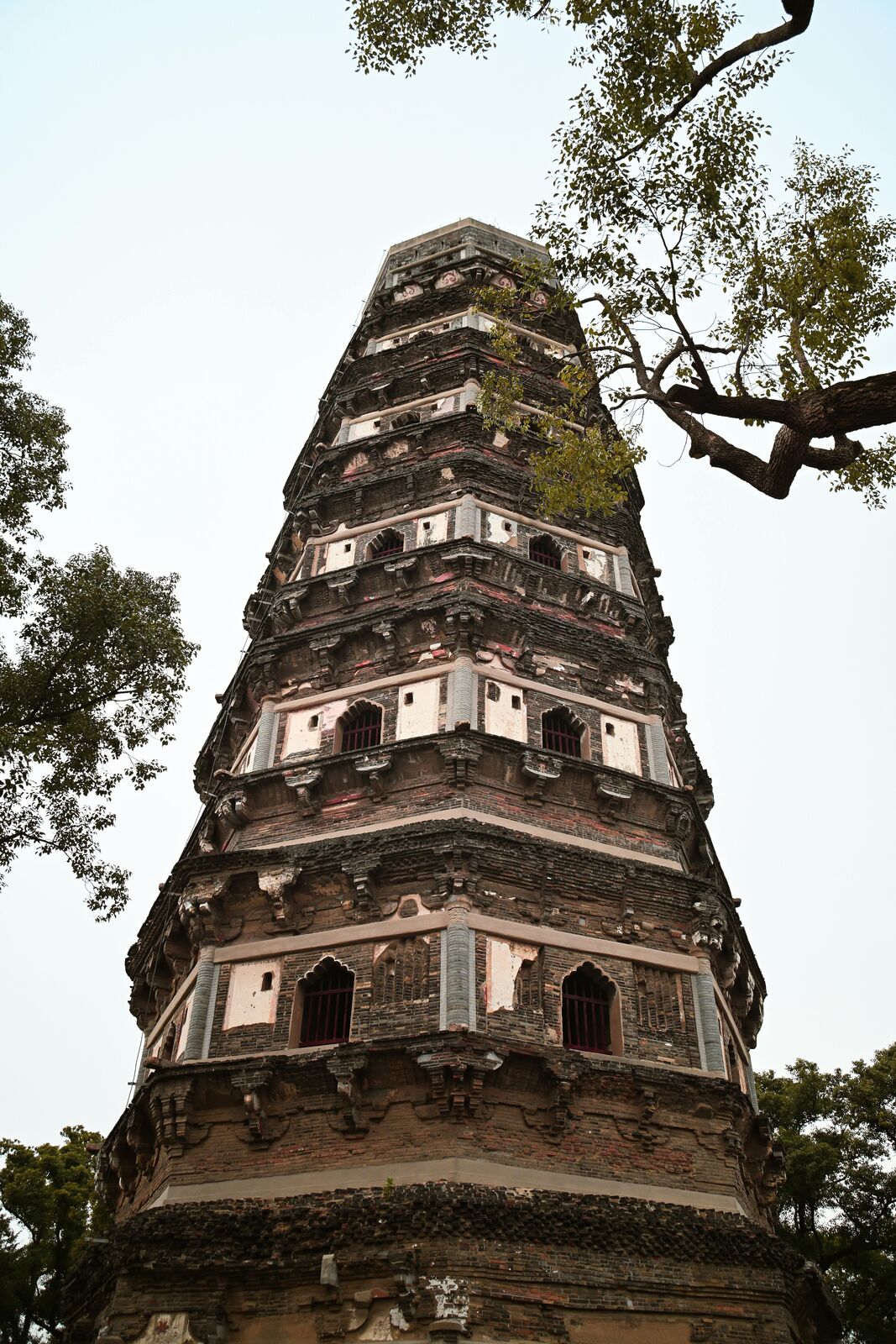
Tickets & what's on the hill
Tiger Hill is a single ticketed scenic area. One admission ticket covers everything — the climb, the leaning pagoda at the top, the Sword Pool and the garden grounds; there is no separate charge inside.
| Item | What it is | Price |
|---|---|---|
| Admission | Scenic-area entry — the climbing path, the Yunyan Pagoda, the Sword Pool and the grounds. | ¥70 peak ¥60 off-peak |
| Pagoda ground floor 云岩寺塔一层 | A short, guided look inside the base of the leaning pagoda — Song-era timber-mimic brackets and wall paintings, and the lean up close (no photos inside). | Free, but reserve |
| Included | The Sword Pool fissure, Thousand-Man Rock, old wells, steles and tea terraces. | Included |
Peak season is April, May and July–October (hours 07:30–18:00 May–October; 17:30 November–April, last tickets 17:00). You cannot climb the pagoda — but its ground floor opens to just ~100 people a day in small batches (~10 min each): reserve “云岩寺塔一层参观” on the official “苏州园林” WeChat account and meet at the guard post below the tower. If you miss it, the after-6:25pm evening slot usually needs no reservation (staff walk you in with a torch, though it’s dim). Concessions apply for children and seniors; confirm the current rate when you book.
How to get there
Tiger Hill sits in the northwest of Suzhou, away from the central garden cluster. The simplest approach is Suzhou Metro Line 6 — it opened in 2024 and reaches the hill directly, so it is the easy option. (Older guides naming Line 2 are out of date.)
| From | How | Time |
|---|---|---|
| Anywhere on the metro | Metro Line 6 to Tiger Hill (虎丘) station, ~650 m to the gate | + ~8–10 min walk |
| Shantang Street by boat | A canal boat up the Shantang Canal to Tiger Hill’s south gate — the scenic way in | ~30–40 min |
| Suzhou city centre | Taxi or DiDi | ~15–20 min |
| The Lingering Garden | Taxi / DiDi south — easy to combine into one northwest half-day | ~15–20 min |
The canal boat from Shantang Street is the memorable approach — board at the Ancient Stage (古戏台) or Bai Juyi dock and glide up the old Shantang Canal to the south gate. A covered tour boat is about ¥50/person (~30 min); a hand-rowed boat about ¥80 (~40 min, usually 2–3 passengers); online you can sometimes find a ¥63 “boat + Tiger Hill ticket” combo, which makes the ride almost free. Because the Lingering Garden is only about 15–20 minutes south, the efficient plan is to pair the two for a northwest half-day. Our things-to-do guide sets out how Suzhou’s sights stitch together, and the classical gardens guide covers the Lingering Garden in depth.
Best time & how long
| What | Detail |
|---|---|
| Time needed | Half-day · about 2–3 hours including the climb and grounds |
| Spring & autumn | The pick — mild weather for the climb and the greenest grounds |
| Mornings | Quieter on the path; arrive early on weekends and holidays |
| Pairing | Combine with the Lingering Garden (~15–20 min south) for the half-day |
Timing here is about comfort and crowds rather than a single golden hour. Spring and autumn are kindest for the climb, and a morning start keeps the path quieter — then drop down to a classical garden for the rest of the half-day.
Practical & how it fits a Suzhou trip
- Enter by mid-afternoon — the biggest trap: although the gate stays open to ~6 pm, the paths on the two sides (the Wanjing Shanzhuang penjing garden and the back hill) close around 6 pm and only the central axis to the pagoda stays open, so come by ~3 pm to see everything, doing the sides first.
- Shuttle cart if you’re tired — just inside the gate on the right you can take a sightseeing cart (¥10 one way) up to the top and walk down.
- Pair it with a garden — the Lingering Garden is ~15–20 minutes south; Tiger Hill plus one classical garden is the natural northwest half-day.
- Wear comfortable shoes and pay by Alipay / WeChat Pay — it’s a real (if gentle) climb, and the ticket window and shops are cashless-first. Ignore the “discount wedding-dress” touts near the gate (Tiger Hill sits by Suzhou’s bridal-photo district).
The honest call: Tiger Hill is the strongest non-garden sight in Suzhou and a genuine half-day highlight — the leaning pagoda, the Sword Pool and the founding legend earn it a place on a first trip. Do a classical garden and Pingjiang Road too, and slot Tiger Hill in alongside the nearby Lingering Garden.
Book Tiger Hill tickets or a Suzhou tourNASDAQ: TCOM
Trip.com lists Tiger Hill admission and Suzhou day tours that include it — booked in English on a foreign card, with the ticket sorted before you arrive.
Frequently asked questions
Is Tiger Hill worth visiting?
Yes — it is the strongest non-garden sight in Suzhou and a genuine half-day highlight. The wooded hill packs in the leaning Yunyan Pagoda, the Sword Pool fissure tied to Suzhou's founding king, the Thousand-Man Rock and old tea terraces along an easy climbing path. On a first trip it pairs neatly with a classical garden; the nearby Lingering Garden is about 15–20 minutes south, so the two make an efficient northwest half-day.
How much are Tiger Hill tickets, and is it free?
It is not free. Admission is ¥70 in peak season (April, May, July–October) and ¥60 off-peak, with concessions for children and seniors. The one ticket covers the whole scenic area — the climb, the Yunyan Pagoda's surroundings, the Sword Pool and the garden grounds. You can't climb the pagoda, but its ground floor opens to about 100 people a day by free reservation (book '云岩寺塔一层参观' on the official '苏州园林' WeChat account). Hours are roughly 07:30–18:00 from May to October (to 17:30 November–April, last tickets 17:00).
What is Tiger Hill famous for?
Two things above all. The Yunyan Pagoda (云岩寺塔) on the summit — a seven-storey octagonal brick pagoda built in 961 AD that has tilted about 3–4° over the centuries, earning it the nickname 'the Leaning Tower of China'. And the legend: King Helü of Wu, who made Suzhou a capital around 514 BC, is said to be buried here, with a white tiger appearing to guard his tomb three days after his death — giving the hill its name. The Sword Pool fissure at the base is believed to conceal his burial pit.
How do you get to Tiger Hill in Suzhou?
The simplest way is Suzhou Metro Line 6 to Tiger Hill (虎丘) station, then a short walk to the scenic-area gate; Line 6 opened in 2024 and reaches the hill directly. (Older guides naming Line 2 are out of date — it is Line 6.) A taxi or DiDi from the city centre takes roughly 15–20 minutes. Tiger Hill sits in the northwest of the city, with the Lingering Garden about 15–20 minutes south — easy to combine.
How long do you need at Tiger Hill?
Plan a half-day — about two to three hours. That covers the climb up the wooded path past the Thousand-Man Rock to the Sword Pool, the leaning Yunyan Pagoda at the top, and a wander through the tea terraces and garden grounds on the way down. It is an unhurried sight rather than a quick photo stop; pairing it with the nearby Lingering Garden fills the rest of the half-day.
Is the pagoda at Tiger Hill really leaning, and is it safe?
Yes — the Yunyan Pagoda genuinely leans, by about 3–4° off vertical, and the tilt is visible from several hundred metres away, which is why it is called the Leaning Tower of China. It is structurally stable: the lean developed gradually over a thousand years as the brick tower settled on uneven ground, and it has been monitored and reinforced. You can't climb the upper storeys, but the ground floor opens to a small number of visitors a day by free reservation (via the '苏州园林' WeChat account) — a short, guided look at the Song-era timber-mimic brickwork and the lean from inside; otherwise you view it from the surrounding grounds.
Sources
Checked August 2026 · Written from our own first-hand travel in China.