Route guide · Cross-border high-speed rail
Hong Kong to Guangzhou by High-Speed Train (2026)
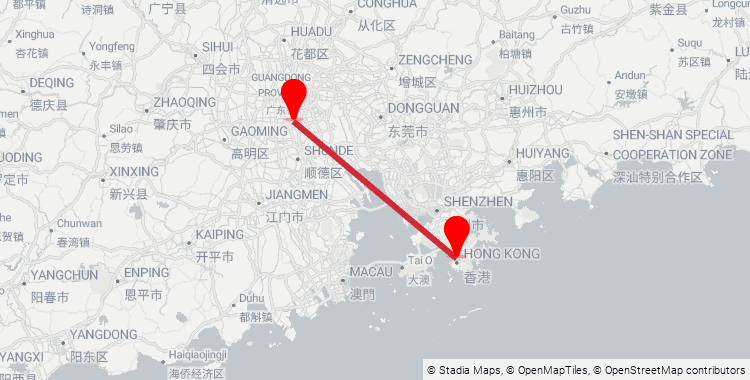
141 km across the border on the Express Rail Link — about 47m downtown to downtown, 60+ trains a day, and Hong Kong exit and mainland China entry stamped in one queue at West Kowloon before you board. The fastest, calmest way onto the mainland.
China for Travelers EditorialUpdated Save this — opening times and closures changeRail data refreshed monthly
- 2nd class
- ¥185 – ¥215
- what everyone buys
- Frequency
- 60/day
- 06:32 – 21:32
- Train types
- G
- G = cross-border
- Immigration
- Before boarding
- co-located at West Kowloon
You cross the border inside West Kowloon station, before you board — Hong Kong exit and mainland China entry are stamped in one building, one queue, typically 10–20 minutes. At Guangzhou South you simply walk out; no immigration on the train.
The route at a glance
The Hong Kong–Shenzhen–Guangzhou Express Rail Link is one of the most useful pieces of infrastructure for foreign visitors in southern China: 47m downtown to downtown, about 60 trains a day each way from 06:32 – 21:32, ¥185 – ¥215 in second class, and the entire Hong Kong-exit + mainland-entry process handled in one building at the Hong Kong end before you board. All cross-border trains run between Hong Kong West Kowloon 香港西九龙站 and Guangzhou South 广州南站 (Panyu, on Metro Lines 2, 7 & 22); most stop at Futian, Shenzhen North and Humen along the way. Arriving into Guangzhou and continuing from there? See the Guangzhou South station guide.
On the Guangzhou side, don’t confuse Guangzhou South with the old downtown Guangzhou Station or Guangzhou East — neither runs the Hong Kong route. And if you are actually heading to Shenzhen rather than Guangzhou, get off at Futian or Shenzhen North rather than riding the full cross-border leg; see Hong Kong → Shenzhen for that shorter hop.
How the cross-border bit works
This is the part travellers worry about, and it is genuinely the easy bit. Hong Kong West Kowloon uses the co-located inspection model: Hong Kong exit immigration and mainland Chinese entry immigration sit in the same terminal, in two adjacent halls inside the Mainland Port Area. You queue once, walk through both checkpoints before you board, then ride an already-cleared train and step straight out at Guangzhou South.
At Hong Kong West Kowloon 西九龙站both stamps
Both stamps happen here before you board: Hong Kong exit, then mainland China entry, in one walk-through inside the Mainland Port Area. Total queue time is usually 10–20 minutes on a normal weekday, so arrive with time to clear it before your train.
At Guangzhou South 广州南站just walk out
Because you were already cleared into the mainland at West Kowloon, there is no immigration in Guangzhou. You step off the train and walk straight out to Guangzhou South’s metro and taxi level like any domestic arrival.
On Friday evenings and at the start of mainland public holidays, expect the immigration halls to be busier — budget 30–45 minutes then, and get to West Kowloon earlier. There is no passport control on the train itself; the whole border crossing is the few minutes you spend on foot at West Kowloon.
Visa and entry rules
The cross-border train involves two jurisdictions with different visa regimes, and going this direction is a full mainland China entry. Hong Kong and the mainland are separate immigration zones — being admitted to Hong Kong grants you nothing on the mainland, so you must independently qualify to enter Guangzhou:
- Mainland China side (your arrival) — requires a valid Chinese visa, or you qualify under the 240-hour visa-free transit. Hong Kong counts as a third region for the transit policy, so a Hong Kong → Guangzhou (transit) → Tokyo itinerary is valid. A single-entry China visa you have already used cannot be reused for this entry.
- Hong Kong side (your departure) — you are leaving, so your Hong Kong entry status simply needs to still be valid. Most passports got visa-free entry to Hong Kong on arrival (US, UK, EU, Australia, Canada, Japan, Korea, Singapore and many others); this train does not change that.
Unsure how your nationality stands? The visa checker shows both the Mainland China and Hong Kong policies side by side, and the 240-hour transit planner checks a transit itinerary if your mainland leg is visa-free.
Classes and price
For a 47-minute ride the class barely matters, but for completeness — and note the same seats are sold in HKD on the MTR side and in CNY on the mainland side, with shared inventory:
| Class | Price | Worth it? |
|---|---|---|
| Second classmost buy | ¥185 – ¥215 | 3+2 seating, power at every seat — what almost everyone buys for under an hour. |
| First class | ¥296 – ¥344 | 2+2 seating, a little wider — a small upgrade that rarely matters on a short ride. |
| Business class | ¥645 | Lie-flat seat with attendant service — overkill for 47 minutes, though it is the cheapest business-class experience in China if you are continuing a long journey across the mainland from Guangzhou. |
¥185–¥215 second class is roughly HK$200–HK$235 / US$26–30. The HK side sells the identical tickets in HKD through the MTR system; a seat sold via MTR is unavailable via 12306 and vice-versa.
How to book with a foreign passport
MTR Hong Kong — the natural channel if you are booking from the HK side and want to pay in HKD. Same shared inventory; tickets open 15 days before departure on both sides, so book the moment the window opens for Friday evenings, Sunday afternoons and mainland public holidays.
Trip.com ↗ — the same cross-border G-train seats, booked in English with a foreign Visa or Mastercard, no Chinese phone number and no verification wait, plus 24/7 multilingual support. It sells at the same official fare with no booking fee, and new-customer promotions can bring a first trip below face price. You can also add Guangzhou hotels, attraction tickets and tours to the same trip. See the booking walkthrough.
12306 English app — the official China Railway channel: face-value fares in CNY, no booking fee. The trade-off is hassle — passport real-name registration must clear before you can buy (often slow), payment checks can add friction, and customer service is Chinese-first and limited if a booking goes wrong.
Book on Trip.comNASDAQ: TCOM
The international arm of Ctrip — one of the few platforms selling real China Railway tickets in English, to a foreign passport and card. (Is it legit? — 12306 vs Trip.com )
Arrived at Guangzhou South — getting into the city
Guangzhou South Railway Station (广州南站) sits in Panyu, south of central Guangzhou, but it is wired straight into the network: Metro Lines 2, 7 & 22 run from the station, with Line 2 heading north through the old centre (Gongyuanqian, Guangzhou Railway Station). It is also the southern hub of the national high-speed network, so if Guangzhou is a connection rather than your destination you can change here for trains deeper into the mainland. Times below are approximate — see the note under the table.
| City area | Metro | Taxi / DiDi |
|---|---|---|
| Zhujiang New Town 珠江新城 (CBD) | Metro Line 7 → interchange for Line 3/5 to the CBD. ~40–50 min. | ~¥60–80, ~30–40 min |
| Yuexiu / old centre 越秀 (Gongyuanqian) | Metro Line 2 direct north to Gongyuanqian (公园前). ~35–45 min. | ~¥60–80, ~35–45 min |
| Onward HSR across the mainland | Stay inside Guangzhou South and change platforms; it is a national HSR hub. | — |
Guangzhou South is well south of the centre, so the metro ride into the core takes a while — budget 35–50 minutes to most central districts. Times and distances are approximate; confirm live on the day. On the mainland you pay with Alipay or WeChat Pay (both now take a foreign card) or set up DiDi for foreigners for a fixed English fare. The full station layout and onward transport are in the Guangzhou South station guide.
Frequently asked questions
How far is Hong Kong from Guangzhou?
About 141 km (88 miles) — the cross-border Express Rail Link covers it in about 47 minutes.
How do I get from Hong Kong to Guangzhou?
By the cross-border high-speed Express Rail Link. Trains run Hong Kong West Kowloon to Guangzhou South about 60 times a day, taking ~47 minutes, from ¥185 — Hong Kong exit and mainland China entry are cleared at West Kowloon before you board, so you simply walk out in Guangzhou. Book on the official 12306 app, on Trip.com, or via MTR Hong Kong.
How long is the Hong Kong to Guangzhou train?
The fastest G-train does Hong Kong West Kowloon to Guangzhou South in 47 minutes. Most trains run 50–80 minutes depending on stops at Futian, Shenzhen North, and Humen. About 60 trains a day each direction.
How much is the Hong Kong to Guangzhou train ticket?
2nd class is ¥185–¥215 (~$26–$30 / HK$200–HK$235). 1st class is ¥296–¥344. Business class is ¥645. Tickets are sold both in HKD (Hong Kong side) and CNY (mainland side); same train, same seat, identical inventory.
Where do I clear immigration?
All passport control happens at Hong Kong West Kowloon station, before you board. Hong Kong exit and mainland China entry are stamped in the same building (co-located inspection model) — you walk through both checkpoints in one queue, usually 10–20 minutes total, then board an already-cleared train. At Guangzhou South you simply walk out; there is no immigration there and none on the train.
Do I need a China visa to take this train into Guangzhou?
Yes — this train is a full mainland China entry, so you need a valid Chinese visa, or you qualify under the 240-hour visa-free transit. Hong Kong and the mainland are separate immigration zones, so a Hong Kong entry grants you nothing on the mainland, and a single-entry China visa you have already used cannot be reused. Our visa checker shows both the Mainland China and Hong Kong policies for your nationality.
Can I use the 240-hour visa-free transit on this train?
Yes. Hong Kong counts as a third region for the 240-hour transit policy. So a route like Hong Kong → Guangzhou (240h transit, mainland China) → Tokyo qualifies. You enter mainland China via the West Kowloon train and exit by air within the transit window.
Train vs flight: which wins?
Train wins door-to-door. Flight time is 60 minutes, but HKG and CAN airports both add 60–90 minutes for security and transit, plus immigration on arrival. Door-to-door, the train is roughly 90 minutes (downtown Kowloon → downtown Guangzhou), the flight is 4–5 hours. The train is also about half the price.
How do I book the Hong Kong–Guangzhou train?
Three options: (1) MTR Hong Kong's site if you are booking from the HK side in HKD. (2) Trip.com in English with a foreign card — same face fare, no booking fee, 2-minute checkout. (3) The 12306 app for tickets bought in CNY — needs your passport for real-name binding. Tickets open 15 days before departure.
Sources
Checked August 2026 · Written from our own first-hand travel in China.
Once the train gets you across
The crossing is the easy part — Hong Kong and Guangzhou sit at two ends of the Pearl River Delta, with Shenzhen and Macau in between.