Key takeaways
- Hangzhou’s best-preserved old quarter — a run of restored Qing-era shophouses below Wushan hill, just south-east of West Lake.
- It is free to wander; you pay only for the extras — snacks and food, the historic Huqing Yu Tang (胡庆余堂) medicine museum (¥10; the pharmacy hall is free), and the shops.
- Come after dark: the lanterns come on around 18:00 in winter / 19:00 in summer and off ~22:30 — the blue hour (18:30–20:30) is the sweet spot for atmosphere and photos.
- Watch the by-weight snack stalls (fruit cups, pork jerky) and “free tasting” / fake face-changing hooks; locals eat cheaper on Gaoyin Street (高银街) and Shiwukui Alley just off the strip.
- Closest metro is Line 7 to 吴山广场 (Wushan Square) — Hefang Street runs east from the exit, ~6 min walk (Line 1 定安路 is farther, ~13 min).
What Qinghefang & Hefang Street is
The quarter sits under Wushan hill (吴山), a short walk from the lake’s southern end, and it is not one street but several: Hefang Street (河坊街) is the pedestrian spine — flagstones, closed to traffic, grey-tile timber storefronts — with narrower lanes running off it north and south. This was one of the city’s commercial heart streets for centuries; what stands now is a restoration, and it keeps the look and the trades of an old Chinese shopping street rather than the original fabric.
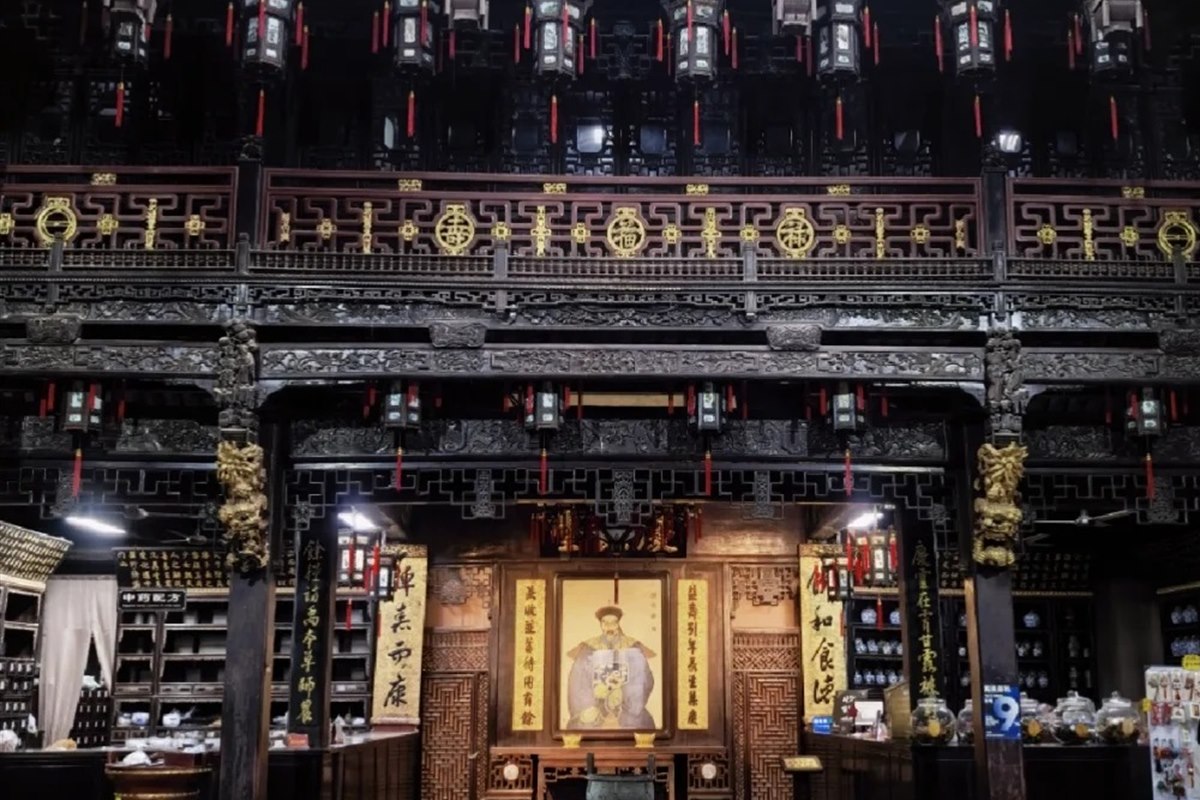
It is touristy, but genuinely atmospheric. The shopfronts hold traditional snack stalls, tea and silk shops, and craft makers — scissors, fans, combs, paper umbrellas and carved seals — alongside the historic Huqing Yu Tang (胡庆余堂), a working traditional-Chinese-medicine hall founded in the 19th century, on the atmospheric side alley of Dajing Alley (大井巷); its inner rooms are a museum of Chinese medicine. Food is half the point: the stalls sell Hangzhou street snacks, and the quarter graze-walks well. It is not a half-day sight — a paced 1–2 hour stroll and snack crawl, best folded into West Lake’s south end in the evening.
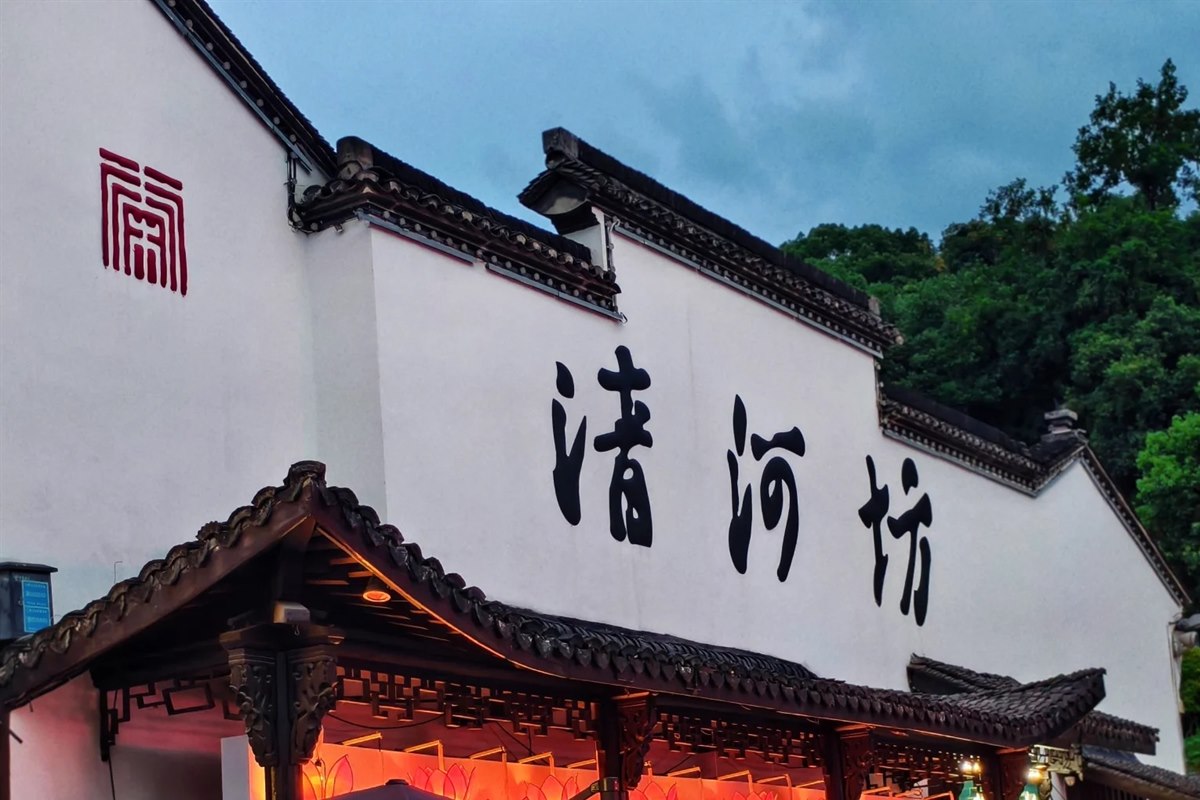
Night view & photo spots
The quarter is at its best after dark. Traveller reports say the lanterns run on a seasonal schedule: on around 19:00 in summer (mid-April to end-September) and around 18:00 in winter (October to April), and off around 22:30 either way. The sweet spot is 18:30–20:30 — the blue hour just after the lanterns come on, before the biggest crowds. Best photo spots, per travellers:
| Photo spot | What you get |
|---|---|
| Drum Tower (鼓楼) lantern corridor | Shoot up from below the Drum Tower — layered red lanterns against the old eaves, with strong depth; the classic “Song-dynasty night market” frame |
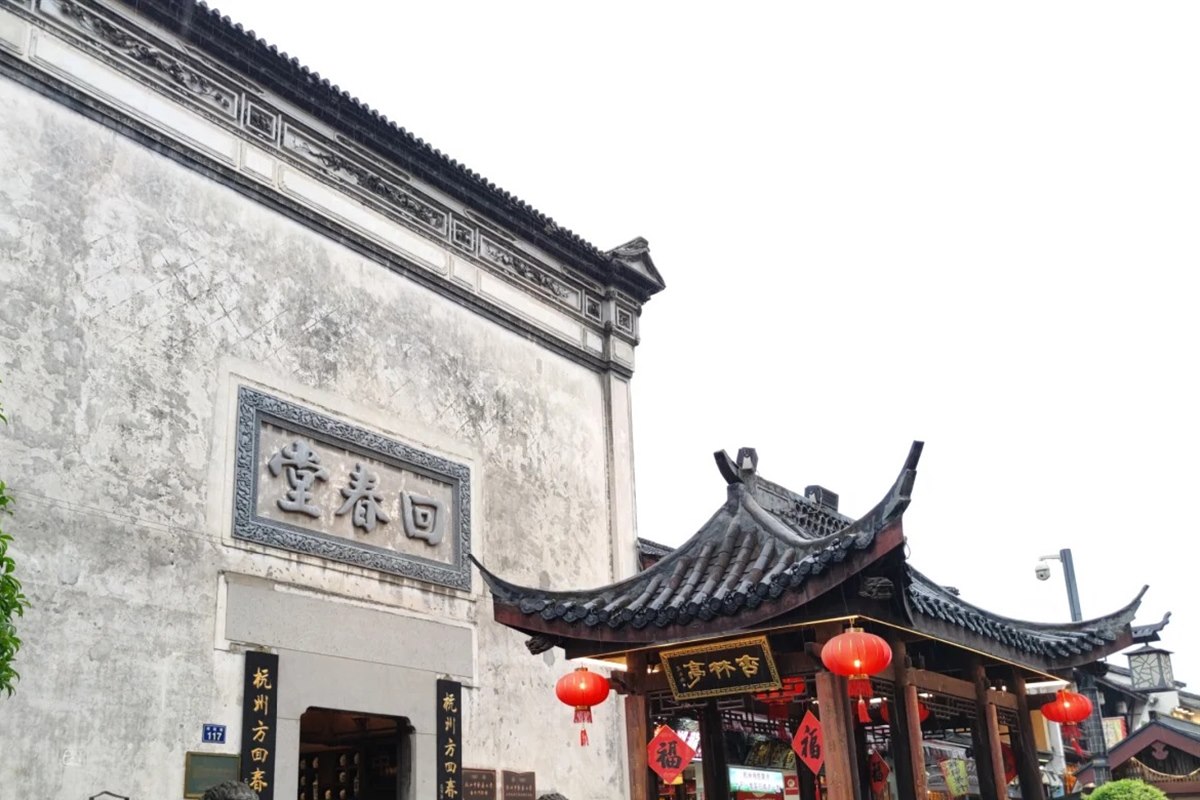
| Huqing Yu Tang grey-brick wall | The century-old pharmacy’s dark-brick wall and plaque under warm light — a story-book backdrop for qipao or hanfu shots |
| Xiaoxia Alley (晓霞弄) | A hidden spot where Wangxian Pavilion lines up with the distant Chenghuang Pavilion; note the pavilion is usually lit only Friday–Sunday — if the lit line-up is the point, make it a weekend evening |
| Drum Tower wall (east end) | Climb the tower or the wall for a look down over the lantern-lit lanes — the same structure as the row above, seen from on top rather than underneath |
| Wushan Square (west end) | The busiest street-life feel of the quarter. Note it is at the opposite end from the Drum Tower, about 700 m away — two separate stops on the walk in the next section, not one place |
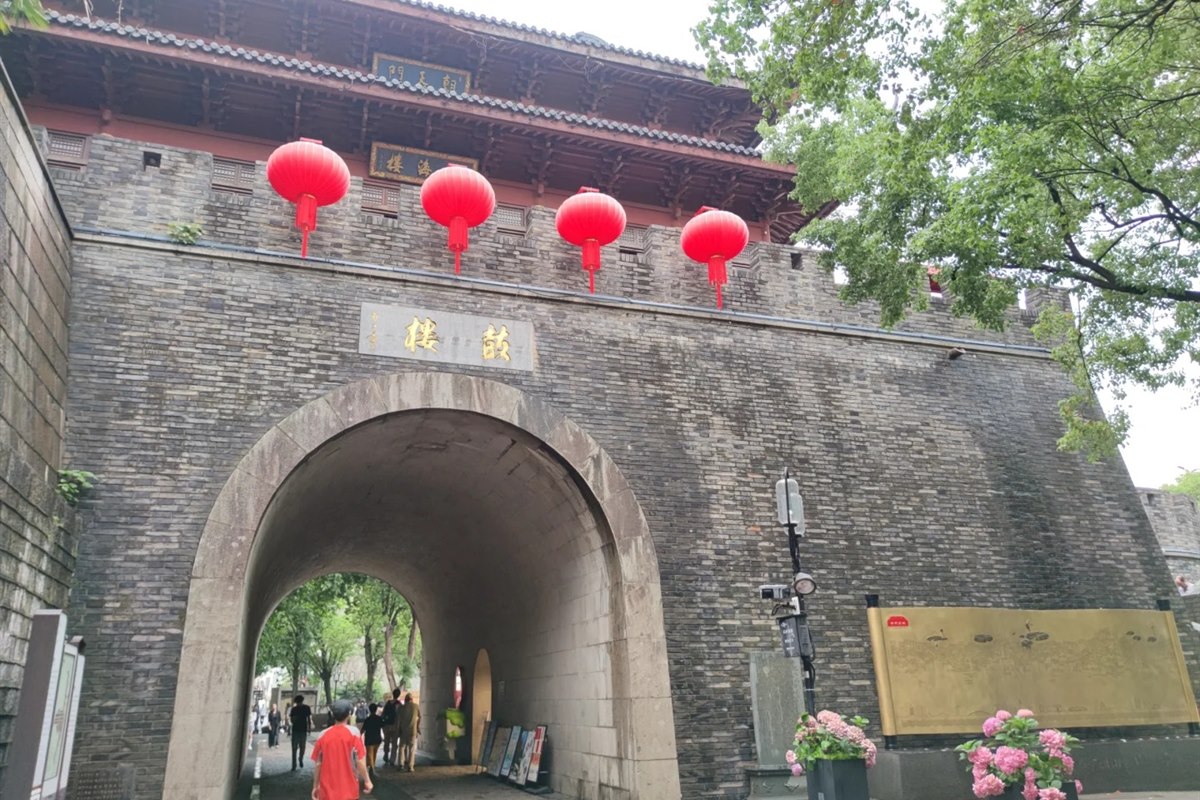
The evening walk, and which end to leave from
The quarter is a loop, not a line, which is the thing to know before you plan an evening here. Hefang Street is the busy pedestrian spine along the north; Dajing Alley (大井巷) is the quieter lane along the south; the two join at both ends — beside Huqing Yu Tang in the west, and at Zhongshan South Road by the Drum Tower in the east. So you can cover the whole quarter without walking anything twice, and finish at the station you arrived at.
Start from Metro Line 7 at Wushan Square, at the western end. Walk east along Hefang Street to the Imperial Street junction, turn south there for the Drum Tower and the Shiwukui and Xiaoxia alleys, then come back west along Dajing Alley and Gaoyin Street — the locals’ food lane — to the same station. That is roughly 2.5 km of walking, which is an hour or so with stops. If the evening carries on east afterwards, end at the Drum Tower instead and walk about 700 m to Jiangcheng Road (Lines 5 and 7).
The two metro exits are not interchangeable. Wushan Square sits at the quarter’s west end and Jiangcheng Road about a kilometre off its east end, so they are some two kilometres apart on foot. Pick one before you set off — finishing at the Drum Tower and then heading for Wushan Square means 14 minutes back across ground you have already walked.
Loop back to Line 7. The busy half and the quiet half are different lanes. Out along Hefang Street, south at the Imperial Street junction, then back west down Dajing Alley past Huqing Yu Tang and along Gaoyin Street, the food lane — with the Drum Tower and the photo alleys at the turn.
One thing that is not part of the loop: the Southern Song Imperial Street (南宋御街) runs north away from Hefang Street, along Zhongshan Middle Road, from the junction where you turn south for the Drum Tower. It is a restored shopping street in its own right and worth the detour if you have time, but it is a there-and-back spur rather than a step in the walk. Note the road names, because they are one character apart and at different ends of the quarter: the Imperial Street is on Zhongshan Middle Road, while the Drum Tower stands on Zhongshan South Road.
What it costs & what's there
The quarter itself is free. Qinghefang and Hefang Street are open public lanes, so walking them and browsing the shopfronts costs nothing — there is no admission gate. You pay only for the extras you choose.
| Item | What it is | Cost |
|---|---|---|
| Walking the street | The open old quarter, Hefang Street and its shopfronts — no ticket, no gate. | Free |
| Snacks & food | Traditional snack stalls and restaurants along the lane — Hangzhou street snacks and small bites. | Pay per item |
| Huqing Yu Tang (胡庆余堂) | The working TCM pharmacy hall (free to walk into) and, at 大井巷95号, its museum of Chinese medicine. Open 08:30–17:00; reduced tickets are reported at ¥5 for university students and visitors 60+, with freeentry for several categories including under-18s and over-70s. ⚠️ Whether it shuts on Mondays is contested — see the note below. | Museum ¥10 |
| Shops & crafts | Tea, silk, scissors, fans, combs, paper umbrellas and carved seals — buy what you like. | Varies |
Not confirmed: whether the Huqing Yu Tang museum shuts on Mondays. The sources genuinely disagree, so we are not going to pick one for you. The museum’s own map record at 大井巷95号 reads Tuesday–Sunday 08:30–17:00 with Mondays closed; a second record beside the pharmacy entrance reads daily 09:00–16:00, and web listings split the same way. The practical form is the useful one: opening hours are 08:30–17:00, and Monday should not be the only day you could go. The street itself is open whatever the museum does.
Stall prices and which shops are open shift through the year, so treat the above as a guide rather than as a price list. Pay with Alipay or WeChat Pay: the stalls and shops are cashless-first.
Getting there
The quarter is in Shangcheng District, below Wushan hill and close enough to the south end of West Lake that the lakeside is a walk rather than a ride — which is what makes it the natural evening half of a West Lake day. Two metro lines land within walking distance, and the choice between them is worth seven minutes on foot:
| From | How | Time |
|---|---|---|
| Metro (closest) | Metro Line 7 to 吴山广场 (Wushan Square) — Hefang Street runs east from the exit | ~6 min walk |
| Metro (alt.) | Metro Line 1 to 定安路 (Ding’anlu) + walk | ~13 min walk |
| West Lake south shore | Walk east from the lakeside, or a short taxi / DiDi | ~15–20 min on foot |
| Hangzhou East Railway Station | Taxi or DiDi (~9 km); or Metro Line 1 | ~20–30 min by taxi |
Why this is an add-on to a West Lake day, not a trip of its own
~1.5 km from the lakeWalkable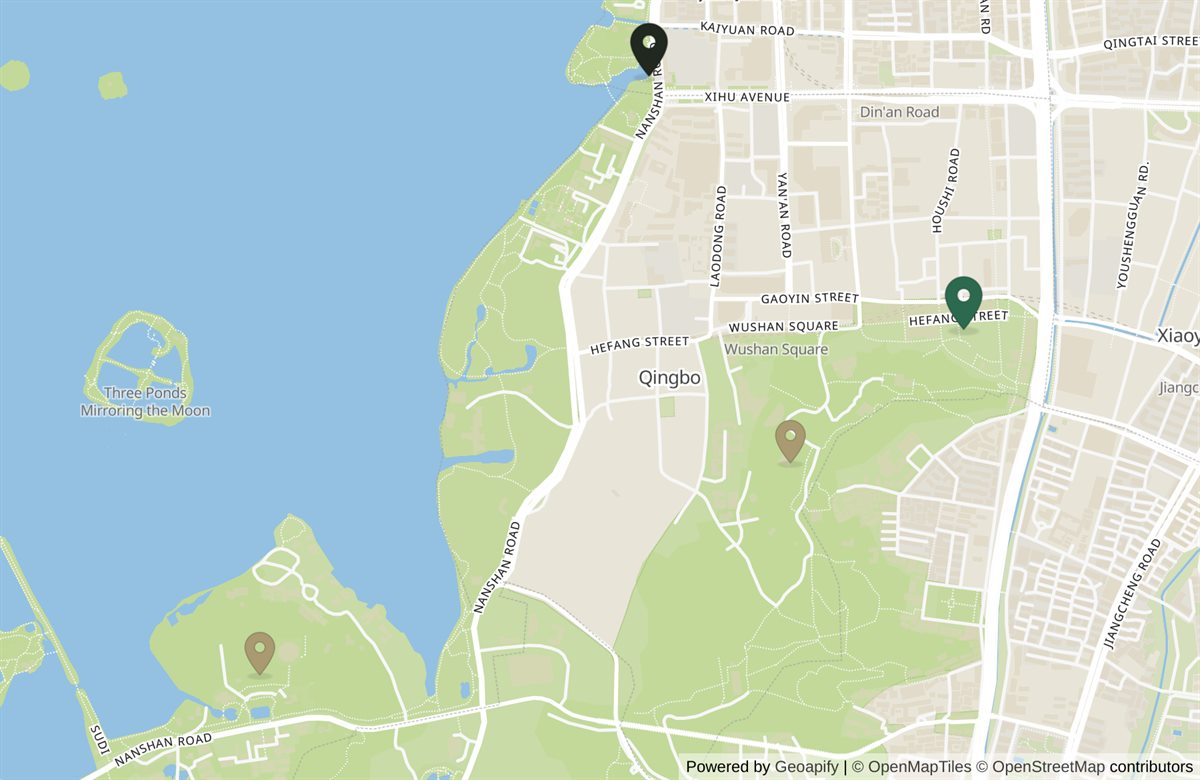 QinghefangQinghefangWest Lake — east shoreWest LakeLeifeng PagodaLeifengWushan hillWushan
The quarter sits just inland from the lake’s south end, so it stitches into a West Lake day rather than standing on its own. Our things-to-do guide sets out how the sights connect.
Snack traps & where locals eat
The main street is best for wandering and photos — for eating, travellers flag some traps and point to cheaper streets just off it.
Watch out for:
- Snacks “sold by weight” — fruit cups (水果捞), pork jerky and crab-roe noodles where a few yuan of fruit can weigh out to ¥30–40 and a few slices of jerky to over ¥100. Walk past the by-weight stalls.
- “Internet-famous” queues & free tastings — many long-queue snacks are mass-produced; a roadside “free Longjing tasting” or a “street face-changing” show is a hook to sit you down and upsell. Smile and keep walking.
- Souvenir & cake shops on the main strip — pricey and generic; buy specialities at a supermarket or a proper old-brand store instead.
Where locals eat nearby:
- Gaoyin Street (高银街) — one lane north of Hefang Street’s western half and running parallel to it, so it is on your way back to the Line 7 station rather than a detour. The locals’ food lane, at a few tens of yuan a head.
- Shiwukui Alley (十五奎巷) & Chengtou Alley (城头巷) — old residential lanes with authentic, cheaper Hangzhou-cuisine restaurants a short walk away.
- Cheap street snacks — look for cong-bao-hui (葱包桧, a scallion-and-fried-dough wrap, a few yuan) and freshly made dingsheng cake (定胜糕).
Practical & how it fits a Hangzhou trip
- It’s a stroll, not an outing — fold Qinghefang into a West Lake day as an evening, rather than making a separate trip for it.
- Go for the blue hour — arrive around when the lanterns come on (~18:00–19:00) and walk it before the crowds peak.
- Eat off the main strip — graze lightly on the main lane, but do a real meal on Gaoyin Street or in the alleys.
- Pay with Alipay or WeChat Pay — the stalls and shops are cashless-first, so set up a mobile wallet before you travel.
The honest call: Qinghefang is not a half-day sight — it is an atmospheric 1–2 hour stroll and snack crawl, best after the lanterns come on. Do West Lake and Leifeng Pagoda first, then fold the old street into the end of the day.
Book a Hangzhou old-town walk or food tourNASDAQ: TCOM
The street is free to walk — but a guide takes the guesswork out of the snack traps. Trip.com lists Hangzhou old-town walks, street-food tours and evening experiences that take in Qinghefang and Hefang Street, booked in English on a foreign card.
Frequently asked questions
Is Qinghefang / Hefang Street free to visit?
Yes — the street itself is free. Qinghefang and its pedestrian spine, Hefang Street, are open public lanes, so wandering them and browsing the shopfronts costs nothing. You only pay for the extras you choose: snacks and food from the stalls and restaurants, ¥10 for the Huqing Yu Tang (胡庆余堂) traditional-medicine museum (the working pharmacy hall beside it is free to walk into), and whatever you buy from the tea, silk and craft shops. Prices change — treat those as planning figures; the street and the working pharmacy hall stay free either way.
What time does Hefang Street light up, and when is the best time to go?
Traveller reports say the lanterns run on a seasonal schedule: on around 19:00 in summer (mid-April to end-September) and around 18:00 in winter (October to April), and off around 22:30 either way. The sweet spot is 18:30–20:30 — the 'blue hour' just after the lanterns come on gives the old shopfronts the most atmosphere and the crowds are lighter than mid-afternoon. The street is open and free at all hours, so timing is about atmosphere, not opening times.
How do you get to Qinghefang / Hefang Street in Hangzhou?
It sits near the south end of West Lake, below Wushan hill. The closest metro is Line 7 to 吴山广场 (Wushan Square) — Hefang Street runs east from the exit and it is about a 6-minute walk. Metro Line 1 to 定安路 (Ding'anlu) also works but is farther, about a 13-minute walk. From West Lake's south shore it is a short walk or taxi east, so it pairs neatly with the lake's south end and Wushan hill.
What are the food and shopping scams to avoid on Hefang Street?
Travellers flag a few: snacks 'sold by weight' — fruit cups (水果捞), pork jerky and crab-roe noodles where a few yuan of fruit can weigh out to ¥30–40 and a few slices of jerky to over ¥100, so walk past the by-weight stalls. Many long-queue 'internet-famous' snacks are mass-produced; a roadside 'free Longjing tasting' or a 'street face-changing' show is a hook to sit you down and upsell, so smile and keep walking. Buy souvenirs at a supermarket or a proper old-brand shop, not the pricey main-street stalls.
Where do locals eat near Hefang Street instead of the main strip?
The main street is best for wandering and photos, not value dining. Travellers point to Gaoyin Street (高银街), right beside Hefang Street, as the locals' food lane, and to Shiwukui Alley (十五奎巷) and Chengtou Alley (城头巷) for cheaper, authentic Hangzhou-cuisine restaurants a short walk away. For cheap street snacks, look for cong-bao-hui (葱包桧, a scallion-and-fried-dough wrap, a few yuan) and dingsheng cake (定胜糕) made fresh — well under the main-strip prices.
Is Qinghefang / Hefang Street worth visiting?
Yes, as a short stop. Qinghefang is Hangzhou's best-preserved old quarter — a run of restored Qing-era shophouses below Wushan hill, just south-east of West Lake, with snack stalls, tea and silk shops, scissor and fan makers and the historic Huqing Yu Tang medicine hall. It is touristy and busy by afternoon, but genuinely atmospheric after the lanterns come on, and it folds naturally into a West Lake day as an evening stroll and snack crawl. Plan 1–2 hours.
Sources
Checked July 2026 · Written from our own first-hand travel in China.
Corrected since publication: An earlier version of the evening route had the sequence and the exit wrong. Both maps were rebuilt from coordinates rather than patched.