Key takeaways
- The hills south-west of West Lake grow West Lake Longjing (西湖龙井, ‘Dragon Well’), one of China’s most famous green teas.
- The China National Tea Museum (中国茶叶博物馆) is free (closed Tuesdays, not Mondays; Shuangfeng branch 9:00–16:30, hillside Longjing branch 9:30–16:00, weekend reservation); Longjing Village and Meijiawu are working hamlets free to walk.
- On a first visit go for Longjing Village (the ‘Shililangdang’ terrace overlook) plus the Tea Museum; pair with Lingyin Temple in the same hills for a full half-day.
- Come March–May for the spring harvest — pre-Qingming tea (明前, mid-Mar–Apr 4) is the top grade; pre-Guyu (雨前, ~Apr 5–20) is the value pick.
- Drink, don’t impulse-buy: real West Lake Longjing runs ¥300–800/斤 (雨前) up to ¥3,000–8,000+/斤 (明前 first-pick); cheap ‘first-pick’ is tea from elsewhere.
What the Longjing tea villages are
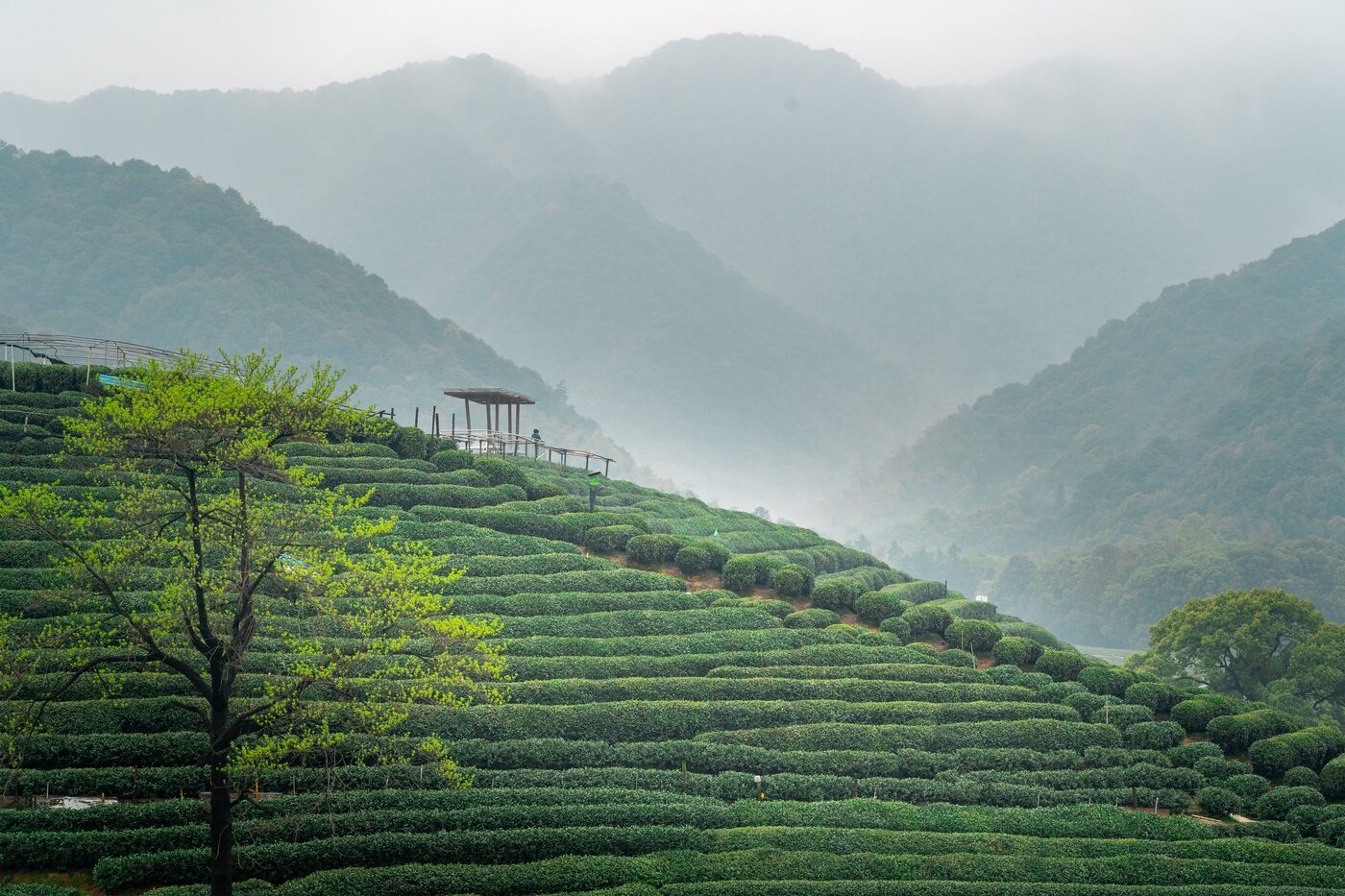
The hills immediately south-west of West Lake grow West Lake Longjing (西湖龙井, “Dragon Well”) — one of China’s most famous green teas, a pan-fired leaf with flat, smooth blades and a mellow, chestnut-sweet taste. The spring harvest from these slopes is small, prized and expensive, and tea has been grown here for centuries.
Set among the terraces is the China National Tea Museum (中国茶叶博物馆), which is free and explains the whole culture — the history, the varieties, how leaves are grown, picked and pan-fired, and how tea is brewed across China. It has two branches in the hills: the older Shuangfeng site (双峰馆区, Longjing Road 88) and the newer Longjing site (龙井馆区, Wengjiashan 268), built into the slope. Just beyond, Longjing Village (龙井村) and Meijiawu (梅家坞) are working tea hamlets where you can walk the terraced slopes, watch leaves being pan-fired by hand in spring, and sit down for a tasting. It is calm and green — a different register from the busy lakefront, and a highlight for anyone interested in tea.
Which to visit, and a half-day with Lingyin
On a first visit, traveller reports suggest this order of priority:
| Where | Why / who it’s for |
|---|---|
| Longjing Village (龙井村) | The top pick — the “Shililangdang” (十里琅珰) overlook of the terraces, the strongest view; village family teahouses for a cup |
| China National Tea Museum | Free, calm and uncrowded, with proper explanations; the Longjing branch is built into the hillside — “a whole mountain of a museum” |
| Meijiawu (梅家坞) | The most relaxed — a valley of tea houses and farmhouse restaurants; suits older tea drinkers or a slow afternoon |
A half-day with Lingyin Temple (traveller route): arrive at Lingyin Temple before 7:30 to beat the crowds and see Lingyin + Feilai Feng; walk or take the ¥10 shuttle toward Faxi Temple. From there, hikers walk the downhill Shililangdang trail to Longjing Village (~1–1.5 hr) over the tea fields; non-hikers take bus 103 to Huangniling, then bus 27 or 87 to the village. Finish with tea and the museum in the afternoon (museum closes ~16:00–16:30).
What it costs & real tea prices
It is free. The China National Tea Museum charges no admission (closed Tuesdays — not Mondays, as most listings claim — and its two branches keep different hours, Shuangfeng 9:00–16:30 and the hillside Longjing branch 9:30–16:00, with weekend visits needing a reservation; bring your passport), and walking the village hills and terraces costs nothing. The only thing you pay for is tea tasting and buying.
| Item | What it is | Cost |
|---|---|---|
| China National Tea Museum | The free museum among the terraces — galleries on tea history, varieties and brewing. Closed Tuesdays. | Free (ID / passport) |
| Walking the villages | The terraced slopes and lanes of Longjing Village and Meijiawu — no ticket, no gate. | Free |
| Tea tasting | A pot at a village teahouse (~¥20–30 a cup) or the museum tea room (~¥100 a pot) — ask the price before you sit down. | Confirm the price first |
| Buying loose-leaf Longjing | By weight; genuine West Lake Longjing is limited and costly (see the buying section below). | ¥300–8,000+ per 斤 (500 g) by grade |
Prices peak in spring at harvest. Pay with Alipay or WeChat Pay — the teahouses and shops are cashless-first.
Buying tea safely (and what it really costs)
Buying tea in the villages is where travellers get caught. The three rules locals repeat: drink, don’t impulse-buy · insist on clear pricing · check the anti-fake label.
- Drinking: villagers who wave you in for tea will usually try to sell you leaves. If you want the experience, that’s fine — but ask “how much per cup / per pot” before you sit down, and confirm whether it’s just tea or a buy-obligation.
- Beware cheap “first-pick”: genuine core-area pre-Qingming first-pick is very expensive, so anyone offering “first-pick” for around ¥1,000 is almost certainly selling tea from elsewhere.
- Know the growing zones: the West Lake zone (Shifeng / Longjing / Yunqi / Hupao / Meijiawu) is the most authentic but scarce and dear; Qiantang and Yuezhou zone teas are cheaper and fine for everyday drinking. Look for the “West Lake Longjing” geographic-indication mark on the packaging.
| Grade | Rough price per 斤 (500 g) |
|---|---|
| Pre-Qingming first-pick (明前头采), core zone | ¥3,000–8,000+ |
| Pre-Qingming, mid/late (明前) | ¥1,000–3,000 |
| Pre-Guyu (雨前) — best everyday value | ¥300–800 |
For a low-risk cup with clear pricing, travellers point to the museum tea room and settled village family teahouses over a hard-sell roadside stall. Prices change through the year — agree them on the day before you buy.
Getting there
There is no metro in these hills. From the West Lake area, reach the China National Tea Museum and the villages by bus or taxi / DiDi — roughly 20–30 minutes depending on traffic; buses 27 and 87 serve Longjing Village.
| From | How | Time |
|---|---|---|
| West Lake / lakefront | Bus or taxi / DiDi up to the Tea Museum and Longjing Village | ~20–30 min |
| Lingyin Temple | Same western hills — bus 103 to Huangniling then bus 27/87, or a short taxi | ~15–20 min |
| Central Hangzhou | Metro Line 1 to the West Lake side, then a bus or taxi up the hills | ~40–55 min total |
Because the tea hills and Lingyin Temple share the same western slopes, many visitors do both in one half-day to a day. Our things-to-do guide sets out how the western-hills sights stitch together.
Best time & the spring harvest
| What | Detail |
|---|---|
| Best months | March–May — the peak for looks and experience; new buds, green terraces, and picking & pan-firing to watch |
| Pre-Qingming (明前) | Mid-March to ~April 4 — slow-grown tender buds, the top grade |
| Pre-Guyu (雨前) | ~April 5 to April 20 — bigger leaf, richer and the best value for everyday tea |
| Summer & beyond | After June the harvest is over and the hills look a little bare, but summer is deep green and cool by the streams |
| Time of day | Mornings are quieter and cooler for walking the slopes before the day-trippers |
Spring is the signature season, when the new leaves are picked and the terraces are at their greenest, but the hills are pleasant year-round and far calmer than the lakefront. However you time it, go slow — the point is the green hills and the tea, not ticking off a sight.
Book a Longjing tea-village tour or tastingNASDAQ: TCOM
The hills and museum are free to walk — but a guided tour takes the guesswork out of the tea buying. Trip.com lists Longjing tea-village tours, tastings and western-hills day trips, booked in English on a foreign card.
Frequently asked questions
Is Longjing tea village free to visit?
Yes — the tea hills and villages are free to walk, and the China National Tea Museum is free to enter. There is no admission gate for Longjing Village or Meijiawu; you can wander the terraced slopes and the museum's galleries for nothing. Note the museum is closed on TUESDAYS — not Mondays, which is what most listings say — and its two branches keep different hours — Shuangfeng 9:00–16:30, the hillside Longjing branch 9:30–16:00 — with weekend visits needing a reservation. You only pay for what you consume: a pot of tea at a village teahouse, or tea you decide to buy.
Which is worth visiting first — Longjing Village, Meijiawu or the Tea Museum?
Traveller reports rank Longjing Village first: it has the classic 'Shililangdang' overlook of the tea terraces, the strongest view. The China National Tea Museum (its Longjing branch is built into the hillside) is next — free, calm, uncrowded and with proper explanations. Meijiawu, a valley of tea houses and farmhouse restaurants, is the most relaxed and suits older tea drinkers or a slow afternoon. On a first visit, do Longjing Village plus the Tea Museum.
How do you plan a half-day combining Lingyin Temple and the tea hills?
A common route: arrive at Lingyin Temple before 7:30 to beat the crowds, see Lingyin and Feilai Feng, then walk or take the ¥10 shuttle toward Faxi Temple. From there, hikers can walk the downhill 'Shililangdang' trail to Longjing Village (about 1–1.5 hours) overlooking the tea fields; non-hikers take bus 103 to Huangniling and change to bus 27 or 87 to the village. Finish with tea and the museum in the afternoon — the museum closes around 16:00–16:30.
When is the best time to visit, and when is the spring harvest?
March to May is the peak for both looks and experience — new buds, green terraces, and a chance to watch picking and pan-firing. The prized 'pre-Qingming' tea (明前) is picked from mid-March to about April 4, and the good-value 'pre-Guyu' tea (雨前) from about April 5 to April 20. After June the harvest is over and the hills look a little bare, but summer is deep green and pleasantly cool by the streams. Mornings are quieter than afternoons.
How do you avoid tea-buying scams, and what does real West Lake Longjing cost?
Three rules travellers repeat: drink, don't buy on impulse; insist on clear pricing; and check the anti-fake label. Genuine core-area West Lake Longjing is limited and expensive, so be very sceptical of cheap 'first-pick' tea — anyone selling 'first-pick' for around ¥1,000 is almost certainly passing off tea from elsewhere. As a rough guide per 斤 (500 g): pre-Qingming first-pick from the core area runs ¥3,000–8,000+, mid/late pre-Qingming ¥1,000–3,000, and pre-Guyu ¥300–800 (the best value for everyday drinking). Look for the 'West Lake Longjing' geographic-indication mark.
How do you get to the Longjing tea villages?
There is no metro in these hills. From the West Lake area, take a bus or a taxi / DiDi up to the China National Tea Museum and Longjing Village — roughly 20–30 minutes depending on traffic; buses 27 and 87 serve Longjing Village. Many visitors combine the tea hills with Lingyin Temple, which sits in the same western hills, doing both in one half-day to a day.
Sources
Checked July 2026 · Written from our own first-hand travel in China.