Key takeaways
- ⭐ Much of Xixi is free. The Fu and Green causeways, Gaozhuang, Hezhu Street, the birdwatching area and the China Wetland Museum need no ticket — and plenty of visitors never buy one.
- The ¥80 ticket buys the enclosed zone: the deep boat routes, Shentankou, and the plum and reed displays. One ticket covers both the East Zone and Hongyuan in the west.
- Booking is real-name and the window is only 7 days — so book the moment your date opens, not months out. Gates read a Chinese ID card or your booking QR code; a passport will not scan.
- The hand-oared boat is the thing worth paying for (¥100 per hour, per boat, ~¥30–50 each shared) — and in reed season it is the only boat that reaches the reeds. Go at opening; they can sell out by mid-afternoon.
- Season decides it: plum Feb–Mar, lotus Jun–Aug, persimmons Sep–Oct, reeds mid-Nov–early Dec. Deep winter and high summer are the weak windows.
Free or ¥80? Start here
Xixi is a freshwater wetland of about 11 km² on Hangzhou’s western edge — travellers describe it as roughly three West Lakes — a maze of slow channels, fish ponds, reed beds and persimmon groves laced with boardwalks. Almost every English guide describes it as an ¥80 ticketed park. That is only half true, and the half it misses is the one most visitors actually want.
The park’s officially designated free-entry areas are the Fu Causeway (福堤), the Green Causeway (绿堤), the Yulin Road stretch between Gaozhuang and the lotus beach, the Jingyuan heritage area at Wujiawan, and the Longshezui rest area. That is not a token strip: it takes in Gaozhuang’s Qing-dynasty garden, the Hezhu Street old lane with its restaurants and cafés, the Lianhuatan birdwatching area and the China Wetland Museum. In the domestic travel corpus, “free zone or ticketed zone?” is the single most-argued-over question about Xixi — and a recurring regret among people who paid is discovering the free scenery was just as good and quieter.
| The free zone | The ticketed zone | |
|---|---|---|
| What you get | Fu Causeway, Green Causeway with its underwater ecology corridor and lawn, Gaozhuang’s Qing garden, Hezhu Street, Lianhuatan birdwatching, the China Wetland Museum | The enclosed scenic area — the deep water lanes, Shentankou, Yanshui Yuzhuang, and the plum and reed displays |
| Cost | Nothing | ¥80, covering the East Zone and Hongyuan |
| Boats | A short hand-oared route from the Fu Causeway pier — widely rated the weak one | Electric boat ¥60 per person · hand-oared ¥100 per hour, per boat · the reed-island line ¥99 per person |
| Booking | None, except a free reservation for some areas on public holidays | Real-name, opens 7 days ahead |
| Best arrival | Xixi Wetland North (Line 19, exit E2), or Huawu / Dongyue on Line 3 | Xixi Wetland South (Line 3, exit A) for Zhoujiacun and the piers |
The park is split by the Fu Causeway into the East Zone (developed first — the piers, Hezhu Street, the restaurants) and the West Zone, called Hongyuan (洪园), which is quieter and more natural and holds the lotus pond and the persimmon groves. One ¥80 ticket covers both; there is no separate Hongyuan ticket.
The film connection. Xixi is where Feng Xiaogang shot If You Are the One (非诚勿扰, 2008), using three spots in the park: the reed beds near Qiuxue’an, Shentankou, and a villa in the creative-industries park. The film is a large part of why the park is famous domestically. (An earlier version of this page credited a different director’s film; we could not corroborate it, so it has been removed.)

One park, two ticketed zones — and a free strip along the north-east
Three metro stationsDifferent gatesThe station everyone is sent to opens onto the part you have to pay for. Line 3 to Xixi Wetland South puts you at the Zhoujiacun main gate and the piers — the ticketed core. The free half is the north-east strip, a good 2.5 km away along the Fu and Green causeways, and Line 19 stops right above it at Xixi Wetland North. The west zone, Hongyuan, is a third place again with its own Line 3 station. Pick the station before you pick the day.
Tickets, the 7-day window & getting in on a passport
Entry to the ticketed zone is real-name, and the booking window is the detail that trips people up: reservations open only 7 days ahead, never earlier, with a maximum of 9 people per booking and one booking per document per day. So the standard advice to “book well in advance” is simply wrong here — what you actually do is book the moment your date enters the window.
| Item | What it is | Price |
|---|---|---|
| Scenic-area admission | ⭐ One ticket covers BOTH the East Zone and the West Zone (Hongyuan) — there is no separate Hongyuan ticket. But Hongyuan's own gates (Longshezui, Wujiawan) admit only people who already hold it. | ¥80 |
| Electric boat 电瓶船 | Valid the day of purchase. Line A runs the East Zone core (Zhoujiacun – Yanshui Yuzhuang – Shentankou); Line B is the Hongyuan leisure loop. A large boat roughly every 20 minutes with fixed stops you can get on and off at. | ¥60 per person |
| Hand-oared boat 摇橹船 | ⭐ Priced by the BOAT (2–6 people), not per head, with a one-hour minimum and about ¥50 per extra half hour — so it needs at least two people and a solo traveller cannot take one. Sharing at the pier brings it to roughly ¥30–50 each for two hours. Now sold real-name. | ¥100 per hour, per boat |
| Sightseeing cart 电瓶车 | ⚠️ The official figure. Travellers variously report a ¥30 all-day loop fare and a ¥10 sectional one, so treat the exact structure as unsettled and confirm at the stop. Your wristband colour limits which zones you may ride in — free-zone visitors can only ride inside the free zone. | ¥10 single leg · ¥20 through-ticket |
Half price applies to ages 6–18 with an adult, full-time students up to bachelor’s level, over-60s with ID, and children 1.2–1.5 m — who also get half-price boat and cart fares. Under-6s, children under 1.2 m and over-70s go free. The ~¥29.9 Hangzhou park card that lets local residents in for nothing is a residents’ product, not a route open to a visitor.
Getting through the gate with a passport. The turnstiles read a Chinese identity card or the booking QR code — and the QR is the part that matters, because a passport carries no Chinese ID chip and will not scan. Two paths work: book online entering your passport details and walk in on the resulting order QR code, or take the passport original to the visitor centre or a staffed window and exchange it for a paper ticket. Bring the physical document either way — counters refuse photos and photocopies — and note that concession tickets always have to be exchanged at a window.
Peak dates sell out. The ticketed zone genuinely runs out on summer-holiday weekends, May Day and National Day week. On public holidays even parts of the free zone — the Green Causeway, the Lianhuatan birdwatching area — can require a separate free reservation, and people who arrive without one are turned away.
Opening hours, and the sights that keep their own
The park runs 07:30–18:30 from 1 April to 7 October and 08:00–17:30 from 8 October to 31 March. Ticket sales stop an hour before closing and admission stops 30 minutes before, so the last useful arrival is about 17:30 in summer and 16:30 in winter. The free causeways keep the same gate hours — they are not open around the clock.
The catch is that the park’s indoor sights keep much narrower hours, and one of them shuts weekly — which is how people arrive to find the thing they came for closed:
- ⚠️ China Wetland Museum — closed Mondays (Tue–Sun 09:00–16:30, last admission 16:00). It is free, and it is the free zone’s best indoor attraction, so a Monday visit loses the wet-weather fallback entirely.
- Qiuxue’an — 13:30–17:00 only. Since it is an island reached by boat, an early-morning boat plan does not work; the reed island is an afternoon.
- Gaozhuang 09:00–17:00 · Meizhu Shanzhuang 08:00–16:30 · Lianhuatan birdwatching 08:30–17:00.
The boats — and which one reaches the reeds
Boat fares are separate from admission and are not included in any ticket. There are two kinds, and they are not interchangeable.
The electric boat (¥60 per person) is the efficient one: a large boat roughly every 20 minutes on fixed routes you can get on and off at. Line A runs the East Zone core — Zhoujiacun, Yanshui Yuzhuang, Shentankou — and Line B is the Hongyuan leisure loop. It is the sensible choice with children or older relatives.
The hand-oared boat (¥100 per hour, per boat) is the one worth paying for. It is priced by the boat, not per head, seats 2–6, and has a one-hour minimum — so it needs at least two people, and a solo traveller cannot take one at all. Shared at the pier it comes to roughly ¥30–50 each for two hours. The classic routes from Zhoujiacun are one hour to Meizhu Shanzhuang, two hours round trip to Qiuxue’an, and three hours to Shentankou.
In reed season, the boat choice is the whole visit. The “flying snow” reed beds — over 360 mu of them around Qiuxue’an, an island you can only reach by water — are accessible by hand-oared boat only. The electric boat does not go there. There is also a dedicated electric line, the “Listen to the Reeds” service (¥99 per person) from the North Gate pier, running roughly every 30 minutes from 09:00 to 16:30 — but its last outbound sailing is about 15:30 and the last boat back from the island about 16:30, a good deal earlier than the park closes.
Three things travellers consistently warn about. Boats can be gone by around 15:40 even though sales are posted later, because the boatmen have to be back by 17:30 — and after 10:00 at a weekend the queue runs one to two hours, so the practical advice is to arrive at opening. The hand-oared boats in the free zone, at the Fu Causeway pier, run short routes over small water and disappoint people expecting the paid-zone experience. And the on-board tea packages (¥288–388) are widely rated poor value.
⚠️ One trap inside the ticketed zone. The cultural-creative shop beside Shentankou has an exit that leads straight onto an exit turnstile. Walking into it can put you out of the scenic area with a spent single-entry ticket and several kilometres between you and another gate. If you want to go in, ask staff whether there is a way back inside.
Which entrance & getting there
Xixi sits west of West Lake — about 11 km, roughly 26 minutes by taxi or DiDi, or about 48 minutes on Metro Line 3 for ¥4. The park is big enough that which station you pick matters more than how you travel, and the free and ticketed halves have different best arrivals.
| Station | Line | What it serves |
|---|---|---|
| Xixi Wetland South 西溪湿地南 | Line 3, exit A | The ticketed zone — about 500 m to the Zhoujiacun main gate, the visitor centre and the main boat piers. |
| Xixi Wetland North 西溪湿地北 | Line 19, exit E2 | The best arrival for the free zone — you come out onto the Fu Causeway and the Jiangcun market quarter. |
| Huawu 花坞 | Line 3, exit A | The southern free edge — closest to Gaozhuang and the China Wetland Museum. |
| Dongyue 东岳 | Line 3 | The eastern end, for the Green Causeway and the museum. |
| Hongyuan 洪园 | Line 3 | The West Zone and the Longshezui entrance — useful only if you already hold a ticket. |
A common free-zone plan is to go in at the North Gate from Line 19 and walk south along the Fu Causeway to Hezhu Street and Gaozhuang, coming out at Dongyue or Huawu on Line 3 — a one-way walk with no backtracking. If you are buying a ticket for the boats, go to Zhoujiacun instead: it has the fullest set of routes.
Avoid Longshezui as a first entrance. It is close to the city and looks convenient on a map, but travellers rate it poorly: one pier, little to see on arrival, and you still need the ¥80 ticket to get in. Inside the park the sightseeing cart (¥10 single leg · ¥20 through-ticket) links the main gates, though your wristband colour limits which zones you may ride in — free-zone visitors can only ride within the free zone. The vintage little train between the museum and Gaozhuang is widely called poor value: the ride is about five minutes where the walk is twenty, and the wait usually exceeds the walk.
When to go — season decides this one
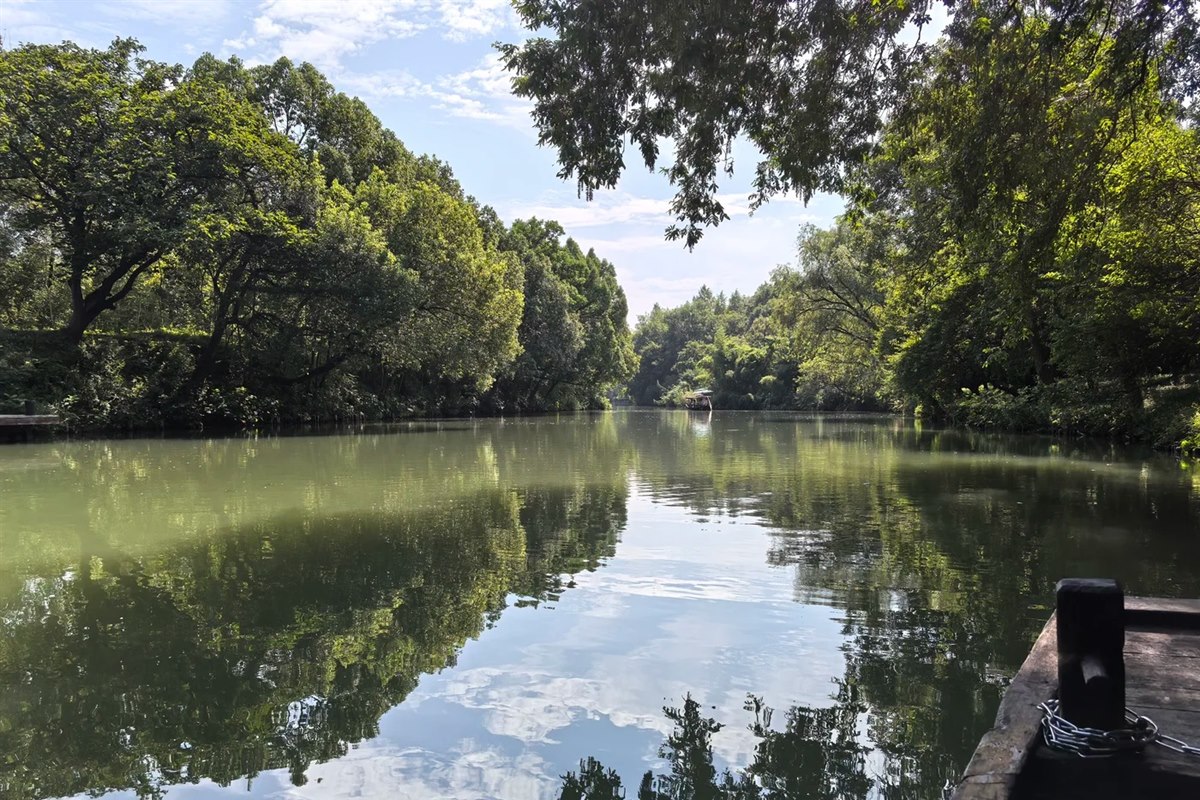
Xixi is more season-dependent than any other Hangzhou sight, for the simple reason that what you have come to look at is vegetation. Out of season the ticketed half draws a blunt verdict in the domestic corpus: it looks like an ordinary large pond.
| Season | What’s happening | Where |
|---|---|---|
| Feb – early Mar | Plum blossom — the classic Xixi season | Xixi Meishu, Meizhu Shanzhuang, Yanshui Yuzhuang (ticketed); best seen from a boat |
| Jun – Aug | Lotus and water lilies | Hongyuan’s Dongguan pond (ticketed); the Jiuqu Bridge at the Green Causeway’s west end is the free alternative |
| Sep – Oct | Persimmons on ~2,000 old trees | Mostly Hongyuan (ticketed) |
| Mid-Nov – early Dec | ⭐ Reed “flying snow” — the most striking of the four | 360+ mu around Qiuxue’an; hand-oared boat only |
Two windows are genuinely weak: late July to late August, when it is hot, humid and heavily mosquito-ridden, and January to early February. If your dates fall there and you do not intend to take a boat, walk the free causeways and skip the ticket.
Within a day there are two good windows — 07:30–09:30, when there is mist on the water and almost nobody about, and 16:30–18:30 for soft light. Midday, 12:00 to 15:00, is the worst of it in summer: exposed boardwalks, mosquitoes, and lotus flowers closed up in the glare. Weekends and public holidays peak 10:00–14:00.
Two practical notes. The mosquitoes here are not a formality — regular visitors specify a repellent with 20%+ DEET and long trousers in summer. And the park closes outright in severe weather, free zones included: typhoon Bavi shut the whole of Xixi in July 2026 and it reopened on the 13th, so between July and September it is worth checking the official notice the morning you go.
Is it worth half a day?
Two findings pull in opposite directions here, and both are real, so the honest answer is a conditional one rather than a verdict.
Chinese travellers are hard on the ticketed zone out of season — “¥80 for nothing” is a common line, and the frequent regret is not having simply walked the free causeways. Yet the same body of traveller reports says something we did not expect: visitors from Europe and North America tend to react better to Xixi than to West Lake. The reasons given are consistent — a large near-natural wetland sitting inside a major city is something they have no equivalent for at home, and its quiet reads as a relief after West Lake’s crowds and Lingyin’s queues.
So the calculation is not “is Xixi good” but which Xixi, and when:
- Go, and buy the ticket — if you are here in plum or reed season, or you want the hand-oared boat through the water lanes. That is the experience the ticket exists for.
- Go, and skip the ticket — if you want a green half-day, a garden, an old street and a good museum without crowds. This is what a growing share of local visitors now recommend.
- Leave it — if your trip is short, it is deep winter or high summer, and you only intend to walk. Do West Lake and Lingyin Temple first.
Xixi is a half-day out rather than a base — stay near West Lake or in central Hangzhou and come from there. Ticket windows, boats and shops are cashless-first, so have Alipay or WeChat Pay set up. Our things-to-do guide sets out how the city’s sights fit together.
Book Xixi admission or a Hangzhou tourNASDAQ: TCOM
The official channel is a real-name Chinese mini-programme with a 7-day window. Trip.com lists Xixi admission and half-day Hangzhou tours in English on a foreign card — useful if you would rather not work the domestic booking flow.
Frequently asked questions
Is Xixi Wetland free?
Partly — and this is the single most useful thing to know about it. Large parts of the park are free to walk with no ticket at all: the Fu Causeway (福堤), the Green Causeway (绿堤), the Yulin Road stretch between Gaozhuang and the lotus beach, the Jingyuan heritage area at Wujiawan and the Longshezui rest area. Inside that free zone you also get Gaozhuang's Qing-dynasty garden, the Hezhu Street old lane with its restaurants and cafés, the Lianhuatan birdwatching area and the China Wetland Museum. The ¥80 ticket buys the enclosed scenic area — principally the deep boat routes, Shentankou and Yanshui Yuzhuang, and the plum and reed displays. A great many visitors walk the free half and never buy a ticket.
How much are Xixi Wetland tickets and the boats?
Admission to the ticketed scenic area is ¥80, and one ticket covers both the East Zone and the West Zone (Hongyuan) — there is no separate Hongyuan ticket. Boats are extra and are not included in any admission ticket: the electric boat is ¥60 per person on fixed hop-on routes, and the hand-oared boat is ¥100 per hour, per boat for 2–6 people, which works out around ¥30–50 each if you share at the pier. The sightseeing cart is ¥10 single leg · ¥20 through-ticket. Half price applies to ages 6–18, students, over-60s and children 1.2–1.5 m; under-6s and over-70s go free.
Do you need to book Xixi Wetland in advance, and how far ahead?
Entry is real-name and booking is expected, but the window is short: reservations open only 7 days ahead, never earlier, with a maximum of 9 people per booking and one booking per document per day. So the useful instruction is not "book well in advance" — it is to book as soon as your date enters the 7-day window. Staffed windows still sell on the day, but the ticketed zone genuinely sells out on summer-holiday weekends, May Day and National Day. On public holidays even parts of the free zone can require a separate free reservation.
Can foreign visitors get in with a passport?
Yes, but not through the ID-card turnstile. The gates read a Chinese identity card or the booking QR code — a passport has no Chinese ID chip and will not scan. Two paths work: book online entering your passport details and go in on the order QR code, or take the passport original to the visitor centre or a staffed window and exchange it for a paper ticket. Bring the physical passport either way; counters refuse photographs and photocopies. Concession tickets always have to be exchanged at a window.
Which boat should you take at Xixi Wetland?
The hand-oared boat (摇橹船) is the one worth paying for — it threads the narrow water lanes and reed beds at ¥100 per hour, per boat, so roughly ¥30–50 each shared. It needs at least two people; a solo traveller cannot take one. The classic routes are one hour to Meizhu Shanzhuang, two hours round trip to Qiuxue'an and three hours to Shentankou. In reed season this is not just the nicer option — the "flying snow" reed beds are reached only by hand-oared boat, and the electric boat does not go there. Go early: boats can be gone by around 15:40 despite later posted times, and weekend queues after 10:00 run one to two hours.
How do you get to Xixi Wetland from West Lake?
It is about 11 km west of West Lake, roughly 26 minutes by taxi or DiDi, or about 48 minutes by Metro Line 3 for ¥4. Which station you want depends on which half you are visiting: Xixi Wetland South (Line 3, exit A) is the one for the paid zone and the main boat piers at Zhoujiacun; Xixi Wetland North on Line 19, exit E2, is the best arrival for the free zone, putting you straight onto the Fu Causeway. Huawu and Dongyue (both Line 3) serve the southern and eastern free edges, and Hongyuan (Line 3) serves the West Zone.
When is the best time to visit Xixi Wetland?
Xixi is more season-dependent than any other Hangzhou sight, because what you are looking at is vegetation. Plum blossom runs February to early March, lotus June to August, persimmons September to October, and the reed "flying snow" from mid-November to early December — the most striking of the four. Two windows are genuinely poor: late July to late August, when it is hot and mosquito-heavy, and January to early February. Within a day, aim for 07:30–09:30 for mist and empty water, or 16:30–18:30 for soft light; avoid midday, and expect crowds 10:00–14:00 at weekends.
Is Xixi Wetland worth visiting?
Conditionally, and the conditions are the season and knowing about the free zone. Domestic travellers are blunt that the ticketed half out of season looks like an ordinary large pond and is poor value at ¥80. But the same traveller reports say Western visitors often react better to Xixi than to West Lake, because a large near-natural wetland inside a city is something they have no equivalent for at home, and because it is quiet where West Lake is crowded. In the right season, or with a hand-oared boat, or simply as a free green half-day away from the crush, it earns its half-day. In deep winter or high summer, walking only, the ticketed half does not.
Sources
Checked August 2026 · Written from our own first-hand travel in China.