Key takeaways
- A UNESCO 2013 World Heritage cultural landscape — ~1,300 years of working Hani rice terraces on the Ailao slopes.
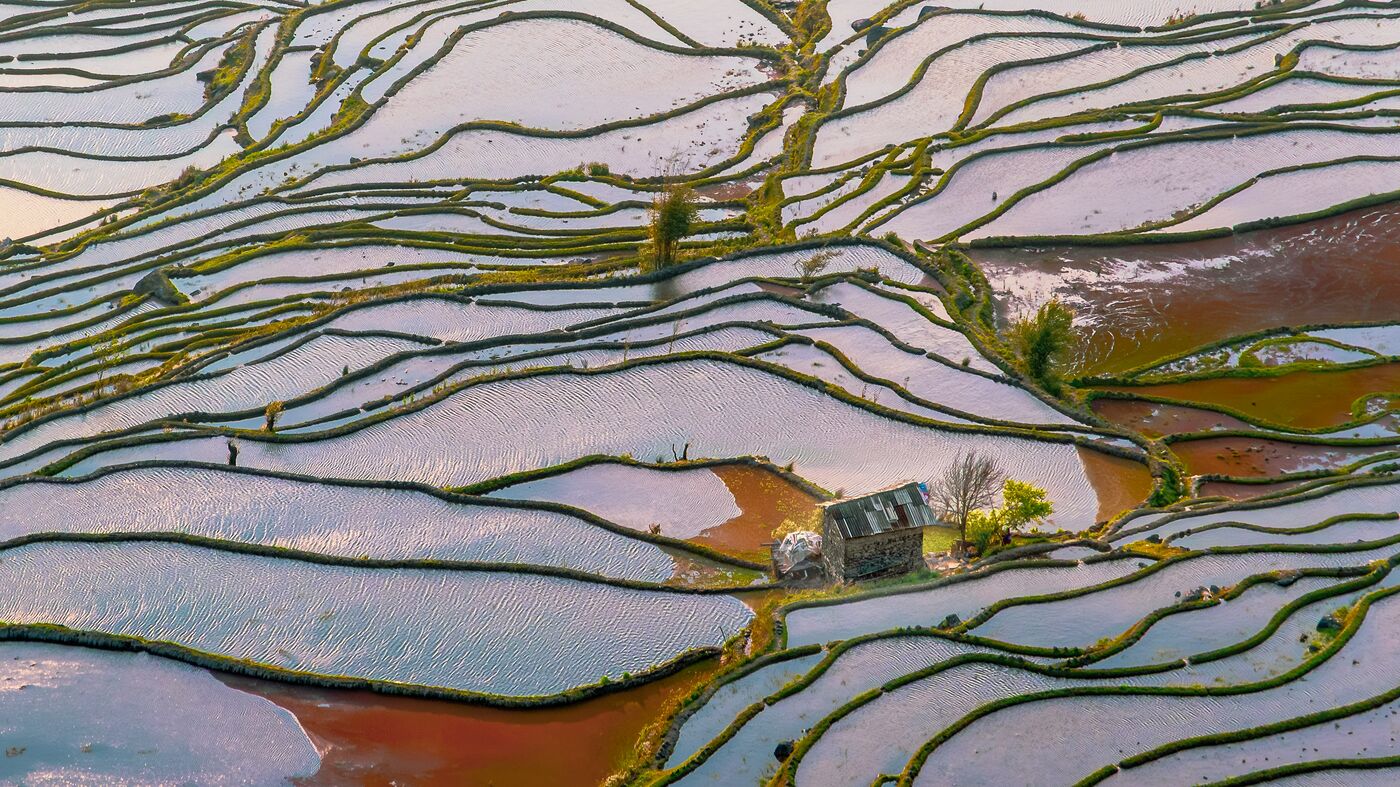
- The icon is the Duoyishu sunrise in the flooded mirror-water season (late Nov → early Apr); Dec–Feb is peak — and winter sunrise is 07:10–07:50, not pre-dawn dark.
- It’s ~4.5–5 hours south of Kunming (~280 km) by hired car or direct bus; or bullet train to Honghe station (Mengzi) in ~1.5 h + a 2-hour transfer.
- An overnight on the terrace rim (Duoyishu / Huangcaoling / Pugaolao) is mandatory for the sunrise — this is not a day trip.
- One ¥70 ticket, valid 3 days, covers Duoyishu, Bada and Laohuzui; Azheke village is a separate ¥30.
What Yuanyang is
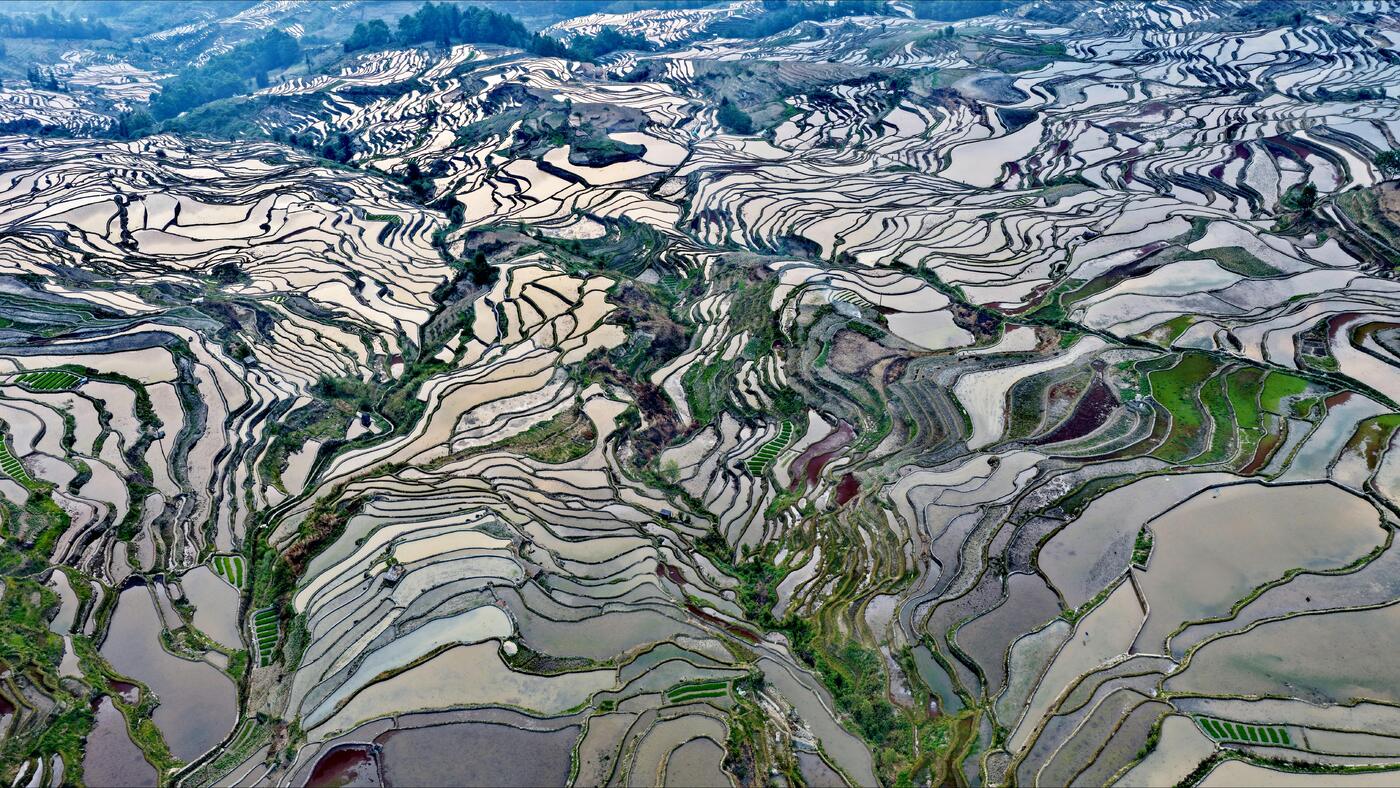
The Yuanyang terraces are not a static landscape — they are a functioning agricultural system the Hani minority (哈尼族) have built and maintained for roughly 1,300 years on the steep Ailao Mountain (哀牢山) slopes of Honghe Prefecture, southern Yunnan. UNESCO inscribed the wider Cultural Landscape of Honghe Hani Rice Terraces in 2013, citing “an outstanding example of human cultural adaptation to a difficult environment” — 12,000+ individual terraces across ~1,000 km², managed by communal water and forest systems rather than state engineering.
The genius is a four-tier vertical design: forest at the top catches rainfall and feeds mountain springs; Hani villages sit in the mild middle band; rice terraces (1,400–1,800 m) descend below the villages, fed gravity-fed through stone channels; and the river valley at the bottom is where the water finally exits. The whole system runs year-round without pumping. After the autumn harvest the terraces are refilled — full mirror-water from about late November through the winter — which is exactly when the famous reflection conditions appear. This is real, working agriculture, not a museum.
The viewpoints & the village
One ¥70 ticket (valid 3 days, re-entry allowed) covers the three paid viewpoint clusters — Duoyishu for sunrise, Bada and Laohuzui for sunset. Azheke, the mushroom-house village, is a separate ¥30. The clusters sit 18–26 km apart on mountain roads, so plan around one sunrise and one sunset a day rather than a sprint.
| Stop | Best light | Note |
|---|---|---|
| Duoyishu 多依树 | Sunrise · 07:10–07:50 winter (be there 06:00–06:30) | The iconic east-facing sunrise overlook (~1,800 m). The multi-level platform’s bottom rail fills first — arrive early or shoot telephoto from the upper tiers. The pre-dawn reflection colours often beat the sunrise itself. Sleep in the villages above. |
| Bada 坝达 | Sunset · golden from ~17:00 (winter sunset 18:00–18:30) | The biggest terrace amphitheatre — widest sense of scale, and the first-choice sunset platform. The usual Day-1 session after checking in. |
| Laohuzui 老虎嘴 (“Tiger’s Mouth”) | Sunset (alternative) | The classic cliff-edge valley view, reopened after its landslide closure — upper platform ~100 m from the road, lower platform ~500 m down stone steps (~10 min). Dramatic light, though travelers note the accessible area is smaller than before; if time is short, Bada wins. |
| Azheke 阿者科 · ¥30 | Midday / late afternoon | The best-preserved Hani “mushroom house” (蘑菇房) village, reached by a short village shuttle. ~2 unhurried hours; the paddy-dyke walk below the village glows at golden hour. A working village — ask before photographing residents. |
A natural Day-2 flow is Duoyishu sunrise → the Aichun “blue terraces” around 10:00 (direct light turns the water a Tiffany-like blue) → Azheke around midday → Bada for sunset. Beyond the paid gates, travelers rate the free platforms — the Pugaolao village square, Quanfuzhuang’s “fingerprint” terraces and the Laoyingzui outcrop — as close rivals to the ticketed views. The older Qingkou folk village now gets mixed reviews (more commercial, smaller terraces); most visitors are happier spending that time at Azheke.
The ticket & the loop
Admission is a single ¥70 combined ticket covering the three paid clusters — Duoyishu, Bada and Laohuzui. It is valid for three days with unlimited re-entry, checked by scan at each gate; no advance reservation is currently required (worth re-checking the scenic area’s latest notice before you travel). Viewpoint hours run roughly 06:00–19:30. Azheke village is a separate ¥30, which includes the mushroom-house quarter — guests sleeping inside the village are usually exempt.
Alipay and WeChat Pay are accepted at the gates; children under 1.2 m and seniors 70+ enter free with ID. One traveler-tested tip: on a foggy morning, don’t rush to buy at the gate — check the view from a free platform first, then buy once the fog lifts (the mountain weather can differ completely from the valley’s). Prices and hours are revised from time to time — confirm the current rate at the gate.
When to go — the three windows
The Yuanyang window is driven entirely by the rice-growing cycle. The flooded mirror-water season is the reason most people come; the harvest is a quieter alternative; the rainy summer is the one to skip.
| Window | Months | What you get |
|---|---|---|
| Mirror-water (flooded) | Late Nov → early Apr | Flooded terraces reflect sky, cloud and sunrise — the iconic pink-orange-gold images. Tripod essential. Dec–Feb is peak: fullest, clearest water and the best cloud-sea odds (traveler reports put Jan–Feb at the top). Early Nov is too early — fields are still refilling after harvest and the mirror is patchy. |
| Transplanting → green | Apr → Aug | April–May the villagers transplant seedlings (water and green mixing); June–August the terraces turn solid emerald. No mirrors, but ~27°C mountain air, green waves and post-rain cloud seas — a quiet-season trip, with the caveat that sustained summer rain can fog everything out. |
| Golden harvest | Sep → Oct | Ripe rice turns the terraces yellow-gold before the October–November harvest — a warmer, textured look without reflections. Fewer visitors than winter, milder (15–22°C). |
Reality check on the weather: even in peak winter the mirror sunrise is never guaranteed — mountain fog can blank a morning out entirely, which is why serious photographers stack 2–3 nights. The local rescue trick is that Yuanyang’s micro-climates differ ridge to ridge: when Duoyishu is fogged in, Laohuzui (20 km away) or the Xinjie side can be clear — a chartered car lets you chase the gaps. Fog days are also exactly when Azheke’s village lanes and the Aichun blue terraces earn their keep. See best time to visit Yunnan for the regional dry-season picture.
Getting there from Kunming
The terrace hub town of Xinjie is ~280–295 km south of Kunming — about 4.5–5 hours by road now that the expressway runs most of the way, with a winding final climb to the 1,600 m rim. Three realistic ways in for foreign visitors:
| Method | Route | Time · approx. cost |
|---|---|---|
| Hired car (simplest) | Private driver via Trip.com or a Yunnan agency, Kunming direct — door to guesthouse, no ticketing barrier, flexes around the sunrise. | ~4.5–5 h drive · typically ¥1,800–2,500 for a 2-day round trip |
| Direct bus | Kunming South Coach Station (metro “South Bus Station”) → Yuanyang, ~2 departures/day (typically ~10:20 & ~12:00). Choose the “Xinjie 新街” terminus — “Nansha 南沙” is the valley county seat an hour below the terraces. | 4.5–6 h · ¥79–107 |
| Train + car | Bullet train Kunming South (昆明南) → Honghe station 红河站 (Mengzi) in ~1¼–1½ h — or Kunming → Jianshui (建水) in ~1½–2 h — then a 2–3 h mountain transfer (~110 km) to the terraces. | ~1.5 h train + 2–3 h car · train from ~¥80 + car ¥200–300 (shared seat ~¥100–150) |
No flights yet: the new Honghe Mengzi Airport had not opened commercial service as of July 2026 (opening is expected later in 2026, with first routes planned to Beijing, Shanghai, Guangzhou and Chengdu — not Kunming). Until then, road and rail are the only ways in.
Why a hired car is still the first-timer default: the bus is cheap but its tickets pre-sell through a Chinese-language WeChat mini-program (buy at the station or ask your hotel to help), and the train option still leaves a mountain transfer usually negotiated in Chinese. Once on the rim there is no shuttle system — viewpoints are linked by shared local minivans (~¥5–15 a leg, hailed roadside) or a chartered car (~¥300–400/day; agree the price before boarding, and let your guesthouse call a trusted driver). A pre-arranged driver removes all of that at once. See getting around Yunnan and getting to Yunnan for the full picture — Yuanyang sits at the southern end of the loop, reached from Kunming, not Lijiang or Dali.
Book a Yuanyang terraces tour or transferNASDAQ: TCOM
Trip.com lists Yuanyang private transfers, driver-guides and 2-day terrace tours from Kunming — the friction-free way to solve the 5–6 hour drive and the Mengzi handoff, booked in English on a foreign card.
Where to stay & how long
If the sunrise is the goal, sleep on the terrace rim — never down in Nansha, the hot valley county seat an hour below. Four bases, in order of convenience: Duoyishu village (closest to the platform, most food and rooms; some inns need a short bag-carry from the road); Huangcaoling (the cluster of view-window boutique inns — many rooms genuinely face the sunrise from bed); Pugaolao (gentler prices, its own free viewing square); and Shengcun (the local market town — cheap food, morning market, a short drive from the platforms). Xinjie town is the fallback: conventional hotels, but ~26 km / ~45 min of pre-dawn mountain road from Duoyishu. Traveler-reported rates run ¥200–500 in the green season, ¥600–1,500 in the flooded-season peak; book 2–4 weeks ahead for Dec–Feb weekends and much earlier for Chinese New Year.
How long: the minimum is 2 days / 1 night — Day 1: leave Kunming in the morning, arrive early afternoon, browse Shengcun’s market, Bada at sunset; Day 2: Duoyishu sunrise (in position ~06:15 in winter), the Aichun blue terraces ~10:00, Azheke around midday, and drive out. Serious photographers add a second or third night to stack sunrise chances against the fog risk.
Where to book these: the Duoyishu and Pugaolao village inns are family-run and list most completely on Trip.com, with English checkout and foreign-card payment — the main platform for mainland properties; Western sites like Booking and Agoda carry few of them. Some tiny guesthouses are walk-in or WeChat-only, so book early or let your Yunnan driver help contact them.
Where to sleep for the sunrise (village by village)
If the Duoyishu sunrise is the goal, sleep on the high rim near it — never down in Nansha, the hot valley county seat an hour below the terraces. The rim options are all independent guesthouses and small view hotels (no international chain operates near the terraces): Duoyishu village is the closest-to-the-platform 'C position', Huangcaoling is the cluster of view-window boutique inns, Pugaolao has its own free viewpoint and gentler prices, and Shengcun is the local market town. Expect roughly ¥200–500/night in the green season and ¥600–1,500 in the flooded-season peak; Chinese New Year sells out weeks ahead.
- On the slope directly above the Duoyishu viewpoint — walking distance to the sunrise platform.The closest base for the pre-dawn window, with the most food and room choice. Some inns are not reachable by car door-to-door — confirm parking and bag help when booking. The Duoyishu Banshan resort by the platform draws praise for its view windows and mixed reviews on upkeep.
- Huangcaoling (黄草岭), the next hamlet along the rim — rooms face the Duoyishu terraces directly.The cluster travelers pick for watch-the-sunrise-from-bed rooms with big view windows and terraces. Narrow lanes: check where cars can actually stop. Peak-season rooms here are the first to sell out.
- Pugaolao (普高老) hamlet beside the Duoyishu terraces — its own free viewing square is a short walk out.The value pick: simple Hani-family inns at gentler prices, and a free 360° viewing square about 15 minutes on foot that travelers rate close to the paid platform.
- Xinjie (新街镇), the scenic-area hub town — but ~26 km / ~45 min of mountain road from the Duoyishu platform.More conventional hotels (the larger Yunti hotel sits here) and the bus terminus — but the sunrise needs a pre-dawn car and the drive is longer than most visitors expect. A fallback, not the plan.
- Jianshui (建水) heritage town — ~110 km / ~3 h of road north of the terrace rim, on the Kunming approach.Many travellers break the journey with a night in Jianshui (a destination in its own right, with direct trains from Kunming). A comfortable bookend, not a sunrise base.
How Yuanyang fits a Yunnan trip
Yuanyang sits at the southern end of the Yunnan loop, reached from Kunming rather than the Dali–Lijiang–Shangri-La corridor to the northwest. It pairs most naturally with:
- Kunming + Jianshui + Yuanyang — the southern arc; break the journey with a night in the heritage town of Jianshui (建水) — direct trains from Kunming in ~1½–2 h, then ~3 h of mountain road up to the terrace rim.
- As a 2-night extension to a Kunming city stay, before or after the northwest loop — not the first stop in a solo China trip given the transport chain.
- With a guided Yunnan package, which usually handles the driver, ticket and village guesthouse together — the simplest route for first-timers.
- Onward to Vietnam — the Hekou (河口) border crossing to Lào Cai is ~185 km / ~2.5–3 h east of the terraces by road, so Yuanyang works as the last China stop on a Yunnan→Vietnam overland route.
Honest expectation-setting: Yuanyang is moderately challenging — the viewpoints are easy, but the long drive, the mandatory overnight and the simple village guesthouses make it a better second or third stop than a first landing. Combine it with the broader region via our things to do in Yunnan guide and the Yunnan travel guide.
Practical for foreigners
- Elevation & warmth: viewpoints sit ~1,400–1,800 m; pre-dawn drops to ~5–10°C in winter and the platform is windy — warm windproof layers, and a head torch for village lanes.
- Weather is a lottery: mountain fog is normal, and the rim’s weather differs completely from the valley’s. Build in a spare morning; when one ridge fogs in, another 20 km away can be clear — chartering a car to chase gaps is the local move.
- Getting around: no shuttle, no taxis, no ride-hailing — shared minivans (~¥5–15 a leg) or a chartered car (~¥300–400/day). Agree prices before boarding; guesthouse owners will call trusted drivers.
- Gear: a tripod is essential in the mirror-water season (2–30 s exposures); wide lens for scale, telephoto to compress the stacked terraces from the upper tiers. Phones work but lag in the pre-dawn low light.
- Payment & language: Alipay / WeChat Pay accepted at the gates and most guesthouses (carry some cash for minivans and markets); English is limited throughout — a pre-booked driver-guide removes most of the friction.
- Village etiquette: the Hani communities are working farms, not a theme park — ask before photographing residents (especially women, children, ceremonies), and don’t enter homes uninvited.
Frequently asked questions
When did Yuanyang become a UNESCO World Heritage Site?
The Cultural Landscape of Honghe Hani Rice Terraces — which includes the Yuanyang terrace cluster — was inscribed by UNESCO in June 2013 as a World Heritage Site. The inscription citation describes it as 'an outstanding example of human cultural adaptation to a difficult environment.' The Hani people have been cultivating these terraces on Ailao Mountain for approximately 1,300 years.
Mirror-water season vs golden harvest — which is better for photos?
Both are spectacular in different ways. From late November to early April the terraces are flooded for the next planting cycle: the paddies become sky-mirrors, and December-February is the peak — fullest, clearest water, dry-season air, and the best cloud-sea odds (traveler reports put January-February at the top). Mid-September through October is the golden-harvest window: ripe rice turns the terraces yellow-gold — warmer, more textured, fewer crowds. June-August is the green season: no mirror reflections, but emerald terraces, post-rain cloud seas and ~27°C mountain air — better suited to a quiet summer escape than the classic photography trip. One trap: early November is too early — the fields are still refilling after harvest and the mirror is patchy. Wait until late November.
How much is the Yuanyang ticket in 2026?
The combined scenic-area ticket is ¥70, covering the three paid viewpoint clusters — Duoyishu, Bada and Laohuzui — and it is valid for three days with unlimited re-entry, so there is no need to cram everything into one day. Entry is currently by scanning at the gate; no advance reservation is required, though it is worth checking the scenic area's latest notice before travelling. Azheke village charges a separate ¥30, which includes the mushroom-house quarter (children under 1.2 m free; guests sleeping in the village are usually exempt). Children under 1.2 m and seniors 70+ enter the main scenic area free with ID. Prices are revised from time to time — confirm at the gate.
How do I get from Kunming to Yuanyang?
Three realistic routes. (1) DIRECT BUS — the no-transfer option: from Kunming South Coach Station (metro Line 1 'South Bus Station'), about two departures a day (typically ~10:20 and ~12:00), ¥79-107, 4.5-6 hours. Check the destination when buying: 'Xinjie' (新街) is the terrace-area hub town, 'Nansha' (南沙) is the valley county seat roughly an hour below the terraces. Tickets sell via a Chinese-language WeChat mini-program — as a foreign visitor, buy at the station or ask your hotel to help. (2) TRAIN + CAR: bullet trains run Kunming South → Honghe station (Mengzi) in as little as ~1¼-1½ hours, and direct trains reach Jianshui in ~1½-2 hours; from either it is a 2-3 hour mountain transfer (private car ~¥200-300, shared seat ~¥100-150 per traveler reports). (3) HIRED CAR / PRIVATE TOUR direct from Kunming: ~280-295 km, now ~4.5-5 hours on the expressway — the simplest door-to-door option for first-timers, bookable in English on Trip.com. There are currently no flights: the new Honghe Mengzi Airport had not opened commercial service as of July 2026.
Is an overnight stay really mandatory?
Yes, if you want the Duoyishu sunrise — which is the point of the trip. In the winter peak the sun rises 07:10-07:50, and you need to be on the platform by 06:00-06:30 to get a rail spot (the multi-level platform's bottom tier fills first). No same-day transport from Kunming arrives anywhere near that early, and even from Xinjie town it is a ~45-minute pre-dawn mountain drive. All serious Yuanyang itineraries run 2 days / 1 night minimum — Day 1: arrive + Bada sunset; Day 2: Duoyishu sunrise + villages + drive out — sleeping in Duoyishu village or one of its neighbours (Pugaolao, Huangcaoling, Shengcun), a walk or short drive from the viewpoint.
What time is sunrise — and what gear should I bring?
Winter (December-February): sunrise 07:10-07:50 Beijing time, so arrive 06:00-06:30. Summer (June-August): sunrise ~05:40-06:00, so photographers set out 04:30-05:00. The best colour is the roughly 30 minutes BEFORE sunrise, when pre-dawn light reflects off the flooded paddies — once the sun is fully up, the water tends to blow out. Bring a tripod (2-30 s exposures are normal in the pre-dawn window), a warm windproof layer (the rim sits at ~1,600-1,800 m; pre-dawn drops to ~5-10°C in winter), and ideally a graduated ND filter to balance bright water against dark terrace walls. A telephoto (70-200 mm) compresses stacked terrace lines and lets you shoot from the upper tiers when the front rail is taken; wide-angle (16-24 mm) captures the scale. Phones get usable results but lag in the pre-dawn low light.
Can I see all the main viewpoints in one day?
With an overnight at Duoyishu, yes — the classic Day-2 flow is: sunrise at Duoyishu (in position ~06:15 in winter), the 'blue terraces' pocket at Aichun around 10:00 when direct light turns the water a Tiffany-like blue, Azheke village around midday, then Bada for sunset (golden light from ~17:00; winter sunset 18:00-18:30). Laohuzui is the alternative sunset classic — a dramatic cliff-edge valley view, reopened after its landslide closure, though travelers note the accessible area is smaller than before. There is no shuttle system: the viewpoints sit 18-26 km apart on mountain roads, so you hop between them by local shared minivan (~¥5-15 a leg, hailed on the road) or a chartered car (~¥300-400/day — your guesthouse can arrange one). The ¥70 ticket is valid three days, so nothing forces a one-day sprint.
Are drones allowed at Yuanyang?
Drone use at Yuanyang is officially restricted and permit-only within the scenic area. In practice, visitor reports through 2026 describe plenty of drones in the air at the sunrise platforms, with inconsistent enforcement — but confiscation remains a real risk, and a packed viewing platform is a bad launch site. The safe assumption is that you need a formal permit before arrival. The site is photographically rich from ground level; a drone is not necessary to capture the scale.
Is Azheke village worth it — and what about Qingkou?
Azheke (阿者科) is the village visit worth planning around: a working Hani village with the best-preserved 'mushroom house' (蘑菇房) quarter, a separate ¥30 ticket that includes the village and its house quarter, and a short village shuttle from the road. Two unhurried hours is enough; walking the paddy dykes below the village in late-afternoon light is the highlight. The older Qingkou (箐口) folk village, once the standard stop, now gets mixed reviews — travelers widely describe it as more commercial with smaller terraces, and suggest spending the time at Azheke or the free platforms instead. Wherever you go, these are working farm villages, not a theme park: ask before photographing residents (especially women, children and ceremonies), don't enter homes uninvited, and follow posted guidance. The village guesthouses are Hani-run family businesses — staying in one puts money directly into the community.
Is Yuanyang suitable for first-time China visitors?
Yuanyang is a moderately challenging destination for first-time China visitors. The site itself is manageable — the viewpoints have paved paths and basic facilities. The challenge is getting there: the transport chain (Kunming → HSR + drive or hired car) requires either Chinese-language confidence for self-booking or an arranged driver/guide. The Duoyishu guesthouses are simple (basic en-suite rooms, limited English, squat toilets common in older buildings) rather than international-standard hotels. Recommended for first-timers only if combined with a guided Yunnan package or with the hired-car option pre-booked through a reputable English-interface platform. Not recommended as the first stop in a solo China trip — better after a few days in Kunming or Lijiang.
What is the Hani four-tier mountain system?
The Hani people developed a sophisticated land-use system over ~1,300 years that treats the Ailao Mountain slopes as four vertically-stacked zones. At the top: forest, left intact to catch rainfall and feed mountain springs that supply the entire system. Below the forest: the Hani villages, positioned in the middle band where temperatures are mild and the water supply is reliable. Below the villages: the rice terraces, fed gravity-fed through a web of stone-and-earth channels — with carved wooden notch-dividers (木刻分水) traditionally apportioning each family's share of the flow. At the bottom: the river valleys, where the water finally exits the system after passing through all the terraces. The design waters the terraces year-round without pumping — the technical achievement UNESCO cited in the inscription.
Sources
Checked July 2026 · Written from our own first-hand travel in China.