Key takeaways
- The two tickets are the same site at two entry times, and the site does not clear out at 16:30 — so going in at ~16:00 on the ¥48 ticket buys the whole lit evening at the day rate.
- The photograph everyone posts is free: the whole tower, shot from the pedestrian footbridge across the road. The outer food street is ungated too.
- It is a 2019 commercial complex, not an old town — a 109.9 m tower in Tujia stilt-house form, a snack street and scheduled folk shows.
- It is in Zhangjiajie city, not Wulingyuan — 3.4 km from the West high-speed station, 32 km from the national park.
- Worth an evening only if you are already sleeping in the city: an arrival night, or after Tianmen Mountain. Never worth a special trip.
What 72 Qilou actually is
72 Qilou (七十二奇楼) is a commercial cultural-tourism complex that opened around 2019. Its centrepiece is a tower 109.9 metres tall, built in the form of a Tujia stilt house — the timber-framed, cantilevered houses of the minority people whose homeland this region is — and certified by Guinness World Records as the tallest building of that form anywhere. Around it sit roughly 110,000 m² of floor space in three zones, containing a snack street of something like 127 food outlets, craft and intangible-heritage workshops, small museums and galleries, and folk performances on a schedule.
It is worth being blunt about the category, because the expectation gap causes most of the disappointment: this is not a historic quarter. Nothing here is old. It is a night-economy development built to give a city that empties out after dark somewhere to spend an evening, and judged as that it is competent. Judged as an ancient town — which is how the photographs read — it is not one.
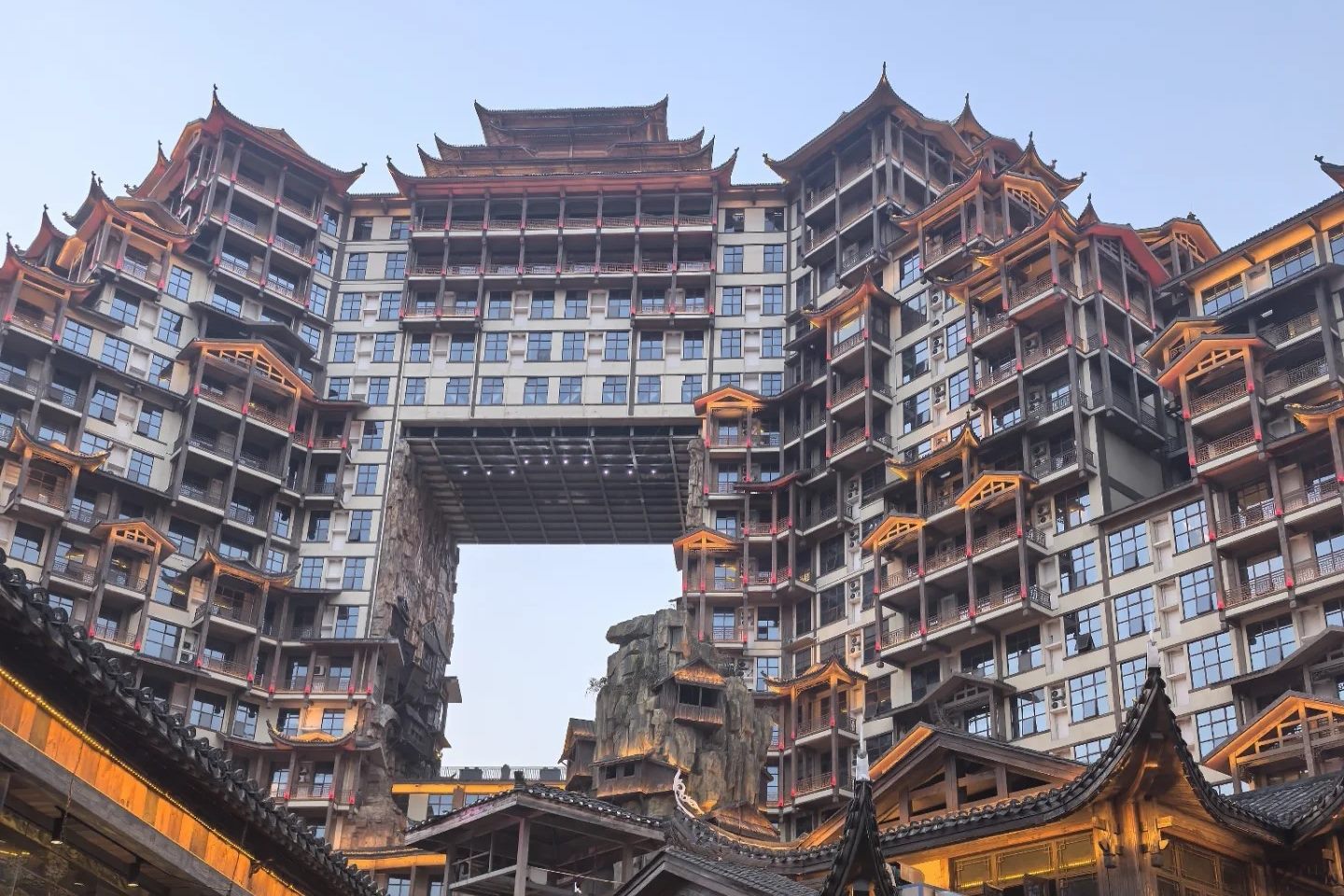
A word about the name. 奇楼 qílóu means “wonder tower”, and it is a different word from 骑楼 qílóu, the arcade shophouse architecture of Guangzhou and Haikou. Searching the bare word “qilou” will mostly return those arcades — and a Japanese streamer. This place is always 72 Qilou, sometimes translated as the “72 Wonder Buildings”.
Where it is — and where it is not
This is the practical thing people get wrong, including some published guides: 72 Qilou is in Zhangjiajie city (Yongding district, No. 1 Wulingshan Avenue). It is not in Wulingyuan, the park town where most visitors sleep for the national forest park, which is about 32 km away. If your hotel is in Wulingyuan, this is a 40-minute drive each way for an evening walk — which is a large part of why we do not recommend a special trip.
Terrain © Stadia Maps · Stamen Design · OpenMapTiles · © OpenStreetMap contributors.
72 Qilou is the ringed pin in the south, in the city cluster beside Zhangjiajie West station, the central station and the airport — not in the northern cluster around Wulingyuan town and the National Forest Park, which is where the mountains and most visitors’ hotels are. That single fact decides whether an evening here is a five-minute taxi or a 40-minute drive each way.
| From | How | Time |
|---|---|---|
| Zhangjiajie West (HSR) | Taxi, ~¥7 — closer to the station than to anything else | ~6 min |
| Hehua airport (DYG) | Taxi, ~¥13 | ~12 min |
| Zhangjiajie station (central) | Taxi, ~¥14 — the Tianmen Mountain cable-car base is beside this station | ~17 min |
| Wulingyuan town | Coach or taxi — a long way for an evening | ~40 min |
That first row is the whole argument for the place. It is a few minutes from the high-speed station and a few more from the airport, which makes it a sensible thing to do with the evening you arrive on — when your hotel is in the city, you have hours to fill and no appetite for anything strenuous. There are hotels inside the complex itself, including an international mid-range chain, which reinforces the same logic.
Tickets — the cheap one is the good one
Zhangjiajie’s ticketing has a habit of hiding its logic, and this is a clean example. The two prices look like a budget option and a premium option. They are not. They are the same site at two different entry times.
| Ticket | Admits you | What you get | Price |
|---|---|---|---|
| Day | Before 16:30 | Everything — including the evening, because the site does not clear out | ¥48 |
| Night | From 16:30 | The same evening, bought later | ¥88 |
| Concession | Students, 14–18s | As above | ~¥66 |
| Free | Under-14s, over-70s, Zhangjiajie residents | As above, with ID | — |
So the move is simply to be through the gate before 16:30. Arrive around four in the afternoon, walk the lanes in daylight, eat, and you are still inside when the facade lights come up and the evening set pieces run — all on the ¥48 ticket. Arriving an hour later costs you the difference for exactly the same night.
Where the “tickets from ¥20” figure comes from. A lot of English coverage — including an earlier version of ours — quotes about ¥20 for daytime entry. That is a promotional price on third-party Chinese booking platforms, not the gate price, and it comes and goes. The posted day rate is ¥48. If you find it discounted, good; do not plan on it.
The free version, which is what locals recommend
Ask a taxi driver or a hotel front desk in Zhangjiajie about 72 Qilou and you will often get the same unprompted answer: photograph it from across the road and do not buy a ticket. It is worth taking seriously, because the thing that makes the place famous is entirely visible from outside.
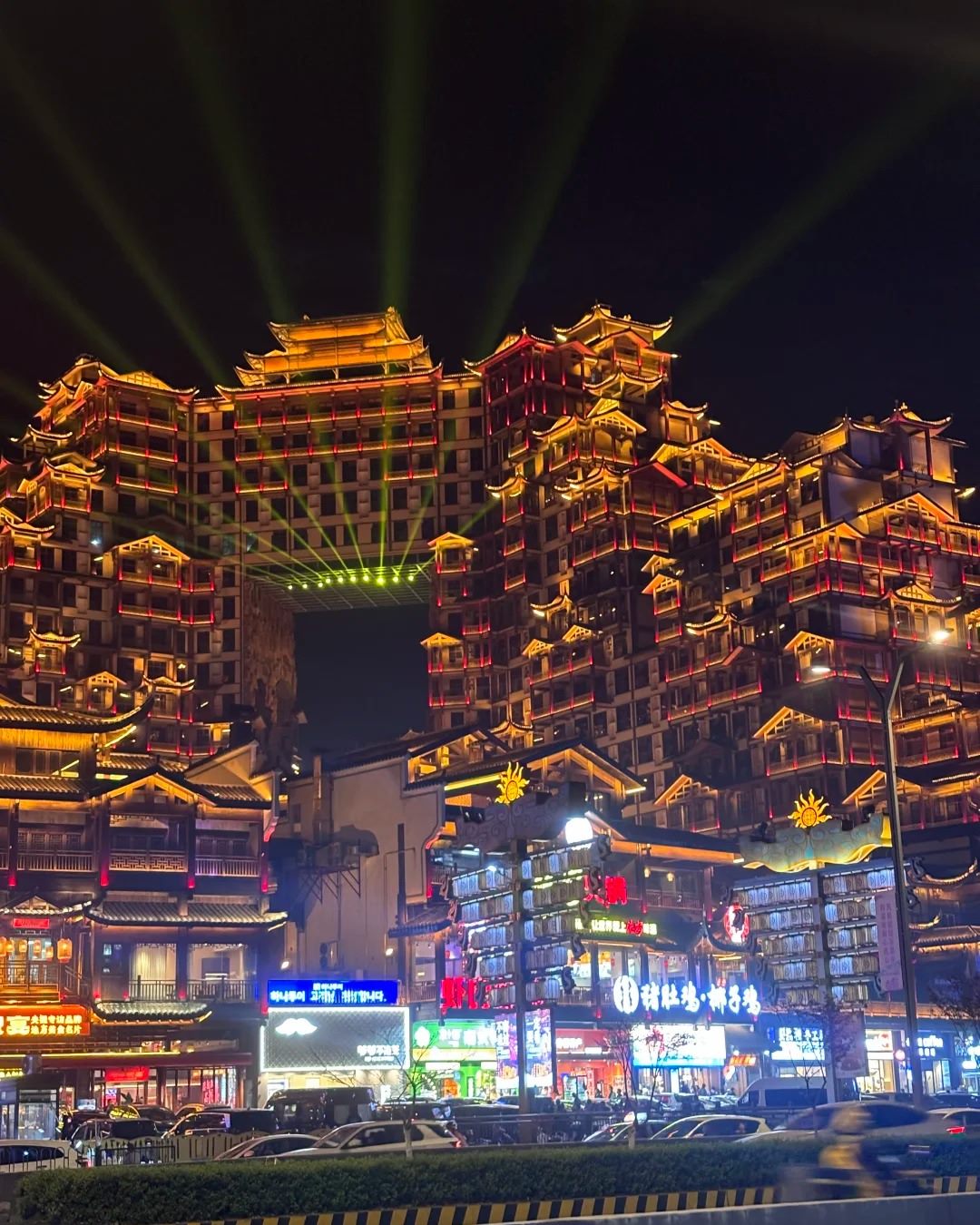
- The photograph. The shot circulating on social media — the whole tower lit from base to roof — is taken from the pedestrian footbridge opposite the complex, or from the exit of the underpass. You need the distance to fit 110 metres of building in frame; from inside you cannot.
- Use the bridge or the underpass. Do not cross at road level to line up the shot. This is a main avenue and it carries real traffic after dark.
- The outer food street is ungated. You can walk it, eat and look at the building without a ticket at all. What the ticket buys is the inner complex, the lantern ceremony and the bonfire.
- Photo stalls work that side of the road — roughly ¥10 for an unedited frame and ¥15 retouched, if you want yourself in the picture with the tower behind you.
None of that is a trick or a loophole; it is simply how the site is laid out. If your interest in 72 Qilou is the photograph — and for most foreign visitors arriving off a TikTok clip, it is — then the free version is the whole of what you came for, and it takes twenty minutes.
When to go, and when the lights come on
| What | Detail |
|---|---|
| Open | ~09:00 (Apr–Oct) / ~10:30 (Nov–Mar) |
| Last admission | ~22:00; the day/night ticket boundary is 16:30 and the site runs to ~23:00 |
| ⭐ Best arrival | ~16:00, on the ¥48 day ticket |
| Lights on | ~19:00–19:45 in summer (fully lit ~19:30) · ~18:00–19:00 in winter |
| Evening set pieces | A lantern-lighting ceremony, then a bonfire-and-dance finale |
| Time needed | 1.5–2.5 hours inside · ~20 minutes for the free photo from outside |
The lighting tracks sunset, so it moves through the year — roughly 19:00 to 19:45 in summer, fully lit around 19:30, and roughly an hour earlier in winter. The half hour after the lights come up, while there is still colour in the sky, is the photograph; once the sky goes black the contrast blows out.
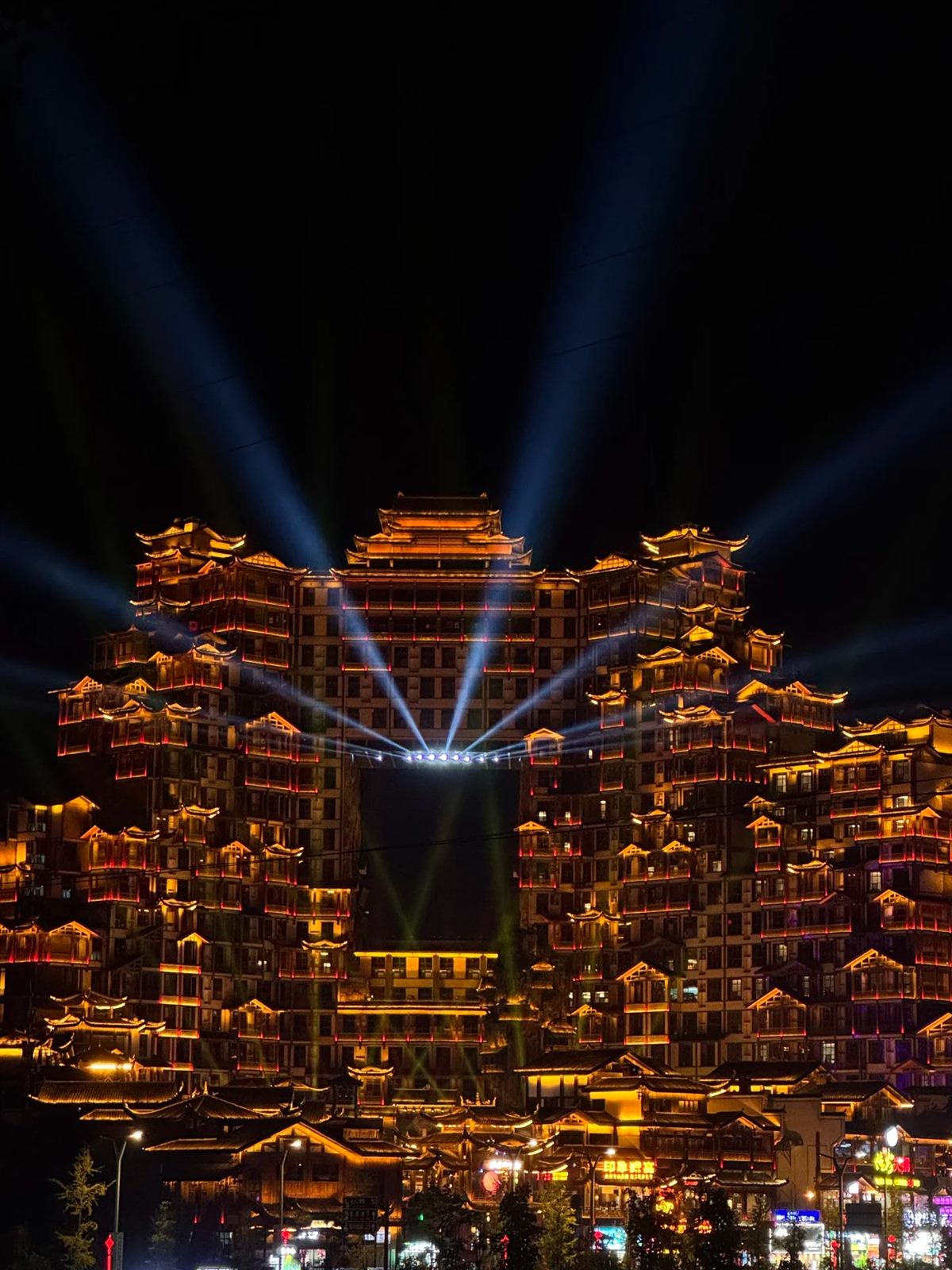
We are deliberately not printing a show timetable. Two set pieces run every evening — a lantern-lighting ceremony that switches on thousands of lanterns at once, and a bonfire with Tujia dancing that closes the night. But the published running orders disagree with each other by up to half an hour, and they shift with the season, so any minute we printed would be wrong somewhere. The reliable version, and the one travellers themselves use: photograph the programme board at the gate when you go in, and plan the evening off that.
Is it worth it?
Do not make a special trip. Go if you are already there. That is the whole verdict, and it is unusually well supported — it is what local drivers and hotel staff say, and it matches what visitors write afterwards.
| Situation | Call |
|---|---|
| Arriving in the city late by train or plane | ✅ Good — a short taxi ride, somewhere to eat and walk |
| The evening after Tianmen Mountain | ✅ Good — no more climbing, and you are already in the city |
| Staying in Wulingyuan for the park | ❌ Skip — a 40-minute drive each way for an evening walk |
| Three days or fewer in Zhangjiajie | ❌ Skip — the park, Tianmen and the glass bridge come first |
| You only want the photograph | ⭐ Shoot it from the footbridge, free, and keep the evening |
When people do regret paying, three complaints recur. The ¥88 night ticket feels like paying an entrance fee to a shopping street. The performances are scattered down different lanes with no clear signage, so the evening turns into a chase after a timetable and you miss half of them anyway. And the secondary spending inside — archery, foot massage and similar stalls — is priced opaquely. None of that makes it a bad evening, but it does explain why so much local advice reduces to “take the photo from outside”.
One piece of context that is changing the calculation as of mid-2026: Dayong Ancient City (大庸古城), a separate reconstruction in the same city, relaunched on 10 July 2026 as Qihuan Dayong City under a new operator and is now free to enter, with paid attractions inside. It is far too new for anyone to have a settled verdict on, and we are not offering one — but free entry means walking in costs nothing if you are in the city anyway, and travellers have already begun recommending the pairing: photograph 72 Qilou from the footbridge, then spend the evening in Dayong for nothing.
Zhangjiajie evening tickets & toursNASDAQ: TCOM
If you do want the ticket rather than the free view, Trip.com sells it in English on a foreign card — along with the city’s other evening options.
Frequently asked questions
What is 72 Qilou, and is it an old town?
No — and this is the most common misunderstanding. 72 Qilou (七十二奇楼) is a purpose-built cultural-tourism complex that opened around 2019 in Zhangjiajie city. Its centrepiece is a 109.9-metre tower constructed in the form of a Tujia stilt house, certified by Guinness World Records as the tallest building of that form, with roughly 110,000 m² of floor space around it split into three zones. Inside are a snack street with something like 127 food outlets, craft and intangible-heritage shops, small galleries and scheduled folk performances. It is a modern night-economy development, not a surviving historic quarter, and travellers who arrive expecting an old town are the ones who leave disappointed.
Should you buy the day ticket or the night ticket?
The day ticket, almost always — and the reason is not obvious from the prices. The two tickets are not a cheap version and a good version: they are the same site at two different entry times. The ¥48 day ticket admits you before 16:30 and the ¥88 night ticket admits you from 16:30 onwards, but the site does not clear out at the changeover. So if you go through the gate at around 16:00 on the day ticket, you keep the whole evening — the facade lighting, the lantern-lighting ceremony and the bonfire finale are all in the price you already paid. Arriving at 17:00 instead means paying ¥88 for the same evening you could have had for ¥48. Concessions are about ¥66 for students and 14-18s; under-14s, over-70s and Zhangjiajie residents enter free.
Can you see 72 Qilou without paying?
Yes, and this is what most local advice actually recommends. The outer food street is ungated and free to walk, so you can eat there and look at the building without a ticket. More importantly, the photograph everyone posts — the whole lit tower, top to bottom — is taken from outside the complex, on the pedestrian footbridge across the road (the underpass exit works too). Taxi drivers and hotel front desks in Zhangjiajie routinely tell visitors to do exactly that. Use the bridge or the underpass rather than crossing at road level; the road carries heavy traffic in the evening. Photo-service stalls work that side of the road at roughly ¥10 for an unedited frame and ¥15 retouched, if you want a picture of yourself with the tower behind you.
What time do the lights come on at 72 Qilou?
The facade lighting tracks sunset, so it moves through the year: roughly 19:00 to 19:45 in summer, fully lit by about 19:30, and roughly 18:00 to 19:00 in winter. Treat any single published time as unreliable. The evening also has two set pieces — a lantern-lighting ceremony that switches on thousands of lanterns at once, and a bonfire-and-Tujia-dance finale that closes the night — but published running orders for these disagree with each other by as much as half an hour, and they shift with the season. The reliable move, and the one travellers recommend, is to photograph the programme board at the gate when you arrive.
How do you get to 72 Qilou, and how long do you need?
It is in Zhangjiajie city, not in Wulingyuan where the national park is — a distinction worth making, because the two are about 32 km apart and guides sometimes place it in the wrong one. It sits on Wulingshan Avenue in Yongding district, roughly 3.4 km and six minutes by taxi (about ¥7) from Zhangjiajie West high-speed railway station, 6.7 km and twelve minutes from Hehua airport, and 7.3 km and about seventeen minutes from the central Zhangjiajie railway station. Allow 1.5 to 2.5 hours inside — enough to walk the lanes, eat and catch the evening set pieces. Under an hour and you have not seen it; much over three and you have run out of things to look at.
Is 72 Qilou worth visiting?
Only if you are already sleeping in Zhangjiajie city — and that is a genuine "only". It works as an evening on the night you arrive by train or plane, or after a day on Tianmen Mountain when your legs are finished and you want somewhere to eat and walk that involves no more climbing. It does not work as a reason to travel, and it is never worth moving a national park day for. When people regret going, three complaints recur: paying the night-ticket price to walk into what is essentially a shopping street; performances scattered down different lanes with no clear signage, so the evening becomes a chase after a timetable; and secondary spending inside — archery, foot massage and similar — priced opaquely. The honest summary is that the building is more impressive from outside than the experience is from inside.
Is 72 Qilou the same as Dayong Ancient City?
No — they are two different sites in the same city, and mixing them up is easy because both are recent builds selling an old-Zhangjiajie atmosphere. Dayong Ancient City (大庸古城) is a separate reconstruction that closed and then relaunched on 10 July 2026 as Qihuan Dayong City (奇幻大庸城) under a new operator, repositioned around entertainment and now free to enter with paid attractions inside. Because that relaunch is very recent, nobody has a settled verdict on it yet — but free entry changes the arithmetic, and travellers have already started recommending the combination of photographing 72 Qilou from outside and then walking Dayong for nothing.
Sources
Checked July 2026 · Written from our own first-hand travel in China.
Corrected since publication: An earlier version placed this building in Wulingyuan — it stands in Yongding district.