Key takeaways
- The ¥236 park pass does not cover this cave — different operator, own gate, same as Baofeng Lake and the glass bridge.
- ¥121 is three compulsory charges added together: ¥60 admission + ¥36 boat + ¥25 audio guide. That is why the web quotes three different prices for one cave.
- The eight-minute boat can cost you two hours of queueing in peak season. Be at the 08:00 opening — there is no late-afternoon alternative, because admission stops around 16:00.
- Around 800 steps, damp underfoot, no toilets and no phone signal inside. There is a way out of most of the climbing, and it is in the practical section below.
- The honest verdict: a good first cave, a familiar second one. The heavy coloured lighting and projections are the complaint travellers raise most.
What Yellow Dragon Cave is
First, the name. There are two Yellow Dragon Caves in Chinese tourism and they are nothing alike. This page is the one in Zhangjiajie — a major show cave in the Wulingyuan scenic area of Hunan. Hangzhou has a small park of the same name (黄龙洞圆缘民俗园) beside the West Lake, which is a garden with a tea house, not a cave system. If you searched the plain English name, this is probably the one you meant, but it is worth checking.
Yellow Dragon Cave (黄龙洞) is a limestone cave hollowed out by an underground river, and it is large by any standard: four levels — two dry, two carrying water — with roughly 13 km of mapped passage, 13 halls, 96 linking galleries, two underground rivers, three underground waterfalls, and a largest chamber of about 12,000 m². Visitors see a fraction of that on the fixed route, but the fraction is enough that the scale is the thing people remember.
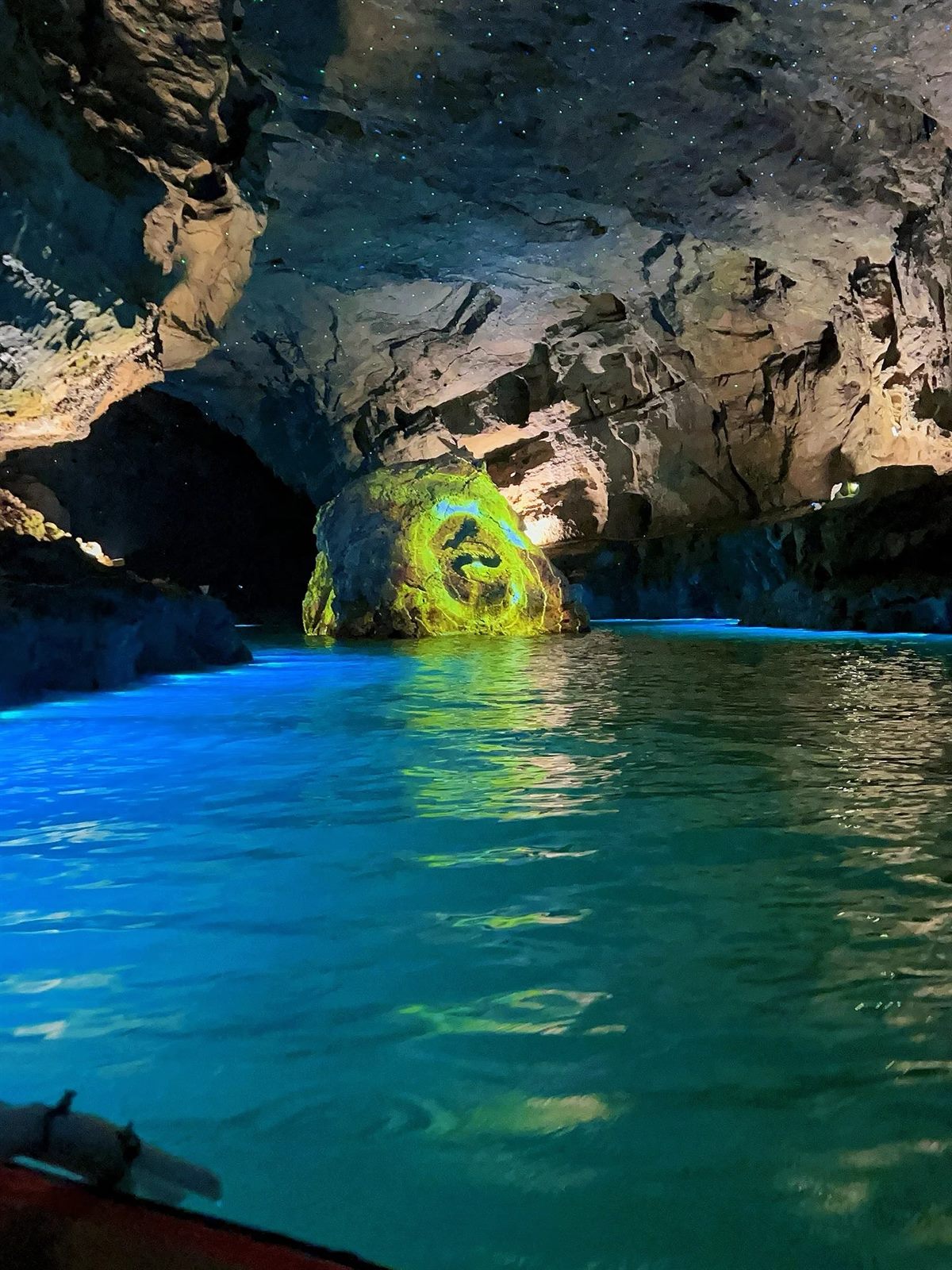
The tour is one-way with no backtracking, and it has a rhythm worth knowing before you start. From the scenic-area gate it is a ten-minute walk to the actual cave mouth, past paddy fields and fish ponds, with no shuttle — people forget to count it. Inside, you pass through the Dragon Dance Hall, where a short projection gives your eyes time to adjust, and reach the Xiangshui River pier. The boat crosses 800 metres of underground river in about eight minutes. Then the climbing starts: up through the Tianxian Palace to the Dragon Palace Hall, the largest chamber on the route, with more than 1,700 stalagmites.
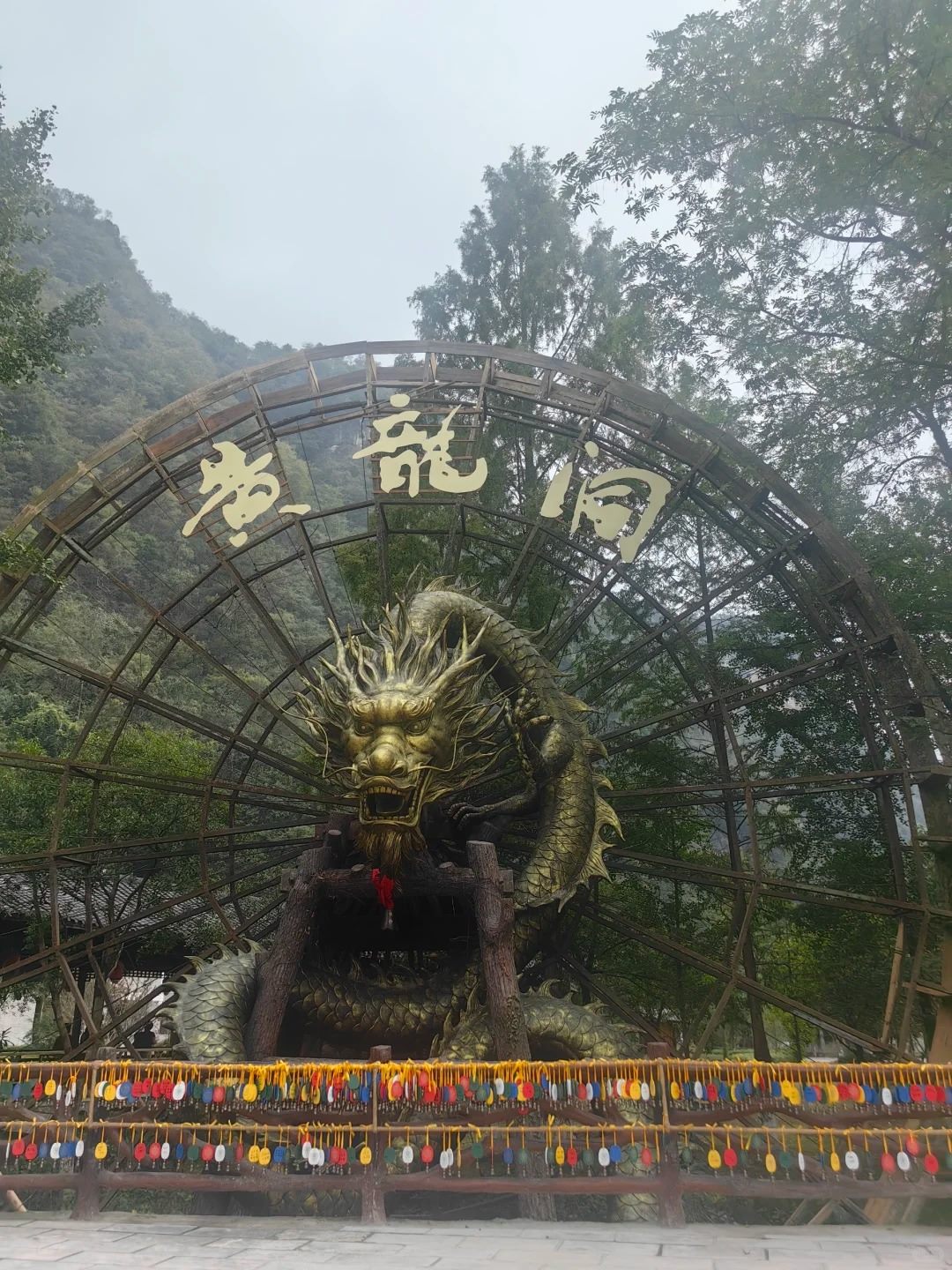
The formation everyone stops for is the Sea-Calming Needle (定海神针), a single stalagmite 19.2 metres tall and about 10 centimetres across at its narrowest point — a shape that took an implausible length of time to grow and could be snapped in a moment, which is why the operator famously insured it for ¥100 million. Beyond it, the Hundred-Step Ladder climbs on toward the exit, past the turn-off for the optional Labyrinth, and the route finishes outside among a cluster of water wheels and a koi pond.
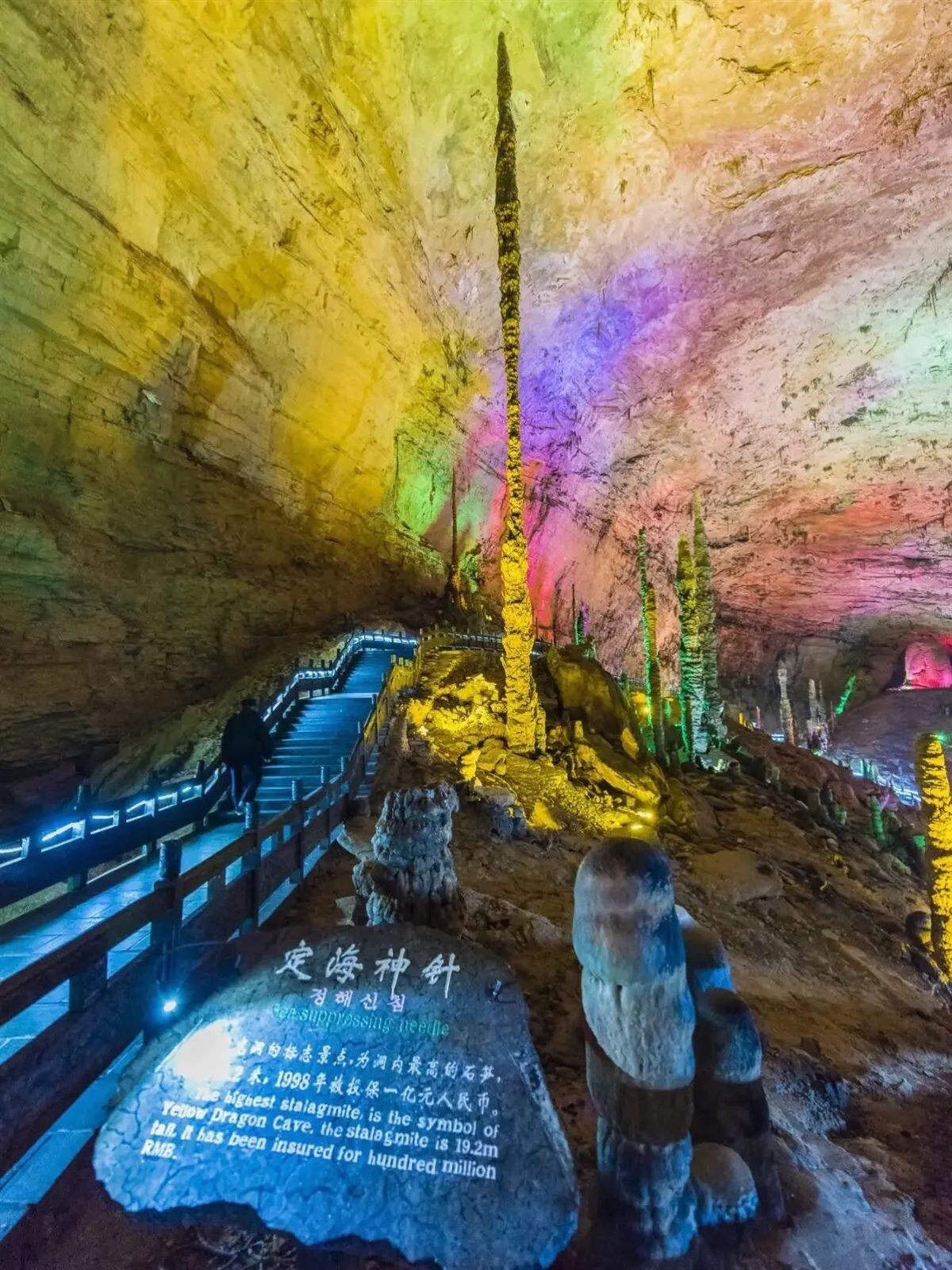
Historically it is a recent discovery. Local people had avoided the cave for generations on the strength of a Qing-dynasty drought legend, and it was not properly surveyed until early 1983, when a villager named Mao Jinchu led nine militiamen inside. Development broke ground in February 1984 and it opened to visitors at the end of that year. In 2005 it was voted China’s most beautiful tourist cave.
Tickets — and why one cave has three prices online
Published guides disagree about what this cave costs, and several of them quote a number lower than ¥121. None of those is a discount. ¥121 is not a price — it is a sum, and a source quoting less has copied one part of it.
| Component | What it covers | Price |
|---|---|---|
| Admission | Entry to the scenic area and the cave | ¥60 (concession ¥30) |
| Boat | The 800 m underground-river crossing, ~8 minutes | ¥36 (concession ¥18) |
| Audio guide | The commentary device — issued, not optional | ¥25 (no concession) |
| Total | What you actually pay | ¥121 (concession ¥73) |
| Insurance | Offered at the window — voluntary, not required | ¥4 |
Two things follow from that table, and both catch people out. First, the three items are sold as one bundle: there is no admission-plus-boat option, and the audio-guide component cannot be dropped at the window. You will find advice online saying an adult can decline it and save ¥25 — the official price listing says otherwise, and proves it in an unexpected place. Look at the concession rows: the categories that enter free — under-14s, over-65s, disabled visitors and serving military — are still billed half the boat and the full ¥25 for the guide, which comes to about ¥47. A charge you still pay when your admission is free is not an optional extra.
Second, the concession structure is narrower than people expect. ¥73 covers 14–18s, 60–65s and full-time students — half price on the admission and the boat, full price on the guide. There is one genuinely optional add-on inside: the Labyrinth (迷宫秘境), ¥15, not included in ¥121.
The ¥236 park pass does not cover this. Yellow Dragon Cave has a different operator, its own gate and its own ticket office — the same arrangement as Baofeng Lake and the Grand Canyon glass bridge. If someone near the gates or at your hotel offers a bundle that “covers everything”, ask which of those three separately ticketed sites are actually in it. Low-price tickets and “skip-the-queue insider” passes sold outside the gate are the standard local scam.
How to buy it with a passport
Buy the ticket before you arrive rather than at the window: the price is identical either way (¥121 online and at the counter), but peak-season capacity limits mean the window can sell out or queue badly. The official channel is a Chinese-language WeChat mini-program that needs a Chinese phone number and real-name registration, so the practical English route is an international booking site — see the card further down. Then allow 30–40 minutes at the gate: unlike the national forest park, whose gates were upgraded in July 2026 to read foreign passports directly, this scenic area still runs ID-card gates, and passport holders are directed to a staffed counter. That is 5–10 minutes on an ordinary weekday and 20–40 on a public holiday. Your ticket is checked twice — at the cave mouth and again at the boat pier — so keep it to hand.
Getting there
It is closer to Wulingyuan than most guides suggest — 7.9 km and about 13 minutes by road, east-north-east of the town (Amap-routed). If you have read that it sits fifteen kilometres north, that is wrong in distance and misleading in direction. It does not need a day built around it.
Terrain © Stadia Maps · Stamen Design · OpenMapTiles · © OpenStreetMap contributors.
Yellow Dragon Cave is the ringed pin on the eastern side, between Wulingyuan town and the glass bridge. The map makes the separately ticketed problem visible: the ¥236 pass covers only what is inside the enlarged National Forest Park panel — the cave, Baofeng Lake and the glass bridge each sell their own. Tap any pin for its price and time.
| From | How | Time |
|---|---|---|
| Wulingyuan town | Taxi or DiDi, ¥15–25 — dropped at the gate | ~13 min |
| Wulingyuan town | City bus 1路, ¥2, roughly every 20 min — but it sets down at the car park, ~15 min walk short of the gate | ~10 min + walk |
| Baofeng Lake | Taxi, ~¥17 — the standard non-park pairing | ~17 min |
| Zhangjiajie city | Coach or taxi to Wulingyuan first | ~50 min |
The bus is genuinely cheap and genuinely slower than it looks, because of that fifteen-minute walk at the far end and because waits of twenty minutes are common. With a taxi at ¥15–25 for a group, most visitors take the taxi out and the bus back. If you do use the bus in the evening, note that the last run back to town is usually somewhere between 18:30 and 19:30 depending on the season, so be at the stop by 18:00 — holiday timetables run later, but do not plan around that.
Because it is so close to town, the usual mistake is scheduling rather than transport: people tack the cave onto the end of a full park day, arrive at three in the afternoon and discover that admission has closed. It works far better as the second half of a non-park day — Baofeng Lake in the morning, the cave in the afternoon, both of them separately ticketed and neither of them requiring mountain legs.
Opening hours, and the queue that decides the visit
| What | Detail |
|---|---|
| Open | 08:00–17:30 peak (Mar–Oct) · 08:30–17:00 off-season (Nov–Feb) |
| Last admission | ~16:00 in peak — but be through the gate by 15:00 |
| ⭐ Best time | 08:00, straight in at opening |
| Boat queue | Near walk-on early · 45 min–1.5 h peak · up to ~2 h on holidays |
| Time needed | 2–2.5 h (guided groups 1.5–2 h; +30–40 min for the Labyrinth) |
| Pairs with | Baofeng Lake, as a non-park day |
The eight-minute boat is the reason to get up early. From roughly 09:30, when the organised groups land, the pier queue runs 45 minutes to an hour and a half, and public holidays have been reported near two hours. Two things make it harder than the number suggests: the queue is built on two levels, so the front you can see is not the front, and there is essentially no phone signal underground to pass the time.
Most sights in Zhangjiajie give you a second window in the late afternoon once the coaches leave. This one does not — admission stops around 16:00 and the route takes over two hours, so the late slot simply is not available. If you cannot make the opening, an off-season weekday is the next best thing: in winter the same queue is minutes, though the cave opens half an hour later and closes half an hour earlier.
One weather note that gets missed: the cave is drained by a live underground river, and heavy rain can raise the water and close it at short notice. If it has poured overnight, check before you commit an afternoon to the trip.
Inside the cave — what to expect and what to carry
- It is 16 °C all year. That makes it the best indoor escape in Zhangjiajie in July and August — and cold enough that shorts and a t-shirt are uncomfortable. A light jacket is standard advice, not fussiness.
- Roughly 800 steps, and the climbing all comes after the boat. The floor is damp, dripping in places and slippery — non-slip shoes matter here more than the “easy cave” billing suggests.
- No toilets, no shops, no phone signal anywhere inside. Deal with all three before the ticket gate, carry your own water, and agree a meeting point with anyone you might lose.
- Flash photography is banned to protect the formations, and phone photos come out soft in the low light. A small handheld light does more good than any camera setting.
- The boat seat matters a little — the bow or the right-hand side has the clear view.
- The ¥15 Labyrinth is the quiet part. Denser, finer formations than the main halls and coach groups do not go in; it adds 30–40 minutes. Worth it if you are photographing, skippable otherwise.
- Expect the photo hustle. Staff take a “free” small photograph near the entrance and produce a framed ¥30 print when you collect it. A digital copy alone is around ¥10, and declining is entirely normal.
The accessibility trick nobody publishes. If the 800 steps are the problem — older parents, small children, knees that have already done two days in the park — you do not have to walk the full route. Stay on the boat when it reaches the far side and ride back to the pier, then head for the exit. That is about an hour in total, it still includes the underground river, and it skips most of the climb. Chinese visitors do this routinely with grandparents; no English guide mentions it.
Is it worth it?
The reviews split, and the split has a clean explanation: it depends almost entirely on whether this is your first Chinese show cave. First-timers find the scale genuinely impressive and rate the underground boat well. Visitors who have already seen one of China’s headline caves tend to describe it as more of the same.
| Cave | Where | How it compares |
|---|---|---|
| Zhijin Cave (织金洞) | Guizhou | The benchmark — far bigger chambers and more restrained lighting, but a longer, harder walk |
| Reed Flute Cave (芦笛岩) | Guilin | Smaller and prettier, with more natural-looking lighting; easy to add to a Guilin trip |
| Yellow Dragon Cave | Zhangjiajie | The only one of the three with a real underground-river boat — and the most heavily lit and projected |
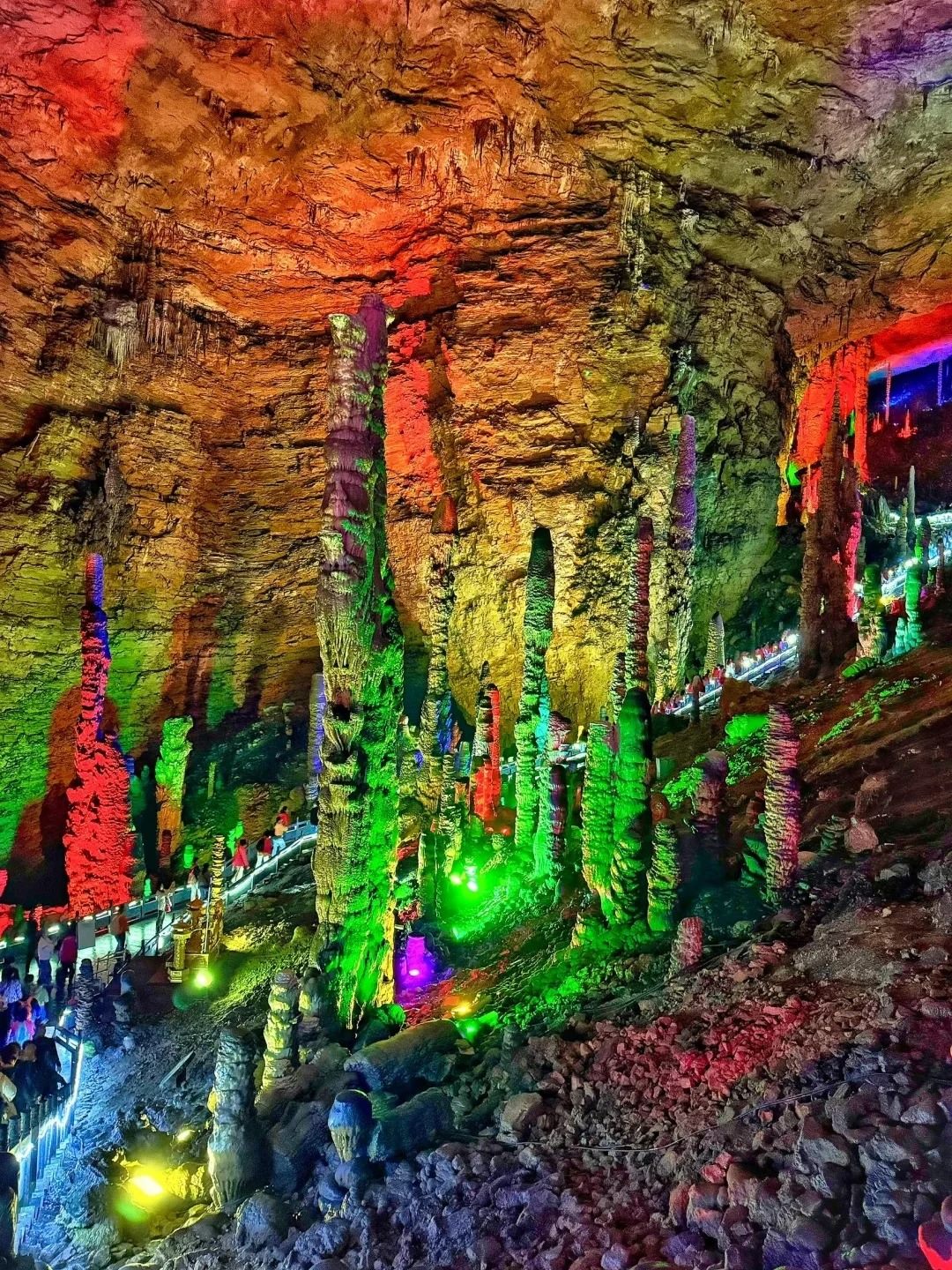
That last column is the substance of the complaint. Coloured floodlights, dragon projections and cartoon animation are laid over the formations here more heavily than at either of the others, and enough visitors find it kitsch that it is the single most repeated criticism. Whether that ruins the cave is a matter of taste — but if what you want from a cave is darkness and quiet, this is not the one.
The honest call: on three days or fewer in Zhangjiajie, skip it — spend them on the national forest park and Tianmen Mountain, and put the glass bridge ahead of this if you want one more paid sight. It earns its place on a longer trip: as a rain plan, as a genuine escape from summer heat, as the gentle half of a non-park day with Baofeng Lake, or when you are travelling with people who cannot face another mountain. Judged that way it is good. Judged as a headline attraction it will disappoint.
Book Yellow Dragon Cave tickets or a Zhangjiajie tourNASDAQ: TCOM
Trip.com’s own page for this cave is its ticket page — admission in English on a foreign card, so the separately ticketed part is sorted before you arrive. It is filed under the pinyin name, Huanglong Cave.
Frequently asked questions
Is Yellow Dragon Cave included in the Zhangjiajie National Forest Park ticket?
No. The ¥236 four-day park pass covers the sights inside the national forest park — Yuanjiajie, Tianzi Mountain, Yangjiajie, Golden Whip Stream and Huangshizhai. Yellow Dragon Cave is run by a different operator, with its own gate and its own ticket office, exactly like Baofeng Lake and the Grand Canyon glass bridge. Budget ¥121 for it on top of the pass. This is also worth knowing as scam protection: if a tout or a hotel desk offers a package that "covers everything", ask specifically which of those separately ticketed sites are included and at what price.
How much is a Yellow Dragon Cave ticket, and what does the price include?
¥121, and the useful thing is that it is a sum rather than one price: ¥60 admission + ¥36 for the underground-river boat + ¥25 for the audio guide, with ¥4 insurance offered separately as a voluntary extra. That structure explains why published guides disagree about the price: a source quoting less than ¥121 has copied one component rather than found a discount. The three items are sold as one bundle: there is no admission-plus-boat option and no way to decline the audio-guide component. The concession total is ¥73 for 14–18s, 60–65s and full-time students. Note the counter-intuitive part: the free-admission categories — under-14s, over-65s, disabled visitors and serving military — still pay half price for the boat and the full ¥25 for the guide, so a "free" entry still costs about ¥47.
How long does Yellow Dragon Cave take, and what is the route?
Two to two and a half hours, one-way with no backtracking. From the scenic-area gate there is a ten-minute walk to the cave mouth itself, past paddy fields and fish ponds, with no shuttle on that stretch — people routinely forget to budget for it. Inside, you cross the Dragon Dance Hall, board a boat for an 800-metre, roughly eight-minute passage along the underground river, and then climb: travellers count around 800 steps up through the Dragon Palace Hall, the largest chamber, which holds more than 1,700 stalagmites and the cave's signature formation. The optional Labyrinth section adds another 30 to 40 minutes. Guided groups move faster, about 1.5 to 2 hours; walking it at your own pace takes 2.5 to 3.
How bad is the boat queue at Yellow Dragon Cave?
It is the single biggest cost of the visit, and worse than the eight-minute ride suggests. Peak-season waits run 45 minutes to an hour and a half, and public holidays have been reported at close to two hours. Two details make it harder than an ordinary queue: it is built on two levels, so the front you can see is not the front, and there is essentially no phone signal underground to pass the time. The fix is timing rather than money — be at the 08:00 opening and the boat is close to walk-on, because organised groups arrive from about 09:30. There is no late-afternoon escape here, because admission stops around 16:00.
Can foreign visitors scan a passport at the gate?
Plan for the staffed window instead. This matters because Zhangjiajie is not one ticketing system: the national forest park upgraded in July 2026 and its self-serve gates now read foreign passports directly, but Yellow Dragon Cave is a separately run scenic area, and traveller reports through July 2026 still describe its gates reading Chinese ID cards only, with passport holders directed to a staffed counter. Buy online in advance, then present the passport and the booking at the counter — about 5 to 10 minutes on an ordinary weekday, 20 to 40 on a public holiday. Arrive 30 to 40 minutes before you want to be inside. One more thing to expect: the ticket is checked twice, once at the cave mouth and again at the boat pier.
Is Yellow Dragon Cave worth it?
It depends almost entirely on whether you have seen a major Chinese show cave before. If this is your first, the scale and the underground boat genuinely land, and it is the easiest indoor option in a place that otherwise demands mountains — a real draw for families, older visitors and anyone escaping a Hunan summer, since it holds a constant 16 °C. If you have seen Zhijin Cave in Guizhou or Reed Flute Cave in Guilin, expect it to feel familiar, and expect one specific complaint to land: the lighting. Coloured floodlights, dragon projections and cartoon animation are laid over the formations far more heavily here than at either of those, and it is the most-repeated criticism by some distance. In a Zhangjiajie itinerary it sits in the third tier — behind the national forest park and Tianmen Mountain, and behind the glass bridge if you want one more paid sight.
What should you know before going into the cave?
It is a constant 16 °C year-round, which is a relief in summer and cold enough in shorts that a light jacket is standard advice. There are no toilets, no shops and effectively no phone signal anywhere inside, so deal with all three before the ticket gate. The floor is damp and slippery and there are roughly 800 steps, so non-slip shoes matter more than they sound like they should. Flash photography is banned to protect the formations. And expect a mild hustle near the entrance: staff take a "free" small photograph and then present a framed ¥30 print when you collect it — travellers report a digital copy alone is about ¥10, and declining is fine.
Sources
Checked July 2026 · Written from our own first-hand travel in China.
Corrected since publication: Several guides, an earlier version of ours included, place this cave north of town. It is about 13 minutes from Wulingyuan.