Key takeaways
- One flat ticket, ¥120 all year (no peak/off-peak), covers both parks — the pit halls and Lishan Park, where the bronze chariots now live; real-name, passport required, and it must be booked online in advance (walk-up windows are gone).
- Walk the pits Pit 1 → Pit 3 → Pit 2, then take the free shuttle to Lishan Park for the two bronze chariots (moved there in 2021) and the tomb mound.
- Allow 5–6 hours on-site for both parks + 2–3 hours travel — most visitors under-allocate and rush it.
- Get there on the ¥19.9 tourist coach from the Bell Tower and other city-centre points (outbound mornings only), Metro Line 9 plus bus 602, or a Trip.com English day tour. ⛔ The 游5 bus no longer leaves Xi’an Railway Station — it has run from 纺织城枢纽站 since 2019, whatever older guides say.
- One of the few sites that lives up to its reputation — UNESCO World Heritage (1987), ~8,000 warriors, still being excavated.
One flat ¥120 ticket covers both parks — real-name, passport-checked, bought online. The choice is ticket-only or a day tour that also solves the 40 km.
See tickets & day toursWhat the Terracotta Army is
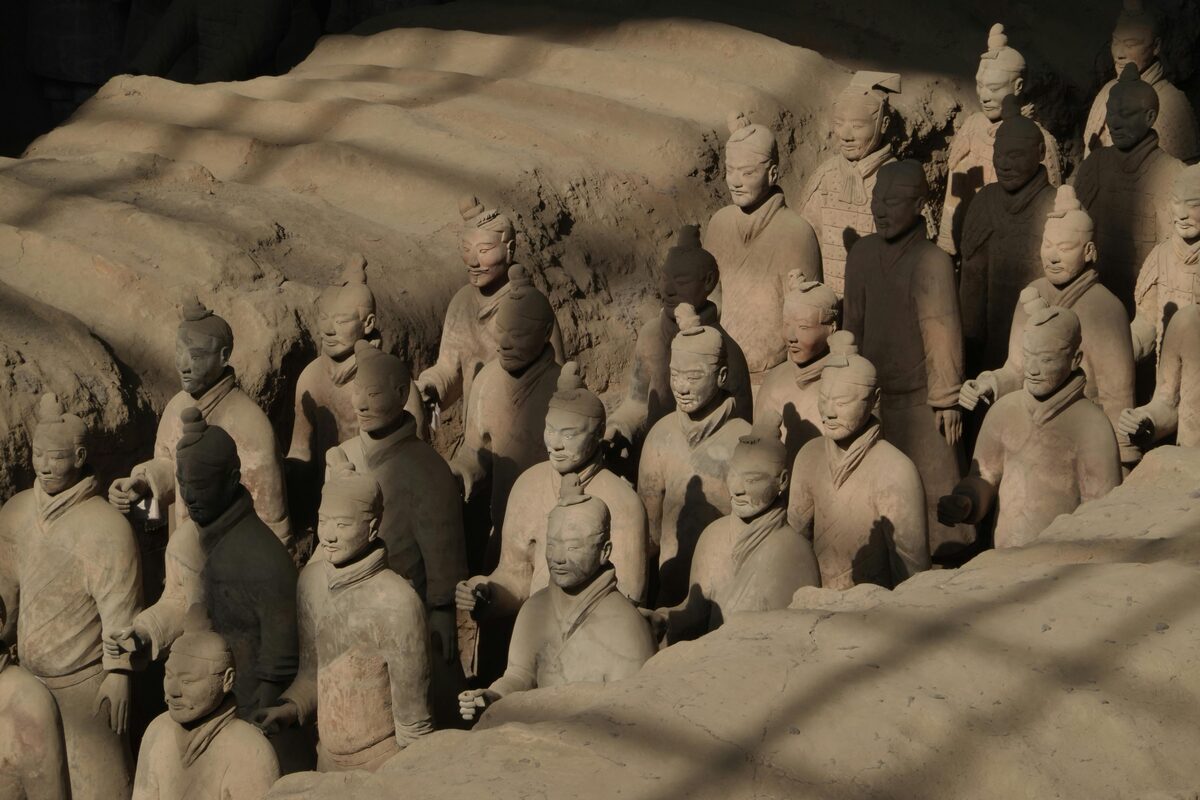
At Lintong District ~40 km east of Xi'an lies the funerary army of Qin Shi Huang (秦始皇, r. 246–210 BCE), founder of the Qin dynasty and first emperor of unified China: an estimated 8,000 life-sized terracotta soldiers plus 130 chariots and 670 horses, buried 2,200 years ago to guard his tomb. Sculpted with individual faces and positioned 1.5 km east of the burial mound — facing the direction of the conquered states — the army lay undiscovered until March 1974, when a farmer, Yang Zhifa, digging a well struck a pottery shard. UNESCO inscribed the site in 1987 (ID 441). It is still being excavated — only ~2,000 figures are fully reassembled — so today's museum differs from a decade ago and from a decade hence.
Tickets, hours & how to book
One flat ticket, ¥120 all year (no peak/off-peak split), covers both parks: the pit-hall museum and Lishan Park (丽山园), the tomb-mound site park where the two bronze chariots now live. Real-name (实名制) ticketing is mandatory — carry the passport you booked with — and it must be booked online in advance: the on-site ticket windows have been removed, so there is nothing to queue for at the gate.
The museum’s own site (bmy.com.cn) takes a passport directly, and a passport is one of the documents the gate scanners read, so you can do this yourself without WeChat or a Chinese phone number. Slots open 7 days ahead in peak season. That window matters more than it sounds: the site is capped at 65,000 visitors a day and stops selling when it fills — on 11 August 2026 the entire day’s online allocation was gone by 12:30, and the museum logged seven consecutive days at or near 60,000. Book on the day your date enters the window, and take a morning slot if you want one. A Trip.com tour that bundles the ticket is the alternative if you would rather not manage the booking at all — but it is a convenience, not a workaround for a channel you cannot use.
| Item | Cost | Notes |
|---|---|---|
| Combined ticket both parks | ¥120 flat, all year | Valid one day. Covers the pit museum (Pits 1, 2, 3 + relics hall) and Lishan Park (bronze chariots + tomb mound + acrobat & civil-official pits). Students ¥60. |
| Shuttle bus pits ↔ Lishan Park | Free | Free with your ticket, from the exit car park opposite the Qin Shi Huang statue; about 2 km. Last one around 16:50, and the peak-season queue for it runs 50–60 minutes — leave the pit halls by 16:20. |
| Lishan Park cart 电瓶车 (optional) | ¥15 | Stops at the acrobat pit (K9901), the Bronze Chariot Museum (铜车马博物馆) and the burial mound. Worth it: the chariot hall is a further ~685 m past the Lishan Park gate, and running out of legs is the usual reason people run out of day. |
| Guide / audio | ¥30–¥60 | Audio handset ¥30 (+¥100 deposit); official licensed guide ¥60/person in a pooled group (+¥500 deposit, refunded). Booked inside — never on the walk in. |
| Free entry | — | Under-16s with a guardian, over-65s, disabled visitors, with documentation. Free entry still needs a booked slot. Whether a foreign passport is accepted as proof of age here is not something we could confirm — budget for the full ¥120. |
Opening hours: 08:30 daily, all year including Chinese New Year. Last admission is 17:00 from 16 March to 15 November and 16:30 from 16 November to 15 March; the halls stay open about ninety minutes past that. Last admission is the number to plan around — it is the gate that turns people away, and it is the same at both parks, so arriving at the pit halls at 16:30 does not also buy you Lishan Park.
⚠️ The museum runs extended hours in some summers and at Spring Festival, announced a few weeks ahead and withdrawn again afterwards — the 2026 summer extension ran 11 July to 21 August and normal hours resumed on 24 August. Treat any earlier opening time you see quoted as a past season’s, not a rule.
The pits — then the bronze chariots at Lishan Park
The site is two parks on one ticket. First, the pit-hall museum: three vaults plus a relics hall, best walked Pit 1 → Pit 3 → Pit 2 — do the icon while you're fresh and the light is even, use the small command pit as a breather, then take Pit 2's close-up detail as crowds thin. Then take the free shuttle to Lishan Park for the two bronze chariots and the tomb mound. This matters: the celebrated bronze chariots moved out of the pit museum to a dedicated hall in Lishan Park in 2021 (both chariots reunited there in 2024), so skipping the second park now means skipping the finest artefacts on site — the old “just do the three pits” advice is out of date.
| Hall | What’s there | Don’t miss |
|---|---|---|
| Pit 1 the icon — most jaw-dropping | 230 m × 62 m hall, ~6,000 figures in 11 columns of infantry, archers and chariots; raised perimeter balcony. | The long view down the ranks (the classic photo); the active reassembly workshops at the far end (~4,000 still in fragments). |
| Pit 3 the command post | Smallest hall, ~68 figures arranged as officers and ceremonial guards — the army’s “headquarters”, laid out in a U. | 30-min stop; the chariot bay and the layout that marks it as the command post — makes far more sense with a guide. |
| Pit 2 the finest detail | The richest mix of units — crossbowmen, cavalry, chariots, infantry; dim controlled lighting. Only partially excavated by design. | The star individual figures shown up close in glass cases — the kneeling archer, the general, the rare green-faced warrior. |
| Lishan Park via free shuttle | The tomb-mound site park: acrobat pit, the Bronze Chariot Museum (铜车马博物馆 — the name on the signs inside the park), the civil-official pit, and the emperor’s burial mound itself. | The two half-size bronze chariots (~210 BCE) — gold and silver fittings, working axles, “the crown of bronze” and arguably the finest ancient bronzework in China. |
How to get there from Xi'an
The site is ~40 km east in Lintong District. Four sensible ways out — plus one to avoid:
| Mode | Time · cost | Best for |
|---|---|---|
| Tourist coach 华旅观光巴士 | ~1 h · ¥19.9 flat | Simplest without booking a tour. Twenty-one lines run direct from named city-centre points — Bell Tower (钟楼饭店), 北大街, 朱雀门, 建国门, 永兴坊, 新城广场 and others — straight to the museum. Outbound 08:00–13:30 only: there is no afternoon coach out of the city. |
| Metro Line 9 + bus | ~1 h 50 min · metro + ¥2 | What the maps actually route you onto, and it dodges the road traffic. Line 9 to Huaqing Pool (华清池), then bus 602 (¥2 end-to-end) to 秦兵马俑. Bus 613 covers the same hop for ¥6 — a different fare, not the same one. Don’t get off at 秦陵西: no bus connects from there. |
| 游5 (306路) bus cheapest DIY | ~70 min · ¥2 boarding, ¥5 end-to-end | The public tourist bus, 22 stops, 07:00–19:00, terminus at the museum. ⛔ It leaves from 纺织城枢纽站 (Fangzhicheng hub, Metro Lines 1 and 6) — not from Xi’an Railway Station. See the note below. |
| Trip.com English tour | Door-to-door · USD $40–90/pp | First-time foreigners who want the interpretation as well as the transport. Hotel pickup + transport + ticket + English guide; full-day adds Huaqing Hot Springs. |
| Random hotel taxi | ~50 min · ¥150–250 asked | Not recommended — it is 40.3 km and ¥13 of tolls each way, and the Lintong run is a known mark-up route. Use DiDi or a booked car. |
If you have read anywhere that 游5 leaves from Xi’an Railway Station East Square, that information is from 2019 or earlier. The route was moved out of the railway station on 24 October 2019 and the station’s own stop list has carried no 306 since; it now starts at 纺织城枢纽站. The fare moved with it, from a flat ¥7 to ¥2 boarding and ¥5 end-to-end. Nearly every English guide still prints the old version — and the touts working the East Square are trading on precisely that expectation, because travellers arrive there looking for a bus that is not coming.
The Terracotta Army has an unusually aggressive scam scene — worth knowing before you go:
- Fake “游5” vans. The real bus is a marked public bay with staff and never touts. Anyone who approaches you offering a “cheaper ride” or to “show you the way” is running a private van that ends at a shopping stop or a fake site — don’t board.
- Replica museums. Legally-registered knock-offs — the “Eighth Wonder / 世界八大奇迹馆” and a fake “underground palace / 秦陵地宫” — display resin copies and wax figures. Touts claim the real warriors are “far away”, or that ¥120 “only covers part” and you need an extra ticket. Not true.
- How to stay on the real site. The genuine name is the Mausoleum of the First Qin Emperor (秦始皇帝陵博物院); one ¥120 ticket covers everything and there is no separate “Pit 1 / Pit 2” fee. Driving or in a taxi, navigate to the North Gate (北门) — fakes steer you to a “west gate” or a “tourist transfer centre”. The official guide desk is inside the Pit 1 hall, on the left; official guides never work the entrance.
Guide, audio guide or self-guided?
The major panels are bilingual (discovery, excavation, Qin context, formations, restoration), so the headlines are covered without help. The deeper context — why each face is unique, the 1974 discovery, why the warriors face east, the Qin succession crisis — is much harder to extract solo. Chinese travellers put it bluntly: without interpretation the visit is “looking at rows of clay figures,” and the tomb mound is “just a mound of earth.”
- Official licensed guide, ¥60/person — the best value on site. Pooled groups form at about ten people, so take a number as you come in; there is a ¥500 deposit, taken per family or group and refunded at the end. Regulated, in-depth, no upselling.
- Cultural-bureau guide, ¥90 for one to five people — booked at the entrance service desk. Worth it for a couple or a family, who would otherwise pay ¥60 a head.
- Audio handset, ¥30 (+¥100 deposit) — rented at the Pit 1 entrance hall or the Lishan Park entrance, returned at the museum exit. Comprehensive and self-paced, though the auto-positioning is occasionally off.
- Trip.com English day tour (USD $40–90) — an English-speaking guide, hotel pickup, transport and the ticket in one booking. Choose a no-shopping itinerary — budget Chinese-market tours often bury a jade or “silk” stop.
- Self-guided (¥125) — ¥120 ticket + ¥5 bus. Cheapest, but you're largely photographing without interpretation; pick it only if you've read up first.
⛔ ¥90 is also what the touts shout. On the approach path and in the car park you will be offered “a guide, ¥90 for your group” or a pooled rate around ¥30 a head, and several of those end at a VR show, a jade counter or a tea room. The price is not what tells them apart — the location is. Everything official is bought inside: the ¥60 licensed guide at the desk on the left-hand side of the Pit 1 hall, past both ticket checks, where the staff wear uniform and badges and their photographs are posted on a screen above the counter; the ¥90 bureau guide at the entrance service desk. Nothing official is ever sold to you on the walk in.
Best time & how long
Allow 5–6 hours on-site for both parks (the pits ~2–2.5h, then the free shuttle and Lishan Park ~1.5h, plus breaks) and 2–3 hours of round-trip travel. Time your entry: the 08:30 opening or after 2:30pm are the calm windows; 9:30am–noon is when the tour buses pile in. Go in the afternoon and you must start the pits by ~2:30pm to still shuttle to Lishan Park before it stops admission at 5pm.
| When | What it's like |
|---|---|
| Apr–May & Sep–Oct | Best overall — 15–25°C, comfortable for the 5–6 hour visit. Book ahead on weekends. |
| Jul–Aug | Hot (32–38°C) but the vault halls are climate-controlled; heat only bites on the walks and the Lishan Park loop. |
| Dec–Feb | Cold outside (−5 to 5°C), comfortable inside, far smaller crowds — travellers call it a “VIP” experience, with little or no queue for Pits 1–2. Same ¥120 ticket year-round. |
| Golden Weeks | Avoid the Oct 1 and May 1 blocks and Spring Festival: visitor caps, a ~20-min queue just to enter Pit 1, “sardine-can” crowds inside, and a 20-min shuffle down the packed exit street on the way out. |
See our best time to visit China guide for the wider seasonal picture.
Practical for foreigners
Photography rules
- Photos are allowed throughout the pits with a phone or camera, but no flash anywhere — it's enforced. Pit 1's perimeter balcony gives the standard long-view shot; expect ~5–15 keepers from Pit 1.
- The bronze chariots at Lishan Park sit behind glass in low, preservation-controlled light — no flash, and reflections make good shots hard; treat that hall as look-more-than-photograph.
- Tripods, selfie sticks and professional rigs need advance permission; drones are banned within 5 km.
Payment, cash & what to bring
The ticket office takes Alipay, WeChat Pay and cash; foreign Visa/Mastercard works at the main POS but fails often — carry ¥200–300 cash. Restaurants on-site and in Lintong are mostly Alipay/WeChat only. Setting up Alipay with a foreign card before arrival is the most reliable option. Bring your passport (real-name entry, no exceptions), a water bottle (you'll walk 3–4 km), layers (interior ~22°C year-round), comfortable shoes and earphones for the audio guide.
Lunch
Skip the visitor-centre food courts and the exit shopping street — the “网红” snack stalls, “smash-bowl wine” and cold-noodle stands there are overpriced tourist fare, and any restaurant a driver or tout “warmly recommends” is paying a kickback. In Lintong town, travellers point to spots like Fushunxiang (福顺祥) for da pan ji big-plate chicken (~¥30–50/person, with belt noodles), Chongbin (崇斌) for shui pen yang rou (a warming lamb-and-flatbread soup), or stone-baked shizi mo flatbread at the Dongguan (东关) market. Most places are Alipay/WeChat only.
How it fits a Xi'an trip
For most travellers the Terracotta Army fills a full day of a 2–3 day Xi'an base, and it pairs naturally with the rest of Lintong on the same eastern axis: Huaqing Palace (华清宫, ~7 km away — the Tang-dynasty bathing palace of the Yang Guifei story, with the “Xi'an Incident” rooms) and Mount Lishan rising behind it for a sunset over the city. The classic Lintong day: warriors in the morning (Pit 1→3→2, then the free shuttle to Lishan Park for the bronze chariots), a Lintong lunch, then Huaqing Palace and the Lishan cable car for sunset — capped, if you pre-book, by the open-air Song of Everlasting Sorrow (长恨歌) evening show at Huaqing.
- Day 1 — arrive Xi'an North HSR; afternoon City Wall bike ride, evening Big Wild Goose Pagoda fountain.
- Day 2 — Terracotta Army + Lishan Park (this guide), then the Huaqing Palace / Mount Lishan add-on; evening Muslim Quarter food walk back in the city (or the 长恨歌 show in Lintong).
- Day 3 (optional) — a Hua Shan day trip or the Hanyangling Mausoleum.
When NOT to go: the Golden Week start days (visitor caps + 2-hour queues), peak afternoon if you have severe crowd aversion, or with a child under 5 (it's ~80% standing and walking).
Book Terracotta Army tickets & a guided day tourNASDAQ: TCOM
Trip.com lists English-language day tours from Xi'an (USD $40–90) with hotel pickup, transport, the ticket and a guide — or ticket-only entry, booked in English on a foreign card.
Where to stay for the visit
You don't base at the Terracotta Army — it's a half-day trip ~40 km out at Lintong, with no foreigner-friendly chain at the gate. Stay in central Xi'an inside the Ming-dynasty City Wall instead: nearly every morning coach to the site leaves from that square kilometre, Metro Line 2 connects it to Line 9 for the DIY route, and the Muslim Quarter is a walk away for the evening you come back to. Distances below are real, not guessed.
Where to book these: China’s home-grown chains — 全季 (JI) and 亚朵 (Atour) — are listed most completely on Trip.com, with English checkout and foreign-card payment. It’s the main booking platform for mainland hotels; Western sites like Booking and Agoda carry only a fraction of their branches.
Base in central Xi'an, day-trip out (recommended)
The Terracotta Army is ~40 km east of the city at Lintong District — a half-day trip out, not somewhere you stay. Base inside (or just by) the Ming-dynasty City Wall around the Bell Tower: it is a pickup point for the tourist coach to the site and sits on the metro, walkable to the Muslim Quarter and Drum Tower, and central for the rest of Xi'an. Most foreign visitors do best in a home-grown mid-range chain like 全季 (JI) or 亚朵 (Atour) — reliable, English-app booking, a fraction of the five-star rate. Two international five-stars are listed if you want them.
- Central Xi'an, Bell Tower — inside the City Wall on Metro Line 2, with the Line 2/Line 9 interchange for the DIY route two stops away.China's most popular home-grown mid-range chain — modern, spotless, easy English-app booking, roughly a third the price of the five-stars.
- Central Xi'an, Bell Tower — a block off the Muslim Quarter, so the evening food crawl is a walk, not a metro ride back.Design-led mid-range chain that foreign guests rate highly — comfortable, well-run, and far better value than the luxury towers.
- Central Xi'an, by the South Gate, where the City Wall bike rental is — the obvious pairing for your non-Lintong day.Heritage five-star in the former state guesthouse grounds, the top international option in the walled city.
- Central Xi'an, between the Bell Tower and the South Gate — the easiest walk-out radius on a two-night stay.Reliable international five-star in the centre with English-speaking front desk.
Closer to the site (Lintong)
If you specifically want to be near the warriors — for an early-opening visit or an onward Hua Shan trip — Lintong town has business and budget hotels a short hop from the entrance, but there is no foreigner-friendly chain right at the gate, so check reviews and English service before booking.
- Lintong District, ~10-15 min from the entrance by taxi; near Huaqing Hot Springs.No chain right at the gate — a live list of what is currently bookable around Lintong.
Frequently asked questions
How much does it cost to visit the Terracotta Army?
One flat ¥120 ticket, the same all year (the old peak/off-peak split is gone). It covers both parks — the pit-hall museum (Pits 1, 2, 3 + relics hall) and Lishan Park (the tomb-mound site park that holds the bronze chariots) — and is valid one day. Students pay ¥60; under-16s with a guardian, over-65s and disabled visitors go free, though free entry still needs a booked slot and we could not confirm that a foreign passport is accepted as proof of age. The shuttle between the two parks is free with your ticket; an optional electric cart inside Lishan Park is ¥15. Real-name ticketing is mandatory — bring the passport you booked with — and it must be booked online in advance: the on-site ticket windows have been removed. The museum's own site (bmy.com.cn) takes a passport directly, so you do not need WeChat or a Chinese phone to buy one; the two WeChat official accounts are the other sanctioned channels. Slots open 7 days ahead in peak season and the site is capped at 65,000 visitors a day, after which it stops selling — in the 2026 summer holidays whole days went by lunchtime.
How long should I plan for the visit?
5-6 hours on-site for both parks, plus 2-3 hours round-trip travel from Xi'an = 7-9 hours total. Most foreign visitors allocate 2-3 hours and regret it. Rough breakdown: Pit 1 (~1 hour, the iconic large hall), Pit 3 (~30 min, command post), Pit 2 (~45 min, the finest individual figures in glass cases), plus the relics hall — then the free shuttle to Lishan Park (~1.5 hours) for the two bronze chariots and the tomb mound. Lishan Park is large and the chariot hall sits about 685 m past its gate; the optional ¥15 cart is what most people wish they had taken. The constraint that catches people out is not closing time but the shuttle: the last one goes around 16:50 and the peak queue for it runs 50-60 minutes, so leave the pit halls by 16:20. Last admission at both parks is 17:00 in peak season.
How do I get from Xi'an to the Terracotta Army?
Four options. (1) The 华旅观光巴士 tourist coach, ¥19.9 flat, about an hour, direct from named city-centre pickup points including the Bell Tower (钟楼饭店), 北大街, 朱雀门, 建国门 and 永兴坊 — the simplest way out if you are not booking a tour, but outbound coaches run 08:00-13:30 only, so it is a morning option. (2) Metro Line 9 to Huaqing Pool (华清池), then bus 602 (¥2 end-to-end) to 秦兵马俑; bus 613 covers the same hop for ¥6, a different fare. This is what the mapping apps route you onto and it dodges the road traffic; about 1 h 50 min from Xi'an Railway Station. Don't get off at 秦陵西, which has no connecting bus. (3) Bus 游5 (306路), ¥2 boarding and ¥5 end-to-end, 07:00-19:00, terminus at the museum — but it leaves from 纺织城枢纽站 (Metro Lines 1 and 6), NOT from Xi'an Railway Station East Square. It was moved out of the railway station in October 2019; most guides still print the old departure point, and touts at the East Square trade on travellers arriving to look for a bus that no longer calls there. (4) Trip.com English-language day tour, USD $40-90 per person, hotel pickup, English guide, ticket bundled. Avoid a random hotel taxi: it is 40 km each way plus ¥13 of tolls, and the Lintong run is a known mark-up route.
In what order should I visit the pits?
Pit 1 → Pit 3 → Pit 2, then take the free shuttle to Lishan Park for the bronze chariots. Pit 1 is the iconic 6,000-warrior hall and the most jaw-dropping — visit first while you're fresh. Pit 3 is small (~68 figures, the command post) and works as a 30-min breather. Pit 2 holds the finest individual figures — the kneeling archer, the general, the green-faced warrior — shown up close in glass cases; save it for when crowds thin. Then shuttle to Lishan Park: the celebrated two bronze chariots moved there from the pit museum in 2021, so this second park is where the site's finest artefacts now are — not an optional add-on.
Can I take photos at the Terracotta Army?
Yes — photography is allowed throughout the pit halls with a phone or camera, but flash is banned everywhere and enforced. Pit 1's perimeter balcony gives the classic long-view shot down the ranks; most visitors come away with 5-15 keepers from Pit 1. The bronze chariots at Lishan Park sit behind glass in low, preservation-controlled light, so no flash and reflections make good shots hard — treat that hall as look-more-than-photograph. Tripods, selfie sticks and professional rigs need advance permission, and drones are banned within 5 km of the site.
Is the Terracotta Army worth the trip from Xi'an?
Yes, almost universally — this is one of three or four global archaeological sites (alongside Pompeii, the Pyramids of Giza, and Machu Picchu) that genuinely deliver on their reputation. The 8,000 individually-sculpted warriors at scale, the 2,200-year-old workshop discovery story, the still-actively-excavated state of the site (only ~2,000 of estimated 8,000 figures fully excavated), and the UNESCO World Heritage 1987 status all combine into something no Xi'an day-trip alternative matches. The single skip case: visitors with extreme crowd aversion who can't tolerate Pit 1's peak-hour density. For everyone else, this is the headline reason most foreigners go to Xi'an.
Should I take a Trip.com English tour or DIY?
First-time foreign visitors: take the Trip.com tour. The major panels are bilingual, so the discovery story and the pits' overall structure are translated — but the deeper context (what each warrior unit is, why faces are individual, the 1974 farmer Yang Zhifa's discovery, why no two warriors are identical, the failed Qin succession, why the warriors face east) is much harder to extract without a guide, and locals warn that going in 'blind' reduces the visit to 'looking at rows of clay figures.' USD $40-90 for hotel pickup + transport + ticket + English guide is a good ratio — just pick a no-shopping itinerary. DIY (¥5 bus + ¥120 ticket = ¥125) saves most of that but you're largely photographing without interpretation; if you go DIY, the official licensed guide (¥60/person pooled, ¥500 refundable deposit) at the desk inside the Pit 1 hall, or the ¥30 audio handset, fills the gap. ⛔ Note that ¥90 buys a legitimate cultural-bureau guide for up to five people AT THE ENTRANCE SERVICE DESK — and is also the price touts shout on the walk in. The location is what tells them apart, not the number: nothing official is sold to you before you are through the ticket checks.
Is Lishan Park (the tomb mound) worth it, or can I just do the three pits?
It's now essential, not optional — and it's already included in your ¥120 ticket. When the celebrated bronze chariots moved out of the pit museum into a dedicated hall in Lishan Park in 2021 (both chariots reunited there in 2024), the second park became the home of the site's finest artefacts. Chinese travellers put it bluntly: skip Lishan Park and 'you've half-wasted the trip.' From the pit-museum exit car park, opposite the Qin Shi Huang statue, a free shuttle covers the ~2 km to the park; inside, an optional ¥15 electric cart loops past the acrobat pit, the Bronze Chariot Museum, the civil-official pit and the emperor's grass-covered burial mound at the foot of Mount Lishan. ⭐ Leave the pit halls by 16:20: the last shuttle goes around 16:50 and its peak-season queue runs 50-60 minutes, and arriving at the Lishan Park gate is not the same as arriving at the chariots — the hall is a further ~685 m inside. That deadline, not the 17:00 last admission, is what people actually miss. Separately, you can pair the day with Huaqing Palace (华清宫) and a Mount Lishan sunset, both a short hop away.
Sources
Checked July 2026 · Written from our own first-hand travel in China.