Key takeaways
- Doable as a day trip, and the direction matters: going up the west side and down the north puts you on the ridge at 2,082 m and off it at 1,614 m, so you walk 468 m downhill instead of up. The all-night soldier’s path needs an overnight.
- HSR Xi’an North → Huashan North: 28–41 minutes, ¥54–59, more than 50 a day — but the first is 07:52, not the 7:00am widely quoted.
- The gate is half price (¥80) until 10 October 2026, so a day on the mountain is ¥360 right now against ¥440 after it, plus ¥54–59 each way on the train. ⚠️ The two valley shuttles are separate services at separate prices (¥60 for the standard routing), not one round-trip fare.
- The Plank Walk in the Sky (长空栈道, a ¥30 harness add-on with a 150 cm height minimum) is terrifying but optional — skip it if heights scare you or your return train is tight.
- Go April–May or Sep–Oct; avoid July–August monsoon fog and the three Golden Weeks (3-hour queues). Winter is cheaper on every fare — the North car drops to ¥45.
What Hua Shan is
Hua Shan is the Western Mountain of China’s Five Great Sacred Mountains (五岳), dedicated in Daoist tradition to the west and the autumn. Five granite peaks rise almost vertically from the Wei River plain to 2,154 m at South Peak, with no foothills to soften the approach — the most physically demanding and most visually dramatic of the five. It has been a Daoist pilgrimage site since the 2nd century BCE and is one of the four sacred sites of the Quanzhen sect; UNESCO listed it as a Global Geopark in 2004. The global fame, though, comes from one feature: the Chang Kong Plank Walk in the Sky (长空栈道) on South Peak’s south face — planks ~30 cm wide bolted into a vertical 2,000m cliff.
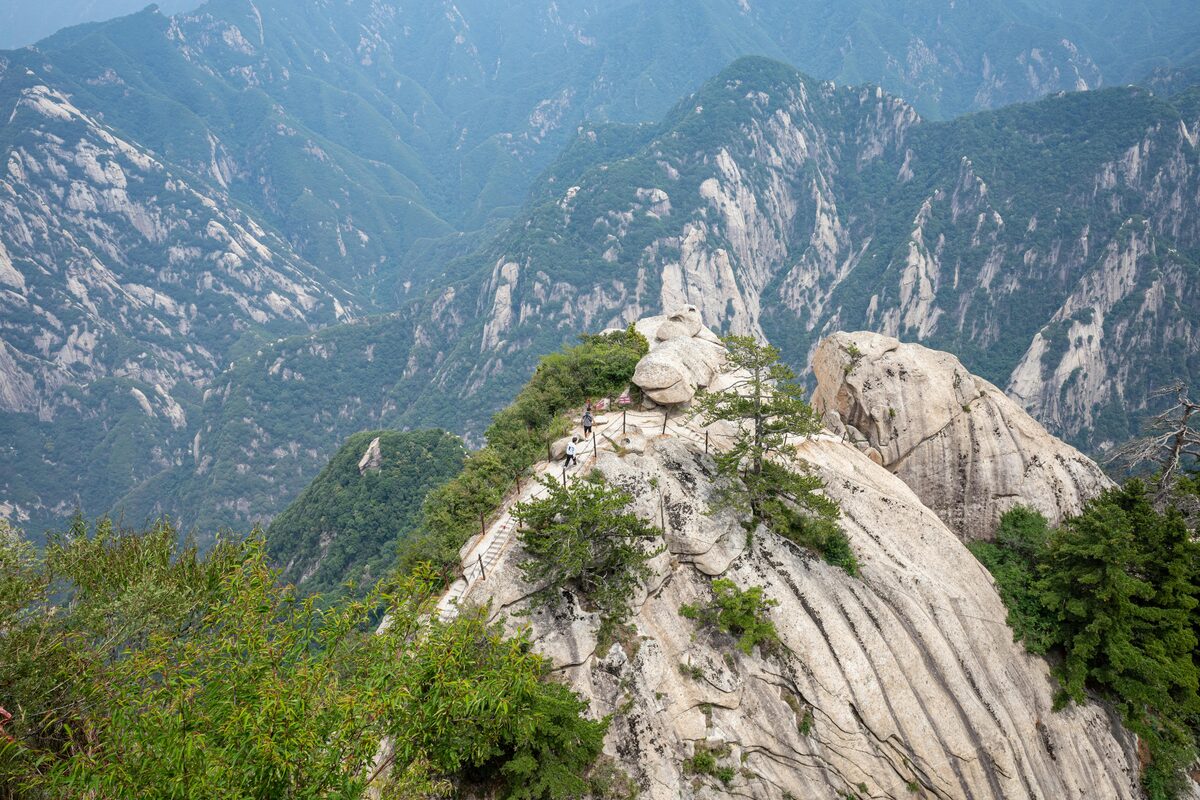
Worth it for: hikers who want the headline experience without an overnight, photographers (the granite skyline at golden hour is China’s best alpine landscape), Daoism-history visitors, and anyone tempted by the Plank Walk. Skip if: heights scare you at all (ridge walks have big drops on both sides), knee or ankle issues (long stone-stair descents), or you only have two days in Xi'an — the Terracotta Army takes priority.
Getting there from Xi'an
HSR is the only sensible option. Xi'an North (西安北) → Huashan North (华山北) runs more than 50 trains a day, ¥54–59 in 2nd class, 28–41 minutes depending on train type — though almost all of them take 28 minutes.
The first train is 07:52, not 7:00am. Itineraries for this mountain are almost all written around a 7:00am departure. Checked against the booking system on two separate dates, the first service from Xi'an North is 07:52, arriving 08:20. The 07:15 that feeds the confusion leaves the other station — Xi'an, on the conventional line — and runs to 华山, not 华山北. Turning up at 07:00 buys you a wait, not a head start.
| Mode | Time (one-way) | Cost · note |
|---|---|---|
| HSR Xi'an North → Huashan North | 28–41 minutes | ¥54–59 · the standard option |
| HSR + Trip.com day tour | Door-to-door | ~USD $80–140 all-in · easiest for first-timers |
| Regular train (普速) | 2.5 hours | ¥30–40 · not recommended |
| Coach / bus | 3 hours | ¥40–60 · not recommended |
Book the train on Trip.com if you want the smoother foreigner path: English checkout, foreign-card payment, no verification wait, 24/7 multilingual support, and new-customer promos that can sometimes make the final price lower. The official 12306 English app accepts international phone numbers, but passport identity approval, payment checks, and Chinese-first customer service can still make it slower for a short trip. Huashan North Station is not at the trailhead: it sits 4.8 km north of the Tourist Center, so allow roughly 15–25 minutes to cover it by the signed local shuttle/tourist bus or by taxi/Didi. If you are racing the first cable car, do not budget this as a walk-up arrival from the train platform. From the Tourist Center you then pick a valley, not just a bus: Wengyu (¥40) runs west and serves the ascent most visitors want, Huangfuyu (¥20) runs north and serves the descent, and the Yuquanyuan (玉泉院) walking-trail area is a third destination again. Self-drive is not an option for most foreign tourists without a Chinese licence.
The free car from the station has a catch-22 if you hold a passport. Traveller reports describe a free onward service from Huashan North to the visitor centre — ordinary taxis rather than a bus, boarding about 50 m to the right of the exit under 免费接驳车 signage, four passengers to a car, roughly ten minutes, running about 08:00–18:00. The catch is that it wants to see an existing online ticket order, and a passport holder cannot have one, because the passport ticket is issued at the window you are trying to reach. The practical answer is to pay outbound and ride free on the way back: a taxi is about ¥15–20, the ordinary bus about ¥5, and once you hold a ticket the return car is free.
Which is exactly what the touts at the exit are working with. They offer ¥5–10 rides and are reported to tell arrivals that the free cars have stopped running or that the wait is long. The same line gets used in reverse at the visitor centre in the evening. Walk to the signed boarding point and ask staff there rather than taking anyone’s word for it at the door — and note that after about 18:00 the free service really has finished, so a paid ride then is not a scam.
Tickets & the two cable cars
Right now the gate is half price: ¥80, not ¥160. The scenic area is running a half-price campaign on main-peak admission from 15 July 2026 to 10 October 2026, open to everyone with no document needed. It covers the gate only — the cable cars and both valley shuttles are full price throughout — and it does not stack with the student or senior concession. That brings a day on the mountain to ¥360 instead of ¥440. After 10 October 2026 the gate returns to ¥160.
Entry and the cable cars are separate tickets, and the gate fee is the smaller half of what the day costs. The standing price is ¥160 peak (Mar–Nov) / ¥100 off-peak (Dec–Feb), real-name (实名制) — bring your passport. ⛔ There is no ordinary ticket window at the gate any more: booking is online and timed, so arriving without one is arriving without a ticket. The cable cars run 07:00–19:00 from Mar 1 to Nov 30 and 08:00–18:00 from Dec 1 to Feb 28, but uphill check-in closes at 16:00 in both seasons — up to three hours before the cars themselves stop. The walking ascent is open around the clock.
| Ticket | Peak (Mar–Nov) | Low (Dec–Feb) | What it accesses |
|---|---|---|---|
| West Cable Car 西峰索道 | ¥140 one-way ¥280 round-trip | ¥120 one-way ¥240 round-trip | 4,211 m of line, 894 m of rise, 20–25 minutes in the cabin — it lands you 489 m from the West Peak summit (2,082 m). The standard ascent. |
| North Cable Car 北峰索道 | ¥80 one-way ¥150 round-trip | ¥45 one-way ¥80 round-trip | Shorter, faster line to North Peak (1,614 m) — the low end of the ridge and the natural endpoint of a West→South→East→North circuit. The standard descent. |
| Wengyu shuttle 瓮峪旅游专线 | ¥40 one-way | The west valley road, and the only way to the West Cable Car base — about 30 minutes. No return fare is published. | |
| Huangfuyu shuttle 黄甫峪旅游专线 | ¥20 one-way ¥40 round-trip | The north valley road to the North Cable Car base — about 20 minutes. A different service on a different side of the mountain. | |
| Plank Walk harness 长空栈道 | ¥30 rental | Rented at the route entrance below South Peak. Minimum height 150 cm, minimum age 15; most tour packages exclude it. | |
There is no single “shuttle bus” fare, and this catches people. The two valleys are separate services at separate prices, serving cable-car bases on opposite sides of the massif. West up and North down means one leg of each — ¥40 + ¥20 = ¥60, not the ¥40 return fare that belongs to the north line alone. Boarding the wrong one is not a small overcharge; it puts you at the wrong end of the mountain.
The recommended combo: West up + North down = ¥220 in cable fares (¥165 in low season). West Cable Car drops you at the high end of the ridge; the walk then runs downhill to North Peak, where the North Cable Car descends. A round-trip on a single side (¥280 West / ¥150 North) costs more and forces a backtrack — only do it for a minimal one- or two-peak visit. Adding it up, the standard “cable up, cable down” day costs ¥440 on the mountain in peak season and ¥325 in winter, before the train.
The five peaks & the Plank Walk
The standard one-day circuit links all five peaks — five to seven hours of stair-and-ridge walking even with both cable cars, and it is the volume of descent rather than the distance that people underestimate. From the West Cable Car the natural route is West → South (Plank Walk add-on) → East → Central → North.
Why West up and North down, really. The usual explanation is that the West Cable Car is “closest to South Peak”. The better reason is in the heights below: the West car lands you at the 2,082 m end of the ridge and the North car leaves from the 1,614 m end, so the whole traverse is a net descent of 468 m. Run it the other way and that becomes a climb, on stone stairs, in the afternoon.
| Peak | Height | Why it matters |
|---|---|---|
| South 南峰 | 2,154 m | The highest. Hosts the Plank Walk in the Sky + the Cuiyungong shrine — the standard photographic destination. |
| East 东峰 | 2,096 m | The sunrise peak; East Peak hostel is the overnight base for the Sunrise Platform. |
| West 西峰 | 2,082 m | The sunset peak, and where the West Cable Car lands you — 489 m from the summit itself. The high end of the ridge. |
| Central 中峰 | 2,037 m | The lowest summit but the geographic centre; most visitors pass through it on the ridge. |
| North 北峰 | 1,614 m | The North Cable Car base and the standard descent point. |
The Plank Walk in the Sky — the danger reality
The Plank Walk (长空栈道) is a narrow, harnessed cliff-side route near South Peak, walked clipped to a safety cable. It is a dead-end: you walk to a small carved-stone platform with a tea-house shrine, then turn back. The fearsome “world’s most dangerous hike” reputation is a poor planning tool:
- There is a bar to clear before the harness — minimum height 150 cm and minimum age 15, and the neighbouring Yaoshen Turnover (鹞子翻身) sets its own bar higher again. The ¥30 harness rental is on top of everything else you have already paid.
- Do not assume turning up is enough. Sources disagree on how the slot is released — one describes buying on the spot at the 南天门 service point, another a small daily online allocation that wants two people together and a phone already inside the summit area. We could not reach an operator page to settle it, so ask at the gate on your way in rather than at the plank entrance after a two-hour walk.
- The harness is mandatory when the route is operating; do not attempt it in wind, rain, fog, or if staff pause entry.
- Real hazards are often the stairs, not only the cliff — long descents wreck knees and ankles; the East→North descent is the section most day-trippers feel.
- It’s a dead-end with a queue — recent peak-season traveler reports put the Plank Walk at 2–4 hours when demand is high; Yaoshen Turnover is usually shorter, often 30–60 min. The walk itself runs 30–45 min once you’re on the planks.
- Skip it with any fear of heights, untreated vertigo, panic-attack history, or a tight HSR return — you can photograph it from the South Peak platform without going on it.
- The ridge alone is exposed on both sides — most visitors get plenty of altitude without adding the planks.
Day trip vs sunrise overnight
For ~90% of foreign visitors the cable-up / cable-down day trip is the right call: take the 07:52 from Xi'an North (arriving 08:20), ride the West Cable Car up by about 9:30am, walk West → South → East → Central → North across the day, and start moving toward North Peak by 15:00–15:30 so the descent queue does not collide with the train you want. Budget ¥360 on the mountain while the gate discount runs, ¥440 after it, plus ¥54–59 each way on the train, and expect 5–6 hours actually walking. It misses sunrise but covers all five peaks plus the optional Plank Walk. Skip the Plank Walk if you want an early train home comfortably.
The queue is what ruins this day, and the first train is the only way round it. Traveller reports put the West cable car at two to four hours in high season, with 10:00–13:00 the worst band as tour groups and late risers converge; the shuttle queue adds another 30–60 minutes. The clean slot is to be on the cable car by about 09:30 — which is exactly what the 07:52 delivers, and not a minute earlier. ⛔ The advice you will read everywhere, to arrive for the 07:00 opening, is not available to anyone coming from Xi'an by train: that batch is people who slept at the foot of the mountain or walked up in the dark. ⚠️ And the other standard tip — come after 14:00, once the groups have gone — collides with the 16:00 cutoff and leaves no day to walk in.
16:00 is an uphill deadline, not a descent one. Check-in for the cable cars going up stops at 16:00 in both seasons, while the cars keep running to 19:00 in peak season and 18:00 in winter. So arriving at the mountain after lunch is the trip-ending mistake; being on North Peak at 16:30 is not, though the queue there is the one that competes with your train.
The sunrise overnight trades the rush for the headline view. Ascend by West Cable Car in the afternoon, walk slowly to East Peak, sleep at the East Peak hostel (¥300–600 dorm bed / ¥800–1,500 private double, 5 min from the Sunrise Platform), catch sunrise around 5:00–6:30am, then descend by North Cable Car and HSR back to Xi'an by midday. Book the hostel 2–4 weeks ahead for sunrise weekends.
The all-night soldier’s path (传统登山道) — the Chinese-domestic tradition of climbing ~6,000 stairs from Yuquanyuan from midnight by headlamp to reach East Peak for sunrise — is demanding (typically 6–8 hours for ordinary hikers, with stone stairs, chains, darkness and cold wind near the summit) and not recommended for most foreigners. Bring a headlamp, gloves, grippy shoes, a power bank and warm layers if you choose it. The cable-car version delivers ~90% of the views at ~10% of the effort.
Best time to visit
| Window | What it’s like |
|---|---|
| Apr–May | Best overall — mid-mountain cherry blossoms, full waterfalls, 8–15°C base / 0–8°C summit. |
| Sep–Oct | Post-monsoon clarity, golden larch on the upper slopes — the best photographic conditions. |
| Jul–Aug | Avoid. Monsoon fog blanks the peaks ~50% of mornings; rain on granite stairs is hazardous; base hits 35–40°C. |
| Nov–Mar | Clear, quiet, best cloud-sea odds, but summit −5 to −15°C and snow can close the upper cable cars. Not for first-timers. |
| Golden Weeks | Avoid. Spring Festival (mid-Feb), May 1–5, Oct 1–7 — 2–3 hour cable queues, 3-hour Plank Walk waits, doubled hotel rates. |
Winter is the cheap season, and almost nobody says so. From 1 December to the end of February the gate drops to ¥100, the West car to ¥120 one-way and the North car to ¥45 — the North car is nearly half its summer fare. A day on the mountain comes to ¥325 instead of ¥440. What you trade is daylight and certainty: the cars start an hour later (08:00 rather than 07:00) while the 16:00 uphill cutoff does not move, so the usable window is genuinely shorter, and snow closes the upper cars outright. Worth it if you want the cloud sea and can absorb a wasted trip; wrong if this is your only free day in Xi'an.
See our best time to visit China guide for the broader regional picture.
Practical for foreigners
Buying the tickets on a passport — budget an hour for it
This is the part that costs foreign visitors their morning, and no official source spells it out. The gates read Chinese ID cards and do not scan a passport, so the self-service turnstiles are not available to you. You are handled at the visitor centre’s special-ticket desk (特殊票种办理处) — the one counter still open now that ordinary ticket windows are gone. Travellers report 15–30 minutes of queue there at weekends and in season, and that not every window handles passports.
Then it splits, because the gate, the shuttles and the cable cars are three different companies on three systems. You buy the gate ticket and the valley shuttle at that desk; you buy the cable car again at its own window when the shuttle drops you at the base; and you buy the downhill shuttle a third time after you come off the mountain. Booking through Trip.com does sell to foreign passports and skips the first queue, but travellers report the cable-car leg often cannot be bought online, so expect at least one window either way.
The desk is reported to shut at 16:00, and that is earlier than it sounds. The Wengyu shuttle to the West cable car is another 40 minutes on top of whatever you spend at the window — so a passport holder’s real deadline for getting up the mountain sits well before the 16:00 cable-car cutoff that applies to everyone else. Treat an early-afternoon arrival as a wasted trip rather than a tight one.
What to bring
- Hiking shoes or trail runners — long stone-stair descents destroy knees in soft shoes; trekking poles help.
- Layers — the summit runs 10–15°C cooler than the base, with wind on the ridge.
- Sun protection — granite reflects UV strongly; sunburn on the upper peaks is common even in spring.
- Water + snacks — recent traveler reports still put bottled water around ¥10–15 on the mountain; carry 1–2 bottles plus dense snacks, but do not overload the daypack.
- Cash backup ¥300–500 — Alipay/WeChat Pay work at cable stations and most cafes, but mountain-top vendors occasionally need cash.
- Offline map — download Gaode (高德) before departure; cell signal is intermittent on the upper ridges.
Safety & who should reconsider
- Knee or ankle injuries — the 999-stair East→North descent is brutal on bad joints.
- Heart conditions — small medical stations sit at North and West Peak with basic supplies; no routine helicopter evacuation. Cardiac-risk visitors should not attempt the soldier’s-path ascent.
- Altitude — 2,154 m is mild but real; hydrate the day before and avoid the Plank Walk if you’re sensitive (it compounds anxiety + altitude).
- Children — not recommended under 8; assess fitness honestly under 12. Cable cars carry kids solo, not in tandem.
Book Hua Shan tickets, cable car & a day tourNASDAQ: TCOM
Trip.com bundles English-language Hua Shan day tours from Xi'an (~USD $80–140) with hotel pickup, HSR or coach, entry + shuttle + both cable cars and an English guide — or book the HSR and entry separately, all on a foreign card.
Where to stay
You don’t need to sleep at the mountain for a day trip — base in central Xi'an near the Bell Tower (walkable to the Muslim Quarter, on the metro for the City Wall and Terracotta-Army bus, ~25 min to Xi'an North for the HSR) and ride out for the day. Stay near Hua Shan only if you want sunrise on the summit. Distances below are positions, not guesses.
Where to book these: China’s home-grown chains — 全季 (JI) and 亚朵 (Atour) — are listed most completely on Trip.com, with English checkout and foreign-card payment. It’s the main booking platform for mainland hotels; Western sites like Booking and Agoda carry only a fraction of their branches.
Stay in central Xi'an and day-trip out (recommended)
Most visitors base in central Xi'an near the Bell Tower — walkable to the Muslim Quarter, on the metro for the City Wall and the Terracotta-Army bus, and a 28 minutes HSR hop from Hua Shan. A home-grown mid-range chain like 全季 (JI) or 亚朵 (Atour) is the sensible call: reliable, English-app booking, and a fraction of the five-star rate. Two international five-stars are listed if you want them.
- Central Xi'an by the Bell Tower — Metro Line 2 to Xi'an North for the Huashan HSR (~25 min).China's most popular home-grown mid-range chain — modern, spotless, easy English-app booking, roughly a third the price of the five-stars.
- In the Bell Tower / Muslim Quarter core — Metro Line 2 to Xi'an North for the Huashan HSR (~25 min).Design-led mid-range chain that foreign guests rate highly — comfortable, well-run, and far better value than the luxury towers.
- In a garden compound a short ride from the Bell Tower — Metro Line 2 to Xi'an North for the Huashan HSR.
- LuxuryShangri-La Xi'an →High-tech-zone west of the centre — direct metro to Xi'an North for the Huashan HSR.
Overnight near Hua Shan for the sunrise
Only worth it if you want sunrise on the mountain. Huayin (华阴) — the town at the foot of the mountain, and the name on local signage and in a taxi app — has business and budget hotels for a pre-dawn start, and the East Peak hostel (东峰客栈) sleeps you on the summit itself: basic and pricey, but the only way to catch the Sunrise Platform. There is no foreigner-friendly chain at the mountain, so check reviews and English service before booking.
- Huayin, ~10-15 min from the Tourist Center — a base for an early start without sleeping on the mountain.No chain right at the gate — a live list of what is currently bookable near the mountain base.
- On East Peak, ~5 min from the Sunrise Platform — the only on-mountain stay for sunrise.Basic dorm beds (¥300-600) and private doubles (¥800-1,500); book 2-4 weeks ahead for sunrise weekends.
Frequently asked questions
Can you do Hua Shan as a day trip from Xi'an?
Yes, but only with the cable-car-up cable-car-down strategy. The first Xi'an North → Huashan North HSR is 07:52, arriving 08:20 (28–41 minutes, ¥54–59) — note that it is 07:52, not the 7:00am that most itineraries for this mountain quote. From the station allow 15–25 minutes to cover the 4.8 km to the Tourist Center, then the Wengyu shuttle to the West Cable Car; up by about 9:30am; ridge walk between West / South / East / North peaks through the middle of the day; start moving toward North Peak by 15:00–15:30; North Cable Car down late afternoon; train back around dinner. Do not start late: uphill cable-car check-in closes at 16:00 in both seasons even though the cars keep running to 19:00 in summer. The famous all-night soldier's path ascent (传统登山道) is a different overnight/sunrise plan, not a normal day trip.
How much does Hua Shan cost?
Less than usual at the moment: the scenic area is running a half-price campaign on main-peak admission from 15 July 2026 to 10 October 2026, so the gate is ¥80 rather than ¥160, open to everyone with no document needed. It covers the gate only — cable cars and shuttles are full price — and it does not stack with the student or senior concession. The standing price is ¥160 peak (Mar–Nov) / ¥100 off-peak, and the gate fee is the smaller half of the day either way. Cable cars are separate and seasonal: West Cable Car ¥140 one-way / ¥280 round-trip in peak season, ¥120 / ¥240 in low season; North Cable Car ¥80 / ¥150 peak, ¥45 / ¥80 low. ⚠️ The valley shuttles are TWO different services, not one: the Wengyu line to the West cable car is ¥40 one way, the Huangfuyu line to the North cable car is ¥20 one way (¥40 return). A West-up/North-down visit uses one leg of each, so it pays ¥60. Plank Walk harness rental ¥30. Adding the compulsory items up, the standard 'cable up, cable down' day costs ¥360 per person on the mountain while the gate discount runs, ¥440 at the standing peak price, or ¥325 in winter — then ¥54–59 each way for the train.
Is Hua Shan really the most dangerous mountain in the world?
No — that is a YouTube reputation, not a useful risk assessment. The Plank Walk in the Sky (长空栈道) is visually terrifying: a narrow, harnessed cliff-side route on South Peak. But for ordinary visitors the practical hazards are more mundane: thousands of stone steps that punish knees and ankles, sudden fog/rain/wind that can close cable cars, queues that make you miss a return train, and the much harder overnight soldier's-path climb. Treat the Plank Walk as an optional add-on, not the reason to take unsafe risks.
How do I get from Xi'an to Hua Shan?
HSR is the only sensible option. Xi'an North Station (Xi'an Bei, 西安北站) → Huashan North Station (华山北, Huashan Bei): 28–41 minutes — almost all of them 28 minutes — ¥54–59 in 2nd class, with more than 50 departures a day. The first is 07:52. Huashan North Station is 4.8 km north of the Tourist Center, not at the trailhead: allow roughly 15-25 minutes by signed shuttle/local bus or taxi/Didi. From the Tourist Center you choose a valley rather than just a bus — the Wengyu line (¥40) serves the West Cable Car base, the Huangfuyu line (¥20) serves the North Cable Car base, and the Yuquanyuan walking-trail area is a third destination. NOT recommended: regular train (普速, about 2.5 hours) or bus (about 3 hours). Drive-yourself is not an option for most foreign tourists without a Chinese driving licence.
Should I attempt the Plank Walk in the Sky?
Only if you're physically and mentally up for it — the Plank Walk is genuinely terrifying for many people. It is a dead-end cliff-side route near South Peak: you clip into a safety cable with a rented harness (¥30), walk out, then return the same way. There is a minimum height of 150 cm and a minimum age of 15. ⚠️ Do not assume you can simply turn up and pay: sources disagree on whether the place is bought on the spot at the 南天门 service point or released as a small daily online allocation, and we could not reach an operator page to settle which applies — so ask at the gate on the way in, not at the plank entrance after a two-hour walk. Peak-season waits can be a time sink, with recent traveler reports describing 2-4 hours when demand is high, and bad weather closes exposed routes. Skip it if you have fear of heights, untreated vertigo, mobility issues, panic-attack history, or a tight HSR return. The ridge walks between peaks already deliver plenty of altitude exposure without adding the Plank Walk.
West Cable Car vs North Cable Car — which one?
For a one-day visit ascending and descending: West Cable Car UP (¥140 one-way), North Cable Car DOWN (¥80 one-way), ¥220 in cable fares. The reason is the profile, not just the map: the West line is 4,211 m of cable with 894 m of rise and takes 20–25 minutes, and it sets you down 489 m from the West Peak summit at 2,082 m — the HIGH end of the ridge. The North Cable Car works from North Peak at 1,614 m, the LOW end. So West-up/North-down means the whole traverse is a net descent of 468 m; reverse it and you climb that on stone stairs. Round-trip on a single cable car costs more (¥280 West / ¥150 North) and forces you to backtrack — don't do it unless you're only visiting one or two peaks. In low season every one of these fares drops (¥120 and ¥45 one-way).
How fit do you need to be?
Moderate fitness for the cable-up cable-down day version: five to seven hours on uneven stone stairs and exposed ridges, with far more stair DESCENT than a normal city walk — that is the part people underestimate, not the distance. Most foreign visitors who can hike a half-day on uneven ground will manage it; many will be sore for 2-3 days afterward. Going West-up/North-down helps, because the traverse then runs 468 m downhill overall rather than up. The all-night soldier's-path ascent from Yuquanyuan to East Peak is a serious 6-8 hour climb for ordinary hikers and needs headlamp confidence, gloves and warm layers. The Plank Walk doesn't require much fitness, but it does require nerve. Skip the mountain entirely if you have knee or ankle injuries, severe altitude sensitivity (2,154 m is mild but real), chronic vertigo, or you are traveling with kids under 8.
When is the best time to visit Hua Shan?
April-May for cherry blossoms at mid-mountain and waterfalls running full from spring melt. September-October for post-monsoon clarity and golden larch on the upper slopes — best photographic conditions. AVOID July-August: monsoon-season fog blanks the peaks on roughly 50% of mornings; rain on the granite stairs is genuinely hazardous; mid-summer heat at the base hits 35-40°C. Avoid Chinese Golden Weeks (Spring Festival mid-Feb, May 1, October 1): both cable cars hit 2-3 hour queues at peak hour; Plank Walk wait can stretch to 3 hours. Winter is clear and quiet but cold (−5 to −15°C summit), and cable cars close on snow days — it is also, unusually, the cheap season, which the best-time section above works through.
Sources
Checked July 2026 · Written from our own first-hand travel in China.