Key takeaways
- The street itself is free — walk north from the Drum Tower; only the Great Mosque (¥25) is ticketed.
- Metro Line 2 → Bell Tower, Exit C, then west under the Drum Tower archway (~5 min).
- Go 11am–1pm or 8–10pm; avoid the 6–7:30pm domestic-dinner crush.
- Eat: yangrou paomo, biang biang noodles, roujiamo, lamb skewers — all halal.
- Don’t miss the hidden Great Mosque (742 CE), built in Tang-Chinese, not Middle Eastern, style.
What the Muslim Quarter is
The Muslim Quarter is a 4-street network in central Xi'an, beginning one archway north of the Drum Tower (鼓楼) and beside the Bell Tower, all inside the old City Wall. “Muslim Quarter” is a tourism label — locals call it 回民街 (Huimin Jie, “Hui People Street”) or 北院门 (Beiyuanmen). It has been home to Hui Chinese Muslims (回族) since the Tang dynasty (618–907 CE), when Persian and Central Asian Silk Road traders settled in Chang'an — today's Xi'an. Their descendants spoke Chinese natively within a few generations while keeping Islam, and the enclave now holds roughly 60,000 Hui Chinese and around ten mosques. The point for a visitor: it is China's most concentrated halal food street — no pork is sold anywhere — wrapped around a genuinely old religious quarter.
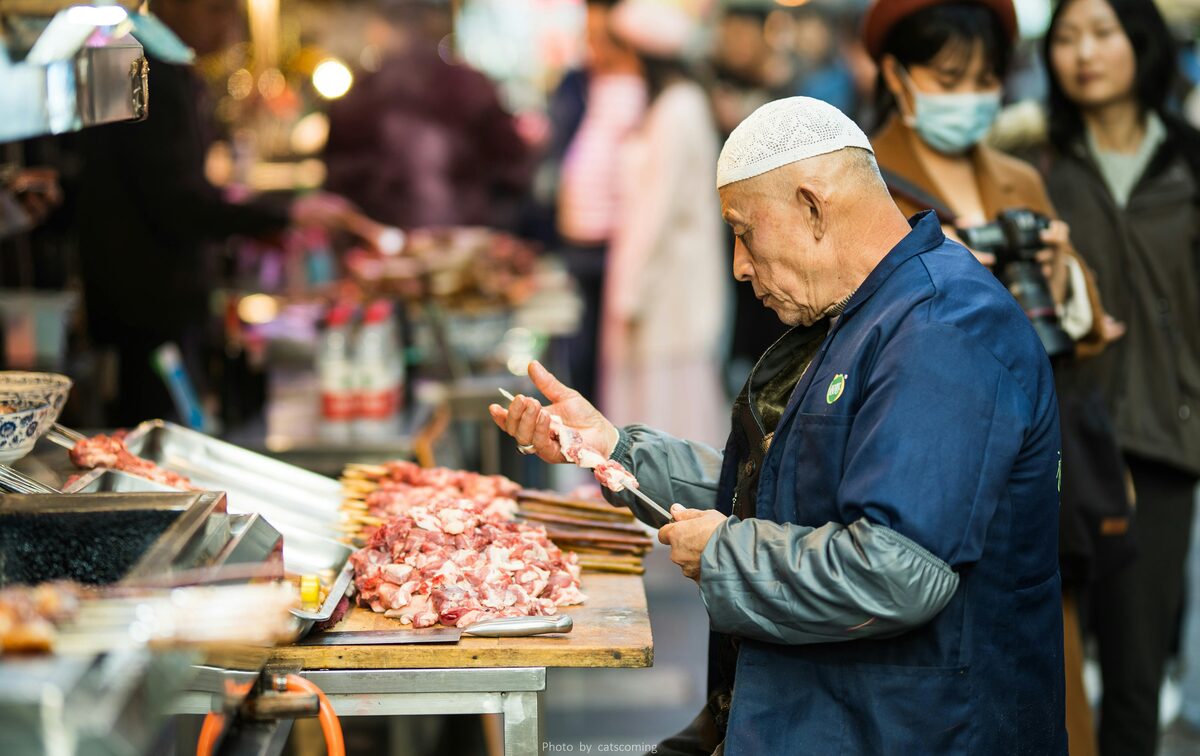
The 4 streets — what's where
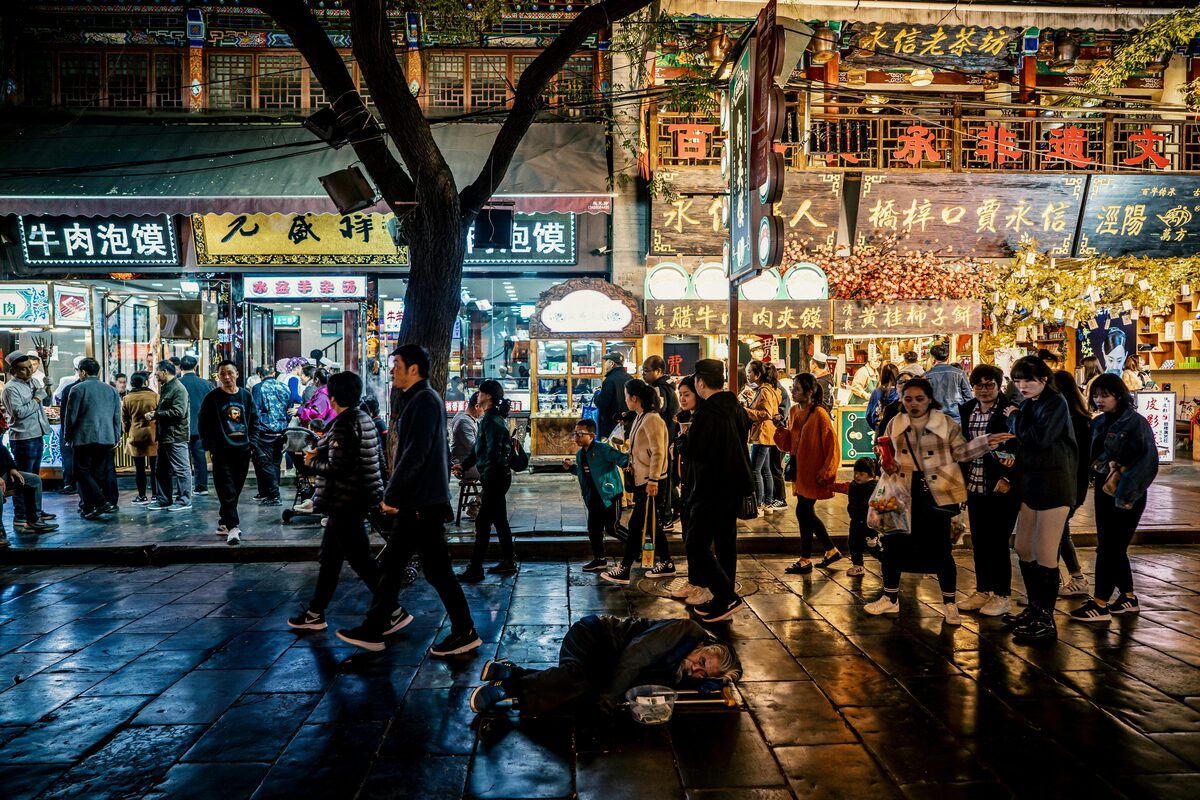
“The Muslim Quarter” most foreigners walk is really just the main lane. Four streets make up the network; the side streets are 5-minute-away alternatives with a more local clientele and lower prices:
| Street | What’s on it | Crowd |
|---|---|---|
| Beiyuanmen 北院门 | The main 500 m food lane straight north of the Drum Tower — lamb skewers, paomo, roujiamo, persimmon cakes, red lanterns. | Highest |
| Xiyangshi 西羊市 | Side street west of Beiyuanmen — cheaper paomo and walnut-cake stalls, fewer tour groups. | Medium |
| Damaishi 大麦市 | Sit-down restaurants — the well-known 老孙家饭庄 / 同盛祥 paomo halls. | Medium |
| Huajue Xiang 化觉巷 | Small alley running west — leads to the Great Mosque entrance. | Lowest |
The standard pattern: walk Beiyuanmen north for the atmosphere and headline snacks, dip into Damaishi for a serious sit-down paomo, and end at Huajue Xiang for the mosque. But the real advice from locals is to keep walking — the shops they queue at are in the deeper lanes north and west, a few minutes off the tourist strip.
Where locals actually eat (the deeper lanes)
Main-street Beiyuanmen is where the tour groups eat; residents head into Saginqiao (洒金桥), Dapiyuan (大皮院) and Daxuexi Xiang (大学习巷) / Miaohou Jie (庙后街). Reach them fastest via Metro Line 6 Guangjijie (广济街) or Saginqiao (洒金桥) station. A few named old shops travellers point to (a shortlist, not exhaustive):
- Saginqiao (洒金桥) — breakfast & snacks: Pangzi zenggao (胖子甑糕, sold from the morning market, gone by ~9am), Lao Jin egg-and-veg roujiamo (老金家蛋菜夹馍), Ma’er sour-soup dumplings (马二酸汤水饺).
- Dapiyuan (大皮院) — the carbs & meat: Dingjia crispy pork-free beef (定家小酥肉, in an enamel bowl), Shijia baozi (石家包子, cumin-beef buns).
- Daxuexi Xiang / Miaohou Jie — late-night & gifts: the Qingzhen skewers (清真学习巷串串, evenings only), Yang’s BBQ (杨家烤肉), Zhiliang steamed dumplings (志亮蒸饺), Junjun mung-bean cake (军军绿豆糕, the best edible souvenir).
Roughly ¥50–80 a head grazing across the lanes — and cheaper, better food than the main strip.
The 12 signature dishes
The whole menu in one table — what each dish is and the 2026 street price. The first four are the ones to prioritise; the rest are snacks and drinks to graze on as you walk.
| Dish | Price | What it’s like |
|---|---|---|
| Yangrou paomo 羊肉泡馍 | ¥35–50 | The Xi'an signature: you tear a plain flatbread into ~1 cm cubes by hand, then the kitchen returns it as a bowl of lamb broth, meat, glass noodles, garlic and chili oil. Best at 同盛祥 / 老孙家 on Damaishi. |
| Biang biang noodles biáng biáng 面 | ¥25–35 | Belt-wide hand-pulled noodles (~3–5 cm × ~1 m) in chili oil, vinegar, scallion and ground meat. Its 58-stroke character is the most complex in common Chinese use. Veg version (素) ~¥20. |
| Roujiamo 肉夹馍 | ¥10–15 | The “Chinese hamburger” — crisp split flatbread stuffed with cumin-stewed lamb (the Quarter is all-halal, so lamb not pork). |
| Liang pi 凉皮 | ¥10–15 | Cold rice/wheat noodles in chili-vinegar dressing with sprouts, cucumber and gluten cubes. Vegan as standard; best in summer. |
| Lamb skewers 羊肉串 | ¥3–5 each | Cumin-and-chili lamb grilled over charcoal. Order 5–10, eat standing. Pick stalls with visible flame and active grilling, not pre-cooked trays. |
| Persimmon cakes 柿子饼 | ¥5–10 | Pan-fried glutinous cakes stuffed with sweet persimmon paste, eaten hot. Best Oct–Mar when Lintong persimmons are in season. |
| Zenggao 甑糕 | ¥10 | Steamed glutinous rice layered with red dates and beans, sliced from a giant ceramic steamer. Sweet, dense; a Tang-era palace dessert. |
| Pomegranate juice 石榴汁 | ¥10–15 | Fresh-pressed from local Lintong pomegranates (peak Oct–Jan). Look for the visible fruit piles and presses out front. |
| Sour plum drink 酸梅汤 | ¥5–8 | Chilled sour-plum tea with hawthorn and licorice — the traditional summer cooler, tart and lower-sugar than soda. |
| Eight-treasure congee 八宝粥 | ¥10–15 | Sweet rice porridge with beans, peanuts, lotus seeds, dates and raisins. Vegan comfort food, good on a cold morning. |
| Walnut cake 核桃饼 | ¥10–15 | Crisp thin pancakes with crushed walnut and rock sugar. Best from stalls pan-frying to order; also the best edible souvenir (keeps 1–2 weeks). |
| Chuan'r combo 串儿 | ¥30–50 | A sit-down set of 10–15 skewers (lamb, beef, tendon, bread cube, enoki, pepper) with a local Hans beer (汉斯啤酒, ¥8–15) — the standard Xi'an evening. |
Vegetarians can eat well by sticking to liang pi, congee, zenggao, persimmon/walnut cakes and the drinks; vegan biang biang must be ordered as 素 (sù). For the same dishes priced for locals away from the tourist lane, see the broader Xi'an food guide.
Is it halal? The Great Mosque & 清真
Yes — the entire Quarter is halal (清真, qīngzhēn). It is a working Hui Muslim neighbourhood, so no pork is sold and the lamb/beef dishes are the staples. Strictly observant visitors who want certified kitchens can stick to the established 清真 sit-down halls (老孙家饭庄, 同盛祥) rather than individual street stalls, where hygiene practices vary stall to stall.
The historical heart is the Great Mosque of Xi'an (西安清真大寺, Xi'an Qingzhen Dasi) — one of China's oldest and largest at 12,000 m², yet tucked into the western alleys and routinely missed. Founded 742 CE under Tang Emperor Xuanzong, it has functioned for ~1,300 years (the current buildings are mostly a 14th-century Ming rebuild). What makes it remarkable: it is built entirely in Tang-Chinese style — courtyards, glazed-tile roofs, arched gates, no minaret and no dome — so it reads like a Buddhist temple from outside. Only the east-west prayer-hall axis (oriented to Mecca) and the Arabic calligraphy inside reveal its function.
| Visiting the mosque | Detail |
|---|---|
| Entrance | Via Huajue Xiang (化觉巷), ~200 m north of the Drum Tower — small ticket booth with English signage. |
| Ticket | ¥25 (separate from the free street) |
| Hours | ~8:00am–7:30pm summer / 8:00am–6:30pm winter; closed to tourists during the five daily prayer times. |
| Time needed | 45–60 min |
| Dress | Shoulders and knees covered; women need not cover hair; shoes off in the carpeted prayer hall. |
Best time to go
The street runs year-round, 7 days a week, with most stalls open ~9am–11pm (later in summer). Timing within the day matters more than the season:
| Window | What it’s like |
|---|---|
| 11am–1pm (weekday) | The calmest good window — vendors fully active, paomo tables free, clear photos. Best for a first visit. |
| 8–10pm | Second-best: lantern-lit atmosphere, food visibly cooking, crowds easing off the dinner peak. |
| 6–7:30pm | Avoid. The domestic-tourist dinner crush — shoulder-to-shoulder for 500 m, 30–45 min waits at the paomo halls. |
| Weekend 2–5pm | Second-most crowded; skip if you have a choice. |
Seasonally there are no closures except Spring Festival (Chinese New Year), when ~30% of stalls shut for 5–7 days (sit-down restaurants mostly stay open). October is peak persimmon and pomegranate season. Prices spike 20–30% over the May 1 and October 1 Golden Weeks. See our best time to visit China guide for the wider picture.
Overcharge & tourist-trap cautions
The Quarter is real but heavily touristed; the cautions are about price, not safety. The objective points:
- Main-lane markup — Beiyuanmen prices run ~30–50% above what the same dishes cost on the side streets or elsewhere in Xi'an. Buy your snacks and souvenirs in the deeper lanes, not on the main strip.
- Weigh-by-jin / by-portion items (nut brittle, dried fruit, jerky, cut fruit, pomegranate juice) — the price is often per jin (500 g) or per liang (50 g), not per piece. Ask “yī fèn or yī jīn?” (a portion or a pound?) and confirm the total before they cut/bag it; a “¥15” sign can become ¥60+.
- The scratch-card jewellery scam — if a shop hands you a scratch card and you “win” a ¥3,000 jade/jewellery voucher, walk away immediately. It’s a hook to sell cheap fake jade at a fake discount.
- Fake “old shops” — a place blasting the pop song Xi’an Ren de Ge with a menu that does everything (paomo + liangpi + roujiamo all at once) and paid queue-fillers is a tourist trap. Real old shops are quieter and specialise in one dish.
- Order the right roujiamo — the Quarter is halal, so its roujiamo is cured beef (腊牛肉夹馍); the classic pork version (腊汁肉夹馍) isn’t authentic here. For paomo, tear the bread yourself into soybean-size pieces — machine-cut bread is the tourist shortcut.
- Don’t buy jade/“antiques”, “Tang-Sancai” pottery, or bulk saffron/goji here — mass-produced and marked up 3–5×. Worth buying: walnut cakes, Junjun mung-bean cake and Lintong dried persimmons.
- Bring tissues — many street stalls don’t provide napkins, and the food is heavy on oil and chili.
Practical for foreigners
Getting there
- From the Bell Tower (city centre): walk west under the underground passage — 5 min.
- Metro (main strip): Line 2 to Bell Tower (钟楼), Exit C, then west under the Drum Tower archway to Beiyuanmen.
- Metro (the local lanes): Line 6 to Guangjijie (广济街) or Saginqiao (洒金桥) drops you straight into the deeper lanes (大皮院 / 洒金桥), skipping the tourist strip.
- From Xi'an North HSR station: Line 2 direct to Bell Tower — ~30 min.
- From the Big Wild Goose Pagoda: Line 3 → Line 2 at Xiaozhai → Bell Tower — ~25 min.
Payment & ordering
Alipay and WeChat Pay are universal; cash still works but is rare. Foreign Visa/Mastercard work at the sit-down halls and larger shops, but not at street stalls — carry ¥200–300 in cash as backup, or set up Alipay with a foreign card before you arrive. Many stall menus are Chinese-only with photo cards — pointing works; useful phrases are liǎng gè (两个, “two of these”) and bùyào ròu (不要肉, “no meat”). English is limited beyond the big restaurants.
How it fits a Xi'an trip
The Muslim Quarter is the natural Day 2 evening of a 2–3 day Xi'an base — after a Terracotta-Army day, when you're back in the centre hungry. It is steps from the Bell and Drum Towers and a 5-minute walk from the City Wall, so it pairs cleanly with those:
- Day 1 evening — Big Wild Goose Pagoda + Datang Everbright City fountain show.
- Day 2 day — Terracotta Army.
- Day 2 evening — Muslim Quarter food walk + the Drum/Bell Tower exteriors, with a daytime City Wall bike ride alongside.
Skip it if: you’re a strict vegan with no flexibility (lamb and beef dominate), or you can only come during the 6–7:30pm crush. It does not pair well with a Big Wild Goose Pagoda evening — that area 4 km south has its own overlapping halal food scene.
Book a Xi'an Muslim Quarter food tourNASDAQ: TCOM
Trip.com lists English-language food tours (~USD $30–55, 2–3 hours, 6–8 dishes, hotel pickup) — the guide handles ordering and portion sizes when the menus are Chinese-only.
Where to stay
This is the one Xi'an attraction you can base right beside. The Quarter sits in the dead centre — by the Bell and Drum Towers, inside the City Wall — which is also the prime stay area for a first Xi'an trip: walkable to the food street and the wall, on Metro Line 2.
Frequently asked questions
Where is the Xi'an Muslim Quarter exactly?
The Muslim Quarter (回民街 Huimin Jie / 北院门 Beiyuanmen) is a 4-street network running NORTH from the Drum Tower (鼓楼) in central Xi'an. The main pedestrian food street is Beiyuanmen (北院门, the 500m strip directly north of the Drum Tower passage), with three side streets — Xiyangshi, Damaishi, and Huajue Xiang — running parallel or branching west. Closest Metro: Line 2 Bell Tower Station (钟楼站, Exit C), then walk west under the Drum Tower archway. The 'Muslim Quarter' name is a Western tourism convention — Chinese signs and locals call it 回民街 (Hui People Street) or 北院门 (Beiyuanmen). All food on the street is halal — no pork visible anywhere.
What should I eat in the Muslim Quarter?
Twelve signature dishes worth seeking out: (1) yangrou paomo (羊肉泡馍, lamb broth with diner-broken flatbread, ¥35-50), (2) biang biang noodles (biáng biáng 面, hand-pulled belt-wide noodles, ¥25-35), (3) roujiamo (肉夹馍, Xi'an's 'Chinese hamburger' with cumin-stewed lamb, ¥10-15), (4) liang pi (凉皮, cold rice noodles in chili-vinegar sauce, ¥10-15), (5) lamb skewers (羊肉串, ¥3-5/skewer), (6) persimmon cakes (柿子饼 huǒjǐng bǐng, fried persimmon-stuffed pancakes, ¥5-10), (7) zenggao (甑糕, steamed glutinous rice with red dates, ¥10), (8) pomegranate juice (石榴汁, ¥10-15), (9) sour plum drink (酸梅汤, ¥5-8), (10) eight-treasure congee (八宝粥, ¥10-15), (11) chuan'r combo (skewer set, ¥30-50), (12) walnut cake (核桃饼, ¥10-15). Most are street-stall format; sit-down restaurants serve the noodles and paomo.
When is the best time to visit?
11:00am-1:00pm for lunch with manageable crowds and full vendor activity, OR 8:00pm-10:00pm for the lit-up evening atmosphere with live food cooking visible. AVOID 6:00pm-7:30pm — the Chinese-tourist dinner peak when Beiyuanmen fills shoulder-to-shoulder and tables at the popular paomo restaurants run 30-45 min wait. Weekday lunch is the calmest window. The street operates 7 days a week year-round; most stalls open 9:00am-11:00pm with later hours in summer. Spring Festival (Chinese New Year) closes about 30% of stalls for 5-7 days; otherwise no seasonal closures.
Is the Muslim Quarter authentic or a tourist trap?
Both. Beiyuanmen is genuinely 1,200 years old — Hui Chinese Muslims have lived in this enclave since the Tang dynasty (618-907 CE) when Silk Road traders settled in Chang'an. The food traditions are real and developed here. BUT: the main 500m of Beiyuanmen is now ~90% targeted at Chinese domestic tourists, with prices roughly 30-50% above what locals pay elsewhere in Xi'an for the same dishes. The QUIETER PARALLEL STREETS (Xiyangshi, Damaishi, Huajue Xiang) still serve a more local clientele and have better prices. The historical depth — the 8th-century Great Mosque hidden inside the quarter — is genuinely worth seeking out and most foreign tourists miss it. Strategy: eat your headline dishes on Beiyuanmen for the atmosphere, save the Great Mosque visit and the cheaper second meal for the quieter side streets.
Can vegetarians eat in the Muslim Quarter?
Yes, though it requires effort. The quarter is famous for lamb and beef dishes (yangrou paomo, lamb skewers, cumin lamb roujiamo) so vegetarians have to be selective. Vegetarian-friendly options that are genuinely good: liang pi (凉皮, cold rice noodles in chili-vinegar — fully vegan as standard), eight-treasure congee (八宝粥), persimmon cakes (柿子饼), sour plum drink (酸梅汤), zenggao rice cake (甑糕), most pastries and walnut cakes. Vegan biang biang noodles exist but have to be ordered specifically (素 biang biang 面, ~¥20). Many restaurants will substitute lamb with mushrooms or potato in roujiamo on request — Beiyuanmen vendors generally understand 'no meat' (不要肉, bùyào ròu) and 'vegetarian' (素食, sùshí). Strict halal vegan visitors should note: oils may have been used to fry lamb dishes; if that's an issue, stick to dedicated congee and noodle stalls.
How do I find the Great Mosque of Xi'an?
The Great Mosque (西安清真大寺 Xi'an Qingzhen Dasi) is hidden inside the Muslim Quarter, accessed via Huajue Xiang Alley (化觉巷) — a small side alley running west off the main Beiyuanmen street about 200m north of the Drum Tower. Look for a small ticket booth signed both in Chinese and English; ¥25 entry. The mosque is genuinely one of China's oldest (founded 742 CE during Tang Emperor Xuanzong's reign) and largest at 12,000 m², but it's built ENTIRELY in Tang-Chinese architectural style — courtyards, glazed-tile roofs, arched gates, looking more like a Buddhist temple than a Middle Eastern mosque. Allow 45-60 minutes; closed during the five daily prayer times (Hui Muslim worshippers still pray here daily). Open ~8:00am-7:30pm summer / 8:00am-6:30pm winter. Modest dress recommended; women don't need to cover hair but shoulders and knees should be covered.
Should I take a food tour or DIY?
First-time foreign visitors who don't read Chinese: take a Trip.com English food tour (~USD $30-55, 2-3 hours, 6-8 dishes covered, hotel pickup). The food tour structure helps because: (1) the menu signage is mostly Chinese only and the photo menus at small stalls aren't always reliable; (2) ordering 12 different dishes solo means committing to portion sizes you can't finish; (3) a guide explains what each dish is and the history behind it. DIY works fine if: you know the 5-6 dishes you want, you've identified specific stall locations from this guide or Google Maps reviews, and you're comfortable pointing-and-paying. Average cost per person eating your way down Beiyuanmen DIY: ¥80-120 for 5-6 dishes; the food tour costs ~3x more but eliminates decision fatigue.
Sources
Checked August 2026 · Written from our own first-hand travel in China.