Key takeaways
- The world’s most complete intact ancient city wall — a 13.74 km Ming-era rectangular loop (rebuilt 1370 CE) you can cycle on top of.
- Budget about ¥99 all in: ¥54 entry (flat all year) + ¥45 single bike (¥90 tandem); ¥100 refundable deposit. Real-name ticket — bring your passport.
- The full loop is ~1.5–2 hours casual; a 3-hour rental limit applies (¥5 per 10 min over on a single, ¥10 on a tandem). Electric bikes are not allowed; the surface is bumpy brick.
- Enter at South Gate (Yongningmen) — Metro Line 2, 5 min from the Bell Tower and Muslim Quarter, the ceremonial gate. Go at dusk for the golden wall and the lit-up ramparts.
- Just want photos? Walk the short Yongningmen → Hanguangmen segment (~1.5 km, 30–40 min) past the barbican and the round southwest corner tower.
What the wall is
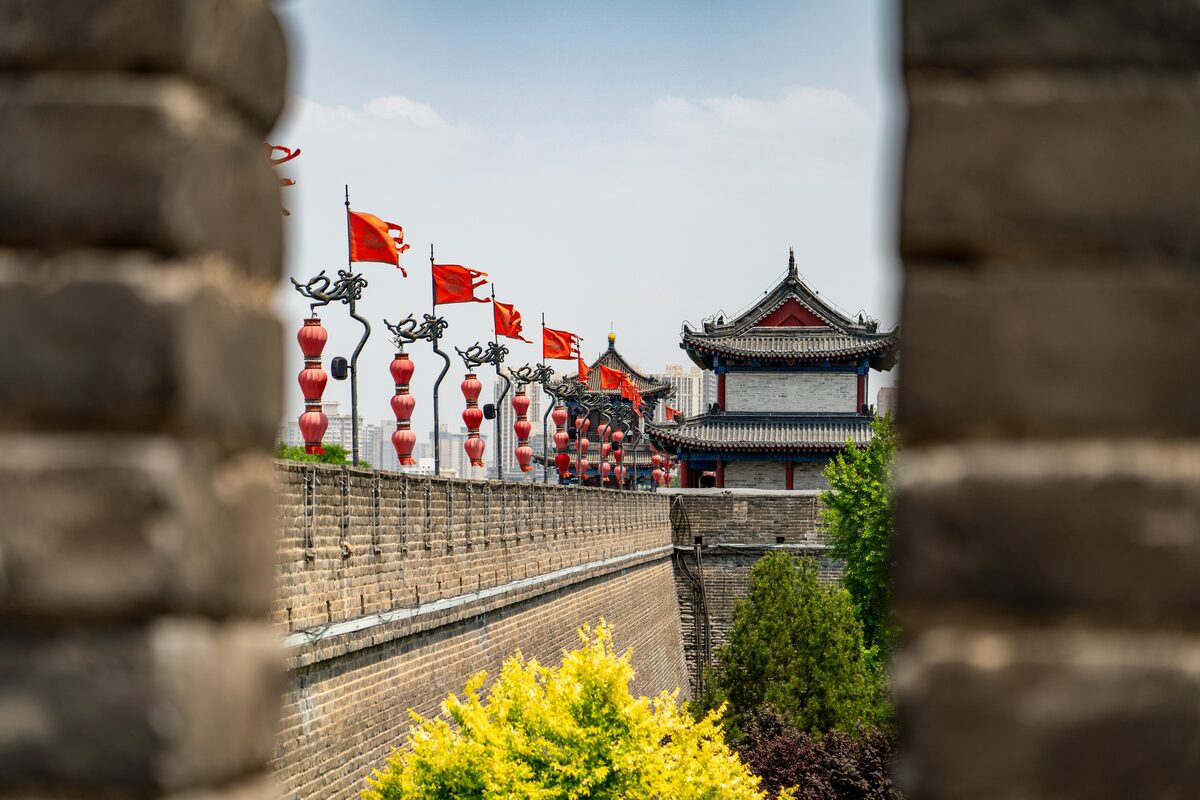
The Xi'an City Wall is a rectangular 13.74 km loop of brick-faced, rammed-earth ramparts enclosing the entire historical core of the city. It was rebuilt in its current form in 1370 CE under the Ming founder Hongwu, on the southern third of the foundations of the 7th-century Tang imperial-capital wall. It is the largest fully intact ancient city wall in the world — and the only one where you can rent a bike on top and ride the full circumference.
The wall stands 12–14 m tall and 12–18 m wide at the base, with chest-height crenellations on the outer edge, corner watchtowers, 98 enemy-spotting platforms (敌台) at ~120 m intervals, and four layered gate complexes. UNESCO placed it on its Tentative List in 2008 (entry 5350). Xi'an is the only major Chinese city whose medieval defensive perimeter survives complete — Beijing's Ming wall was demolished in the 1950s–60s, and Pingyao's UNESCO-listed wall is a much smaller 6.4 km.
Tickets, hours & bike rental
Entry and bike rental are charged separately. The per-person total for the bike ride is ¥99, the same all year.
| Item | Price | Notes |
|---|---|---|
| Wall entry | ¥54 flat all year ¥27 concession | Flat all year — no peak/off-season split; ¥80 during the Spring Festival lantern display. Real-name (实名制) — bring passport. |
| Single bike | ¥45 / 3 hr | ¥5 per 10 min over on a single, ¥10 on a tandem; ¥100 deposit (keep the receipt, refunded on undamaged return). Different-gate return supported, but after 20:00 all bikes must go back to South Gate. |
| Tandem bike | ¥90 / 3 hr | 2-person; slower and wobblier than two singles on the bumpy brick. Electric bikes are not permitted. |
| Electric cart (观光车) | ~¥80 round-trip | Full loop with audio guide — useful for visitors with mobility limits, or those barred from cycling (under 12 / over 65). |
Hours (South Gate): the busiest gate stays open latest — the South-Gate access points run roughly 8:00am–10:00pm; other gates typically close around 8:00pm, so plan your return accordingly. The wall is lit through the evening until about 22:00, best after dusk. At South Gate, a daily Welcoming Ceremony runs 9:00am–9:30am.
Cycling the wall — the 90-minute loop
Most riders loop from South Gate around the four sides — the brick surface is uneven, so anything above ~15 km/h is jarring; allow 25–30 minutes between gate stops and mind the 3-hour rental limit. One quirk to plan for: there's a walk-only stretch of roughly 800 m–1 km near South Gate where you return your bike, walk across on foot, and re-rent on the far side (your rental slip is marked for this).
| Side | Distance | What you see |
|---|---|---|
| South wall Yongningmen → SW corner | 3.4 km | Most-photographed segment — old-city rooftops north, modern skyline south; Bell Tower inside, Big Wild Goose Pagoda 4 km off on a clear day. Stop at the SW corner watchtower (西南角楼). |
| West wall SW → Andingmen → NW corner | 2.7 km | Least-trafficked, most open feel. Andingmen (West Gate) has a 1370 CE original gate-tower; restroom + snack stop. |
| North wall NW → Anyuanmen → NE corner | 3.4 km | Anyuanmen (North Gate) overlooks Xi'an Railway Station plaza; the NE corner watchtower is a popular sunset spot. |
| East wall NE → Changlemen → Yongningmen | 2.7 km | Changlemen (East Gate) connects to the Drum Tower district; the final stretch overlooks the Bell Tower, Drum Tower and Muslim Quarter within 1 km. |
The singles are old mountain bikes with a fixed (non-adjustable) seat and a low handlebar — test-ride before setting off and ask to swap if it doesn't suit you. Children under 12 and adults over 65 are not permitted to cycle; they can take the electric cart or walk a segment. The wall closes to bikes in heavy rain or snow.
The four gates — which to start at
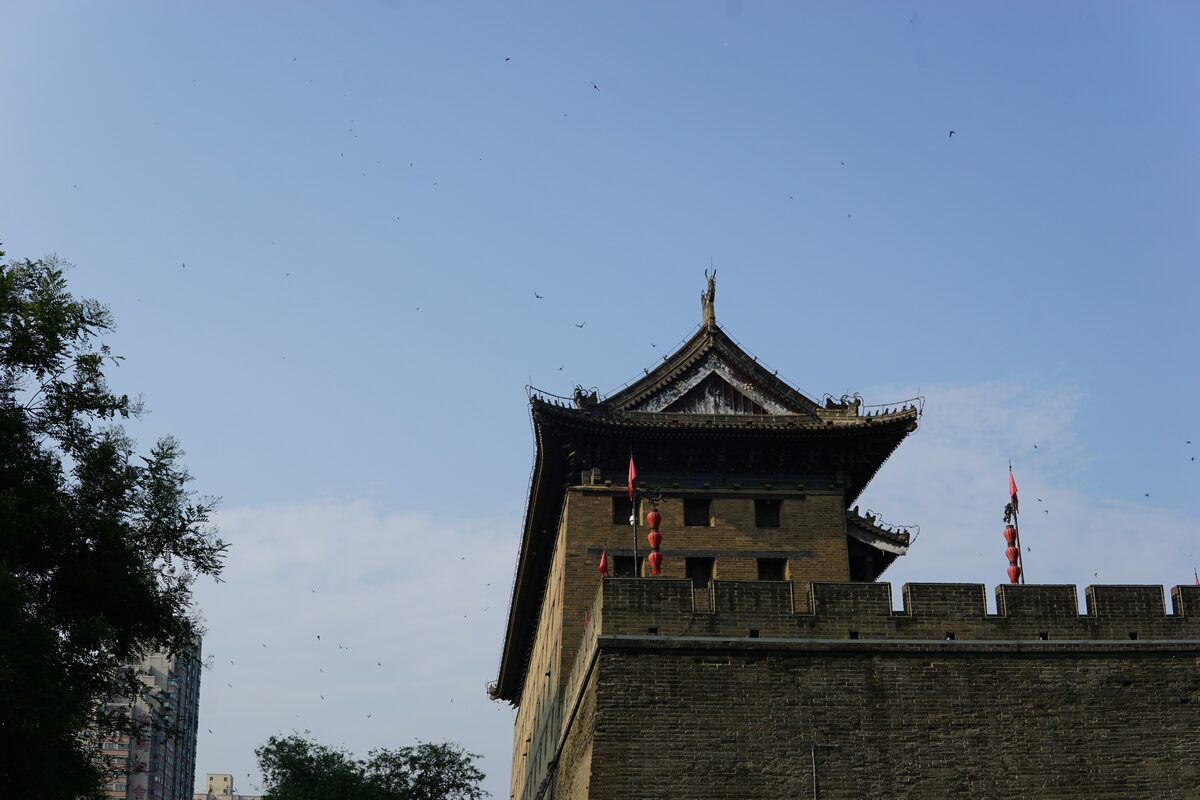
South Gate (永宁门 Yongningmen) is the classic start for around 90% of foreign visitors: the most ceremonial and fully restored of the four, directly above its own Metro Line 2 station, and a 5-minute walk from both the Bell Tower and the Muslim Quarter. Its daily Welcoming Ceremony (迎宾仪式, 9:00–9:30am) is performed in Tang-dynasty costume — free standing room outside, paid seats (¥80–200) inside the barbican. The other three gates suit specific arrivals:
| Gate | Closest Metro | Best for |
|---|---|---|
| South / Yongningmen 永宁门 | Line 2 Yongningmen | First-timers; Bell Tower & Muslim Quarter; the ceremony and the best southern view. |
| North / Anyuanmen 安远门 | Line 2 Anyuanmen | Arrivals from the (city) railway-station district — a 5-min walk away. |
| East / Changlemen 长乐门 | Line 1 Wulukou (5-min walk) | Shortest walk to the Drum Tower neighborhood; less crowded. |
| West / Andingmen 安定门 | Line 1 Sajinqiao (10-min walk) | Least-trafficked; good for crowd-avoiders and sunset photography. |
Getting to South Gate is easy from the old-city core: walk 5 minutes south from the Bell Tower, or 10 from the Muslim Quarter. From Xi'an North HSR station, Metro Line 2 runs direct to Yongningmen in ~30 min. See the Xi'an city guide for the wider old-city layout.
Walking & electric-cart alternatives
You don't have to cycle. Walking the full $13.74 km loop takes 3–4 hours and most foreign visitors don't finish it — the payoff doesn't justify the distance. Choose your mode by what you want from the visit:
- Bike if you want to circle the entire old city — the ~1.5–2 hour loop is the headline experience.
- Walk the highlight segment — from South Gate west to Hanguangmen (含光门), ~1.5 km / 30–40 min. It packs in the best photos: the deep-perspective barbican stairs at Yongningmen (a favourite for Tang-costume shots), the turn where a 2–3× phone zoom lines the wall up with the Bell Tower, and the round southwest corner tower — the only circular corner on the wall, superb at sunset. At Hanguangmen you can step down into the free wall-ruins museum to see a Tang wall cross-section.
- Electric cart (~¥80 round-trip, with audio guide) for the full loop without effort — the best option for limited mobility, or anyone barred from cycling.
Best time, night lights & lanterns
The wall is open year-round; the two best windows are a weekday morning (9–11am) for an empty surface and clean architecture light, and sunset for blue-hour photographs plus the nightly illumination. Avoid weekend afternoons 2–5pm, when bike-rental queues hit 30–45 minutes.
| When | What it's like |
|---|---|
| Apr–May | Best overall — 15–25°C, blossoms in the moat park, comfortable cycling. |
| Sep–Oct | Second-best; October light is strong for golden-hour photography. |
| Jul–Aug | Hot (30–38°C); cycle only before 7:30am or after 6pm. |
| Spring Festival | The Lantern Festival — the iconic winter image. Worth the crowds if you're in China for the holiday. |
| Rain / snow | Bikes suspended; the wall is walkable but slippery. |
Night lights. The full perimeter is lit through the evening until about $22:00, most photogenic in the blue hour 15–30 minutes after sunset (so roughly 18:00–18:45 in winter, 20:30–21:15 in summer — the start shifts with the season). The iconic shot is the South Gate moat-and-wall reflection from outside — the southwest corner of the moat park, a short walk west of Yongningmen station Exit C.
Lantern Festival. Over the 15-day Spring-Festival window (late Jan–mid Feb), the whole wall is covered in 100,000+ red lanterns with themed gate installations — China's most famous traditional lantern display. Tickets rise to ¥80, crowds are extreme, and bike rentals are suspended on the 5–7 busiest evenings (you walk only). Book wall entry via the official WeChat Mini-Program “Xi'an City Wall” 7–10 days ahead; same-day tickets often sell out by 3pm. Pair it with the best-time-to-visit-China guide when planning a holiday-window trip.
Book the City Wall + a Xi'an tourNASDAQ: TCOM
Trip.com sells City Wall entry and English half-day combo tours (City Wall + Bell Tower + Muslim Quarter, ~USD $30–55) — tickets included, booked in English on a foreign card.
Practical for foreigners
Payment & the bike deposit
The ticket office takes Alipay, WeChat Pay and cash; foreign Visa/Mastercard works at the South Gate POS but not at the other three gates. Bike rental needs a ¥100 deposit — cash (refunded as cash) or Alipay (refunded to balance within 1–2 hours). Visitors without Alipay are sometimes steered to cash-only, so carry RMB. Bind a foreign card to Alipay before you arrive to avoid the cash-only fallback.
On the wall
- Toilets, water, snacks at all four gate complexes and the SE/SW corners (¥10–15 bottled water, ¥20–30 ice cream/skewers).
- English signage is bilingual at the four gates and corner towers; mid-wall panels are Chinese-only. An English audio guide is ¥40 at South Gate — skippable if you just want to cycle.
- Accessibility: the wall surface is flat brick (no stairs once you're up via lift/ramp at South Gate), but uneven — the electric cart is the comfortable option for limited mobility.
How it fits a Xi'an trip
For most foreign travelers the wall is the active afternoon half-day of a 2–3 day Xi'an base. The classic old-city day: a morning of the Bell Tower, Drum Tower and a Muslim Quarter food walk (yangrou paomo, biang biang noodles), the wall bike ride in the afternoon, then Big Wild Goose Pagoda and the Datang Everbright City fountain in the evening. Keep a separate full day for the Terracotta Army.
When NOT to prioritise it: if you only have one day in Xi'an, the Terracotta Army comes first. Skip the bike if you can't cycle (the walk is 3–4 hours), or in active rain/snow (bikes suspended).
Frequently asked questions
How long does it take to bike around the Xi'an City Wall?
About 1.5–2 hours of casual cycling for the full 13.74 km loop; budget 3 hours if you stop often for photos. The bike rental has a 3-hour time limit — overtime is charged even a minute over, rounded up in 10-minute blocks (¥5 per 10 minutes on a single, ¥10 on a tandem — double), so return and re-rent near the limit rather than run over. Single bikes ¥45, tandems ¥90; electric bikes are NOT permitted on the wall surface. Note there's a walk-only zone of roughly 800 m–1 km near South Gate where you return your bike, walk across, and re-rent on the far side (your rental slip is marked).
How much does the Xi'an City Wall cost?
¥54 entry, flat all year — there is no peak/off-season split, and ¥27 is a concession (6–18s, full-time students, veterans), not a winter price. Under-1.2 m, under-6s, over-65s and disabled visitors are free. Bike rental is separate: ¥45 for a single bike, ¥90 for a tandem (2-person), with a ¥100 deposit (keep the receipt — refunded on return if the bike is undamaged and not overtime). Total budget per person for the bike-ride experience: about ¥99 all in. Real-name ticketing. 7 days of slots are released on the official mini-programme and the manned windows stopped selling to domestic visitors in 2023 — but since 1 July 2026 the gates read Chinese ID cards or faces rather than QR codes, so a passport holder buys online and then collects a PAPER voucher at a ticket window before entering. South Gate (Yongningmen) is the standard entry — closest to the Bell Tower and directly above Metro Line 2 Yongningmen station.
Is it safe and comfortable to bike on the wall?
Safe, yes — the surface is wide brick with chest-height crenellations on the outer edge, so there's effectively zero falling risk. Comfortable is another matter: the green-brick surface is genuinely bumpy (the northwest corner especially), so anything above ~15 km/h is jarring on the wrists and seat. The ¥45 singles are old mountain bikes with a non-adjustable seat and a low handlebar — test-ride before you set off and ask to swap if it doesn't fit. Wear comfortable shoes and avoid a long skirt or trailing trousers (they catch in the wheel). Children under 12 and adults over 65 are not permitted to cycle (they can take the electric cart or walk); the wall closes to bikes in heavy rain and snow.
When is the best time to bike the wall?
Weekday mornings 9:00-11:00am for empty wall, golden-hour photography in spring and autumn. Sunset (the standard tourist time, 17:30-19:00 in summer / 16:30-17:30 in winter) gives you blue-hour photographs and the wall's nightly illumination from 18:30 — but it's also peak crowd. Avoid Saturday and Sunday afternoons 14:00-17:00; bike-rental queues hit 30-45 min and the wall surface gets congested. The Lantern Festival period (春节 Spring Festival, late Jan-Feb, 15-day window) is the most spectacular wall photography of the year — red lanterns cover the entire perimeter — but also the most crowded; book accommodation 6-8 weeks ahead.
Can I walk the wall instead of biking?
Yes. Walking the full 13.74 km loop takes 3-4 hours at moderate pace and most foreign visitors don't do it — too long for the payoff. The walking-vs-biking decision: walk if you only want to do a short segment (e.g. South Gate to East Gate, 3 km, 45 min) and want to stop at every watchtower, OR if you have mobility issues that make biking on uneven brick uncomfortable. Bike if you want to circumnavigate the entire old city. There are also electric carts (观光车) running ¥80 round-trip for the full loop — useful for visitors with severe mobility limits.
Where should I enter the wall?
South Gate (永宁门 Yongningmen) for 90% of foreign tourists. It's: (1) closest to the Bell Tower and the Muslim Quarter — a 5-minute walk; (2) directly above Metro Line 2 Yongningmen station; (3) the most ceremonial entry, with the Welcoming Gate ceremony performed daily 9:00am-9:30am for arriving visitors; (4) the gate with the best southern view of the city. Enter at North Gate (安远门) only if you're arriving from the train station district. Enter at East Gate (长乐门) for the shortest walk to the Drum Tower neighborhood. West Gate (安定门) is the least-trafficked and a nice option for crowd-avoiders.
How is the wall illuminated at night?
The full 13.74 km perimeter is lit through the evening until about 22:00 with warm floodlighting on the wall surface, gate-tower spotlights, and red lanterns along the ramparts. It's most photogenic in the blue hour, 15-30 minutes after sunset (so roughly 18:00-18:45 in winter, 20:30-21:15 in summer — the start time shifts with the season). From outside the wall, the South Gate moat-and-wall reflection on a windless night is the iconic photograph; the spot is the southwest corner of the moat park, a short walk west of Yongningmen station Exit C.
Is the Lantern Festival worth visiting for?
Yes — Xi'an's wall during Spring Festival (the 15-day Lunar New Year period, late January to mid-February) is China's most famous traditional lantern display. The full perimeter is covered in 100,000+ red lanterns, plus themed installations at the 4 main gates featuring zodiac animals and historical figures. Wall ticket prices increase to ¥80 during the festival. Crowd density is extreme: the wall surface fills shoulder-to-shoulder on peak nights and bike rentals are suspended on the 5-7 most crowded evenings. Book wall entry tickets via the official WeChat Mini-Program 'Xi'an City Wall' 7-10 days ahead; same-day tickets often sell out by 15:00. Pair with a Spring Festival Beijing or Pingyao trip for a full traditional New Year experience.
Sources
Checked August 2026 · Written from our own first-hand travel in China.