Key takeaways
- Be through the gate by noon. The ticket office shuts at 15:00 — three hours before the valley does — and the site is 30+ km deep, so the bus round trip alone is close to two hours.
- The buses do not stop on the way down. Anything you skip on the way up is gone. The itineraries that promise you will “never double back” are describing a walk, not the bus.
- Entry is ¥70 plus a compulsory ¥70 shuttle; the inner cart at the top is separate again at ¥20 one-way or ¥30 return. Booking is real-name and through booking platforms only.
- It sells out and turns people away — the operator has posted full-capacity notices for mid-November and for 2 January. Winter is not a walk-up season here.
- Come for the autumn colour (20 Oct – 5 Nov) or the snow. In summer there is no colour, and the same day is better spent at Mount Siguniang.
What Bipenggou actually is
A single long glaciated valley on the eastern rim of the Tibetan plateau, in Li County in the Ngawa Tibetan and Qiang Autonomous Prefecture. It runs from about 2,200 m at the entrance to about 3,837 m at Yanziyanwo at its head, and you gain all of that on wheels — there is a shuttle bus for the long lower run and an electric cart for the upper section, and private vehicles do not go in.
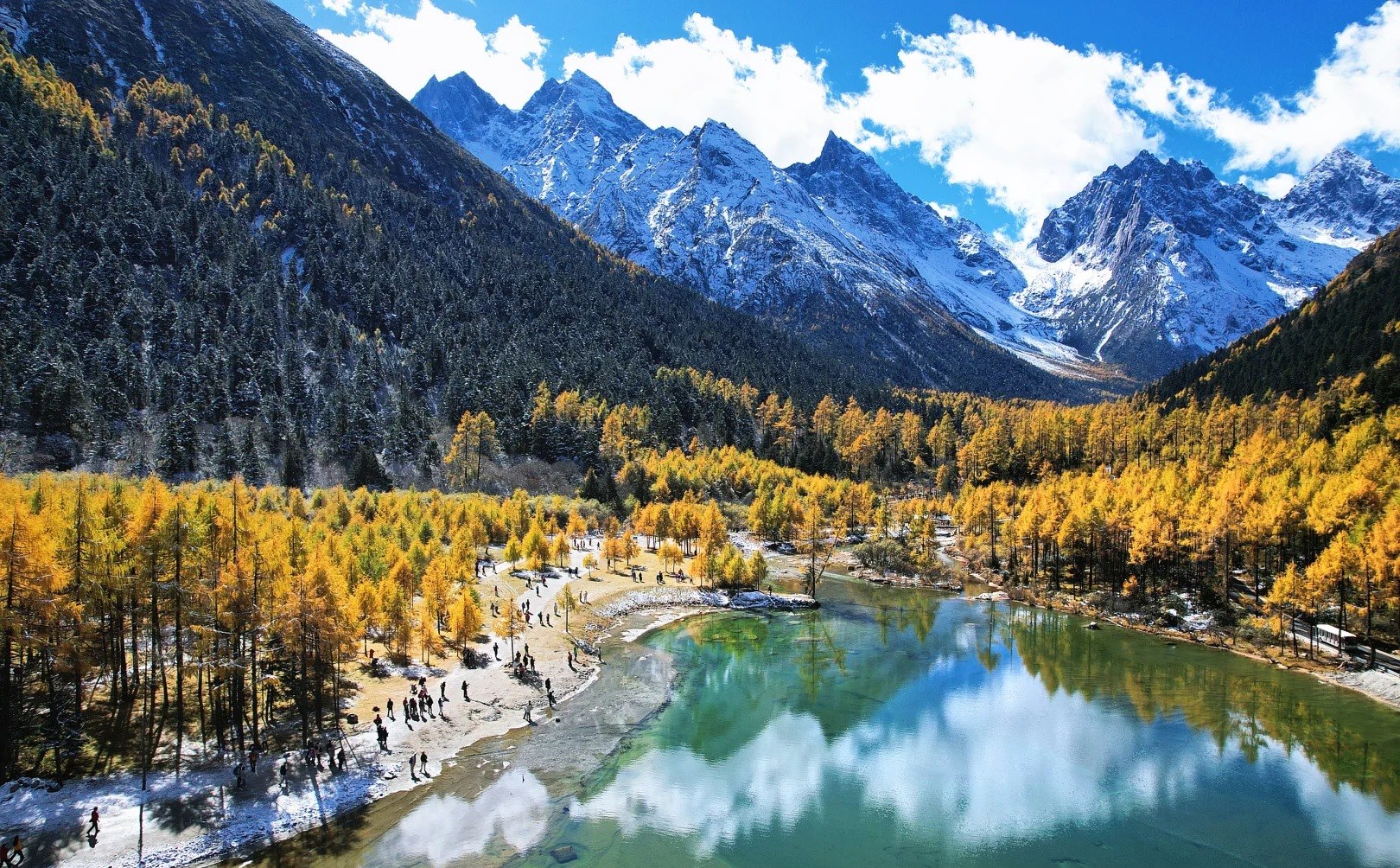
What is up there is lakes, waterfalls and forest: Longwang Lake at about 2,950 m, eleven kilometres from the visitor centre; Panyang Lake at 3,676 m, which is where the reflection photograph comes from; Hongshan Lake at 3,750 m, where colour, red rock, water and alpine rhododendron all occur together; and the Bailong waterfall, roughly ten metres wide with a drop of about a hundred. The lower eleven kilometres are the Red Leaf Valley, which is what the place is famous for and the reason to time a visit at all.
Where Bipenggou is — and why it is not a Siguniang add-on
222.9 km · ~3h10no pass36 km apart, 129.6 km by road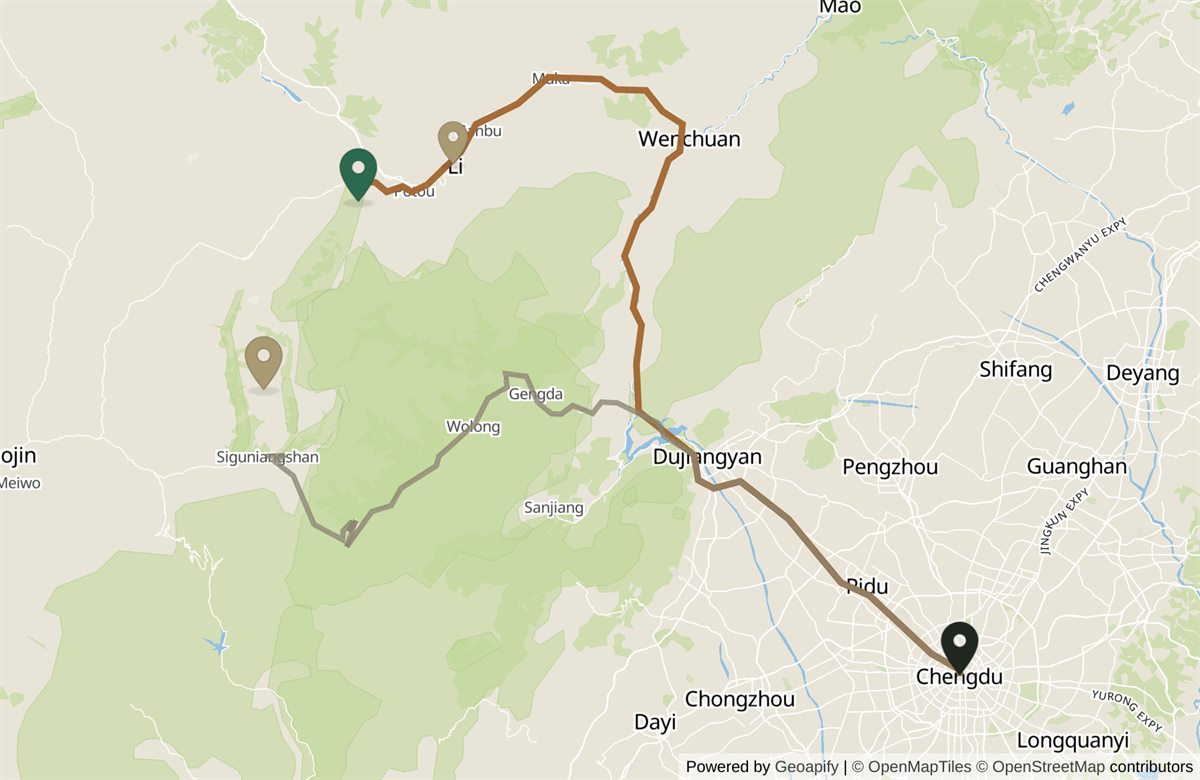 Bipenggou ValleyBipenggouLi CountyLi CountyMount SiguniangMt SiguniangChengduChengdu
It is easier to reach than most Sichuan alpine scenery — three hours from Chengdu on a good road, no pass, no permit — and that ease is genuinely its selling point. It is also why the honest verdict below is conditional rather than enthusiastic: this valley is superb for about a fortnight a year and pleasant-but-ordinary outside it.
It is not the panda base
Two names collide here and both mislead in English. Bipenggou (毕棚沟) is this valley, north-west of Chengdu in Li County. Bifengxia (碧峰峡) is a giant panda base near Ya’an, south-west of Chengdu, in a different direction entirely. Romanised they are one letter apart; spoken they are close enough that drivers and ticket clerks get them confused. If you are booking a car or showing a phone screen, show 毕棚沟.
The second collision is inside the valley. The mid-way service area — where the shuttle bus hands over to the inner cart, and the only place with food and toilets — is called Shanghaizi (上海子). It has nothing to do with Shanghai; the resemblance is an accident of romanisation. Never shorten it.
The first collision is the expensive one, because the two places are not merely different — they are in opposite directions and they answer different questions. Bifengxia is where you go to see captive pandas, on the road south-west towards Ya’an; this valley is three hours north-west and has none. Booking one while meaning the other is not a detour, it is a different day and a different half of the province, and it is easy to do because the two names sound alike to an ear that does not have the tones.
The practical defence is simple and worth taking seriously anywhere in Sichuan: carry the characters, not the romanisation. A driver, a ticket clerk or a hotel desk will read 毕棚沟 without hesitation and may well guess wrong from the English. If you are also planning to see pandas, our guide to the four panda bases covers Bifengxia properly — it is a real recommendation, just not this one.
The way back is the decision
Every Chinese itinerary for this valley carries the phrase 不走回头路 — “never doubles back”. For the trip almost everybody actually takes, it is not true, and the gap between those two things is the most useful thing on this page.
Terrain © Stadia Maps · Stamen Design · OpenMapTiles · © OpenStreetMap contributors. Stop positions Amap-verified August 2026.
Going up, the shuttle bus and then the cart stop at each point and you get on and off as you like. Coming down, both run non-stop straight to the gate. So the all-riding day — the one the overwhelming majority do — travels the entire road twice and stops on the second pass at nothing at all.
The version the phrase actually describes is different: take the cart to Yanziyanwo at the head of the valley, then walk down. It is roughly ten kilometres of gently descending boardwalk through Panyang Lake and Zhuomatan to the Shanghaizi service area, past red-rock beds and forest that the buses drive past, and it genuinely does not repeat itself. It is downhill the whole way, which is easier on the knees than it sounds and much easier than the same distance climbing at this altitude.
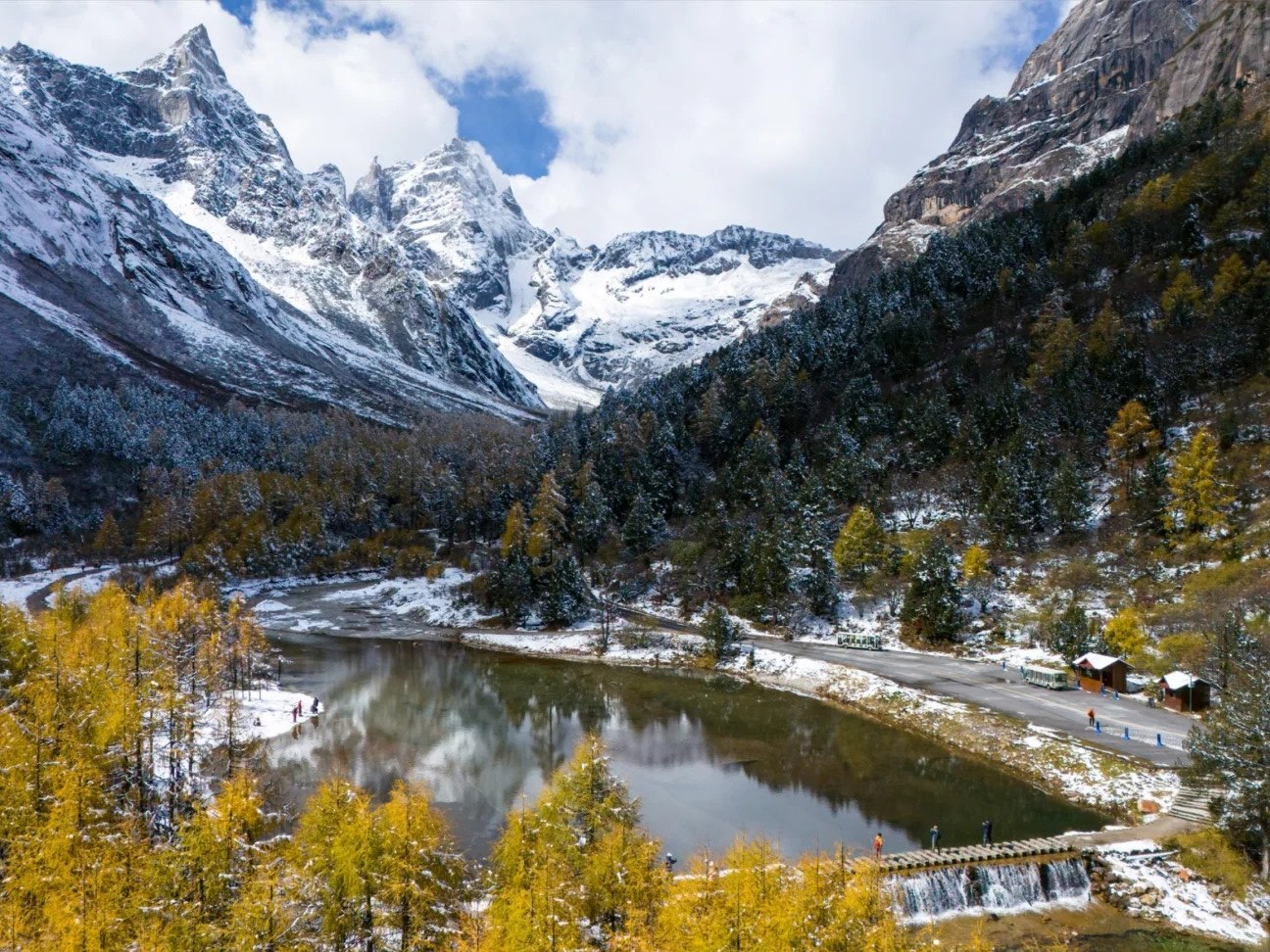
What this costs you if you get it wrong. Zhuomatan — clear running water ringed by colour in autumn — is passed twice by the bus and visited neither time. Jinghai, the first stop, has a viewpoint a short walk back along the road from where the bus drops you, which almost everyone misses by following the crowd the other way, and which the descent bus cannot give you a second shot at. If you are riding the whole way, do your stopping on the way up and treat the ride down as transport.
Three closing times, and none of them is the deadline
The valley closes at 18:00 on summer weekdays and 18:30 at summer weekends — the weekend half-hour at each end is real, and it is the only day-of-week split we have found anywhere in this cluster — dropping to 17:30 daily from October. The visitor centre shuts at 16:00. The ticket office shuts at 15:00.
None of those is the number that governs your day. The valley is over 30 km deep and the bus round trip alone runs to close to two hours before you have stood anywhere. An arrival at 15:00 is permitted and leaves you almost nothing. The advice Chinese guides give is to be through the gate by noon, and it is correct.
That in turn is why the drive matters more here than the distance suggests. Three hours ten from Chengdu means leaving the city around 08:00 to be comfortably inside by midday — which is achievable as a day trip in a way that Mount Siguniang, over its pass, is not. It is also why the afternoon-arrival mistake is so common: the road is easy enough that people underestimate what is waiting at the other end.
Tickets, and the vehicle you did not budget for
| Item | Price | Optional? |
|---|---|---|
| Admission | ¥70 | No |
| Shuttle bus 景交车 | ¥70 | No — the gate is 3.71 km from the valley and there is no walk-in |
| Inner cart 电瓶车 — two segments | ¥20 one-way · ¥30 return, each | In name — the alternative is walking at 3,600–3,800 m |
The cart is the part people get wrong, because ¥20/¥30 buys ONE segment and there are two of them — Shanghaizi to Panyang Lake, then Moon Bay to Yanziyan. So the honest budget is ¥170 if you turn round at Panyang Lake and ¥200 if you go to the head of the valley and back, against the ¥140 you will see quoted. It is the sort of thing people decline at the window and regret at altitude. Travellers report a lower winter rate — ¥50 admission plus ¥30 shuttle — from December to March; the operator publishes no seasonal table, so treat that as reported rather than posted and check when you book.
One thing worth knowing before you queue twice. Trip.com carries a combo listing that bundles admission, the shuttle and both cart segments return, priced at ¥200 — the same as buying the four parts separately, so it saves money only when it is discounted. What it saves is the transaction: you are not buying cart tickets again at 3,600 m. It is also listed explicitly for non-mainland visitors, which is the part that matters here, because the domestic platforms below assume a mainland identity. Checked 13 August 2026; if you only want the gate and the bus, that pair is the ¥140 listing.
Booking is real-name and booking-app only. The operator sends visitors to Meituan, Ctrip and Tongcheng rather than selling through its own site; of the three, Ctrip is the one with an international front end. Booking opens at most 15 days ahead. And it genuinely sells out: the valley runs a daily cap and posts full-capacity notices turning walk-ups away, with dated examples on its own site for 13 and 14 November and 2 January. That January date is the one to register, because it means the quiet-looking winter season is not a walk-up season.
When the colour turns
The peak fortnight is 20 October to 5 November. But the more useful fact, and the one that lets you plan around a fixed set of dates, is that the colour works downhill.
From late September the high ground turns first — Yanziyanwo at about 3,837 m and Panyang Lake at about 3,676 m — while everything below is still green. That is a quiet, thin, uncrowded window. Through mid-October to early November the whole valley is in it at once: orange at the bottom, gold at mid-height, snow on the tops. By mid-November the high leaves are down, but the lower stretch from the entrance up to Shanghaizi still pairs snow peaks with what colour is left.
The altitudes are therefore a calendar. If you are early, go high and spend your time at the top of the valley. If you are late, stay low and do not bother with the cart. That is a decision you can make on the morning, from the forecast and the date, and it is the difference between a good day and a flat one.
Winter, and the ski field
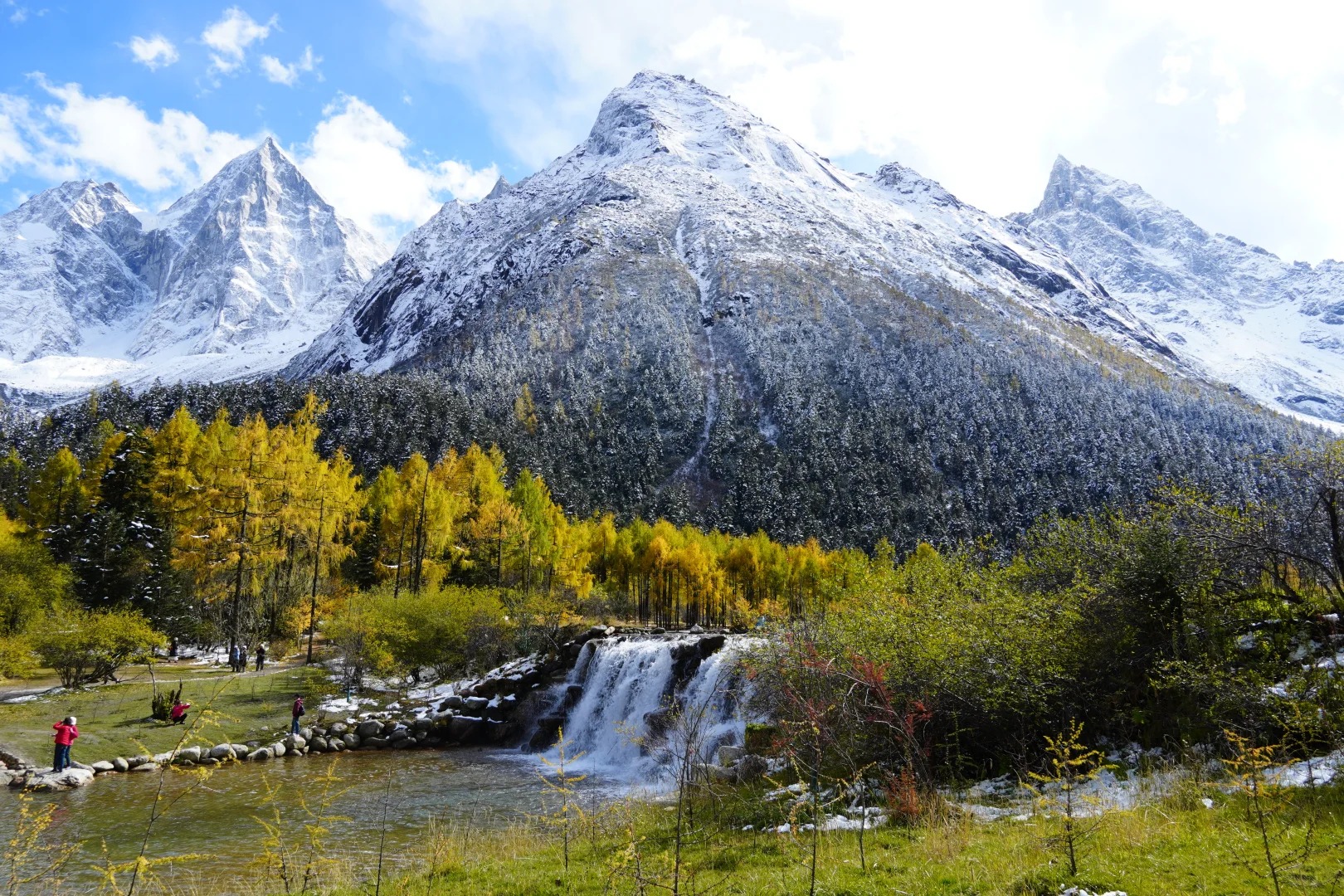
The valley does not close for winter — a point worth making because the mapping data suggests otherwise, describing opening hours only from May to December. It is open, and it sells out: the operator posted a full-capacity notice for 2 January.
There is a ski field, opening between late November and early December — 27 November in 2025 — and running to March. Be clear about what it is: a small field with one beginner slope. Anyone who skis properly will find it thin, and it is not a reason to make the trip on its own. What it is good for is a first-timers-and-children afternoon in a genuinely spectacular setting. The local way to use it is to pair it with the hot springs at Guergou (古尔沟) down the road: snow in the morning, hot spring in the afternoon.
Do not read the quiet season as an easy one. That 2 January sell-out is the fact to plan around: this is a weekend valley for Chengdu, three hours each way, and a clear winter Saturday fills it as reliably as an October one. Book it exactly as you would in autumn.
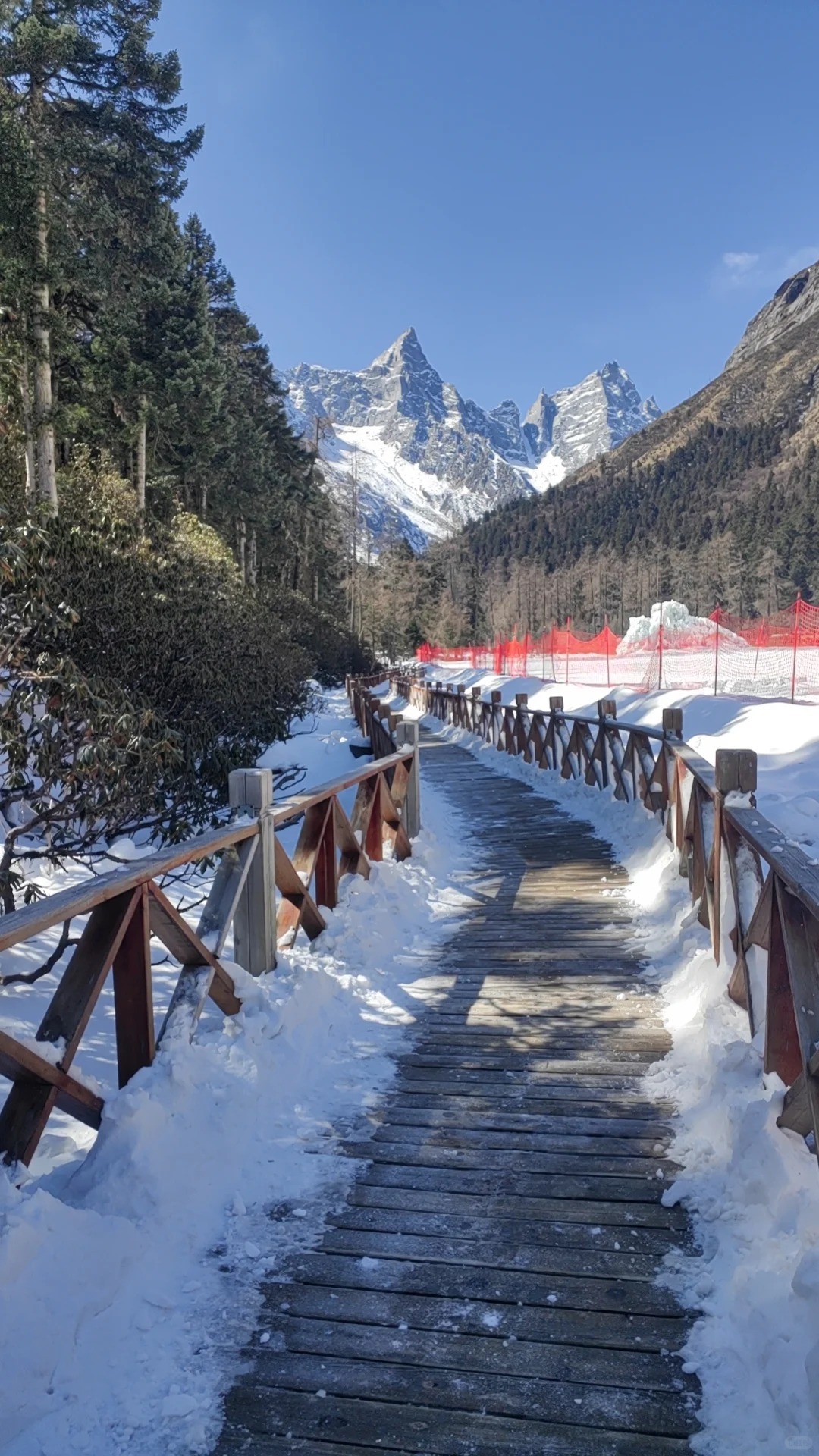
What winter actually buys you is a different valley rather than a lesser one. The colour is gone, but the lakes freeze, the peaks that the autumn crowds photograph through haze come out clean, and the upper section — the part where the cart matters most in October, because everyone wants it — is quiet. The costs are real too: the days are short against a 15:00 ticket cut-off that does not move, the boardwalks ice, and if you are driving yourself the same winter road rules apply here as everywhere on this edge of the plateau. Bring proper footwear rather than assuming the boardwalk will be swept.
Getting there — and why you cannot chain it with Siguniang
From Chengdu: 222.9 km, about three hours ten. The route runs up the Dujiangyan–Wenchuan expressway to Li County and crosses no high pass, which makes it about an hour shorter than Mount Siguniang despite sounding like the more remote of the two.
And you cannot do both in one loop. The two valleys are only about 36 km apart in a straight line and they very nearly touch — Yanziyanwo at the head of this valley backs directly onto the Siguniang massif, which is why the operator calls it “the back view of the Four Sisters”. But there is a mountain in between and no road across it: driving from one to the other is 129.6 km and about two and a half hours. They are two separate trips out of Chengdu. Anyone planning a Sichuan alpine week should treat them as alternatives for a given day rather than a chain, and in summer — when this valley has no colour — Mount Siguniang is the better use of the day.
In summer the drive carries a real hazard: sustained rain in the June-to-September season triggers mudslides on the access road, and the valley closes and turns people away when that happens. Check the operator’s notice the night before you travel.
On the day
Take something for motion sickness, and take it before you board. This is the advice travellers give most often about Bipenggou and it is not the one people expect. The in-valley bus climbs more than twenty kilometres of tight switchbacks and drivers take them briskly; what ruins a day here is far more often car sickness than altitude, and the two get conflated because they produce similar misery at similar moments. The remedies are completely different.
Seats matter and the advice reverses by direction. Going up, sit on the left, where the views are. Coming down, take a front row — the bus does not stop, and the front is where motion sickness bites least.
Dress for a valley that changes its mind. Sun, rain and hail inside half an hour is normal here, so carry a light down layer and a disposable poncho regardless of what the weather is doing at the gate. Food inside is limited and expensive — instant noodles around ¥20, a rice plate around ¥35 — and the toilets are mostly dry pits, so bring what you would rather not buy.
If you are driving yourself, keep right on entering the car park: a short ramp takes you to within about ten metres of the ticket office instead of the walk from the far end.
Frequently asked questions
Is Bipenggou the same place as Bifengxia, the panda base?
No, and the two get confused constantly because the romanisations are one letter apart. Bipenggou (毕棚沟) is an alpine valley in Li County, in the Ngawa Tibetan and Qiang Autonomous Prefecture, about 223 km north-west of Chengdu — no pandas, no enclosures, just a glaciated valley you ride a bus up. Bifengxia (碧峰峡) is a panda base near Ya'an, in a completely different direction south-west of Chengdu. If you are booking a car or showing a phone screen, show the characters 毕棚沟, because the spoken English names are close enough to send you to the wrong province-corner entirely.
What does it cost?
Entry is ¥70 and the shuttle bus is ¥70, so ¥140 before you get to anything optional. The shuttle is compulsory in practice rather than in name: the ticket office sits 3.71 km from the valley proper, and there is no walk-in route. At the top of the valley an inner electric cart runs the last section in two segments — Shanghaizi to Panyang Lake, then Moon Bay to Yanziyan — and EACH is sold separately at ¥20 one-way or ¥30 return, so riding both ways on both is ¥60 and the full-valley total is ¥200. That one is genuinely optional — you may walk it — but the walk it replaces is at 3,600 to 3,800 m, and declining it to save ¥30 is a well-worn way of bringing on altitude symptoms. Travellers report a cheaper winter rate from December to March, but those reports predate the 2024 shuttle rise and we have not been able to re-check them against the current fare, so do not budget on them.
What time do I actually need to be there?
Through the gate by noon. There are three different closing times here and only one of them matters: the valley itself runs to 18:00 on summer weekdays and 18:30 at summer weekends, the visitor centre shuts at 16:00, and the ticket office shuts at 15:00. But the binding constraint is the size of the place — the valley is over 30 km deep and the bus round trip alone runs to nearly two hours, so an arrival at 15:00 is legal and leaves you almost no time on the ground. Chinese guides say midday and they are right.
Do the buses stop on the way back down?
No, and this is the single most useful thing to know before you go. Both the shuttle bus and the inner cart run non-stop from the top straight back to the gate. Whatever you skipped on the way up, you do not get a second chance at — which matters most at Zhuomatan, a stretch of clear water ringed by colour in autumn, and at Jinghai, the first stop, whose best viewpoint is a short walk back along the road from where the bus lets you off. Most people follow the crowd off the bus and never find it. If you want to see those properly, either get off going up, or take the walk-down option.
What is the "never doubles back" route everyone mentions?
It is a real route, and it is not the one most people are on when they repeat the phrase. Ride the cart all the way to Yanziyanwo at the head of the valley, then walk down — roughly 10 km of gently descending boardwalk through Panyang Lake and Zhuomatan to the Shanghaizi service area, past red-rock beds and forest the buses drive straight past. That version genuinely does not repeat itself. The all-riding version, which is what the great majority actually do, repeats the entire road, because the return leg is non-stop. The caption got copied from one onto the other.
When does the autumn colour peak?
The consensus fortnight is 20 October to 5 November, but the more useful fact is that it does not arrive all at once — it works downhill. From late September the high ground turns first: Yanziyanwo at about 3,837 m and Panyang Lake at about 3,676 m. Mid-October to early November is the peak across the whole valley, with orange low down, gold at mid-height and snow above. By mid-November the high leaves are down, but the stretch from the entrance up to Shanghaizi still pairs snow peaks with what is left. So the altitudes double as a calendar: if you are early, go high; if you are late, stay low.
Do I need to book, and does it sell out?
You need to book, it is real-name, and it does sell out. The operator directs visitors to booking platforms — Meituan, Ctrip and Tongcheng — rather than selling through its own site, and of those Ctrip is the one with an international front end. Booking opens at most 15 days ahead; one to two days is usually enough, but for an October weekend travellers watch for tickets a week out. The valley runs a daily cap and publishes full-capacity notices, turning away visitors who arrive without one: its own dated examples include 13 and 14 November and 2 January. That last one is worth registering, because it means winter is not the walk-up season it looks like.
How high is it, and will I get altitude sickness?
The valley runs from about 2,200 m at the entrance to 3,837 m at Yanziyanwo, so you gain more than 1,600 m in a single morning without walking. That is enough to feel. But the thing that most often ruins a day here is not altitude at all — it is motion sickness, because the in-valley bus climbs 20-plus kilometres of tight switchbacks and drivers take them briskly. Travellers advise taking a tablet before boarding, which is a different remedy from anything that helps with altitude. Buy oxygen in town rather than in the valley if you want it, walk slowly at the top, and treat the cart at the upper section as the sensible option rather than a soft one.
Is there skiing, and is it any good?
There is a ski field, it opens between late November and early December — 27 November in 2025 — and it runs to March. Be realistic about it: it is a small field with one beginner slope, so anyone who skis properly will find it thin. What it has is the setting, snow peaks and forest all round, and it works well as a first-timers-and-children afternoon. The local way to use it is to combine it with the hot springs at Guergou, down the road: snow in the morning, hot spring after.
Can I combine Bipenggou with Mount Siguniang?
Not in the way the map suggests. The two are only about 36 km apart in a straight line, but there is a mountain in between and no direct road: driving between them is 129.6 km and about two and a half hours. They are two separate trips out of Chengdu, not a chain. Bipenggou is the closer of the two — about 223 km and three hours ten, against 233 km and four and a quarter to Siguniang, because Bipenggou avoids the Balang Pass. If you have one day and it is summer, Siguniang is the better use of it; if it is late October, Bipenggou is the one with the colour. Curiously the two do touch: Yanziyanwo at the head of this valley backs directly onto the Siguniang massif, which is why the operator calls it 'the back view of the Four Sisters'.
What should I bring, and what is the food like?
A light down layer and a disposable rain poncho regardless of the temperature at the gate — the valley can run through sun, rain and hail inside half an hour. Grippy shoes if you intend to walk any of it. Food inside is limited and dear, with instant noodles around ¥20 and a rice plate around ¥35, and the toilets are mostly dry pits; travellers bring self-heating meals and a flask. If you are driving yourself, keep right through the car park and a short ramp takes you to within about 10 m of the ticket office rather than the length of it. On the bus, sit on the left going up for the views and take a front seat coming down.
Sources
Checked August 2026 · Written from our own first-hand travel in China.