Key takeaways
- Fenghuang (凤凰, “Phoenix”) is a Tuojiang-riverside garrison town in western Hunan — stilt houses, covered bridges, stepping stones and Miao/Tujia culture — and the hometown of the writer Shen Congwen.
- Entering the town is free. The ¥128 nine-sight through-ticket (3 days) only gates the courtyard sights and the daytime boat — much of the web still quotes a stale ¥148.
- It’s 51–66 min by high-speed rail from Zhangjiajie West (~¥84, ~23 trains/day) and 27–40 min from Furong; the station is ~7.5 km north — ¥7 shuttle, ~¥25–30 taxi, or the maglev.
- Stay one night and time it: lights ~19:30, but the 6:30–8:00 river mist is what people remember. Bar quiet-hours are 23:30 — sleep upstream or downstream of Hongqiao.
- It is heavily touristed and the daytime river often runs muddy — go for the setting and the right hours, not for an undiscovered village.
What Fenghuang is
Fenghuang (凤凰, “Phoenix”) is a garrison town laid out in 1704 on the Tuojiang River in the Miao and Tujia hill country of Xiangxi, western Hunan. Its image is one of the most recognisable in China: tiers of wooden stilt houses (吊脚楼) hanging over green water, covered bridges, and files of stepping stones crossing the river below the old North Gate. The New Zealand writer Rewi Alley’s line calling it China’s most beautiful small town is quoted on half the signage in Hunan — and, commerce and crowds notwithstanding, the setting still explains why.
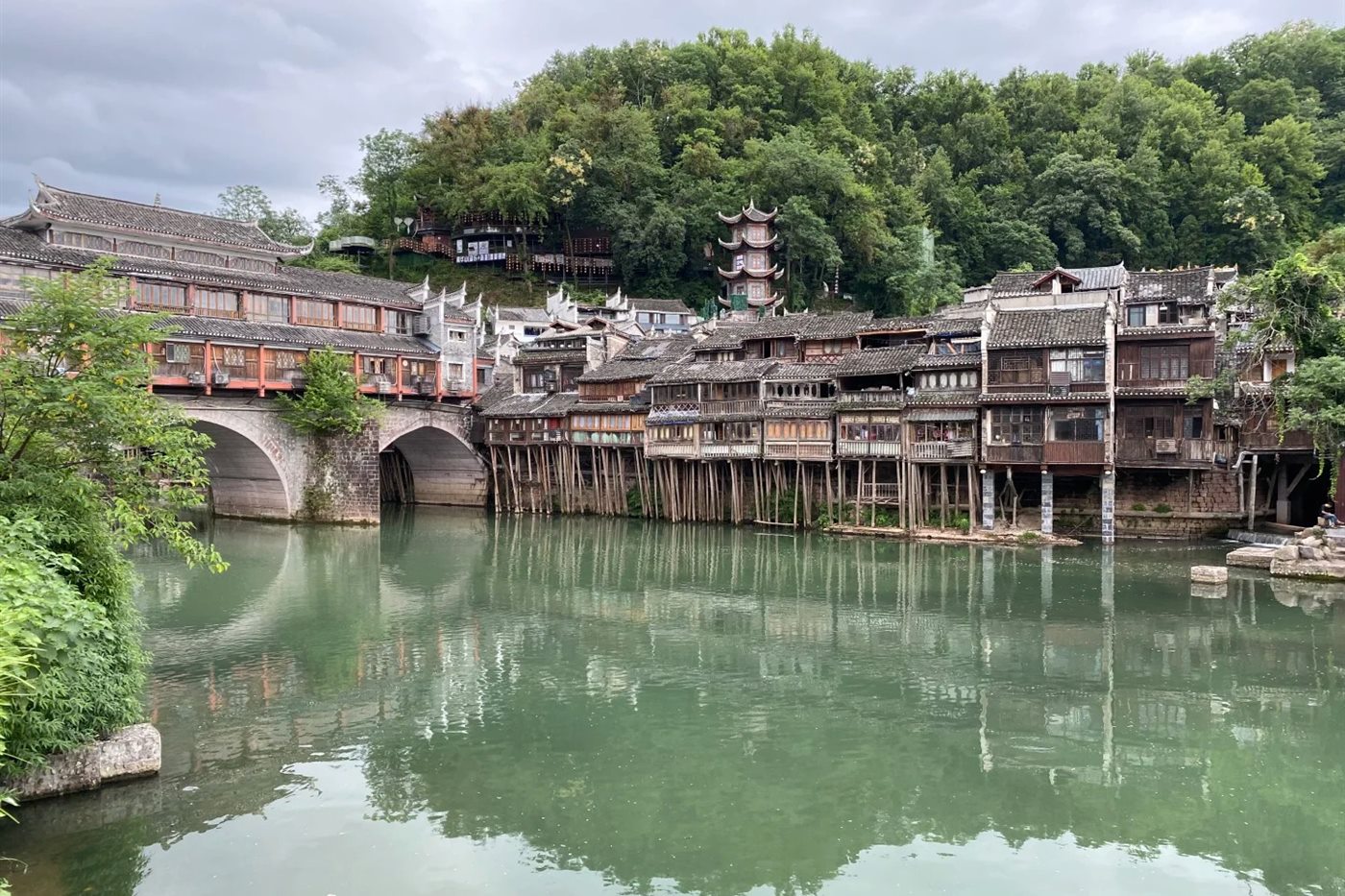
Its literary fame comes from Shen Congwen (沈从文), born here in 1902, whose writing fixed this river world — ferrymen, garrison soldiers, Miao villages — in the Chinese imagination. His courtyard birthplace in the lanes is the through-ticket’s anchor sight.
One correction worth making: English guides routinely call Fenghuang “the setting of Border Town”. It isn’t. Shen Congwen’s 《边城》 is set in Chadong (茶峒), a smaller river town at the Hunan–Guizhou– Chongqing tri-border about 100 km away — which renamed itself Biancheng (“Border Town”) in 2005 on the strength of it. Fenghuang is his hometown, and the wider Xiangxi world his books describe; that is a real connection, just not the one the brochures claim.
For a foreign visitor the practical shape of a visit: a free-to-wander river town that rewards an overnight — lanes and courtyard sights by day, the lantern-lit riverfront after ~19:30, and the misty, almost-empty river between about 6:30 and 8:00 in the morning.
And the lay of it is simple — the river is the axis, the town wraps its banks, and one loop walks it all:
The riverside loop — lanes out, riverfront back
Town entry free1–9 = the through-ticket sightsAmber river = the bar stretchThe nine sights on the ¥128 through-ticket
- Xiong Xiling Former Residence 熊希龄故居
Birthplace of the Republic’s first elected premier, in the north lanes. - Ancient Town Museum 古城博物馆
Three halls in one — the Chen Baozhen family mansion, the town museum and the Lei Yutian art hall. - Shen Congwen Former Residence 沈从文故居
The writer’s 1902 birthplace — a small Qing courtyard, the ticket’s anchor sight. - Chongde Hall 崇德堂Reported shut
An 1884 all-timber merchant’s house on Shijia Lane, built by a Jiangxi trader — but reported shut and derelict through 2026, with no official notice either way. - Yang Family Ancestral Hall 杨家祠堂
A clan hall of 1836 against the old wall, with an opera stage in the courtyard. - East Gate Tower 东门城楼
The best-preserved garrison gate (1715). Ticket to climb; free to walk beneath. - Hongqiao Art Gallery 虹桥艺楼
The upstairs gallery on the covered bridge (08:00–17:30). Crossing the bridge is free. - Wanshou Palace 万寿宫
The Jiangxi merchants’ guild hall at Shawan on the far bank, built in the Qianlong era. - Tuojiang boat ride 沱江泛舟
The daytime poled boat (08:00–18:00) from the North Gate pier. Night cruises are sold separately.
Sights open roughly 08:30–17:30, with ticket desks closing about 17:00 — the lanes themselves never close. Everything else on the map is free: every lane, the stepping stones, both bridges as crossings, the Wanming Pagoda, the riverfront and the night lights.
The town is free to enter — the loop is the sight. Walk out through the lanes past the courtyard sights (amber — these need the ¥128 nine-sight through-ticket), cross the river on Hongqiao Bridge (its deck is free; only the upstairs gallery is ticketed), follow the far bank past the Wanming Pagoda to the Feng Bridge, and come back along the stilt-house riverfront — recrossing on the famous stepping stones by the North Gate. The boat leg on the Tuojiang is covered by the through-ticket by day; night cruises are sold separately. Skip the ticket and the loop, the bridges, the stepping stones and the night lights still cost nothing.
The river tint is the where-to-sleep answer. The middle stretch — Nanhua Bridge to Hongqiao — is the core and the bar strip, and riverside rooms there are genuinely loud. Upstream of the Nanhua Bridge is quiet, cheaper, and the end the maglev and the Line 2 shuttle (to Nanhuali) arrive at — the Line 1 shuttle instead drops you mid-town at Qifeng Square, near Hongqiao. Downstream of Hongqiao toward Shawan is the quiet stretch with the views.
Free entry — and what the ¥128 ticket actually buys
The headline most first-timers miss: entering Fenghuang is free. The blanket gate-fee experiment is long over; today you can walk in from any side, wander every lane, cross Hongqiao and the stepping stones, and watch the night lights without paying a yuan. What is ticketed is a defined set of nine sights, sold as one ¥128 through-ticket valid three days, with concession rates for students and seniors.
Ignore the ¥148 figure. A great deal of guidance — English and Chinese alike — still quotes ¥148, or an “eight-sight” package at ¥148/¥188. Those are superseded: the current headline product is the ¥128 nine-sight ticket. Prices are reviewed periodically, so confirm at the window or on the scenic area’s own channel before you buy.
| What | Deal |
|---|---|
| The town itself — lanes, bridges, stepping stones, riverfront, night lights | Free, year-round, no gate |
| Nine-sight through-ticket — Shen Congwen & Xiong Xiling residences, the Ancient Town Museum (古城博物馆), Chongde Hall, Yang Family Hall, East Gate Tower, the Hongqiao gallery, Wanshou Palace + the daytime Tuojiang boat — all nine mapped above | ¥128 · valid 3 days · concessions for students & seniors |
| Chongde Hall (崇德堂) — nominally one of the nine | Reported shut — visitors through 2026 describe it closed and derelict, with no official notice either way. In practice the ticket buys eight sights plus the boat |
| How the through-ticket works — 3 days from purchase | One entry per sight, scanned and recorded at each gate — spread the nine over two or three days if you like, but you can’t re-enter one you’ve used. Sights open ~08:30–17:30; ticket desks stop about 17:00 |
| Individual sights — a single courtyard house if that’s all you want | Sold separately and cheap: travellers report about ¥20 for the Shen Congwen Residence, ¥10 for Xiong Xiling, and around ¥5 each for the smaller halls |
| Big combo ticket — the nine sights plus the Southern Great Wall & Qiliang Cave outside town | ~¥226 — only if you’re doing those day-trips anyway |
| Night cruise on the lit river (~19:00–22:00, boarding near Wanshou Palace) | Separate ticket (roughly ¥80–120 depending on boat and platform) — the daytime boat in the through-ticket does not cover it |
Should you buy it? The daytime boat is what the through-ticket is really for. Add up the individual prices and the arithmetic is blunt: the two big residences plus a few small halls come to something like ¥45–60 at the gate, so if you don’t want to be on the water, paying per sight beats the ¥128 ticket outright — and Chinese travellers who come back repeatedly say so plainly. Buy the through-ticket if you want the boat plus a proper courtyard morning; buy singles if two or three houses is all you’re after; buy nothing if you came for the riverside atmosphere, the crossings and the night view, because the free town already delivers most of Fenghuang. In practice most visitors get through three or four sights in a day alongside eating and wandering — the “all nine” run is a half-day-to-full-day project that few people actually finish. The map above shows exactly which stops are which — worth a look before you set off, because several of the ticketed courtyards are unassuming doorways wedged between shops and houses, and walking straight past one you paid for is the most common way to waste the ticket.
Book the through-ticket & Xiangxi toursNASDAQ: TCOM
Trip.com lists the Fenghuang sight ticket, night cruises and Zhangjiajie–Fenghuang day tours with transport — the simplest way to book any of it in English on a foreign card.
Night lights, boats — and the misty morning
Fenghuang’s best hours sit on either side of the night. The riverside lights come on around 19:30, with dusk — stilt houses, Hongqiao and the pagoda doubled in the black water. This is when the crowds peak, the bar strip around Hongqiao wakes up, and the night cruise (roughly 19:00–22:00, separate ticket, boarding near Wanshou Palace) poles through the reflections with costumed performers on the water. Walk the far-bank stretch between the Wanming Pagoda and the Feng Bridge for the widest lit panorama — it’s the loop’s quiet side even at peak hour.
Expectation check on the night view. Through 2026, returning visitors have consistently reported that the lighting is dimmer than it used to be — some bridges have lost their under-lighting entirely — and that the on-water show is now performers on bamboo rafts rather than the projection spectacle of a few years ago. It is still the best hour of the day here; it is not the hyper-saturated image that sells the town online.
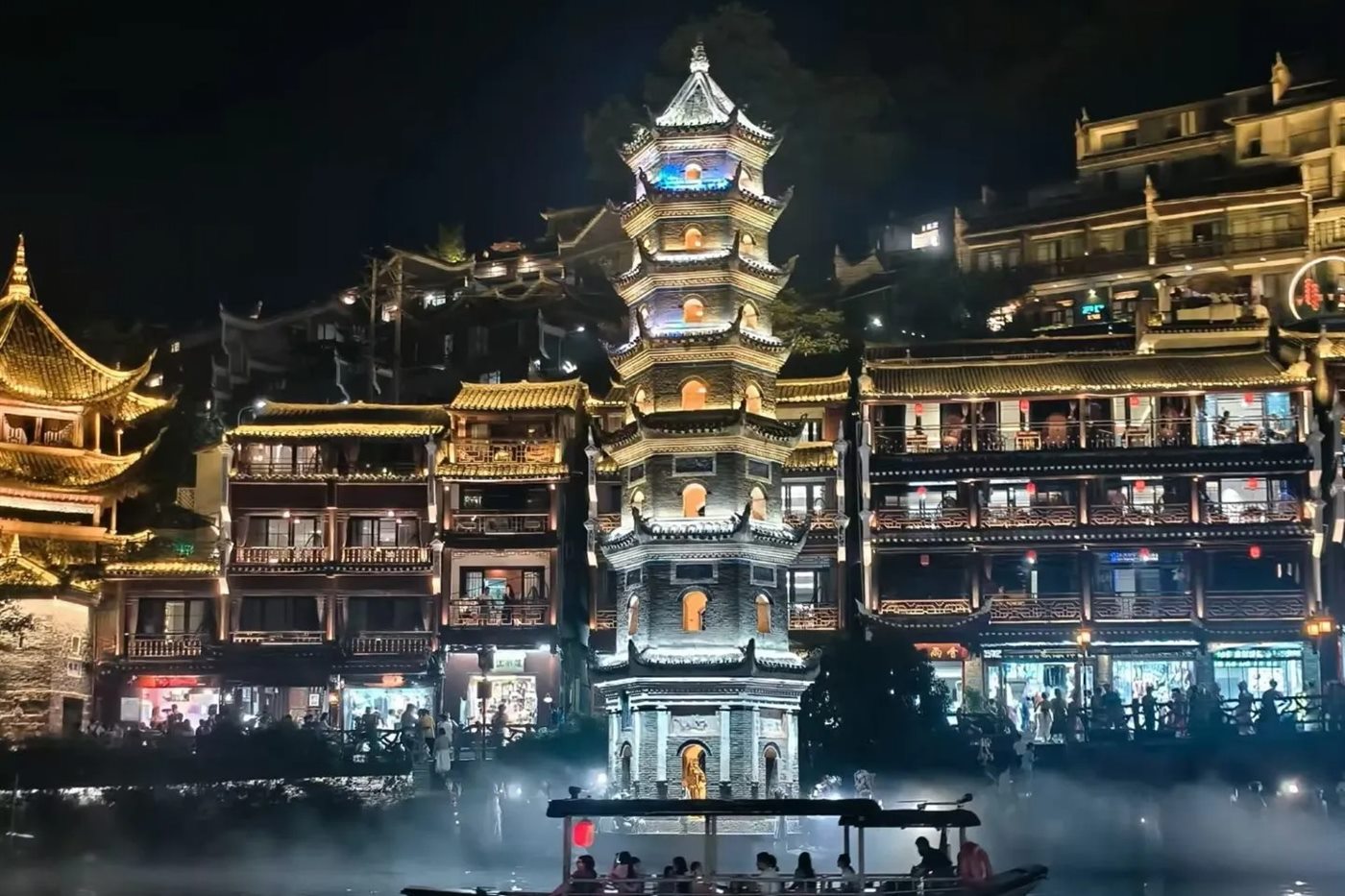
The other window is the one day-trippers never see: 6:30 to 8:00 in the morning, when river mist hangs over the water, the lanes are empty, and locals wash and fish along the banks below the stilt houses. Chinese travellers — photographers especially — consistently rate this above the lights, and it is the single strongest argument for sleeping here rather than day-tripping in. A third decent window is after about 22:30, once the crowds thin but before the bars go quiet at 23:30. The daytime Tuojiang boat (08:00–18:00, included in the through-ticket) is the water-level view; short and touristy, but the angle up at the stilt houses is one no bank path gives you.
What to see on the loop
Everything worth seeing strings onto the riverside loop in the map above — lanes out, riverfront back, crossing at Hongqiao and the stepping stones. The six that anchor it, in close-up:
The town’s centrepiece — a covered “wind-and-rain” bridge astride the Tuojiang. Crossing it is free; the art gallery upstairs (08:00–17:30) is a through-ticket sight. The views up and down the river from mid-bridge are the postcard.
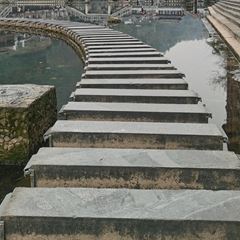
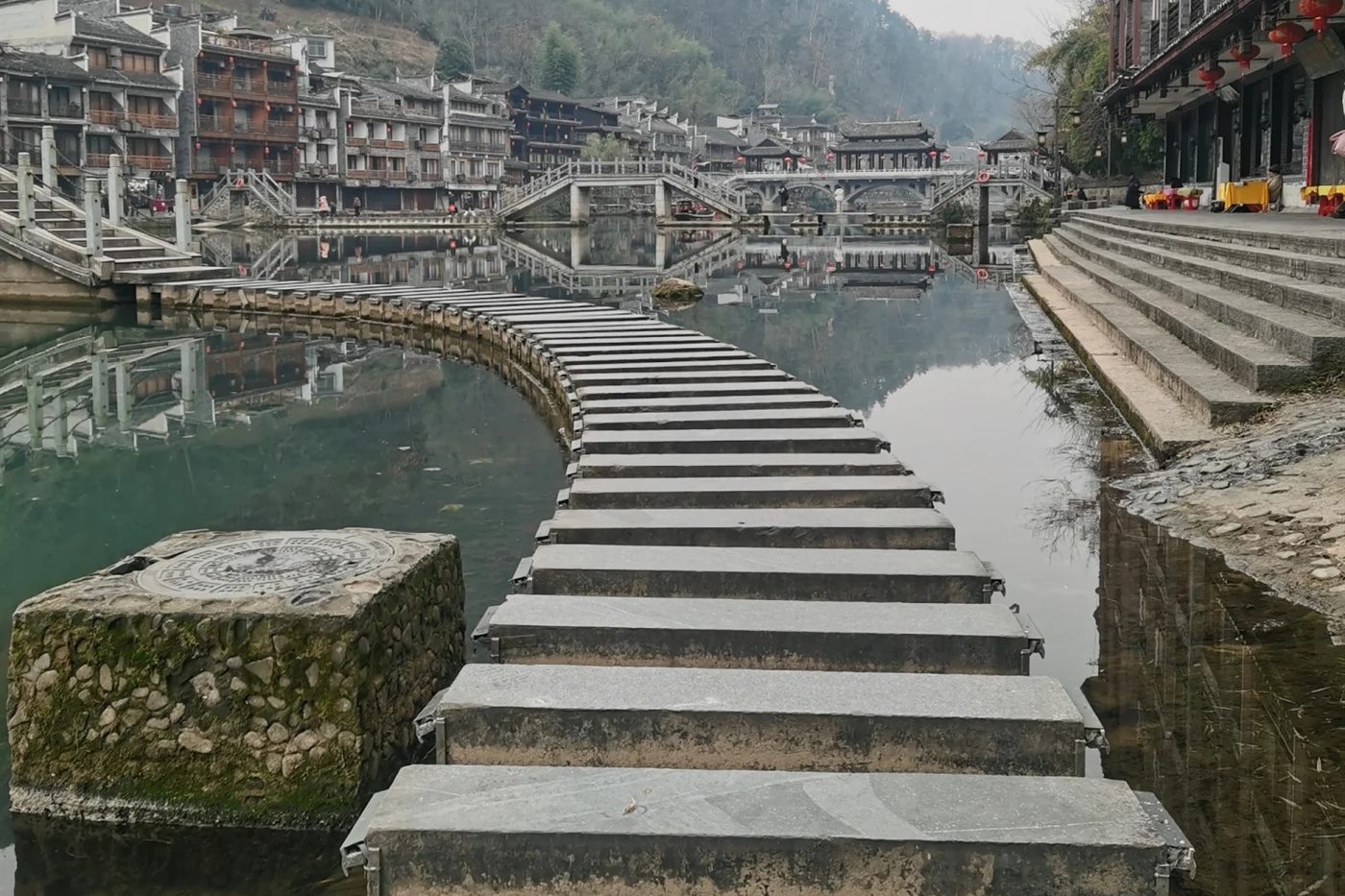
Two files of stone pillars crossing the river by the North Gate — Fenghuang’s most photographed crossing, in use since the town was a garrison. Cross early: by mid-morning it’s a queue, and after rain the river runs high over the stones.
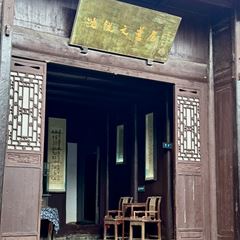
The 1902 birthplace of the writer who put this river world into modern Chinese literature — a modest Qing courtyard in the lanes with manuscripts and photographs. The literary heart of the through-ticket; his grave lies downstream by Ting Tao hill.
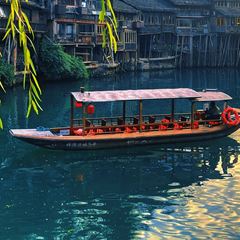
A poled wooden boat down the water under the stilt houses — the daytime ride (08:00–18:00) is included in the ¥128 ticket; the separate night cruise runs ~19:00–22:00 for the lit-up version. Short, touristy, and still worth it for the water-level view.
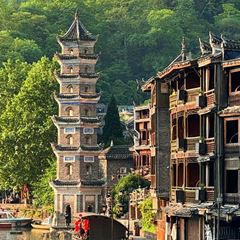
A slim hexagonal pagoda on the far bank downstream of Hongqiao — free to walk to, and one end of the classic reflected-in-the-river shot. The stretch between it and the Feng Bridge is the best stilt-house panorama on the loop.

The best-preserved of the old garrison gates (1715), a stone arch with a timber tower, steps from the river. Through-ticket to climb; free to walk beneath. Pair it with the Yang Family Ancestral Hall two lanes away.
Also on the through-ticket as you pass: the Xiong Xiling Residence (熊希龄故居 — a Republican-era premier’s birthplace in the north lanes), the Yang Family Ancestral Hall (杨家祠堂 — an 1836 clan hall with an opera stage), Wanshou Palace(万寿宫 — the Jiangxi merchants’ guild hall) on the far bank, plus Chongde Hall(崇德堂, an 1884 timber merchant’s house) and the Ancient Town Museum (古城博物馆). On the hill south of town, the Nanhuashan / Shenfeng culture park (09:00–21:00) is bundled into some ticket versions — check what your ticket lists when you book.
Where to stay — riverside view vs sleep
Fenghuang is an inn town — hundreds of guesthouses in and around the old lanes — and the whole decision compresses to view versus noise. Chinese guides split the riverfront into three stretches, using the Nanhua Bridge and Hongqiao as the dividers, and the three are genuinely different places to sleep. (This is a different question from where to base your Zhangjiajie nights — that one is Wulingyuan versus the city, and it is settled in the Zhangjiajie hotels guide. Most people sleep here for one night at the end of the trip, not instead of a park base.)
| Stretch | What it’s like | Who it suits |
|---|---|---|
| Upstream above the Nanhua Bridge | Quieter and cheaper than the middle; closest to the shuttle and maglev arrival side; some inns have parking | Families, anyone with an early train, light sleepers who still want to be in the old town |
| Mid-stream between Nanhua Bridge & Hongqiao | The core — and the bar strip, around Hongqiao and the south bank. River-facing rooms here are genuinely loud; the timber buildings barely muffle it | Night owls who want the lit river and the bars at the door |
| Downstream below Hongqiao toward Shawan | Quiet with a view; near the Wanming Pagoda and Wanshou Palace; mostly calmer bars and shops underneath | The best compromise for most people — river view, no 2am wake-up |
Four booking details travellers repeat, in rough order of how much they matter:
- Bar quiet-hours are 23:30 — but the crowd noise and stragglers run nearer 1am. Plan for the later number, not the posted one.
- Ask for double glazing, and a room on the 4th floor or higher. Both make a large difference in old timber buildings, and both are things you have to ask about specifically.
- If you do stay mid-stream, don’t take the river-facing room. A courtyard or back-lane room in the same inn is quieter and usually cheaper.
- Ask whether the inn collects luggage. The lanes are stone and steps — dragging a suitcase in is the most-regretted 20 minutes of the trip. Many inns will meet you or send someone.
Peak seasons (May Day, summer weekends, the October 1–7 holiday) sell out the view rooms days ahead and multiply prices — book early, and book on an international platform so the reservation, and any dispute, is in English.
Inns on the stretch you actually wantNASDAQ: TCOM
Upstream, mid-stream and downstream are three different nights at similar prices. Sort by the map rather than the photographs — a river-facing room in the middle stretch is the loud one, and the listing almost never says so.
What to eat
The dish is blood-cake duck (血粑鸭) — duck braised with cakes of duck’s blood and sticky rice, chilli-forward in the Xiangxi way; most old-town restaurants serve it. The snack is ginger candy (姜糖), worked by hand in shopfronts all over the lanes from ginger, brown sugar and sesame. You will see it made two ways: pulled into strips like taffy, or pounded with a wooden mallet into the crumbly version sold as 姜酥. Either way, buy it where you can watch it being made, and buy it warm. Around those two: Miao sour-soup fish and the sour-spicy register generally, cypress-smoked cured pork (腊肉), and local tofu dishes.

Where NOT to eat: the main-drag restaurants with staff calling you in, and anywhere a tout leads you (commissions inflate the bill). Walk a lane or two off the river and eat where the queue is local.
Getting there — the 张吉怀 line and the maglev
Fenghuang has its own high-speed station, Fenghuang Gucheng (凤凰古城站), on the Zhangjiajie–Jishou–Huaihua (张吉怀) line opened in December 2021 — the same line as Furong Ancient Town, which is what makes the Zhangjiajie → Furong → Fenghuang chain so clean. The station sits ~7.5 km north of the old town.
| From | How | Time · fare |
|---|---|---|
| Zhangjiajie West (张家界西) | HSR direct, ~23 trains/day | 51–66 min · 2nd class ~¥84 |
| Furong Town (芙蓉镇) | HSR direct, ~14/day | 27–40 min · ~¥53 |
| Changsha South (长沙南) | HSR direct, ~11/day | ~2–2.5 h · ~¥198 |
| Station → old town (~7.5 km) | Scenic shuttle ¥7 · taxi ~¥25–30 · maglev | ~15–30 min door to door |
That last 7.5 km is the bit nobody plans for, so here are the three ways in, ranked by what you’re carrying:
| Option | Cost & hours | The catch |
|---|---|---|
| Official scenic shuttle — Line 1 → Qifeng Square (奇峰广场, near Hongqiao), Line 2 → Nanhuali (南华里, near the Nanhua Gate side) | ¥7 per person · roughly 07:00–22:00 · about every 30 min | Follow the scenic-area shuttle signs and use the official counter; ignore anyone selling “group circuit” minibus seats. At peak times a service may run only to the terminus. |
| Taxi from the station’s underground rank | ~¥25–30 · about 15 min · any hour | Nothing much — this is the right answer with luggage, and splits to a few yuan each between three or four people. |
| Maglev — alight at Fenghuang Lansheng (凤凰揽胜), ~5 min walk down to the upstream end of town | ~¥28 single (passes sold) · roughly 08:45–21:30, ~15 min at peak | Novelty ride, not a luggage solution: no racks in the carriages and a roundabout walk from the platform. Times vary by source — check at the station. |
- Book trains in English on Trip.com, or at the station with your passport; fares above are live 12306 samples (July 2026) — check your date.
- Doing it as a day trip? There is free left-luggage at the Nanhuali visitor centre (open to about 21:30) — drop the bags there and walk in light.
- Inside the old town it is walking only — stone lanes and steps, and ride-hailing barely operates in the core. Pack accordingly.
- Coming from Zhangjiajie parks: allow ~40 min from Wulingyuan to Zhangjiajie West station first; the whole park-to-Fenghuang move is a comfortable half day.
- Intercity buses from Jishou and elsewhere still run to the Fenghuang bus station — the pre-HSR route, now mainly useful if train slots sell out.
See the Zhangjiajie itinerary guide for how the Fenghuang night fits a 4–6 day Xiangxi run.
Fenghuang vs Furong — and doing both
The two Xiangxi old towns sit 27–40 minutes apart on the same line and are different enough to justify both — the honest comparison:
| Fenghuang | Furong | |
|---|---|---|
| The draw | The Tuojiang riverfront, stilt houses, Border Town, Miao culture | A 60 m waterfall pouring through a Tujia town; the night-lit falls |
| Entry | Free — ¥128 only for the nine sights | Ticketed — ~¥108 to enter at all |
| Size / feel | Bigger, livelier, more commercial; 1–2 nights | Small and waterfall-centred; half a day + 1 night |
| Season risk | Low — the river always flows | High — the waterfall shrinks to a trickle in dry winter |
The classic pattern: Day 1 Zhangjiajie → Furong (waterfall by day, lights at dusk, overnight); Day 2 the quiet Furong morning, then the 27–40 min hop to Fenghuang for the riverfront evening; Day 3 misty Fenghuang morning, then out — Changsha South is ~2–2.5 h direct. One-way, no backtracking. Full detail on the Furong side: Furong Ancient Town guide.
Practical for foreigners
- Ignore the touts at the stations. Freelance “helpers” at the HSR and bus stations steer you to commission-paying inns and tours. Book your room ahead, and walk to it yourself — the old town is compact.
- The cheap Miao-village day tour is the town’s classic trap. Bundles pitched on the street, at the stations, or even at an inn’s front desk (“our private guide” is often the same agency) sell below cost and make their money in the shop stop: silver, cinnabar and “Miao medicine” sold with a hard pitch, a promised village feast that turns into a canteen lunch, and pressure on anyone who doesn’t buy. If you want a village, book a reviewed tour on a real platform.
- Costume photo shoots: the “all-in for ¥199” boards on the street are the production-line end of the business — tired outfits, rushed makeup, add-ons at the end. Look at a studio’s actual client photos and agree what’s included before you pay, or rent an outfit and shoot it yourself.
- Boat touts on the bank are not the scenic-area service. People working the riverside with “¥50 and I’ll take you out” are private operators — the price is invented on the spot and the boat is outside the licensed operation. The daytime ride included in your ticket boards at the North Gate pier; the night cruise has its own official boarding point.
- Bar quiet-hours are 23:30, and the streets really settle around 1am. Plan your room location accordingly (see Where to stay).
- Buy souvenirs with your eyes open: street “handmade” silver is mostly wholesale stock at a marked-up price, and ginger candy is cheaper by the bag off the main drag. Don’t buy anything unpriced, and ask the total before it’s weighed.
- Driving? Don’t drive in. On holidays the core is closed to private cars in the evening — you park in an outer lot and shuttle in, and the exit queues are their own ordeal.
- Rain moves the river fast: after heavy rain the stepping stones can run awash and boats pause — build in slack if crossings and cruises matter to your plan.
- Cash-light travel: set up Alipay or WeChat Pay with an international card before arriving — lane stalls and candy shops are effectively cashless.
Frequently asked questions
Is Fenghuang Ancient Town free to enter? Do I need the ¥128 ticket?
Entering the town itself is free, year-round — the old blanket entry fee is gone, and you can wander the lanes, cross every bridge and the stepping stones, and see the night lights without paying anything. The ¥128 'nine-sight' through-ticket (3-day validity) only matters if you want to go inside the ticketed courtyard sights — the Shen Congwen and Xiong Xiling former residences, the Ancient Town Museum (古城博物馆 — the Chen Baozhen mansion, the town museum and the Lei Yutian art hall in one), Chongde Hall, the Yang Family Ancestral Hall, the East Gate Tower, the gallery upstairs on Hongqiao Bridge and Wanshou Palace — plus the daytime Tuojiang boat ride. All nine are numbered on the map in this guide. Note that a lot of older guidance (English and Chinese) still quotes ¥148 or an 'eight-sight' package: those are stale. Concession rates exist for students and seniors — ask at the window. Two things worth knowing before you buy. First, the sights are also sold individually and cheaply — travellers report about ¥20 for the Shen Congwen Residence, ¥10 for Xiong Xiling and roughly ¥5 each for the smaller halls — so if you don't want the boat, paying per sight is cheaper than the through-ticket. Second, Chongde Hall has been reported closed and derelict through 2026 with no official notice, so in practice the ticket covers eight sights plus the boat. The through-ticket is valid three days but allows one entry per sight, scanned at each gate; sights open around 08:30–17:30 and stop selling tickets about 17:00. Honest take from Chinese travellers who go repeatedly: if you mainly came for the riverside atmosphere, the crossings and the night view, you genuinely do not need it — the free loop is most of Fenghuang. Buy it if the daytime boat and the courtyard interiors are what you came for.
How do I get to Fenghuang Ancient Town from Zhangjiajie?
By high-speed rail on the Zhangjiajie–Jishou–Huaihua (张吉怀) line: trains run from Zhangjiajie West to Fenghuang Gucheng station (凤凰古城站) in 51–66 minutes, about 23 direct trains a day, second class around ¥84 (live 12306 sample, July 2026). The station is about 7.5 km north of the old town, and you have three ways in. The cheapest is the official scenic shuttle: ¥7 a head, roughly every 30 minutes from about 07:00 to 22:00, with Line 1 running to Qifeng Square (奇峰广场, close to Hongqiao) and Line 2 to Nanhuali (南华里, close to the Nanhua Gate side) — follow the 'scenic area shuttle' signs out of the station and use the official counter, not the people touting 'group circuit' minibuses. The most comfortable with luggage is a taxi from the station's underground rank: about ~¥25–30 and 15 minutes straight to a town gate, which splits to a few yuan a head between three or four people. The most fun is the maglev (see below). If you are coming via Furong Ancient Town, the hop onward to Fenghuang is just 27–40 minutes (~¥53). Book trains in English on Trip.com, or at the station with your passport.
What is the Fenghuang maglev, and is it worth taking?
Fenghuang has a short maglev line — opened in August 2022 as China's first maglev built for a tourist town — running about 9 km from beside the high-speed-rail station toward the old town, with 4 stops. A single ride is about ¥28, with return and multi-day passes also sold; travellers report roughly 08:45 to 21:30 running hours and about 15 minutes between trains at peak, but published figures vary, so check the times at the station. Get off at Fenghuang Lansheng (凤凰揽胜) — there is a viewing platform there and it is about a 5-minute walk down to the upstream end of the old town. Two honest caveats from recent riders: the walk from the platform to the scenic-area entrance is a roundabout one (escalators and lifts exist, but it is unpleasant with a big suitcase), and the carriages have no luggage racks. Take it as an experience or if you're travelling light; with luggage or after the last train, take the taxi.
Is the Fenghuang night view worth staying overnight for?
Yes — but manage expectations on both ends. The riverside lights come on around 19:30 with dusk and turn the stilt houses, Hongqiao Bridge and the pagoda into the classic reflected-in-the-Tuojiang scene, and the night cruise (branded 湘见·沱江夜游, boarding near Wanshou Palace, roughly 19:00–22:00, sold separately from the daytime through-ticket boat) puts you at water level among the reflections. The caveat, reported repeatedly through 2026: the lighting has been scaled back compared with a few years ago — some bridges are noticeably dimmer than the photos that made the town famous, and the on-water performance is now performers on bamboo rafts rather than the old projection effects. The other, quieter reward for staying is the early morning: between about 6:30 and 8:00 the day-trip crowds haven't arrived, river mist hangs over the water and locals wash and fish along the banks. Chinese travellers consistently rate that misty window above the night lights — a one-night stay gets you both, and the third good hour is after about 22:30 when the crowds thin.
Fenghuang or Furong Ancient Town — which should I visit?
Do both if you can — they sit on the same 张吉怀 high-speed line, 27–40 minutes apart, and are genuinely different. Fenghuang is the bigger, more famous one: free to enter, built along the Tuojiang River with lantern-lit stilt houses, the hometown of the writer Shen Congwen, with Miao and Tujia culture — and correspondingly more commercial and more crowded. Furong is smaller and ticketed (~¥108), and its whole identity is the waterfall pouring through the middle of town — quieter, half a day plus a night. Chinese travellers often note Furong feels cleaner and less hassled. The classic one-way run is Zhangjiajie → Furong (1 night) → Fenghuang (1 night), then out via Huaihua or back to Changsha — no backtracking.
How long do I need in Fenghuang?
One night is the sweet spot for most visitors: arrive early afternoon, walk the loop and the ticketed sights before closing time, have dinner, see the lit riverfront at night, and catch the misty early morning before moving on. A rushed no-overnight day trip misses the two best windows — the night lights and the 6:30–8:00 am calm. Two nights only if you want a genuinely slow pace, a Miao-village day trip (choose carefully — see the scams section), or a photography-heavy visit. The town core is compact; it is the atmosphere, not the checklist, that takes time.
Where should I stay in Fenghuang — riverside or in the lanes?
Chinese guides split the riverfront into three stretches using the Nanhua Bridge and Hongqiao Bridge as the dividers, and the choice is really about noise versus view. The middle stretch (between the two bridges) is the core — and it is also where the bars are, on and around Hongqiao and the south bank; riverside rooms there are genuinely loud, and the old timber buildings have poor sound insulation. The upstream stretch (above the Nanhua Bridge) is quieter and cheaper and closest to the shuttle and maglev arrival side, which suits early departures and families. The downstream stretch (below Hongqiao, toward the Shawan area) is the quiet one with a view, near the Wanming Pagoda and Wanshou Palace. Practical tips travellers repeat: bar quiet-hours are 23:30 but the crowd noise really settles nearer 1am; ask specifically for double-glazing and a room on the 4th floor or above; if you do stay mid-stream, take a courtyard or back-lane room rather than a river-facing one; and ask whether the inn will collect your luggage — the lanes are stone steps and dragging a suitcase in is miserable. In peak season (May Day, summer weekends, the October holiday) view rooms sell out early and prices multiply.
What food is Fenghuang known for?
The signature dish is blood-cake duck (血粑鸭): duck braised with cakes of duck's-blood-and-sticky-rice, chilli-forward in the Xiangxi style. The signature snack is ginger candy (姜糖), hand-pulled in shopfronts from ginger, brown sugar and sesame — watch it being stretched, buy it warm. Beyond those, this is Miao and Tujia mountain cooking: sour-soup fish, cypress-smoked cured pork (腊肉), stone-pot fish, glutinous rice cakes and beef noodles. Where you buy matters more than what: on the main riverside drag, ginger candy runs about ¥25 a bag and is often factory stock, while the small workshops in the back lanes (Dongzheng Street and Wenxing Street are the two named repeatedly) sell hand-pulled candy at roughly ¥10–15 and let you watch. For blood-cake duck, the advice is to walk away from the river — the residential blocks near the Nanhua Gate are where people eat for about ¥30–60 a head. Avoid: restaurants with staff calling you in, stalls that don't display prices, anything sold by weight without a quoted total, and 'free tasting' counters that turn into a hard sell.
Is Fenghuang too touristy? Honest answer.
It is heavily touristed, and Chinese travellers are blunt about it: the most common regret is not the price but the mismatch with the photos. Expect costume-photography touts on nearly every corner asking if you want a shoot, a bar strip through the middle of the riverfront, and — the one nobody warns you about — a Tuojiang that in daylight often runs yellowish rather than the jade green of the promotional images. The lighting has also been scaled back from its peak years. Three honest counterpoints. First, timing changes everything: 6:30–8:00 in the morning, or after about 22:30, the town is a different and much better place. Second, the setting itself — stilt houses stacked over a river between hills, with the stepping stones and covered bridges — is genuine and survives the commerce. Third, most of what's good is free, so the downside risk is your time, not your money. Go with calibrated expectations and the right hours and it earns its reputation; go at midday in a holiday week expecting an undiscovered village and you will be disappointed.
Sources
Checked July 2026 · Written from our own first-hand travel in China.
Corrected since publication: An earlier version repeated the common claim that Border Town is set in Fenghuang. The novel is set in Chadong; Fenghuang is Shen Congwen's birthplace.