Key takeaways
- Furong Ancient Town (王村, Wangcun) is a 2,000-year-old Tujia town where a 60 m waterfall runs straight through the middle; it was renamed after the 1986 film 《芙蓉镇》.
- It’s a ticketed town: ~¥108 (valid 3 days), covering the waterfall, the Tusi Palace, the Baishou Hall and the evening folk show — online often ~¥60–90. Not a free old town.
- The waterfall is seasonal: huge in the wet season (Jun–Sep), a trickle in dry winter — most “not worth ¥108” reviews are off-season visits.
- It’s ~23 min by high-speed train from Zhangjiajie West on the 张吉怀 line; the station is ~2.5 km from town. The same line runs on to Fenghuang.
- Stay overnight. Lights come on ~18:30 and the lit town is the payoff; the 7–9am window has the fewest crowds.
What Furong Ancient Town is
Furong Ancient Town (芙蓉镇) sits on the Youshui River in Yongshun County, in the Tujia-and-Miao hill country of western Hunan known as Xiangxi. Its defining feature is simple and rare: a 60-metre waterfall pours straight through the middle of the town, with the old wooden stilt houses (吊脚楼) clinging to the cliffs on either side of it. That is why it is nicknamed “the thousand-year town that hangs on a waterfall”.
The town is genuinely old — over two thousand years, a river port the old texts called a “gateway between Chu and Shu” — but its modern fame comes from a film. It was called Wangcun (王村) until 2007, when it was officially renamed Furong after Xie Jin’s 1986 movie 《芙蓉镇》 (Hibiscus Town), starring Liu Xiaoqing and Jiang Wen, which was shot here. Liu Xiaoqing’s character ran a rice-tofu (米豆腐) stall — which is exactly why a bowl of 米豆腐 is the town’s signature snack today. For a foreign visitor the practical shape of a trip is: a compact, photogenic river town, an afternoon of Tujia sights and a waterfall, and a night of lantern-lit streets — reached in about 23 minutes by high-speed train from Zhangjiajie.
And the lay of it is simple — in at the east-end gate, one gently downhill walk through every sight, out at the river dock:
The lay of the town — one walk, gate to dock
Mostly downhillNo doubling backIn at the east end, out at the river. The gate and ticket office sit by the visitor centre at the town’s east end; the walk climbs briefly to the cliff-top Tusi Palace, then runs gently downhill — over the covered Tuwang Bridge, down the stone-slab street, past the waterfall and across the stepping stones — to the Wangcun dock at the south-west corner. No doubling back; half a day covers it at sightseeing pace, and optional boat rides run from the dock on the Youshui River (roughly 8:30–19:00).
Tickets — ¥108, and what it covers
Unlike a free old town such as Chongqing’s Ciqikou, Furong is a ticketed scenic area — you need the ticket to enter the town itself. The gate price is ¥108 per person, valid for 3 days (some older listings still say ¥100; the current price is ¥108). Online travel platforms routinely discount it to around ¥60–90, and it is worth booking ahead — foreign visitors can reserve it, and a bilingual day tour, through international booking sites in English. Children under 1.4 m / 14, seniors 65+, people with disabilities and active military enter free.
| The ¥108 ticket covers | What it is |
|---|---|
| The waterfall & water-curtain walk | The 60 m falls and the walkway carved into the cliff behind the cascade — the centrepiece (best in the wet season; see below). |
| Tusi (chieftain) Palace 土王行宫 | The cliff-top summer palace of the old local chieftains — a Tujia stilt-house complex with big views, and a filming location for the 1986 movie. |
| Baishou Hall + folk show 摆手堂 | The Tujia ceremonial hall and stage; the evening “Hua Kai Furong” folk performance (around 21:00) is usually included. |
| Xizhou Bronze Pillar 溪州铜柱 | A national-treasure relic — a bronze pillar cast in 940 AD recording a treaty between the Chu king and the local chieftain. |
| The old town | The 5-li (~1,200 m) stone-slab street, the stilt houses, the covered Tuwang Bridge and the Wangcun river dock. |
Book the ticket & a Xiangxi day tourNASDAQ: TCOM
Trip.com lists Furong Ancient Town entry tickets and Xiangxi day tours with transport and a bilingual guide — the simplest way to handle the ticket and the transfer in English on a foreign card.
The waterfall — and why the season decides everything
The waterfall is the whole reason Furong exists as a destination, and its volume changes completely with the season — this is the single most important thing to get right. In the wet season (roughly June to September), the 60-metre double drop is thunderous, throwing spray across the town, and you can walk the “water-curtain” walkway (水帘洞栈道) carved into the cliff behind the falls — cool, loud and genuinely memorable. In the dry winter, the same waterfall can shrink to a thin trickle, and this is where almost all the “underwhelming, not worth ¥108” reviews come from.
| Season | The waterfall |
|---|---|
| Wet — Jun to Sep | ⭐ Full volume, dramatic, spray across the town; the water-curtain walk is open and worth it. The season to come for the falls. |
| Spring / autumn — Apr–May, Oct | Moderate flow, green and pleasant; a fair compromise if summer doesn’t suit. (Avoid the Oct 1–7 Golden Week crush.) |
| Dry winter — Dec–Feb | Can drop to a trickle. Come for the town, the culture and the night lights — not for the waterfall. |
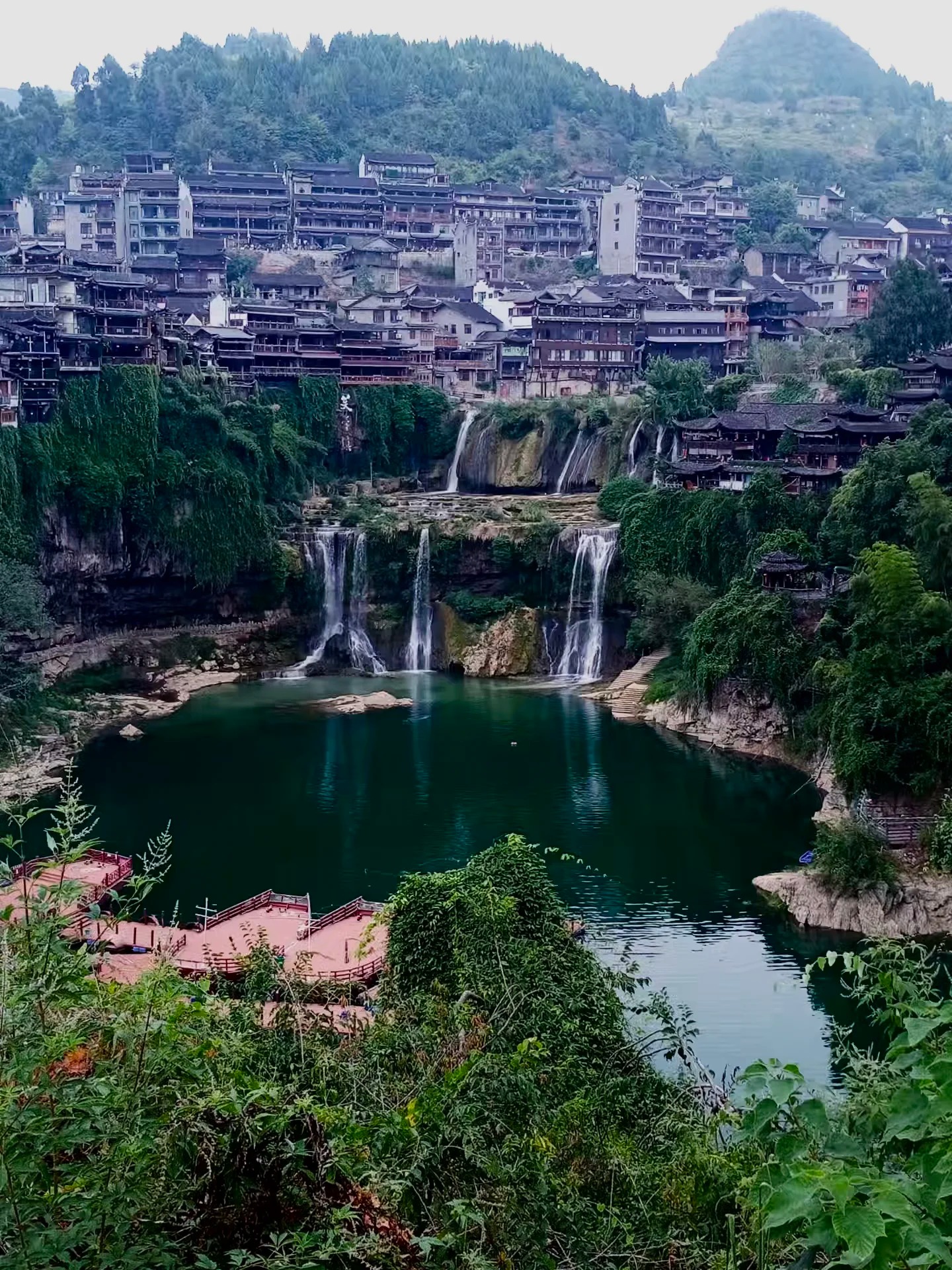
For the water-curtain walk, bring a waterproof phone pouch and wear grippy shoes — the stone under the falls stays wet and slick. The best full-frame views of the waterfall with the town are from the 观瀑台 viewing platform and from the Tuwang Bridge (土王桥), both of which are even better after dark (next section).
The night view — and why you should stay over
Furong is officially a national-level night-tourism zone, and for most visitors the evening is the best part of the trip. The lights come on around 18:30 (a little earlier in summer, later in winter), and the ~30 minutes of “blue hour” that follow— warm lantern light washing over the waterfall and the stilt houses while the sky is still deep blue — is the photo everyone comes home with. The best vantage points are the same two: the 观瀑台 viewing platform and the red-lantern-hung Tuwang Bridge.
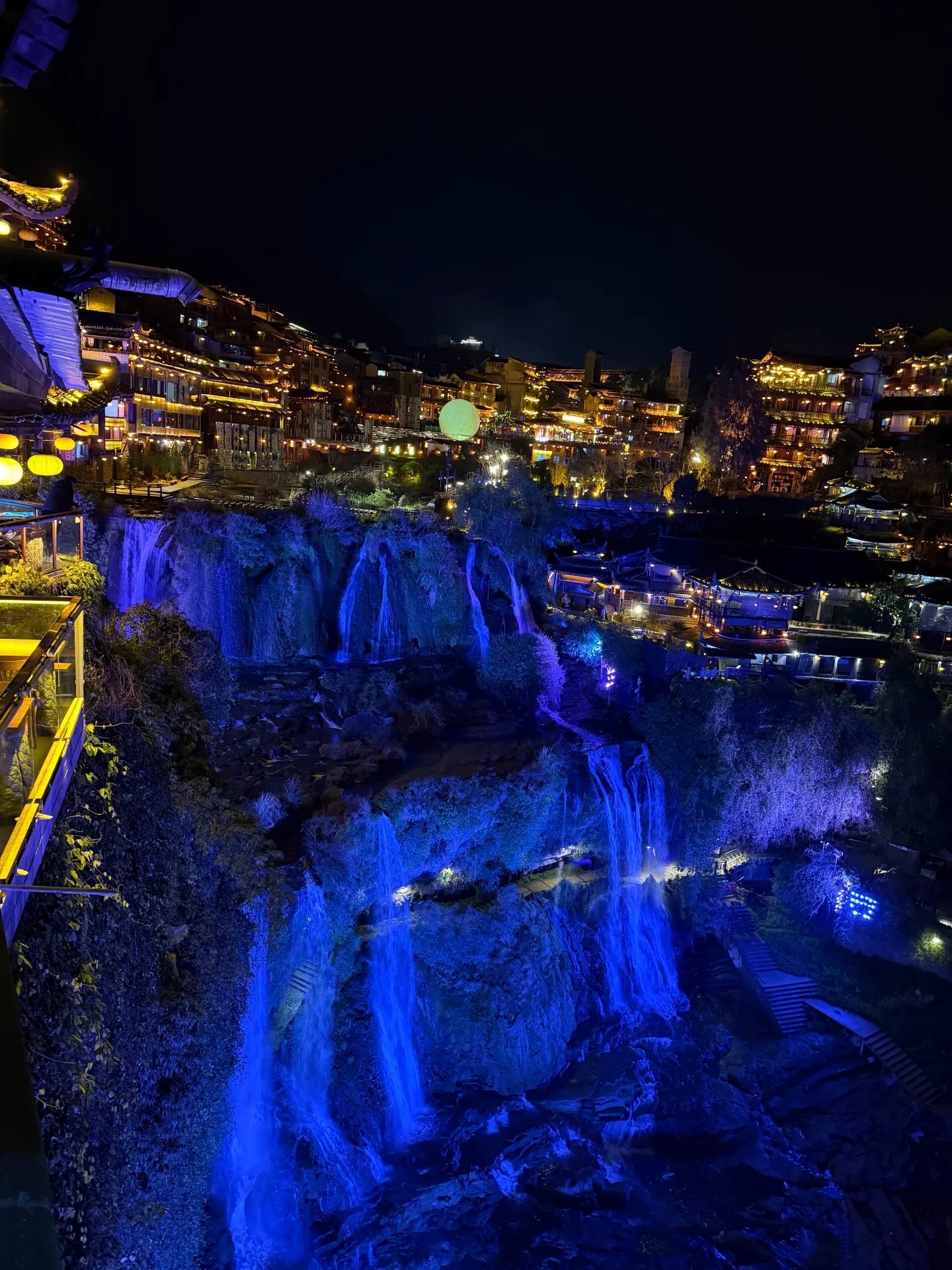
This is why we’d stay one night rather than day-trip. An overnight gets you the waterfall by day, the lit town at dusk and after dark, the evening folk show, and — best of all — the quiet before ~9am, when the day-trippers arriving by train from Zhangjiajie haven’t turned up yet and you have the stone streets and the misty river almost to yourself. On where to sleep:
- Inside the scenic area, with a waterfall/river view — the atmospheric (and priciest) choice; you step out into the lit town at night. Book a room that actually faces the water.
- Just outside the gate, in the newer town / walking street — much cheaper guesthouses (a fraction of the in-town rate), a short walk from the entrance; the sensible budget pick. Your 3-day ticket lets you come and go.
Worth being clear that this is a one-night decision, not a base: Furong is a stop on the way out, 23 minutes down the line from Zhangjiajie West. Where you sleep for the park itself is a separate and bigger call — Wulingyuan versus Zhangjiajie city, which decides which park gate you wake up next to.
Rooms that face the water — and the cheaper ones that don’tNASDAQ: TCOM
Read the room description, not the hotel name — inside the scenic area the thing to confirm is that the room actually faces the water. The rooms outside it are the cheaper half of the same choice, and your three-day ticket still walks you back in.
What to see inside the town
Furong is compact and linear — as the walk map in the first section shows, every sight strings onto one gently downhill walk from the east-end gate to the river dock, with a short climb up to the cliff-top Tusi Palace early on and no doubling back. The four essentials along that walk, in close-up:
The ~1,200 m main old street and the spine of the town — worn flagstones, stilt-house shops, snack stalls and lantern-strung lanes climbing away from the river. Walk it end to end; it’s where the town’s daily life happens.
The centrepiece — the 60 m falls tumbling through the town, and the walkway carved into the cliff behind the cascade (open in the wet season; bring a waterproof phone pouch). Best light-and-town views from the 观瀑台 platform, day or after dark.
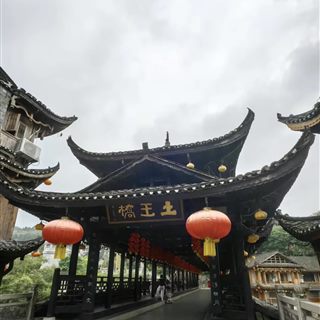
A covered “wind-and-rain” bridge built without a single nail, hung with red lanterns — the town’s best photo spot, and even better at dusk when the lanterns light up. It links the old town to the Tusi Palace side.
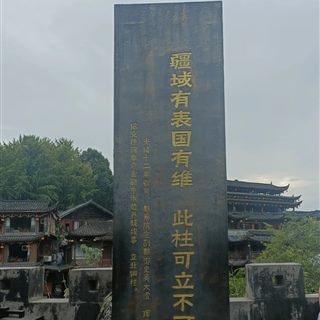
A national-treasure relic — the bronze pillar recording a 940 AD treaty between the Chu king and the local Tujia chieftain, inscribed “this pillar may stand but must not be moved”. One for history buffs; a quiet corner off the main street.
Also covered by the ticket and worth a look as you pass: the cliff-top Tusi Palace (土王行宫), a 1986-film location with big gorge views; the Baishou Hall (摆手堂), the Tujia ceremonial hall that stages the evening folk show; and the stepping stones (跳岩) and old Wangcun dock (王村码头) — quiet, photogenic corners off the main street.
What to eat
The dish to try is rice tofu (米豆腐, mǐ dòufu) — a soft, savoury rice-jelly served cold in a sour-and-spicy sauce, and the town’s claim to fame thanks to the 1986 film. The best-known shop is the Liu Xiaoqing rice-tofu shop at No. 113 (a bowl runs about ¥5–10); note that copycat shops trade on the name, so look for the actual house number. Beyond that, this is hearty Xiangxi Tujia mountain food: smoke-cured pork (腊肉), wild pine mushrooms (枞菌), pounded glutinous-rice cakes (蒿草粑粑, ~¥3), local sweet rice wine (甜酒), and blood-rice duck (血粑鸭).

Where NOT to eat: the restaurants right on the cliff edge and the ones with staff calling you in from the door are, by common consensus, overpriced and ordinary. Walk a little deeper into the town — or out into the newer town by the gate — and eat where locals are queuing.
Getting there — the 23-minute train from Zhangjiajie
The easy way in is the high-speed train. Furong has its own station, Furong Town station (芙蓉镇站), on the Zhangjiajie–Jishou–Huaihua (张吉怀) line that opened in December 2021 — locals describe it as “the high-speed railway that runs right into the scenic area”.
| From | How | Time |
|---|---|---|
| Zhangjiajie West (张家界西) | High-speed train to Furong Town station | ~20–23 min |
| Changsha (long-haul) | HSR via Zhangjiajie West, or via Huaihua onto the 张吉怀 line | ~3–4 h |
| Zhangjiajie / Jishou (by bus) | Intercity coach — the fallback if train times don’t suit | ~1.5–2 h |
| Furong Town station → the old town | Scenic shuttle bus (~¥3) or taxi from the forecourt | ~10 min (2.5 km) |
- Book the train in English on Trip.com, or at the station with your passport (the station machines and staffed windows both take passports).
- From the station, follow signs to the scenic-area shuttle bus in the forecourt, or take a taxi — it’s only about 2.5 km to the old-town gate.
- Times are estimates from published rail data; check live schedules and fares on Trip.com or 12306 for your date.
See the Zhangjiajie itinerary guide for how a Furong night slots into a wider Xiangxi trip.
On to Fenghuang — the one-way Xiangxi chain
The smartest way to fit Furong into a trip is not as a there-and-back day trip from Zhangjiajie, but as one stop on a one-way westbound run: Zhangjiajie → Furong → Fenghuang — all on the same 张吉怀 high-speed line, so you never double back. Furong Town station to Fenghuang Ancient Town station (凤凰古城站) is about 27–40 minutes;from there the ¥7 scenic shuttle, a ~¥25–30 taxi or the local maglev covers the ~7.5 km into Fenghuang. The full day-by-day shape of the chain is in our Zhangjiajie itinerary.
| Furong Ancient Town | Fenghuang Ancient Town | |
|---|---|---|
| The draw | A waterfall running through a Tujia town; night lights | The Tuojiang riverfront & stilt houses; Miao culture, Shen Congwen’s hometown |
| Entry | Ticketed, ~¥108 (3-day) | Free to enter (only some small sites are ticketed) |
| Size / pace | Small — half a day + overnight | Bigger, more commercial — 1–2 days |
| How long | 1 night | 1–2 nights |
A clean three-day version: Day 1 train from Zhangjiajie to Furong, afternoon town + waterfall, dusk lights, overnight Furong; Day 2 quiet early morning, train on to Fenghuang, riverfront afternoon and night, overnight Fenghuang; Day 3 misty-morning Fenghuang, then the train home. Both towns are on the line back toward Changsha/Huaihua.
Practical for foreigners
- You need the ticket to enter — Furong is a gated scenic area, not a free old town; the ¥108 ticket is valid 3 days, so keep it for coming and going if you stay over. Book online (usually cheaper) or with your passport at the gate.
- Book the train and any tour in English on Trip.com; the official scenic channels are Chinese-only (WeChat mini-programs and real-name booking), which is friction most foreign visitors skip.
- Skirts and the waterfall don’t mix, and stone is slick. Wear grippy flat shoes for the wet, worn flagstones and the water-curtain walk; bring a waterproof phone pouch for the spray.
- Photo-shoot touts. The costume “travel photography” studios quote roughly ¥100–300; negotiate, or rent an outfit and shoot it yourself. Nobody has to buy one.
- Mosquitoes at night, cooler by the water. Pack repellent in summer and a light layer for the evening river breeze.
- Cash-light travel. Set up Alipay or WeChat Pay with an international card before you arrive — small shops and snack stalls are effectively cashless.
Frequently asked questions
Where is Furong Ancient Town and what is it?
Furong Ancient Town (芙蓉镇), formerly called Wangcun (王村), is a 2,000-year-old Tujia riverside town in Yongshun County, in the Xiangxi Tujia-Miao Autonomous Prefecture of western Hunan. Its nickname is 'the thousand-year town that hangs on a waterfall': a 60-metre double-drop waterfall runs straight through the middle of the town, tumbling under the cliffside stilt houses. It was renamed from Wangcun to Furong in 2007 after the 1986 Xie Jin film 《芙蓉镇》 (Hibiscus Town) — starring Liu Xiaoqing and Jiang Wen — made it nationally famous. It is about 23 minutes by high-speed train from Zhangjiajie, which is why most foreign visitors reach it as a side trip from a Zhangjiajie holiday rather than as a destination in its own right.
Is Furong Ancient Town worth the ¥108 ticket?
Honest answer: it depends entirely on the season, and reviews are genuinely polarised. The scenic area charges ¥108 per person (valid 3 days) and — unlike free old towns such as Ciqikou — you need the ticket to enter the town itself. In the wet season (roughly June to September) when the waterfall is thundering, plus the night lights and the Tujia folk show, most visitors feel it is worth it. In the dry winter, when the waterfall shrinks to a thin trickle, a lot of the 'felt robbed at ¥108' complaints appear — so timing is everything. Online platforms often discount the ticket to around ¥60–90, and foreign visitors can usually book it (and a bilingual day tour) through international booking sites. Our take: go in the wet season, stay overnight for the lights, and it earns the ticket; treat it as part of a Zhangjiajie + Fenghuang trip rather than a standalone stop.
What is the best time of year to visit Furong Ancient Town?
For the waterfall — the town's whole reason for being — aim for the wet season, roughly June to September, when the 60-metre falls are at full volume and you can walk the carved walkway behind the cascade (the 'water-curtain' path). Spring and early autumn (April-May, October) are pleasant and greener with a moderate flow. The dry winter is the one to avoid if the waterfall is your main reason to come: it can drop to a trickle, which is where most of the disappointed reviews originate. Whatever the season, the town looks its best in the evening once the lights come on, so an overnight stay works in any month. Avoid the October 1-7 Golden Week if you can — the whole Xiangxi region is packed then.
How do I get to Furong Ancient Town from Zhangjiajie?
By high-speed train, it is quick and easy: trains run from Zhangjiajie West station (张家界西) to Furong Town station (芙蓉镇站) in about 23 minutes on the Zhangjiajie-Jishou-Huaihua (张吉怀) line, which opened in December 2021 and is often described as 'the high-speed railway that runs right into the scenic area'. The station is about 2.5 km / 10 minutes from the old town — take the scenic-area shuttle bus (a few yuan) or a taxi from the station forecourt. Buy the train ticket on Trip.com in English or at the station with your passport. There are also slower intercity buses (from Zhangjiajie or Jishou, roughly 1.5-2 hours) if the train times do not suit, but the HSR is by far the simplest option for foreign visitors.
Is the night view worth staying overnight for?
Yes — for most visitors the overnight stay is what makes Furong worth the trip. The lights come on around 18:30 (a little earlier in summer, later in winter), and the ~30 minutes of 'blue hour' after that — when warm lantern light washes over the waterfall and the stilt houses while the sky is still deep blue — is the town's best photo window and the moment people remember. Furong is officially a national-level night-tourism zone, and there is an evening folk performance ('Hua Kai Furong') that is usually included in the ticket. Staying the night also means you get the waterfall by day, the lit town by night, and the quietest hour of all: before about 9am the day-trippers have not yet arrived. Rooms with a waterfall view sell at a premium; budget guesthouses in the newer town just outside the gate are much cheaper.
Furong Ancient Town or Fenghuang — which should I choose, and can I do both?
They are different enough that many people do both, on one westbound line. Furong is smaller, ticketed (¥108), and all about the waterfall, the night lights and Tujia culture — you can see the essentials in half a day plus an overnight. Fenghuang Ancient Town is bigger, free to enter (only some small sites are ticketed), more commercial, and about the Tuojiang riverfront, the covered bridge and Miao/Xiangxi culture — it is the hometown of the writer Shen Congwen — and warrants one to two days. The neat part: they sit on the same 张吉怀 high-speed line, so the classic one-way route is Zhangjiajie → Furong → Fenghuang. Furong Town station to Fenghuang Ancient Town station is about 27-40 minutes; from Fenghuang's station a shuttle, taxi or the local maglev line runs toward the old town.
How long do I need at Furong Ancient Town?
Furong is compact — the core is the waterfall, the 5-li stone-slab street, the Tujia sights and the night lights — so half a day of sightseeing plus one overnight is the sweet spot: arrive in the afternoon, see the waterfall and the folk show, wait for the lights at dusk, stay the night, and catch the quiet early morning before moving on. A rushed day-trip (train in, train out, no overnight) is possible but misses the night view, which is the best part. If you are slotting it into a Zhangjiajie itinerary, one night in Furong on the way to Fenghuang is the standard pattern.
Is the town free to walk around, or do I need the ticket?
You need the ¥108 ticket to enter the scenic area and the old town itself — Furong is a ticketed ancient town, not a free one like Chongqing's Ciqikou. The ticket is valid for 3 days, so you can come and go (useful if you stay overnight and want to see the town both by day and lit up at night). The ticket covers the waterfall, the water-curtain walkway, the Tusi (chieftain) Palace, the Baishou Hall with its evening folk show, the Xizhou Bronze Pillar, the covered Tuwang Bridge and the stone-slab street. Buying online in advance usually costs less than the ¥108 gate price. If you are staying at a guesthouse inside the scenic area, ask whether your booking includes or arranges the entry ticket.
Sources
Checked July 2026 · Written from our own first-hand travel in China.