Key takeaways
- You must pre-book a real-name ticket on intl.dpm.org.cn — released 8pm Beijing time, 7 days ahead; no reliable walk-up sales.
- Ticket is ¥60 peak (Apr 1–Oct 31) / ¥40 low (Nov 1–Mar 31); the Treasure and Clock galleries are +¥10 each.
- Enter at Wumen (south), exit at Shenwumen (north) — arriving at the wrong gate is the #1 foreign-visitor mistake.
- Walk the central axis: Wumen → Three Great Halls → Inner Court → Imperial Garden → Shenwumen, in 3–4 hours.
- Go at the 8:30am opening on a weekday; closed Mondays; pair with Jingshan north for the iconic roof-top photo.
Slots open 7 days out and there is no reliable walk-up window — a guided visit is for when you would rather not run that booking yourself.
See guided visitsWhat the Forbidden City is
The Forbidden City is the headline reason most foreign travellers go to Beijing — the Ming-Qing imperial palace at the dead centre of the city, and the largest surviving wooden-architecture palace complex in the world. Built 1406–1420 under the Yongle Emperor, it was the political and ceremonial heart of China for almost five centuries: seat of 24 emperors across the Ming and Qing dynasties (1420–1912). After the last emperor Puyi was expelled it opened as the Palace Museum (故宫博物院) in 1925. It covers roughly 720,000 m² with some 980 surviving buildings on a strict north–south axis, and was inscribed as UNESCO World Heritage in 1987 (ID 439).
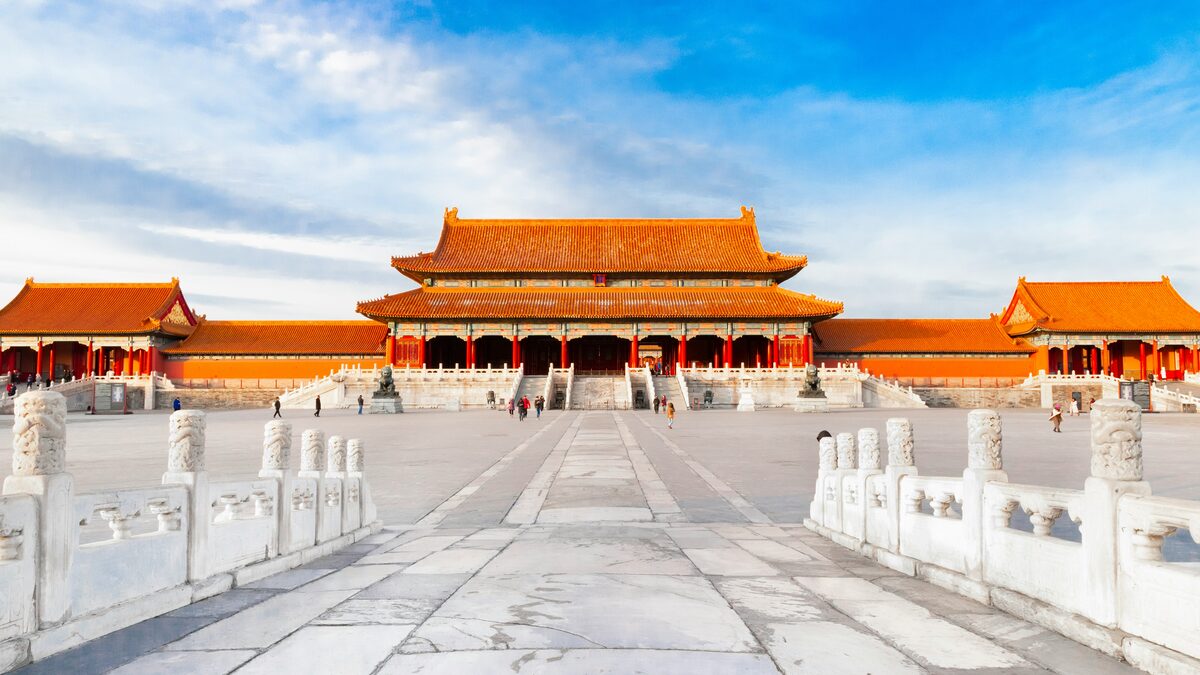
Tickets — real-name booking, 7 days ahead
Foreign visitors cannot reliably walk up and buy a ticket. The Palace Museum sells a fixed daily quota (about 40,000 tickets, raised to ~60,000 on a few peak days), and the entire quota goes by real-name advance booking. Prices and the two foreigner channels:
| Ticket | Price | Notes |
|---|---|---|
| Standard adult | ¥60 peak / ¥40 low | Peak = Apr 1 – Oct 31; low = Nov 1 – Mar 31. Released ~8:00pm Beijing time, 7 days ahead. |
| Treasure Gallery 珍宝馆 | +¥10 | Bought on top of entry. Palace of Tranquil Longevity, east side of the Inner Court. |
| Clock Gallery 钟表馆 | +¥10 | Bought on top of entry. Hall for Ancestral Worship (Fengxiandian); demos twice daily. |
| Under-18s & concessions | Free / half | Chinese under-18s enter free (reservation still required); students and seniors 60+ get discounts. Foreign children are not automatically free — book a ticket under each passport. |
Book on the official Palace Museum channel — it is the only legitimate one (there is no authorised reseller). For foreign passport holders:
- Official English site — open the Palace Museum site and use the English toggle in the top-right; there is a dedicated English ticketing channel. Register with an email, pre-load each visitor’s passport details (name in pinyin + passport number) under the account before release so you’re not typing them mid-rush, then pick a date and a morning or afternoon slot. Pays with Visa / Mastercard (also Alipay / WeChat Pay); if online payment fails you can generate the order and pay at the Wumen manual counter with your passport.
- WeChat Mini-Program “故宫博物院” — easier if you already have a passport-verified WeChat; switch the interface to English.
Tickets release at 8:00pm Beijing time, seven days ahead. On peak-season weekends, holidays and the summer break the morning slots can sell out in seconds; afternoon slots are a little easier. If you miss it, keep refreshing — unpaid tickets flow back around 8:05–8:30pm, and scattered refunds appear the afternoon and evening before the visit date. Bring the physical passport you booked with — the gate scans the document, and an e-passport or photo won’t pass. Closed Mondays except public-holiday Mondays.
Which gate — south in, north out
The single most-common foreign-visitor mistake is arriving at the wrong gate. The rule is simple: enter at Wumen (south), exit at Shenwumen (north). The east and west gates remain on city maps and are walkable on the outer side, but cannot be used to enter with a standard ticket.
| Gate | Role | Nearest metro / walk |
|---|---|---|
| Wumen 午门 (Meridian) | Entry only — the single ticketed entry gate | Line 1 Tiananmen East (天安门东) Exit A → ~10–15 min walk north through Tiananmen + Duanmen. Tiananmen West Exit B is the same walk on the west side. |
| Shenwumen 神武门 (Divine Prowess) | Exit only — north gate, no ticket entry | Closest metro Line 8 Shichahai (什刹海), ~15 min via Jingshan. Bus 101/103/109/124/128 stop at the gate. |
| Donghuamen 东华门 (East) | Not a public entry — staff / scheduled exits only | Line 6 Dengshikou or Line 1 Tiananmen East, ~10 min walk. Small paid Donghuamen parking lot on the access road. |
| Xihuamen 西华门 (West) | Not a public entry — staff and restricted areas | Bus 5 / Sightseeing Line 2 to 西华门. Beihai Park south gate is one block west. |
Allow 30–45 minutes from the Tiananmen East metro exit to the Wumen ticket-scan in shoulder season — the Tiananmen Square security screening between the metro and Wumen adds 5–15 minutes in peak season, and an hour during Golden Week. Our Beijing subway guide has the full line and exit detail.
Skip the square scrum. Tiananmen Square itself now needs its own (free) reservation, and although a Palace Museum booking is meant to admit you to the square, the square security is heavy — the crossing means three checks and, in peak season, a 1–2 hour queue. Many visitors instead approach from the east: Metro Line 8 to Jinyu Hutong (金鱼胡同) Exit C, then walk to Donghuamen and along the moat’s east wall to Wumen — no square queue, good red-wall photos, roughly 10 minutes to the gate.
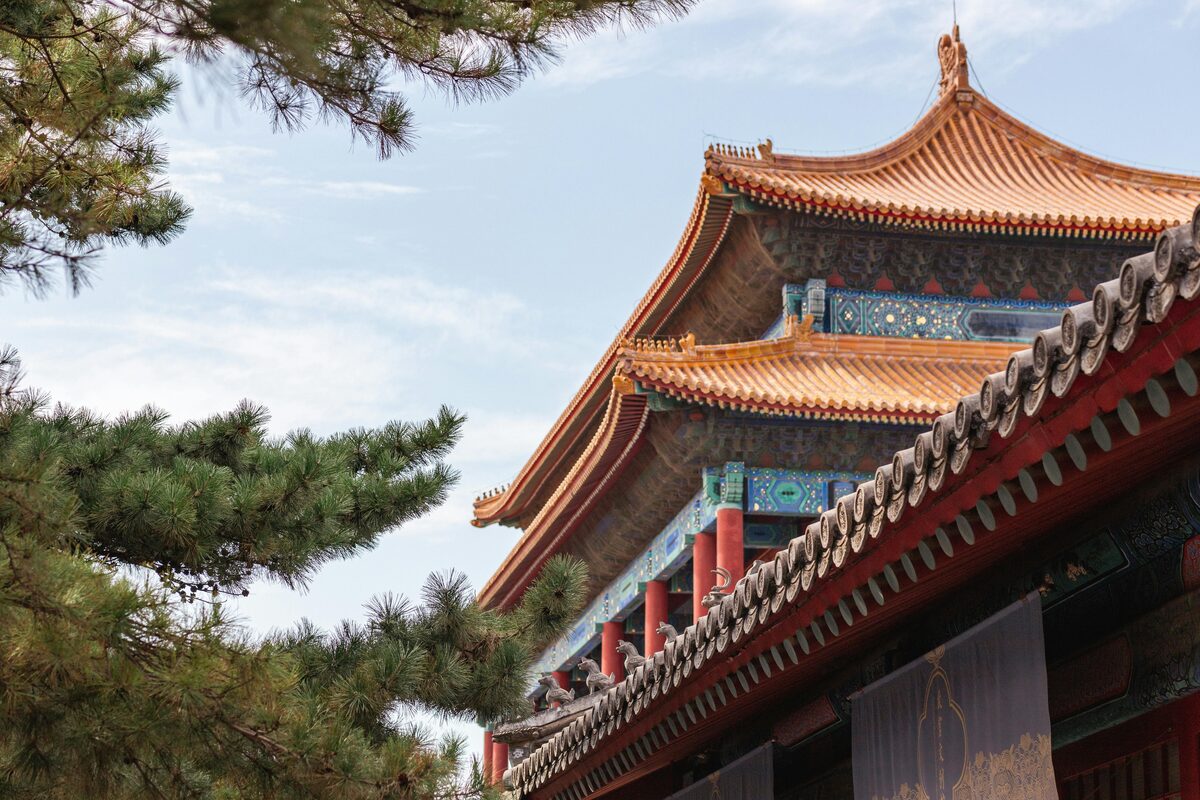
The route inside — Wumen to Shenwumen
The palace is composed on a strict north–south axis, so the visit is essentially a walk north from the entry gate to the exit gate. The central axis is what almost every visit covers; the side palaces are quieter and reward the extra hour.
| Stop on the axis | What it is |
|---|---|
| Wumen 午门 | Ticket scan, bag deposit on the right inside. The five-arch gate is the largest in the palace. |
| Taihemen 太和门 | Gate of Supreme Harmony — bronze lions, opens onto the great ceremonial courtyard. |
| Three Great Halls 三大殿 | Taihedian (largest wooden hall in China, coronations), Zhonghedian (the emperor’s rest hall), Baohedian (banquets & the palace exam). The dragon-carved central stairway is the single most-photographed object. |
| Inner Court 内廷 | Through Qianqingmen: Qianqinggong (Palace of Heavenly Purity), Jiaotaidian (Hall of Union), Kunninggong (Palace of Earthly Tranquility) — the residential half. |
| Imperial Garden 御花园 | Small symmetrical Ming-Qing garden with twisted cypresses and rockeries — the last stop before the exit. |
| Shenwumen 神武门 | The north exit, onto Jingshan Front Street opposite Jingshan Park. |
Side trips worth the extra hour — both galleries are rated must-do by travellers, not filler:
- Treasure Gallery (珍宝馆, +¥10) — east of the Three Great Halls in the Palace of Tranquil Longevity: the kingfisher-feather phoenix crown, imperial jade and gold, the Concubine Zhen well, and the adjoining Nine-Dragon Screen (九龙壁), one of only three surviving large glazed-tile dragon screens in China. This is where the imperial-luxury “wow” lives.
- Clock Gallery (钟表馆, +¥10) — in the Hall for Ancestral Worship: 18th-century European and Qing-court mechanical clocks, many still working, with live chiming demonstrations at set times — travellers rate it the single most surprising room in the palace.
- Hall of Mental Cultivation (养心殿 Yangxindian) — reopened after a long restoration; where eight late-Qing emperors actually lived and worked. It’s one-way (in at Zunyi Gate, out at Jixiang Gate) and just off the main axis, so it’s the most-skipped stop — worth the small detour. The western Six Palaces beyond it are a pilgrimage for Story of Yanxi Palace fans.
The central axis alone is comfortably walked in 2–3 hours; add the two galleries for a 4–5 hour visit, the realistic ceiling for most first-timers before the legs give out. Do the galleries by turning right at Qianqingmen after the Three Great Halls, then rejoin the axis for the Inner Court and garden.
Best time — time of day & season
The single best window is the 8:30am opening on a weekday. The full picture:
| When | What it’s like |
|---|---|
| 8:30–9:30am | The Three Great Halls are dramatically quieter than mid-morning; east light hits the Taihedian terraces well. The sweet spot. |
| 10:30am–2pm | Peak crowds — the central axis compresses shoulder-to-shoulder. Use this window for the quieter side palaces. |
| 3pm–close | Eases again; last entry 4pm peak / 3:30pm low, site cleared by 5pm in peak season and 4:30pm in winter. |
Best months: late September–October and late March–early May (comfortable, clear, the courtyard scale reads best in long light). Winter (Dec–Feb) is uncrowded, the off-peak ticket applies, and snow on the gold roofs is the photo winter visitors remember. Avoid October 1–7 (National Day), Spring Festival week and May 1–5 — daily caps are hit, the axis is impassable, and Beijing hotel rates double. And note again: closed Mondays except public-holiday Mondays — a Monday-arrival / Tuesday-departure trip is a common way to lose the only window. See our best time to visit China guide for the broader picture.
Practical for foreigners
Hours, gallery fees, accessibility
- Hours: 8:30am–5pm peak (last entry 4pm); 8:30am–4:30pm low (last entry 3:30pm). Closed Mondays except public-holiday Mondays.
- Galleries: Treasure Gallery (珍宝馆) +¥10; Clock Gallery (钟表馆) +¥10, each bought on top of entry.
- Accessibility: the central axis sits on raised platforms with several flights of stone steps; wheelchairs and strollers use marked ramped detours that bypass most steps — ask staff at Wumen for the accessible route map. Expect 2–4 km of walking on uneven stone.
- Bags & water: bottles over 300 ml aren’t allowed through security (refill stations inside); large daypacks must be checked free at the bag deposit just inside Wumen.
Payment, English & passport
Bring the exact passport you booked with — even a renewed passport with a different number is refused at the Wumen scan. Alipay and WeChat Pay work at the internal food court, shop and gallery counters; foreign cards are not accepted inside, so set up a mobile wallet first (see our Alipay for foreigners guide). An English audio guide is ¥40 at Wumen (passport-scan deposit), and the official Palace Museum app is free in English. A travel eSIM keeps maps and your dpm.org.cn confirmation QR reachable across the large site — how to stay connected in China.
Guide, audio guide or self-guided?
The palace is “30% looking, 70% listening” — without context it can read as “red walls and yellow roofs.” Options, cheapest to dearest:
- Official audio guide — ~¥20 (¥100 deposit) at Wumen; rent the headset version near Taihedian rather than the ear-hook type, which slips off.
- Shared-group human guide — booked through a reputable platform, ~¥30–50/person for ~3 hours with a wireless headset; the value pick for hearing the stories without a private-guide price.
- Official licensed guide — at the service stations just inside Wumen or Shenwumen; roughly ¥100 for the central route, ~¥250 for the full palace (up to 5 people). Regulated, no upselling.
- Trip.com English day tour — the friction-free foreigner option: an English guide plus the reservation handled for you (see below).
Scams & touts to refuse
- “Insider” or high-price tickets at the gate are fake or void — the ticket is real-name, online-only, and there is no legitimate reseller.
- “Fast-track” guides who hand out cards around Duanmen and the Wumen forecourt are unlicensed; the real official guides only work the service stations inside security.
- Leafleted day tours touted around Qianmen and Tiananmen often bait with a low price, then bundle a shopping stop — decline them.
What to combine the same day
The Forbidden City sits on Beijing’s historic ceremonial axis; the natural same-day route is a south-to-north walk:
- Before — Tiananmen Square (south): arrive via Line 1 Tiananmen East / West, clear the square’s security, and walk north under the Tiananmen gate-tower and through Duanmen to the Wumen scan.
- Inside: 3–4 hours on the central axis, or 5 with the galleries.
- After — Jingshan Park (north): exit at Shenwumen, cross Jingshan Front Street, enter Jingshan’s south gate (just ¥2, bookable on the 畅游公园 WeChat account or at the gate). The 10–15 minute climb to the Wanchunting pavilion gives the iconic photograph — the gold roof sea looking south with the full axis and the Tiananmen tower beyond. Best light is 4–5pm, when the sun lights up the glazed tiles; stand dead-centre in the pavilion and shoot straight down the axis for the symmetry.
- Dinner — Wangfujing (east): walk or taxi east for an early dinner. Siji Minfu (四季民福) is the standard Peking-duck choice; Da Dong (大董) is the upscale alternative. The where-to-stay-in-Beijing guide has the Wangfujing context.
When NOT to go: the three Golden Weeks (domestic crowds + daily caps), any Monday (closed), or a Monday-in / Tuesday-out trip that leaves no other window. The galleries close 30–60 min before the main site, so do them before the Inner Court if you want both.
Book a guided Forbidden City visit & skip-the-queue tourNASDAQ: TCOM
Trip.com lists guided Tiananmen + Forbidden City + Jingshan day tours with an English-speaking guide for visitors who’d rather outsource the 7-day booking and the gate-routing — paid in English on a foreign card.
Where to stay near the Forbidden City
The most atmospheric base for a first Beijing trip is Wangfujing / Dongcheng, a 20–25 minute walk east of Wumen along Donghuamen Street and one Line 1 stop from Tiananmen East — it keeps both palace gates, the Wangfujing dinner strip and the metro within walking distance. South of Tiananmen, Qianmen trades luxury depth for a compact old-city feel; the Houhai hutong belt north-west of Jingshan is the courtyard-hotel option. Distances below are measured.
Where to book these: China’s home-grown chains — 全季 (JI) and 亚朵 (Atour) — are listed most completely on Trip.com, with English checkout and foreign-card payment. It’s the main booking platform for mainland hotels; Western sites like Booking and Agoda carry only a fraction of their branches.
Wangfujing / Dongcheng — walk to the gates (recommended)
The most useful base for a first Beijing trip is Wangfujing in Dongcheng, a 20–25 minute walk east of Wumen along Donghuamen Street and one stop on Metro Line 1 from Tiananmen East. It keeps both palace gates, the Wangfujing dinner strip and Line 1 within walking distance. Most foreign visitors do best in a home-grown mid-range chain — 全季 (JI) or 亚朵 (Atour) — reliable, English-app booking, and a fraction of the five-star rate. Two international five-stars are listed below if you want them.
- Wangfujing / Dongcheng — ~10–15 min walk or one Line 1 stop (Tiananmen East) to Wumen.China's most popular home-grown mid-range chain — modern, spotless, easy English-app booking, roughly a third the price of the five-stars.
- Wangfujing area, Dongcheng — ~15 min walk to the Wangfujing dinner strip and Line 1 to the Forbidden City.Design-led mid-range chain that foreign guests rate highly — comfortable, well-run, and far better value than the luxury towers.
- On Wangfujing Street in Dongcheng — ~20 min walk to Wumen, or one Line 1 stop from Wangfujing.International five-star right on the Wangfujing dinner strip, within walking distance of both palace gates.
- Wangfujing, Dongcheng — ~20–25 min walk to Wumen along Donghuamen Street.International five-star a short walk east of the Forbidden City, handy for the Wangfujing duck restaurants.
Houhai / hutong belt — courtyard hotels
North-west of Jingshan, the Houhai hutong belt is the courtyard-hotel option — smaller heritage properties, 15–20 minutes’ walk from Shenwumen, in the most-photographed old streetscapes in the city. Foreigner-friendly chains are thin here, so check English service and reviews before booking.
- Houhai / hutong belt, ~15–20 min walk from Shenwumen (the north exit gate).No major chain right in the hutongs — a live list of the boutique courtyard hotels currently bookable in the Houhai area.
Frequently asked questions
Do I need a ticket for the Forbidden City, and can I buy it at the gate?
Yes, you need a ticket, and no, you cannot reliably buy one at the gate. The Palace Museum sells a fixed daily quota of ~40,000 tickets, all by real-name advance booking on its official platform — the gate window does not sell same-day tickets to walk-ups in any predictable way. Foreigners book from the English gateway at intl.dpm.org.cn, which hands off to bookingticket.dpm.org.cn, or via the WeChat Mini-Program '故宫博物院观众服务', using a passport. Standard ticket is ¥60 in peak season (April 1 – October 31) and ¥40 in low season (November 1 – March 31). Tickets are released around 8:00 PM Beijing time, seven days ahead, and weekend / holiday dates regularly sell out within minutes. The site is closed on Mondays except on public-holiday Mondays.
Which gate do I enter and exit by?
Entry is south, exit is north. The south gate, Wumen (午门, the Meridian Gate), is the only entry gate for ticketed visitors. The north gate, Shenwumen (神武门, the Gate of Divine Prowess), is exit-only. East and west gates are no longer used as standard ticketed entrances. Wumen is a short walk north from Tiananmen Square — the closest metro is Line 1 Tiananmen East (天安门东) Exit A, then about a 10–15 minute walk north through the Tiananmen archway and the Duanmen courtyard before you reach the Wumen ticket-scan. Most foreign visitors get this wrong on the first try by arriving at Shenwumen and being turned away.
Do I need to reserve Tiananmen Square, and what is the fastest way in to Wumen?
Tiananmen Square now requires its own free reservation (passport, released daily; book 1–7 days ahead). A Palace Museum booking is officially meant to admit you to the square on your visit date, but in practice the square security is strict and slow — crossing it to reach Wumen means three checks and, in peak season, a 1–2 hour queue. Many visitors skip the square approach entirely and come in from the east instead: Metro Line 8 to Jinyu Hutong (金鱼胡同) Exit C, walk to Donghuamen, then along the moat's east wall to the Wumen entrance — no square queue, good red-wall photos, about 10 minutes to the gate.
How long should I plan?
Three to four hours on-site is the realistic minimum for the central axis from Wumen through the Three Great Halls, the Inner Court and the Imperial Garden, exiting at Shenwumen. Add 60–90 minutes if you also want the ticketed Treasure Gallery (珍宝馆) in the Palace of Tranquil Longevity on the eastern side and the Clock Gallery (钟表馆) in the Hall for Ancestral Worship, each a separate ¥10. Most foreign visitors who allocate two hours run out of time before the Inner Court and regret it; most who allocate a full day finish in five and walk out for a late lunch.
What is the optimal route inside?
Wumen → Taihemen → the Three Great Halls (Taihedian, Zhonghedian, Baohedian) → Qianqingmen into the Inner Court → Qianqinggong → Jiaotaidian → Kunninggong → Imperial Garden (Yuhuayuan) → Shenwumen exit. This is the central north–south axis and the route the layout is designed around. Side trips: branch east after the Three Great Halls for the Treasure Gallery and the Nine-Dragon Screen; branch west into the Hall of Mental Cultivation (Yangxindian, where late-Qing emperors actually lived and worked) if it is open. The crowd compresses on the central axis; the side palaces are far quieter.
What are the Treasure Gallery and the Clock Gallery, and are they worth the extra ¥10?
Yes, especially the Clock Gallery. The Treasure Gallery (珍宝馆) sits inside the Palace of Tranquil Longevity (Ningshougong) on the eastern side of the Inner Court — jade, gold ceremonial objects, imperial seals, the Nine-Dragon Screen. The Clock Gallery (钟表馆) in the Hall for Ancestral Worship (Fengxiandian) holds an unusually deep collection of 18th-century European and Qing-court mechanical clocks gifted by Jesuits and ordered for the Qianlong emperor — many still working, demonstrated twice a day. Each is a separate ¥10 ticket bought on top of your entry. Together they add about 90 minutes to the visit.
When is the best time of day to go?
First entry, 8:30 AM, on a weekday in the shoulder seasons. The Three Great Halls at 8:30–9:30 AM are dramatically less crowded than at 11:00 AM, and the morning light from the east hits the Taihedian terraces well. The site closes ticket entry at 4:00 PM in peak season (April–October) and at 3:30 PM in low season; last visitors are cleared out by 5:00 PM. Avoid October 1–7 (National Day Golden Week), Spring Festival week and May 1–5 — daily caps are reached and the central axis becomes shoulder-to-shoulder.
What should I combine with the Forbidden City on the same day?
The natural combination is Tiananmen Square south of Wumen before you enter, and Jingshan Park north of Shenwumen after you exit. Jingshan is the small artificial hill just across the road from the north gate; the 10–15 minute climb to Wanchunting at the top gives the single iconic photograph of the Forbidden City's gold roof sea looking south, with Tiananmen and the Beijing skyline behind. After Jingshan, walk east through the Donghuamen / Wangfujing area for dinner. The whole sequence — Tiananmen, Forbidden City, Jingshan, Wangfujing — is the classic Beijing first-day.
Is the Forbidden City accessible / kid-friendly?
Partially. The central axis is on a series of raised platforms with multiple flights of stone steps; wheelchairs and strollers can use marked ramped detours that bypass most of the steps, but you will need to ask staff at Wumen for the accessible route map. The whole visit involves 2–4 kilometres of walking on uneven stone. Chinese under-18s enter free (a reservation is still required); foreign children are not automatically free, so book a ticket under each child's passport. Strollers are allowed; large daypacks must be checked at the bag-deposit just inside Wumen. No water bottles larger than 300 ml are permitted through security.
Sources
Checked August 2026 · Written from our own first-hand travel in China.