This guide is written by an editorial team based in Chongqing — the editor has lived in mainland China since 2018. It draws on first-hand Xi'an visitor experience (including the Terracotta Army in 2024) and on aggregated 2024-2026 r/travelchina and food-writing sources for the dish detail and the eat-here / skip-here calls. aggregated editorial coverage (see about page) — first-hand visitor experience; specific shop recommendations are kept general because individual stalls open and close.
Why Xi'an food is different
Xi'an does not eat like the China most foreign visitors picture. It is a wheat city, not a rice city — noodles, flatbreads and buns, not bowls of rice — and its flavour signature is cumin, dried chilli, black vinegar and garlic, not the sweet-soy register of the east coast. That comes from two histories: Xi'an was the eastern terminus of the Silk Road, and it has a long-established Hui Chinese Muslim community whose lamb-and-beef cooking shaped the whole city's palate. The result is one of the most distinctive regional cuisines in the country, and it is cheap: the four dishes below, eaten properly, will cost you very little.
Roujiamo — the “Chinese hamburger”
Roujiamo (肉夹馍) is the dish foreign visitors fall for fastest. Meat is slow-stewed with cumin, star anise and a house spice mix until it shreds, then chopped fine and packed into a baijimo — a flat wheat bun griddle-baked until it is crisp outside and soft within. The name literally means “meat clamped in the bun.”
There are two versions and the difference matters. In the Muslim Quarter the meat is beef or lamb, and the whole quarter is halal. Elsewhere in Xi'an the classic is lazhi roujiamo — pork stewed in a long-aged braising liquid. Both are excellent; halal travellers simply stay with the Muslim Quarter version. Expect to pay ¥8-15. The quality test is turnover: a stall with a queue is restocking its stewed meat and griddling buns fresh; a quiet one is serving you what has been sitting.
Biang biang noodles — belt-wide and hand-pulled
Biang biang noodles (biángbiáng面) are the noodle every visitor photographs — a single hand-pulled noodle as wide as a belt and as long as your arm, one noodle filling the bowl. They are most often served you po (油泼): chilli flakes, garlic and scallion are piled on top, then hot oil is poured over at the table, and the whole bowl hisses and releases its aroma. You toss it through before eating.
The dish is also famous for its name. The character biáng is one of the most complex in common Chinese use — more than 50 strokes — and it does not appear in standard dictionaries; shops paint it on their signs as a point of pride. A bowl runs ¥15-30, it is genuinely filling, and it is unmistakably Xi'an. Order it with a side of garlic cloves the way locals do.
Yangrou paomo — the lamb-broth bread bowl
Yangrou paomo (羊肉泡馍) is Xi'an's iconic dish, and eating it is a small ritual. You are brought a dense, only-half-baked flatbread and an empty bowl. Your job is to tear the bread into small pieces by hand — and the locals are not joking about “small”: the more even and fingernail-sized the pieces, the better the texture when it is cooked. You hand the bowl back, and the kitchen simmers your torn bread in a long-cooked lamb broth with vermicelli noodles and sliced meat.
It comes back as a rich, hearty stew, served with pickled sweet garlic and a dab of chilli paste on the side. A beef version, niurou paomo, exists too. This is a slow, sit-down meal, not street food — allow yourself the time, and do the tearing rather than asking the kitchen to do it, because the tearing is the point. It costs ¥30-55, and the long-running shops in and around the Muslim Quarter do the definitive version.
Liangpi and the everyday snacks
Liangpi (凉皮) — “cold skin” — is the everyday Xi'an snack: wide, slippery noodles made from wheat or rice starch, served cold and dressed with chilli oil, black vinegar, garlic water, bean sprouts and chewy squares of wheat gluten (面筋). It is refreshing, naturally meat-free, and costs ¥8-15. There are regional variants — the rice-based mipi from nearby Qinzhen, the thicker ganmianpi — and Xi'an argues about which is best.
The classic local lunch combination, the so-called three-Qin set (三秦套餐), is a roujiamo, a bowl of liangpi, and a bottle of Bingfeng (冰峰) — the orange soda that is to Xi'an what a local cola is to other cities. Ordering it is the easiest way to eat like a resident rather than a tour group.
Around these staples sits a wide field of snacks worth grazing: persimmon cakes (黄桂柿子饼, fried sweet cakes made with Lintong persimmons), lamb skewers (羊肉串, cumin-dusted, ¥3-5 each), guantang baozi (灌汤包, soup-filled steamed buns), zenggao (甑糕, a steamed glutinous-rice cake with red dates and beans), and hulatang (胡辣汤, a peppery breakfast soup). None of these needs a destination restaurant — they are the constant, inexpensive background of eating in Xi'an.
The Xi'an dumpling banquet
The dumpling banquet (饺子宴) is the one deliberately theatrical Xi'an meal. It is a multi-course tasting of dozens of different dumplings — each shaped and coloured to look like what is inside it, from a walnut-shaped walnut dumpling to a tiny duck — finished with a communal hot-pot course. It was invented in the 1980s at De Fa Chang (德发长), the long-running restaurant on the Bell Tower square, and it is now a set-piece of the Xi'an tourist circuit.
Be clear-eyed about it: the dumpling banquet is touristy and not cheap — roughly ¥150-400 per person depending on the set — and it is more of a fun group dinner than a profound meal. But it is a genuinely enjoyable evening for a family or a group, and De Fa Chang on the Bell Tower square is the original. Book ahead in peak season.
Where to eat — the Muslim Quarter and beyond
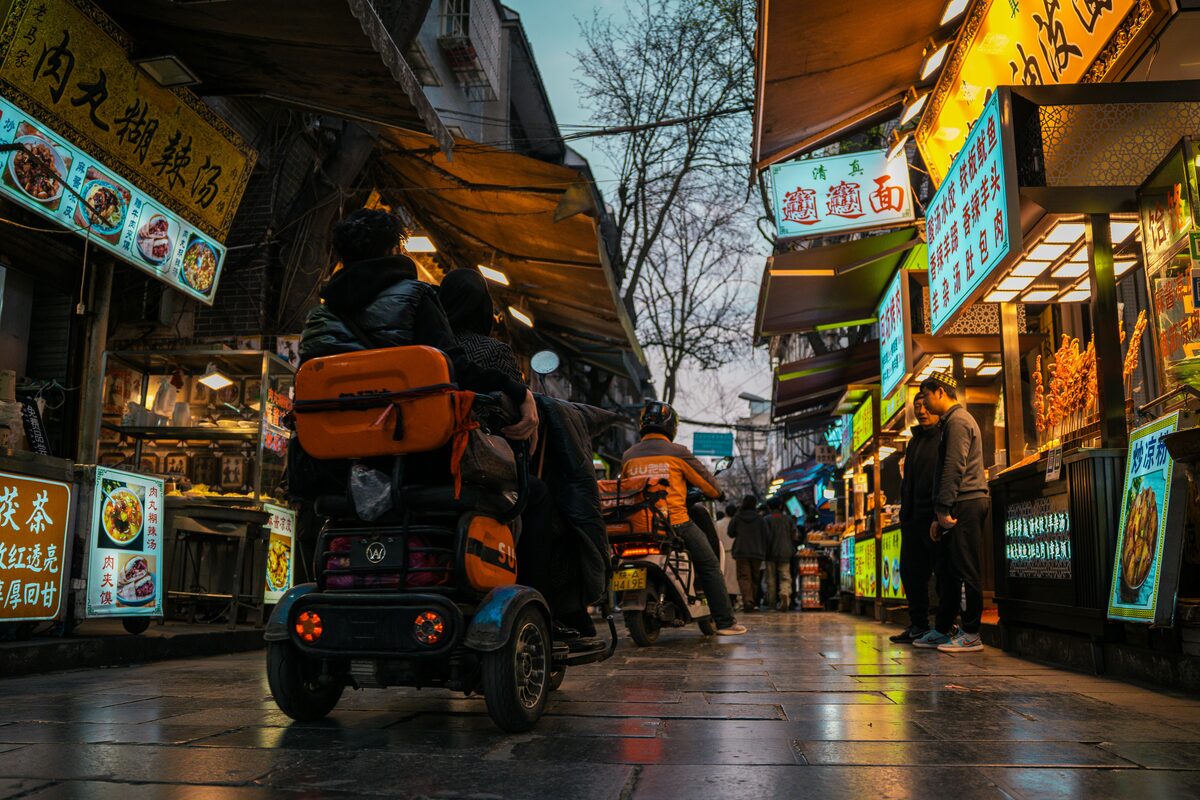
The Muslim Quarter (回民街 / Beiyuanmen) is the obvious food hub — a 1,200-year-old, entirely halal network of food streets running north from the Drum Tower, and the single easiest place to eat your way through the dishes above. But the most useful thing to know is this: the main pedestrian strip is the tourist version. Beiyuanmen, the street the tour groups walk, is real Hui-Muslim food but priced and styled for visitors. Walk one or two streets back — Da Pi Yuan (大皮院) and Sa Jin Qiao (洒金桥) are the names to remember — and you find the long-standing paomo and roujiamo shops where Xi'an residents actually eat, cheaper and better. Our Muslim Quarter food guide covers the quarter street by street.
Two other anchors worth knowing. Yongxingfang (永兴坊), near the City Wall's east side, is a curated courtyard of Shaanxi-province food stalls — it is built for visitors but the breadth is genuine and it is a good single stop. And for the heritage sit-down versions of paomo and Shaanxi cooking, the old-name restaurants on and around West Street inside the City Wall — places like Tong Sheng Xiang and De Fa Chang — are reliable. Wherever you eat, you will pay with Alipay or WeChat Pay; small stalls rarely take cash gracefully any more.
Frequently asked questions
What is the most famous food in Xi'an?
Is the Muslim Quarter food authentic or a tourist trap?
What is roujiamo?
What is yangrou paomo and how do you eat it?
Is Xi'an food halal?
What should vegetarians eat in Xi'an?
What do locals order — what is the "three-Qin set"?
Related Xi'an guides
- Xi'an city guide — things to do, getting in and out, getting around, where to stay, and practical essentials.
- Xi'an Muslim Quarter food guide — the food streets street by street, plus the Great Mosque.
- Where to stay in Xi'an — including how to weigh sleeping inside the Muslim Quarter.
- Alipay setup for foreigners and WeChat Pay setup — how you will pay at stalls and restaurants.
- Terracotta Army visitor guide — the headline sight; pair it with a Muslim Quarter dinner.
Browse Xi'an hotels on Trip.com →
Footer — verification scope
Verified first-hand by this editor: Xi'an visitor experience including a 2024 trip; the QR-payment norm at China food stalls, used daily across mainland China.
Not confirmed: long-term residence in Xi'an and current individual-stall quality (stalls open and close — specific shop names are kept general for that reason). Editor is based in Chongqing, not Xi'an — aggregated editorial coverage aggregated from published sources.
Sources: editorial team based in Chongqing (8-year mainland-China resident), editor's about page, aggregated 2024-2026 r/travelchina threads and published Xi'an food writing, cross-referenced for dish detail and the tourist-strip-versus-local-lane distinction.