Key takeaways
- Tianzi Mountain is the high northern zone of Zhangjiajie National Forest Park — the widest peak-forest panorama, rated just behind the Avatar pillars. It is not Tianmen Mountain (the glass-skywalk peak by the city).
- The pillars are quartz-sandstone, cut by erosion from an uplifted seabed over ~300 million years — the “Zhangjiajie landform.” No separate ticket: it’s in the ¥236 park pass.
- You can’t see all dozen viewpoints — the keepers are Yubi Feng, Dianjiangtai and Yunqingyan, plus the Tianzi Pavilion for sunset. The ¥72 cable car’s worst queue is going DOWN in the afternoon.
- The sea of cloud comes on the first clear morning after rain, best from Dianjiangtai around 6:30–8:30am. Sunrise needs an overnight on the plateau; sunset is the Tianzi Pavilion.
Tianzi Mountain — and why it isn't Tianmen
First, the mix-up that catches almost every foreign visitor: Tianzi Mountain (天子山) and Tianmen Mountain (天门山) are two different mountains. The names sound alike and both get called “Zhangjiajie,” but:
| Tianzi Mountain | Tianmen Mountain | |
|---|---|---|
| Where | Inside the National Forest Park (Wulingyuan) | By Zhangjiajie city, ~32 km away |
| What | Peak-forest viewpoints, sea of cloud | Glass skywalks, “Heaven’s Gate” arch |
| Ticket | In the ¥236 park pass | Separate, ~¥288 |
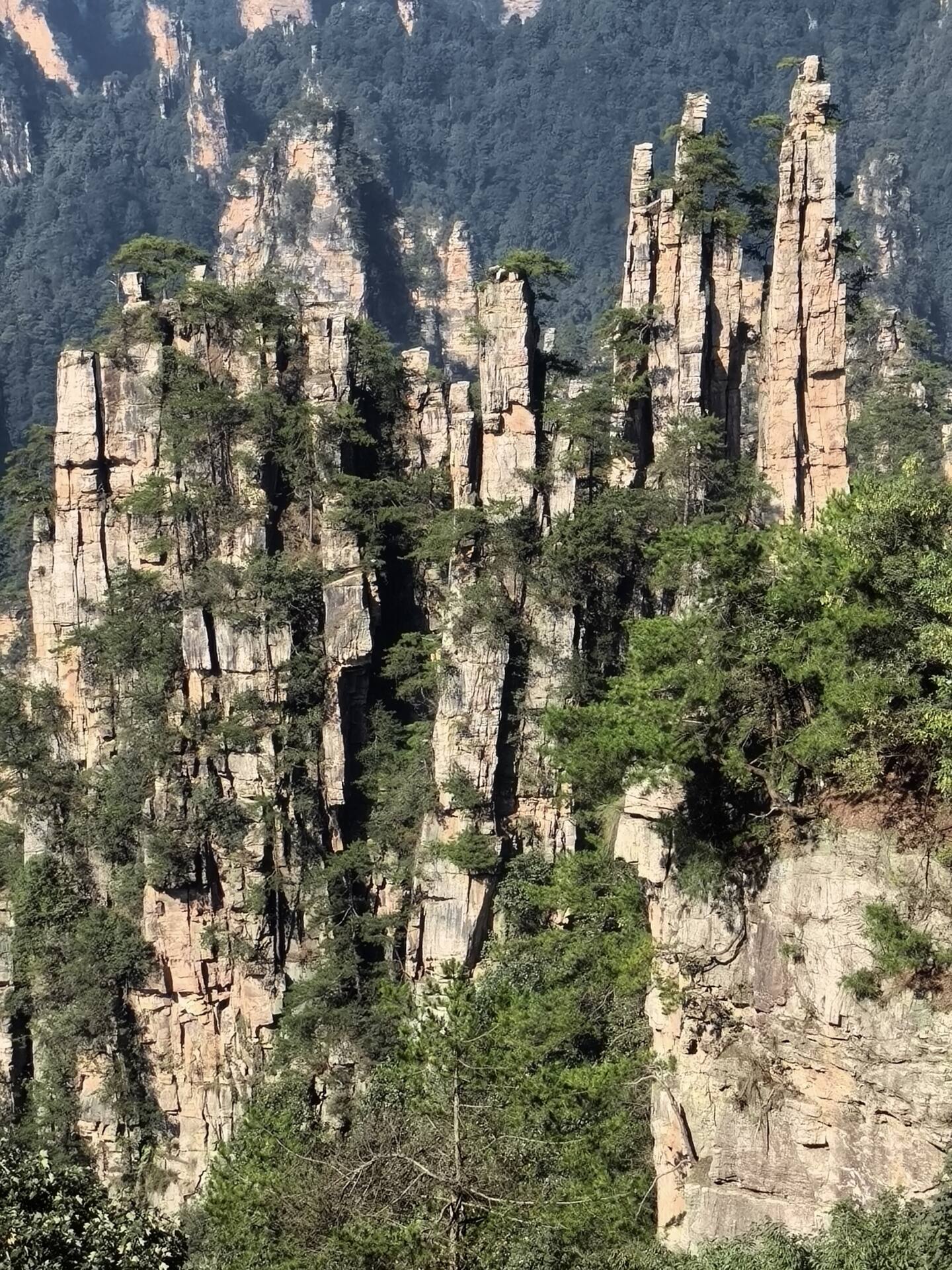
This page is about Tianzi Mountain — the high northern zone of the Avatar-pillar park. It is where the park opens out into its widest view: a horizon of quartz-sandstone columns that travellers rate second only to the Avatar pillar itself, and the park’s best stage for a sea of cloud. For Tianmen’s cliff walkways, see the Tianmen Mountain guide.
Why the peaks look like that
The most-asked question about these mountains is simply how did they form? The columns are quartz-sandstone — hard, near-vertical rock — and the shape is so distinctive that geologists gave it its own name: the “Zhangjiajie landform.” The short version: this was once an ancient seabed of thick quartz-sandstone. It was lifted above the water, and then rain, running water and freeze-thaw spent roughly 300 million years cutting the rock along its vertical joints into thousands of free-standing pillars. They weren’t pushed up as separate spikes — they are what’s left behind after the softer rock eroded away. Tianzi Mountain’s highest point, Kunlun Peak, reaches 1,262.5 m.
Which viewpoints — see these, skip those
Tianzi has a dozen named viewpoints and you cannot do them all in half a day — chasing every one is how people end up exhausted and underwhelmed. Here is the honest tier list:
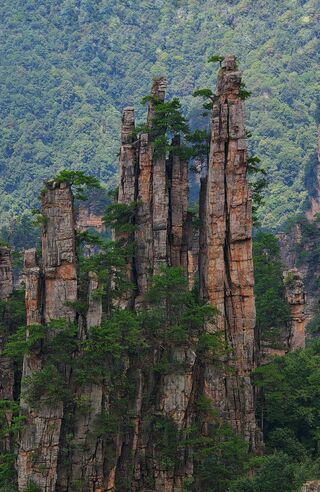
The signature spot — a cluster of straight, thin columns like a row of upright writing brushes. Highest photo-rate on the mountain; ethereal at dawn or in an after-rain cloud sea.
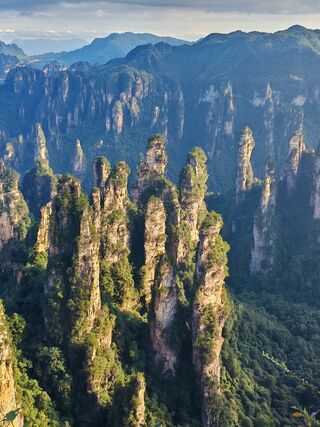
The locals' pick — a ~270° overlook of the West Sea peak forest, with far fewer people than the main road and the best sea-of-cloud vantage.
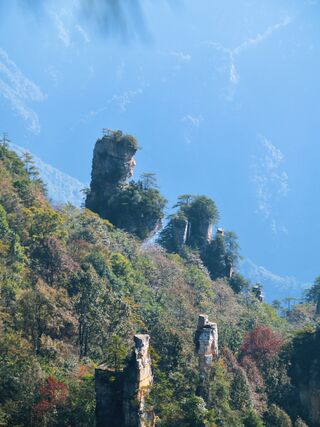
The rest stop with a view — shaded, breezy, benches to sit on, and a fine West Sea panorama. Where you recover mid-walk.
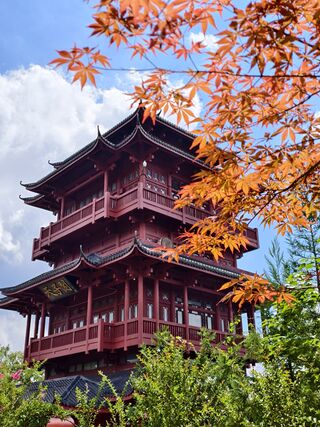
A 6-storey tower with a 360° view. Skippable by day (it overlaps Dianjiangtai and adds a stair climb) but the single best sunset spot — peaks in silhouette under a gold-to-purple sky.
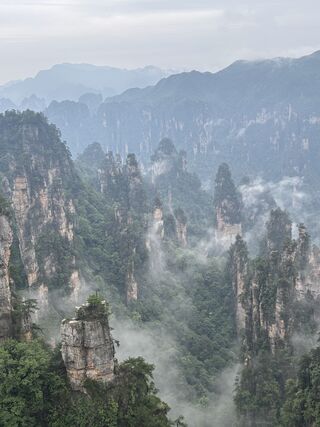
A mysterious concave valley where mist wells up into a "cloud waterfall." Atmospheric, but no toilets or food, and close to Dianjiangtai.
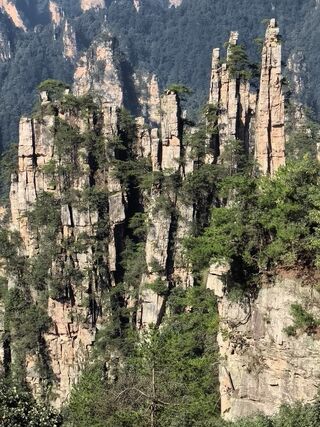
Dozens of massed peaks — magnificent, but out in the Laowuchang area, reached only by a separate ~¥64 round-trip electric cart. Skip it on a half-day.
The efficient half-day, cable up: ride the Tianzi cable to He Long Park, shoot Yubi Feng (and Fairy Scattering Flowers beside it); walk or hop a short eco-bus to Yunqingyan to rest in the shade; then tell the eco-bus driver you want Dianjiangtai, see it, and reboard there. That covers the three keepers on flat paths and dodges the tour-group crush on the main road.
The cable car, the walk, and the queue
The Tianzi cable car is ¥72 one way and covered by neither more nor less than your own legs would be — the point is which way you ride it. The quirk worth planning around: the DOWN direction is the bottleneck. Because the classic park loop is Bailong Elevator up, Tianzi cable down, everyone converges here to descend in the afternoon: reckon ~30–60 minutes up but 1–2 hours or more down on a peak afternoon (it’s near queue-free on an off-season weekday).
Last car runs early — have a backup
The Tianzi cable normally runs to ~17:00–17:30, but on peak days and weekends the last descent can be pulled forward to 16:00 or even 14:00, and it closes for occasional maintenance — be at the station by mid-afternoon and keep the walk-down as a backup.
Prefer your legs? Yes — the free 'Health Avenue' (健康大道) stair trail climbs from the valley, but travellers report ~4.7 km and 2.5–3 hours up (thousands of steps), punishing on the knees and cardio. Most ride the cable UP and walk DOWN from the Tianzi Pavilion (~1.5 h) — it skips the long cable-descent queue and saves the knees the ascent. That “cable up, walk down” version is the one most people are happiest with — you get the mid-level views on the way down and skip the descent queue entirely.
Book the park entry & Zhangjiajie toursNASDAQ: TCOM
Tianzi is covered by the timed park entry — Trip.com sells it, plus English guided day-tours across the Avatar pillars and Tianzi, booked on a foreign card.
Sea of cloud, sunrise & sunset: when and where
Tianzi is the park’s stage for the “floating” effect, and it is worth timing your visit around it. The sea of cloud is the prize: it forms on the first clear morning after rain (locals call it 雨后初晴) — a day of steady rain saturates the air, and as it clears the vapour condenses into a white sea that fills the valleys and leaves the pillar tops adrift.
- Sea of cloud: best 6:30–8:30am from Dianjiangtai or Shentangwan, whose deep valleys funnel the mist. Spring (Apr–Jun) and autumn (Sep–Oct) have the best odds; a flat clear day or steady heavy rain give you nothing.
- Sunrise: from Yubi Feng / He Long Park (summer ~5–6am, winter ~6–7am). Note the catch — eco-buses only start ~7:30am, so to be at the viewpoint for a 5am sunrise you must stay overnight on the plateau, not down in Wulingyuan.
- Sunset: the Tianzi Pavilion is the spot — the sun drops behind the peak forest and 3,000 columns turn to silhouettes under a gold-to-purple sky.
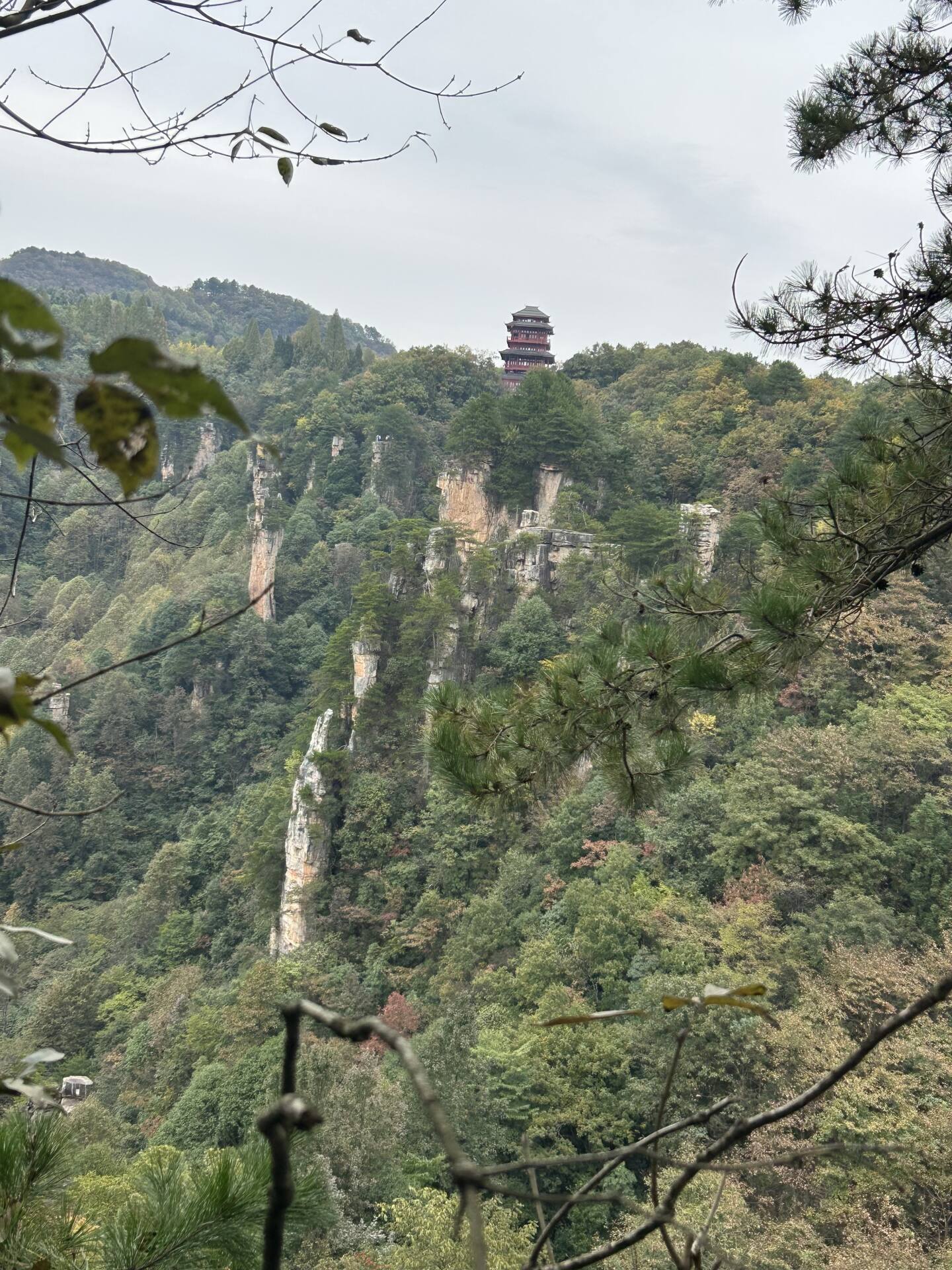
On the ground: toilets and shops line the He Long Park → Yubi Feng main road, but the quiet viewpoints (Dianjiangtai, Shentangwan) have almost none — go before you leave the main road, and expect ¥5–10 mountaintop prices for water. Coming down the cable, note the valley-floor eco-buses run in three separate segments, so to continue to the Golden Whip Stream you walk to Shuiraosimen to change. And skip the “free guide” touts at the gates — they route you into forced shopping.
Where to stay for Tianzi Mountain
For the standard Bailong-up / Tianzi-down day, base in Wulingyuan town by the east gate. Only chase a plateau inn if you specifically want the sunrise — they’re basic, pricey and sell out far ahead. Full comparison in where to stay in Zhangjiajie.
Base in Wulingyuan town (or on the plateau for sunrise)
Wulingyuan town by the east gate is the practical base for the Bailong-up / Tianzi-down loop. For a Tianzi sunrise you need to be on the plateau overnight — the mountaintop inns are basic and sell out ahead, so book early.
- Wulingyuan town, ~5 min from the east gate.China's most reliable mid-range chain — spotless and modern, right by the gate for an early start.
- Wulingyuan town, ~10 min from the east gate.Design-led mid-range chain foreign guests rate highly — the comfortable pick by the park.
Frequently asked questions
Is Tianzi Mountain the same as Tianmen Mountain?
No — this is the single most common Zhangjiajie mix-up. Tianzi Mountain (天子山) is a high zone INSIDE Zhangjiajie National Forest Park (the Avatar-pillar park in Wulingyuan), covered by the park pass. Tianmen Mountain (天门山) is a separate single peak right by Zhangjiajie city, with the cliff glass skywalks and 'Heaven's Gate' arch, and its own ~¥288 ticket. Same-sounding names, two different mountains ~32 km apart — most people visit both, on different days.
How were the Tianzi mountains formed?
They are quartz-sandstone pillars — a landform so distinctive that geologists named it the 'Zhangjiajie landform.' An ancient seabed of quartz sandstone was uplifted above the water, and then rain, running water and freeze-thaw slowly cut the thick rock layer into thousands of free-standing columns over roughly 300 million years. Tianzi Mountain's highest point, Kunlun Peak, stands at 1,262.5 m. So they were carved by erosion, not pushed up as separate spikes.
Which Tianzi Mountain viewpoints are worth it?
There are a dozen; on a half-day, three are the keepers: Yubi Feng (御笔峰, the 'Imperial Brush Peaks' — the signature shot), Dianjiangtai (点将台, the locals' quiet ~270° overlook and best cloud-sea vantage), and Yunqingyan (云青岩, a shaded rest spot with a fine panorama). Add the Tianzi Pavilion (天子阁) only for sunset. Skip Shentangwan (神堂湾) if time is tight, and skip Shenbing Juhui (神兵聚会) unless you want to pay a separate ~¥64 electric-cart round trip out to it.
Do you need a separate ticket for Tianzi Mountain, and how much is the cable car?
No separate ticket — Tianzi Mountain is inside Zhangjiajie National Forest Park and covered by the ¥236 four-day park pass (which includes the free eco-buses). The Tianzi cable car is a paid add-on at ¥72 one way. Since 2025 every park entry needs an advance timed reservation tied to a gate; foreigners book in English online with a passport number and use the staffed passport lane.
How long is the Tianzi Mountain cable car queue?
The catch with the Tianzi cable is that the DOWN direction is the bottleneck — the classic park loop is Bailong Elevator up, Tianzi cable down, so everyone descends here in the afternoon. Expect ~30–60 minutes up but 1–2 hours or more down on a peak afternoon; it is near queue-free on an off-season weekday. The Tianzi cable normally runs to ~17:00–17:30, but on peak days and weekends the last descent can be pulled forward to 16:00 or even 14:00, and it closes for occasional maintenance — be at the station by mid-afternoon and keep the walk-down as a backup.
Can you walk up Tianzi Mountain instead of the cable car?
Yes — the free 'Health Avenue' (健康大道) stair trail climbs from the valley, but travellers report ~4.7 km and 2.5–3 hours up (thousands of steps), punishing on the knees and cardio. Most ride the cable UP and walk DOWN from the Tianzi Pavilion (~1.5 h) — it skips the long cable-descent queue and saves the knees the ascent.
When can you see the sea of cloud on Tianzi Mountain?
The cloud sea forms on the first clear morning after rain (locals call it 雨后初晴) — a day of mid-to-heavy rain leaves the air saturated, and as it clears the next morning the vapour condenses into a rolling sea below the peaks. Aim for 6:30–8:30am at Dianjiangtai or Shentangwan, where the deep valleys funnel the mist. Spring (Apr–Jun) and autumn (Sep–Oct) have the best odds; a flat clear day or steady heavy rain both give you nothing.
How does Tianzi Mountain fit with the Avatar pillars — how many days?
Both are in the same park, so they pair into one classic day: enter the east gate, ride the Bailong Elevator (¥65) up to the Yuanjiajie 'Avatar' plateau in the morning light, cross to Yangjiajie and Tianzi Mountain, and take the Tianzi cable (¥72) down. Two days is the standard for the park itself (add the Golden Whip Stream valley on day two). See the day-by-day Zhangjiajie itinerary for the full plan.
Sources
Checked August 2026 · Written from our own first-hand travel in China.