Key takeaways
- Yangjiajie is the quietest of the four zones inside Zhangjiajie National Forest Park — same landscape as the Avatar plateau next door, a tenth of the crowd. (And no, it’s not “Zhangjiajie” misspelt — three different family names.)
- Its signature is the “peak wall”: the Natural Great Wall viewpoint looks over blade-thin rock walls — geologically a pillar forest that hasn’t finished forming. Near-flat, ~1 h, anyone can do it.
- The famous climb is Wulongzhai — a real bandit-fort spur entered through three squeeze passes (the tightest ~30 cm) and topped by the Tianbofu overlook. Brilliant for the sure-footed; elderly, small kids and acrophobes should skip it.
- No separate ticket — it’s in the ¥236 park pass; the cable car is ¥76 one way. Don’t ride the cable DOWN mid-visit — its lower station sits by the far west exit, away from everything.
Yangjiajie, Yuanjiajie, Zhangjiajie — untangled
First, the name soup. Three places here end in -jiajie (家界, “family’s territory”), and they are not the same place:
| What it is | Whose name | |
|---|---|---|
| Zhangjiajie 张家界 | The city, and the brand name of the whole national forest park | The Zhang family |
| Yuanjiajie 袁家界 | The plateau with the Avatar pillars — the famous, crowded one | The Yuan family |
| Yangjiajie 杨家界 | This page: the quiet western zone with the peak walls | The Yang family |
Yangjiajie sits inside the park, one eco-bus stop west of Yuanjiajie, covered by the same ¥236 pass. The Yang name isn’t random: local folklore says the Yang family generals (杨家将) of Northern-Song legend campaigned here and some of the clan settled — a local Yang genealogy book and Ming/Qing-era Yang graves survive, and the place names keep the story alive: Liulang Bay, Qilang Bay, Zongbao Peak, and Tianbofu, the overlook named after the generals’ legendary mansion in the old capital. That quiet layer of legend, plus the emptiest trails in the park, is the Yangjiajie experience.
Peak walls: a pillar forest that isn't finished
Yuanjiajie’s skyline is free-standing columns. Yangjiajie’s is walls — rows of blade-thin sandstone ramparts stacked one behind another, which is why its signature viewpoint is called the Natural Great Wall (天然长城).
The geology makes the difference intuitive. The documented evolution of the Zhangjiajie landform runs platform → mesa → peak wall → peak cluster → peak forest → residual — young to old. Rain and frost cut the quartz-sandstone along its vertical joints; where erosion has sliced along one set of joints but not yet through the crossing set, you get walls. Give it a few more million years and the walls break into the columns Yuanjiajie is famous for. In other words: Yangjiajie is a pillar forest that hasn’t finished forming — you’re looking at the previous geological chapter of the Avatar mountains next door.
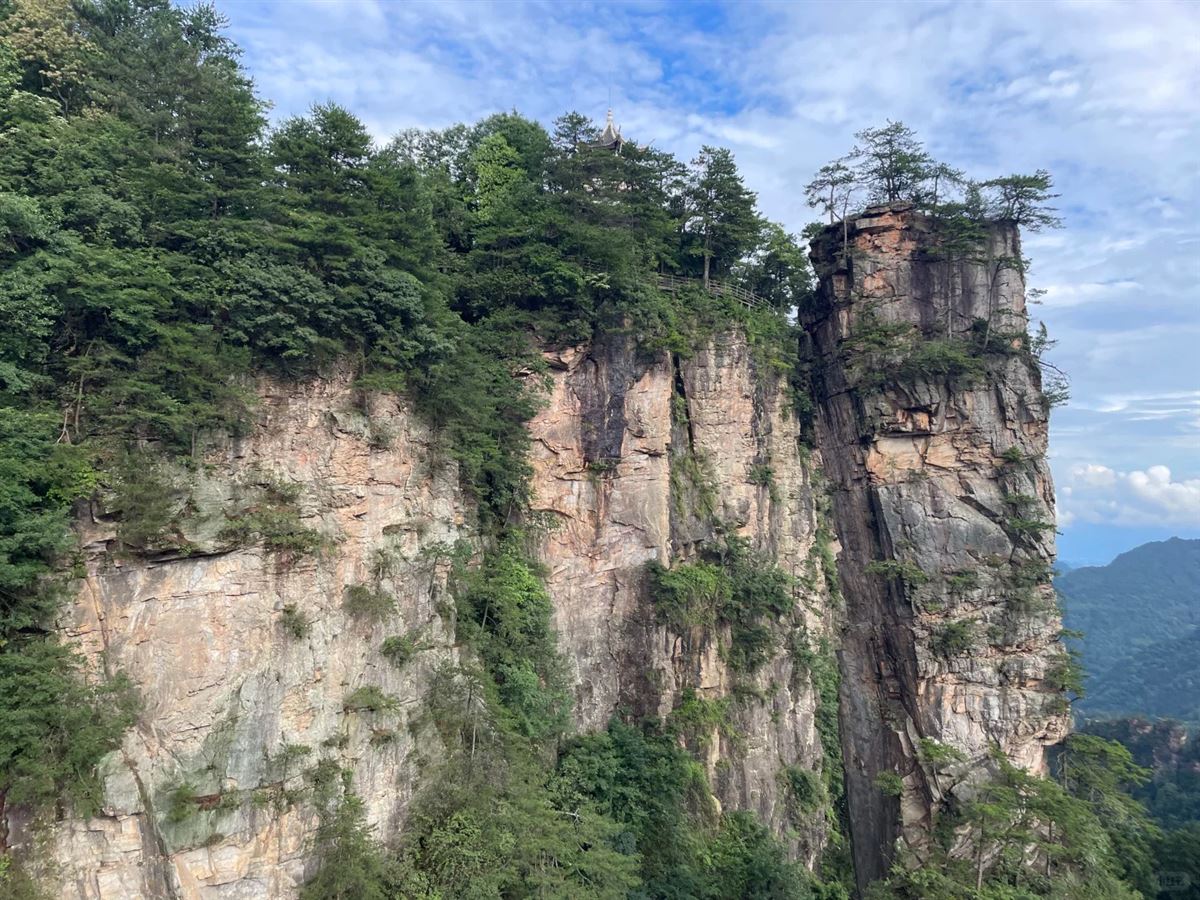
The Natural Great Wall viewpoint is Yangjiajie’s one everyone-can-do sight: a near-flat walk of about an hour round trip from the 天然长城观景台 eco-bus stop, with the wall rows filling the horizon. If you do nothing else in this zone, do this.
What's here — and how much to take on
Yangjiajie’s real question isn’t “is it worth it” — it’s how much of it your legs want. The sights sit on separate dead-end branches (more on that below), so they stack into three honest tiers:
The named sights, in the order you meet them:
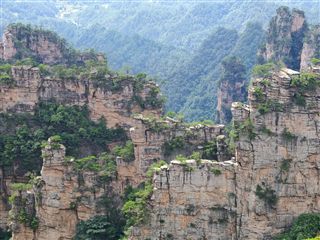
The zone’s signature: rows of blade-thin sandstone walls like a rampart built by giants — the textbook “peak wall” stage of the landform. A near-flat ~1 h round-trip walk from the eco-bus stop; every fitness level.
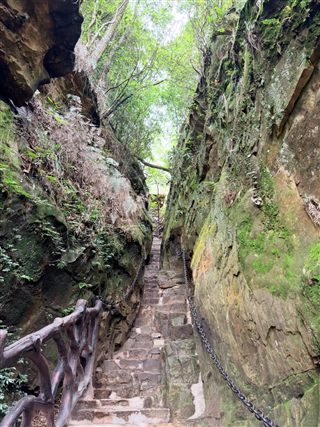
A real bandit-fort spur entered through three squeeze passes — one-person cliff steps, a stoop-tunnel, and the ~30 cm One-Man Pass. ~15 min of steady climb from the 乌龙寨路口 bus stop to the fort gate, then the steps to Tianbofu. Hands-and-feet fun for the sure-footed.
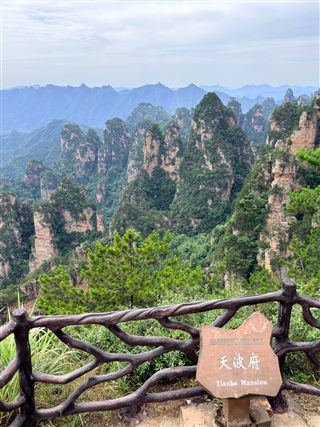
The clifftop overlook above the fort, reached by a near-vertical iron ladder — a 360° sweep over the peak-wall rows, the best view in the zone. Named after the Yang generals’ legendary mansion. 2–2.5 h round trip together with Wulongzhai.
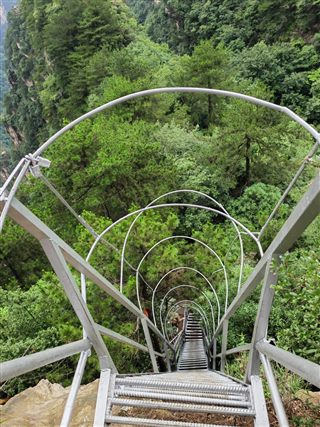
The far, near-empty branch: a 32-rung iron ladder to the zone’s highest point, then a cliff-hugging ledge path. Budget 3–4 h out-and-back and bring real legs — travellers rate it the most striking and the most tiring thing here.
Wulongzhai: the bandit fort, honestly
Wulongzhai (乌龙寨) is the thing people come back talking about — a fort spur so cliff-bound it has a single approach, guarded by what locals call the “three gates of hell”:
- 一步难行 “One Hard Step” — steps one person wide with the drop right beside you; railed now, but you still sidle along the rock.
- 谁敢不低头 “Who Dares Not Bow” — a tunnel under two pinched boulders, under a foot wide; you stoop, then squat, then shuffle.
- 一夫关 “One-Man Pass” — the narrowest squeeze, about 30 cm: strictly one person at a time, bags off, sideways.
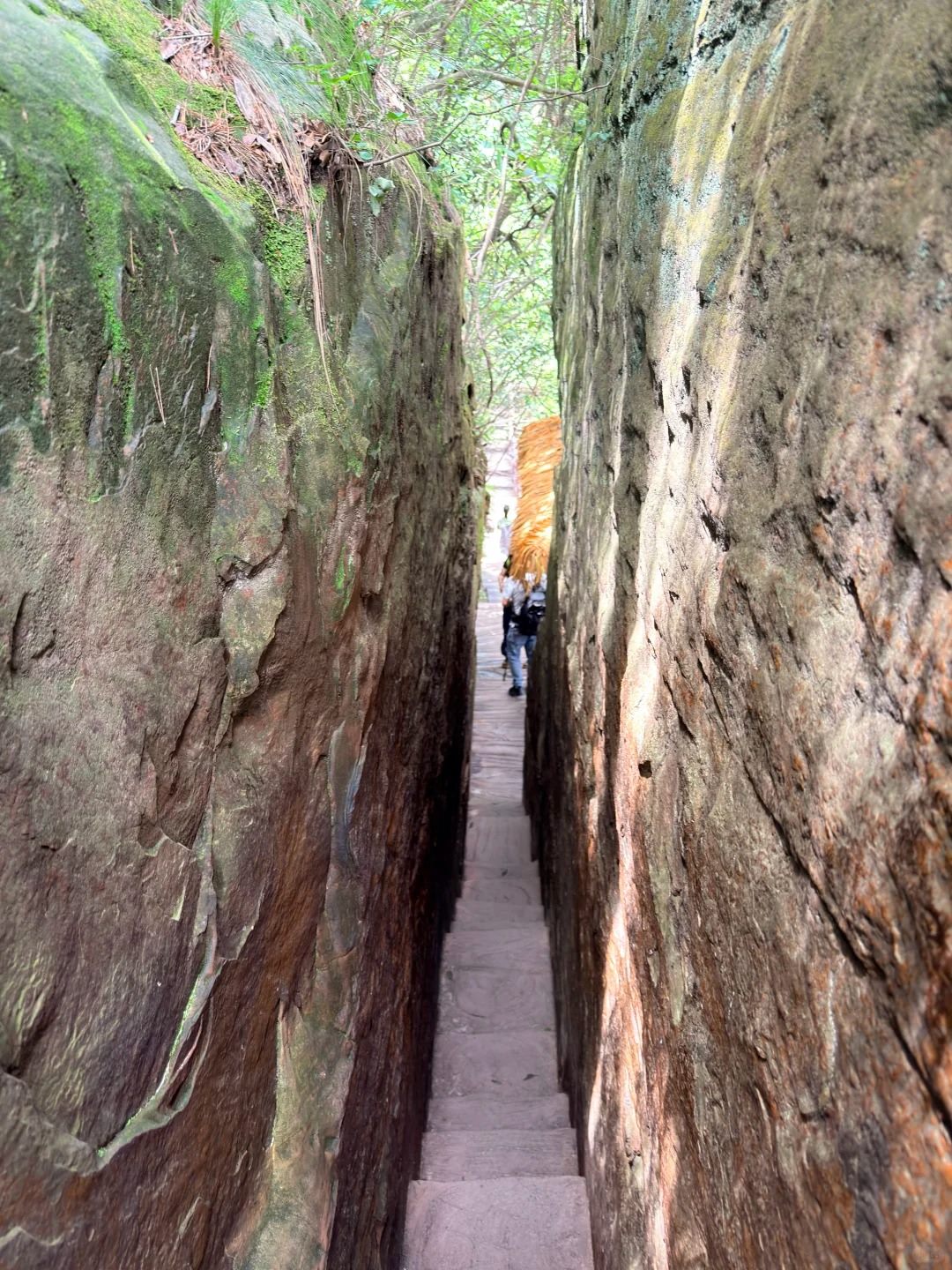
Three layers of truth about the fort itself. The bandit past is real: remote, defensible, and used as a stronghold into the Republic era. The name is marketing — it was originally 黑龙寨, “Black Dragon Fort,” and the tourism bureau renamed it after the hit 1980s bandit-hunt TV series 乌龙山剿匪记. And the buildings on top are modern reconstructions — the reward isn’t the huts, it’s the climb itself and Tianbofu, the iron-ladder overlook above the fort with the zone’s best 360° sweep of the peak walls.
Who should skip Wulongzhai
No — treat it as a scramble, not a stroll. The three squeeze passes narrow to ~30 cm, need hands-and-feet and a stoop, and there is a near-vertical iron ladder; travellers advise against it outright for elderly visitors and small kids, warn acrophobes the railed cliff ledges still feel exposed, and note larger builds must side-squeeze through 一夫关. Skip the fort and do the Natural Great Wall viewpoint instead — flat, ~1 h, and it is the zone’s signature view anyway.
Getting around: the cable trap and the no-loop rule
Two quirks of this zone strand more visitors than anything else in the park:
- The cable-car trap. The calmest lift on the mountain — near queue-free most of the day, ~30–50 min only on summer/holiday mornings. ⚠️ The classic trap is riding it DOWN mid-visit: the lower station sits by the quiet west-side exit, far from everything else — ride it UP to start (or skip it), never down as a shortcut. Fare is ¥76 one way / ¥152 return.
- No loop exists. The Natural Great Wall, Wulongzhai/Tianbofu and One-Step-to-Heaven/Air Corridor sit on three separate dead-end branches — everything except the walls viewpoint is strictly out-and-back. Plan each spur as its own round trip, and don’t trust the entrance trail map blindly: travellers report it has errors (a new shortcut missing, a distance understated). Use a map app, and ask staff at the junctions.
Getting here is easy: the plateau eco-bus links Yangjiajie to Yuanjiajie (~10 min from the No. 1 Bridge parking lot) and on toward Tianzi Mountain; the local stops are 杨家界索道上/下站 (the cable stations), 天然长城观景台站 (the walls viewpoint) and 乌龙寨路口站 (the Wulongzhai trailhead). The classic day pairs Yuanjiajie in the morning, Yangjiajie in the afternoon — pillars with the crowds, then walls without them. Any time beats the crowds — this is the park’s quietest zone even mid-morning; summer/holiday cable queues (~30–50 min) melt away before 8am or after 4pm. And the spots sit far apart on dead-end branches, so budget conservatively and be back at a bus stop or the cable by ~5pm — the last services strand slow walkers; carry water and a pole (“the knee endgame”), kiosks are few and pricey.
Is it open? Check before you commit
The Wulongzhai–Tianbofu trail closes periodically for repairs (May-Day and rainy-season closures are regularly reported) and the cable car has its own maintenance and weather stops — mid-July 2026 traveller reports had everything open, but check the park’s official channel the day you go.
Book the park entry & Zhangjiajie toursNASDAQ: TCOM
Yangjiajie is covered by the timed park entry — Trip.com sells it, plus English guided day-tours that pair the Avatar plateau with this quieter zone, booked on a foreign card.
Where to stay for Yangjiajie
Same answer as the rest of the park: base in Wulingyuan town by the east gate and reach Yangjiajie on the plateau eco-bus loop. Full comparison in where to stay in Zhangjiajie.
Base in Wulingyuan town, by the park gates
Yangjiajie is deep inside the park, so you stay in Wulingyuan town by the east gate like everyone else — it pairs into the same days as Yuanjiajie and Tianzi Mountain.
- Wulingyuan town, ~5 min from the east gate.China's most reliable mid-range chain — spotless and modern, right by the gate for an early start.
- Wulingyuan town, ~10 min from the east gate.Design-led mid-range chain foreign guests rate highly — the comfortable pick by the park.
Frequently asked questions
Is Yangjiajie the same as Zhangjiajie?
No — the three '-jiajie' names trip everyone up. ZHANGjiajie (张家界) is the city and the brand name of the whole national forest park; YUANjiajie (袁家界) is the plateau with the Avatar pillars; YANGjiajie (杨家界) is this quieter zone on the park's western side. All three literally mean 'the Zhang / Yuan / Yang family's territory' — three clans, three corners of the same landscape. Yangjiajie is INSIDE the park, covered by the same ticket.
Is Yangjiajie worth it compared to Yuanjiajie?
Different question than most people think: Yuanjiajie is the must-see (the Avatar pillars), but it is packed. Yangjiajie is where the same landscape goes quiet — travellers consistently report having its viewpoints nearly to themselves, and its "peak wall" scenery is rated as striking as the famous pillars. On one day in the park, do Yuanjiajie in the morning and give Yangjiajie the afternoon. Skip it only if you have a single rushed day and average fitness — in that case see the Natural Great Wall viewpoint and move on.
What is the Natural Great Wall?
Yangjiajie's signature view: rows of blade-thin quartz-sandstone walls stacked one behind another like a wall built by giants. Geologically it is the 'peak wall' stage of the Zhangjiajie landform — erosion has cut the rock into parallel blades along one set of joints but hasn't yet sliced through the crossing set, so it is literally a pillar forest that hasn't finished forming. The viewpoint is a near-flat ~1 h round-trip walk from the eco-bus stop — the one Yangjiajie sight everyone can do.
How hard is Wulongzhai really, and who should skip it?
No — treat it as a scramble, not a stroll. The three squeeze passes narrow to ~30 cm, need hands-and-feet and a stoop, and there is a near-vertical iron ladder; travellers advise against it outright for elderly visitors and small kids, warn acrophobes the railed cliff ledges still feel exposed, and note larger builds must side-squeeze through 一夫关. Skip the fort and do the Natural Great Wall viewpoint instead — flat, ~1 h, and it is the zone’s signature view anyway.
Was Wulongzhai really a bandit hideout?
Three layers of truth: yes, the bandit past is real — a cliff-bound spur with a single approach, used as a stronghold into the Republic era. But the NAME is marketing: it was originally 黑龙寨 (Black Dragon Fort) and the tourism bureau renamed it to ride the hit 1980s bandit-hunt TV series 《乌龙山剿匪记》. And the fort buildings on top are modern reconstructions — you climb it for the squeeze-passes and the Tianbofu view, not the huts.
How much is the Yangjiajie cable car, and should you ride it?
¥76 one way / ¥152 return — and it is the calmest lift in the park, with real queues (~30–50 min) only on summer and holiday mornings. One warning travellers repeat: don't ride it DOWN in the middle of your visit. The lower station sits by the quiet west-side exit, far from everything else — riding down "to save time" strands you outside the zone. Ride it UP to start the day, or skip it and arrive by eco-bus from Yuanjiajie.
Do you need a separate ticket for Yangjiajie?
No — it is inside Zhangjiajie National Forest Park and covered by the ¥236 four-day park pass (which includes the eco-buses). Only the cable car (¥76 one way) is a paid add-on. Since 2025 every park entry needs an advance timed reservation tied to a gate; foreigners book in English online with a passport number and use the staffed passport lane.
How do you combine Yangjiajie with Yuanjiajie in one day?
The classic pairing: ride the Bailong Elevator up in the morning and walk Yuanjiajie (Mihuntai → the Hallelujah pillar → the No. 1 Bridge), then take the ~10-minute eco-bus hop from the No. 1 Bridge parking lot to Yangjiajie for the quiet afternoon — the Natural Great Wall for everyone, Wulongzhai and Tianbofu if your legs have more in them — and finish by bus toward Tianzi Mountain or ride the Yangjiajie cable down to exit the west side. See the day-by-day Zhangjiajie itinerary for the full plan.
Sources
Checked August 2026 · Written from our own first-hand travel in China.