Route guide · High-speed rail
Shanghai to Shenzhen by High-Speed Train (2026)
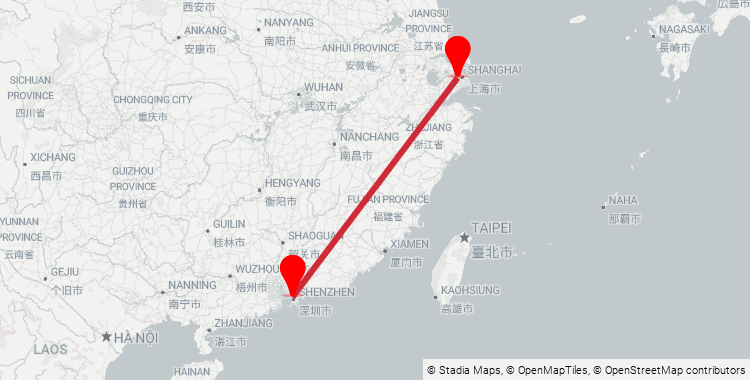
1,580 km down the southeast coast, from the Yangtze delta to the Pearl River delta — about 6h 35m on the fastest G-trains, a full day on the rails. At this distance most travelers fly. The honest question is whether you should be one of them.
China for Travelers EditorialUpdated Save this — opening times and closures changeRail data refreshed monthly
- 2nd class
- ¥552 – ¥710
- what everyone buys
- Frequency
- 22/day
- 06:52 – 20:15
- Train types
- G
- G = fastest
- Flight
- ~2.5h
- most people fly
Most people fly this route — ~2.5h in the air vs 6h 35m – 12h on rails. Take the train for the coastal scenery, to skip airports, or if you avoid flying.
The route at a glance
Shanghai Hongqiao (上海虹桥) to Shenzhen North (深圳北) follows the southeast-coast high-speed line down through Zhejiang and Fujian to the Pearl River delta — roughly 1,580 km, one of the longer single rides a tourist is likely to consider. The fastest scheduled G-train does it in 6h 35m; most run 6h 35m – 12h with a string of intermediate stops (often Hangzhou and the Fujian coast cities), and there is about 22 a day each way from 06:52 – 20:15. Arriving from further afield first? See the Shanghai Hongqiao station guide.
One fact drives everything below: there is no overnight high-speed service on this corridor — every G departure runs in daylight, so the ride eats a full day either way. That is why, unlike the short Shanghai hops, the honest first question here is not “which station” but train or plane.
Train vs flight — the honest comparison
This is the part most route guides skip. On short corridors the train wins easily; on a haul this long, for most travelers it does not. Here is the trade laid out plainly:
| High-speed train | Flight | |
|---|---|---|
| Journey time | 6h 35m fastest (6h 35m – 12h) | ~2.5h in the air |
| Price (economy) | ¥552 – ¥710 | ¥600 – ¥1,300 (est.) |
| Door-to-door (real) | ~11h — both ends on the metro; Shanghai Hongqiao sits ~19 km west and Shenzhen North is up in Longhua, so budget one onward ride each end. | ~6h — 2h check-in + the run to each airport (Pudong ~50 km / Hongqiao central; Bao’an ~32 km) + bag claim. |
| Experience | A full day watching the coast change; power at every seat; you can walk around. | Over and done by lunch; nothing to see but cloud. |
- Fly
- if you want your day back — door-to-door the plane saves roughly five hours.
- Take the train
- if you dislike airports, want a guaranteed downtown-to-downtown ride, or are pairing it with stops up the southeast coast.
Fly to save a day. The plane is roughly ~2.5h in the air against 6h 35m on the rails — door-to-door, even with a 2-hour check-in and the runs out to the airports, it saves the better part of a day, and the fares sit close enough that the train rarely saves money. For most travelers the flight is the sensible call.
Ride for the experience. The train earns its day if you dislike flying, want a guaranteed downtown-to-downtown ride, want to watch the southeast coast roll by, or plan to break the journey at Hangzhou or a Fujian city along the way. There is no overnight option, so a daytime departure means a full day on board. The air fare above is an editorial estimate, not a live quote; check the day’s flights before deciding.
If the train wins it for you, Shanghai–Shenzhen high-speed services arrive at Shenzhen North 深圳北站 in Longhua, on Metro Lines 4, 5 & 6 — Line 4 runs direct to the Futian CBD, so a downtown hotel is one ride away without a taxi. For onward Hong Kong, see Shenzhen → Hong Kong.
Classes and price
Fares are dynamically priced, so the exact number depends on the train and how far ahead you book — but on a journey this long the class you pick actually matters:
| Class | Price | Worth it? |
|---|---|---|
| Second classmost buy | ¥552 – ¥710 | 3+2 seating, power at every seat — fine, but it is a long time in one seat. |
| First class | ¥1076 – ¥1134 | 2+2 seating, wider and quieter — genuinely worth the upgrade on a journey this long. |
| Business class | ¥2260 – ¥2660 | Lie-flat pods — a real luxury for a full day, but at this price most travelers just fly business instead. |
Pricing tip: the cheapest second-class fares go to off-peak mid-week departures; peak daytime slots and holidays trend toward the top of the band. Because the seat is identical across trains, if a little saving matters more than an hour, take the cheaper departure.
What's waiting in Shenzhen
Nobody does Shenzhen as a day trip from Shanghai — at a full day each way it is an overnight-plus destination. The draws are modern rather than historic: the Huaqiangbei electronics markets, the largest in the world; theme parks like Window of the World and the OCT cultural district; the old Dongmen shopping streets in Luohu; and a coastline of beaches and parks. Above all, Shenzhen is the gateway to Hong Kong — you can cross at Futian or Luohu, or ride the cross-border express rail. It is also a launch point for Shenzhen → Macau.
The obvious onward high-speed hop is the short shuttle to Guangzhou — Guangzhou ↔ Shenzhen runs every few minutes — or straight on to Hong Kong; see Shenzhen → Hong Kong for the cross-border details.
How to book with a foreign passport
12306 English app — the official China Railway channel: face-value fares, no booking fee. The trade-off is hassle — passport registration must be approved before you can buy (often slow), and customer service is Chinese-first and limited if a booking goes wrong.
Trip.com ↗ — the same China Railway seats, booked in English with a foreign Visa or Mastercard, no verification wait and 24/7 multilingual support. It sells at the same 12306 face fare with no booking fee, and new-customer promotions can bring a first trip below face price. You can also add hotels, attraction tickets and tours to the same trip. See the booking walkthrough.
Book a few days ahead — departures are limited (~22/day) and the fastest daytime slots sell first. The name and passport number on the ticket must match what you present; e-tickets are scanned at the gate, no paper pickup needed.
Book on Trip.comNASDAQ: TCOM
The international arm of Ctrip — one of the few platforms selling real China Railway tickets in English, to a foreign passport and card. (Is it legit? — 12306 vs Trip.com )
Arrived at Shenzhen North — getting into the city
Shenzhen North Railway Station (深圳北站) is in Longhua, north of the CBD, so the metro is the fast way in — Lines 4, 5 and 6 all serve it, and Line 4 runs direct to Futian. The DiDi / 网约车 pickup is on the West Plaza B1 (zones A/B/C — allow ~15–20 minutes in holiday peaks); the taxi rank is on the East Plaza at street level. Times below are for the areas foreign visitors most often stay.
| City area | Metro / Bus | Taxi / DiDi |
|---|---|---|
| Huaqiangbei 华强北 (Futian, electronics) | Metro Line 6 → Line 7. ~44 min, ¥6. | ¥40–55, ~40 min (12.8 km) |
| Dongmen / Luohu 东门老街 (old town) | Metro Line 6 → Line 3. ~45 min, ¥7. | ¥50–65, ~49 min (16.3 km) |
Transit times and driving distances via Amap (高德地图) routing, checked 2026-06-14. Shenzhen North is in Longhua, ~40 min north of the Futian/Luohu centre; Metro Line 4 runs direct to Futian CBD in ~30 min. Shenzhen metro is distance-based ¥2–11. Set up DiDi for foreigners for a fixed English fare.
Frequently asked questions
How far is Shanghai from Shenzhen?
About 1,580 km (982 miles) by rail down the southeast coast.
How do I get from Shanghai to Shenzhen?
By high-speed train or by air. G-trains run Shanghai Hongqiao to Shenzhen North about 22 times a day, taking ~10h 20m, from ¥552 in second class (book on the official 12306 app or on Trip.com in English). Flights are about 2h 30m.
How long is the flight from Shanghai to Shenzhen?
About 2h 30m in the air. On a ~10-hour corridor the flight wins on time; take the train for the coastal ride or if you avoid flying.
How long does it take to get from Shanghai to Shenzhen?
The fastest G-train covers the southeast-coast route from Shanghai Hongqiao to Shenzhen North in about 10 hours 20 minutes. Most services run 10–12 hours with several stops (often Hangzhou and the Fujian coast cities).
Should I fly or take the train from Shanghai to Shenzhen?
For pure speed, fly — it is roughly 2h30m in the air versus ~10h on the train. The train makes sense if you dislike flying, want a guaranteed downtown-to-downtown ride, or are pairing it with stops along the coast. The fares are close, so the train is rarely the cheaper option here.
How much is a Shanghai to Shenzhen train ticket?
Second class starts around ¥552, with first and business class scaling up. Fares are dynamically priced; the lowest second-class fares go to off-peak mid-week departures.
Which stations do Shanghai–Shenzhen trains use?
Trains leave from Shanghai Hongqiao Railway Station (上海虹桥站) and arrive at Shenzhen North Railway Station (深圳北站). Both are on the metro, so a downtown hotel at either end is reachable without a taxi.
How many trains run between Shanghai and Shenzhen each day?
About 22 high-speed services a day each way along the busy southeast-coast corridor. Book a couple of days ahead for the fastest daytime departures.
Sources
Checked August 2026 · Written from our own first-hand travel in China.
Once the journey gets you to Shenzhen
The corridor is the long part — Shenzhen pairs naturally with Guangzhou and Hong Kong across the wider Pearl River Delta.